ETHICS OF RESEARCH
Research for Daily Life
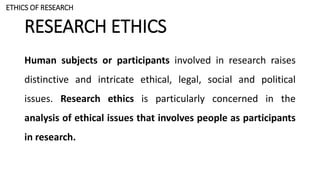
RESEARCH ETHICS
Human subjects or participants involved in research raises
distinctive and intricate ethical, legal, social and political
issues. Research ethics is particularly concerned in the
analysis of ethical issues that involves people as participants
in research.
ETHICS OF RESEARCH
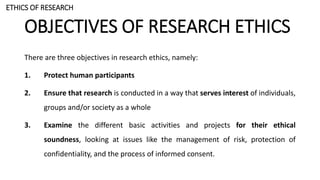
OBJECTIVES OF RESEARCH ETHICS
There are three objectives in research ethics, namely:
1. Protect human participants
2. Ensure that research is conducted in a way that serves interest of individuals,
groups and/or society as a whole
3. Examine the different basic activities and projects for their ethical
soundness, looking at issues like the management of risk, protection of
confidentiality, and the process of informed consent.
ETHICS OF RESEARCH
OBJECTIVES OF RESEARCH ETHICS
There are three objectives in research ethics, namely:
1. Protect human participants
2. Ensure that research is conducted in a way that serves interest of individuals,
groups and/or society as a whole
3. Examine the different basic activities and projects for their ethical
soundness, looking at issues like the management of risk, protection of
confidentiality, and the process of informed consent.
ETHICS OF RESEARCH
MINIMIZING THE RISK OF HARM
Any type of research should not harm
participants. There must be strong
justifications where there is the
possibility that participants could be
harmed or put in a position of
discomfort.
There are a number of types of harm
that participants can be subjected to .
These include:
• physical harm to participants
• psychological distress and discomfort
• social disadvantage
• harm to participants of financial
status
• an invasion of participants privacy
and anonymity
ETHICS OF RESEARCH
OBJECTIVES OF RESEARCH ETHICS
Typically, it is not harm that should be
thought about since a researcher does not
intentionally go out to cause harm rather, it
is the risk of harm that a researcher should
try to lessen. In order to lessen the risk of
harm the researchers should think about:
1. obtaining informed consent from
participants
2. protecting the anonymity and
confidentiality of participants
3. avoiding deceptive practices when
designing the research
4. providing participants with the right to
withdraw from the research at any time
ETHICS OF RESEARCH
OBTAINING INFORMED CONSENT
One of the foundations of research ethics is the idea of informed consent. Essentially, this
means that potential research participants must be completely informed about the
procedures and risks implicated in research and must request their approval to
participate.
Simply put, informed consent means the participants should understand that they are
partaking in research and what the research needs of them without having been coerced
and deceived. Such information may comprise the purpose of the research, the methods
being used, the possible outcomes of the research, as well as associated demands,
discomforts, inconveniences and risks that the participants may meet.
ETHICS OF RESEARCH
OBTAINING INFORMED CONSENT
Whilst it is not possible to know precisely what information a possible participant
would (or would not) want to know. The researcher should aim not to leave out
any material information; that is, information that he feels would influence
whether consent would (or would not) be granted.
Where informed consent cannot be obtained from participants, the researcher
must explain why this is the case. You should also be aware that there are
instances informed consent is not necessarily needed or needs to be relaxed. This
includes certain educational, organizational and naturalistic research settings.
ETHICS OF RESEARCH
PROTECTING ANONYMITY
Protecting the anonymity and confidentiality of research participants is a vital and
practical component of research ethics. Normally participants will only be willing
to volunteer information, especially information of a private or a sensitive nature,
if the researcher agrees to hold such information in confidentiality.
It is possible that research participants may be hurt in some way if the data
gathering methods used is somehow insensitive. There is perhaps a greater
danger that harm can be caused once data has been collected.
ETHICS OF RESEARCH
PROTECTING ANONYMITY
This occurs when data is not treated confidentially, whether in terms of the
storage data, it's analysis, or during the publication process.
However, this does not mean that all data gathered from research participants
need to be kept confidential or anonymous. It may be possible to reveal the
identity and views of the individuals at various stages of the research process.
However, permissions should be required before such confidential information is
disclosed. And alternative is to eliminate identifiers.
ETHICS OF RESEARCH
AVOIDING DECEPTIVE PRACTICES
in most circumstances, research should keep away from any kinds of
deceptive practices. However, this is not always the case. Deception is
sometimes an indispensable component of covert research, which can
be justified in some cases. Covert research reflects research where the
identity of the observer and or the purpose of the research are not
known to participants.
ETHICS OF RESEARCH
AVOIDING DECEPTIVE PRACTICES
Cases where researcher may choose to engage in covert research may include
instances:
It is not feasible to let everyone in a particular research setting know what the
researcher is doing. This is most likely to be the case where research involves
observation, rather than the direct contact with participants, especially in a public
or online setting.
1. observing what users are doing in an Internet chat room
2. observing individuals going about their business (shopping, going to work etc.)
ETHICS OF RESEARCH
AVOIDING DECEPTIVE PRACTICES
Cases where researcher may choose to engage in covert research may include
instances:
It is not feasible to let everyone in a particular research setting know what the
researcher is doing. This is most likely to be the case where research involves
observation, rather than the direct contact with participants, especially in a public
or online setting.
1. observing what users are doing in an Internet chat room
2. observing individuals going about their business (shopping, going to work etc.)
ETHICS OF RESEARCH
OVERT OBSERVATION
Overt observation or knowledge of the purpose of the research may
alter the particular phenomenon that is being studied. Knowledge of
the true purpose of the research has the potential to alter the
particular phenomenon that the research is interested in, this is a
major concern in terms of the quality of his findings.
Some of the following scenarios where covert research may be
considered justifiable:
ETHICS OF RESEARCH
OVERT OBSERVATION
Overt observation or knowledge of the purpose of the research may
alter the particular phenomenon that is being studied. Knowledge of
the true purpose of the research has the potential to alter the
particular phenomenon that the research is interested in, this is a
major concern in terms of the quality of his findings.
Some of the following scenarios where covert research may be
considered justifiable:
ETHICS OF RESEARCH
SCENARIO A
The researcher is conducting a piece of research looking at prejudice. While
participants are given a questionnaire to complete that measures their
prejudice, it is not obvious from the questions that this is the case.
Furthermore, participants are not told that the research is about prejudice
because it is felt that this could alter their responses. After all, few people
would be happy if other people thought they were prejudice. As a result, if
participants knew that this is the purpose of the study, they may well provide
responses that they think will make them appear less prejudice.
ETHICS OF RESEARCH
SCENARIO B
The researcher is interested in understanding the organizational
culture in a single firm. He feels that observation would be an
appropriate research method in such a naturalistic setting. However,
he feels that if employees knew that he was monitoring them, they
may behave in a different way. Therefore, he may have received
permission to go undercover or provide a story to explain why he is
there, which is not the truth.
ETHICS OF RESEARCH
PROVIDING THE RIGHT TO WITHDRAW
With the exception of those instances of covert observation where it is not
feasible to let everyone that is being observed know what the researcher is
doing, research participants should always have the right to withdraw from
the research process.
Furthermore, participants should have the right to withdraw at any stage in
the research process. When the participant chooses to withdraw from the
research process, they should not be pressured or coerced in any way to try
and stop them from withdrawing.
ETHICS OF RESEARCH
REFERENCES
• Cristobal, A. P. & Cruz-Cristobal, M. C. (2017). Practical Research for
Senior High School 1. C & E Publishing Incorporated.

Research Ethics.pptx

  • 1.
  • 2.
    RESEARCH ETHICS Human subjectsor participants involved in research raises distinctive and intricate ethical, legal, social and political issues. Research ethics is particularly concerned in the analysis of ethical issues that involves people as participants in research. ETHICS OF RESEARCH
  • 3.
    OBJECTIVES OF RESEARCHETHICS There are three objectives in research ethics, namely: 1. Protect human participants 2. Ensure that research is conducted in a way that serves interest of individuals, groups and/or society as a whole 3. Examine the different basic activities and projects for their ethical soundness, looking at issues like the management of risk, protection of confidentiality, and the process of informed consent. ETHICS OF RESEARCH
  • 4.
    OBJECTIVES OF RESEARCHETHICS There are three objectives in research ethics, namely: 1. Protect human participants 2. Ensure that research is conducted in a way that serves interest of individuals, groups and/or society as a whole 3. Examine the different basic activities and projects for their ethical soundness, looking at issues like the management of risk, protection of confidentiality, and the process of informed consent. ETHICS OF RESEARCH
  • 5.
    MINIMIZING THE RISKOF HARM Any type of research should not harm participants. There must be strong justifications where there is the possibility that participants could be harmed or put in a position of discomfort. There are a number of types of harm that participants can be subjected to . These include: • physical harm to participants • psychological distress and discomfort • social disadvantage • harm to participants of financial status • an invasion of participants privacy and anonymity ETHICS OF RESEARCH
  • 6.
    OBJECTIVES OF RESEARCHETHICS Typically, it is not harm that should be thought about since a researcher does not intentionally go out to cause harm rather, it is the risk of harm that a researcher should try to lessen. In order to lessen the risk of harm the researchers should think about: 1. obtaining informed consent from participants 2. protecting the anonymity and confidentiality of participants 3. avoiding deceptive practices when designing the research 4. providing participants with the right to withdraw from the research at any time ETHICS OF RESEARCH
  • 7.
    OBTAINING INFORMED CONSENT Oneof the foundations of research ethics is the idea of informed consent. Essentially, this means that potential research participants must be completely informed about the procedures and risks implicated in research and must request their approval to participate. Simply put, informed consent means the participants should understand that they are partaking in research and what the research needs of them without having been coerced and deceived. Such information may comprise the purpose of the research, the methods being used, the possible outcomes of the research, as well as associated demands, discomforts, inconveniences and risks that the participants may meet. ETHICS OF RESEARCH
  • 8.
    OBTAINING INFORMED CONSENT Whilstit is not possible to know precisely what information a possible participant would (or would not) want to know. The researcher should aim not to leave out any material information; that is, information that he feels would influence whether consent would (or would not) be granted. Where informed consent cannot be obtained from participants, the researcher must explain why this is the case. You should also be aware that there are instances informed consent is not necessarily needed or needs to be relaxed. This includes certain educational, organizational and naturalistic research settings. ETHICS OF RESEARCH
  • 9.
    PROTECTING ANONYMITY Protecting theanonymity and confidentiality of research participants is a vital and practical component of research ethics. Normally participants will only be willing to volunteer information, especially information of a private or a sensitive nature, if the researcher agrees to hold such information in confidentiality. It is possible that research participants may be hurt in some way if the data gathering methods used is somehow insensitive. There is perhaps a greater danger that harm can be caused once data has been collected. ETHICS OF RESEARCH
  • 10.
    PROTECTING ANONYMITY This occurswhen data is not treated confidentially, whether in terms of the storage data, it's analysis, or during the publication process. However, this does not mean that all data gathered from research participants need to be kept confidential or anonymous. It may be possible to reveal the identity and views of the individuals at various stages of the research process. However, permissions should be required before such confidential information is disclosed. And alternative is to eliminate identifiers. ETHICS OF RESEARCH
  • 11.
    AVOIDING DECEPTIVE PRACTICES inmost circumstances, research should keep away from any kinds of deceptive practices. However, this is not always the case. Deception is sometimes an indispensable component of covert research, which can be justified in some cases. Covert research reflects research where the identity of the observer and or the purpose of the research are not known to participants. ETHICS OF RESEARCH
  • 12.
    AVOIDING DECEPTIVE PRACTICES Caseswhere researcher may choose to engage in covert research may include instances: It is not feasible to let everyone in a particular research setting know what the researcher is doing. This is most likely to be the case where research involves observation, rather than the direct contact with participants, especially in a public or online setting. 1. observing what users are doing in an Internet chat room 2. observing individuals going about their business (shopping, going to work etc.) ETHICS OF RESEARCH
  • 13.
    AVOIDING DECEPTIVE PRACTICES Caseswhere researcher may choose to engage in covert research may include instances: It is not feasible to let everyone in a particular research setting know what the researcher is doing. This is most likely to be the case where research involves observation, rather than the direct contact with participants, especially in a public or online setting. 1. observing what users are doing in an Internet chat room 2. observing individuals going about their business (shopping, going to work etc.) ETHICS OF RESEARCH
  • 14.
    OVERT OBSERVATION Overt observationor knowledge of the purpose of the research may alter the particular phenomenon that is being studied. Knowledge of the true purpose of the research has the potential to alter the particular phenomenon that the research is interested in, this is a major concern in terms of the quality of his findings. Some of the following scenarios where covert research may be considered justifiable: ETHICS OF RESEARCH
  • 15.
    OVERT OBSERVATION Overt observationor knowledge of the purpose of the research may alter the particular phenomenon that is being studied. Knowledge of the true purpose of the research has the potential to alter the particular phenomenon that the research is interested in, this is a major concern in terms of the quality of his findings. Some of the following scenarios where covert research may be considered justifiable: ETHICS OF RESEARCH
  • 16.
    SCENARIO A The researcheris conducting a piece of research looking at prejudice. While participants are given a questionnaire to complete that measures their prejudice, it is not obvious from the questions that this is the case. Furthermore, participants are not told that the research is about prejudice because it is felt that this could alter their responses. After all, few people would be happy if other people thought they were prejudice. As a result, if participants knew that this is the purpose of the study, they may well provide responses that they think will make them appear less prejudice. ETHICS OF RESEARCH
  • 17.
    SCENARIO B The researcheris interested in understanding the organizational culture in a single firm. He feels that observation would be an appropriate research method in such a naturalistic setting. However, he feels that if employees knew that he was monitoring them, they may behave in a different way. Therefore, he may have received permission to go undercover or provide a story to explain why he is there, which is not the truth. ETHICS OF RESEARCH
  • 18.
    PROVIDING THE RIGHTTO WITHDRAW With the exception of those instances of covert observation where it is not feasible to let everyone that is being observed know what the researcher is doing, research participants should always have the right to withdraw from the research process. Furthermore, participants should have the right to withdraw at any stage in the research process. When the participant chooses to withdraw from the research process, they should not be pressured or coerced in any way to try and stop them from withdrawing. ETHICS OF RESEARCH
  • 19.
    REFERENCES • Cristobal, A.P. & Cruz-Cristobal, M. C. (2017). Practical Research for Senior High School 1. C & E Publishing Incorporated.

Editor's Notes

  • #4 Researchers must meet professional, institutional and academic standards for conducted research especially with human participants. Indeed , researchers face an array of ethical principles.
  • #13 Clearly, in this cases, where individuals are coming and going , it may simply be impossible to let everyone know what the researcher is doing. The researcher may not be intentionally trying to engage in deceptive practices, but clearly participants are not giving him their informed consent.
  • #18 Even as such covert research and deceptive practices, especially when used intentionally, can be viewed as controversial, it can be argued that they have a place in research.
  • #19 Even as such covert research and deceptive practices, especially when used intentionally, can be viewed as controversial, it can be argued that they have a place in research.