Ethical considerations
2
2
Ethical Practice/considerations?
• The research that forms part of your study needs to be designed and
conducted according to ethical principles
• An understanding of research ethics and personal safety is a key aspect of the
research process. In designing a research project we need to consider the
impact we may have on research subjects and other parties.
So what do we mean by research ethics/practice or what should we consider in
research?
• This means to think about what are the implications/consequences of what
you do during and after your research
• It expects you “to test critically [your] judgements, responsibilities, aims, and
actions” in your academic practice”.
What is research ethics?
• Research Ethics is all about integrity, transparency and quality in the design
and conduct of research.
• Why is quality at the heart of ethical considerations?
“A fundamental ethical requirement of all research is that it is scientifically
sound. It should be properly designed and carried out by researchers with
adequate levels of expertise and supervision. It should also be ‘worth doing’,
in the sense that the results are likely to lead to tangible benefit.”
Quality of research that has recently become more central to research bodies’
priorities are:
•  consideration of ‘impact’ of research
•  designing research that addresses needs of ‘user community’
•  emphasis on feeding back results
• “What will be done to ensure that potential beneficiaries have the
opportunity to engage with this research?”
Research ethics entail having strategies and procedures in place to ensure
these (Key principles of ethical research):
• Informed consent and voluntary participation
• Avoidance of harm
• Anonymity and confidentiality
• Independence and impartiality
• Appropriate storage and handling of data
Confidentiality of data
It is thinking about sharing of data?
• at all
• with whom
• at which time
• in which format
• legal issues of public images (esp. of minors)
Some Scenarios
Scenarios 1: working with young children
A researcher wishes to study interactions between young children aged 2-4
and their carers, both at home and in nursery school.
The aim of the research is to identify the types of interaction which are most
conducive to children’s language development. She plans to use video as her
main data gathering method.
What are the ethical issues arising?
Scenario 2: working with adult bilinguals
A researcher wishes to study interactions between a group of bilingual adults who all
work in the same factory.
The aim of the research is to identify which language is used in certain contexts, and
she plans to tape the interactions.
What are the ethical issues arising?
Scenario 3: Working in your own institution
Researchers are studying teaching and learning in their own institution,
watching classes and interviewing staff and students. They want to understand
Scenario 4: working across the Internet
A researcher wishes to study L2 chat room discourse on the Internet.
The aim of the research is to identify the linguistic configuration of this style
of language.
What are the ethical issues arising?
Working with Participants
Respecting research participants
Seeking voluntary informed consent (through participation info sheet
and consent form – coming ahead)
Use of deception (explanation coming ahead)
Respecting participants’ right to withdraw
Working with children
11
Using incentives
Privacy, confidentiality and anonymity (explanation coming ahead)
Reporting back (compensating subjects)
Avoidance of harm to research subjects (as basic and uncontroversial).
But what is harm?
Inconvenience,
Stress, distress, anxiety,
invasion of privacy,
Harm to participants’ reputation or self-esteem, Ensuring that participants
are never uncomfortable
12
Participant Information Sheets
It includes information regarding:
- Purpose of research
- Who is funding it
- What the research will involve, including types of questions that will
be asked, time it will take, where it will be done, whether recorded or
not
- Voluntary nature of participation
- Uses to which data will be put
- Name, and contact details of researcher(s)
- Ethics number
13
Consent Form
It contains information such as:
- Statement that participation is voluntary
- That subjects are free to refuse to answer questions
-That they are free to withdraw
- Separate permission request to audio- or video-record interview or to
use photographs (where relevant)
-Separate permission request if anonymisation not possible
- Signature of subject
-Ethics number
14
Common forms of ‘deception’
Avoiding full explanations of research to encourage participation;
Suppressing information about exact research aims so as to avoid
influencing responses;
Cultivating rapport so participants forget they are taking part in research
and divulge more than they might otherwise have done.
Limiting the information your subjects have about you (for reasons of
safety, to enhance rapport, to avoid censure).
15
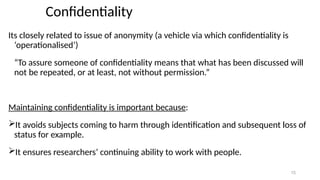
Confidentiality
Its closely related to issue of anonymity (a vehicle via which confidentiality is
‘operationalised’)
“To assure someone of confidentiality means that what has been discussed will
not be repeated, or at least, not without permission.”
Maintaining confidentiality is important because:
It avoids subjects coming to harm through identification and subsequent loss of
status for example.
It ensures researchers’ continuing ability to work with people.
16
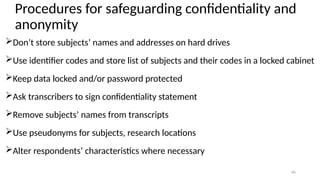
Procedures for safeguarding confidentiality and
anonymity
Don’t store subjects’ names and addresses on hard drives
Use identifier codes and store list of subjects and their codes in a locked cabinet
Keep data locked and/or password protected
Ask transcribers to sign confidentiality statement
Remove subjects’ names from transcripts
Use pseudonyms for subjects, research locations
Alter respondents’ characteristics where necessary
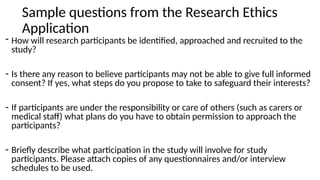
Sample questions from the Research Ethics
Application
- How will research participants be identified, approached and recruited to the
study?
- Is there any reason to believe participants may not be able to give full informed
consent? If yes, what steps do you propose to take to safeguard their interests?
- If participants are under the responsibility or care of others (such as carers or
medical staff) what plans do you have to obtain permission to approach the
participants?
- Briefly describe what participation in the study will involve for study
participants. Please attach copies of any questionnaires and/or interview
schedules to be used.
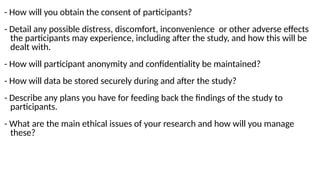
- How will you obtain the consent of participants?
- Detail any possible distress, discomfort, inconvenience or other adverse effects
the participants may experience, including after the study, and how this will be
dealt with.
- How will participant anonymity and confidentiality be maintained?
- How will data be stored securely during and after the study?
- Describe any plans you have for feeding back the findings of the study to
participants.
- What are the main ethical issues of your research and how will you manage
these?
Academic integrity/Avoiding plaigiarism
What is plaigiarism?
• Plagiarism is a term that describes the unacknowledged use of someone's
work. This includes material or ideas from any (published or unpublished)
sources, whether print, web-based (even if freely available) or audiovisual.
Using the words or ideas of others without referencing your source would be
construed as plagiarism and is a very serious academic offence. The following
are considered forms of plagiarism:
• Passing off as your own a piece of work that is partly or wholly the work of
another person
• Citing and referencing sources that you have not used
• Quoting, summarising or paraphrasing material in your assignment without
citing the original source
• 'Recycling' a piece of your own work that you have previously submitted for
another module or course (i.e. self-plagiarism).
How to avoid it?
• Make sure your work is your own.
• Be careful to distinguish between content of the text & your own ideas
• Be clear about what is your own work and where you have used the ideas of others
• Understand how to reference your work properly and acknowledge where others’
ideas may have contributed to your work
• Allow enough time to check your final draft for possible referencing errors or
omissions: for example, check that all your in-text citations have a corresponding
entry in your reference list, and vice versa
Some useful sources
• Bryman, A. (2012) Social Research Methods, 4th ed., Oxford: Oxford University
Press. [Chapter 6]
• Graham, J., Grewal, I. and Lewis, J. (2007) Ethics in Social Research: The Views
of Research Participants, Government Social Research Unit.
[http://www.civilservice.gov.uk/Assets/ethics_participants_tech_tcm6-
5784.pdf]
• Richards, H. M. and Schwartz, L. J. (2002) 'Ethics of qualitative research: are
there special issues for health services research?', Family Practice, 19(2), 135-
139. [e-journals]
• Research ethics guidebook: http://www.ethicsguidebook.ac.uk/key-ethics-
principles-15

Research ethics.pptx research methodology

  • 1.
  • 2.
    2 2 Ethical Practice/considerations? • Theresearch that forms part of your study needs to be designed and conducted according to ethical principles • An understanding of research ethics and personal safety is a key aspect of the research process. In designing a research project we need to consider the impact we may have on research subjects and other parties. So what do we mean by research ethics/practice or what should we consider in research? • This means to think about what are the implications/consequences of what you do during and after your research • It expects you “to test critically [your] judgements, responsibilities, aims, and actions” in your academic practice”.
  • 3.
    What is researchethics? • Research Ethics is all about integrity, transparency and quality in the design and conduct of research. • Why is quality at the heart of ethical considerations? “A fundamental ethical requirement of all research is that it is scientifically sound. It should be properly designed and carried out by researchers with adequate levels of expertise and supervision. It should also be ‘worth doing’, in the sense that the results are likely to lead to tangible benefit.”
  • 4.
    Quality of researchthat has recently become more central to research bodies’ priorities are: •  consideration of ‘impact’ of research •  designing research that addresses needs of ‘user community’ •  emphasis on feeding back results • “What will be done to ensure that potential beneficiaries have the opportunity to engage with this research?”
  • 5.
    Research ethics entailhaving strategies and procedures in place to ensure these (Key principles of ethical research): • Informed consent and voluntary participation • Avoidance of harm • Anonymity and confidentiality • Independence and impartiality • Appropriate storage and handling of data
  • 6.
    Confidentiality of data Itis thinking about sharing of data? • at all • with whom • at which time • in which format • legal issues of public images (esp. of minors)
  • 7.
    Some Scenarios Scenarios 1:working with young children A researcher wishes to study interactions between young children aged 2-4 and their carers, both at home and in nursery school. The aim of the research is to identify the types of interaction which are most conducive to children’s language development. She plans to use video as her main data gathering method. What are the ethical issues arising?
  • 8.
    Scenario 2: workingwith adult bilinguals A researcher wishes to study interactions between a group of bilingual adults who all work in the same factory. The aim of the research is to identify which language is used in certain contexts, and she plans to tape the interactions. What are the ethical issues arising? Scenario 3: Working in your own institution Researchers are studying teaching and learning in their own institution, watching classes and interviewing staff and students. They want to understand
  • 9.
    Scenario 4: workingacross the Internet A researcher wishes to study L2 chat room discourse on the Internet. The aim of the research is to identify the linguistic configuration of this style of language. What are the ethical issues arising?
  • 10.
    Working with Participants Respectingresearch participants Seeking voluntary informed consent (through participation info sheet and consent form – coming ahead) Use of deception (explanation coming ahead) Respecting participants’ right to withdraw Working with children
  • 11.
    11 Using incentives Privacy, confidentialityand anonymity (explanation coming ahead) Reporting back (compensating subjects) Avoidance of harm to research subjects (as basic and uncontroversial). But what is harm? Inconvenience, Stress, distress, anxiety, invasion of privacy, Harm to participants’ reputation or self-esteem, Ensuring that participants are never uncomfortable
  • 12.
    12 Participant Information Sheets Itincludes information regarding: - Purpose of research - Who is funding it - What the research will involve, including types of questions that will be asked, time it will take, where it will be done, whether recorded or not - Voluntary nature of participation - Uses to which data will be put - Name, and contact details of researcher(s) - Ethics number
  • 13.
    13 Consent Form It containsinformation such as: - Statement that participation is voluntary - That subjects are free to refuse to answer questions -That they are free to withdraw - Separate permission request to audio- or video-record interview or to use photographs (where relevant) -Separate permission request if anonymisation not possible - Signature of subject -Ethics number
  • 14.
    14 Common forms of‘deception’ Avoiding full explanations of research to encourage participation; Suppressing information about exact research aims so as to avoid influencing responses; Cultivating rapport so participants forget they are taking part in research and divulge more than they might otherwise have done. Limiting the information your subjects have about you (for reasons of safety, to enhance rapport, to avoid censure).
  • 15.
    15 Confidentiality Its closely relatedto issue of anonymity (a vehicle via which confidentiality is ‘operationalised’) “To assure someone of confidentiality means that what has been discussed will not be repeated, or at least, not without permission.” Maintaining confidentiality is important because: It avoids subjects coming to harm through identification and subsequent loss of status for example. It ensures researchers’ continuing ability to work with people.
  • 16.
    16 Procedures for safeguardingconfidentiality and anonymity Don’t store subjects’ names and addresses on hard drives Use identifier codes and store list of subjects and their codes in a locked cabinet Keep data locked and/or password protected Ask transcribers to sign confidentiality statement Remove subjects’ names from transcripts Use pseudonyms for subjects, research locations Alter respondents’ characteristics where necessary
  • 17.
    Sample questions fromthe Research Ethics Application - How will research participants be identified, approached and recruited to the study? - Is there any reason to believe participants may not be able to give full informed consent? If yes, what steps do you propose to take to safeguard their interests? - If participants are under the responsibility or care of others (such as carers or medical staff) what plans do you have to obtain permission to approach the participants? - Briefly describe what participation in the study will involve for study participants. Please attach copies of any questionnaires and/or interview schedules to be used.
  • 18.
    - How willyou obtain the consent of participants? - Detail any possible distress, discomfort, inconvenience or other adverse effects the participants may experience, including after the study, and how this will be dealt with. - How will participant anonymity and confidentiality be maintained? - How will data be stored securely during and after the study? - Describe any plans you have for feeding back the findings of the study to participants. - What are the main ethical issues of your research and how will you manage these?
  • 19.
    Academic integrity/Avoiding plaigiarism Whatis plaigiarism? • Plagiarism is a term that describes the unacknowledged use of someone's work. This includes material or ideas from any (published or unpublished) sources, whether print, web-based (even if freely available) or audiovisual. Using the words or ideas of others without referencing your source would be construed as plagiarism and is a very serious academic offence. The following are considered forms of plagiarism: • Passing off as your own a piece of work that is partly or wholly the work of another person • Citing and referencing sources that you have not used • Quoting, summarising or paraphrasing material in your assignment without citing the original source
  • 20.
    • 'Recycling' apiece of your own work that you have previously submitted for another module or course (i.e. self-plagiarism). How to avoid it? • Make sure your work is your own. • Be careful to distinguish between content of the text & your own ideas • Be clear about what is your own work and where you have used the ideas of others • Understand how to reference your work properly and acknowledge where others’ ideas may have contributed to your work • Allow enough time to check your final draft for possible referencing errors or omissions: for example, check that all your in-text citations have a corresponding entry in your reference list, and vice versa
  • 21.
    Some useful sources •Bryman, A. (2012) Social Research Methods, 4th ed., Oxford: Oxford University Press. [Chapter 6] • Graham, J., Grewal, I. and Lewis, J. (2007) Ethics in Social Research: The Views of Research Participants, Government Social Research Unit. [http://www.civilservice.gov.uk/Assets/ethics_participants_tech_tcm6- 5784.pdf] • Richards, H. M. and Schwartz, L. J. (2002) 'Ethics of qualitative research: are there special issues for health services research?', Family Practice, 19(2), 135- 139. [e-journals] • Research ethics guidebook: http://www.ethicsguidebook.ac.uk/key-ethics- principles-15