

The document discusses the ethical considerations in research involving human subjects, emphasizing the importance of consent, preventing harm, ensuring privacy, and avoiding deception. It highlights the need for subjects to be fully informed and to voluntarily participate, especially when involving vulnerable groups like children or those with mental disabilities. Failing to uphold these ethical principles can lead to harm, privacy violations, and legal consequences for researchers.
Research on humansto a large extent depends on
volunteer subjects. Often the products of research
results in benefits to society. These benefits come
in the form of new methods of learning, treatments
for disease, and ways of conducting our affairs.
There are four areas of concern where the rights
and dignity of the subject must be preserved.
1. CONSENT
2. HARM
3. PRIVACY
4. DECEPTION
ETHICS IN RESEARCH
3.
CONSENT
This is theprocedure by which research subjects choose
whether or not they wish to participate in a research study.
Capacity is defined as the ability to acquire or
retain knowledge, and the authority, or legal qualification,
to perform an act.
Information consists of insuring the subjects are
told, and they understand, the purpose of the study
and their roles as subjects.
Voluntariness means that the subject chooses to
be in the study of his/her own free will and is free to
withdraw from the study at any time.
Special attention must be paid to obtaining the consent of children,
psychiatric patients, and mentally retarded persons. These groups,
usually require that a parent or guardian give consent.
4.
HARM
One of themost important issues in all of
research ethics is that subjects not be
harmed by your study. To avoid physical
harm is obvious, but other areas need to
be avoided also. These areas are:
psychological stress, personal
embarrassment, and humiliation. The
dignity of the subject (be it human or
animal) needs to always be a concern of
the researcher.
5.
PRIVACY
Every subject hasthe right to keep private the
fact that he/she participated in your study, and
the right that information given to you not be
shared to others. Research often is based on
information obtained from the subjects. The
information will be used in the study, and
perhaps published, but it must be done in a way
that insures the individual's anonymity. Violation
of the promise of privacy can result in harm to
the subject.
6.
DECEPTION
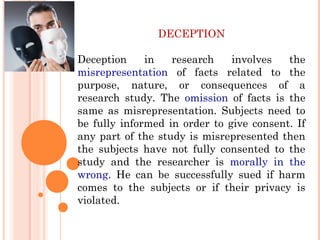
Deception in researchinvolves the
misrepresentation of facts related to the
purpose, nature, or consequences of a
research study. The omission of facts is the
same as misrepresentation. Subjects need to
be fully informed in order to give consent. If
any part of the study is misrepresented then
the subjects have not fully consented to the
study and the researcher is morally in the
wrong. He can be successfully sued if harm
comes to the subjects or if their privacy is
violated.
7.
Humble request toall of
you kindly avoid these
during you research work.
Thankyou