Ethics
in
Engineering profession
and
Some case study
Prepared by:
Kamal Shahi
Roll no: 25
Ethics


Study of the general
nature of morals and of
the specific moral choices
to be made by a person



Set of standard or codes
derived from human
reasons and experience
by which human actions
are determined as right or
wrong/ good or evil
Generally Ethics Is:
a. The science of customs or habits
b. The science of character or conducts
c. The science of rightness or wrongness
d. The science of morality
e. A normative science






Shakespeare -- "When in Rome, do as the
Romans do"
Kant -- "Do not do unto others as you
would not have them do unto you"
the Bible -- "he that dig a pit shall fall
into it“ confront
Engineering Ethics




field of applied ethics and system of moral
principles that apply to the practice of
engineering
examines and sets the obligations by
engineers to society, to their clients, and to the
profession
Why ETHICS in Engineering???


Engineers responsibility to society in not only
bringing new technology, discoveries, and
designs to the world
but
also in protecting the public interest



On the beginning of 20th century there had been
significant structural failures like Ashtabula River
Railroad Disaster (1876), Tay Bridge Disaster
(1879), and the Quebec Bridge collapse (1907),
Boston molasses disaster etc…
Ashtabula River Railroad Disaster (1876)

Quebec Bridge(before)

Quebec Bridge(After)
CITICORP BUILDING(case study
explained later)

Tay Bridge(Before)
Tay Bridge(after)






These disasters forced the engineering profession
to confront shortcomings in technical and
construction practice, as well as ethical standards
engineers are reminded of their responsibilities
starting in early-college coursework and progressing
throughout their careers in continuing education
courses.

It is not for preaching virtue rather, its objective is
to increase your ability as engineers to
responsibly tackle the moral issues raised by
technological activity.
SCOPE OF ENGINEERING
ETHICS
Engineering as
Social
Experimentation

Moral Values

Micro &
Macro
Issues

Technological
Development

Engineering
Ethics
Code of Ethics for Engineers




Engineering is an important and learned profession.
Engineering has a direct and vital impact on the quality of life
for all people so services provided by engineers require
honesty, impartiality, fairness, and equity, and must be
dedicated to the protection of the public health, safety, and
welfare
Fundamental principles:







Hold paramount the safety, health, and welfare of the public.
Perform services only in areas of their competence.
Issue public statements only in an objective and truthful manner.
Act for each employer or client as faithful agents or trustees.
Avoid deceptive acts.
Conduct themselves honorably, responsibly, ethically, and
lawfully so as to enhance the honor, reputation, and usefulness
of the profession
National Society of Professional Engineers has
provided the set of codes of ethics for engineers
including
1. Fundamental canons
2. Rules of practice
3. Professional obligations
(detail on report)
The professional Code of Conduct to be followed by the registered Engineers of the
Council, subject to the
provision of the Nepal Engineering Council (NEC) Act, 2055 (1998) and the Nepal
Engineering Council Regulation,
2057(2000), has been published as follows :
1.
2.
3.
4.
5.
6.
7.
8.

Discipline and honesty
Politeness and confidentiality
Non-discrimination
Professional Work
Deeds which may cause harm to the engineering profession
Personal responsibility
State name, designation and registration no
No publicity or advertisement must be made which may cause unnecessary
effect
Nepal Engineers’ Association adopted code of ethics for its fellow
members in Chaitra 6, 2065.
According to NEA
 Fundamental Principles of Professional Engineering Ethics





Upholding and advancing engineering profession
Keeping high standards of Ethical conduct

Quality of Engineers to adhere with above principles
Engineer







Will be honest and fair and serve employer, clients and public
Will declare to the advancement of competence of engineering profession
and to disseminate engineering knowledge
Will use his knowledge and skill in the service of humanity

Code also directs the relationship of Nepalese Engineer with




Relation with Public
Relation with Employers and Clients
Relation with Engineers
Some case studies
OF
ENGINEERING ETHICS
1. THE CASE OF THE KILLER
ROBOT








Randy Samuels employed as a programmer at the
Silicon Techtronic's Inc. The charge involves the death of
Bart Matthews, who was killed by an assembly –line
robot .
Victim worked as robot operator at Cybernetics Inc. in
Silicon Heights. He was crushed to death when the robot
he was operating malfunctioned and started to wave its
hands violently.
written formula ,provided by the project physicist, which
Samuels was supposed to program. But he negligently
misinterpreted the formula leading to this huge
gruesome death. Society must protect itself against
programmers who make careless mistakes
For more
http://www.onlineethics.org/Resources/Cases/killerrobot/
article-6.aspx#abstract
2. DC – 10 JUMBO JET


The cargo door of DC – 10 Jumbo jet was developed by Convair, a sub
contractor for McDonnell Douglas.



So he reported to his senior engineer that the Cargo door could burst
open, leading to crash of the plane. Hence the door has to be
redesigned and the cabin floor has to strengthened



Top Management at Convair neither disputed the technical facts or the
predictions made by Applegate. The liabilities and the cost of
redesign were to high.
Two years went by and In 1974 the cargo door of DC – 10 Jumbo burst
open and the jet crashed near Paris killing 346

Detail info @
http://www.airdisaster.com/special/special-thy981.shtml
3. CITICORP BUILDING
Structural Engineer Bill LeMessurier faced a big design
problem when he worked on the Citicorp Centre, N.Y – fifth
highest skyscraper in New York.
The 900 feet bank would
rise from 9-storey (114’)
This was because of a
corner of the plot
belonged toa church and
the church had to be accommodated there.
The building was completed in 1977. An engineering
student like you questioned: what will happen when the
wind loading is oblique?
While LeMessurier designed welded joints, the contractor, Bethlehem Steel
changed them to bolted joints. Recalculation was not done to check what the
construction change would do.
Wind Tunnel Tests proved that the diagonal wind loading (with a return period of
16 years) canwas deeply troubled. He considered hisjoints and therefore the
LeMessurier lead to the failure of the critical bolted options
building.

Silence
Suicide
He explained the problem to his client Citicorp.

The building was strengthened by welding two-inch thick steel plates over
each of the 200 bolted joints. With only welding half the number of bolts
hurricane Ella was threatening to strike the building. Luckily Ella’s
direction
changed.
NOTHING WAS HAPPENED LATER BUT THIS WAS HIDDEN FROM
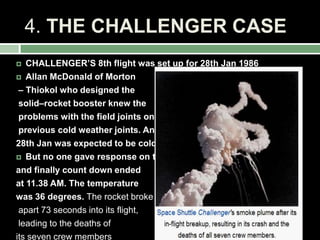
4. THE CHALLENGER CASE
CHALLENGER’S 8th flight was set up for 28th Jan 1986
 Allan McDonald of Morton
– Thiokol who designed the
solid–rocket booster knew the
problems with the field joints on
previous cold weather joints. And
28th Jan was expected to be cold.
 But no one gave response on that
and finally count down ended
at 11.38 AM. The temperature
was 36 degrees. The rocket broke
apart 73 seconds into its flight,
leading to the deaths of
its seven crew members

WHISTLE BLOWING
Whistle blowing is alerting relevant persons
to some moral or legal corruption, where “Relevant
persons” are those in a position to act in
response
 person who exposes misconduct, alleged dishonest
or illegal activity occurring in an organization
 No topic in Engineering ethics is more
controversial than
whistle – blowing.

conclusion
When you leave this Lecture Hall today you

must leave with the knowledge and
conviction that you have a professional
and moral responsibility to yourselves and
to your fellow human beings to defend the
truth and expose any questionable practice

that will lead to an unsafe product or
process
References











http://classes.soe.ucsc.edu/cmpe080e/Spring10/Week%
2001/Engineering%20Ethics%20&%20cases.pdf
http://www.nec.gov.np/img/downloads/Code%20of%20C
onduct.pdf
http://eeiccourses.engineering.osu.edu/sites/eeiccourse
s.engineering.osu.edu/files/uploads/au2013/1181/Class/
Class03_Ethics/Ethics_Assigned_Cases_Schedule6.pdf
http://www.bookspar.com/wpcontent/uploads/vtu/notes/1st-2ndsem/cipe/Professional-ethics.pdf
www.nec.gov.np
http://www.airdisaster.com/special/special-thy981.shtml
THANK YOU

Ethics in engineering profession kamal25

  • 1.
    Ethics in Engineering profession and Some casestudy Prepared by: Kamal Shahi Roll no: 25
  • 3.
    Ethics  Study of thegeneral nature of morals and of the specific moral choices to be made by a person  Set of standard or codes derived from human reasons and experience by which human actions are determined as right or wrong/ good or evil
  • 4.
    Generally Ethics Is: a.The science of customs or habits b. The science of character or conducts c. The science of rightness or wrongness d. The science of morality e. A normative science
  • 5.
       Shakespeare -- "Whenin Rome, do as the Romans do" Kant -- "Do not do unto others as you would not have them do unto you" the Bible -- "he that dig a pit shall fall into it“ confront
  • 6.
    Engineering Ethics   field ofapplied ethics and system of moral principles that apply to the practice of engineering examines and sets the obligations by engineers to society, to their clients, and to the profession
  • 7.
    Why ETHICS inEngineering???  Engineers responsibility to society in not only bringing new technology, discoveries, and designs to the world but also in protecting the public interest  On the beginning of 20th century there had been significant structural failures like Ashtabula River Railroad Disaster (1876), Tay Bridge Disaster (1879), and the Quebec Bridge collapse (1907), Boston molasses disaster etc…
  • 8.
    Ashtabula River RailroadDisaster (1876) Quebec Bridge(before) Quebec Bridge(After)
  • 9.
    CITICORP BUILDING(case study explainedlater) Tay Bridge(Before) Tay Bridge(after)
  • 11.
       These disasters forcedthe engineering profession to confront shortcomings in technical and construction practice, as well as ethical standards engineers are reminded of their responsibilities starting in early-college coursework and progressing throughout their careers in continuing education courses. It is not for preaching virtue rather, its objective is to increase your ability as engineers to responsibly tackle the moral issues raised by technological activity.
  • 12.
  • 13.
    Engineering as Social Experimentation Moral Values Micro& Macro Issues Technological Development Engineering Ethics
  • 14.
    Code of Ethicsfor Engineers   Engineering is an important and learned profession. Engineering has a direct and vital impact on the quality of life for all people so services provided by engineers require honesty, impartiality, fairness, and equity, and must be dedicated to the protection of the public health, safety, and welfare Fundamental principles:       Hold paramount the safety, health, and welfare of the public. Perform services only in areas of their competence. Issue public statements only in an objective and truthful manner. Act for each employer or client as faithful agents or trustees. Avoid deceptive acts. Conduct themselves honorably, responsibly, ethically, and lawfully so as to enhance the honor, reputation, and usefulness of the profession
  • 15.
    National Society ofProfessional Engineers has provided the set of codes of ethics for engineers including 1. Fundamental canons 2. Rules of practice 3. Professional obligations (detail on report)
  • 16.
    The professional Codeof Conduct to be followed by the registered Engineers of the Council, subject to the provision of the Nepal Engineering Council (NEC) Act, 2055 (1998) and the Nepal Engineering Council Regulation, 2057(2000), has been published as follows : 1. 2. 3. 4. 5. 6. 7. 8. Discipline and honesty Politeness and confidentiality Non-discrimination Professional Work Deeds which may cause harm to the engineering profession Personal responsibility State name, designation and registration no No publicity or advertisement must be made which may cause unnecessary effect
  • 17.
    Nepal Engineers’ Associationadopted code of ethics for its fellow members in Chaitra 6, 2065. According to NEA  Fundamental Principles of Professional Engineering Ethics    Upholding and advancing engineering profession Keeping high standards of Ethical conduct Quality of Engineers to adhere with above principles Engineer      Will be honest and fair and serve employer, clients and public Will declare to the advancement of competence of engineering profession and to disseminate engineering knowledge Will use his knowledge and skill in the service of humanity Code also directs the relationship of Nepalese Engineer with    Relation with Public Relation with Employers and Clients Relation with Engineers
  • 18.
  • 19.
    1. THE CASEOF THE KILLER ROBOT     Randy Samuels employed as a programmer at the Silicon Techtronic's Inc. The charge involves the death of Bart Matthews, who was killed by an assembly –line robot . Victim worked as robot operator at Cybernetics Inc. in Silicon Heights. He was crushed to death when the robot he was operating malfunctioned and started to wave its hands violently. written formula ,provided by the project physicist, which Samuels was supposed to program. But he negligently misinterpreted the formula leading to this huge gruesome death. Society must protect itself against programmers who make careless mistakes For more http://www.onlineethics.org/Resources/Cases/killerrobot/ article-6.aspx#abstract
  • 20.
    2. DC –10 JUMBO JET  The cargo door of DC – 10 Jumbo jet was developed by Convair, a sub contractor for McDonnell Douglas.  So he reported to his senior engineer that the Cargo door could burst open, leading to crash of the plane. Hence the door has to be redesigned and the cabin floor has to strengthened  Top Management at Convair neither disputed the technical facts or the predictions made by Applegate. The liabilities and the cost of redesign were to high.
  • 21.
    Two years wentby and In 1974 the cargo door of DC – 10 Jumbo burst open and the jet crashed near Paris killing 346 Detail info @ http://www.airdisaster.com/special/special-thy981.shtml
  • 22.
    3. CITICORP BUILDING StructuralEngineer Bill LeMessurier faced a big design problem when he worked on the Citicorp Centre, N.Y – fifth highest skyscraper in New York. The 900 feet bank would rise from 9-storey (114’) This was because of a corner of the plot belonged toa church and the church had to be accommodated there. The building was completed in 1977. An engineering student like you questioned: what will happen when the wind loading is oblique?
  • 23.
    While LeMessurier designedwelded joints, the contractor, Bethlehem Steel changed them to bolted joints. Recalculation was not done to check what the construction change would do. Wind Tunnel Tests proved that the diagonal wind loading (with a return period of 16 years) canwas deeply troubled. He considered hisjoints and therefore the LeMessurier lead to the failure of the critical bolted options building. Silence Suicide He explained the problem to his client Citicorp. The building was strengthened by welding two-inch thick steel plates over each of the 200 bolted joints. With only welding half the number of bolts hurricane Ella was threatening to strike the building. Luckily Ella’s direction changed. NOTHING WAS HAPPENED LATER BUT THIS WAS HIDDEN FROM
  • 24.
    4. THE CHALLENGERCASE CHALLENGER’S 8th flight was set up for 28th Jan 1986  Allan McDonald of Morton – Thiokol who designed the solid–rocket booster knew the problems with the field joints on previous cold weather joints. And 28th Jan was expected to be cold.  But no one gave response on that and finally count down ended at 11.38 AM. The temperature was 36 degrees. The rocket broke apart 73 seconds into its flight, leading to the deaths of its seven crew members 
  • 25.
    WHISTLE BLOWING Whistle blowingis alerting relevant persons to some moral or legal corruption, where “Relevant persons” are those in a position to act in response  person who exposes misconduct, alleged dishonest or illegal activity occurring in an organization  No topic in Engineering ethics is more controversial than whistle – blowing. 
  • 26.
    conclusion When you leavethis Lecture Hall today you must leave with the knowledge and conviction that you have a professional and moral responsibility to yourselves and to your fellow human beings to defend the truth and expose any questionable practice that will lead to an unsafe product or process
  • 28.
  • 29.