ENGINEERING ETHICS – CASE STUDIES
1. What is Engineering Ethics?
2. Why study Engineering Ethics?
3. The scope of Engineering Ethics
4. Case studies in Engineering Ethics
a. Killer Robot
b. DC - 10
c. Whistle Blowing
d. Citicorp Building
e. The Challenger case
1. Sample Codes
a. Hammurabi’s code
b. ABET code
1. Further case studies
a. Bhopal
b. Three Mile Island
c. Chernobyl
7. Concluding remarks
WHAT IS ENGINEERING ETHICS
 Engineering Ethics is the study of moral issues
and decisions confronting individuals and
organizations engaged in engineering.
 The Study of related questions about moral
ideals,character,policies and relationship of
people and corporations involved in technological
activity.
WHY STUDY ENGINEERING ETHICS
 What is the point in studying engineering ethics?
 What can be gained from taking a course in ethics?
 Engineering ethics course is not about preaching virtue
rather, its objective is to increase your ability as
engineers to responsibly confront moral issues raised by
technological activity.
THE SCOPE OF ENGINEERING
ETHICS
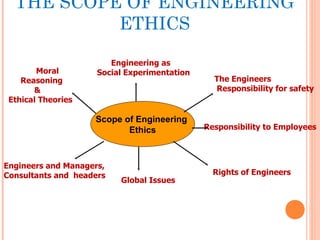
Scope of Engineering
Ethics
Moral
Reasoning
&
Ethical Theories
Engineering as
Social Experimentation
The Engineers
Responsibility for safety
Engineers and Managers,
Consultants and headers
Global Issues
Rights of Engineers
Responsibility to Employees
ENGINEERING ETHICS –
CASE STUDIES
CASE 1 : THE CASE OF THE KILLER
ROBOT
Jane McMurdock, prosecuttting attorney for the
city of Silicon Valley, announced today the indictment of
Randey Samuels on charges of manslaughter.
Samuels employed as a programmer at the Silicon
Techtronic's Inc. The charge involves the death of Bart
Matthews, who was killed last May by an assembly –line
robot.
Matthews worked as robot operator at
Cybernetics Inc.,in Silicon Heights. He was crushed to
death when the robot he was operating malfunctioned
and started to wave its hands violently.
The Robot arm struck Matthews, throwing him
against a wall and crushing his skull. Matthews died almost
instantly. According to the indictment, Samuels wrote the
particular piece of computer program responsible for the
robot malfunction.
“There’s a smoking gun!” McMurdock announced
triumphantly at a press conference held in the hall of
Justice." We have the hand written formula ,provided by
the project physicist, which Samuels was supposed to
program.
But he negligently misinterpreted the formula leading
to this huge gruesome death. Society must protect itself
against programmers who make careless mistakes.
The Sentinel – observer has obtained a copy of the
handwritten formula in question. There are actually three
similar formulas ,scrawled on piece of yellow legal pad
paper.
Each formula describes the motion of the robot in one
direction: east-west, North-south and up –down. The
Sentinel-Observer showed the formulas to Bill Park a
professor of physics at Silicon Valley University.
He confirmed that these equations could be used to
describe the motion of a robot arm. The Sentinel – Observer
then showed Park the program code written by the accused
in the programming language.
We asked Park who is fluent in C and several other
languages, whether the program code was correct for the
given robot – arm formulas.
Parks response was immediate. He exclaimed, “By
Jove! It looks like he misinterpreted the formula. He's
guilty as hell, if you ask me”.
The Sentinel – Observer was unable to contact
Samuels for comment. “He is deeply depressed about all
this,” his girl friend told us over the phone," but Randy
believes he will be acquitted when he gets a chance to tell
his side of the story.
Issues:
CASE 2: DC – 10 JUMBO JET
The fuselage of the DC – 10 Jumbo jet of which the
cargo door is a part was developed by Convair, a sub
contractor for McDonnell Douglas.
Convair’s senior engineer directing the project, Dan
Applegate had written to the Vice president of the company:
“The Cargo door could burst open, leading to crash of
the plane. Hence the door has to be redesigned and the
cabin floor has to strengthened”.
Top Management at Convair neither disputed the
technical facts or the predictions made by Applegate. The
liabilities and the cost of redesign were to high.
Two years went by.
In 1974 the cargo door of DC – 10 Jumbo burst open and
the jet crashed near Paris killing 346 .
Issues:
CASE 3: WHISTLE BLOWING
Definition: Whistle blowing is alerting relevant persons
to some moral or legal corruption, where “Relevant
persons” are those in a position to act in response.
 No topic in Engineering ethics is more controversial than
whistle – blowing.
 Carl Houston was a welding supervisor for a nuclear
power facility in Virginia (1970) for Stone & Weber
He saw
 Improper welding procedures
 Use of wrong materials
 Welders were not trained properly
 The Situation was dangerous
He reported to Stone & Weber’s Manager, who
ignored him. He threatened to write to Stone & Weber’s
Headquarters. Shortly thereafter he was fired on trumped –
up charges.
Finally he wrote to Senators Howard's Baker and
Albert Gore. The Senators prompted the Atomic Energy
Commission to investigate, which confirmed his
allegations.
Issues :
Structural Engineer Bill LeMessurier faced a big design
problem when he worked on the Citicorp Centre, N.Y – fifth
highest skyscraper in New York.
The 900 feet bank would rise from 9-storey (114’)
high columns. The columns are positioned as follows: one at
the center and the other at the CENTER OF EACH SIDE OF
THE TOWER and not at the CORNERS OF THE TOWERS (as is
usual)
This was because of a corner of the plot belonged to
a church and the church had to be accommodated there.
The building was completed in 1977. An engineering
student like you questioned: what will happen when the
wind loading is oblique?
CASE 4: CITICORP BUILDING
y
x
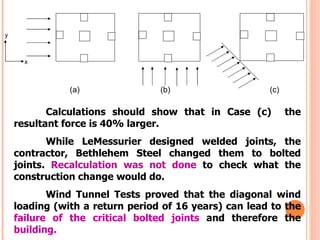
Calculations should show that in Case (c) the
resultant force is 40% larger.
While LeMessurier designed welded joints, the
contractor, Bethlehem Steel changed them to bolted
joints. Recalculation was not done to check what the
construction change would do.
Wind Tunnel Tests proved that the diagonal wind
loading (with a return period of 16 years) can lead to the
failure of the critical bolted joints and therefore the
building.
(a) (b) (c)
LeMessurier was deeply troubled. He considered his options
 Silence
 Suicide
Then he told himself:
• I have information that nobody else in the world had.
• I have power to effect extraordinary events that only I
could initiate.
He explained the problem to his client Citicorp.
The building was strengthened by welding two-inch
thick steel plates over each of the 200 bolted joints. With
only welding half the number of bolts hurricane Ella was
threatening to strike the building. Luckily Ella’s direction
changed.
Despite the fact that nothing happened as the result of
the engineering gaffe, the crises was kept hidden from
the public for almost 20 years.
LeMessurier was criticized for
 Insufficient oversight leading to bolted rather than
welded joints.
 For misleading the public about the extent of the
danger during the reinforcement process
 For keeping the engineering insights from his peers
for decades.
 However his act of altering Citicorp to the problem
inherent in his own design is now used as an example of
ethical behavior in several engineering textbooks.
Issues:
After a lot of delays CHALLENGER’S 8th
flight was set
up for 28th
Jan 1986
Allan McDonald of Morton – Thiokol who designed
the solid–rocket booster knew the problems with the field
joints on previous cold weather joints. And 28th
Jan was
expected to be cold.
CASE 5. THE CHALLENGER CASE
Seal experts Arnold Thompson and Roger Boisjoly of
Morton – Thiokol, explained to NASA representatives how
upon launch the booster rocket walls bulge and the
combustion gases can blow past one or even both of the O-
rings that make up the field joints.
The rings char and erode, as had been observed on
many previous flights. In cold weather the problem is
aggravated because the rings and the putty packing are less
pliable then (more brittle)
Senior Vice President Jerry Mason told Bob Lund (Vice
President Engineering) “TO TAKE OFF YOUR ENGINEERING
HAT AND PUT ON YOUR MANAGEMENT HAT”. The managers
(not engineers) voted that the seals COULD NOT BE SHOWN
TO BE UNSAFE.
The count down ended at 11.38 AM. The
temperature was 36 degrees. As the rocket carrying the
Challenge Rose from the ground, cameras showed
smoke emanating through the O rings.
Soon these turned into a flame that hit the
external fuel tank and a strut holding the booster
rocket. The hydrogen in the tank caught fire, the
booster rocket broke loose, smashed into Challenger’s
wing, then into the external tank. At 76 seconds into
the flight, by the time Challenger and its rocket had
reached 50,000 feet, it was totally engulfed in a fire ball.
The crew cabin separated and fell into the ocean, killing
all abroad. Mission Commander: Francis Scobee.
Pilot: Michael Smith. Mission specialist: Gpegory Jarvis,
Ronald McNair, Ellison Onizuka, Judith Resnick.
Teacher in space: Christa MacAuliffe (Chosen from
11,000 applicants)
Issues:
Babylon’s Building Code
(Hammurabi’s Code)
If a builder has built a house for a man and has not
made his work sound, and the house which he has built has
fallen down and so caused the death of the house-holder,
the builder should be put to death ……………
SAMPLE CODES
CODE OF ETHICS FOR ENGINEERS
THE FUNDAMENTAL PRINCIPLES
Engineers Uphold and advance the integrity, honor and
dignity of the engineering profession by:
I.Using their knowledge and skill for the enhancement
of human welfare;
II. Being honest and impartial, and serving with fidelity
the public, their employers and clients:
III. Striving to increase the competence and prestige of the
engineering profession; and
I.Supporting the professional and technical societies of
their disciplines.
Fundamental Canons
1. Engineers shall hold paramount the safety, health and
welfare of the public in the performance of their
professional duties.
2. Engineers shall perform services only in the areas of
their competence.
3. Engineers shall issue public statements only in an
objective and truthful manner.
4. Engineers shall act in professional matters for each
employer or client as faithful agents or trustees, and
shall avoid conflicts of interest.
5. Engineers shall build their professional reputation on
the merit of their services and shall not compete unfairly
with others.
6.Engineers shall act in such a manner as to uphold and
enhance the honor, integrity and dignity of the profession.
7. Engineers shall continue their professional development
throughout their careers and shall provide opportunities
for the professional development of those engineers
under their supervision.
CONCLUDING REMARKS
When you leave this Lecture Hall today you must
leave with the knowledge and conviction that you have a
professional and moral responsibility to yourselves and to
your fellow human beings to defend the truth and expose
any questionable practice that will lead to an unsafe
product or process
1. Martin, Mike & Schinzinger, Ronald: Ethics in
Engineering, 3rd
Ed. McGraw Hill
1. http://temp.onlinethics.org/cases/robot/article- 1.htm/
REFERENCES

ENGINEERING_ETHICS_CASE_STUDIES.pdf

  • 1.
    ENGINEERING ETHICS –CASE STUDIES 1. What is Engineering Ethics? 2. Why study Engineering Ethics? 3. The scope of Engineering Ethics 4. Case studies in Engineering Ethics a. Killer Robot b. DC - 10 c. Whistle Blowing d. Citicorp Building e. The Challenger case 1. Sample Codes a. Hammurabi’s code b. ABET code 1. Further case studies a. Bhopal b. Three Mile Island c. Chernobyl 7. Concluding remarks
  • 2.
    WHAT IS ENGINEERINGETHICS  Engineering Ethics is the study of moral issues and decisions confronting individuals and organizations engaged in engineering.  The Study of related questions about moral ideals,character,policies and relationship of people and corporations involved in technological activity.
  • 3.
    WHY STUDY ENGINEERINGETHICS  What is the point in studying engineering ethics?  What can be gained from taking a course in ethics?  Engineering ethics course is not about preaching virtue rather, its objective is to increase your ability as engineers to responsibly confront moral issues raised by technological activity.
  • 4.
    THE SCOPE OFENGINEERING ETHICS Scope of Engineering Ethics Moral Reasoning & Ethical Theories Engineering as Social Experimentation The Engineers Responsibility for safety Engineers and Managers, Consultants and headers Global Issues Rights of Engineers Responsibility to Employees
  • 5.
  • 6.
    CASE 1 :THE CASE OF THE KILLER ROBOT Jane McMurdock, prosecuttting attorney for the city of Silicon Valley, announced today the indictment of Randey Samuels on charges of manslaughter. Samuels employed as a programmer at the Silicon Techtronic's Inc. The charge involves the death of Bart Matthews, who was killed last May by an assembly –line robot. Matthews worked as robot operator at Cybernetics Inc.,in Silicon Heights. He was crushed to death when the robot he was operating malfunctioned and started to wave its hands violently.
  • 7.
    The Robot armstruck Matthews, throwing him against a wall and crushing his skull. Matthews died almost instantly. According to the indictment, Samuels wrote the particular piece of computer program responsible for the robot malfunction. “There’s a smoking gun!” McMurdock announced triumphantly at a press conference held in the hall of Justice." We have the hand written formula ,provided by the project physicist, which Samuels was supposed to program. But he negligently misinterpreted the formula leading to this huge gruesome death. Society must protect itself against programmers who make careless mistakes. The Sentinel – observer has obtained a copy of the handwritten formula in question. There are actually three similar formulas ,scrawled on piece of yellow legal pad paper.
  • 8.
    Each formula describesthe motion of the robot in one direction: east-west, North-south and up –down. The Sentinel-Observer showed the formulas to Bill Park a professor of physics at Silicon Valley University. He confirmed that these equations could be used to describe the motion of a robot arm. The Sentinel – Observer then showed Park the program code written by the accused in the programming language. We asked Park who is fluent in C and several other languages, whether the program code was correct for the given robot – arm formulas.
  • 9.
    Parks response wasimmediate. He exclaimed, “By Jove! It looks like he misinterpreted the formula. He's guilty as hell, if you ask me”. The Sentinel – Observer was unable to contact Samuels for comment. “He is deeply depressed about all this,” his girl friend told us over the phone," but Randy believes he will be acquitted when he gets a chance to tell his side of the story. Issues:
  • 10.
    CASE 2: DC– 10 JUMBO JET The fuselage of the DC – 10 Jumbo jet of which the cargo door is a part was developed by Convair, a sub contractor for McDonnell Douglas. Convair’s senior engineer directing the project, Dan Applegate had written to the Vice president of the company: “The Cargo door could burst open, leading to crash of the plane. Hence the door has to be redesigned and the cabin floor has to strengthened”.
  • 11.
    Top Management atConvair neither disputed the technical facts or the predictions made by Applegate. The liabilities and the cost of redesign were to high. Two years went by. In 1974 the cargo door of DC – 10 Jumbo burst open and the jet crashed near Paris killing 346 . Issues:
  • 12.
    CASE 3: WHISTLEBLOWING Definition: Whistle blowing is alerting relevant persons to some moral or legal corruption, where “Relevant persons” are those in a position to act in response.  No topic in Engineering ethics is more controversial than whistle – blowing.  Carl Houston was a welding supervisor for a nuclear power facility in Virginia (1970) for Stone & Weber
  • 13.
    He saw  Improperwelding procedures  Use of wrong materials  Welders were not trained properly  The Situation was dangerous He reported to Stone & Weber’s Manager, who ignored him. He threatened to write to Stone & Weber’s Headquarters. Shortly thereafter he was fired on trumped – up charges. Finally he wrote to Senators Howard's Baker and Albert Gore. The Senators prompted the Atomic Energy Commission to investigate, which confirmed his allegations. Issues :
  • 14.
    Structural Engineer BillLeMessurier faced a big design problem when he worked on the Citicorp Centre, N.Y – fifth highest skyscraper in New York. The 900 feet bank would rise from 9-storey (114’) high columns. The columns are positioned as follows: one at the center and the other at the CENTER OF EACH SIDE OF THE TOWER and not at the CORNERS OF THE TOWERS (as is usual) This was because of a corner of the plot belonged to a church and the church had to be accommodated there. The building was completed in 1977. An engineering student like you questioned: what will happen when the wind loading is oblique? CASE 4: CITICORP BUILDING
  • 15.
    y x Calculations should showthat in Case (c) the resultant force is 40% larger. While LeMessurier designed welded joints, the contractor, Bethlehem Steel changed them to bolted joints. Recalculation was not done to check what the construction change would do. Wind Tunnel Tests proved that the diagonal wind loading (with a return period of 16 years) can lead to the failure of the critical bolted joints and therefore the building. (a) (b) (c)
  • 19.
    LeMessurier was deeplytroubled. He considered his options  Silence  Suicide Then he told himself: • I have information that nobody else in the world had. • I have power to effect extraordinary events that only I could initiate. He explained the problem to his client Citicorp. The building was strengthened by welding two-inch thick steel plates over each of the 200 bolted joints. With only welding half the number of bolts hurricane Ella was threatening to strike the building. Luckily Ella’s direction changed.
  • 20.
    Despite the factthat nothing happened as the result of the engineering gaffe, the crises was kept hidden from the public for almost 20 years. LeMessurier was criticized for  Insufficient oversight leading to bolted rather than welded joints.  For misleading the public about the extent of the danger during the reinforcement process  For keeping the engineering insights from his peers for decades.  However his act of altering Citicorp to the problem inherent in his own design is now used as an example of ethical behavior in several engineering textbooks. Issues:
  • 21.
    After a lotof delays CHALLENGER’S 8th flight was set up for 28th Jan 1986 Allan McDonald of Morton – Thiokol who designed the solid–rocket booster knew the problems with the field joints on previous cold weather joints. And 28th Jan was expected to be cold. CASE 5. THE CHALLENGER CASE
  • 22.
    Seal experts ArnoldThompson and Roger Boisjoly of Morton – Thiokol, explained to NASA representatives how upon launch the booster rocket walls bulge and the combustion gases can blow past one or even both of the O- rings that make up the field joints. The rings char and erode, as had been observed on many previous flights. In cold weather the problem is aggravated because the rings and the putty packing are less pliable then (more brittle) Senior Vice President Jerry Mason told Bob Lund (Vice President Engineering) “TO TAKE OFF YOUR ENGINEERING HAT AND PUT ON YOUR MANAGEMENT HAT”. The managers (not engineers) voted that the seals COULD NOT BE SHOWN TO BE UNSAFE.
  • 25.
    The count downended at 11.38 AM. The temperature was 36 degrees. As the rocket carrying the Challenge Rose from the ground, cameras showed smoke emanating through the O rings. Soon these turned into a flame that hit the external fuel tank and a strut holding the booster rocket. The hydrogen in the tank caught fire, the booster rocket broke loose, smashed into Challenger’s wing, then into the external tank. At 76 seconds into the flight, by the time Challenger and its rocket had reached 50,000 feet, it was totally engulfed in a fire ball. The crew cabin separated and fell into the ocean, killing all abroad. Mission Commander: Francis Scobee. Pilot: Michael Smith. Mission specialist: Gpegory Jarvis, Ronald McNair, Ellison Onizuka, Judith Resnick. Teacher in space: Christa MacAuliffe (Chosen from 11,000 applicants) Issues:
  • 26.
    Babylon’s Building Code (Hammurabi’sCode) If a builder has built a house for a man and has not made his work sound, and the house which he has built has fallen down and so caused the death of the house-holder, the builder should be put to death …………… SAMPLE CODES
  • 27.
    CODE OF ETHICSFOR ENGINEERS THE FUNDAMENTAL PRINCIPLES Engineers Uphold and advance the integrity, honor and dignity of the engineering profession by: I.Using their knowledge and skill for the enhancement of human welfare; II. Being honest and impartial, and serving with fidelity the public, their employers and clients: III. Striving to increase the competence and prestige of the engineering profession; and I.Supporting the professional and technical societies of their disciplines.
  • 28.
    Fundamental Canons 1. Engineersshall hold paramount the safety, health and welfare of the public in the performance of their professional duties. 2. Engineers shall perform services only in the areas of their competence. 3. Engineers shall issue public statements only in an objective and truthful manner. 4. Engineers shall act in professional matters for each employer or client as faithful agents or trustees, and shall avoid conflicts of interest. 5. Engineers shall build their professional reputation on the merit of their services and shall not compete unfairly with others.
  • 29.
    6.Engineers shall actin such a manner as to uphold and enhance the honor, integrity and dignity of the profession. 7. Engineers shall continue their professional development throughout their careers and shall provide opportunities for the professional development of those engineers under their supervision.
  • 30.
    CONCLUDING REMARKS When youleave this Lecture Hall today you must leave with the knowledge and conviction that you have a professional and moral responsibility to yourselves and to your fellow human beings to defend the truth and expose any questionable practice that will lead to an unsafe product or process
  • 31.
    1. Martin, Mike& Schinzinger, Ronald: Ethics in Engineering, 3rd Ed. McGraw Hill 1. http://temp.onlinethics.org/cases/robot/article- 1.htm/ REFERENCES