Hall ticket no:
1286096
DEFINITION
 Ethics is the philosophy of human conduct, a
way of stating and evaluating principles by
which problems of behaviour can be solved.
 Ethics is concerned with standards judging
whether actions are right or wrong.
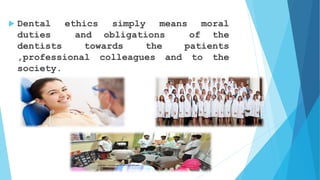
 Dental ethics simply means moral
duties and obligations of the
dentists towards the patients
,professional colleagues and to the
society.
 Hippocratic oath is the first ethical
standards given by Hippocrates ,the
father of medicine, in the 4TH century
BC
EHICAL PRINCIPLES
1. to do no harm[non-maleficence]
2. to do good[beneficence]
3. respect the person
4. Justice
5. veracity or truthfulness
6. confidentiality
TO DO NO HARM
 considered to be the foundation of social
morality even though dental professionals
know they tend to break rules.
 Iatrogenic diseases-doctor induced illness.
 When patient is in pain the doctor should
attempt to minimise the pain if not
alternative minimal treatment or no
treatment is to be given.
TO DO GOOD
 Dentist role is to benefit the patients not
to inflict them harm
 Attempts to maximise the benefits and
minimize harm
RESPECT THE PERSON
 Autonomy
 Informed consent
A.AUTONOMY
 It is the principle that dictates that health
care professionals respects patients right to
make decisions concerning the treatment plan.
 An autonomous person is the one capable of
deliberation about personal goals and acting
under the direction of such deliberations.
 Dentists usually try to direct the patient
towards a particular mode of treatment by
stressing only over the advantages rather
than mentioning disadvantages.
B.INFORMED CONSENT
 Is a two step process, firstly information is
presented to the patient by doctor, secondly the
patient satisfies himself or herself that she
understands and based upon this understanding either
agrees or refuses to undergo the treatment.
 Description of,
a. procedures to be carried out
b. foreseeable risks or discomforts to the subject
c. reasonably expected benefits from the treatment
 A statement that the patient has understood the
procedure and is willing to undergo the treatment.
 The signature of the patient and of a witness.
JUSTICE
 Justice is described as fairness or equal
treatment , giving to each her or his right or
due
 Its difficult to provide well distributed
health care amongst people
 Primary duty of a health professional is to
provide service irrespective of class, creed
, etc.
 Justice demands that each person be treated
equally
 principle of justice is to protect the weak
and to ensure equality in rights and benefits,
for both groups and individuals
TRUTHFULNESS
 The patient - doctor relationship is
based on trust . Lying shows
disrespect to the patient and
threatens relationship
CONFEDENTIALITY
 The patient has right to expect that
all communications and records
pertaining to their care will be
treated as confidential.
EHICAL RULES FOR DENTISTS
[given by DCI]
 Duties of dentist towards patients
 Duties of dentists towards one
another
 Duties of dentists towards the
public
Duties of dentist towards
patients
 Dentists should be courteous ,
sympathetic ,friendly and helpful.
 Should be established as a well
merited reputation for his/her
professional abilities and fidelity.
Duties of dentists towards one
another
 Every dentist should cherish a proper pride
in his / her colleagues and should not
disparage them with words or act.
 If a dentist is consulted by a patient of
another dentist and the former finds that
the patient is suffering from previous
faulty restoration , its the duty of the
dentist to correct the treatment at once
with few comments as possible so as to
avoid reflection on his predecessor.
Duties of dentists towards
the public
 Dentist should take leadership
roles in the communities on
matters related to dental health
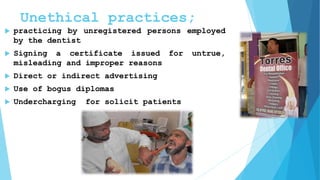
Unethical practices;
 practicing by unregistered persons employed
by the dentist
 Signing a certificate issued for untrue,
misleading and improper reasons
 Direct or indirect advertising
 Use of bogus diplomas
 Undercharging for solicit patients
THE NUREMBERG CODE
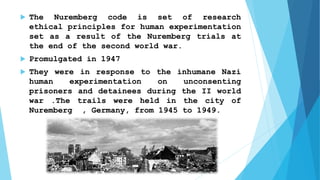
 The Nuremberg code is set of research
ethical principles for human experimentation
set as a result of the Nuremberg trials at
the end of the second world war.
 Promulgated in 1947
 They were in response to the inhumane Nazi
human experimentation on unconsenting
prisoners and detainees during the II world
war .The trails were held in the city of
Nuremberg , Germany, from 1945 to 1949.
1. The voluntary informed consent of the human
subject is absolutely essential.
2. The experiment should be such as to yield
fruitful results for the good of the
society.
3. The experiment should be designed and based
on the results of animals and knowledge of
the natural history of the disease.
4. The experiment should be so as to avoid all
unnecessary physical and mental suffering
and injury.
5. No experiment is to be conducted when there
is a prior reason for death or disabling
injury to occur.
6. The degree of risk to be solved by the experiment
should not exceed the humanitarian importance.
7. Proper preparations and adequate facilities are to
be provided to protect the experimental subjects
from getting injury, disability or death.
8. The experiment is to be conducted only by
scientifically qualified persons.
9. In the course of experiment the human subject has
the liberty to halt the experiment if he has reached
the heights of physical and mental state where
continuation of the experiment seems to be
impossible to him.
10. During the course of the experiment the scientist in
charge must be prepared to terminate the experiment
at any stage if he feels the continuation of the
experiment might result in injury , disability , or
death to the human subject.
ethics and dentistry.pdf

ethics and dentistry.pdf

  • 1.
  • 4.
    DEFINITION  Ethics isthe philosophy of human conduct, a way of stating and evaluating principles by which problems of behaviour can be solved.  Ethics is concerned with standards judging whether actions are right or wrong.
  • 5.
     Dental ethicssimply means moral duties and obligations of the dentists towards the patients ,professional colleagues and to the society.
  • 6.
     Hippocratic oathis the first ethical standards given by Hippocrates ,the father of medicine, in the 4TH century BC
  • 7.
    EHICAL PRINCIPLES 1. todo no harm[non-maleficence] 2. to do good[beneficence] 3. respect the person 4. Justice 5. veracity or truthfulness 6. confidentiality
  • 8.
    TO DO NOHARM  considered to be the foundation of social morality even though dental professionals know they tend to break rules.  Iatrogenic diseases-doctor induced illness.  When patient is in pain the doctor should attempt to minimise the pain if not alternative minimal treatment or no treatment is to be given.
  • 9.
    TO DO GOOD Dentist role is to benefit the patients not to inflict them harm  Attempts to maximise the benefits and minimize harm
  • 10.
    RESPECT THE PERSON Autonomy  Informed consent
  • 12.
    A.AUTONOMY  It isthe principle that dictates that health care professionals respects patients right to make decisions concerning the treatment plan.  An autonomous person is the one capable of deliberation about personal goals and acting under the direction of such deliberations.  Dentists usually try to direct the patient towards a particular mode of treatment by stressing only over the advantages rather than mentioning disadvantages.
  • 14.
    B.INFORMED CONSENT  Isa two step process, firstly information is presented to the patient by doctor, secondly the patient satisfies himself or herself that she understands and based upon this understanding either agrees or refuses to undergo the treatment.  Description of, a. procedures to be carried out b. foreseeable risks or discomforts to the subject c. reasonably expected benefits from the treatment  A statement that the patient has understood the procedure and is willing to undergo the treatment.  The signature of the patient and of a witness.
  • 15.
    JUSTICE  Justice isdescribed as fairness or equal treatment , giving to each her or his right or due  Its difficult to provide well distributed health care amongst people  Primary duty of a health professional is to provide service irrespective of class, creed , etc.  Justice demands that each person be treated equally  principle of justice is to protect the weak and to ensure equality in rights and benefits, for both groups and individuals
  • 16.
    TRUTHFULNESS  The patient- doctor relationship is based on trust . Lying shows disrespect to the patient and threatens relationship
  • 17.
    CONFEDENTIALITY  The patienthas right to expect that all communications and records pertaining to their care will be treated as confidential.
  • 18.
    EHICAL RULES FORDENTISTS [given by DCI]  Duties of dentist towards patients  Duties of dentists towards one another  Duties of dentists towards the public
  • 19.
    Duties of dentisttowards patients  Dentists should be courteous , sympathetic ,friendly and helpful.  Should be established as a well merited reputation for his/her professional abilities and fidelity.
  • 20.
    Duties of dentiststowards one another  Every dentist should cherish a proper pride in his / her colleagues and should not disparage them with words or act.  If a dentist is consulted by a patient of another dentist and the former finds that the patient is suffering from previous faulty restoration , its the duty of the dentist to correct the treatment at once with few comments as possible so as to avoid reflection on his predecessor.
  • 21.
    Duties of dentiststowards the public  Dentist should take leadership roles in the communities on matters related to dental health
  • 22.
    Unethical practices;  practicingby unregistered persons employed by the dentist  Signing a certificate issued for untrue, misleading and improper reasons  Direct or indirect advertising  Use of bogus diplomas  Undercharging for solicit patients
  • 23.
  • 24.
     The Nurembergcode is set of research ethical principles for human experimentation set as a result of the Nuremberg trials at the end of the second world war.  Promulgated in 1947  They were in response to the inhumane Nazi human experimentation on unconsenting prisoners and detainees during the II world war .The trails were held in the city of Nuremberg , Germany, from 1945 to 1949.
  • 25.
    1. The voluntaryinformed consent of the human subject is absolutely essential. 2. The experiment should be such as to yield fruitful results for the good of the society. 3. The experiment should be designed and based on the results of animals and knowledge of the natural history of the disease. 4. The experiment should be so as to avoid all unnecessary physical and mental suffering and injury. 5. No experiment is to be conducted when there is a prior reason for death or disabling injury to occur.
  • 26.
    6. The degreeof risk to be solved by the experiment should not exceed the humanitarian importance. 7. Proper preparations and adequate facilities are to be provided to protect the experimental subjects from getting injury, disability or death. 8. The experiment is to be conducted only by scientifically qualified persons. 9. In the course of experiment the human subject has the liberty to halt the experiment if he has reached the heights of physical and mental state where continuation of the experiment seems to be impossible to him. 10. During the course of the experiment the scientist in charge must be prepared to terminate the experiment at any stage if he feels the continuation of the experiment might result in injury , disability , or death to the human subject.