Anti VEGF agents
Dr. Satyabrata Sahoo
PDT Clinical & Experimental Pharmacology
School of Tropical Medicine, Kolkata
Introduction
• New blood vessel formation/angiogenesis is an essential property
of cancers-Folk man(1971)
• Cancer cells secrete the angiogenic factors that induce the
formation of new blood vessels that enhance neutrient flow to
tumor cells
• Angiogenic factors secreted by tumor cells include VEGF,FGF,TGF-
β,PDGF .
• VEGF initiates endothelial cell proliferation when it binds to a
member of the VEGF receptor (VEGFR) family
• A group of highly homologous receptors with intracellular tyrosine
kinase domains that includes VEGFR1 (FLT1), VEGFR2 (KDR), and
VEGFR3 (FLT4).
• The binding of VEGF to its receptor activates the intracellular VEGFR
tyrosine kinase activity and initiates mitogenic and anti-apoptotic
signaling pathways within the endothelial cell.
Anti VEGF Drugs
• Inhibit VEGF signalling by blocking VEGF ligand
or VEGF receptor function.
• For example-
Bevacizumab,Ramucirumab,Aflibercept,Suniti
nib,Sorafenib,Pazopanib,Axitinib,Lenvatinib,Re
gorafenib
Bevacizumab
• MOA-humanised monoclonal IgG1 antibody binds to VEGF,
prevents interaction of VEGF with its receptors on the surface
of endothelial cells and inhibits receptor signaling that
normally increases vascular permeability and angiogenesis
• ADME-Intravenous route, 30-90 min infusion every 2 weeks in
metastatic colorectal cancer, combination therapy in NSCLC
every 3weeks. The antibody has plasma half life about 20
days(range 11-50 days)
• Indication- metastatic colon cancer, NSCLC, cervical or ovarian
cancer, metastatic RCC, gliobastoma, wet macular
degeneration
• Adverse effects-hypertension, GI perforation,
Thromboembolic events, vessel injury ,bleeding etc
Ramucirumab
• MOA- a human IgG1 monoclonal antibody that binds
VEGFR2,blocking the binding of VEGFR ligands and thereby
inhibiting ligand induced activity in endothelial cells
• ADME-Intravenously every 2-3 weeks, mean half life is 14 days
• Indication-metastatic colorectal cancer, advanced gastric
adeno carcinoma, metastatic NSCLC
• Adverse effects- hypertension, diarrhea, hemorrhage, GI
perforation and impaired wound healing
Aflibercept
• MOA-acts as a trap for VEGFR ligands.
• It is a recombinant fusion protein that contains extracellular
VEGF binding domain of human VEGFR1/2 fused to the Fc
portion of human IgG1
• Binds to human VEGFR ligands with high affinity, reducing
there plasma concentrations to levels that are too low for
significant activation of their cognate receptors
• ADME-half life 6 days, intravenous infusion over 1 hr every 2
weeks.
• Indication-Metastatic colorectal cancer
• Adverse effects- hypertension, diarrhea, hemorrhage etc
Sunitinib
• MOA- small molecule, orally bioavailable inhibitor of multiple
kinases including VEGFR2
• ADME- typical treatment cycle is 4 weeks on treatment
followed by 2 weeks off, metabolised by CYP3A4 to produce
an active metabolite SU12662,t1/2 80-110 hr, steady state
achieved after 2 weeks. PK not affected by food intake
• Indication- metastatic renal cell cancer, pancreatic NETs, GIST
• Adverse effects- bleeding , hypertension ,proteinuria, arterial
thromboembolic events, intestinal perforation, fatigue,
hypothyroidism, bone marrow suppression, neutropenia
Sorafenib
• MOA- like sunitinib
• ADME-given orally everyday without treatment breaks,
metabolised by CYP3A4,t1/2 20-27 hr, steady state
concentration achieved within 1 week
• Indication- is the only drug approved for hepatocellular
carcinoma
• Metastatic renal cell cancer
• Adverse effects- fatigue, nausea,diarrhea, anorexia,rash,bone
marrow suppression, GI perforation, cardiomyopathy, palmar
plantar erythrodysesthesias etc
Pazopanib
• MOA- kinase inhibitor of VEGFR1,2,3 as well as FGFRs,
KIT,LCK,PDGFR and other kinases
• ADME-orally bioavailable, metabolised by CYP3A4,eliminated
with a t1/2 of 31 hr
• Indication-approved in advanced renal cell cancer and
advanced STS after prior chemotherapy
• Adverse effect- hypertension, thrombotic and hemorrhagic
events, GI perforation, QT prolongation, cardiomyopathy,black
box warning for severe life threatening hepatotoxicity
• Contraindicated in elderly patients and liver function test
abnormalities
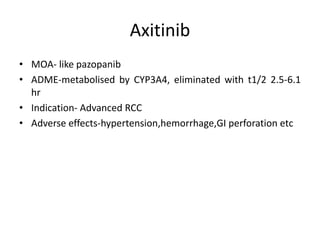
Axitinib
• MOA- like pazopanib
• ADME-metabolised by CYP3A4, eliminated with t1/2 2.5-6.1
hr
• Indication- Advanced RCC
• Adverse effects-hypertension,hemorrhage,GI perforation etc
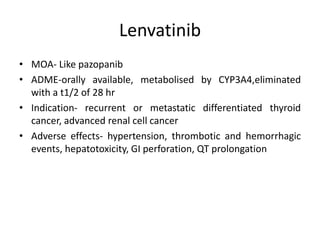
Lenvatinib
• MOA- Like pazopanib
• ADME-orally available, metabolised by CYP3A4,eliminated
with a t1/2 of 28 hr
• Indication- recurrent or metastatic differentiated thyroid
cancer, advanced renal cell cancer
• Adverse effects- hypertension, thrombotic and hemorrhagic
events, hepatotoxicity, GI perforation, QT prolongation
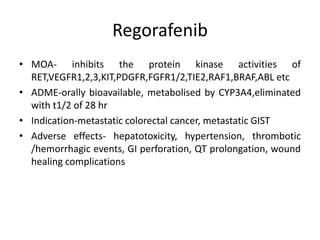
Regorafenib
• MOA- inhibits the protein kinase activities of
RET,VEGFR1,2,3,KIT,PDGFR,FGFR1/2,TIE2,RAF1,BRAF,ABL etc
• ADME-orally bioavailable, metabolised by CYP3A4,eliminated
with t1/2 of 28 hr
• Indication-metastatic colorectal cancer, metastatic GIST
• Adverse effects- hepatotoxicity, hypertension, thrombotic
/hemorrhagic events, GI perforation, QT prolongation, wound
healing complications
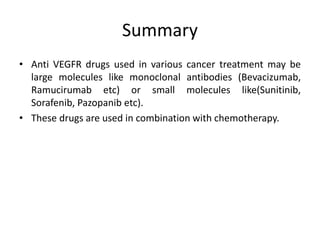
Summary
• Anti VEGFR drugs used in various cancer treatment may be
large molecules like monoclonal antibodies (Bevacizumab,
Ramucirumab etc) or small molecules like(Sunitinib,
Sorafenib, Pazopanib etc).
• These drugs are used in combination with chemotherapy.
References
1.Goodman & Gilman’s the pharmacological basis of therapeutics 13th
edition
2. Giantonio BJ, Catalano PJ, Meropol NJ, O’Dwyer PJ,Mitchell EP,
Alberts SR, Schwartz MA, Benson AB 3rd:Bevacizumab in
combination with oxaliplatin, fluorouracil,and leucovorin (FOLFOX4)
for previouslytreated metastatic colorectal cancer: results from
theEastern Cooperative Oncology Group Study E3200. JClin Oncol
2007; 25: 1539–1544.
3. Motzer RJ, Hutson TE, Cella D, Reeves J, Hawkins R,Guo J, Nathan P,
Staehler M, de Souza P, Merchan JR,Boleti E, Fife K, Jin J, Jones R,
Uemura H, De Giorgi U,Harmenberg U, Wang J, Sternberg CN, Deen
K, Mc-Cann L, Hackshaw MD, Crescenzo R, Pandite LN,Choueiri TK:
Pazopanib versus sunitinib in metastatic renal-cell carcinoma. N
Engl J Med 2013; 369: 722–731.
HDAC inhibitors
Dr. Satyabrata Sahoo
PDT Clinical & Experimental Pharmacology
School of Tropical Medicine, Kolkata
Introduction
• Histone deacetylases are a class of enzymes that catalyze the
removal of acetyl groups from acetylated lysine aminoacids in
histones, thereby altering the transcriptional activation of cellular
genes.
• HDACs can also deaceylate other proteins,including transcription
factors
• Overexpression of HDACs found in some cancers can cause
hypoacetylation of core nucleosomal histones
• HDACs inhibition lead to accumulation of acetyl group on the
histone lysine residues,an open chromatin structure,activation of
target genes that are selectively repressed in tumors
• Cell cycle arrest induced by HDAC inhibitors is caused by several
mechanisms; most common is increased expression of cell cycle
genes such as CDKN1A (Cyclin dependent kinase inhibitor p21)
HDACs inhibitors
• HDAC inhibitors cause cell cycle arrest by various mechanism
• Example of HDAC inhibitors are Panobinostat,
Romidepsin,Vorinostat etc
Panobinostat
• MOA- non selective pan-HDAC inhibitor, inhibitory activity
leads to apoptosis of malignant cells via multiple pathways
• ADME-oral bioavailability around 21%,metabolised through
CYP3A4,elimination half life 37 hr
• Indication-Multiple myeloma
• Adverse effects- diarrhea, fatigue, nausea, peripheral edema,
decreased appetite, pyrexia, vomiting, hypophosphatemia,
hyponatremia, hypokalemia, increased creatinine,
thrombocytopenia, lymphopenia, neutropenia,
anemiaarrythmia, QT prolongation etc
• Closed cardiac monitoring required
Romidepsin
• MOA- functions as a prodrug
• Within cells, a zinc binding thiol of the drug is reduced and
interacts with a zinc atom in the pocket of HDAC to block its
activity
• ADME- Intravenous route, metabolised through
CYP3A4,terminal half life 3hr
• Indication- cutaneous and peripheral T-cell lymphoma
• Adverse effect-nausea, vomiting, thrombocytopenia, anemia,
leukopenia, electrolyte abnormalities, ECG changes
Vorinostat
• Small molecule also known as SAHA based on its chemical name
suberanilohydroxamic acid
• MOA- binds to the active site of HDACs and chelates zinc ions in the
active site. this results in accumulation of histones and other
acetylated proteins, amongst which are transcription factors crucial
for differentiation
• Inhibits enzymatic activities of HDAC1,2,3(class I) and HDAC6(CLASS
II) at nanomolar concentration(IC50< 100 nM)
• ADME-slightly improved when taken with meal, metabolism mostly
through glucuronidation and hydrolysis, elimination t1/2 is about 2
hr
• Indication-cutaneous T-cell lymphoma
• Adverse effect-diarrhea, fatigue, thrombocytopenia, anorexia,
dysgeusia
• Contraindicated in severe hepatic impairment, pregnancy
Summary
• HDAC inhibitors seem to be a promising group of anticancer
drug particularly in combination with other anti cancer drugs
or radiotherapy
• Many other HDAC inhibitors are in clinical trials for the
treatment of both hematological and solid malignancies
References
1.Goodman & Gilman’s the pharmacological basis of
therapeutics 13th edition
2.Bolden, J.E.; Peart, M.M.J.; Johnstone, R.R.W. Anticancer
activities of histone deacetylase inhibitors. Nat. Rev.Drug
Discov. 2006, 5, 769–784. [CrossRef] [PubMed]
3. Butler LM, Zhou X, Xu WS, Scher HI, Rifkind RA, MarksPA et al.
(2002).The histone deacetylase inhibitor SAHA arrests cancer
cell growth, up-regulates thioredoxin-bindingprotein-2, and
down-regulates thioredoxin. Proc Natl AcadSci USA 99:
11700–11705.
THANK YOU

Vegf inhibitors

  • 1.
    Anti VEGF agents Dr.Satyabrata Sahoo PDT Clinical & Experimental Pharmacology School of Tropical Medicine, Kolkata
  • 2.
    Introduction • New bloodvessel formation/angiogenesis is an essential property of cancers-Folk man(1971) • Cancer cells secrete the angiogenic factors that induce the formation of new blood vessels that enhance neutrient flow to tumor cells • Angiogenic factors secreted by tumor cells include VEGF,FGF,TGF- β,PDGF . • VEGF initiates endothelial cell proliferation when it binds to a member of the VEGF receptor (VEGFR) family • A group of highly homologous receptors with intracellular tyrosine kinase domains that includes VEGFR1 (FLT1), VEGFR2 (KDR), and VEGFR3 (FLT4). • The binding of VEGF to its receptor activates the intracellular VEGFR tyrosine kinase activity and initiates mitogenic and anti-apoptotic signaling pathways within the endothelial cell.
  • 3.
    Anti VEGF Drugs •Inhibit VEGF signalling by blocking VEGF ligand or VEGF receptor function. • For example- Bevacizumab,Ramucirumab,Aflibercept,Suniti nib,Sorafenib,Pazopanib,Axitinib,Lenvatinib,Re gorafenib
  • 4.
    Bevacizumab • MOA-humanised monoclonalIgG1 antibody binds to VEGF, prevents interaction of VEGF with its receptors on the surface of endothelial cells and inhibits receptor signaling that normally increases vascular permeability and angiogenesis • ADME-Intravenous route, 30-90 min infusion every 2 weeks in metastatic colorectal cancer, combination therapy in NSCLC every 3weeks. The antibody has plasma half life about 20 days(range 11-50 days) • Indication- metastatic colon cancer, NSCLC, cervical or ovarian cancer, metastatic RCC, gliobastoma, wet macular degeneration • Adverse effects-hypertension, GI perforation, Thromboembolic events, vessel injury ,bleeding etc
  • 5.
    Ramucirumab • MOA- ahuman IgG1 monoclonal antibody that binds VEGFR2,blocking the binding of VEGFR ligands and thereby inhibiting ligand induced activity in endothelial cells • ADME-Intravenously every 2-3 weeks, mean half life is 14 days • Indication-metastatic colorectal cancer, advanced gastric adeno carcinoma, metastatic NSCLC • Adverse effects- hypertension, diarrhea, hemorrhage, GI perforation and impaired wound healing
  • 6.
    Aflibercept • MOA-acts asa trap for VEGFR ligands. • It is a recombinant fusion protein that contains extracellular VEGF binding domain of human VEGFR1/2 fused to the Fc portion of human IgG1 • Binds to human VEGFR ligands with high affinity, reducing there plasma concentrations to levels that are too low for significant activation of their cognate receptors • ADME-half life 6 days, intravenous infusion over 1 hr every 2 weeks. • Indication-Metastatic colorectal cancer • Adverse effects- hypertension, diarrhea, hemorrhage etc
  • 7.
    Sunitinib • MOA- smallmolecule, orally bioavailable inhibitor of multiple kinases including VEGFR2 • ADME- typical treatment cycle is 4 weeks on treatment followed by 2 weeks off, metabolised by CYP3A4 to produce an active metabolite SU12662,t1/2 80-110 hr, steady state achieved after 2 weeks. PK not affected by food intake • Indication- metastatic renal cell cancer, pancreatic NETs, GIST • Adverse effects- bleeding , hypertension ,proteinuria, arterial thromboembolic events, intestinal perforation, fatigue, hypothyroidism, bone marrow suppression, neutropenia
  • 8.
    Sorafenib • MOA- likesunitinib • ADME-given orally everyday without treatment breaks, metabolised by CYP3A4,t1/2 20-27 hr, steady state concentration achieved within 1 week • Indication- is the only drug approved for hepatocellular carcinoma • Metastatic renal cell cancer • Adverse effects- fatigue, nausea,diarrhea, anorexia,rash,bone marrow suppression, GI perforation, cardiomyopathy, palmar plantar erythrodysesthesias etc
  • 9.
    Pazopanib • MOA- kinaseinhibitor of VEGFR1,2,3 as well as FGFRs, KIT,LCK,PDGFR and other kinases • ADME-orally bioavailable, metabolised by CYP3A4,eliminated with a t1/2 of 31 hr • Indication-approved in advanced renal cell cancer and advanced STS after prior chemotherapy • Adverse effect- hypertension, thrombotic and hemorrhagic events, GI perforation, QT prolongation, cardiomyopathy,black box warning for severe life threatening hepatotoxicity • Contraindicated in elderly patients and liver function test abnormalities
  • 10.
    Axitinib • MOA- likepazopanib • ADME-metabolised by CYP3A4, eliminated with t1/2 2.5-6.1 hr • Indication- Advanced RCC • Adverse effects-hypertension,hemorrhage,GI perforation etc
  • 11.
    Lenvatinib • MOA- Likepazopanib • ADME-orally available, metabolised by CYP3A4,eliminated with a t1/2 of 28 hr • Indication- recurrent or metastatic differentiated thyroid cancer, advanced renal cell cancer • Adverse effects- hypertension, thrombotic and hemorrhagic events, hepatotoxicity, GI perforation, QT prolongation
  • 12.
    Regorafenib • MOA- inhibitsthe protein kinase activities of RET,VEGFR1,2,3,KIT,PDGFR,FGFR1/2,TIE2,RAF1,BRAF,ABL etc • ADME-orally bioavailable, metabolised by CYP3A4,eliminated with t1/2 of 28 hr • Indication-metastatic colorectal cancer, metastatic GIST • Adverse effects- hepatotoxicity, hypertension, thrombotic /hemorrhagic events, GI perforation, QT prolongation, wound healing complications
  • 13.
    Summary • Anti VEGFRdrugs used in various cancer treatment may be large molecules like monoclonal antibodies (Bevacizumab, Ramucirumab etc) or small molecules like(Sunitinib, Sorafenib, Pazopanib etc). • These drugs are used in combination with chemotherapy.
  • 14.
    References 1.Goodman & Gilman’sthe pharmacological basis of therapeutics 13th edition 2. Giantonio BJ, Catalano PJ, Meropol NJ, O’Dwyer PJ,Mitchell EP, Alberts SR, Schwartz MA, Benson AB 3rd:Bevacizumab in combination with oxaliplatin, fluorouracil,and leucovorin (FOLFOX4) for previouslytreated metastatic colorectal cancer: results from theEastern Cooperative Oncology Group Study E3200. JClin Oncol 2007; 25: 1539–1544. 3. Motzer RJ, Hutson TE, Cella D, Reeves J, Hawkins R,Guo J, Nathan P, Staehler M, de Souza P, Merchan JR,Boleti E, Fife K, Jin J, Jones R, Uemura H, De Giorgi U,Harmenberg U, Wang J, Sternberg CN, Deen K, Mc-Cann L, Hackshaw MD, Crescenzo R, Pandite LN,Choueiri TK: Pazopanib versus sunitinib in metastatic renal-cell carcinoma. N Engl J Med 2013; 369: 722–731.
  • 15.
    HDAC inhibitors Dr. SatyabrataSahoo PDT Clinical & Experimental Pharmacology School of Tropical Medicine, Kolkata
  • 16.
    Introduction • Histone deacetylasesare a class of enzymes that catalyze the removal of acetyl groups from acetylated lysine aminoacids in histones, thereby altering the transcriptional activation of cellular genes. • HDACs can also deaceylate other proteins,including transcription factors • Overexpression of HDACs found in some cancers can cause hypoacetylation of core nucleosomal histones • HDACs inhibition lead to accumulation of acetyl group on the histone lysine residues,an open chromatin structure,activation of target genes that are selectively repressed in tumors • Cell cycle arrest induced by HDAC inhibitors is caused by several mechanisms; most common is increased expression of cell cycle genes such as CDKN1A (Cyclin dependent kinase inhibitor p21)
  • 17.
    HDACs inhibitors • HDACinhibitors cause cell cycle arrest by various mechanism • Example of HDAC inhibitors are Panobinostat, Romidepsin,Vorinostat etc
  • 18.
    Panobinostat • MOA- nonselective pan-HDAC inhibitor, inhibitory activity leads to apoptosis of malignant cells via multiple pathways • ADME-oral bioavailability around 21%,metabolised through CYP3A4,elimination half life 37 hr • Indication-Multiple myeloma • Adverse effects- diarrhea, fatigue, nausea, peripheral edema, decreased appetite, pyrexia, vomiting, hypophosphatemia, hyponatremia, hypokalemia, increased creatinine, thrombocytopenia, lymphopenia, neutropenia, anemiaarrythmia, QT prolongation etc • Closed cardiac monitoring required
  • 19.
    Romidepsin • MOA- functionsas a prodrug • Within cells, a zinc binding thiol of the drug is reduced and interacts with a zinc atom in the pocket of HDAC to block its activity • ADME- Intravenous route, metabolised through CYP3A4,terminal half life 3hr • Indication- cutaneous and peripheral T-cell lymphoma • Adverse effect-nausea, vomiting, thrombocytopenia, anemia, leukopenia, electrolyte abnormalities, ECG changes
  • 20.
    Vorinostat • Small moleculealso known as SAHA based on its chemical name suberanilohydroxamic acid • MOA- binds to the active site of HDACs and chelates zinc ions in the active site. this results in accumulation of histones and other acetylated proteins, amongst which are transcription factors crucial for differentiation • Inhibits enzymatic activities of HDAC1,2,3(class I) and HDAC6(CLASS II) at nanomolar concentration(IC50< 100 nM) • ADME-slightly improved when taken with meal, metabolism mostly through glucuronidation and hydrolysis, elimination t1/2 is about 2 hr • Indication-cutaneous T-cell lymphoma • Adverse effect-diarrhea, fatigue, thrombocytopenia, anorexia, dysgeusia • Contraindicated in severe hepatic impairment, pregnancy
  • 21.
    Summary • HDAC inhibitorsseem to be a promising group of anticancer drug particularly in combination with other anti cancer drugs or radiotherapy • Many other HDAC inhibitors are in clinical trials for the treatment of both hematological and solid malignancies
  • 22.
    References 1.Goodman & Gilman’sthe pharmacological basis of therapeutics 13th edition 2.Bolden, J.E.; Peart, M.M.J.; Johnstone, R.R.W. Anticancer activities of histone deacetylase inhibitors. Nat. Rev.Drug Discov. 2006, 5, 769–784. [CrossRef] [PubMed] 3. Butler LM, Zhou X, Xu WS, Scher HI, Rifkind RA, MarksPA et al. (2002).The histone deacetylase inhibitor SAHA arrests cancer cell growth, up-regulates thioredoxin-bindingprotein-2, and down-regulates thioredoxin. Proc Natl AcadSci USA 99: 11700–11705.
  • 23.