Contents:
Introduction
Ethical Hacking
Hackers
Types of Hackers
Hacking Process
Why do We need Ethical Hacking
Advantages
Disadvantages
References
Introduction
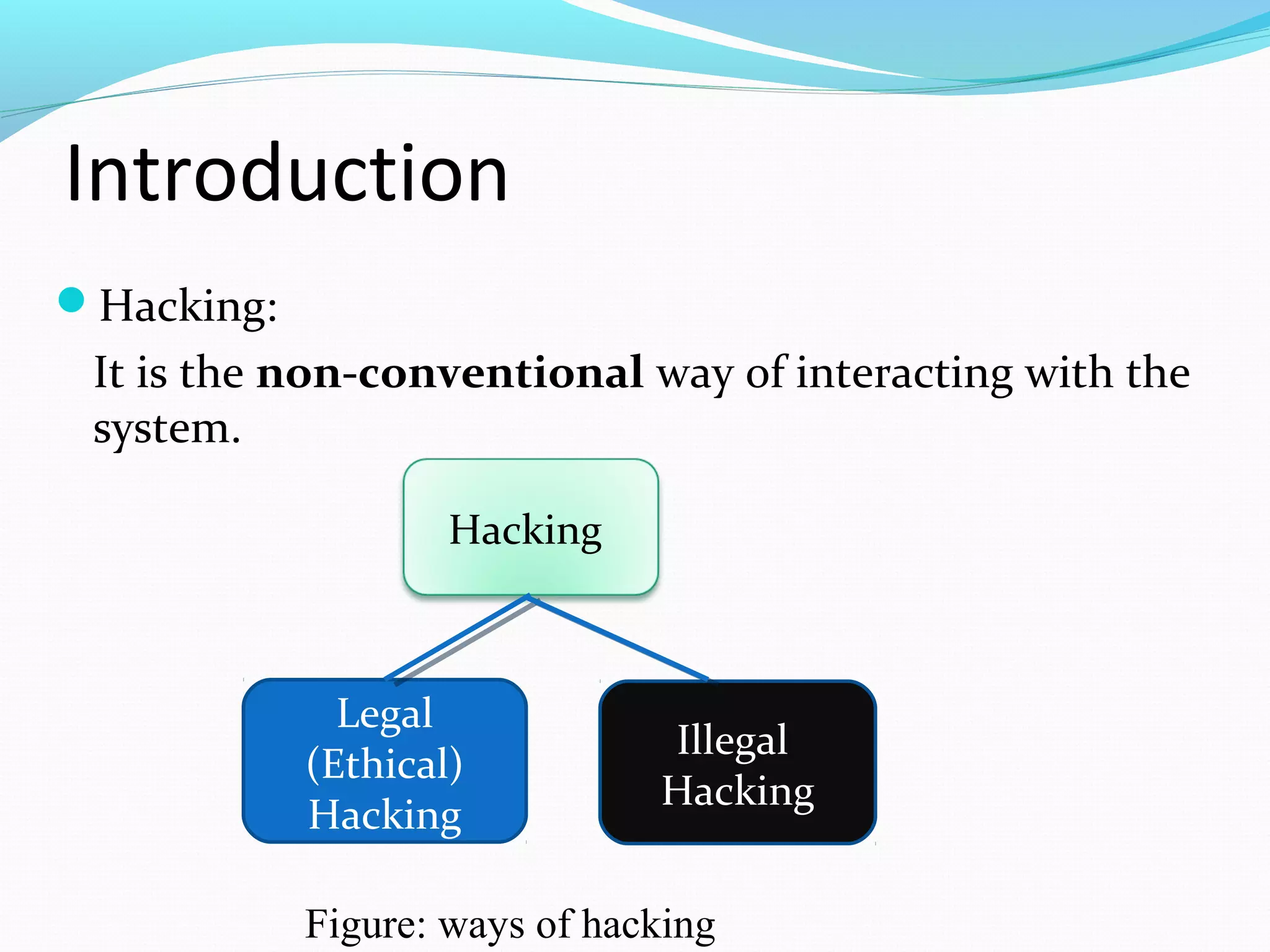
Hacking:
It is the non-conventional way of interacting with the
system.
Legal
(Ethical)
Hacking
Illegal
Hacking
Hacking
Figure: ways of hacking
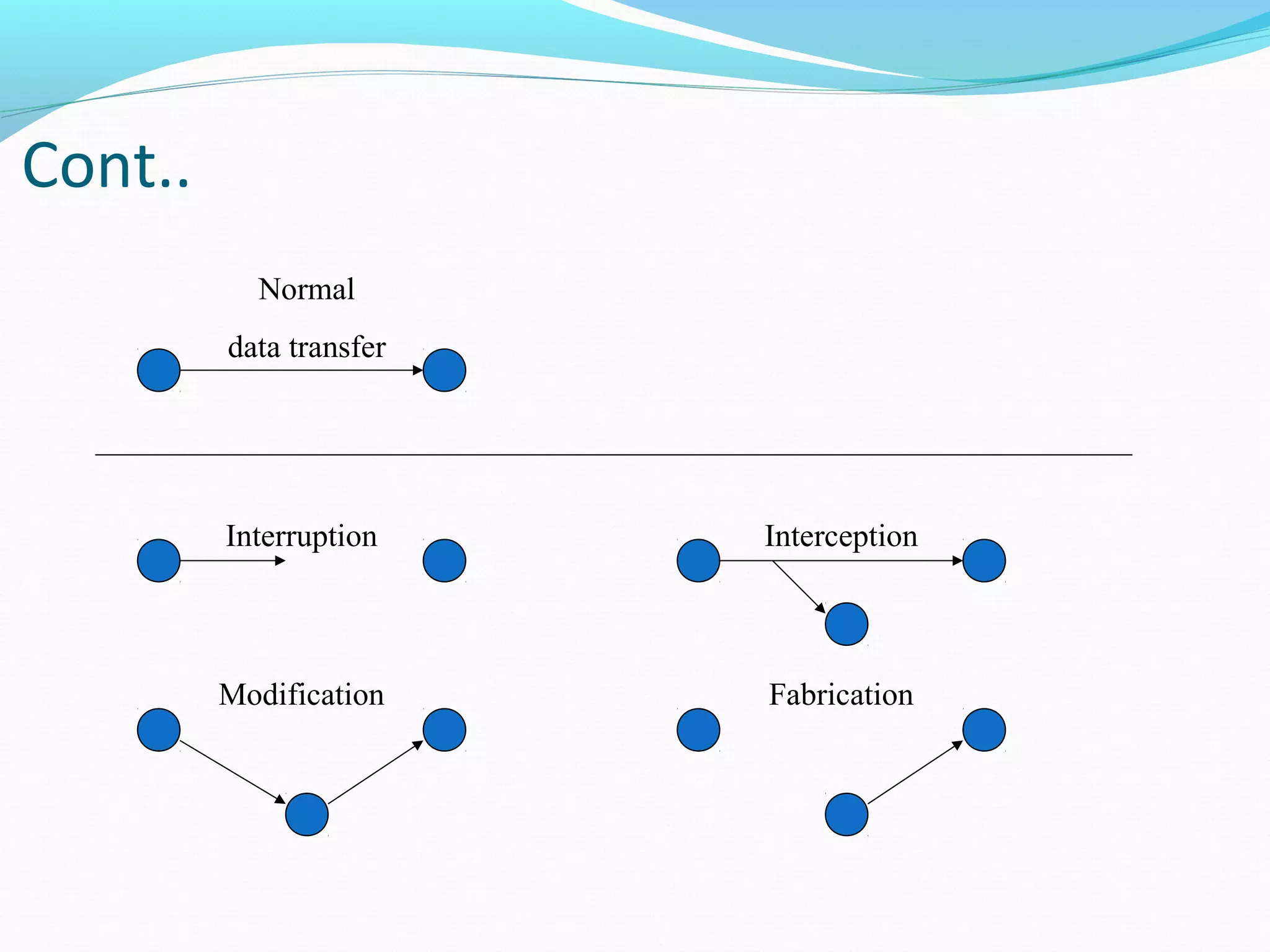
Normal
data transfer
Interruption Interception
Modification Fabrication
Cont..
Interruption: An asset of the system is destroyed or
becomes unavailable or unusable. This is an attack on the
availability.
Interception: Information disclosure/information
leakage. An unauthorized party gains access to an asset.
This is an attack on confidentiality.
Fabrication: An unauthorized party inserts
counterfeit objects into the system. This is an attack
on the authenticity.
Modification: modifying the content of a message being
transmitted in a network which leads integrity violation.
Cont..
Neither damage the target systems nor steal information.
Evaluate target systems security and report back to
owners about the vulnerabilities found.
Ethical Hacking is used in closing the open holes.
An ethical hacker is a computer and networking expert
who systematically attempts to penetrate a computer
system or network on behalf of its owners for the
purpose of finding security vulnerabilities that a
malicious hacker could potentially exploit.
Ethical Hacking:
A hacker is an individual who uses computer,
networking or other skills to overcome a technical
problem.(Good guys)
A person who uses his or her abilities to gain
unauthorized access to systems or networks in order
to commit crimes.(Bad guys)
Hackers:
Types of Hackers
I. Black Hat Hacker
II. White Hat Hacker
III. Grey Hat Hacker
I. Black Hat Hacker
 A black hat hackers or crackers are individuals
with extraordinary computing skills, They use their
knowledge and skill for their own personal gains
probably by hurting others.
II. White Hat Hacker
 White hat hackers are those individuals professing hacker
skills and using them for defensive purposes.
 use their knowledge and skill for the good of others and for
the common good.
Cont..
Cont..
III. Grey Hat Hacker
 These are individuals who work both offensively
and defensively at various times.
 We cannot predict their behavior.
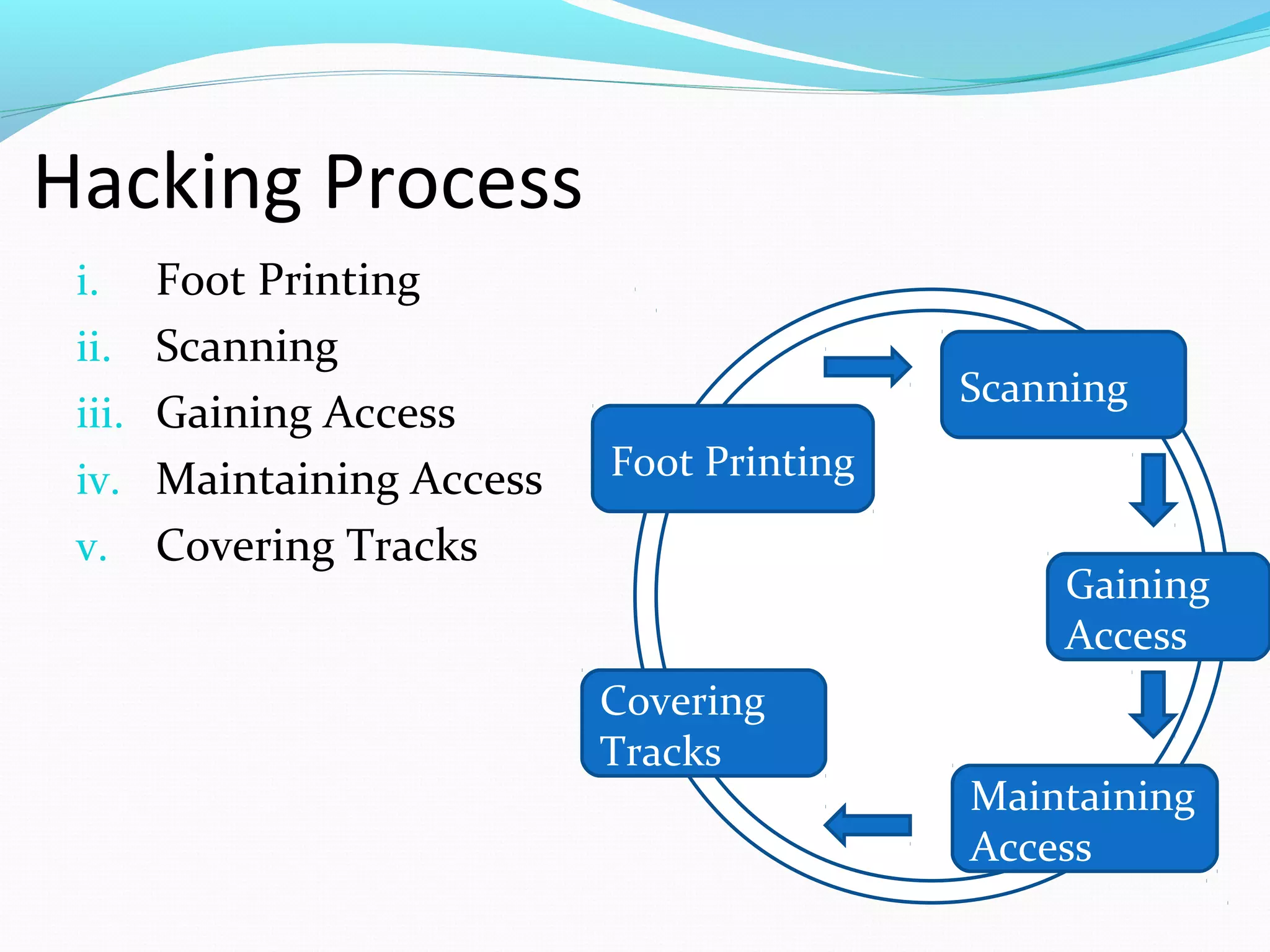
i. Foot Printing
ii. Scanning
iii. Gaining Access
iv. Maintaining Access
v. Covering Tracks
Hacking Process
Foot Printing
Scanning
Gaining
Access
Maintaining
Access
Covering
Tracks
i. Foot Printing:
Collecting as much information about target such as
DNS servers, Administrative contact and problem
revealed by administrative.
ii. Scanning:
Collecting information by Port Scanning, Network
Scanning, Finger Printing, etc. Example: SNMP
Scanner.
iii. Gaining Access:
Enough data has been gathered at this point for
attempt to access the target. Techniques are
password eavesdropping, buffer overflow, etc.
Cont..
Cont..
iv. Maintaining Access:
 Once a hacker has gained access, they want to keep
that access for future exploitation and attacks.
 Once the hacker owns the system, they can use it as a
base to launch additional attacks(eg. Trojans)
v. Covering Tracks:
 Once hackers have been able to gain and maintain
access, they cover their tracks to avoid detection by
security personnel, to continue to use the owned
system, to remove evidence of hacking, or to avoid
legal action.
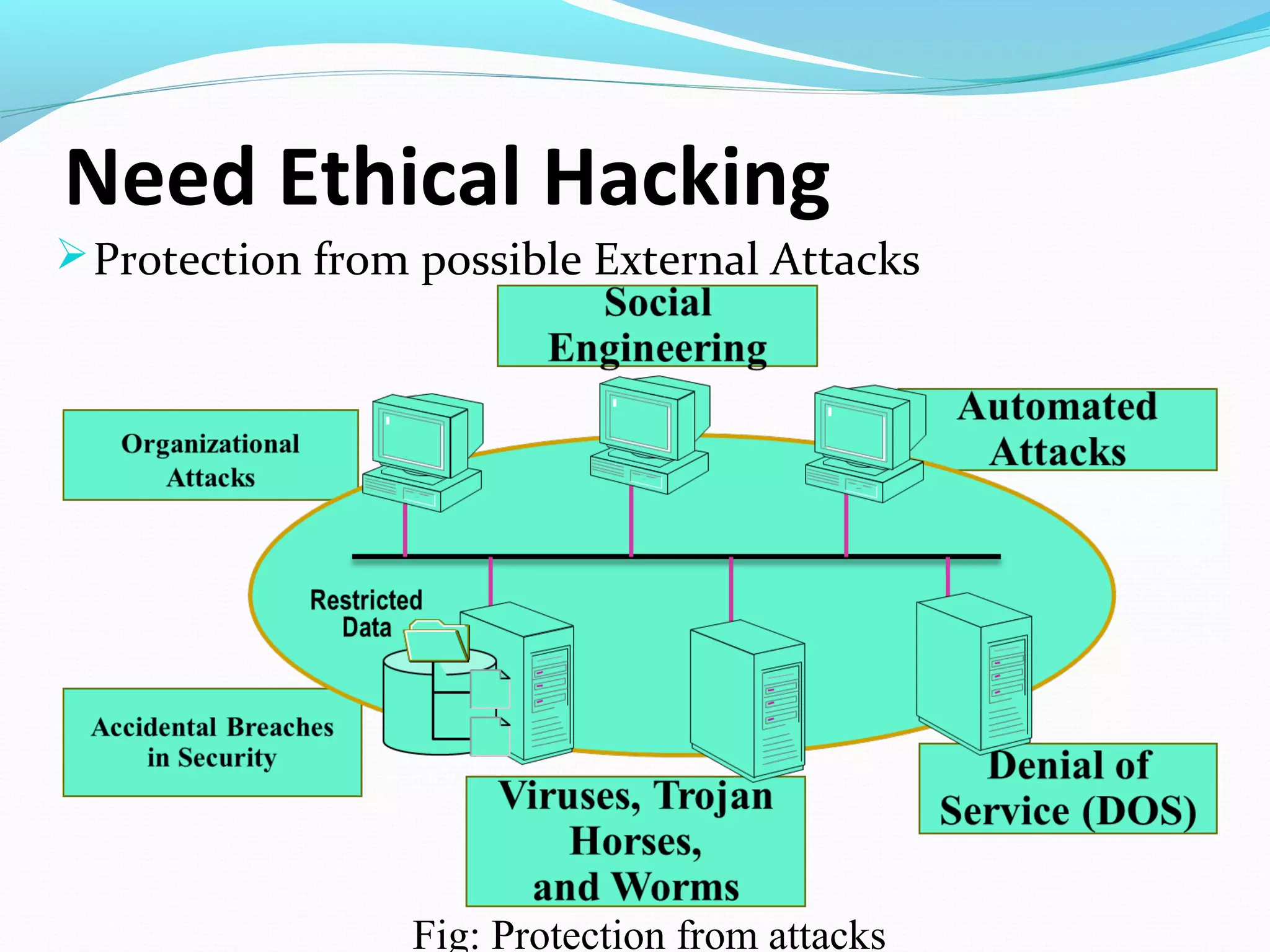
Protection from possible External Attacks
Need Ethical Hacking
Fig: Protection from attacks
Advantage:
To catch a thief -you have to think like a thief.
Helps in closing the open holes in the system network
Prevents website defacements
Provides high security to banking and financial
establishments.
Disadvantage:
All depends upon the trustworthiness of the ethical
hacker.
Hiring professionals is expensive.
References:
[1] Ethical Hacking and Systems Defense: National
CyberWatch Center Edition by Sean-Philip
Oriyano,Edition: 1st/2016.
[2] www.wikipedia.com
[3] https://www.simplilearn.com/roles-of-ethical-hacker-article
Accessed on 13/03/2018/6 :00 PM
Ethical hacking

Ethical hacking

  • 2.
    Contents: Introduction Ethical Hacking Hackers Types ofHackers Hacking Process Why do We need Ethical Hacking Advantages Disadvantages References
  • 3.
    Introduction Hacking: It is thenon-conventional way of interacting with the system. Legal (Ethical) Hacking Illegal Hacking Hacking Figure: ways of hacking
  • 4.
  • 5.
    Interruption: An assetof the system is destroyed or becomes unavailable or unusable. This is an attack on the availability. Interception: Information disclosure/information leakage. An unauthorized party gains access to an asset. This is an attack on confidentiality. Fabrication: An unauthorized party inserts counterfeit objects into the system. This is an attack on the authenticity. Modification: modifying the content of a message being transmitted in a network which leads integrity violation. Cont..
  • 6.
    Neither damage thetarget systems nor steal information. Evaluate target systems security and report back to owners about the vulnerabilities found. Ethical Hacking is used in closing the open holes. An ethical hacker is a computer and networking expert who systematically attempts to penetrate a computer system or network on behalf of its owners for the purpose of finding security vulnerabilities that a malicious hacker could potentially exploit. Ethical Hacking:
  • 7.
    A hacker isan individual who uses computer, networking or other skills to overcome a technical problem.(Good guys) A person who uses his or her abilities to gain unauthorized access to systems or networks in order to commit crimes.(Bad guys) Hackers:
  • 8.
    Types of Hackers I.Black Hat Hacker II. White Hat Hacker III. Grey Hat Hacker
  • 9.
    I. Black HatHacker  A black hat hackers or crackers are individuals with extraordinary computing skills, They use their knowledge and skill for their own personal gains probably by hurting others. II. White Hat Hacker  White hat hackers are those individuals professing hacker skills and using them for defensive purposes.  use their knowledge and skill for the good of others and for the common good. Cont..
  • 10.
    Cont.. III. Grey HatHacker  These are individuals who work both offensively and defensively at various times.  We cannot predict their behavior.
  • 11.
    i. Foot Printing ii.Scanning iii. Gaining Access iv. Maintaining Access v. Covering Tracks Hacking Process Foot Printing Scanning Gaining Access Maintaining Access Covering Tracks
  • 12.
    i. Foot Printing: Collectingas much information about target such as DNS servers, Administrative contact and problem revealed by administrative. ii. Scanning: Collecting information by Port Scanning, Network Scanning, Finger Printing, etc. Example: SNMP Scanner. iii. Gaining Access: Enough data has been gathered at this point for attempt to access the target. Techniques are password eavesdropping, buffer overflow, etc. Cont..
  • 13.
    Cont.. iv. Maintaining Access: Once a hacker has gained access, they want to keep that access for future exploitation and attacks.  Once the hacker owns the system, they can use it as a base to launch additional attacks(eg. Trojans) v. Covering Tracks:  Once hackers have been able to gain and maintain access, they cover their tracks to avoid detection by security personnel, to continue to use the owned system, to remove evidence of hacking, or to avoid legal action.
  • 14.
    Protection from possibleExternal Attacks Need Ethical Hacking Fig: Protection from attacks
  • 15.
    Advantage: To catch athief -you have to think like a thief. Helps in closing the open holes in the system network Prevents website defacements Provides high security to banking and financial establishments.
  • 16.
    Disadvantage: All depends uponthe trustworthiness of the ethical hacker. Hiring professionals is expensive.
  • 17.
    References: [1] Ethical Hackingand Systems Defense: National CyberWatch Center Edition by Sean-Philip Oriyano,Edition: 1st/2016. [2] www.wikipedia.com [3] https://www.simplilearn.com/roles-of-ethical-hacker-article Accessed on 13/03/2018/6 :00 PM

Editor's Notes

  • #4 Conventional way is: opening word files by clicking the GUI. NON-Conventional way : opening the word file by Linux Live CD.
  • #5 Interruption: An asset of the system is destroyed or becomes unavailable or unusable. This is an attack on the availability. Interception: Information disclosure/information leakage. An unauthorized party gains access to an asset. This is an attack on confidentiality. Fabrication: An unauthorized party inserts counterfeit objects into the system. This is an attack on the authenticity. Modification: modifying the content of a message being transmitted in a network which leads integrity violation.
  • #11 Sometimes they use their skills for the common good while in some other times he uses them for their personal gains.