ETHICAL HACKING
BY : DAX J RAJANI
Introduction
• Hacker – is a person with excellent computer skills,
with the ability to create and explore the computer
software and hardware. Ethical hacking – is the use
of hacking tools and tricks to identify vulnerabilities
so as to ensure the system security.
The purpose of ETHICAL HACKING
• The purpose of ethical hacking is to evaluate the
security of and identify vulnerabilities in systems,
networks or system infrastructure. It includes finding
and attempting to exploit any vulnerabilities to
determine whether unauthorized access or other
malicious activities are possible.
TYPE OF HACKER
• There are THREE types of hacker.
1. Black-Hat hacker
2. White-Hat hacker
3. Grey-Hat hackers
1. Black-Hat hacker
• A black hat hacker is a person who attempts to find
computer security vulnerabilities and exploit them
for personal financial gain or other malicious
reasons.
• Black hat hacker are illegal.
2. White-Hat hacker
• A white hat hacker is a computer security specialist
who breaks into protected systems and networks to
test and asses their security. White hat hackers use
their skills to improve security by exposing
vulnerabilities before black hat hackers can detect
and exploit them.
• White hat hacker are legal.
3. Grey-Hat hackers
• Grey hat hacker is the combination of White hat
hacker and Black hat hacker.
• Grey hat hacker are legal and illegal that depends on
their hacking purpose.
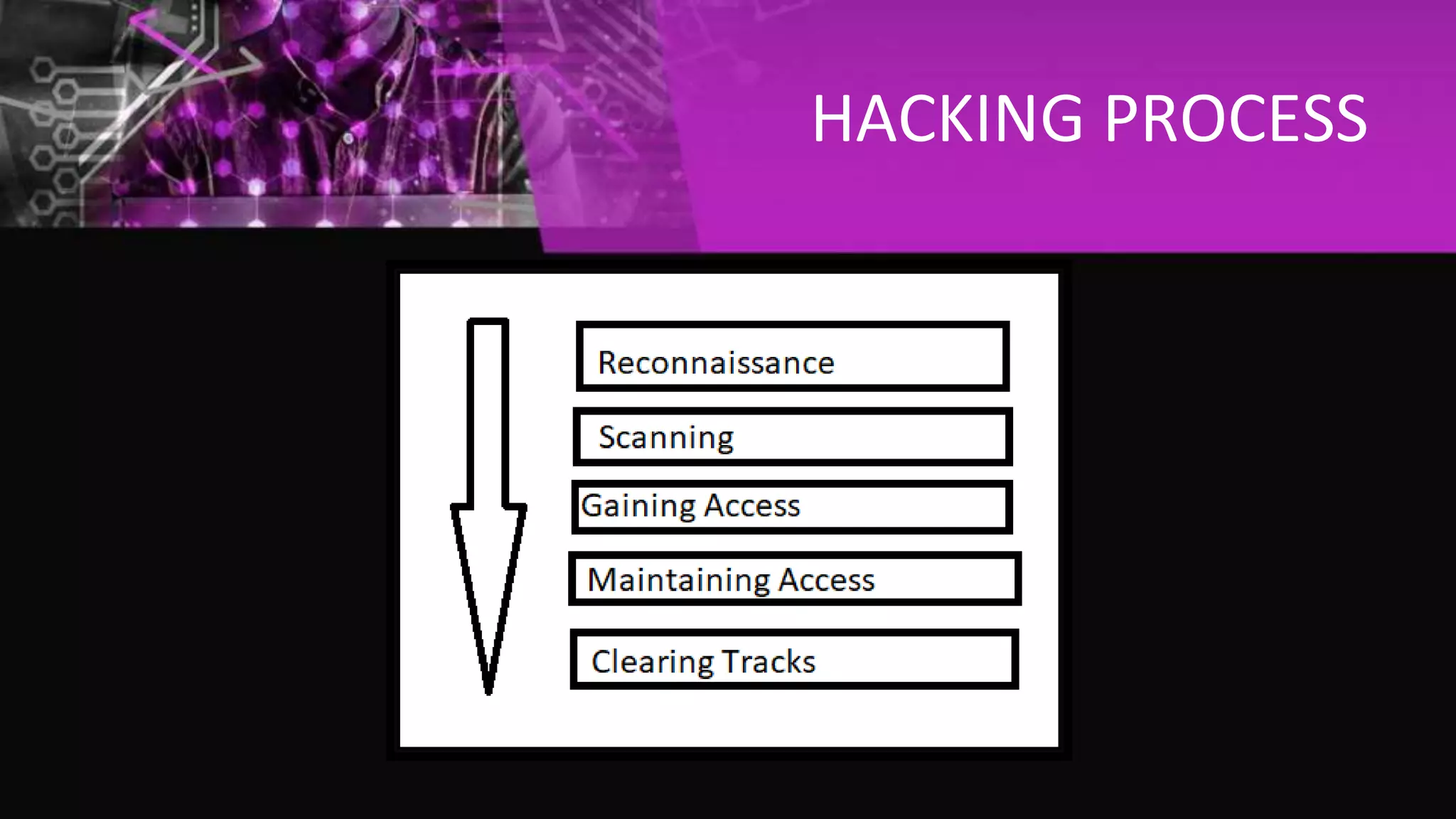
HACKING PROCESS
1. Reconnaissance
• This is the first step of Hacking. It is also called as
Footprinting and information gathering Phase. This is the
preparatory phase where we collect as much information
as possible about the target. We usually collect
information about three groups,
1. Host
2. People involved
3. Network
2. Scanning
• Three types of scanning are involved:
1. Port scanning: This phase involves scanning the target for the
information like open ports, Live systems, various services running on
the host.
2. Vulnerability Scanning: Checking the target for weaknesses or
vulnerabilities which can be exploited. Usually done with help of
automated tools
3. Network Mapping: Finding the topology of network, routers, firewalls
servers if any, and host information and drawing a network diagram with
the available information. This map may serve as a valuable piece of
information throughout the haking process.
3. Gaining Access
• This phase is where an attacker breaks into the
system/network using various tools or methods.
After entering into a system, he has to increase his
privilege to administrator level so he can install an
application he needs or modify data or hide data.
4. Maintaining Access
• Hacker may just hack the system to show it was
vulnerable or he can be so mischievous that he wants to
maintain or persist the connection in the background
without the knowledge of the user. This can be done
using Trojans, Rootkits or other malicious files. The aim is
to maintain the access to the target until he finishes the
tasks he planned to accomplish in that target.
5. Clearing Track
• No thief wants to get caught. An intelligent hacker
always clears all evidence so that in the later point of
time, no one will find any traces leading to him. This
involves modifying/corrupting/deleting the values of
Logs, modifying registry values and uninstalling all
applications he used and deleting all folders he
created.
Required skills of an ethical hacker
• An ethical hacker must be a computer systems
expert and needs to have very strong programming
and computer networking skills. An ethical
hacker needs to have a lot of patience, persistence,
and perseverance to try again and again and wait for
the required result.
Career in ETHICAL HACKING
• There are so much opportunities in ethical hacking.
• The average salary of a Certified Ethical Hacker is
around Rs. 3.5 lakh.
• According to CISO, the annual salary of ethical
hackers is averages Rs 570,000.
• So we can say that career in ethical hacking is soo
bright
Reference
● www.google.com
● www.wikipedia.com
● www.geeksforgeeks.org
THANK YOU

ethical hacking.pptx

  • 1.
  • 2.
    Introduction • Hacker –is a person with excellent computer skills, with the ability to create and explore the computer software and hardware. Ethical hacking – is the use of hacking tools and tricks to identify vulnerabilities so as to ensure the system security.
  • 3.
    The purpose ofETHICAL HACKING • The purpose of ethical hacking is to evaluate the security of and identify vulnerabilities in systems, networks or system infrastructure. It includes finding and attempting to exploit any vulnerabilities to determine whether unauthorized access or other malicious activities are possible.
  • 4.
    TYPE OF HACKER •There are THREE types of hacker. 1. Black-Hat hacker 2. White-Hat hacker 3. Grey-Hat hackers
  • 5.
    1. Black-Hat hacker •A black hat hacker is a person who attempts to find computer security vulnerabilities and exploit them for personal financial gain or other malicious reasons. • Black hat hacker are illegal.
  • 6.
    2. White-Hat hacker •A white hat hacker is a computer security specialist who breaks into protected systems and networks to test and asses their security. White hat hackers use their skills to improve security by exposing vulnerabilities before black hat hackers can detect and exploit them. • White hat hacker are legal.
  • 7.
    3. Grey-Hat hackers •Grey hat hacker is the combination of White hat hacker and Black hat hacker. • Grey hat hacker are legal and illegal that depends on their hacking purpose.
  • 8.
  • 9.
    1. Reconnaissance • Thisis the first step of Hacking. It is also called as Footprinting and information gathering Phase. This is the preparatory phase where we collect as much information as possible about the target. We usually collect information about three groups, 1. Host 2. People involved 3. Network
  • 10.
    2. Scanning • Threetypes of scanning are involved: 1. Port scanning: This phase involves scanning the target for the information like open ports, Live systems, various services running on the host. 2. Vulnerability Scanning: Checking the target for weaknesses or vulnerabilities which can be exploited. Usually done with help of automated tools 3. Network Mapping: Finding the topology of network, routers, firewalls servers if any, and host information and drawing a network diagram with the available information. This map may serve as a valuable piece of information throughout the haking process.
  • 11.
    3. Gaining Access •This phase is where an attacker breaks into the system/network using various tools or methods. After entering into a system, he has to increase his privilege to administrator level so he can install an application he needs or modify data or hide data.
  • 12.
    4. Maintaining Access •Hacker may just hack the system to show it was vulnerable or he can be so mischievous that he wants to maintain or persist the connection in the background without the knowledge of the user. This can be done using Trojans, Rootkits or other malicious files. The aim is to maintain the access to the target until he finishes the tasks he planned to accomplish in that target.
  • 13.
    5. Clearing Track •No thief wants to get caught. An intelligent hacker always clears all evidence so that in the later point of time, no one will find any traces leading to him. This involves modifying/corrupting/deleting the values of Logs, modifying registry values and uninstalling all applications he used and deleting all folders he created.
  • 14.
    Required skills ofan ethical hacker • An ethical hacker must be a computer systems expert and needs to have very strong programming and computer networking skills. An ethical hacker needs to have a lot of patience, persistence, and perseverance to try again and again and wait for the required result.
  • 15.
    Career in ETHICALHACKING • There are so much opportunities in ethical hacking. • The average salary of a Certified Ethical Hacker is around Rs. 3.5 lakh. • According to CISO, the annual salary of ethical hackers is averages Rs 570,000. • So we can say that career in ethical hacking is soo bright
  • 16.
  • 17.