



Unlearning Ethics
“Received Wisdom” and
Principle-Based Ethics
By Sam Knapp, EdD ABPP and John Gavazzi, PsyD, ABPP
June 2013 – Pennsylvania Psychological Association
www.papsyblog.org
More on ethics education
Great resource
Course Objectives
• List common beliefs that are not based on
overarching ethical principles
• Describe the methodology to be used to identify
false or unhelpful ethical or risk management
principles
General Outline
• Acculturation Model
• Three simple strategies
• Principle-based ethics
• Unhealthy or Unhelpful Strategies
General Outline
• The Unlearning Experience**
• Examples of “Received Wisdom”**
**This is the time for the most group interaction.
However, we want to make this fun and
informative, so feel free to contribute at any time
during the presentation.
Participant Safety
• Creating a safe environment
• Avoid the word “unethical”
• We are all learning in this process
• Demonstrate courtesy and respect for others
Exercises
Handout 1: The Dumb Exercise
Handout 2: Wisdom to contemplate
I. An Acculturation Model
One way of remaining a life-long
learner
Provides another way to discuss ethical
behaviors and decisions
Acculturation
A process to change the cultural behavior of an
individual through contact with another culture.
The process of acculturation occurs when there is
an adaptation into an organization or society.
Ethics Acculturation Model
• An outgrowth of positive ethics that integrates
personal ethics and professional obligations.
• Psychology has a system of shared and
distinctive norms, beliefs, and traditions.
• This set of beliefs is reflected in our ethics code.
Acculturation as a Process
• Can be a complex process
• Some parts of a psychologist’s practice and
lifestyle may be easily acculturated while
others not
• Process that will likely continue throughout
the education or career as a psychologist
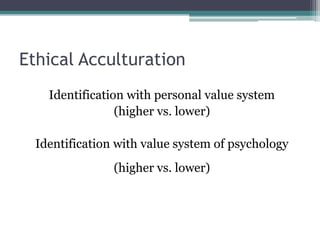
Ethical Acculturation
Identification with personal value system
(higher vs. lower)
Identification with value system of psychology
(higher vs. lower)
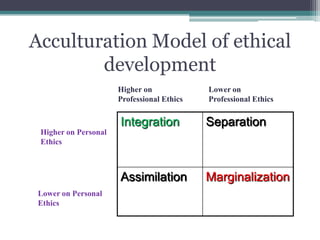
Acculturation Model of ethical
development
Integration Separation
Assimilation Marginalization
Higher on
Professional Ethics
Higher on Personal
Ethics
Lower on Personal
Ethics
Lower on
Professional Ethics
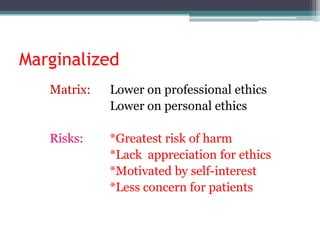
Marginalized
Matrix: Lower on professional ethics
Lower on personal ethics
Risks: *Greatest risk of harm
*Lack appreciation for ethics
*Motivated by self-interest
*Less concern for patients
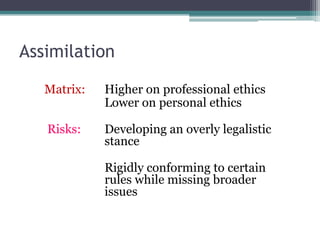
Assimilation
Matrix: Higher on professional ethics
Lower on personal ethics
Risks: Developing an overly legalistic
stance
Rigidly conforming to certain
rules while missing broader
issues
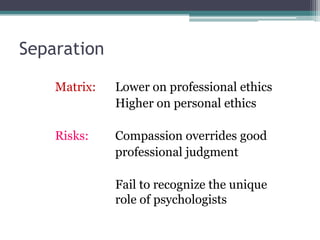
Separation
Matrix: Lower on professional ethics
Higher on personal ethics
Risks: Compassion overrides good
professional judgment
Fail to recognize the unique
role of psychologists
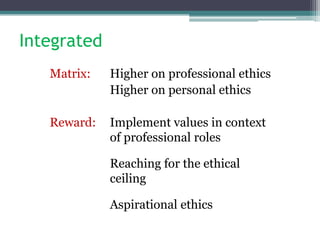
Integrated
Matrix: Higher on professional ethics
Higher on personal ethics
Reward: Implement values in context
of professional roles
Reaching for the ethical
ceiling
Aspirational ethics
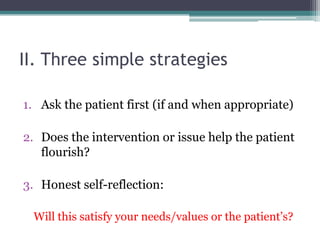
II. Three simple strategies
1. Ask the patient first (if and when appropriate)
2. Does the intervention or issue help the patient
flourish?
3. Honest self-reflection:
Will this satisfy your needs/values or the patient’s?
Autonomy
Beneficence
Nonmaleficence
Fidelity
Justice
III. Principle-Based Ethics
Respect for Autonomy
• Does not mean promoting autonomy
(individuation or separation)
• Means respecting the autonomous decision
making ability of the patient
Autonomy
• It encompasses freedom of thought and action.
• Individuals are at liberty to behave as they
chose.
- Determining goals in therapy
- Making life decisions (e.g., marriage, divorce)
- Scheduling appointments and terminating treatment
Autonomy & Consent
Foundational Standard 3.10
“When psychologists conduct research or provide
assessment, therapy, counseling or consulting
services in person or via electronic transmission
or other forms of communication, they obtain the
informed consent of the individual or individuals
using language that is reasonably understandable
to that person ……”
Beneficence
• The principle of benefiting others and accepting
the responsibility to do good underlies the
profession.
- Providing the best treatment possible
- Competency
- Referring when needed
Beneficence
Basis of foundational standard 2.01
“Psychologists provide services, teach, and
conduct research with populations and in areas
only within the boundaries of their competence.”
Nonmaleficence
The principle is doing no harm.
- Demonstrating competence
- Maintaining appropriate boundaries
- Not using an experimental technique as the
first line of treatment
- Providing benefits, risks, and costs
Nonmaleficence
Foundational Standard 3.04
“Psychologists take reasonable steps to avoid
harming their clients/patients, students,
supervisees, research participants,
organizational clients, and others with whom
they work, and to minimize harm when it is
foreseeable and unavoidable.”
Fidelity
This principle refers to being faithful to
commitments. Fidelity includes promise
keeping, trustworthiness, and loyalty.
- Avoiding conflicts of interests that could
compromise therapy
- Keeping information confidential
- Adhering to therapeutic contract (e.g.,
session length, time, phone contacts, etc.)
Fidelity
Foundational Standard 4.01
“Psychologists have a primary obligation and take
reasonable precautions to protect confidential
information.”
Justice
Justice primarily refers to treating people fairly
and equally.
In their work-related activities, psychologists do not
engage in unfair discrimination based on age, gender,
gender identity, race, ethnicity, culture, national origin,
religion, sexual orientation, disability, socioeconomic
status, or any basis proscribed by law. (3.01)
IV. Unhealthy or Unhelpful
Strategies
These strategies can be readily tied
back into the Acculturation Model
and Principle-based Ethics
Unhealthy or Unhelpful Strategies
• Overemphasis on rules or The Code
• Interpreting rules without understanding
overarching ethical principles
• Setting a low bar for professional behavior
Unhealthy or Unhelpful Strategies
• Intrusive advocacy
• Lack of understanding boundaries and the
“therapeutic frame”
• Allowing personal values to trump professional
boundaries (without self-reflection and/or
consultation)
V. The Unlearning Exercise
10 examples of “Received
Wisdom” that may not be so wise
VI. What about the following
examples of “Received Wisdom”?
More Group Discussion
Informed Consent
• Informed consent only occurs at the beginning
of treatment
• Informed consent mainly involves the patient to
sign forms for risk management purposes
Self-disclosure
• Self-disclosure is never appropriate by the
psychologist during psychotherapy or
assessment
• Self-disclosure is clearly a boundary violation
that is always wrong
Psychotropic medication
• Psychologists cannot talk with patients about
medication.
• Technically, it is practicing medicine without a
license.
Suicidal & Homicidal Patients
• When dealing with high risk patients, it is better
to not document a great deal of information.
• If you do not document much detail, then you
have greater legal protection from an attorney
indicating that you did something wrong.
Attorneys can twist words easily, so the less the
better.
No suicide contract
• This is an important risk management strategy
• This is the standard of care
• This strategy helps the patient from actually
harming him or herself.
Always give 3 names when referring a
person for treatment
• It is the standard of care.
• Co-pay, insurance, ability to access the referral is
immaterial.
• Relationship with the patient or referral is not a
high priority
Never talk with patients about religion
• Psychotherapy is like other polite conversations,
so it is improper to talk about religion.
• Psychologists are not sufficiently trained in
religious matters.
• The best strategy is to refer patients to their
priest, pastor, rabbi or spiritual guide
HIPAA applies in every situation
• HIPAA applies to pre-employment evaluations
• HIPAA applies to security evaluations.
• HIPAA applies to fitness for duty evaluations.
• What about forensic evaluations?
If you have not been investigated,
then you are acting ethically.
• Only people engaging in marginalized behavior
get caught. Therefore, if I am not being
investigated, my behavior must be appropriate.
• I follow all the rules strictly, therefore, I must be
acting ethically.
If you know of another psychologist
engaging in marginalized behavior,
then it is best to not do anything.
• Someone else should bring it up
• “I am not supervising the psychologist, so I cannot
bring it up.”
Other pearls of wisdom that
seem sketchy?
Other ethical dilemmas?
Questions and Answers
Complete course evaluations

Unlearning Ethics

  • 1.
    Unlearning Ethics “Received Wisdom”and Principle-Based Ethics By Sam Knapp, EdD ABPP and John Gavazzi, PsyD, ABPP June 2013 – Pennsylvania Psychological Association
  • 2.
    www.papsyblog.org More on ethicseducation Great resource
  • 3.
    Course Objectives • Listcommon beliefs that are not based on overarching ethical principles • Describe the methodology to be used to identify false or unhelpful ethical or risk management principles
  • 4.
    General Outline • AcculturationModel • Three simple strategies • Principle-based ethics • Unhealthy or Unhelpful Strategies
  • 5.
    General Outline • TheUnlearning Experience** • Examples of “Received Wisdom”** **This is the time for the most group interaction. However, we want to make this fun and informative, so feel free to contribute at any time during the presentation.
  • 6.
    Participant Safety • Creatinga safe environment • Avoid the word “unethical” • We are all learning in this process • Demonstrate courtesy and respect for others
  • 7.
    Exercises Handout 1: TheDumb Exercise Handout 2: Wisdom to contemplate
  • 8.
    I. An AcculturationModel One way of remaining a life-long learner Provides another way to discuss ethical behaviors and decisions
  • 9.
    Acculturation A process tochange the cultural behavior of an individual through contact with another culture. The process of acculturation occurs when there is an adaptation into an organization or society.
  • 10.
    Ethics Acculturation Model •An outgrowth of positive ethics that integrates personal ethics and professional obligations. • Psychology has a system of shared and distinctive norms, beliefs, and traditions. • This set of beliefs is reflected in our ethics code.
  • 11.
    Acculturation as aProcess • Can be a complex process • Some parts of a psychologist’s practice and lifestyle may be easily acculturated while others not • Process that will likely continue throughout the education or career as a psychologist
  • 12.
    Ethical Acculturation Identification withpersonal value system (higher vs. lower) Identification with value system of psychology (higher vs. lower)
  • 13.
    Acculturation Model ofethical development Integration Separation Assimilation Marginalization Higher on Professional Ethics Higher on Personal Ethics Lower on Personal Ethics Lower on Professional Ethics
  • 14.
    Marginalized Matrix: Lower onprofessional ethics Lower on personal ethics Risks: *Greatest risk of harm *Lack appreciation for ethics *Motivated by self-interest *Less concern for patients
  • 15.
    Assimilation Matrix: Higher onprofessional ethics Lower on personal ethics Risks: Developing an overly legalistic stance Rigidly conforming to certain rules while missing broader issues
  • 16.
    Separation Matrix: Lower onprofessional ethics Higher on personal ethics Risks: Compassion overrides good professional judgment Fail to recognize the unique role of psychologists
  • 17.
    Integrated Matrix: Higher onprofessional ethics Higher on personal ethics Reward: Implement values in context of professional roles Reaching for the ethical ceiling Aspirational ethics
  • 18.
    II. Three simplestrategies 1. Ask the patient first (if and when appropriate) 2. Does the intervention or issue help the patient flourish? 3. Honest self-reflection: Will this satisfy your needs/values or the patient’s?
  • 19.
  • 20.
    Respect for Autonomy •Does not mean promoting autonomy (individuation or separation) • Means respecting the autonomous decision making ability of the patient
  • 21.
    Autonomy • It encompassesfreedom of thought and action. • Individuals are at liberty to behave as they chose. - Determining goals in therapy - Making life decisions (e.g., marriage, divorce) - Scheduling appointments and terminating treatment
  • 22.
    Autonomy & Consent FoundationalStandard 3.10 “When psychologists conduct research or provide assessment, therapy, counseling or consulting services in person or via electronic transmission or other forms of communication, they obtain the informed consent of the individual or individuals using language that is reasonably understandable to that person ……”
  • 23.
    Beneficence • The principleof benefiting others and accepting the responsibility to do good underlies the profession. - Providing the best treatment possible - Competency - Referring when needed
  • 24.
    Beneficence Basis of foundationalstandard 2.01 “Psychologists provide services, teach, and conduct research with populations and in areas only within the boundaries of their competence.”
  • 25.
    Nonmaleficence The principle isdoing no harm. - Demonstrating competence - Maintaining appropriate boundaries - Not using an experimental technique as the first line of treatment - Providing benefits, risks, and costs
  • 26.
    Nonmaleficence Foundational Standard 3.04 “Psychologiststake reasonable steps to avoid harming their clients/patients, students, supervisees, research participants, organizational clients, and others with whom they work, and to minimize harm when it is foreseeable and unavoidable.”
  • 27.
    Fidelity This principle refersto being faithful to commitments. Fidelity includes promise keeping, trustworthiness, and loyalty. - Avoiding conflicts of interests that could compromise therapy - Keeping information confidential - Adhering to therapeutic contract (e.g., session length, time, phone contacts, etc.)
  • 28.
    Fidelity Foundational Standard 4.01 “Psychologistshave a primary obligation and take reasonable precautions to protect confidential information.”
  • 29.
    Justice Justice primarily refersto treating people fairly and equally. In their work-related activities, psychologists do not engage in unfair discrimination based on age, gender, gender identity, race, ethnicity, culture, national origin, religion, sexual orientation, disability, socioeconomic status, or any basis proscribed by law. (3.01)
  • 30.
    IV. Unhealthy orUnhelpful Strategies These strategies can be readily tied back into the Acculturation Model and Principle-based Ethics
  • 31.
    Unhealthy or UnhelpfulStrategies • Overemphasis on rules or The Code • Interpreting rules without understanding overarching ethical principles • Setting a low bar for professional behavior
  • 32.
    Unhealthy or UnhelpfulStrategies • Intrusive advocacy • Lack of understanding boundaries and the “therapeutic frame” • Allowing personal values to trump professional boundaries (without self-reflection and/or consultation)
  • 33.
    V. The UnlearningExercise 10 examples of “Received Wisdom” that may not be so wise
  • 34.
    VI. What aboutthe following examples of “Received Wisdom”? More Group Discussion
  • 35.
    Informed Consent • Informedconsent only occurs at the beginning of treatment • Informed consent mainly involves the patient to sign forms for risk management purposes
  • 36.
    Self-disclosure • Self-disclosure isnever appropriate by the psychologist during psychotherapy or assessment • Self-disclosure is clearly a boundary violation that is always wrong
  • 37.
    Psychotropic medication • Psychologistscannot talk with patients about medication. • Technically, it is practicing medicine without a license.
  • 38.
    Suicidal & HomicidalPatients • When dealing with high risk patients, it is better to not document a great deal of information. • If you do not document much detail, then you have greater legal protection from an attorney indicating that you did something wrong. Attorneys can twist words easily, so the less the better.
  • 39.
    No suicide contract •This is an important risk management strategy • This is the standard of care • This strategy helps the patient from actually harming him or herself.
  • 40.
    Always give 3names when referring a person for treatment • It is the standard of care. • Co-pay, insurance, ability to access the referral is immaterial. • Relationship with the patient or referral is not a high priority
  • 41.
    Never talk withpatients about religion • Psychotherapy is like other polite conversations, so it is improper to talk about religion. • Psychologists are not sufficiently trained in religious matters. • The best strategy is to refer patients to their priest, pastor, rabbi or spiritual guide
  • 42.
    HIPAA applies inevery situation • HIPAA applies to pre-employment evaluations • HIPAA applies to security evaluations. • HIPAA applies to fitness for duty evaluations. • What about forensic evaluations?
  • 43.
    If you havenot been investigated, then you are acting ethically. • Only people engaging in marginalized behavior get caught. Therefore, if I am not being investigated, my behavior must be appropriate. • I follow all the rules strictly, therefore, I must be acting ethically.
  • 44.
    If you knowof another psychologist engaging in marginalized behavior, then it is best to not do anything. • Someone else should bring it up • “I am not supervising the psychologist, so I cannot bring it up.”
  • 45.
    Other pearls ofwisdom that seem sketchy? Other ethical dilemmas?
  • 46.