Introduction to Moral Injury


Theory and Practice
John D. Gavazzi, PsyD ABPP


TW Ponessa and Associates


March 19, 2021
www.ethicalpsychology.com
Course Objectives
At the end of the session, the participant will be able
to:


1. Describe the concept of moral injury;


2. Differentiate between moral injury and PTSD; and,


3. Explain how moral injury can be applied to
psychotherapy.
Outline
Biology & Morality


Morality and the Moral Self


Moral Injury: Defining Features


Moral Injury versus PTSD


Clinical Examples of Moral Injury
General Definition of Moral Injury
Moral Injury refers to longstanding emotional,
psychological, social, and spiritual suffering related
to an individual’s moral compass, conscience, or
spiritual beliefs.


Moral injury differs from Post-Traumatic Stress
Disorder (PTSD), but there are some overlaps.
General Definition of Moral Injury
Moral Injury begins to incorporate the concept of
the moral self within every human, which is not
typically the realm of psychology or mental health.


We all have moral aspects of our self. We all have
beliefs, morals, and value systems.


We need to delve into the concept of morality.
Moral Origins
Religions, Biology, & Psychology
Moral Origins: Religion
King James Version - Genesis 2:17


Adam and Eve were not to eat from tree of
knowledge of good and evil, lest they die.


Eating the fruit would give Adam and Eve the
wisdom of God (right & wrong; good & bad).


Ate fruit, felt moral emotions of shame and
embarrassment
Moral Origins: Religions
Morality occurred very quickly


Moral knowledge considered god-like


First moral emotions were negative (shame, guilt)


God became angry (from the moral transgression)


Existential crisis: They would die (and know it)
Moral Origins: Evolution
From a purely evolutionary perspective, morality is
a pre-human concept


Two pillars of morality found in nature


Caring


Reciprocity


Franz DeWaal found these characteristics in elephants,
chimpanzees, and other mammals (non-linguistic)
Moral Origins: Evolution
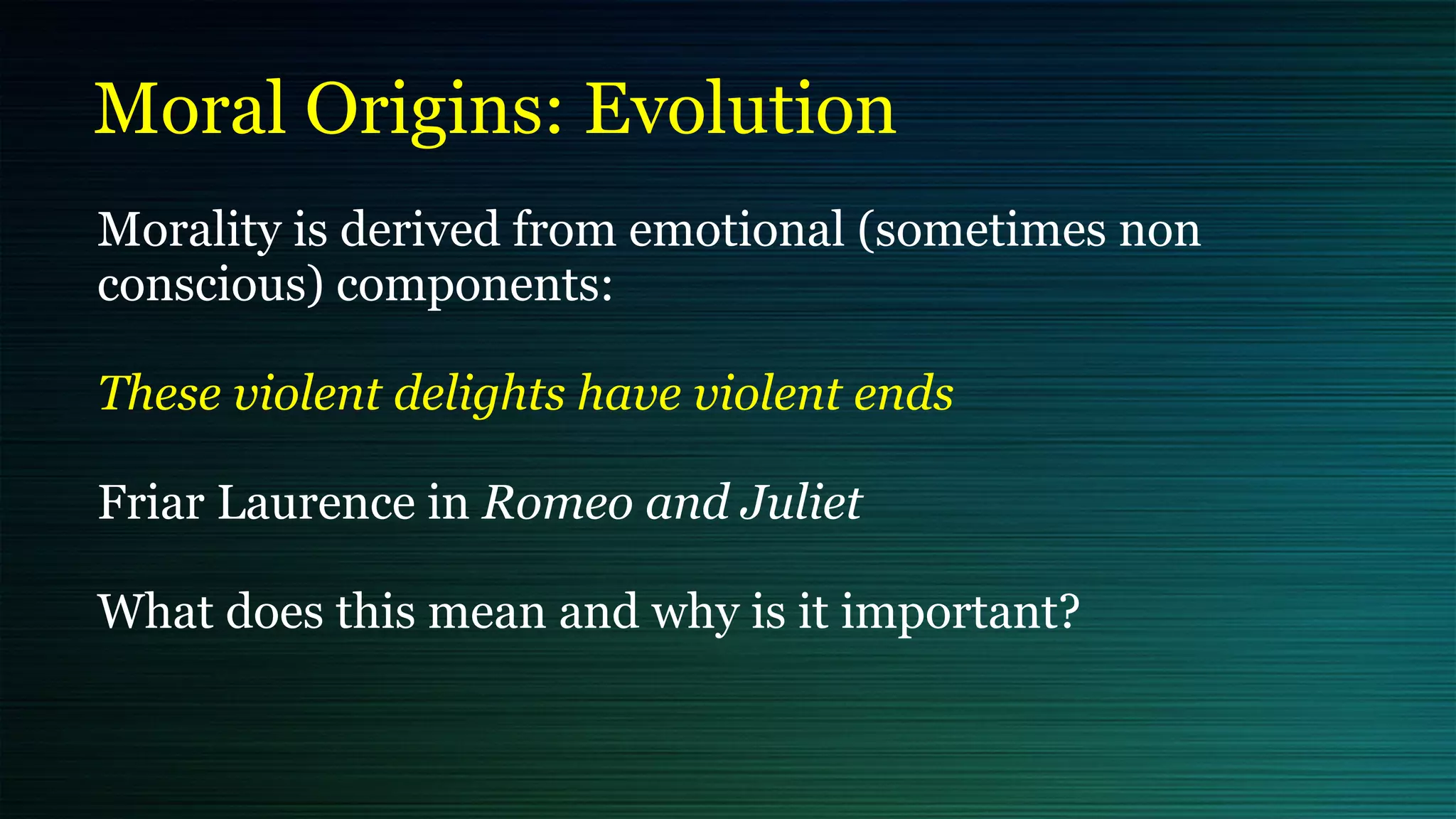
Morality is derived from emotional (sometimes non
conscious) components:


These violent delights have violent ends


Friar Laurence in Romeo and Juliet


What does this mean and why is it important?
Moral Origins: Evolution
Emotions can create attachments.


Attachments form the basis of cooperation and
tribalism.


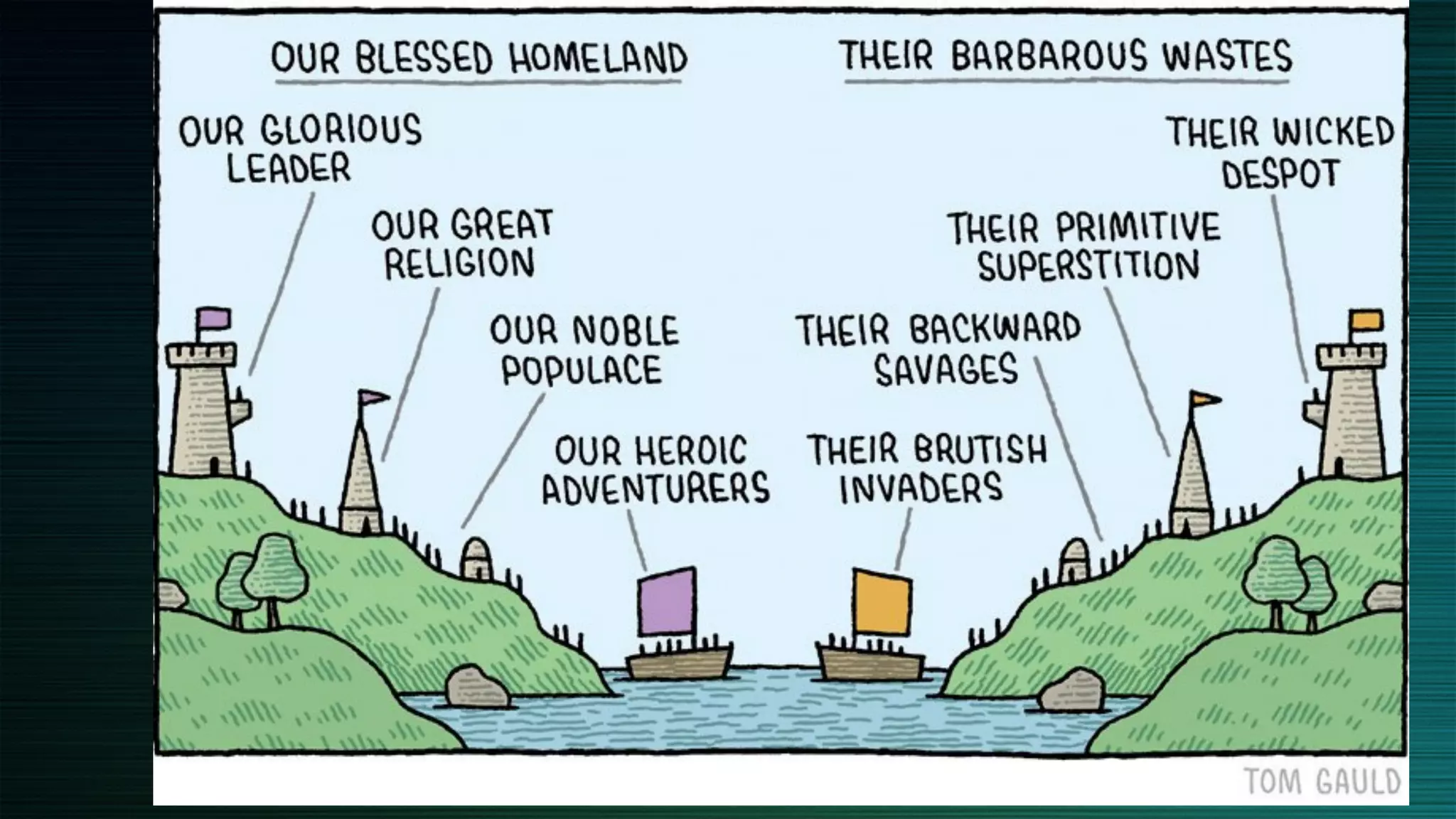
Tribalism creates in-groups and out-groups, which
form the basis of competition


In-group good; out-group bad
Moral Origins: Moral Brains
1. Reciprocity needs sufficient brain power to
determine if fair or not.


Many non-human primates and mammals can assess
fairness.


2. Humans are homo cooperatus, meaning that we
cooperate better than any other species on earth.
Moral Origins: Evolution
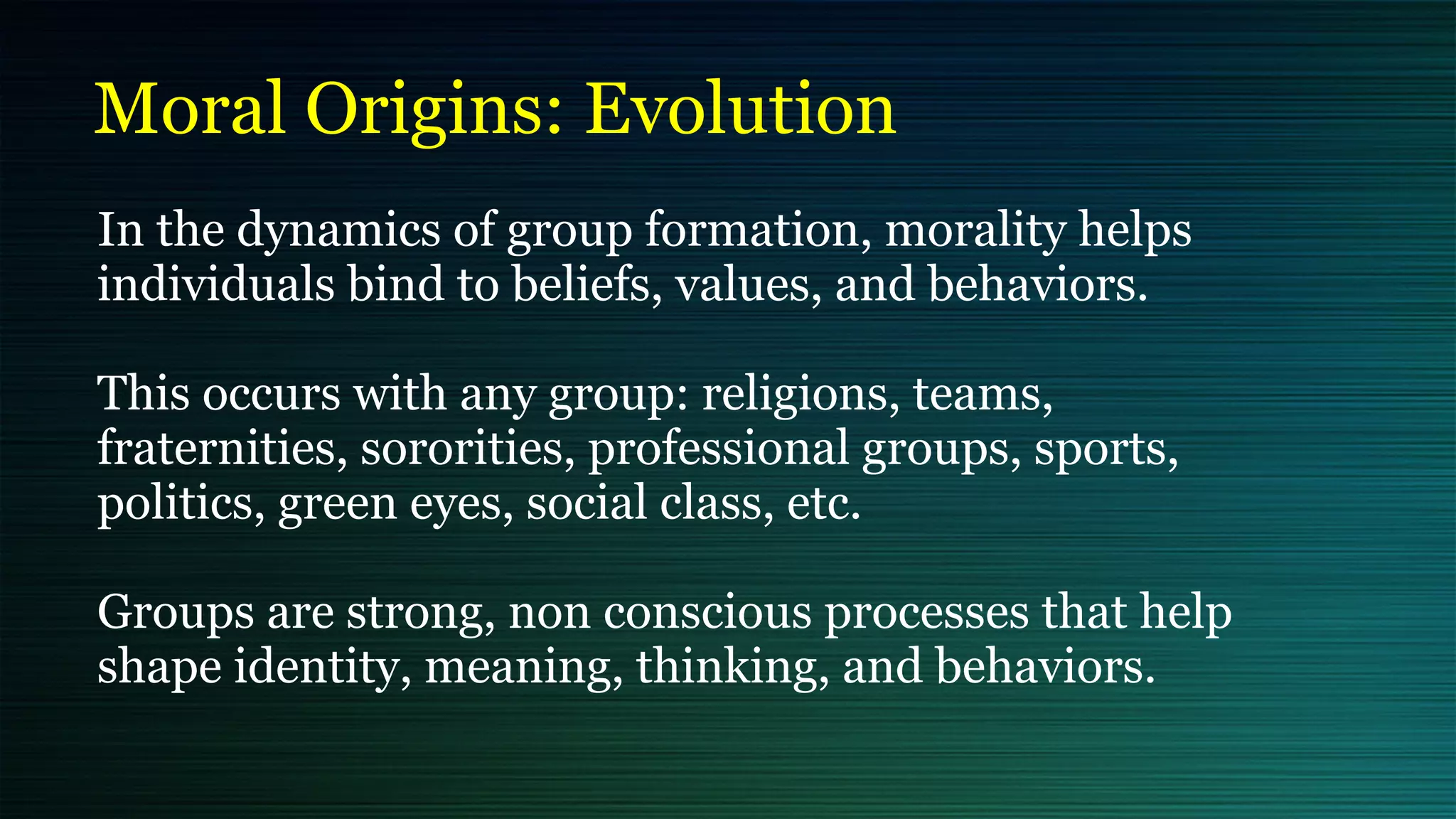
In the dynamics of group formation, morality helps
individuals bind to beliefs, values, and behaviors.


This occurs with any group: religions, teams,
fraternities, sororities, professional groups, sports,
politics, green eyes, social class, etc.


Groups are strong, non conscious processes that help
shape identity, meaning, thinking, and behaviors.
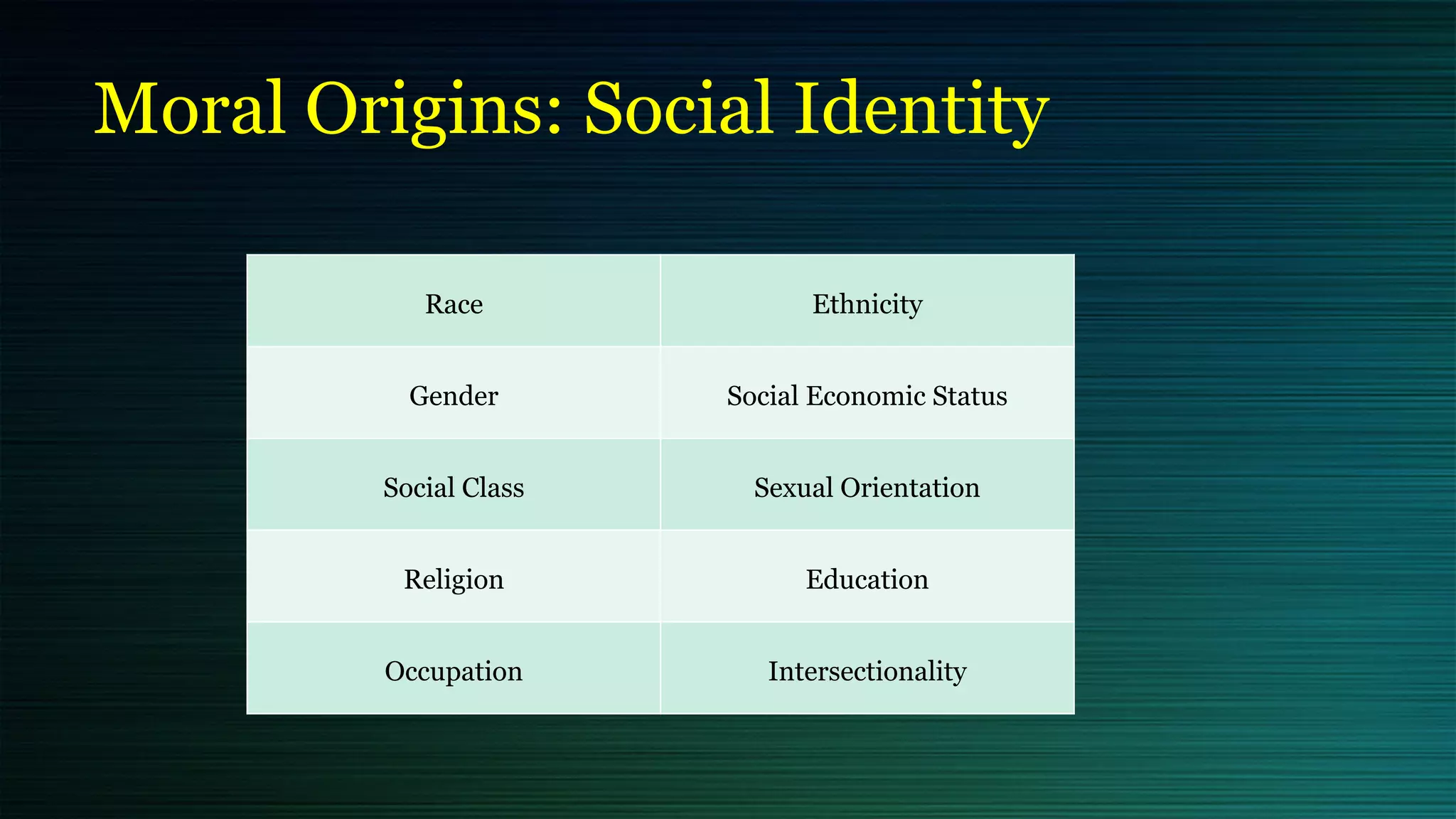
Moral Origins: Social Identity
Race Ethnicity
Gender Social Economic Status
Social Class Sexual Orientation
Religion Education
Occupation Intersectionality
Moral Origins: Moral Brains
Ventromedial Prefrontal Cortex (VMPC)


Moral judgment & mediating moral emotions


Social norms & social values


Orbital Frontal Cortex (OFC)


Reward & punishment processing


Anterior Cingulate Cortex (ACC)


Error detections and theory of mind (ToM)
Moral Origins: Moral Animals
Emotional Components of Morality


Cognitive Components of Morality
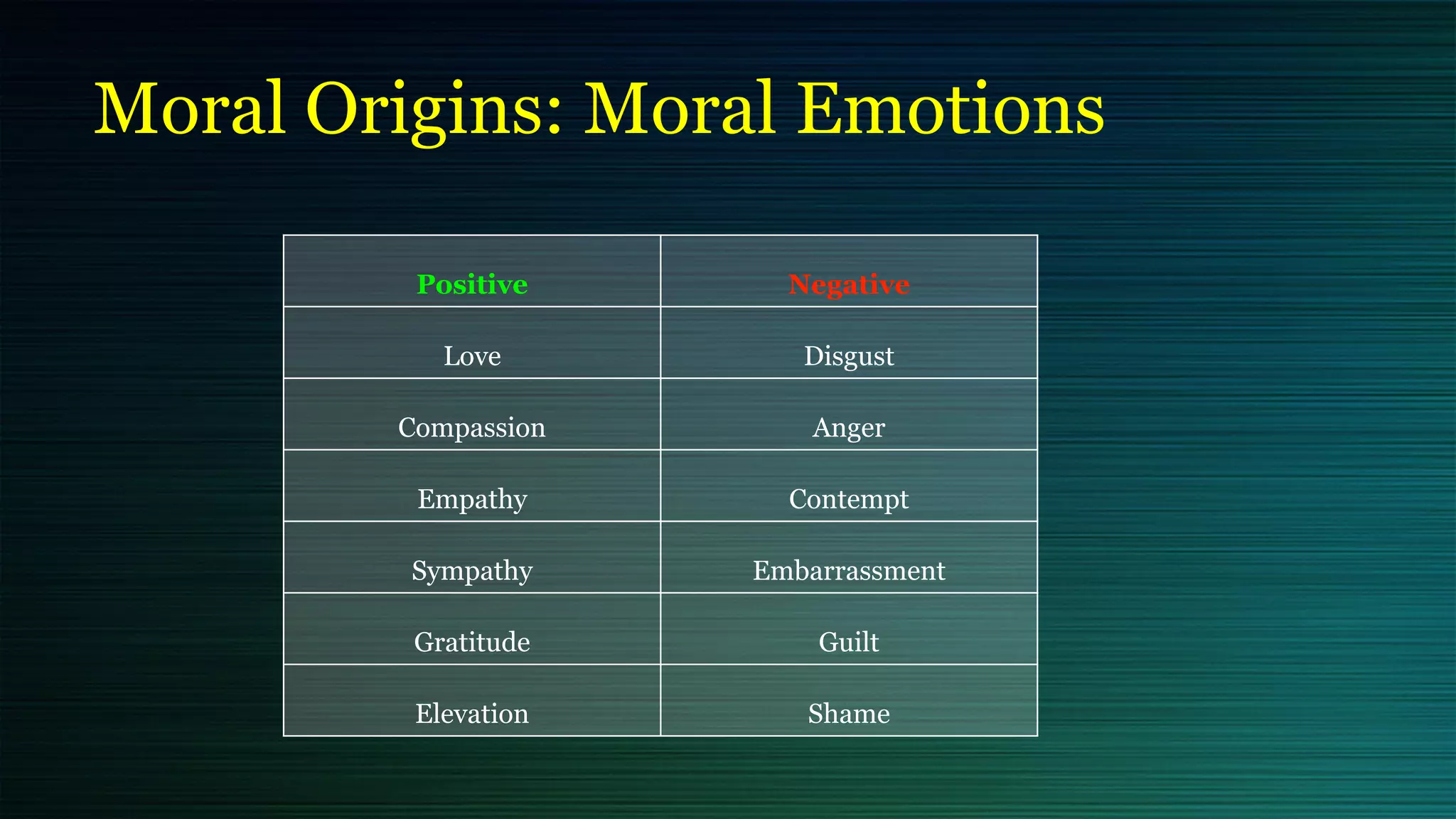
Moral Origins: Moral Emotions
Positive Negative
Love Disgust
Compassion Anger
Empathy Contempt
Sympathy Embarrassment
Gratitude Guilt
Elevation Shame
Moral Origins: Moral Brains
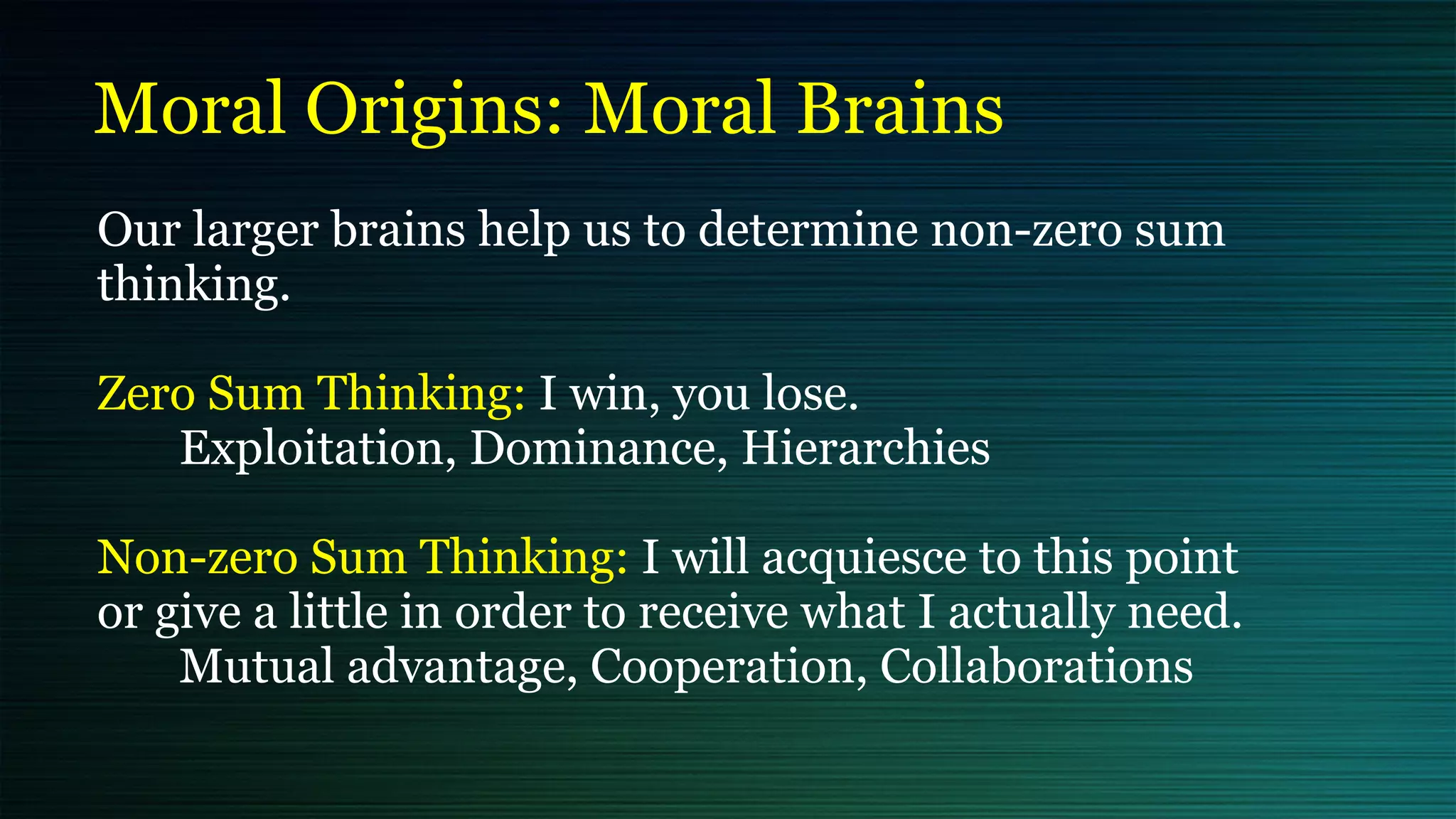
Our larger brains help us to determine non-zero sum
thinking.


Zero Sum Thinking: I win, you lose.


Exploitation, Dominance, Hierarchies


Non-zero Sum Thinking: I will acquiesce to this point
or give a little in order to receive what I actually need.


Mutual advantage, Cooperation, Collaborations
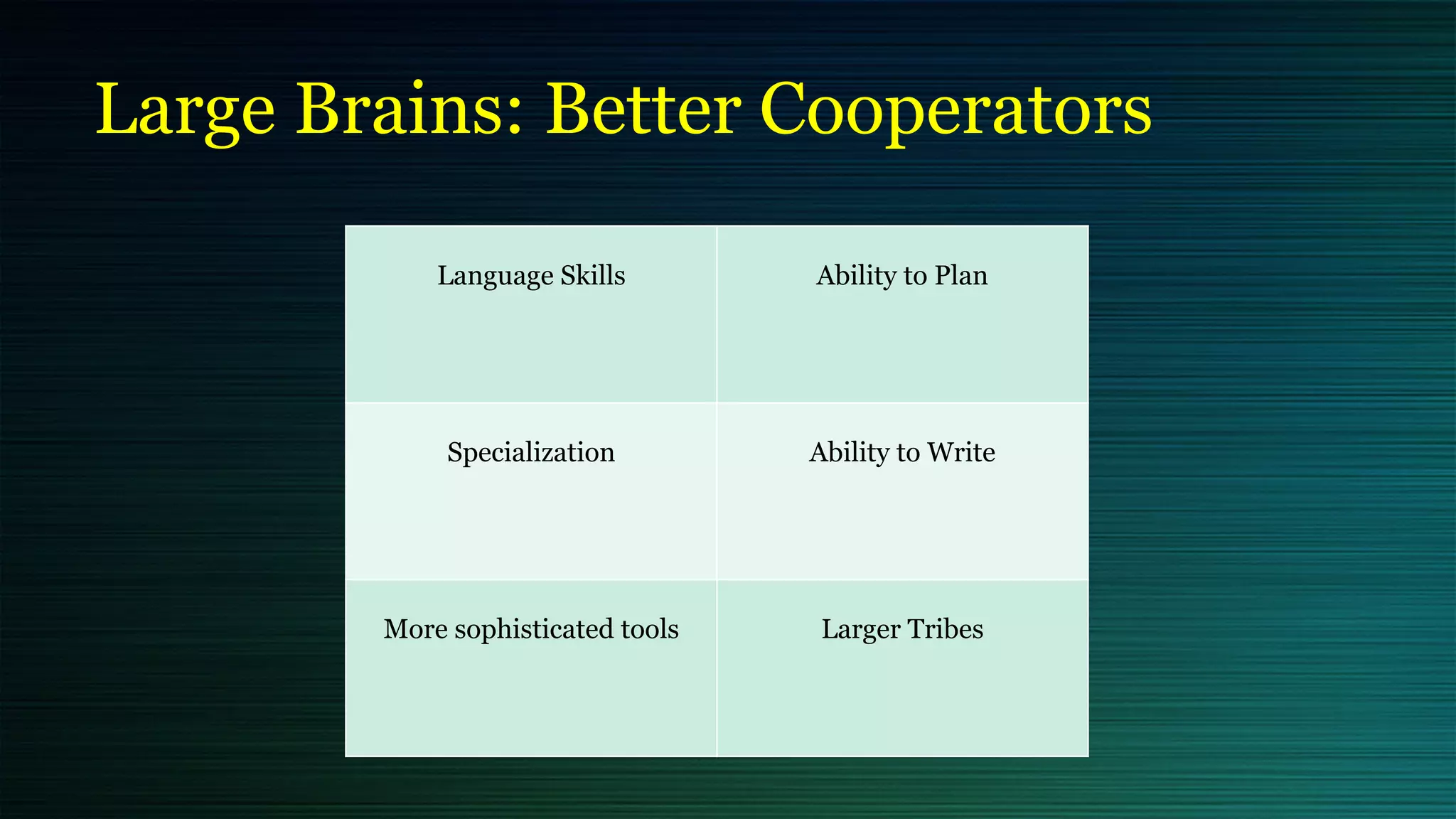
Large Brains: Better Cooperators
Language Skills Ability to Plan
Specialization Ability to Write
More sophisticated tools Larger Tribes
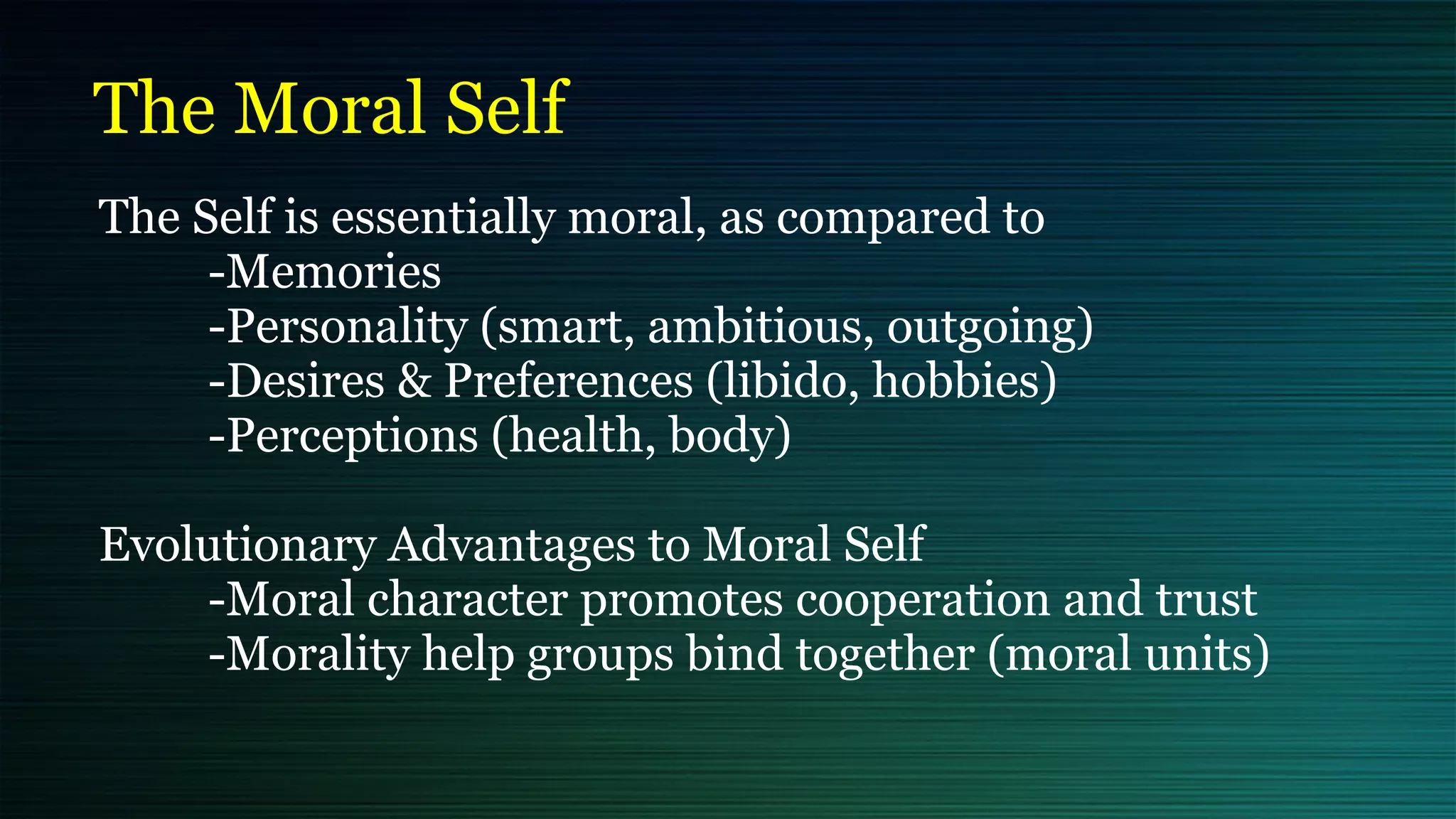
The Moral Self
The Self is essentially moral, as compared to


-Memories


-Personality (smart, ambitious, outgoing)


-Desires & Preferences (libido, hobbies)


-Perceptions (health, body)


Evolutionary Advantages to Moral Self


-Moral character promotes cooperation and trust


-Morality help groups bind together (moral units)
Moral Origins: Biology/Evolution
Morality occurred very slowly


Moral knowledge are a function of our biology


Moral emotions are both negative and positive


Moral emotions bind groups together


Morality is the essential component to the self
Moral Dilemmas for Patients
Moral Conflicts


-Competing moral values


-Mild to moderate physical/emotional discomfort


-Moral distress


Moral Dilemmas


-Competing moral values


-Moderate to significant symptoms


-Higher risk scenario
Jackie is a patient who has been involved in psychotherapy for about six
months, predominantly working on issues related to depression and
relationships. During the course of psychotherapy, Jackie is working on
decreasing interpersonal conflicts, because she can create drama in
relationships.


Jackie’s close friend Beyoncé will be married in two months. Jackie
recently discovered ironclad, incontrovertible evidence that Beyoncé’s
fiancée has been cheating on her for at least several months of their
engagement. Jackie is consciously aware of her pattern of creating
conflicts in relationships; however, she does not want a close friend
married to a cheater.


Jackie is not sure how she can continue to be friends with Beyoncé and her
soon-to-be husband knowing this secret. However, Jackie is fearful she
will lose Beyoncé as her friend, in that Beyoncé may think Jackie is acting
erratically again, mainly for negative attention.
Moral Injury – Brief history
Moral distress, as applied to nursing (Jameton, 1984)


Moral injury applied to veterans (Shay & Monroe, 1999)


-Unit of moral cohesiveness (Honor, Duty, Country)


-Perception of betrayal from legitimate authority


-High stakes scenario


Moral injury as perpetrating, failing to prevent or
witnessing acts that transgress moral beliefs or
expectations (Litz et al, 2009)
Moral Injury
Moral injury violates the norms, expectations, and traditions
of the moral construct or unit (trauma-based)


Moral injury is the consequence of deep, foundational
betrayal that shatters the moral self (meaning)


Associated with religious, spiritual, cultural, or group-based
values (moral complexity)


Moral emotions of guilt, shame, and anger (emotional)
Examples of Moral Injury in therapy
A police officer who caused harm or death of civilians


-Conflict between protecting and serving versus harm


CYS worker who witnesses parental abuse


-Conflict between high value of being a parent versus
witnessing such abuse


A nurse who follows directives based on low staffing
patterns and profit margins


-Conflict between professional values and org demands
Potential Interventions and Ethics
Values Clarification and Meaning Making


Working with moral emotions such as guilt, shame, and
disgust


Understanding and working through the betrayal


Forgiveness and Compassion: Self and Others
Potential Interventions and Ethics
Potential Goals


Reduce shame and guilt


Re-balance moral emotions & cognitions


Appreciate complexity of moral values


Reparation, apologies, & forgiveness
Potential Interventions and Ethics
Potential Goals


Clarifying moral authority & relativity


Developing support network, depending on issue


Develop plan for long-term


Spiritual/religious healing
Potential for Post-Traumatic Growth
Examples may include:


-Greater appreciation for life


-Reset priorities: work, spirituality, relationships


-Enhance meaningfulness


-Personal strength for building from trauma
Professional Examples of Moral Injury
Institutional Betrayal: Transgressions by institutions upon
individuals who are dependent on that organization


Moral Distress:


-Too many high needs patients


-Repetitively discussing patient or cultural traumas


-Vicarious trauma


Intrusive Advocacy: Psychologist places his or her moral
values over the patient’s (trampling patient autonomy)
Question and Answer


Wrap Up


Refences Slide
Graham, J., Haidt, J., Koleva, S., Motyl, M., Iyer, R., Wojcik, S., & Ditto, P. H. (2013). Moral foundations theory: The
pragmatic validity of moral pluralism. Advances in Experimental Social Psychology, 47, p. 55-130.


Jameton A. (1984). Nursing practice: the ethical issues. Englewood Cliffs, NJ: Prentice Hall.


Litz B. T., Stein N., Delaney E., Lebowitz L., Nash W. P., Silva C., & Maguen, S. (2009). Moral injury and moral repair in
war veterans: a preliminary model an intervention strategy. Clinical Psychology Review, 29, 695-706.


Shay, J., & Munroe, J. (1999). Group and milieu therapy for veterans with complex posttraumatic stress disorder. In P. A.
Saigh & J. D. Bremner (Eds.), Posttraumatic stress disorder: A comprehensive text (p. 391–413). Allyn & Bacon.


Schwartz, S. H. (1996). Value priorities and behavior: Applying a theory of integrated value systems. In C. Seligman, J. M.
Olson, & M. P. Zanna (Eds.), The psychology of values: The Ontario Symposium (Vol. 8, pp. 1-24). Hillsdale, NJ: Erlbaum.


Smith, C.P. & Freyd, J.J. (2014). Institutional betrayal. American Psychologist, 69, 575-587.


Strohminger, N. and Nichols, S. (2014). The Essential Moral Self. Cognition, 131, 159-171.

Introduction to Moral Injury, Theory & Practice

  • 1.
    Introduction to MoralInjury Theory and Practice John D. Gavazzi, PsyD ABPP TW Ponessa and Associates March 19, 2021
  • 2.
  • 3.
    Course Objectives At theend of the session, the participant will be able to: 1. Describe the concept of moral injury; 2. Differentiate between moral injury and PTSD; and, 3. Explain how moral injury can be applied to psychotherapy.
  • 4.
    Outline Biology & Morality Moralityand the Moral Self Moral Injury: Defining Features Moral Injury versus PTSD Clinical Examples of Moral Injury
  • 5.
    General Definition ofMoral Injury Moral Injury refers to longstanding emotional, psychological, social, and spiritual suffering related to an individual’s moral compass, conscience, or spiritual beliefs. Moral injury differs from Post-Traumatic Stress Disorder (PTSD), but there are some overlaps.
  • 6.
    General Definition ofMoral Injury Moral Injury begins to incorporate the concept of the moral self within every human, which is not typically the realm of psychology or mental health. We all have moral aspects of our self. We all have beliefs, morals, and value systems. We need to delve into the concept of morality.
  • 7.
  • 8.
    Moral Origins: Religion KingJames Version - Genesis 2:17 Adam and Eve were not to eat from tree of knowledge of good and evil, lest they die. Eating the fruit would give Adam and Eve the wisdom of God (right & wrong; good & bad). Ate fruit, felt moral emotions of shame and embarrassment
  • 9.
    Moral Origins: Religions Moralityoccurred very quickly Moral knowledge considered god-like First moral emotions were negative (shame, guilt) God became angry (from the moral transgression) Existential crisis: They would die (and know it)
  • 10.
    Moral Origins: Evolution Froma purely evolutionary perspective, morality is a pre-human concept Two pillars of morality found in nature Caring Reciprocity Franz DeWaal found these characteristics in elephants, chimpanzees, and other mammals (non-linguistic)
  • 11.
    Moral Origins: Evolution Moralityis derived from emotional (sometimes non conscious) components: These violent delights have violent ends Friar Laurence in Romeo and Juliet What does this mean and why is it important?
  • 12.
    Moral Origins: Evolution Emotionscan create attachments. Attachments form the basis of cooperation and tribalism. Tribalism creates in-groups and out-groups, which form the basis of competition In-group good; out-group bad
  • 13.
    Moral Origins: MoralBrains 1. Reciprocity needs sufficient brain power to determine if fair or not. Many non-human primates and mammals can assess fairness. 2. Humans are homo cooperatus, meaning that we cooperate better than any other species on earth.
  • 14.
    Moral Origins: Evolution Inthe dynamics of group formation, morality helps individuals bind to beliefs, values, and behaviors. This occurs with any group: religions, teams, fraternities, sororities, professional groups, sports, politics, green eyes, social class, etc. Groups are strong, non conscious processes that help shape identity, meaning, thinking, and behaviors.
  • 15.
    Moral Origins: SocialIdentity Race Ethnicity Gender Social Economic Status Social Class Sexual Orientation Religion Education Occupation Intersectionality
  • 18.
    Moral Origins: MoralBrains Ventromedial Prefrontal Cortex (VMPC) Moral judgment & mediating moral emotions Social norms & social values Orbital Frontal Cortex (OFC) Reward & punishment processing Anterior Cingulate Cortex (ACC) Error detections and theory of mind (ToM)
  • 19.
    Moral Origins: MoralAnimals Emotional Components of Morality Cognitive Components of Morality
  • 20.
    Moral Origins: MoralEmotions Positive Negative Love Disgust Compassion Anger Empathy Contempt Sympathy Embarrassment Gratitude Guilt Elevation Shame
  • 21.
    Moral Origins: MoralBrains Our larger brains help us to determine non-zero sum thinking. Zero Sum Thinking: I win, you lose. Exploitation, Dominance, Hierarchies Non-zero Sum Thinking: I will acquiesce to this point or give a little in order to receive what I actually need. Mutual advantage, Cooperation, Collaborations
  • 22.
    Large Brains: BetterCooperators Language Skills Ability to Plan Specialization Ability to Write More sophisticated tools Larger Tribes
  • 23.
    The Moral Self TheSelf is essentially moral, as compared to -Memories -Personality (smart, ambitious, outgoing) -Desires & Preferences (libido, hobbies) -Perceptions (health, body) Evolutionary Advantages to Moral Self -Moral character promotes cooperation and trust -Morality help groups bind together (moral units)
  • 25.
    Moral Origins: Biology/Evolution Moralityoccurred very slowly Moral knowledge are a function of our biology Moral emotions are both negative and positive Moral emotions bind groups together Morality is the essential component to the self
  • 26.
    Moral Dilemmas forPatients Moral Conflicts -Competing moral values -Mild to moderate physical/emotional discomfort -Moral distress Moral Dilemmas -Competing moral values -Moderate to significant symptoms -Higher risk scenario
  • 27.
    Jackie is apatient who has been involved in psychotherapy for about six months, predominantly working on issues related to depression and relationships. During the course of psychotherapy, Jackie is working on decreasing interpersonal conflicts, because she can create drama in relationships. Jackie’s close friend Beyoncé will be married in two months. Jackie recently discovered ironclad, incontrovertible evidence that Beyoncé’s fiancée has been cheating on her for at least several months of their engagement. Jackie is consciously aware of her pattern of creating conflicts in relationships; however, she does not want a close friend married to a cheater. Jackie is not sure how she can continue to be friends with Beyoncé and her soon-to-be husband knowing this secret. However, Jackie is fearful she will lose Beyoncé as her friend, in that Beyoncé may think Jackie is acting erratically again, mainly for negative attention.
  • 28.
    Moral Injury –Brief history Moral distress, as applied to nursing (Jameton, 1984) Moral injury applied to veterans (Shay & Monroe, 1999) -Unit of moral cohesiveness (Honor, Duty, Country) -Perception of betrayal from legitimate authority -High stakes scenario Moral injury as perpetrating, failing to prevent or witnessing acts that transgress moral beliefs or expectations (Litz et al, 2009)
  • 29.
    Moral Injury Moral injuryviolates the norms, expectations, and traditions of the moral construct or unit (trauma-based) Moral injury is the consequence of deep, foundational betrayal that shatters the moral self (meaning) Associated with religious, spiritual, cultural, or group-based values (moral complexity) Moral emotions of guilt, shame, and anger (emotional)
  • 31.
    Examples of MoralInjury in therapy A police officer who caused harm or death of civilians -Conflict between protecting and serving versus harm CYS worker who witnesses parental abuse -Conflict between high value of being a parent versus witnessing such abuse A nurse who follows directives based on low staffing patterns and profit margins -Conflict between professional values and org demands
  • 32.
    Potential Interventions andEthics Values Clarification and Meaning Making Working with moral emotions such as guilt, shame, and disgust Understanding and working through the betrayal Forgiveness and Compassion: Self and Others
  • 33.
    Potential Interventions andEthics Potential Goals Reduce shame and guilt Re-balance moral emotions & cognitions Appreciate complexity of moral values Reparation, apologies, & forgiveness
  • 34.
    Potential Interventions andEthics Potential Goals Clarifying moral authority & relativity Developing support network, depending on issue Develop plan for long-term Spiritual/religious healing
  • 35.
    Potential for Post-TraumaticGrowth Examples may include: -Greater appreciation for life -Reset priorities: work, spirituality, relationships -Enhance meaningfulness -Personal strength for building from trauma
  • 36.
    Professional Examples ofMoral Injury Institutional Betrayal: Transgressions by institutions upon individuals who are dependent on that organization Moral Distress: -Too many high needs patients -Repetitively discussing patient or cultural traumas -Vicarious trauma Intrusive Advocacy: Psychologist places his or her moral values over the patient’s (trampling patient autonomy)
  • 37.
  • 38.
    Refences Slide Graham, J.,Haidt, J., Koleva, S., Motyl, M., Iyer, R., Wojcik, S., & Ditto, P. H. (2013). Moral foundations theory: The pragmatic validity of moral pluralism. Advances in Experimental Social Psychology, 47, p. 55-130. Jameton A. (1984). Nursing practice: the ethical issues. Englewood Cliffs, NJ: Prentice Hall. Litz B. T., Stein N., Delaney E., Lebowitz L., Nash W. P., Silva C., & Maguen, S. (2009). Moral injury and moral repair in war veterans: a preliminary model an intervention strategy. Clinical Psychology Review, 29, 695-706. Shay, J., & Munroe, J. (1999). Group and milieu therapy for veterans with complex posttraumatic stress disorder. In P. A. Saigh & J. D. Bremner (Eds.), Posttraumatic stress disorder: A comprehensive text (p. 391–413). Allyn & Bacon. Schwartz, S. H. (1996). Value priorities and behavior: Applying a theory of integrated value systems. In C. Seligman, J. M. Olson, & M. P. Zanna (Eds.), The psychology of values: The Ontario Symposium (Vol. 8, pp. 1-24). Hillsdale, NJ: Erlbaum. Smith, C.P. & Freyd, J.J. (2014). Institutional betrayal. American Psychologist, 69, 575-587. Strohminger, N. and Nichols, S. (2014). The Essential Moral Self. Cognition, 131, 159-171.