
Just Ethics
The New Science of Morality as it
Applies to Professional Ethics
John Gavazzi, PsyD, ABPP
June 2015 – Pennsylvania Psychological Association
Primitive Brains v. Modern Problems
Why we think with emotions and
heuristics, but not algorithms
Alternative Titles
Please pay attention to Just Ethics
Quick note on the Heuristic Patient
Learning Objectives
1. Explain the difference between ethics and morality
2. Describe two moral emotions in psychotherapy
3. Outline the 4 components of the Ethical
Acculturation Model
4. List two cognitive distortions in ethical decision-
making
5. Apply personal morals and professional ethics to a
vignette
General Outline
• Morality and Moral Development in General
• The New Wave of Moral Psychology
• Acculturation Model
• Principle-based Ethics
• Cognitive Biases and ethical dilemmas
Participant Safety
• Creating a safe environment
• Avoid the word “unethical”
• We are all learning in this process
• Demonstrate courtesy and respect for others
• We are all fallible
Assumptions in this presentation
• We are all products of biological and cultural
evolution
• We all have different tolerances, biases, and
methods of making moral judgments
• We are all subject to biases, heuristics, and
erroneous thought processes. We do not think
in algorithms.
Personal Moral Development
1.Religion/Family of Origin
2.Education: College and CE
3.Personal Education: Reading and Experience
4.Honest self-reflection
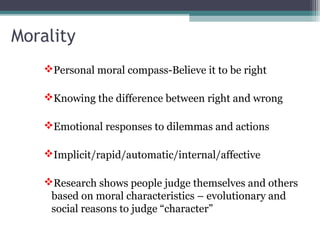
Morality
• Typically, individuals think about morality as
equivalent to religion or religious beliefs.
• At the most general level, morality is a person’s
ability to determine right from wrong, or
• Good from Bad
• Please note the dichotomous thinking
Morality
• Common today for people to believe that
morality is handed down from God.
• Pre-Christian philosophers thought and wrote a
great deal about morality, without supernatural
influence.
• Christian theologians and philosophers thought
and wrote a great deal about morality, typically
looking at different portions of the Bible.
Moral Philosophers
• Hegel: Believed human ability to self-reflect
and imagine helped with developing a strong
moral compass.
• Nietzsche: Believed that ethics and morals
were tied up language, which helped us navigate
the world. However, language binds us to certain
ways of thinking, including accepting our
positions in life.
Morality and Evolution
• A more recent push to understand morality as a
component of evolution
• Moral judgments are typically affective, rapid,
instinctive and unconscious.
• In order for primates to cooperate, form
relationships, and work as groups, reciprocity and
empathy are the two essential “pillars of morality”
• Reciprocity and empathy are needed for human
morality as well.
Evolutionary Differences
There are (at least) two ways to conceptualize
moral decision-making
•Groupishness:
▫ Better for the collective
▫ Statistics on DNA
•Individualism:
▫ Better for individual survival
Personal moral compass-Believe it to be right
Knowing the difference between right and wrong
Emotional responses to dilemmas and actions
Implicit/rapid/automatic/internal/affective
Research shows people judge themselves and others
based on moral characteristics – evolutionary and
social reasons to judge “character”
Morality
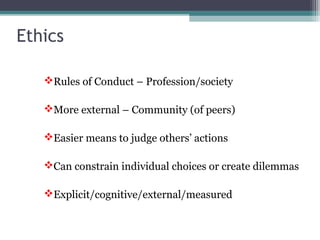
Rules of Conduct – Profession/society
More external – Community (of peers)
Easier means to judge others’ actions
Can constrain individual choices or create dilemmas
Explicit/cognitive/external/measured
Ethics
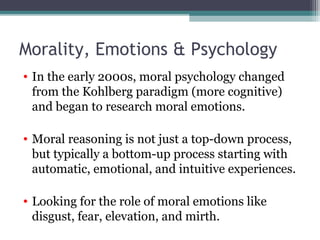
Morality, Emotions & Psychology
• In the early 2000s, moral psychology changed
from the Kohlberg paradigm (more cognitive)
and began to research moral emotions.
• Moral reasoning is not just a top-down process,
but typically a bottom-up process starting with
automatic, emotional, and intuitive experiences.
• Looking for the role of moral emotions like
disgust, fear, elevation, and mirth.
The New Wave of Moral
Psychology
Social Psychology
Experimental Philosophy
Behavioral Economics
Moral Foundations Theory
Jon Haidt, PhD
• There are specific innate, universally available
moral foundations
• These foundations are “intuitive” in that these
are automatic, rapid, affective, and non-rational
• These foundations can be used to judge how
moral or immoral an action or activity is.
Intentional, non-conscious
processing
• The process that binds us blinds us.
• Price paid for the automatic process: accuracy
• A second limitation: rigidity
• The unconscious is swift, less flexible, and not
always accurate. Should I trust my gut or not?
More deliberative
Slower
Possibly more accurate
Energy intensive
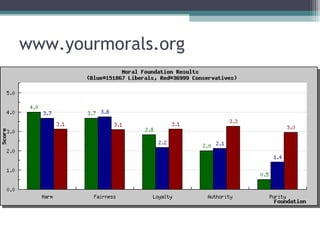
Moral Foundations & Intuitions
Care - Harm
Fairness – Cheating
Loyalty-Betrayal
Authority – Subversion
Sanctity (Purity) – Degradation
[Liberty – Oppression]
www.yourmorals.org
Some Disgusting Examples
Moral Emotion of Disgust
Moral Dumbfounding
Application of Moral Foundations
• Ethics – How do these develop?
• Politics – Partisanship
• Clinical Psychology - Countertransference
• Social Psychology – WEIRD research
Other Concepts in Moral
psychology
• Bad is Stronger than Good
▫ Loss Aversion: Avoid loss v. Find Gain
▫ Sunk Cost Fallacy – When to terminate?
▫ The Knobe Effect
• Priming
• Moral Licensing
What does this mean?
• The “self” is essentially moral
• Evidence supports we understand the self and
others through morality (more so than
memories)
• Morality trumps memories and behaviors
The Acculturation Model
One way of remaining a life-long
learner
Provides another way to discuss ethical
behaviors and decisions
Acculturation
A process to change the cultural behavior of an
individual through contact with another culture.
The process of acculturation occurs when there is
an adaptation into an organization or society.
Ethics Acculturation Model
• An outgrowth of positive ethics that integrates
personal ethics and professional obligations.
• Psychology has a system of shared and
distinctive norms, beliefs, and traditions.
• This set of beliefs is reflected in our ethics code;
especially the overarching ethical principles.
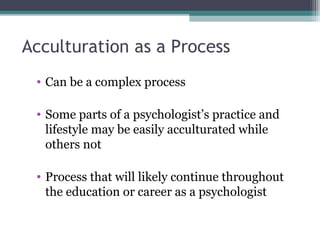
Acculturation as a Process
• Can be a complex process
• Some parts of a psychologist’s practice and
lifestyle may be easily acculturated while
others not
• Process that will likely continue throughout
the education or career as a psychologist
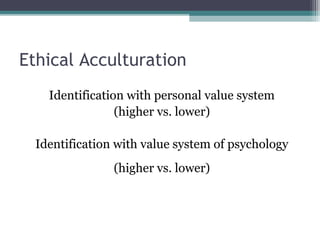
Ethical Acculturation
Identification with personal value system
(higher vs. lower)
Identification with value system of psychology
(higher vs. lower)
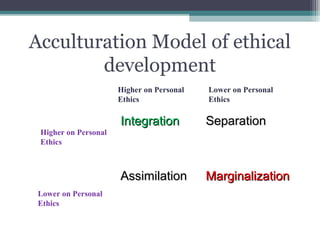
Acculturation Model of ethical
development
IntegrationIntegration SeparationSeparation
AssimilationAssimilation MarginalizationMarginalization
Higher on Personal
Ethics
Higher on Personal
Ethics
Lower on Personal
Ethics
Lower on Personal
Ethics
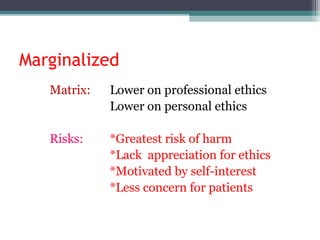
Marginalized
Matrix: Lower on professional ethics
Lower on personal ethics
Risks: *Greatest risk of harm
*Lack appreciation for ethics
*Motivated by self-interest
*Less concern for patients
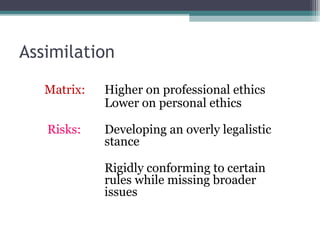
Assimilation
Matrix: Higher on professional ethics
Lower on personal ethics
Risks: Developing an overly legalistic
stance
Rigidly conforming to certain
rules while missing broader
issues
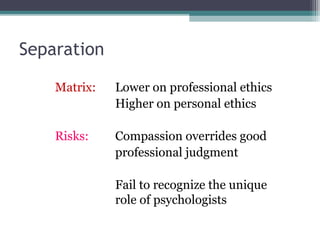
Separation
Matrix: Lower on professional ethics
Higher on personal ethics
Risks: Compassion overrides good
professional judgment
Fail to recognize the unique
role of psychologists
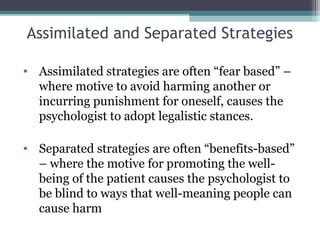
Assimilated and Separated Strategies
• Assimilated strategies are often “fear based” –
where motive to avoid harming another or
incurring punishment for oneself, causes the
psychologist to adopt legalistic stances.
• Separated strategies are often “benefits-based”
– where the motive for promoting the well-
being of the patient causes the psychologist to
be blind to ways that well-meaning people can
cause harm
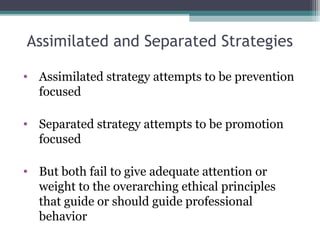
Assimilated and Separated Strategies
• Assimilated strategy attempts to be prevention
focused
• Separated strategy attempts to be promotion
focused
• But both fail to give adequate attention or
weight to the overarching ethical principles
that guide or should guide professional
behavior
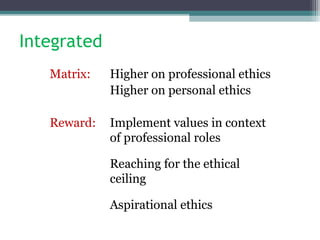
Integrated
Matrix: Higher on professional ethics
Higher on personal ethics
Reward: Implement values in context
of professional roles
Reaching for the ethical
ceiling
Aspirational ethics
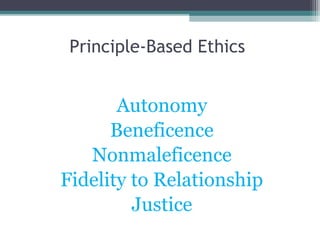
Autonomy
Beneficence
Nonmaleficence
Fidelity to Relationship
Justice
Principle-Based Ethics
Principle-Based Ethics and the
Acculturation Model
Psychologists using integrated strategies are able
to incorporate overarching ethical principles into
their practices
Respect for Autonomy
• Does not mean promoting autonomy
(individuation or separation)
• Means respecting the autonomous decision
making ability of the patient
Autonomy
• It encompasses freedom of thought and action.
• Individuals are at liberty to behave as they
chose.
- Determining goals in therapy
- Making life decisions (e.g., marriage, divorce)
- Scheduling appointments and terminating treatment
Beneficence
• The principle of benefiting others and accepting
the responsibility to do good underlies the
profession.
- Providing the best treatment possible
- Competency
- Referring when needed
Nonmaleficence
The principle is doing no harm.
- Demonstrating competence
- Maintaining appropriate boundaries
- Not using an experimental technique as the
first line of treatment
- Providing benefits, risks, and costs
Fidelity
This principle refers to being faithful to
commitments. Fidelity includes promise
keeping, trustworthiness, and loyalty.
- Avoiding conflicts of interests that could
compromise therapy
- Keeping information confidential
- Adhering to therapeutic contract (e.g.,
session length, time, phone contacts, etc.)
Justice
Justice primarily refers to treating people fairly
and equally.
In their work-related activities, psychologists do not
engage in unfair discrimination based on age, gender,
gender identity, race, ethnicity, culture, national origin,
religion, sexual orientation, disability, socioeconomic
status, or any basis proscribed by law. (3.01)
Ethical and Clinical Decision-
making
We think like defense attorneys
rather than court justices
Bottom up vs. Top Down
• Identify the competing ethical principles
• Help to determine which principle has
precedence and why
• The importance of emotion in ethical decision-
making and moral judgments
• Cognitive biases are also important to consider
Important points to remember
In certain situations, we need to
construct or create a solution
instead of looking up the answer
in a sacred psychology text
The APA Ethical Principles and Code of
Conduct do not include a model of
ethical decision-making
Other resources may aid with decision-making,
but do not highlight how to work through
dilemmas
1.We have to train ourselves to think about larger
ethical principles first
2.We need to have the ability to slow ourselves
down prior to making good, ethical decisions
Why?
Major Point to this Training
Decision-making skills
• Top down approach
• Start with ethical principles
• Work from those principles to make good
decisions about our work
• Intuitive
• Automatic
• Emotional
• Rapid
How people make moral, ethical and
professional decisions
There is an intuitive, non-rational
process in ethical decision-making
Why do psychologists (still and continue to) have sex
with their patients?
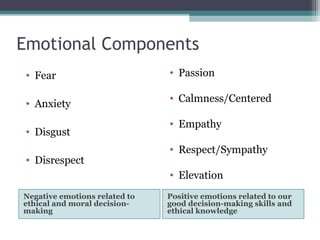
Emotional Components
Negative emotions related to
ethical and moral decision-
making
Positive emotions related to our
good decision-making skills and
ethical knowledge
• Fear
• Anxiety
• Disgust
• Disrespect
• Passion
• Calmness/Centered
• Empathy
• Respect/Sympathy
• Elevation
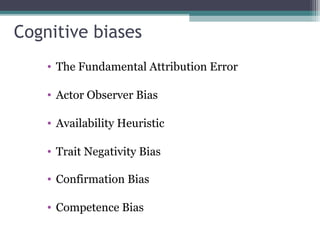
• The Fundamental Attribution Error
• Actor Observer Bias
• Availability Heuristic
• Trait Negativity Bias
• Confirmation Bias
• Competence Bias
Cognitive biases
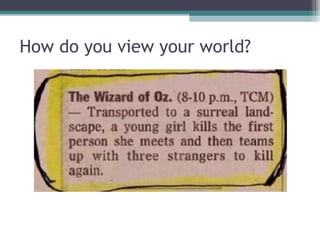
How do you view your world?
Why is any of this important?
Why study ethics and ethical
decision-making as a part of
clinical practice?
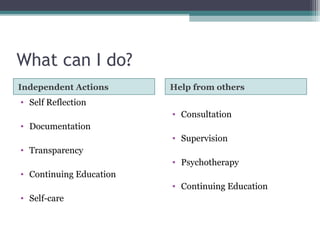
What can I do?
Independent Actions Help from others
• Self Reflection
• Documentation
• Transparency
• Continuing Education
• Self-care
• Consultation
• Supervision
• Psychotherapy
• Continuing Education
www.ethicalpsychology.com
Questions and Answers
Complete course evaluations

Just ethics

  • 1.
    Just Ethics The NewScience of Morality as it Applies to Professional Ethics John Gavazzi, PsyD, ABPP June 2015 – Pennsylvania Psychological Association
  • 2.
    Primitive Brains v.Modern Problems Why we think with emotions and heuristics, but not algorithms Alternative Titles Please pay attention to Just Ethics Quick note on the Heuristic Patient
  • 4.
    Learning Objectives 1. Explainthe difference between ethics and morality 2. Describe two moral emotions in psychotherapy 3. Outline the 4 components of the Ethical Acculturation Model 4. List two cognitive distortions in ethical decision- making 5. Apply personal morals and professional ethics to a vignette
  • 5.
    General Outline • Moralityand Moral Development in General • The New Wave of Moral Psychology • Acculturation Model • Principle-based Ethics • Cognitive Biases and ethical dilemmas
  • 6.
    Participant Safety • Creatinga safe environment • Avoid the word “unethical” • We are all learning in this process • Demonstrate courtesy and respect for others • We are all fallible
  • 7.
    Assumptions in thispresentation • We are all products of biological and cultural evolution • We all have different tolerances, biases, and methods of making moral judgments • We are all subject to biases, heuristics, and erroneous thought processes. We do not think in algorithms.
  • 8.
    Personal Moral Development 1.Religion/Familyof Origin 2.Education: College and CE 3.Personal Education: Reading and Experience 4.Honest self-reflection
  • 9.
    Morality • Typically, individualsthink about morality as equivalent to religion or religious beliefs. • At the most general level, morality is a person’s ability to determine right from wrong, or • Good from Bad • Please note the dichotomous thinking
  • 10.
    Morality • Common todayfor people to believe that morality is handed down from God. • Pre-Christian philosophers thought and wrote a great deal about morality, without supernatural influence. • Christian theologians and philosophers thought and wrote a great deal about morality, typically looking at different portions of the Bible.
  • 11.
    Moral Philosophers • Hegel:Believed human ability to self-reflect and imagine helped with developing a strong moral compass. • Nietzsche: Believed that ethics and morals were tied up language, which helped us navigate the world. However, language binds us to certain ways of thinking, including accepting our positions in life.
  • 12.
    Morality and Evolution •A more recent push to understand morality as a component of evolution • Moral judgments are typically affective, rapid, instinctive and unconscious. • In order for primates to cooperate, form relationships, and work as groups, reciprocity and empathy are the two essential “pillars of morality” • Reciprocity and empathy are needed for human morality as well.
  • 13.
    Evolutionary Differences There are(at least) two ways to conceptualize moral decision-making •Groupishness: ▫ Better for the collective ▫ Statistics on DNA •Individualism: ▫ Better for individual survival
  • 14.
    Personal moral compass-Believeit to be right Knowing the difference between right and wrong Emotional responses to dilemmas and actions Implicit/rapid/automatic/internal/affective Research shows people judge themselves and others based on moral characteristics – evolutionary and social reasons to judge “character” Morality
  • 15.
    Rules of Conduct– Profession/society More external – Community (of peers) Easier means to judge others’ actions Can constrain individual choices or create dilemmas Explicit/cognitive/external/measured Ethics
  • 16.
    Morality, Emotions &Psychology • In the early 2000s, moral psychology changed from the Kohlberg paradigm (more cognitive) and began to research moral emotions. • Moral reasoning is not just a top-down process, but typically a bottom-up process starting with automatic, emotional, and intuitive experiences. • Looking for the role of moral emotions like disgust, fear, elevation, and mirth.
  • 17.
    The New Waveof Moral Psychology Social Psychology Experimental Philosophy Behavioral Economics
  • 18.
    Moral Foundations Theory JonHaidt, PhD • There are specific innate, universally available moral foundations • These foundations are “intuitive” in that these are automatic, rapid, affective, and non-rational • These foundations can be used to judge how moral or immoral an action or activity is.
  • 19.
    Intentional, non-conscious processing • Theprocess that binds us blinds us. • Price paid for the automatic process: accuracy • A second limitation: rigidity • The unconscious is swift, less flexible, and not always accurate. Should I trust my gut or not?
  • 20.
    More deliberative Slower Possibly moreaccurate Energy intensive
  • 21.
    Moral Foundations &Intuitions Care - Harm Fairness – Cheating Loyalty-Betrayal Authority – Subversion Sanctity (Purity) – Degradation [Liberty – Oppression]
  • 22.
  • 23.
    Some Disgusting Examples MoralEmotion of Disgust Moral Dumbfounding
  • 24.
    Application of MoralFoundations • Ethics – How do these develop? • Politics – Partisanship • Clinical Psychology - Countertransference • Social Psychology – WEIRD research
  • 25.
    Other Concepts inMoral psychology • Bad is Stronger than Good ▫ Loss Aversion: Avoid loss v. Find Gain ▫ Sunk Cost Fallacy – When to terminate? ▫ The Knobe Effect • Priming • Moral Licensing
  • 26.
    What does thismean? • The “self” is essentially moral • Evidence supports we understand the self and others through morality (more so than memories) • Morality trumps memories and behaviors
  • 27.
    The Acculturation Model Oneway of remaining a life-long learner Provides another way to discuss ethical behaviors and decisions
  • 28.
    Acculturation A process tochange the cultural behavior of an individual through contact with another culture. The process of acculturation occurs when there is an adaptation into an organization or society.
  • 29.
    Ethics Acculturation Model •An outgrowth of positive ethics that integrates personal ethics and professional obligations. • Psychology has a system of shared and distinctive norms, beliefs, and traditions. • This set of beliefs is reflected in our ethics code; especially the overarching ethical principles.
  • 30.
    Acculturation as aProcess • Can be a complex process • Some parts of a psychologist’s practice and lifestyle may be easily acculturated while others not • Process that will likely continue throughout the education or career as a psychologist
  • 31.
    Ethical Acculturation Identification withpersonal value system (higher vs. lower) Identification with value system of psychology (higher vs. lower)
  • 32.
    Acculturation Model ofethical development IntegrationIntegration SeparationSeparation AssimilationAssimilation MarginalizationMarginalization Higher on Personal Ethics Higher on Personal Ethics Lower on Personal Ethics Lower on Personal Ethics
  • 33.
    Marginalized Matrix: Lower onprofessional ethics Lower on personal ethics Risks: *Greatest risk of harm *Lack appreciation for ethics *Motivated by self-interest *Less concern for patients
  • 34.
    Assimilation Matrix: Higher onprofessional ethics Lower on personal ethics Risks: Developing an overly legalistic stance Rigidly conforming to certain rules while missing broader issues
  • 35.
    Separation Matrix: Lower onprofessional ethics Higher on personal ethics Risks: Compassion overrides good professional judgment Fail to recognize the unique role of psychologists
  • 36.
    Assimilated and SeparatedStrategies • Assimilated strategies are often “fear based” – where motive to avoid harming another or incurring punishment for oneself, causes the psychologist to adopt legalistic stances. • Separated strategies are often “benefits-based” – where the motive for promoting the well- being of the patient causes the psychologist to be blind to ways that well-meaning people can cause harm
  • 37.
    Assimilated and SeparatedStrategies • Assimilated strategy attempts to be prevention focused • Separated strategy attempts to be promotion focused • But both fail to give adequate attention or weight to the overarching ethical principles that guide or should guide professional behavior
  • 38.
    Integrated Matrix: Higher onprofessional ethics Higher on personal ethics Reward: Implement values in context of professional roles Reaching for the ethical ceiling Aspirational ethics
  • 39.
  • 40.
    Principle-Based Ethics andthe Acculturation Model Psychologists using integrated strategies are able to incorporate overarching ethical principles into their practices
  • 41.
    Respect for Autonomy •Does not mean promoting autonomy (individuation or separation) • Means respecting the autonomous decision making ability of the patient
  • 42.
    Autonomy • It encompassesfreedom of thought and action. • Individuals are at liberty to behave as they chose. - Determining goals in therapy - Making life decisions (e.g., marriage, divorce) - Scheduling appointments and terminating treatment
  • 43.
    Beneficence • The principleof benefiting others and accepting the responsibility to do good underlies the profession. - Providing the best treatment possible - Competency - Referring when needed
  • 44.
    Nonmaleficence The principle isdoing no harm. - Demonstrating competence - Maintaining appropriate boundaries - Not using an experimental technique as the first line of treatment - Providing benefits, risks, and costs
  • 45.
    Fidelity This principle refersto being faithful to commitments. Fidelity includes promise keeping, trustworthiness, and loyalty. - Avoiding conflicts of interests that could compromise therapy - Keeping information confidential - Adhering to therapeutic contract (e.g., session length, time, phone contacts, etc.)
  • 46.
    Justice Justice primarily refersto treating people fairly and equally. In their work-related activities, psychologists do not engage in unfair discrimination based on age, gender, gender identity, race, ethnicity, culture, national origin, religion, sexual orientation, disability, socioeconomic status, or any basis proscribed by law. (3.01)
  • 47.
    Ethical and ClinicalDecision- making We think like defense attorneys rather than court justices Bottom up vs. Top Down
  • 48.
    • Identify thecompeting ethical principles • Help to determine which principle has precedence and why • The importance of emotion in ethical decision- making and moral judgments • Cognitive biases are also important to consider Important points to remember
  • 49.
    In certain situations,we need to construct or create a solution instead of looking up the answer in a sacred psychology text
  • 50.
    The APA EthicalPrinciples and Code of Conduct do not include a model of ethical decision-making Other resources may aid with decision-making, but do not highlight how to work through dilemmas
  • 51.
    1.We have totrain ourselves to think about larger ethical principles first 2.We need to have the ability to slow ourselves down prior to making good, ethical decisions Why? Major Point to this Training
  • 52.
    Decision-making skills • Topdown approach • Start with ethical principles • Work from those principles to make good decisions about our work
  • 53.
    • Intuitive • Automatic •Emotional • Rapid How people make moral, ethical and professional decisions
  • 54.
    There is anintuitive, non-rational process in ethical decision-making Why do psychologists (still and continue to) have sex with their patients?
  • 56.
    Emotional Components Negative emotionsrelated to ethical and moral decision- making Positive emotions related to our good decision-making skills and ethical knowledge • Fear • Anxiety • Disgust • Disrespect • Passion • Calmness/Centered • Empathy • Respect/Sympathy • Elevation
  • 57.
    • The FundamentalAttribution Error • Actor Observer Bias • Availability Heuristic • Trait Negativity Bias • Confirmation Bias • Competence Bias Cognitive biases
  • 58.
    How do youview your world?
  • 59.
    Why is anyof this important? Why study ethics and ethical decision-making as a part of clinical practice?
  • 61.
    What can Ido? Independent Actions Help from others • Self Reflection • Documentation • Transparency • Continuing Education • Self-care • Consultation • Supervision • Psychotherapy • Continuing Education
  • 62.
  • 63.