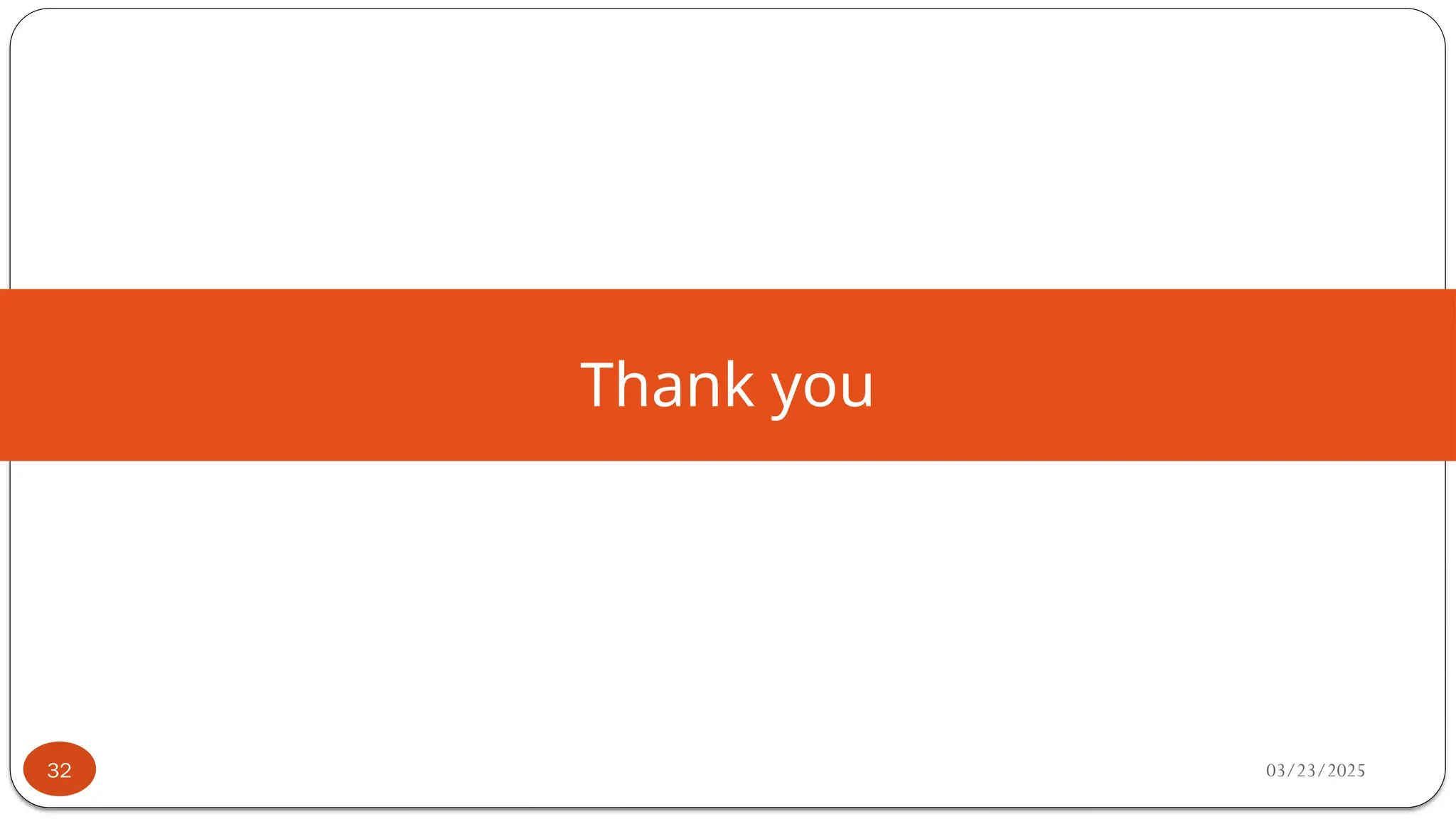
CHAPTER 14
Considering Ethical Issues
in Data Collection
Dr.Gholam M.Payman
Research Method
03/23/2025
1
Contents
Ethics: the concept
Ethical issues to consider concerning research participants
Ethical issues to consider relating to the researcher
Ethical issues to consider regarding the sponsoring organization
03/23/2025
2
Objective
The objectives of the session are:
To understand the concept of research ethics;
To learn the ethical issues concerning research participants;
To discern ethical issues relating to the researcher; and
To understand ethical issues regarding the sponsoring organization.
03/23/2025
3
Keywords
Bias,code of conduct,confidentiality,deprivation of
treatment,ethos,harm,informed consent,principles of
conduct,research participants,sensitive information,
sponsoring organizations,stakeholders,subjectivity
03/23/2025
4
Ethics in Professions
Professions follow codes of ethics that evolve with societal
values and expectations.
Some professions have strict ethical guidelines with
enforcement mechanisms.
Research ethics are distinct in fields like medicine, business,
law, psychology, and education.
03/23/2025
5
Ethics: the concept
Ethics refers to principles of conduct considered correct
within a profession.
Key questions in ethics:
What are ethical principles?
Who determines them?
Are they universal or subject to change?
03/23/2025
6
Ethics & Professional Change
Ethical codes evolve as professions adapt to societal and technological
changes.
What was ethical in the past may not be ethical today.
Ethics are determined by professional bodies and government
organizations.
03/23/2025
7
Ethics in Research
Research ethics prevent:
Harm to individuals
Breach of confidentiality
Improper use of information
Bias in findings
Social science research follows general ethical principles applicable across
disciplines.
03/23/2025
8
ClassActivity
Ethics in Professions –Activity: Ethical Dilemmas in Professions
Divide students into small groups.
Give each group a real-world ethical dilemma from different professions
(e.g., a doctor facing a conflict of interest, a journalist dealing with fake
news, a businessperson handling insider trading).
Each group discusses the case and presents their views on how ethical
guidelines should be applied.
03/23/2025
9
Stakeholders in research
Ethical Considerations in Research:
Research involves multiple stakeholders who must be considered
ethically.
Key stakeholders:
• Research Participants
• Researchers
• Funding Bodies
03/23/2025
10
Research Participants
Who are they?
Individuals, groups, or communities providing information.
Patients in medical studies, consumers in marketing, students in education,
etc.
Ethical concerns:
Informed consent
Privacy & confidentiality
No harm to participants 03/23/2025
11
Researchers
Who are they?
Those conducting studies to expand knowledge while following ethical
guidelines.
 Responsibilities:
Maintain integrity & objectivity
Ensure data accuracy
Avoid bias & misconduct
03/23/2025
12
Funding Bodies
Who funds research?
Businesses, government agencies, institutions, NGOs.
Ethical concerns:
Preventing bias in findings
Ensuring transparency in funding
Avoiding conflicts of interest
03/23/2025
13
Ensuring Ethical Research
Follow ethical codes for fairness & accuracy
Protect all stakeholders from harm
Maintain transparency & accountability
Uphold professional integrity in all research activities
03/23/2025
14
Ethical issues to consider concerning research participants
There are many ethical issues to consider in relation to the
participants of a research activity.
03/23/2025
15
Collecting Information in Research
Why should respondents share information?
 Research aims to improve conditions, so asking questions is justified if the research benefits
society.
Ethical Considerations:
 Always obtain informed consent before asking questions.
 Ensure the research is relevant and useful to avoid wasting respondents' time.
Key Point:
 The researcher's responsibility is to convince others of the research's value and relevance to
society.
03/23/2025
16
Seeking Consent in Research
Ethical Requirement:
Collecting information without participants' knowledge and consent is unethical.
Informed consent is crucial in both medical and social research.
What Informed Consent Entails:
Participants must be informed about the purpose, type of information, and potential
effects of the research.
Consent should be voluntary, without pressure.
03/23/2025
17
Seeking Consent in Research
Criteria forValid Consent (Schinke & Gilchrist, 1993):
Participants must be competent to consent.
Sufficient information must be provided.
Consent must be voluntary and uncoerced.
Competency Considerations:
Certain groups (e.g., children, those with mental impairments, or in crisis) may not
be competent to give consent.
03/23/2025
18
Ethics of Providing Incentives to Respondents
Debate on Incentives:
Some researchers believe offering incentives is ethical as it compensates for participants'
time.
Others argue it is unethical, as it may influence responses.
Author's Opinion:
Most participants engage in studies due to their importance, not for incentives.
Offering a small gift after data collection as a token of appreciation is acceptable.
Offering a gift before data collection is considered unethical.
03/23/2025
19
Ethical Dilemma of Sensitive Information
Sensitive Information:
Questions on sexual behavior, drug use, marital status, income, and age can be intrusive
and considered an invasion of privacy.
Researcher's Dilemma:
Should researchers ask sensitive questions that might upset or embarrass respondents but
are necessary for advancing knowledge?
Author's Opinion:
It is not unethical to ask sensitive questions if:
Respondents are informed about the type of information being requested.
They are given sufficient time to decide whether to participate, without undue pressure or inducements.
03/23/2025
20
The possibility of causing harm to participants
 Research Ethics: Minimizing Harm to Participants
 Types of Harm:
Harm can include discomfort, anxiety, harassment, invasion of privacy, or dehumanizing procedures.
 Minimizing Risk:
Researchers must assess if participant involvement may cause harm.
 Minimal Risk:
The risk of harm should be no greater than what is typically encountered in daily life.
 Ethical Considerations:
It is unethical to cause anxiety or harassment in the data collection process.
Steps should be taken to prevent any harm, discomfort, or anxiety to participants. 03/23/2025
21
Maintaining confidentiality
 Ethical Responsibility:
Sharing information about a respondent for non-research purposes is unethical.
Respondent information must be kept anonymous to protect confidentiality.
Situations Requiring
 Caution:
In some cases, identifying the study population may be necessary to contextualize findings.
If multiple visits to respondents are needed, identification is required until the study is complete.
 Key Principle:
Never disclose identifying information without permission.
Ensure confidentiality is maintained, especially when working with third parties.
Negligence in protecting confidentiality is unethical. 03/23/2025
22
Ethical issues to consider relating to the researcher
Avoiding Bias in Research
Difference Between Bias and Subjectivity:
Subjectivity relates to personal background, training, and perspectives.
Bias is a deliberate attempt to distort or manipulate findings, either by hiding information
or exaggerating it.
Ethical Consideration:
Introducing bias into research is unethical.
Researchers must control their bias to maintain integrity in their work.
Unethical behavior arises from bias, not subjectivity.
03/23/2025
23
Ethics of Provision or deprivation of a treatment
 Control Group Studies:
Is it ethical to provide an unproven treatment to a population?
Depriving the control group of treatment may hinder proving its effectiveness.
Ethical concerns arise when depriving individuals of a treatment that could potentially benefit them.
 Key Consideration:
Deprivation of treatment in control groups is generally accepted to establish treatment
effectiveness, but some argue it may still be unethical.
No simple answers to ethical dilemmas in research.
Ensuring informed consent and minimum risk can help address concerns.
Frank discussion of participation implications can assist in resolving ethical issues.
03/23/2025
24
Using inappropriate research methodology
Researchers must use appropriate methods within their knowledge base.
Unethical practices include:
Deliberately using inappropriate methods.
Selecting biased samples.
Using invalid instruments.
Drawing wrong conclusions.
03/23/2025
25
Incorrect reporting
Reporting findings to serve personal or external interests is unethical.
Ethical research requires:
Accurate and unbiased reporting.
Presenting findings as they are, without distortion.
03/23/2025
26
Inappropriate use of the information
Using information to harm respondents, directly or indirectly, is unethical.
Researchers must consider how information will affect the study population.
Example:
In a study on organizational restructuring, information could benefit the organization
but harm individuals.
Ethical practice:
Inform respondents about the potential use of their data.
Let participants decide whether to participate based on this understanding.
Identifying participants in such cases is unethical. 03/23/2025
27
Ethical issues regarding the sponsoring organization
Restrictions by Sponsors:
Research is often funded by organizations with specific purposes (e.g., evaluating
programs, studying policy impacts).
Sponsoring organizations may impose direct or indirect controls on the
methodology, publication, or findings.
Ethical Concerns:
Imposing restrictions on research findings to serve vested interests is unethical.
It compromises the accuracy and integrity of the research process.
03/23/2025
28
The Misuse of Information
Usage of Research by Sponsors:
Sponsoring bodies may use research to justify management decisions or
agendas.
Ethical Concerns:
Unethical to let research be used to support management decisions
when findings do not align.
Researchers may find it difficult to prevent such misuse, but it remains
an ethical issue. 03/23/2025
29
The Misuse of Information
Usage of Research by Sponsors:
Sponsoring bodies may use research to justify management decisions or
agendas.
Ethical Concerns:
Unethical to let research be used to support management decisions
when findings do not align.
Researchers may find it difficult to prevent such misuse, but it remains
an ethical issue. 03/23/2025
30
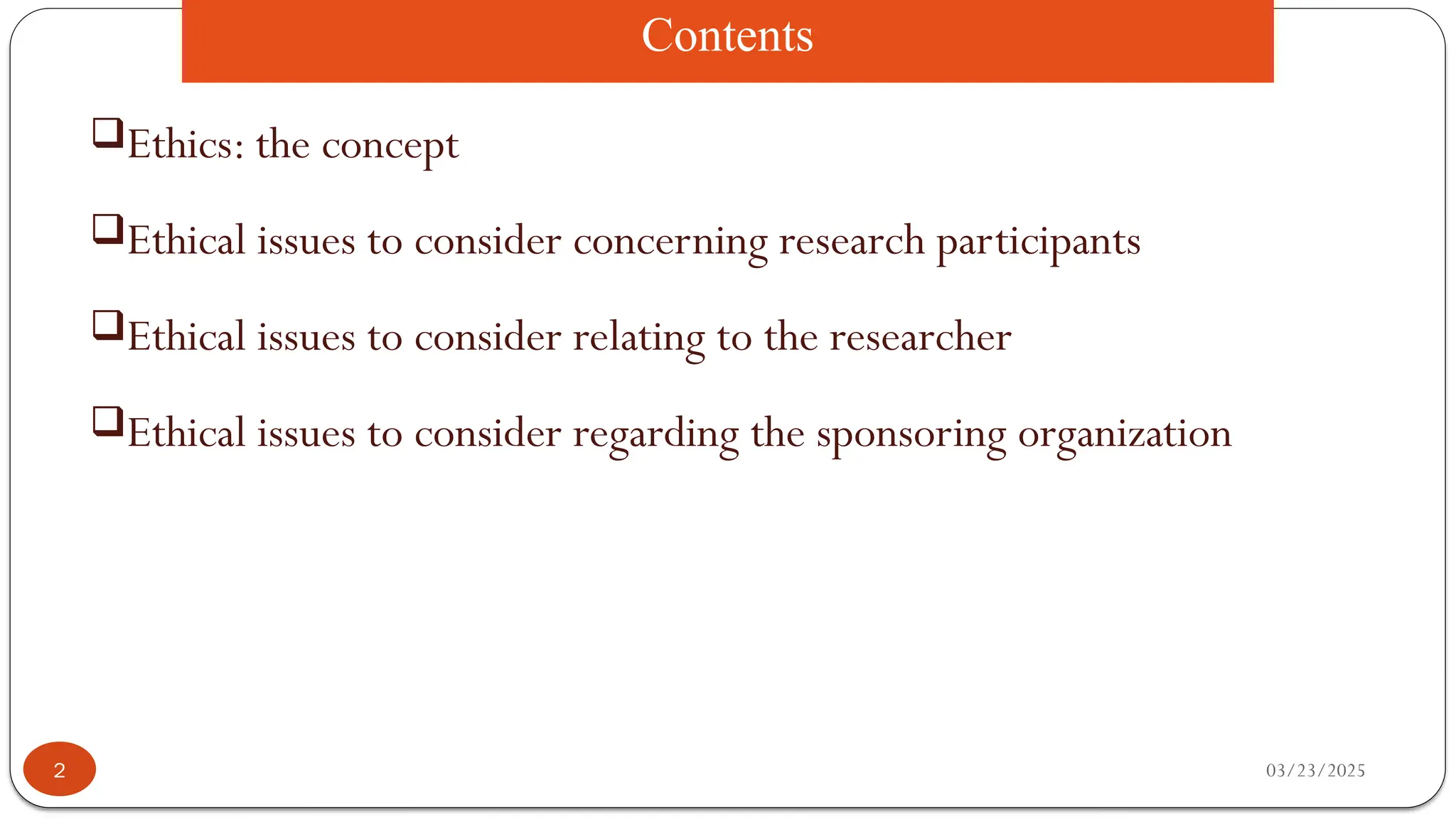
Summary: Ethical Issues in Research
 Ethical Awareness:
 Essential for both quantitative and qualitative research.
 Adhere to the professional code of conduct; deviations are considered unethical.
 Key Ethical Areas:
 Participants:
 Information collection, consent, incentives, sensitive data, harm, confidentiality.
 Researchers:
 Bias, treatment provision, research methodology, reporting, misuse of information.
 Sponsoring Organizations:
 Restrictions, use of findings, and potential manipulation.
 Conclusion:
 Understand ethical issues and implement strategies to prevent harm to all stakeholders. 03/23/2025
31
Thank you
03/23/2025
32

Research Ethics while collecting data in the field

  • 1.
    CHAPTER 14 Considering EthicalIssues in Data Collection Dr.Gholam M.Payman Research Method 03/23/2025 1
  • 2.
    Contents Ethics: the concept Ethicalissues to consider concerning research participants Ethical issues to consider relating to the researcher Ethical issues to consider regarding the sponsoring organization 03/23/2025 2
  • 3.
    Objective The objectives ofthe session are: To understand the concept of research ethics; To learn the ethical issues concerning research participants; To discern ethical issues relating to the researcher; and To understand ethical issues regarding the sponsoring organization. 03/23/2025 3
  • 4.
    Keywords Bias,code of conduct,confidentiality,deprivationof treatment,ethos,harm,informed consent,principles of conduct,research participants,sensitive information, sponsoring organizations,stakeholders,subjectivity 03/23/2025 4
  • 5.
    Ethics in Professions Professionsfollow codes of ethics that evolve with societal values and expectations. Some professions have strict ethical guidelines with enforcement mechanisms. Research ethics are distinct in fields like medicine, business, law, psychology, and education. 03/23/2025 5
  • 6.
    Ethics: the concept Ethicsrefers to principles of conduct considered correct within a profession. Key questions in ethics: What are ethical principles? Who determines them? Are they universal or subject to change? 03/23/2025 6
  • 7.
    Ethics & ProfessionalChange Ethical codes evolve as professions adapt to societal and technological changes. What was ethical in the past may not be ethical today. Ethics are determined by professional bodies and government organizations. 03/23/2025 7
  • 8.
    Ethics in Research Researchethics prevent: Harm to individuals Breach of confidentiality Improper use of information Bias in findings Social science research follows general ethical principles applicable across disciplines. 03/23/2025 8
  • 9.
    ClassActivity Ethics in Professions–Activity: Ethical Dilemmas in Professions Divide students into small groups. Give each group a real-world ethical dilemma from different professions (e.g., a doctor facing a conflict of interest, a journalist dealing with fake news, a businessperson handling insider trading). Each group discusses the case and presents their views on how ethical guidelines should be applied. 03/23/2025 9
  • 10.
    Stakeholders in research EthicalConsiderations in Research: Research involves multiple stakeholders who must be considered ethically. Key stakeholders: • Research Participants • Researchers • Funding Bodies 03/23/2025 10
  • 11.
    Research Participants Who arethey? Individuals, groups, or communities providing information. Patients in medical studies, consumers in marketing, students in education, etc. Ethical concerns: Informed consent Privacy & confidentiality No harm to participants 03/23/2025 11
  • 12.
    Researchers Who are they? Thoseconducting studies to expand knowledge while following ethical guidelines.  Responsibilities: Maintain integrity & objectivity Ensure data accuracy Avoid bias & misconduct 03/23/2025 12
  • 13.
    Funding Bodies Who fundsresearch? Businesses, government agencies, institutions, NGOs. Ethical concerns: Preventing bias in findings Ensuring transparency in funding Avoiding conflicts of interest 03/23/2025 13
  • 14.
    Ensuring Ethical Research Followethical codes for fairness & accuracy Protect all stakeholders from harm Maintain transparency & accountability Uphold professional integrity in all research activities 03/23/2025 14
  • 15.
    Ethical issues toconsider concerning research participants There are many ethical issues to consider in relation to the participants of a research activity. 03/23/2025 15
  • 16.
    Collecting Information inResearch Why should respondents share information?  Research aims to improve conditions, so asking questions is justified if the research benefits society. Ethical Considerations:  Always obtain informed consent before asking questions.  Ensure the research is relevant and useful to avoid wasting respondents' time. Key Point:  The researcher's responsibility is to convince others of the research's value and relevance to society. 03/23/2025 16
  • 17.
    Seeking Consent inResearch Ethical Requirement: Collecting information without participants' knowledge and consent is unethical. Informed consent is crucial in both medical and social research. What Informed Consent Entails: Participants must be informed about the purpose, type of information, and potential effects of the research. Consent should be voluntary, without pressure. 03/23/2025 17
  • 18.
    Seeking Consent inResearch Criteria forValid Consent (Schinke & Gilchrist, 1993): Participants must be competent to consent. Sufficient information must be provided. Consent must be voluntary and uncoerced. Competency Considerations: Certain groups (e.g., children, those with mental impairments, or in crisis) may not be competent to give consent. 03/23/2025 18
  • 19.
    Ethics of ProvidingIncentives to Respondents Debate on Incentives: Some researchers believe offering incentives is ethical as it compensates for participants' time. Others argue it is unethical, as it may influence responses. Author's Opinion: Most participants engage in studies due to their importance, not for incentives. Offering a small gift after data collection as a token of appreciation is acceptable. Offering a gift before data collection is considered unethical. 03/23/2025 19
  • 20.
    Ethical Dilemma ofSensitive Information Sensitive Information: Questions on sexual behavior, drug use, marital status, income, and age can be intrusive and considered an invasion of privacy. Researcher's Dilemma: Should researchers ask sensitive questions that might upset or embarrass respondents but are necessary for advancing knowledge? Author's Opinion: It is not unethical to ask sensitive questions if: Respondents are informed about the type of information being requested. They are given sufficient time to decide whether to participate, without undue pressure or inducements. 03/23/2025 20
  • 21.
    The possibility ofcausing harm to participants  Research Ethics: Minimizing Harm to Participants  Types of Harm: Harm can include discomfort, anxiety, harassment, invasion of privacy, or dehumanizing procedures.  Minimizing Risk: Researchers must assess if participant involvement may cause harm.  Minimal Risk: The risk of harm should be no greater than what is typically encountered in daily life.  Ethical Considerations: It is unethical to cause anxiety or harassment in the data collection process. Steps should be taken to prevent any harm, discomfort, or anxiety to participants. 03/23/2025 21
  • 22.
    Maintaining confidentiality  EthicalResponsibility: Sharing information about a respondent for non-research purposes is unethical. Respondent information must be kept anonymous to protect confidentiality. Situations Requiring  Caution: In some cases, identifying the study population may be necessary to contextualize findings. If multiple visits to respondents are needed, identification is required until the study is complete.  Key Principle: Never disclose identifying information without permission. Ensure confidentiality is maintained, especially when working with third parties. Negligence in protecting confidentiality is unethical. 03/23/2025 22
  • 23.
    Ethical issues toconsider relating to the researcher Avoiding Bias in Research Difference Between Bias and Subjectivity: Subjectivity relates to personal background, training, and perspectives. Bias is a deliberate attempt to distort or manipulate findings, either by hiding information or exaggerating it. Ethical Consideration: Introducing bias into research is unethical. Researchers must control their bias to maintain integrity in their work. Unethical behavior arises from bias, not subjectivity. 03/23/2025 23
  • 24.
    Ethics of Provisionor deprivation of a treatment  Control Group Studies: Is it ethical to provide an unproven treatment to a population? Depriving the control group of treatment may hinder proving its effectiveness. Ethical concerns arise when depriving individuals of a treatment that could potentially benefit them.  Key Consideration: Deprivation of treatment in control groups is generally accepted to establish treatment effectiveness, but some argue it may still be unethical. No simple answers to ethical dilemmas in research. Ensuring informed consent and minimum risk can help address concerns. Frank discussion of participation implications can assist in resolving ethical issues. 03/23/2025 24
  • 25.
    Using inappropriate researchmethodology Researchers must use appropriate methods within their knowledge base. Unethical practices include: Deliberately using inappropriate methods. Selecting biased samples. Using invalid instruments. Drawing wrong conclusions. 03/23/2025 25
  • 26.
    Incorrect reporting Reporting findingsto serve personal or external interests is unethical. Ethical research requires: Accurate and unbiased reporting. Presenting findings as they are, without distortion. 03/23/2025 26
  • 27.
    Inappropriate use ofthe information Using information to harm respondents, directly or indirectly, is unethical. Researchers must consider how information will affect the study population. Example: In a study on organizational restructuring, information could benefit the organization but harm individuals. Ethical practice: Inform respondents about the potential use of their data. Let participants decide whether to participate based on this understanding. Identifying participants in such cases is unethical. 03/23/2025 27
  • 28.
    Ethical issues regardingthe sponsoring organization Restrictions by Sponsors: Research is often funded by organizations with specific purposes (e.g., evaluating programs, studying policy impacts). Sponsoring organizations may impose direct or indirect controls on the methodology, publication, or findings. Ethical Concerns: Imposing restrictions on research findings to serve vested interests is unethical. It compromises the accuracy and integrity of the research process. 03/23/2025 28
  • 29.
    The Misuse ofInformation Usage of Research by Sponsors: Sponsoring bodies may use research to justify management decisions or agendas. Ethical Concerns: Unethical to let research be used to support management decisions when findings do not align. Researchers may find it difficult to prevent such misuse, but it remains an ethical issue. 03/23/2025 29
  • 30.
    The Misuse ofInformation Usage of Research by Sponsors: Sponsoring bodies may use research to justify management decisions or agendas. Ethical Concerns: Unethical to let research be used to support management decisions when findings do not align. Researchers may find it difficult to prevent such misuse, but it remains an ethical issue. 03/23/2025 30
  • 31.
    Summary: Ethical Issuesin Research  Ethical Awareness:  Essential for both quantitative and qualitative research.  Adhere to the professional code of conduct; deviations are considered unethical.  Key Ethical Areas:  Participants:  Information collection, consent, incentives, sensitive data, harm, confidentiality.  Researchers:  Bias, treatment provision, research methodology, reporting, misuse of information.  Sponsoring Organizations:  Restrictions, use of findings, and potential manipulation.  Conclusion:  Understand ethical issues and implement strategies to prevent harm to all stakeholders. 03/23/2025 31
  • 32.