Ethics with respect to
Science and Research
Presented by Dr. Shital Tamakuwala
Prepared by Nadim H. Rabbani
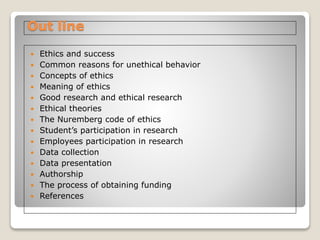
Out line
 Ethics and success
 Common reasons for unethical behavior
 Concepts of ethics
 Meaning of ethics
 Good research and ethical research
 Ethical theories
 The Nuremberg code of ethics
 Student’s participation in research
 Employees participation in research
 Data collection
 Data presentation
 Authorship
 The process of obtaining funding
 References
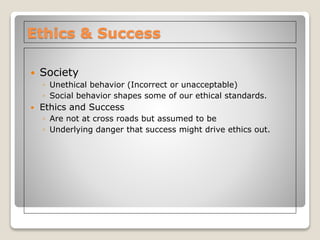
Ethics & Success
 Society
◦ Unethical behavior (Incorrect or unacceptable)
◦ Social behavior shapes some of our ethical standards.
 Ethics and Success
◦ Are not at cross roads but assumed to be
◦ Underlying danger that success might drive ethics out.
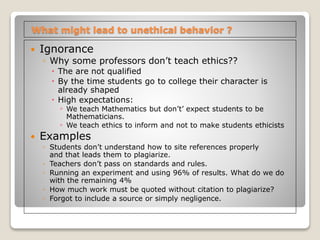
What might lead to unethical behavior ?
 Ignorance
◦ Why some professors don’t teach ethics??
 The are not qualified
 By the time students go to college their character is
already shaped
 High expectations:
◦ We teach Mathematics but don’t’ expect students to be
Mathematicians.
◦ We teach ethics to inform and not to make students ethicists
 Examples
◦ Students don’t understand how to site references properly
and that leads them to plagiarize.
◦ Teachers don’t pass on standards and rules.
◦ Running an experiment and using 96% of results. What do we do
with the remaining 4%
◦ How much work must be quoted without citation to plagiarize?
◦ Forgot to include a source or simply negligence.
Ignorance leading to unethical behavior
 Policies and standards of the school or the institution should
be taught to the students.
 Make sure that policies and standards are followed properly
◦ Before it used to be monitoring, but now it is not enough since labs
are growing and more money and dead lines are involved.
 Telling students where to go with ethical concerns and which
dean to talk to if he needs that.
Stress
 I must get this grant
 I need to get published
 I must meet this deadline
Stress
 Getting some thing done might seem more important than
how to get it done.
 We cannot remove stress but we can teach people how to deal
with it.
◦ Stress on teaching the virtue of science to pursuit knowledge
◦ Talk about the outcome of forging data and future consequences
◦ Patience and immediate result problem
◦ Teach students to talk to teachers:
 Protest the load of work
 Design the experiment is not working and that is leading to this
data.Change the design.
 Ask for help when they need it and help them when they ask.
◦ When things are not clear any more, step back and think
objectively.
◦ Reduce the load of work
◦ Always think that there is an acceptable and ethical outcome
◦ Teach students to think under stress.
Who will blow the whistle? Need a new job?
 What to do when you see some one behaving unethically?
 Relationship with that person will change the way you deal with the
situation
◦ A fellow faculty or a competitor.
 Students make mistakes, you need to tell them that it is wrong to do
it that way and direct them to the right way.
 Witnessing misconduct
◦ Make sure that there is abuse by documenting misconduct and try
to get witnesses and facts.
◦ Prepare a solid foundation.
◦ Approaching the situation the right way
 Can you explain those anomalies to me? OR How long have you been
forging data?
◦ If the person denies misconduct you need to go to higher level.
 Students must be taught to:
◦ Blow the whistle and report misconduct
◦ Which dean to talk to?
◦ What are the policies and regulations?
◦ What is an approved procedure to report misconduct?
Concepts of ethics
 Moral Sensitivity:
◦ “ The ability to recognize an issue or a problem as a moral
problem”
(Penslar,1995 ).
◦ Identifying actions or ranges of actions that might define some
actions that are ethical and some actions that are unethical like the
use of animals in research.
 Moral reasoning:
◦ “Is the process of thinking about proper course of action when
faced with an ethical challenge” (Penslar, 1995 ).
◦ Not different from scientific reasoning but practice is a good idea.
 Moral commitment:
◦ “Is what takes to choose a ethically sound course of action over an
unethical course of action” (Penslar, 1995 ).
◦ What is the primary commitment
 Ethics
 Wealth
 Successful research
Concepts and meaning of ethics
 Moral perseverance:
◦ “Is having the ego strength and tenacity to follow through on one’s
decisions” (Penslar, 1995 ).
◦ Similar to moral commitment but not identical.
 Lack of moral commitment might lead a person to act unethically, and
some one with moral commitment might still act unethically if he became
under pressure to do so.
 Meaning of ethics
◦ “Derived from the Greek ethos, meaning character, custom, or
usage, or morality
( from the Latin synonym meaning manner,custom or habit), is the
philosophical study of normative behavior, the “shoulds” and
“oughts”, the”rights” and “wrongs” of our conduct.” (Penslar, 1995
).
◦ “Research ethics is a kind of applied ethics” (Penslar, 1995 ).
◦ Resolves practical problems in the conduct of research.
◦ Moral acceptability or appropriateness of specific conduct and the
actions to be done.
Good research and ethical research
 Drawing the line between good research and ethical research is
not always clear.
◦ “Good research is concerned with the integrity and the soundness of
data, where as research ethics is concerned with the means the data
was collected” (Penslar, 1995 ).
◦ Research ethics is concerned with the well being of others( Society,
other people, animals) while standards concerning research does not
necessarily do that.
 Issues in research ethics:
◦ Conduct of individuals
◦ Research fraud
◦ Mistreatment of lab animals
◦ Accuracy and honesty in reporting results
◦ Plagiarism
◦ Violation of intellectual property rights
◦ Conflict of interests ( researchers among each other or researchers
and universities)
◦ Principle of the contribution to science as a whole.
◦ Check if a research is harmful to the society or to individuals.
◦ How universities should resolve their conflicts among them selves.
Ethical research
 Helpful resources:
◦ Professional codes
◦ Statement of moral norms by members of a profession
 American Psychological association
 American Historical association
◦ Government regulations
 More like laws
◦ Use of humans as subjects of experiments
◦ Religion
◦ Cultural customs
 Ethical theories:
 Consequential ethics
 Deontological ethics
 Casuistical ethics
 Virtue ethics
The Nuremberg code of ethics
 The voluntary consent of human subject is absolutely essential.
◦ Should have the legal capacity to give consent.
◦ Should be situated to be able to exercise the free power of choice.
 The experiment should be such as to yield fruitful results for the
good of society, unprocurable by other methods or means of
study, and not random and unnecessary in nature.
 The experiment should be so designed and based on the results
of animal experimentation and a knowledge of the natural history
of the disease or other problem under study that the anticipated
results will justify the performance of the experiment.
 The experiment should be so conducted to avoid all unnecessary
physical and mental suffering and injury.
 No experiment should be conducted where there is a priori reason
to believe that death or disabling injury will occur; except,
perhaps, in those experiments where the experimental physicians
also serve as subjects.
 The degree of risk to be taken should never exceed that
determined by the humanitarian importance of the problem to be
solved by the experiment.
The Nuremberg code of ethics
 Proper preparation should be made and adequate facilities
provided to protect the experimental subject against even
remote possibilities of injury, disability, or death.
 The experiment should be conducted only by scientifically
qualified persons. The highest degree of skill and care should
be required through all the stages of the experiment of those
who conduct or engage in the experiment.
 During the course of the experiment the human subject
should be at the liberty to bring the experiment to an end if
he has reached the physical or mental state where
continuation of the experiment seemed to him to be
impossible.
 During the course of the experiment the scientist on charge
must be prepared to terminate the experiment at any stage, if
he has probably cause to believe, in the exercise of the good
faith, superior skill and careful judgment required of him that
a continuation of the experiment is likely to result in injury
disability, or death to the experiment subject.
Basic ethical principles
 The expression “basic ethical principles” refers to those
general judgments that serve as a basic justification for the
many particular ethical prescriptions and evaluations of
human actions.
◦ Respect for persons:
 The person should be treated as autonomous.
 The person with diminished autonomy is entitled to protection.
 Who is an autonomous person:
 Can think and discuss his personal goals and act under those goals.
 Protect those who cannot make their own self determination or they are
not eligible for doing so.
◦ Beneficence:
 Not only respect their decisions and protect them from harm but also
make an effort to secure their well being.
◦ Think of this as an obligation and not a charity.
◦ Do not harm , and maximize possible benefits and minimize possible harms.
◦ Justice:
 The right to be treated equally.
 Some one is denied benefits for no obvious reason.
 The principle of fairness in distribution.
Student’s participation in research
 The question of whether and in what way students are allowed to
participate in research.
◦ Student participation can be included as a course component for
course credit
( Commonly included in psychology departments).
◦ Students agreement to participate in the research might not be
freely given because of a belief that doing so will put them in good
favor with faculty(grades, recommendations , employment).
 However
◦ Prohibiting students from participating in research will be an over
protective behavior.
◦ A good approach is that faculty-investigators advertise for subjects
generally, rather than recruit students individually.
 Students participating in research for credits should be given the fair
alternative of either special projects, brief reports, or brief quizzes for
extra readings .
 The papers and the quizzes are no to be graded.
 Confidentiality
◦ Mental health ,sexual behavior, use of drugs…
Employee’s participation in research
 Similar to the student situation
◦ Influence of power.
◦ Absence of free will because of concerns about grades (students) ,
job advancements( employees).
◦ Confidentiality .
 Employees of biomedical companies are ideal subjects for
they understand the importance of their participation
 Case study on the use of alcohol and the aggressive behavior
Data Collection
 Data collection is a crucial factor in reaching a conclusion in
an experiment.
 The importance of the tools or artifacts used.
 Identifying the relevant variables and noting the significance
of each variable to reach the experimental outcome.
 Collect data with as much precision as possible.
 The more and various are the steps, the more time and
attention is required by the people conducting the
experiment.
 Learning period might yield unreliable data.
 Training and resources.
 What to do with the data collected during the learning period?
 Pressure to produce data within a specific time period to
support a hypothesis.
 Overlooking some variables, or sloppiness
Data Collection
Data selection, analysis and interpretation
◦ Moving from a set of scientific data to a conclusion.
◦ Deciding on which data points can be removed and which are
critical points of the experiment results.
◦ Considering each data point might lead to a question that is of
more importance than the original question.
◦ Smoking and lung cancer???
 Some people smoke and don’t get lung cancer.
◦ Data analysis might be influenced by:
 Expectations
 Desires
 Investment of time , effort, and ego.
 Publication pressure.
Data presentation
 Oral presentation
◦ A scientist is invited to talk about his/her research and may
present some data that has not been published yet. The scientist is
looking for critical feed back and important input.
◦ By sharing the results an early stage, someone else might carry
out the work and obtain credit for it.
◦ Restrict the audience to people that you have previous personal
trust for.
◦ When the research is at a stage to be presented to the outside
world, there are some ethical issues:
 The degree to to which one should be open as far as sharing data,
experiment details…etc
 Appropriately credit those who participated.
 Adequately present the results.
 A good way is to include the names of the people that contributed in the
research in the presentation slides.
◦ Data to present
 Which to present and which to hide ?
 Clear and accurate presentation of the findings.
 The data should be presented in a way that enables them in principle to
be reproduced by another experimenter
 Experiments that present “ clues along the way” (Stern, 1997) are non
reproducible.
Data presentation
 Searching and identifying the uncontrolled variables that
cause variation in the experiment outcome.
 Gordon research conference
◦ Emphasis on informal nature.
◦ Written proceedings are not kept to encourage oral and almost
informal presentation of the findings.
◦ Submission of abstracts that are not peer reviewed, and serve as a
communication medium for the scientists.
◦ Each presenter is limited to 10-15 min presentation.
 You cannot present the whole story.
 Using graphics to present data findings is not an easy task to do.
 Written presentation
◦ Oral presentation does not have the same approval as a peer
reviewed publication.
◦ Peer reviewed does not make the findings true.
 The underlying assumptions that go into the analysis of the data are
shared by the authors and the reviewers.
Data presentation
 Peer reviewed does not guarantee that the assumptions are
true.
 It does attempt to guarantee that:
◦ “The process of attempting to identify critical controls and
analytical pitfalls is carried out in a more formal and considered
manner than it usually possible for oral presentation. “(Stern,
1997)
◦ “A second function of the peer reviewed is to decide on the level of
significance of the findings in the manuscript in relation to the
mission of the journal itself.” (Stern, 1997)
 Concerns on the side of the scientist
◦ If the data and their interpretation are to pass the check from the
reviewers prospective of scientific accuracy and experimental
design.
◦ The content is of sufficient to fit the profile of the journal to which
it was submitted.
 If a reviewers do not accurately understand the aspects of the
paper. A second ,third or even a fourth reviewer is introduced.
 Conflict of interest.
◦ Do you feel comfortable reviewing paper X by author Y?
◦ Author may choose one or two people that they want to be the
reviewers.
 Reviewer taking advantage by delaying a publication to get
his paper published first.
Data presentation
Postpublication ethical concerns
◦ Make some agents or results described in the paper available to
the scientific community.
◦ May be overwhelming for a small lab to respond to a large number
of requests.
◦ A possible solution might be the creation of a small repository with
cost constraints that supply the issues of interest to the scientific
community.
◦ What about taking the results and working on the next stage that
is already being worked on in a small lab and beating them into the
final result?
◦ Some researchers prefer to explore a problem in depth before any
publication or release of data ,but what about competition?
◦ What if there is contradictions in the findings and the original
study?
 A publication to describe the differences between the current findings and
the original ones is most appropriate.
 An instrument might have caused the error.
Data presentation
 Presentation of scientific data and findings to society
◦ Presents serious ethical issues to the scientist.
◦ The pace of publication relative to clear social concern.
 “The findings are of importance to both the public and the makers“.(Stern,
1997)
 “ To carry out the study to the point where the highest degree of accuracy
have been achieved must be considered” .(Stern, 1997)
◦ Present the data in a way that presents the strengths and the
weaknesses of the study.
Authorship
 Primary way for the researchers is to communicate their ideas.
 Credit for one’s effort and contributions is allocated.
 A measure for the level of contribution to the scientific
community.
 Intentional plagiarism is stealing.
 Assigning the responsibility of one’s findings, and the accuracy of
the data presented.
 More than one author , how will the responsibility and the
contribution be distributed ?
 Quantity and quality of publication
◦ Small bits of related data points.
◦ Same idea but different words.
 Credit
◦ Who should be the author and in what order should the authors be
listed?
◦ Concept or problem definition , experimentation or observation, and
calculations; and writing.
◦ Experimental design, data collection, data analysis, and interpretation.
Authorship
 “Authors are those who made a significant scientific
contribution to the original, new information that is the core of
the paper” .(Stern, 1997)
 Should technicians, secretaries, programmers be considered
authors ? Why ? Or why not?
 Authorship is contribution and responsibility to the final
product.
 Must be able to take public responsibility for the contents of
the paper
◦ Why and how observations were made, and how conclusions follow
from the data.
The process of obtaining funds
 Research costs money:
◦ Salaries , equipment, physical space, other services
 Fund sources
◦ Government, private non profit organizations, donations from
private individuals, funds from private industry
 Research grant and research contract
◦ Research grant proposal: “ Justification of the significance of the
question that the scientist proposes to test, the description of the
research strategies and techniques that will be used to test the
hypothesis, and the description of the methods of data analysis
that will be used” .(Stern, 1997)
 “ One key distinction between research grant and research
contract is responsibility of hypothesis generation. “(Stern,
1997)
 ” In the case of the research contract, the hypothesis is to be
tested, as well as the line of the investigation to be perused in
terms of method, and strategy, is explicitly laid out by the
organization providing the funding.” .(Stern, 1997)
The process of obtaining funding
 Ethical issues:
◦ Same as peer reviewed articles
◦ Some of the reviewers might be working on the same topic or
issue.
◦ Some research areas are preferred over others ( example AIDS
related research).
 “A scientist might be faced with an ethical dilemma of being
committed to the type of research being conducted but
disagrees to the motivation behind the research.” (Stern,
1997)
 The use of research on marine mammals by the US Navy to
be used for military purposes.
 The is no set of rules to ensure fairness since the assessment
of scientific merit is somewhat subjective and relevance to
program goals of the funding entity.
References
 Penslar, R. L. (1995). Research Ethics, Cases & Materials,
Indiana University Press.
 Stern, D. E. a. J. E. (1997). Research Ethics, A reader,
University press of New England.
 Protecting human research subjects, Institutional review
board guidebook , 1993, National institute of health.


ResearchEthics.ppt

  • 1.
    Ethics with respectto Science and Research Presented by Dr. Shital Tamakuwala Prepared by Nadim H. Rabbani
  • 2.
    Out line  Ethicsand success  Common reasons for unethical behavior  Concepts of ethics  Meaning of ethics  Good research and ethical research  Ethical theories  The Nuremberg code of ethics  Student’s participation in research  Employees participation in research  Data collection  Data presentation  Authorship  The process of obtaining funding  References
  • 3.
    Ethics & Success Society ◦ Unethical behavior (Incorrect or unacceptable) ◦ Social behavior shapes some of our ethical standards.  Ethics and Success ◦ Are not at cross roads but assumed to be ◦ Underlying danger that success might drive ethics out.
  • 4.
    What might leadto unethical behavior ?  Ignorance ◦ Why some professors don’t teach ethics??  The are not qualified  By the time students go to college their character is already shaped  High expectations: ◦ We teach Mathematics but don’t’ expect students to be Mathematicians. ◦ We teach ethics to inform and not to make students ethicists  Examples ◦ Students don’t understand how to site references properly and that leads them to plagiarize. ◦ Teachers don’t pass on standards and rules. ◦ Running an experiment and using 96% of results. What do we do with the remaining 4% ◦ How much work must be quoted without citation to plagiarize? ◦ Forgot to include a source or simply negligence.
  • 5.
    Ignorance leading tounethical behavior  Policies and standards of the school or the institution should be taught to the students.  Make sure that policies and standards are followed properly ◦ Before it used to be monitoring, but now it is not enough since labs are growing and more money and dead lines are involved.  Telling students where to go with ethical concerns and which dean to talk to if he needs that.
  • 6.
    Stress  I mustget this grant  I need to get published  I must meet this deadline
  • 7.
    Stress  Getting something done might seem more important than how to get it done.  We cannot remove stress but we can teach people how to deal with it. ◦ Stress on teaching the virtue of science to pursuit knowledge ◦ Talk about the outcome of forging data and future consequences ◦ Patience and immediate result problem ◦ Teach students to talk to teachers:  Protest the load of work  Design the experiment is not working and that is leading to this data.Change the design.  Ask for help when they need it and help them when they ask. ◦ When things are not clear any more, step back and think objectively. ◦ Reduce the load of work ◦ Always think that there is an acceptable and ethical outcome ◦ Teach students to think under stress.
  • 8.
    Who will blowthe whistle? Need a new job?  What to do when you see some one behaving unethically?  Relationship with that person will change the way you deal with the situation ◦ A fellow faculty or a competitor.  Students make mistakes, you need to tell them that it is wrong to do it that way and direct them to the right way.  Witnessing misconduct ◦ Make sure that there is abuse by documenting misconduct and try to get witnesses and facts. ◦ Prepare a solid foundation. ◦ Approaching the situation the right way  Can you explain those anomalies to me? OR How long have you been forging data? ◦ If the person denies misconduct you need to go to higher level.  Students must be taught to: ◦ Blow the whistle and report misconduct ◦ Which dean to talk to? ◦ What are the policies and regulations? ◦ What is an approved procedure to report misconduct?
  • 9.
    Concepts of ethics Moral Sensitivity: ◦ “ The ability to recognize an issue or a problem as a moral problem” (Penslar,1995 ). ◦ Identifying actions or ranges of actions that might define some actions that are ethical and some actions that are unethical like the use of animals in research.  Moral reasoning: ◦ “Is the process of thinking about proper course of action when faced with an ethical challenge” (Penslar, 1995 ). ◦ Not different from scientific reasoning but practice is a good idea.  Moral commitment: ◦ “Is what takes to choose a ethically sound course of action over an unethical course of action” (Penslar, 1995 ). ◦ What is the primary commitment  Ethics  Wealth  Successful research
  • 10.
    Concepts and meaningof ethics  Moral perseverance: ◦ “Is having the ego strength and tenacity to follow through on one’s decisions” (Penslar, 1995 ). ◦ Similar to moral commitment but not identical.  Lack of moral commitment might lead a person to act unethically, and some one with moral commitment might still act unethically if he became under pressure to do so.  Meaning of ethics ◦ “Derived from the Greek ethos, meaning character, custom, or usage, or morality ( from the Latin synonym meaning manner,custom or habit), is the philosophical study of normative behavior, the “shoulds” and “oughts”, the”rights” and “wrongs” of our conduct.” (Penslar, 1995 ). ◦ “Research ethics is a kind of applied ethics” (Penslar, 1995 ). ◦ Resolves practical problems in the conduct of research. ◦ Moral acceptability or appropriateness of specific conduct and the actions to be done.
  • 11.
    Good research andethical research  Drawing the line between good research and ethical research is not always clear. ◦ “Good research is concerned with the integrity and the soundness of data, where as research ethics is concerned with the means the data was collected” (Penslar, 1995 ). ◦ Research ethics is concerned with the well being of others( Society, other people, animals) while standards concerning research does not necessarily do that.  Issues in research ethics: ◦ Conduct of individuals ◦ Research fraud ◦ Mistreatment of lab animals ◦ Accuracy and honesty in reporting results ◦ Plagiarism ◦ Violation of intellectual property rights ◦ Conflict of interests ( researchers among each other or researchers and universities) ◦ Principle of the contribution to science as a whole. ◦ Check if a research is harmful to the society or to individuals. ◦ How universities should resolve their conflicts among them selves.
  • 12.
    Ethical research  Helpfulresources: ◦ Professional codes ◦ Statement of moral norms by members of a profession  American Psychological association  American Historical association ◦ Government regulations  More like laws ◦ Use of humans as subjects of experiments ◦ Religion ◦ Cultural customs  Ethical theories:  Consequential ethics  Deontological ethics  Casuistical ethics  Virtue ethics
  • 13.
    The Nuremberg codeof ethics  The voluntary consent of human subject is absolutely essential. ◦ Should have the legal capacity to give consent. ◦ Should be situated to be able to exercise the free power of choice.  The experiment should be such as to yield fruitful results for the good of society, unprocurable by other methods or means of study, and not random and unnecessary in nature.  The experiment should be so designed and based on the results of animal experimentation and a knowledge of the natural history of the disease or other problem under study that the anticipated results will justify the performance of the experiment.  The experiment should be so conducted to avoid all unnecessary physical and mental suffering and injury.  No experiment should be conducted where there is a priori reason to believe that death or disabling injury will occur; except, perhaps, in those experiments where the experimental physicians also serve as subjects.  The degree of risk to be taken should never exceed that determined by the humanitarian importance of the problem to be solved by the experiment.
  • 14.
    The Nuremberg codeof ethics  Proper preparation should be made and adequate facilities provided to protect the experimental subject against even remote possibilities of injury, disability, or death.  The experiment should be conducted only by scientifically qualified persons. The highest degree of skill and care should be required through all the stages of the experiment of those who conduct or engage in the experiment.  During the course of the experiment the human subject should be at the liberty to bring the experiment to an end if he has reached the physical or mental state where continuation of the experiment seemed to him to be impossible.  During the course of the experiment the scientist on charge must be prepared to terminate the experiment at any stage, if he has probably cause to believe, in the exercise of the good faith, superior skill and careful judgment required of him that a continuation of the experiment is likely to result in injury disability, or death to the experiment subject.
  • 15.
    Basic ethical principles The expression “basic ethical principles” refers to those general judgments that serve as a basic justification for the many particular ethical prescriptions and evaluations of human actions. ◦ Respect for persons:  The person should be treated as autonomous.  The person with diminished autonomy is entitled to protection.  Who is an autonomous person:  Can think and discuss his personal goals and act under those goals.  Protect those who cannot make their own self determination or they are not eligible for doing so. ◦ Beneficence:  Not only respect their decisions and protect them from harm but also make an effort to secure their well being. ◦ Think of this as an obligation and not a charity. ◦ Do not harm , and maximize possible benefits and minimize possible harms. ◦ Justice:  The right to be treated equally.  Some one is denied benefits for no obvious reason.  The principle of fairness in distribution.
  • 16.
    Student’s participation inresearch  The question of whether and in what way students are allowed to participate in research. ◦ Student participation can be included as a course component for course credit ( Commonly included in psychology departments). ◦ Students agreement to participate in the research might not be freely given because of a belief that doing so will put them in good favor with faculty(grades, recommendations , employment).  However ◦ Prohibiting students from participating in research will be an over protective behavior. ◦ A good approach is that faculty-investigators advertise for subjects generally, rather than recruit students individually.  Students participating in research for credits should be given the fair alternative of either special projects, brief reports, or brief quizzes for extra readings .  The papers and the quizzes are no to be graded.  Confidentiality ◦ Mental health ,sexual behavior, use of drugs…
  • 17.
    Employee’s participation inresearch  Similar to the student situation ◦ Influence of power. ◦ Absence of free will because of concerns about grades (students) , job advancements( employees). ◦ Confidentiality .  Employees of biomedical companies are ideal subjects for they understand the importance of their participation  Case study on the use of alcohol and the aggressive behavior
  • 18.
    Data Collection  Datacollection is a crucial factor in reaching a conclusion in an experiment.  The importance of the tools or artifacts used.  Identifying the relevant variables and noting the significance of each variable to reach the experimental outcome.  Collect data with as much precision as possible.  The more and various are the steps, the more time and attention is required by the people conducting the experiment.  Learning period might yield unreliable data.  Training and resources.  What to do with the data collected during the learning period?  Pressure to produce data within a specific time period to support a hypothesis.  Overlooking some variables, or sloppiness
  • 19.
    Data Collection Data selection,analysis and interpretation ◦ Moving from a set of scientific data to a conclusion. ◦ Deciding on which data points can be removed and which are critical points of the experiment results. ◦ Considering each data point might lead to a question that is of more importance than the original question. ◦ Smoking and lung cancer???  Some people smoke and don’t get lung cancer. ◦ Data analysis might be influenced by:  Expectations  Desires  Investment of time , effort, and ego.  Publication pressure.
  • 20.
    Data presentation  Oralpresentation ◦ A scientist is invited to talk about his/her research and may present some data that has not been published yet. The scientist is looking for critical feed back and important input. ◦ By sharing the results an early stage, someone else might carry out the work and obtain credit for it. ◦ Restrict the audience to people that you have previous personal trust for. ◦ When the research is at a stage to be presented to the outside world, there are some ethical issues:  The degree to to which one should be open as far as sharing data, experiment details…etc  Appropriately credit those who participated.  Adequately present the results.  A good way is to include the names of the people that contributed in the research in the presentation slides. ◦ Data to present  Which to present and which to hide ?  Clear and accurate presentation of the findings.  The data should be presented in a way that enables them in principle to be reproduced by another experimenter  Experiments that present “ clues along the way” (Stern, 1997) are non reproducible.
  • 21.
    Data presentation  Searchingand identifying the uncontrolled variables that cause variation in the experiment outcome.  Gordon research conference ◦ Emphasis on informal nature. ◦ Written proceedings are not kept to encourage oral and almost informal presentation of the findings. ◦ Submission of abstracts that are not peer reviewed, and serve as a communication medium for the scientists. ◦ Each presenter is limited to 10-15 min presentation.  You cannot present the whole story.  Using graphics to present data findings is not an easy task to do.  Written presentation ◦ Oral presentation does not have the same approval as a peer reviewed publication. ◦ Peer reviewed does not make the findings true.  The underlying assumptions that go into the analysis of the data are shared by the authors and the reviewers.
  • 22.
    Data presentation  Peerreviewed does not guarantee that the assumptions are true.  It does attempt to guarantee that: ◦ “The process of attempting to identify critical controls and analytical pitfalls is carried out in a more formal and considered manner than it usually possible for oral presentation. “(Stern, 1997) ◦ “A second function of the peer reviewed is to decide on the level of significance of the findings in the manuscript in relation to the mission of the journal itself.” (Stern, 1997)  Concerns on the side of the scientist ◦ If the data and their interpretation are to pass the check from the reviewers prospective of scientific accuracy and experimental design. ◦ The content is of sufficient to fit the profile of the journal to which it was submitted.  If a reviewers do not accurately understand the aspects of the paper. A second ,third or even a fourth reviewer is introduced.  Conflict of interest. ◦ Do you feel comfortable reviewing paper X by author Y? ◦ Author may choose one or two people that they want to be the reviewers.  Reviewer taking advantage by delaying a publication to get his paper published first.
  • 23.
    Data presentation Postpublication ethicalconcerns ◦ Make some agents or results described in the paper available to the scientific community. ◦ May be overwhelming for a small lab to respond to a large number of requests. ◦ A possible solution might be the creation of a small repository with cost constraints that supply the issues of interest to the scientific community. ◦ What about taking the results and working on the next stage that is already being worked on in a small lab and beating them into the final result? ◦ Some researchers prefer to explore a problem in depth before any publication or release of data ,but what about competition? ◦ What if there is contradictions in the findings and the original study?  A publication to describe the differences between the current findings and the original ones is most appropriate.  An instrument might have caused the error.
  • 24.
    Data presentation  Presentationof scientific data and findings to society ◦ Presents serious ethical issues to the scientist. ◦ The pace of publication relative to clear social concern.  “The findings are of importance to both the public and the makers“.(Stern, 1997)  “ To carry out the study to the point where the highest degree of accuracy have been achieved must be considered” .(Stern, 1997) ◦ Present the data in a way that presents the strengths and the weaknesses of the study.
  • 25.
    Authorship  Primary wayfor the researchers is to communicate their ideas.  Credit for one’s effort and contributions is allocated.  A measure for the level of contribution to the scientific community.  Intentional plagiarism is stealing.  Assigning the responsibility of one’s findings, and the accuracy of the data presented.  More than one author , how will the responsibility and the contribution be distributed ?  Quantity and quality of publication ◦ Small bits of related data points. ◦ Same idea but different words.  Credit ◦ Who should be the author and in what order should the authors be listed? ◦ Concept or problem definition , experimentation or observation, and calculations; and writing. ◦ Experimental design, data collection, data analysis, and interpretation.
  • 26.
    Authorship  “Authors arethose who made a significant scientific contribution to the original, new information that is the core of the paper” .(Stern, 1997)  Should technicians, secretaries, programmers be considered authors ? Why ? Or why not?  Authorship is contribution and responsibility to the final product.  Must be able to take public responsibility for the contents of the paper ◦ Why and how observations were made, and how conclusions follow from the data.
  • 27.
    The process ofobtaining funds  Research costs money: ◦ Salaries , equipment, physical space, other services  Fund sources ◦ Government, private non profit organizations, donations from private individuals, funds from private industry  Research grant and research contract ◦ Research grant proposal: “ Justification of the significance of the question that the scientist proposes to test, the description of the research strategies and techniques that will be used to test the hypothesis, and the description of the methods of data analysis that will be used” .(Stern, 1997)  “ One key distinction between research grant and research contract is responsibility of hypothesis generation. “(Stern, 1997)  ” In the case of the research contract, the hypothesis is to be tested, as well as the line of the investigation to be perused in terms of method, and strategy, is explicitly laid out by the organization providing the funding.” .(Stern, 1997)
  • 28.
    The process ofobtaining funding  Ethical issues: ◦ Same as peer reviewed articles ◦ Some of the reviewers might be working on the same topic or issue. ◦ Some research areas are preferred over others ( example AIDS related research).  “A scientist might be faced with an ethical dilemma of being committed to the type of research being conducted but disagrees to the motivation behind the research.” (Stern, 1997)  The use of research on marine mammals by the US Navy to be used for military purposes.  The is no set of rules to ensure fairness since the assessment of scientific merit is somewhat subjective and relevance to program goals of the funding entity.
  • 29.
    References  Penslar, R.L. (1995). Research Ethics, Cases & Materials, Indiana University Press.  Stern, D. E. a. J. E. (1997). Research Ethics, A reader, University press of New England.  Protecting human research subjects, Institutional review board guidebook , 1993, National institute of health. 