Ethical by Design:
A Manifesto
Prof Maurice D. Mulvenna
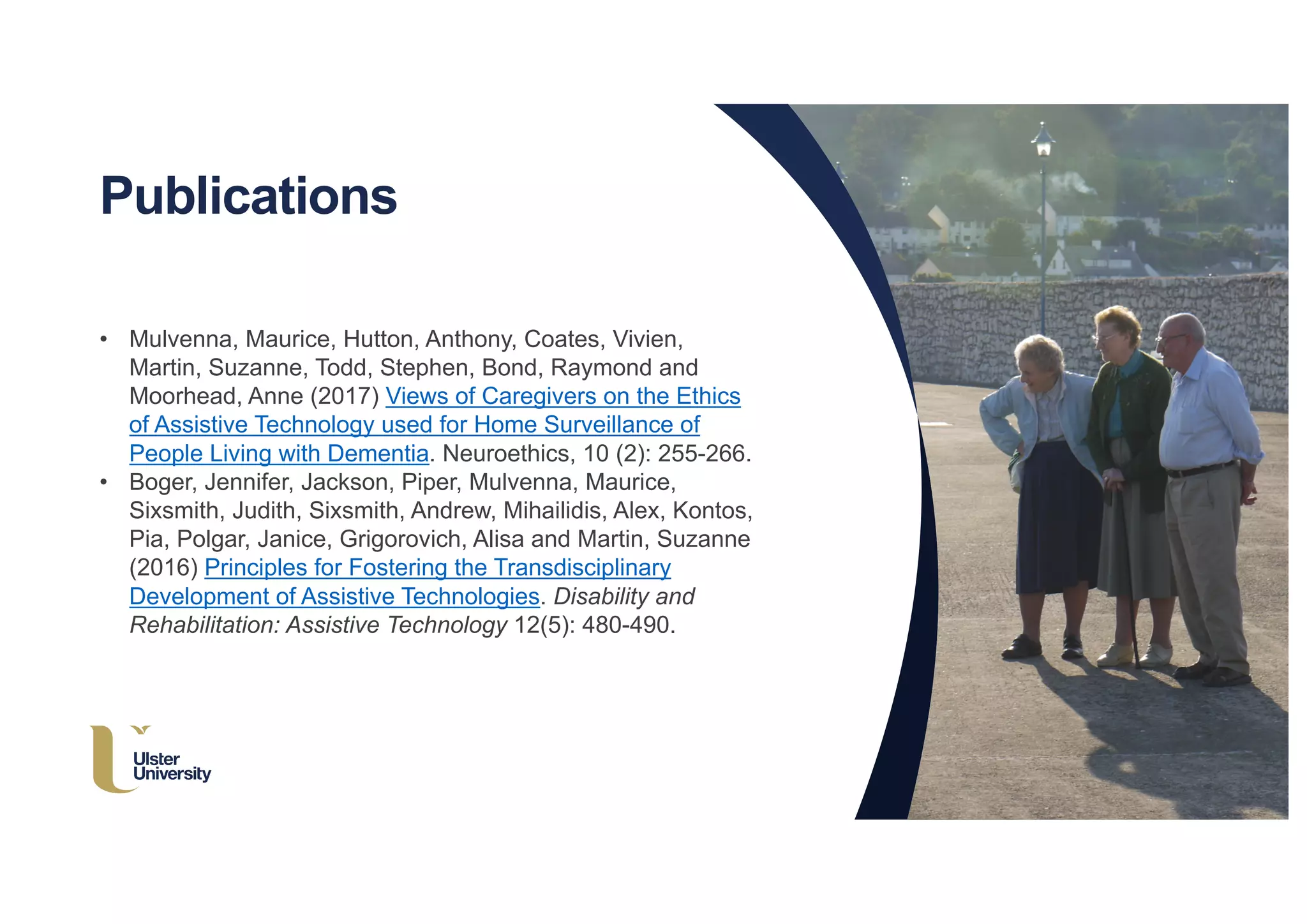
Publications
• Mulvenna, Maurice, Hutton, Anthony, Coates, Vivien,
Martin, Suzanne, Todd, Stephen, Bond, Raymond and
Moorhead, Anne (2017) Views of Caregivers on the Ethics
of Assistive Technology used for Home Surveillance of
People Living with Dementia. Neuroethics, 10 (2): 255-266.
• Boger, Jennifer, Jackson, Piper, Mulvenna, Maurice,
Sixsmith, Judith, Sixsmith, Andrew, Mihailidis, Alex, Kontos,
Pia, Polgar, Janice, Grigorovich, Alisa and Martin, Suzanne
(2016) Principles for Fostering the Transdisciplinary
Development of Assistive Technologies. Disability and
Rehabilitation: Assistive Technology 12(5): 480-490.
• User at centre of design process (UCD)
• User experience (UX)
• Contextual design
• Action research
• Participatory design
• Co-creation
Related work
Literature
• Discourse analysis research: humanist, modernist, political economy and
change management
• Friedman and Kahn: embodied position (one’s own values), exogenous
position (societal values), and interactional position (values of the technology
user)
• Exploring principles relating to the development of assistive technologies
from a transdisciplinary perspective, including complexity and holism,
relationships, communication and transformation
• Advance on the privacy by design approach in the specific area of video
surveillance
Related work
Experience
• “If properly placed being mindful of privacy it
allows the person to live at home for longer and
remain independent”
• “If managed appropriately, I feel that this
concept could enable someone with dementia
to remain at home for longer. Respecting the
individual rights is paramount and this concerns
me. I think education and demonstration would
be beneficial”
• “If it is limited to movement and hallways I
would be more comfortable but in living rooms,
bed rooms you are taking away human rights –
big issue. Everyone is an individual – even with
dementia”
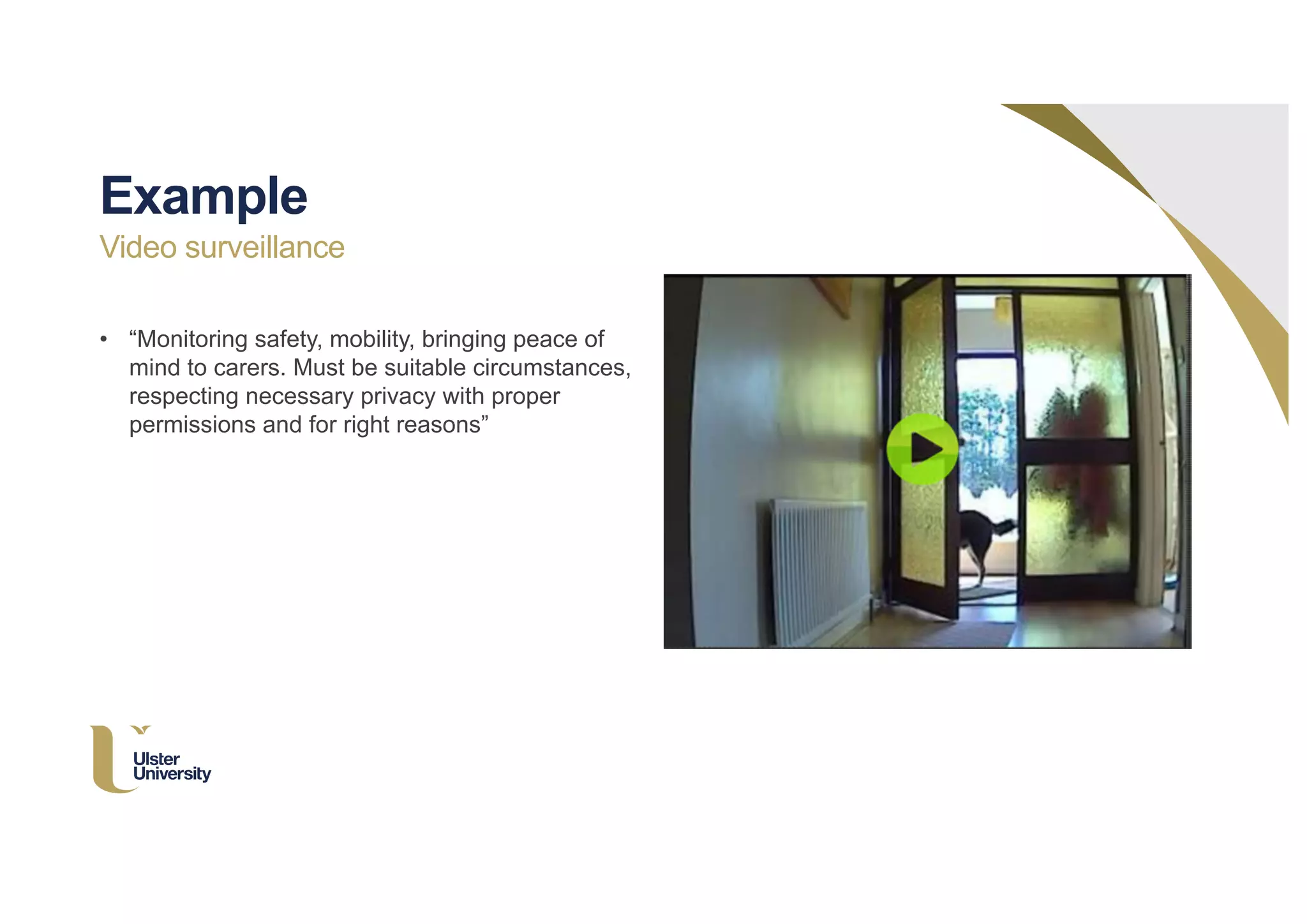
Example
Video surveillance
• “Monitoring safety, mobility, bringing peace of
mind to carers. Must be suitable circumstances,
respecting necessary privacy with proper
permissions and for right reasons”
Example
Video surveillance
• “If used properly, this could provide great
support for those with dementia, provide
comfort for those who are caring for them and
provide valuable insight into the behaviours that
those with dementia exhibit. It could allow
relatives living abroad the opportunity of being
involved in caring for someone with dementia;
like speed cameras, they can change the
behaviours of people. Carers who know and are
aware of the presence of a camera will afford
the person the correct amount of time being
paid for and deliver a better quality of care”
Example
Video surveillance
• ‘Politicisation of data’
Problems ahead
• Design to support the people who will be using the product or service by
engendering empathy for users.
• Provide enough information for people to make informed decisions at every
stage about whether, when, and how to use the product or service.
• Respect people’s right to choose how they engage with the product or
service; offer alternatives or customisation.
Ethical By Design
Manifesto principles
• Balance appropriate privacy and security with equitable access by as many
systems and people as possible, globally
• Seek to integrate with and support the progression of policy
• Actively look for and challenge biases and values that may be reflected in a
product or service design
Ethical By Design
Manifesto principles
raises the question if one should be explicit about
where and why a service is not available (e.g. in
locations / countries where google related systems
are illegal), and if we should point to ways around
this (that are itself officially illegal but in fact do
enable these services, like the use of VPN)
• Complement differing needs, abilities, viewpoints and morals
• Support shared decision making and feedback
• Aim for economically, environmentally, and socially sustainable designs
Ethical By Design
Manifesto principles
• Integrate planning for how to handle failure, including transparency and
reporting
• Be realistic about what is possible and needed
• Support the product or service throughout its lifespan
Ethical By Design
Manifesto principles
include the need to end a
service when it is supposed to
stop, by removing or disabling
any pointers to it and having
mirror (or copy) sites removed.
Context
• Tech is not above us. It should be governed by all of us, by our democratic institutions. It should play by the
rules of our societies. It should serve our needs, both individual and collective, as much as our wants.
• Progress is more than innovation. We are builders at heart. Let us create a new Renaissance. We will open
and nourish honest public conversation about the power of technology. We are ready to serve our societies. We will
apply the means at our disposal to move our societies and their institutions forward.
• Let us build from trust. Let us build for true transparency. We need digital citizens, not mere consumers. We
all depend on transparency to understand how technology shapes us, which data we share, and who has access to
it. Treating each other as commodities from which to extract maximum economic value is bad, not only for society
as a complex, interconnected whole but for each and every one of us.
• Design open to scrutiny. We must encourage a continuous, public, and critical reflection on our definition of
success as it defines how we build and design for others. We must seek to design with those for whom we are
designing. We will not tolerate design for addiction, deception, or control. We must design tools that we would love
our loved ones to use. We must question our intent and listen to our hearts.
• Let us move from human-centered design to humanity-centered design. We are a community that
exerts great influence. We must protect and nurture the potential to do good with it. We must do this with attention
to inequality, with humility, and with love. In the end, our reward will be to know that we have done everything in our
power to leave our garden patch a little greener than we found it.
Context
Techfestival. The Copenhagen Letter, 2017
• Can ethical concerns inherently be addressed by appropriate designs?
• How can such concerns be communicated | resolved | discussed between
different disciplines such as innovation management, industrial product
design, software engineering?
• Can agile and lean concepts from software development (and other viable
techniques) help inform ethical service and product design?
• Accommodating all perspectives – user, funder, designer…
• Early first tentative steps but FAT and Copenhagen Letter shows that there is
a common ground and perhaps the time has come
• Next step is verification by audits to test principles
Conclusions
Thanks
Questions?

Ethical by Design - A Manifesto

  • 1.
    Ethical by Design: AManifesto Prof Maurice D. Mulvenna
  • 2.
    Publications • Mulvenna, Maurice,Hutton, Anthony, Coates, Vivien, Martin, Suzanne, Todd, Stephen, Bond, Raymond and Moorhead, Anne (2017) Views of Caregivers on the Ethics of Assistive Technology used for Home Surveillance of People Living with Dementia. Neuroethics, 10 (2): 255-266. • Boger, Jennifer, Jackson, Piper, Mulvenna, Maurice, Sixsmith, Judith, Sixsmith, Andrew, Mihailidis, Alex, Kontos, Pia, Polgar, Janice, Grigorovich, Alisa and Martin, Suzanne (2016) Principles for Fostering the Transdisciplinary Development of Assistive Technologies. Disability and Rehabilitation: Assistive Technology 12(5): 480-490.
  • 3.
    • User atcentre of design process (UCD) • User experience (UX) • Contextual design • Action research • Participatory design • Co-creation Related work Literature
  • 4.
    • Discourse analysisresearch: humanist, modernist, political economy and change management • Friedman and Kahn: embodied position (one’s own values), exogenous position (societal values), and interactional position (values of the technology user) • Exploring principles relating to the development of assistive technologies from a transdisciplinary perspective, including complexity and holism, relationships, communication and transformation • Advance on the privacy by design approach in the specific area of video surveillance Related work Experience
  • 5.
    • “If properlyplaced being mindful of privacy it allows the person to live at home for longer and remain independent” • “If managed appropriately, I feel that this concept could enable someone with dementia to remain at home for longer. Respecting the individual rights is paramount and this concerns me. I think education and demonstration would be beneficial” • “If it is limited to movement and hallways I would be more comfortable but in living rooms, bed rooms you are taking away human rights – big issue. Everyone is an individual – even with dementia” Example Video surveillance
  • 6.
    • “Monitoring safety,mobility, bringing peace of mind to carers. Must be suitable circumstances, respecting necessary privacy with proper permissions and for right reasons” Example Video surveillance
  • 7.
    • “If usedproperly, this could provide great support for those with dementia, provide comfort for those who are caring for them and provide valuable insight into the behaviours that those with dementia exhibit. It could allow relatives living abroad the opportunity of being involved in caring for someone with dementia; like speed cameras, they can change the behaviours of people. Carers who know and are aware of the presence of a camera will afford the person the correct amount of time being paid for and deliver a better quality of care” Example Video surveillance
  • 8.
    • ‘Politicisation ofdata’ Problems ahead
  • 9.
    • Design tosupport the people who will be using the product or service by engendering empathy for users. • Provide enough information for people to make informed decisions at every stage about whether, when, and how to use the product or service. • Respect people’s right to choose how they engage with the product or service; offer alternatives or customisation. Ethical By Design Manifesto principles
  • 10.
    • Balance appropriateprivacy and security with equitable access by as many systems and people as possible, globally • Seek to integrate with and support the progression of policy • Actively look for and challenge biases and values that may be reflected in a product or service design Ethical By Design Manifesto principles raises the question if one should be explicit about where and why a service is not available (e.g. in locations / countries where google related systems are illegal), and if we should point to ways around this (that are itself officially illegal but in fact do enable these services, like the use of VPN)
  • 11.
    • Complement differingneeds, abilities, viewpoints and morals • Support shared decision making and feedback • Aim for economically, environmentally, and socially sustainable designs Ethical By Design Manifesto principles
  • 12.
    • Integrate planningfor how to handle failure, including transparency and reporting • Be realistic about what is possible and needed • Support the product or service throughout its lifespan Ethical By Design Manifesto principles include the need to end a service when it is supposed to stop, by removing or disabling any pointers to it and having mirror (or copy) sites removed.
  • 13.
  • 14.
    • Tech isnot above us. It should be governed by all of us, by our democratic institutions. It should play by the rules of our societies. It should serve our needs, both individual and collective, as much as our wants. • Progress is more than innovation. We are builders at heart. Let us create a new Renaissance. We will open and nourish honest public conversation about the power of technology. We are ready to serve our societies. We will apply the means at our disposal to move our societies and their institutions forward. • Let us build from trust. Let us build for true transparency. We need digital citizens, not mere consumers. We all depend on transparency to understand how technology shapes us, which data we share, and who has access to it. Treating each other as commodities from which to extract maximum economic value is bad, not only for society as a complex, interconnected whole but for each and every one of us. • Design open to scrutiny. We must encourage a continuous, public, and critical reflection on our definition of success as it defines how we build and design for others. We must seek to design with those for whom we are designing. We will not tolerate design for addiction, deception, or control. We must design tools that we would love our loved ones to use. We must question our intent and listen to our hearts. • Let us move from human-centered design to humanity-centered design. We are a community that exerts great influence. We must protect and nurture the potential to do good with it. We must do this with attention to inequality, with humility, and with love. In the end, our reward will be to know that we have done everything in our power to leave our garden patch a little greener than we found it. Context Techfestival. The Copenhagen Letter, 2017
  • 15.
    • Can ethicalconcerns inherently be addressed by appropriate designs? • How can such concerns be communicated | resolved | discussed between different disciplines such as innovation management, industrial product design, software engineering? • Can agile and lean concepts from software development (and other viable techniques) help inform ethical service and product design? • Accommodating all perspectives – user, funder, designer… • Early first tentative steps but FAT and Copenhagen Letter shows that there is a common ground and perhaps the time has come • Next step is verification by audits to test principles Conclusions
  • 16.