Prof Maurice Mulvenna, University of Ulster
1
Reaching the voice of the
customer: experiences in local
and international test beds and
their value
Outline
•  living labs
•  trail
•  case studies
•  issues
•  realising the value
•  concluding remarks
2
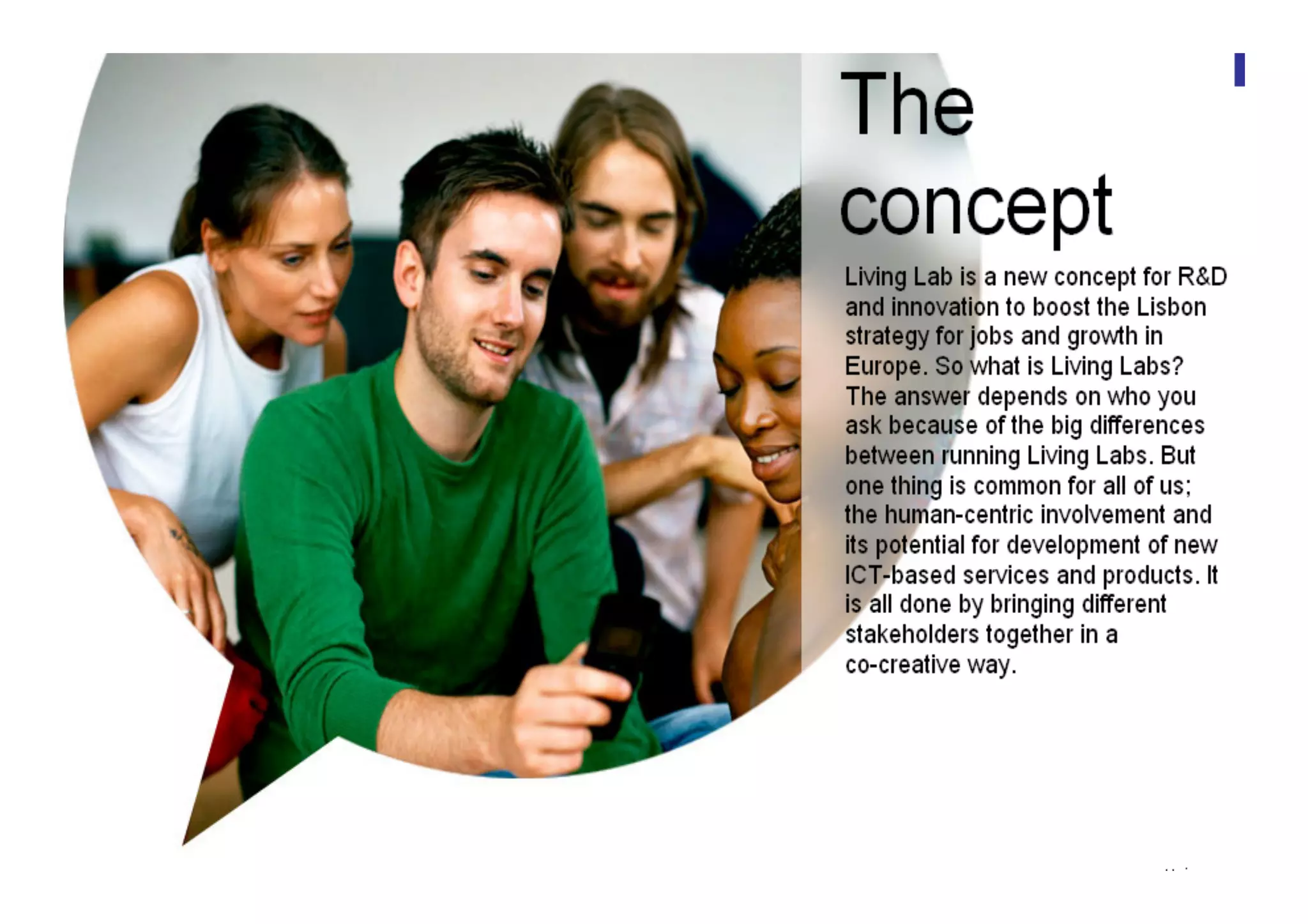
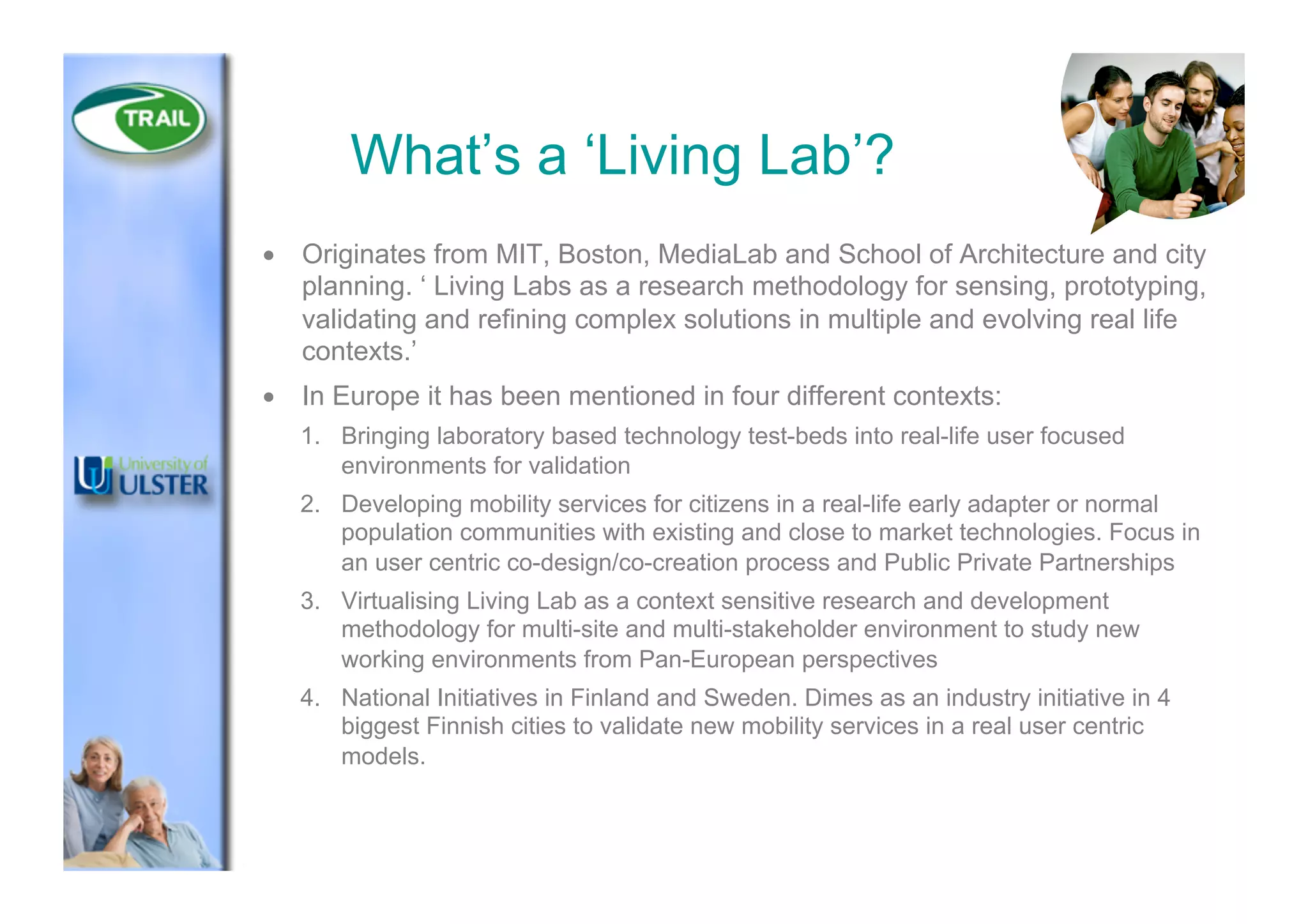
What’s a ‘Living Lab’?
•  Originates from MIT, Boston, MediaLab and School of Architecture and city
planning. ‘ Living Labs as a research methodology for sensing, prototyping,
validating and refining complex solutions in multiple and evolving real life
contexts.’
•  In Europe it has been mentioned in four different contexts:
1.  Bringing laboratory based technology test-beds into real-life user focused
environments for validation
2.  Developing mobility services for citizens in a real-life early adapter or normal
population communities with existing and close to market technologies. Focus in
an user centric co-design/co-creation process and Public Private Partnerships
3.  Virtualising Living Lab as a context sensitive research and development
methodology for multi-site and multi-stakeholder environment to study new
working environments from Pan-European perspectives
4.  National Initiatives in Finland and Sweden. Dimes as an industry initiative in 4
biggest Finnish cities to validate new mobility services in a real user centric
models.
5
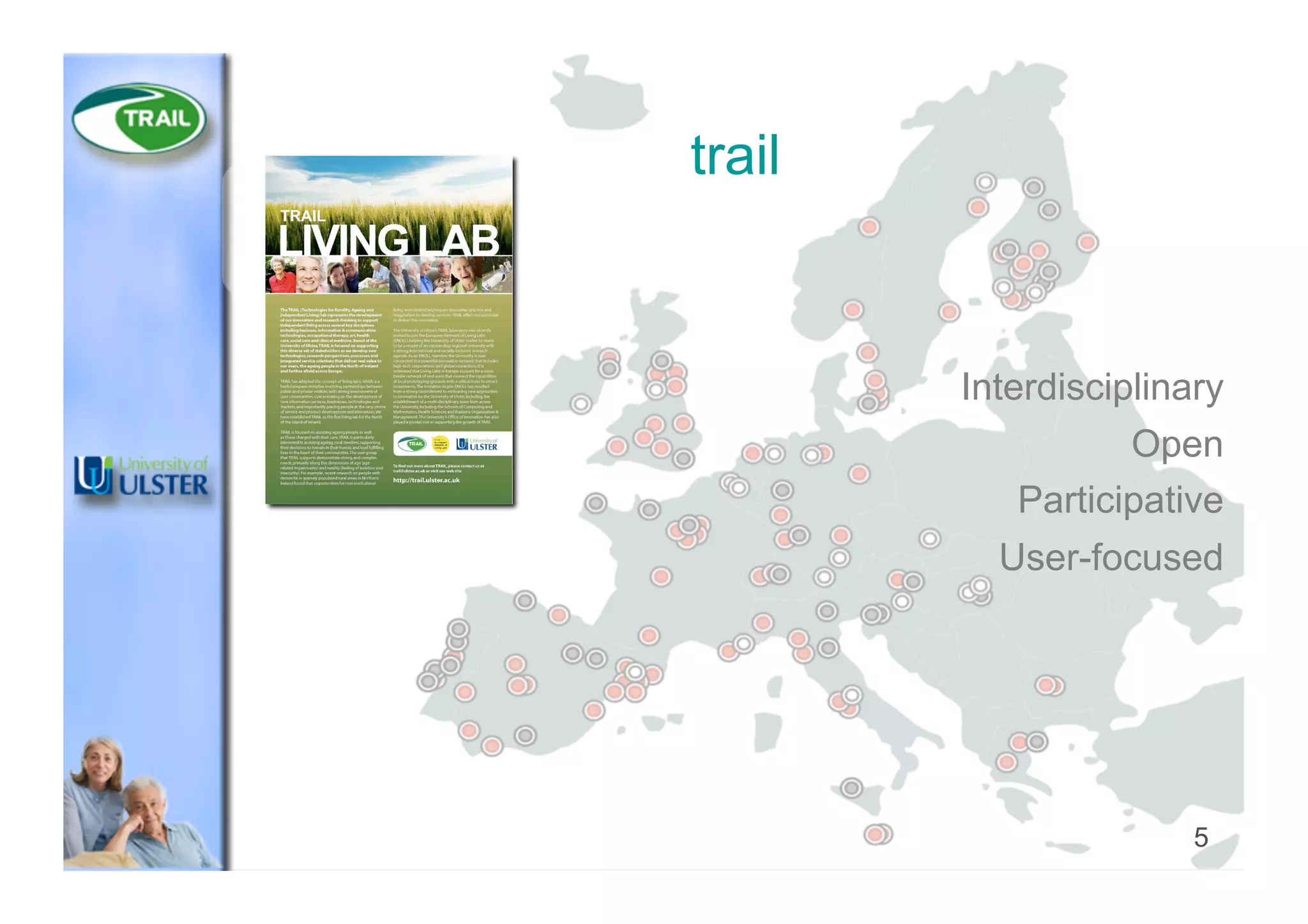
Interdisciplinary
Open
Participative
User-focused
trail
what we do
•  Early stage innovation activities encompassing:
–  Ideation
–  Early research and development, supported by external
funders, in many inter-related areas.
•  Mid-stage market research and preparation
–  Formulating intellectual property and/or know-how
–  Finding local commercialisation partners
6
what we do
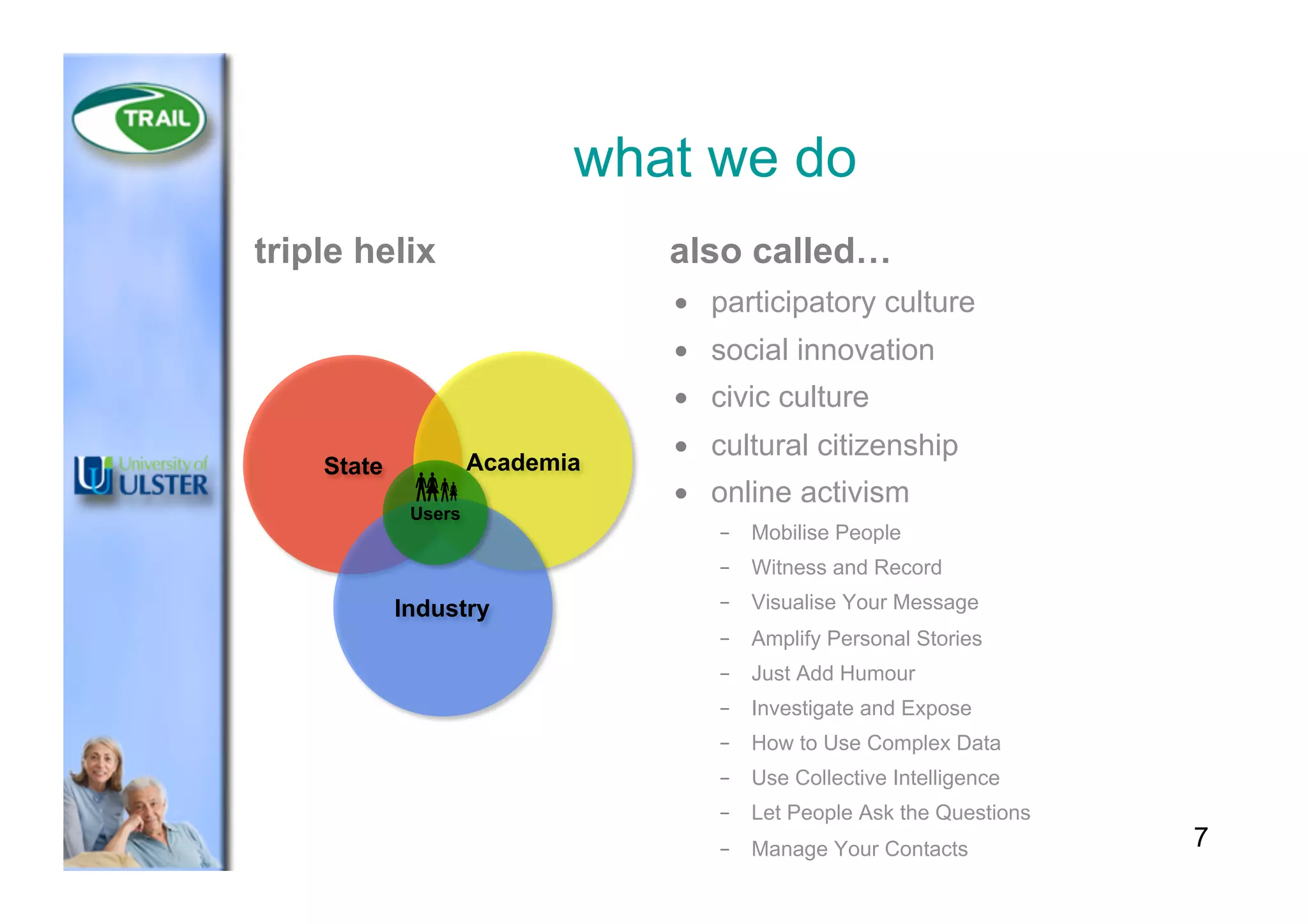
triple helix also called…
•  participatory culture
•  social innovation
•  civic culture
•  cultural citizenship
•  online activism
–  Mobilise People
–  Witness and Record
–  Visualise Your Message
–  Amplify Personal Stories
–  Just Add Humour
–  Investigate and Expose
–  How to Use Complex Data
–  Use Collective Intelligence
–  Let People Ask the Questions
–  Manage Your Contacts 7
State Academia
Industry
Users
relevance to society
•  Living Lab
–  Lessens risk in innovation
–  Speeds up innovation
–  Captures real needs at the beginning of the process
–  New sources of innovation
•  Using ‘lead users’
–  Those that very quickly understand the innovation problem
and articulate their needs because they have acute and latent
needs
–  Ensure higher validity, manage drop-out rates/motivation
levels, buy-in and overall can carry out more efficient
iterations
8
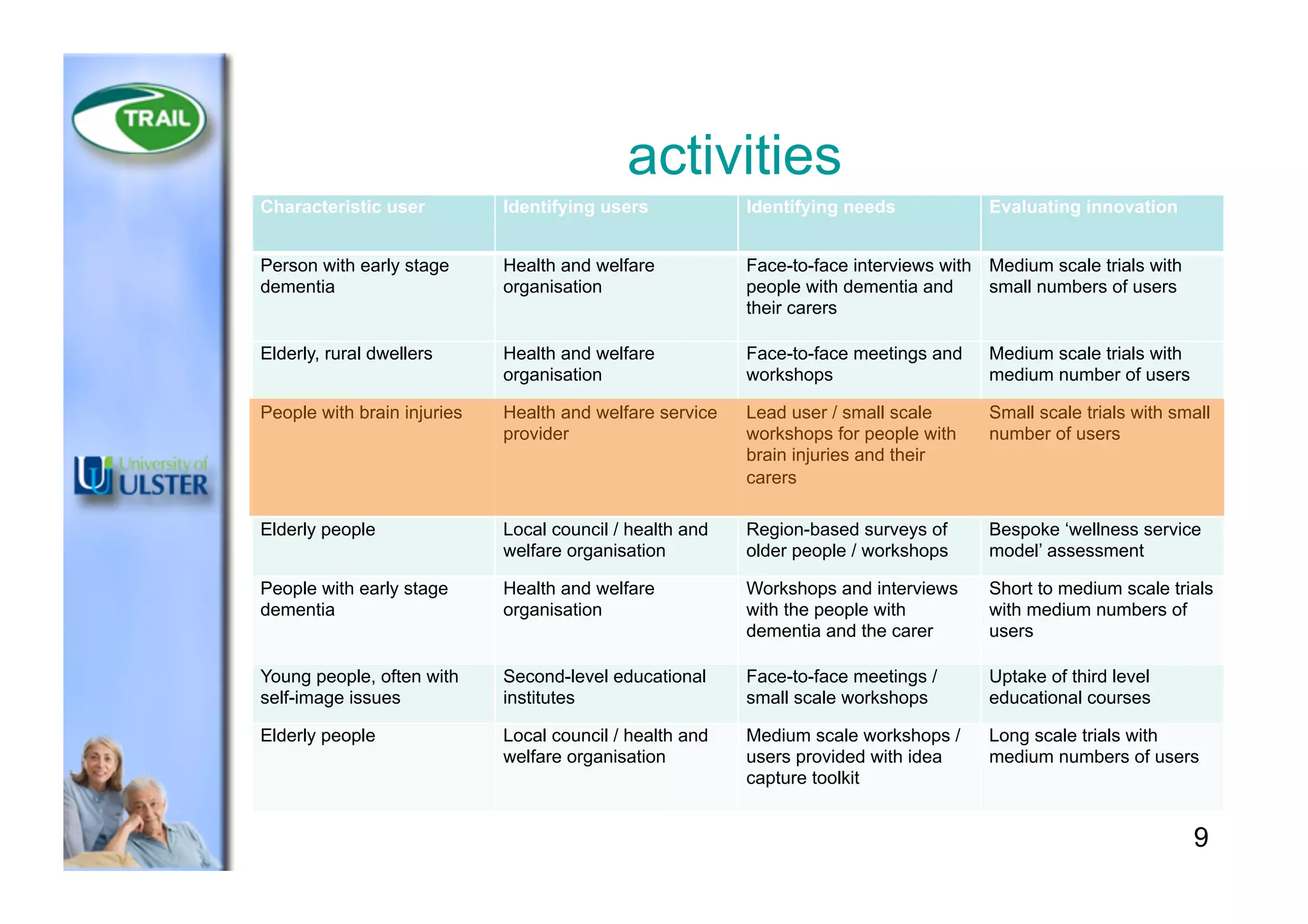
activities
Characteristic user Identifying users Identifying needs Evaluating innovation
Person with early stage
dementia
Health and welfare
organisation
Face-to-face interviews with
people with dementia and
their carers
Medium scale trials with
small numbers of users
Elderly, rural dwellers Health and welfare
organisation
Face-to-face meetings and
workshops
Medium scale trials with
medium number of users
People with brain injuries Health and welfare service
provider
Lead user / small scale
workshops for people with
brain injuries and their
carers
Small scale trials with small
number of users
Elderly people Local council / health and
welfare organisation
Region-based surveys of
older people / workshops
Bespoke ‘wellness service
model’ assessment
People with early stage
dementia
Health and welfare
organisation
Workshops and interviews
with the people with
dementia and the carer
Short to medium scale trials
with medium numbers of
users
Young people, often with
self-image issues
Second-level educational
institutes
Face-to-face meetings /
small scale workshops
Uptake of third level
educational courses
Elderly people Local council / health and
welfare organisation
Medium scale workshops /
users provided with idea
capture toolkit
Long scale trials with
medium numbers of users
9
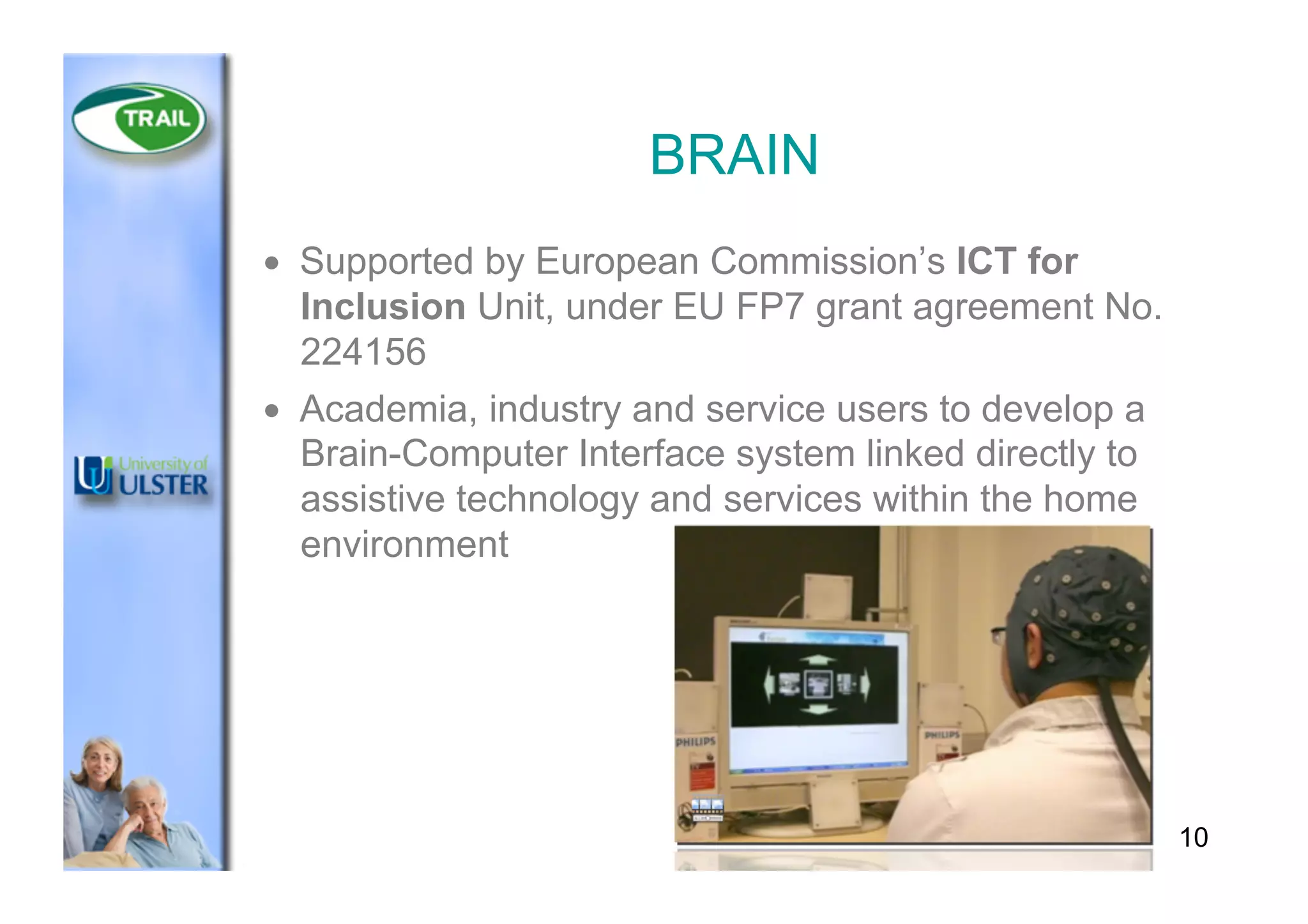
BRAIN
•  Supported by European Commission’s ICT for
Inclusion Unit, under EU FP7 grant agreement No.
224156
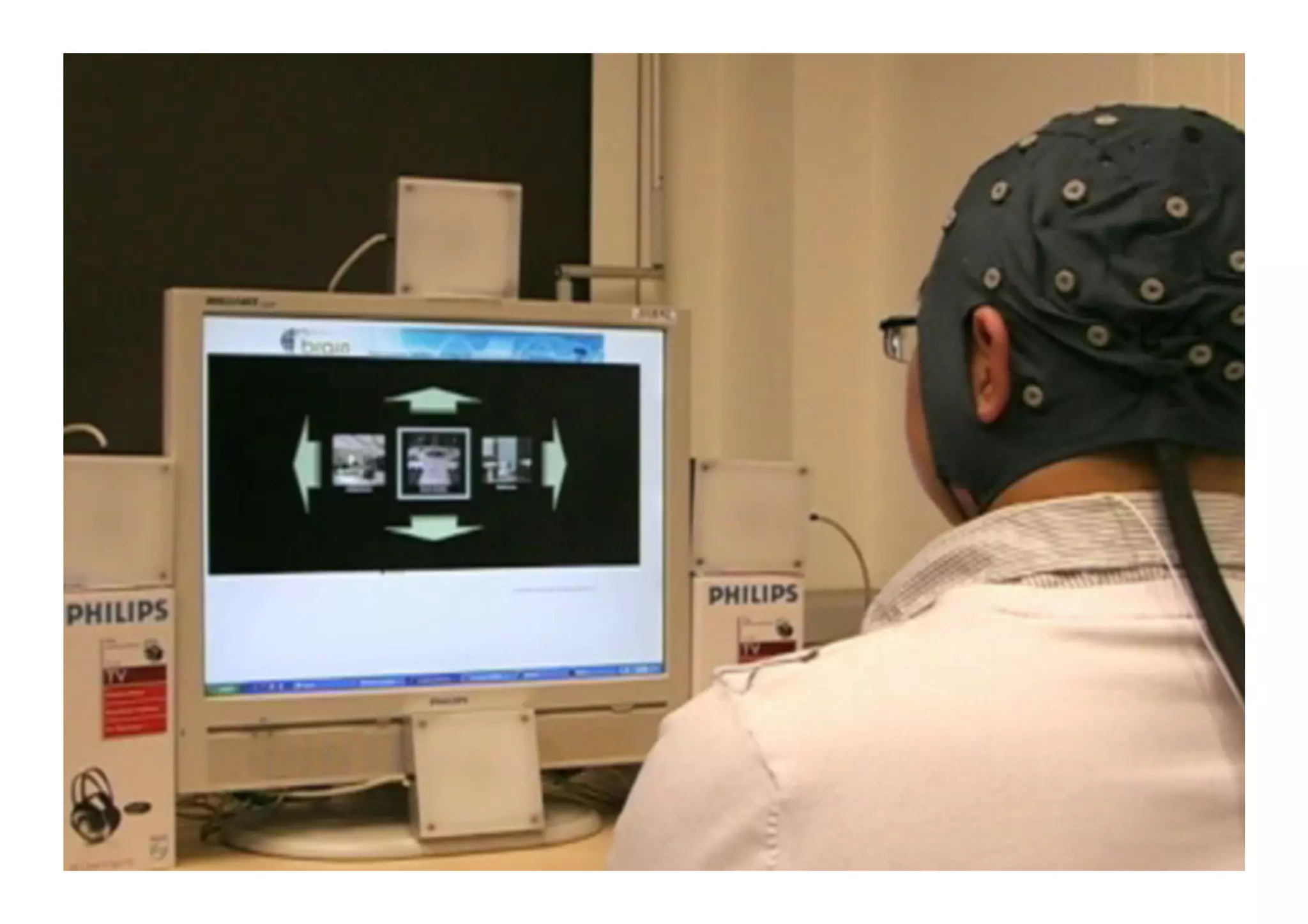
•  Academia, industry and service users to develop a
Brain-Computer Interface system linked directly to
assistive technology and services within the home
environment
10
11
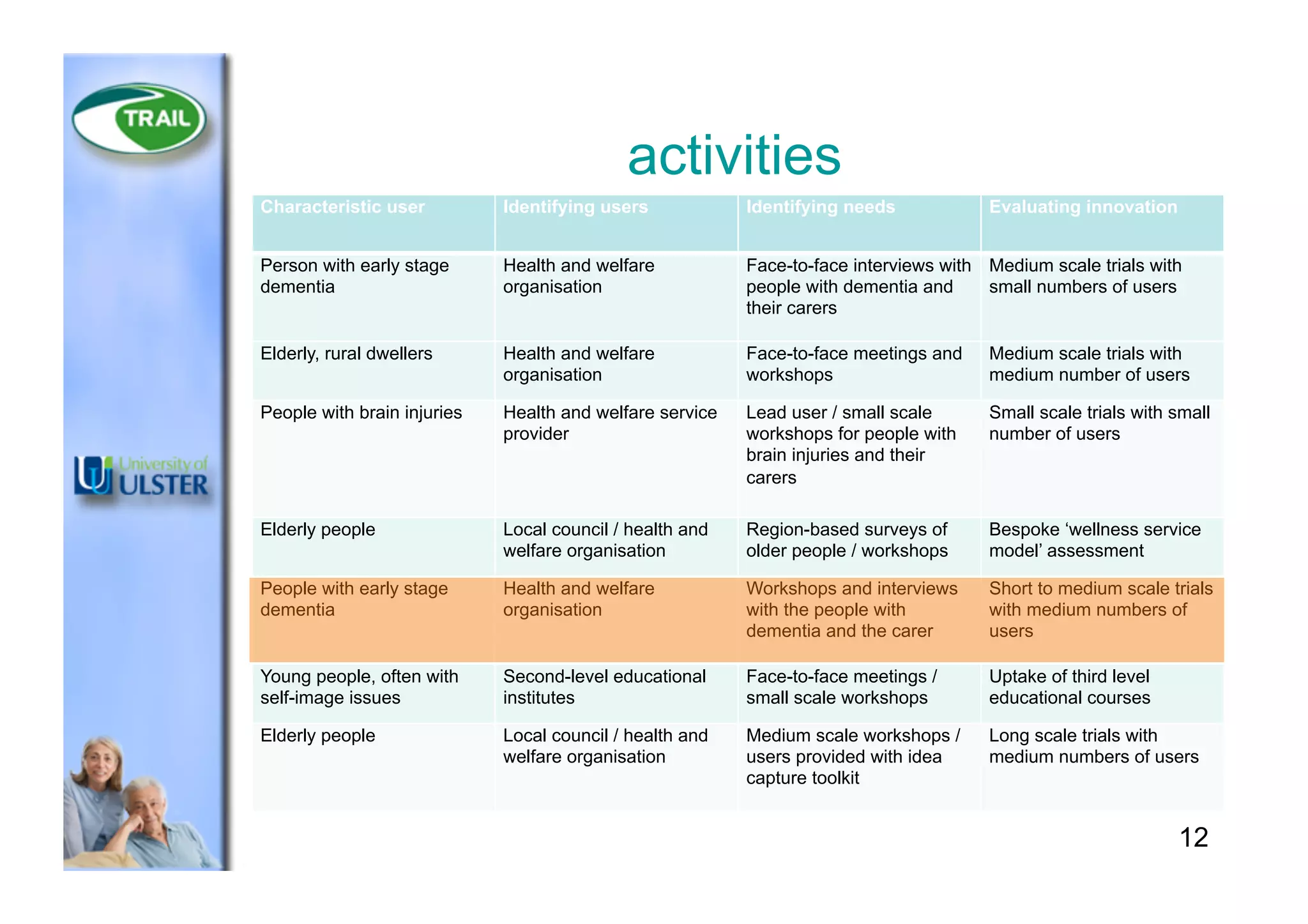
activities
Characteristic user Identifying users Identifying needs Evaluating innovation
Person with early stage
dementia
Health and welfare
organisation
Face-to-face interviews with
people with dementia and
their carers
Medium scale trials with
small numbers of users
Elderly, rural dwellers Health and welfare
organisation
Face-to-face meetings and
workshops
Medium scale trials with
medium number of users
People with brain injuries Health and welfare service
provider
Lead user / small scale
workshops for people with
brain injuries and their
carers
Small scale trials with small
number of users
Elderly people Local council / health and
welfare organisation
Region-based surveys of
older people / workshops
Bespoke ‘wellness service
model’ assessment
People with early stage
dementia
Health and welfare
organisation
Workshops and interviews
with the people with
dementia and the carer
Short to medium scale trials
with medium numbers of
users
Young people, often with
self-image issues
Second-level educational
institutes
Face-to-face meetings /
small scale workshops
Uptake of third level
educational courses
Elderly people Local council / health and
welfare organisation
Medium scale workshops /
users provided with idea
capture toolkit
Long scale trials with
medium numbers of users
12
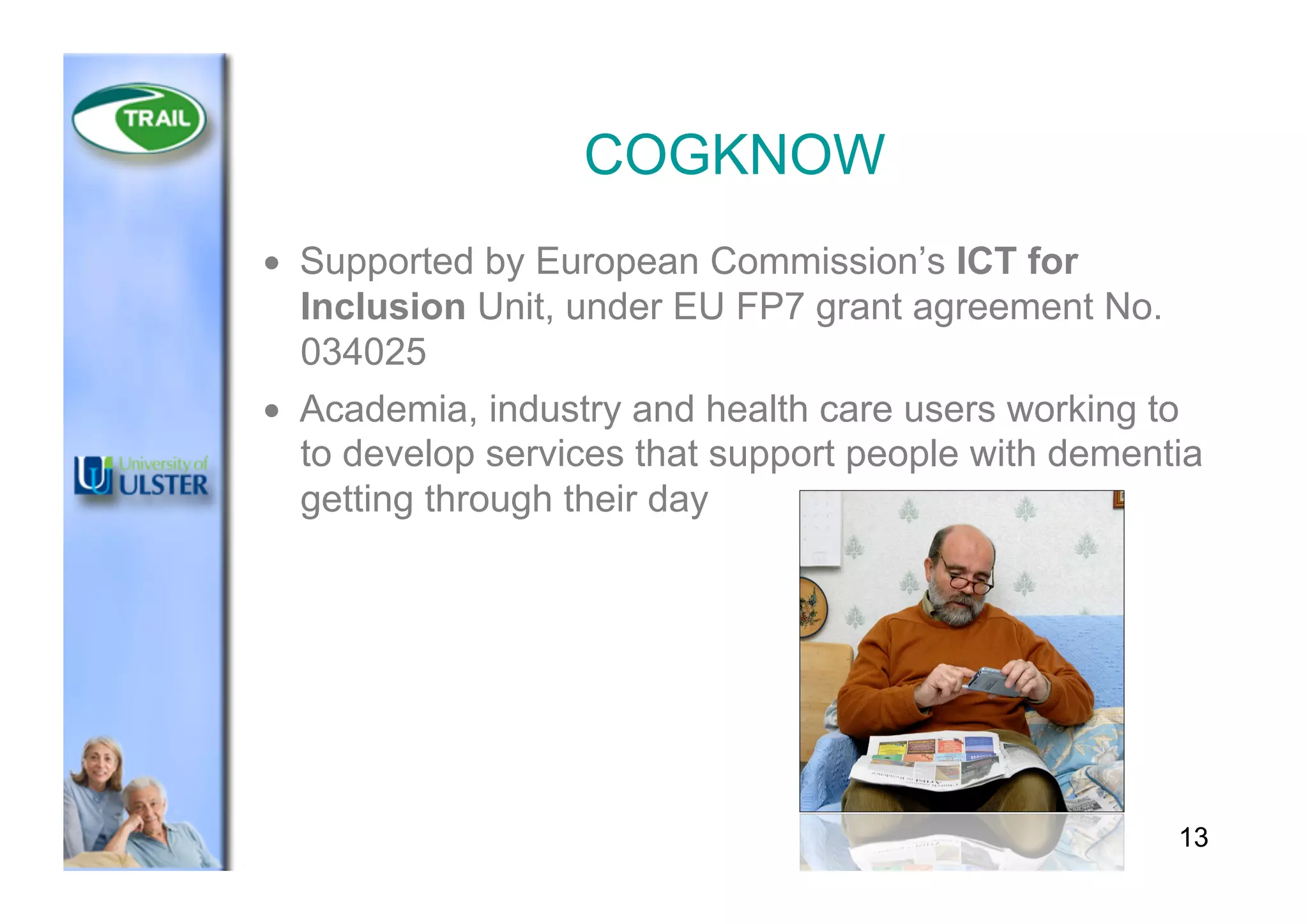
COGKNOW
•  Supported by European Commission’s ICT for
Inclusion Unit, under EU FP7 grant agreement No.
034025
•  Academia, industry and health care users working to
to develop services that support people with dementia
getting through their day
13
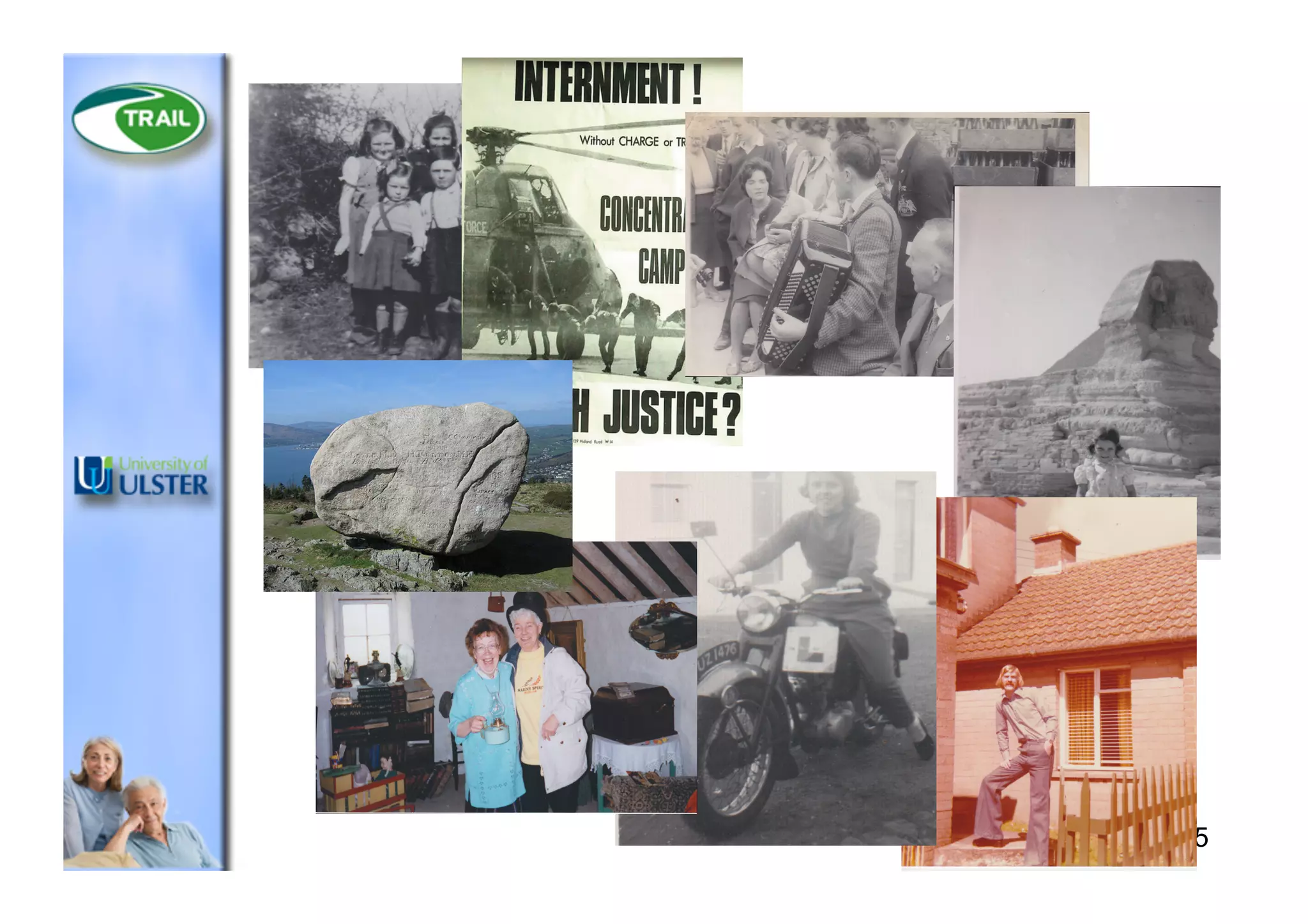
Art of memory
•  “To Encourage the Translation of Research Findings
into Products and Services that will have an Impact
upon the Economy and Society”
•  Aims
–  Assess value of different types of multimedia information
(photographs, film, generic media, person-specific media, or
‘shared experience’ media); and
–  Evaluate ease of organization and change of media by older
people.
14
15
16
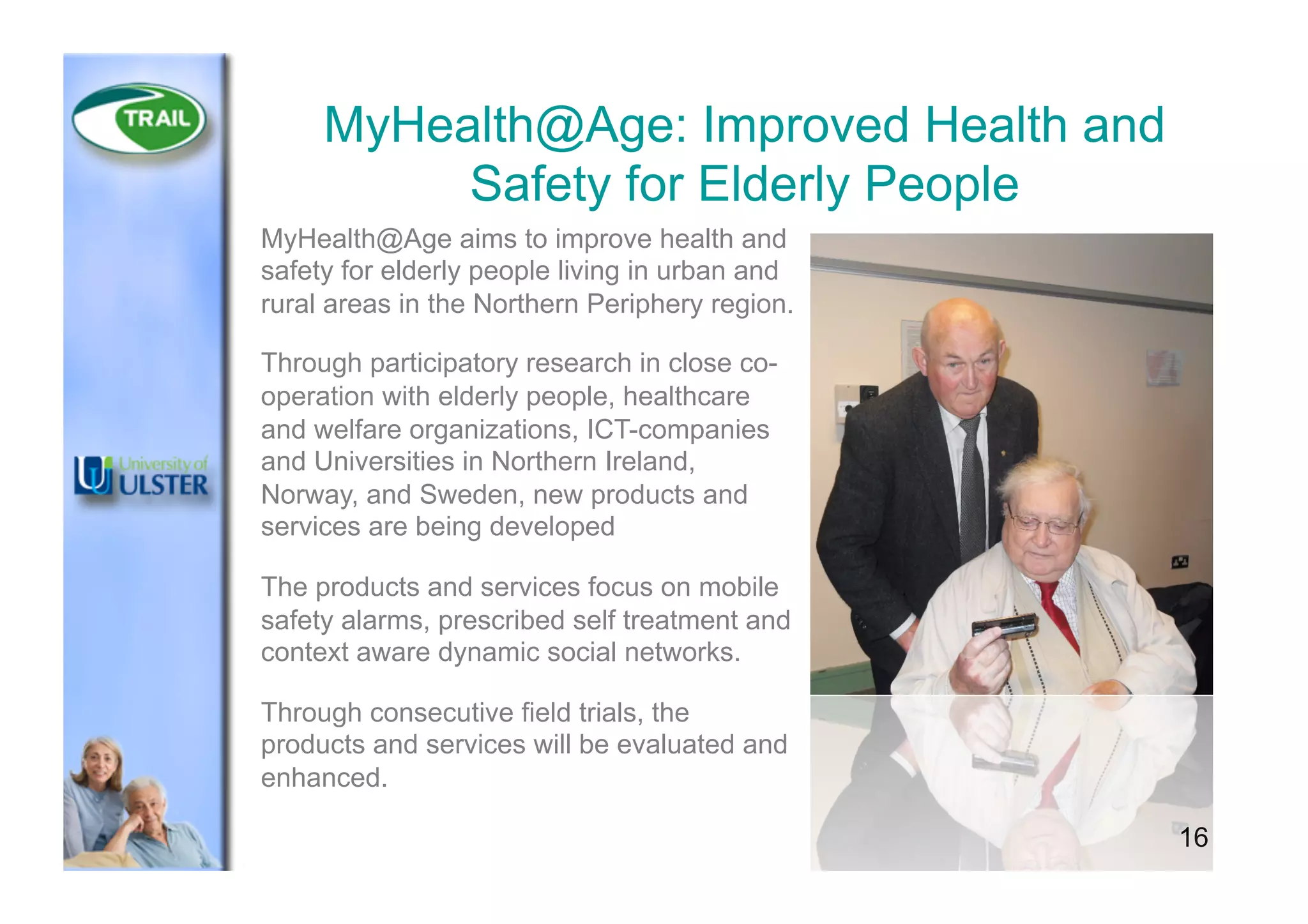
MyHealth@Age: Improved Health and
Safety for Elderly People
MyHealth@Age aims to improve health and
safety for elderly people living in urban and
rural areas in the Northern Periphery region.
Through participatory research in close co-
operation with elderly people, healthcare
and welfare organizations, ICT-companies
and Universities in Northern Ireland,
Norway, and Sweden, new products and
services are being developed
The products and services focus on mobile
safety alarms, prescribed self treatment and
context aware dynamic social networks.
Through consecutive field trials, the
products and services will be evaluated and
enhanced.
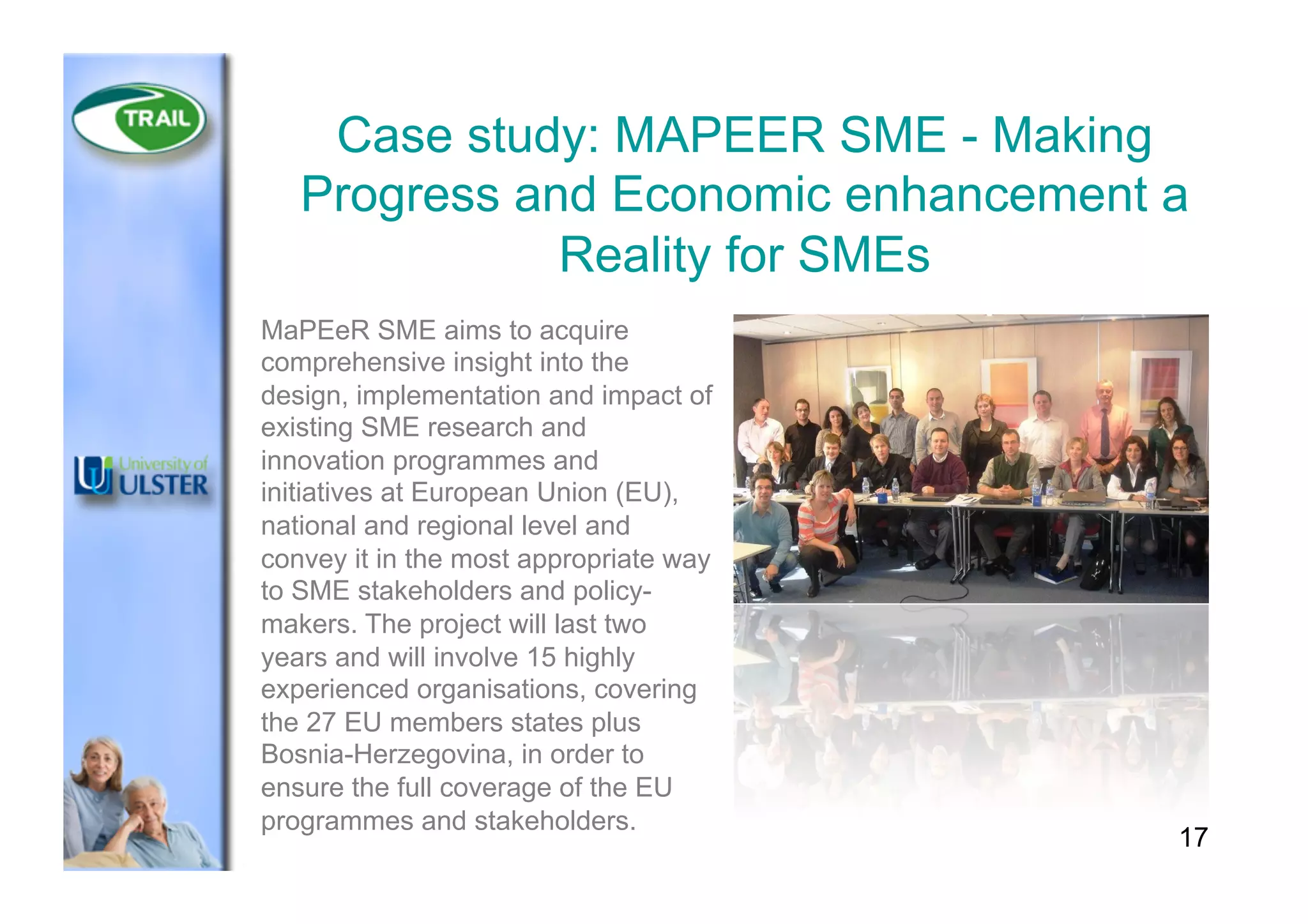
17
Case study: MAPEER SME - Making
Progress and Economic enhancement a
Reality for SMEs
MaPEeR SME aims to acquire
comprehensive insight into the
design, implementation and impact of
existing SME research and
innovation programmes and
initiatives at European Union (EU),
national and regional level and
convey it in the most appropriate way
to SME stakeholders and policy-
makers. The project will last two
years and will involve 15 highly
experienced organisations, covering
the 27 EU members states plus
Bosnia-Herzegovina, in order to
ensure the full coverage of the EU
programmes and stakeholders.
18
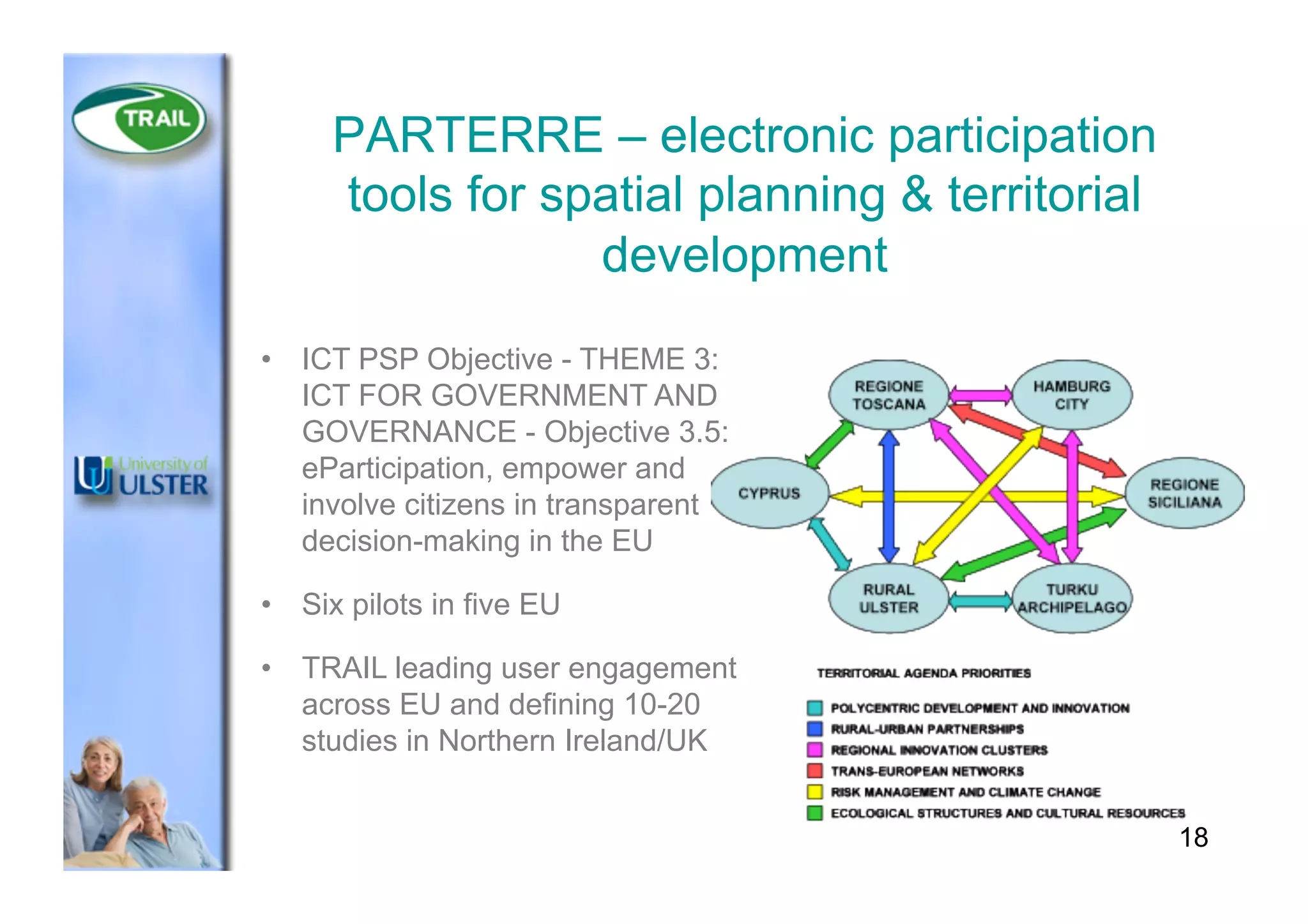
PARTERRE – electronic participation
tools for spatial planning & territorial
development
•  ICT PSP Objective - THEME 3:
ICT FOR GOVERNMENT AND
GOVERNANCE - Objective 3.5:
eParticipation, empower and
involve citizens in transparent
decision-making in the EU
•  Six pilots in five EU
•  TRAIL leading user engagement
across EU and defining 10-20
studies in Northern Ireland/UK
Issues
•  Working with vulnerable users;
•  Managing the tension between users needs and
advancing the state of the art;
•  Informing and educating the regional government to
the benefits of citizen involvement; and
•  Addressing problems inherent in inter-disciplinary
working
19
Working with vulnerable users
•  Ensure that the living lab:
–  Interacts with vulnerable people in an equitable manner,
–  Respecting their needs and wishes ethically,
–  Adheres to relevant legislative provision in the field of ethics,
–  All stakeholder organisations who are responsible for
managing adherence to ethical guidelines do so
20
Managing the tension between users
needs & advancing the state of the art
•  Balance of the management of innovation activities.
•  Majority of activities funded with support from
European and national research and development
grants.
•  The lab focuses on the early innovation stages:
ideation, connection and evaluation;
•  degree of ‘user-driven-ness’ v. state-of-the-art
advancement.
21
Informing and educating the regional
government to the benefits of citizen
involvement
•  Managing the difficulty experienced in embedding the
living lab into the community in the North of Ireland
•  The bedding down of the living lab into the community
is strategically important.
•  Forming long-term linkages with local government and
related municipal organisations, against a backdrop of
political uncertainty at both regional and local
municipal levels.
•  There is also evidence in the Northern Ireland region,
that there is a related issue arising from a pre-
disposition against risk-taking and openness to fresh
thinking in innovation. 22
Addressing problems inherent in inter-
disciplinary working
•  Practical problems in fostering inter-disciplinary
research between different areas of expertise, for
example, computing and health sciences.
•  “Those whose work becomes more interdisciplinary
feel that they are losing their peer group.”
–  Linda Katehi, Vice Chancellor for Academic Affairs at the
University of Illinois at Urbana-Champaign
•  Such human factors were one of the main barriers to
inter-disciplinarity.”
•  This has been experienced in our living lab as external
pressure force academics into ‘discipline silos’.
23
realising the value
24
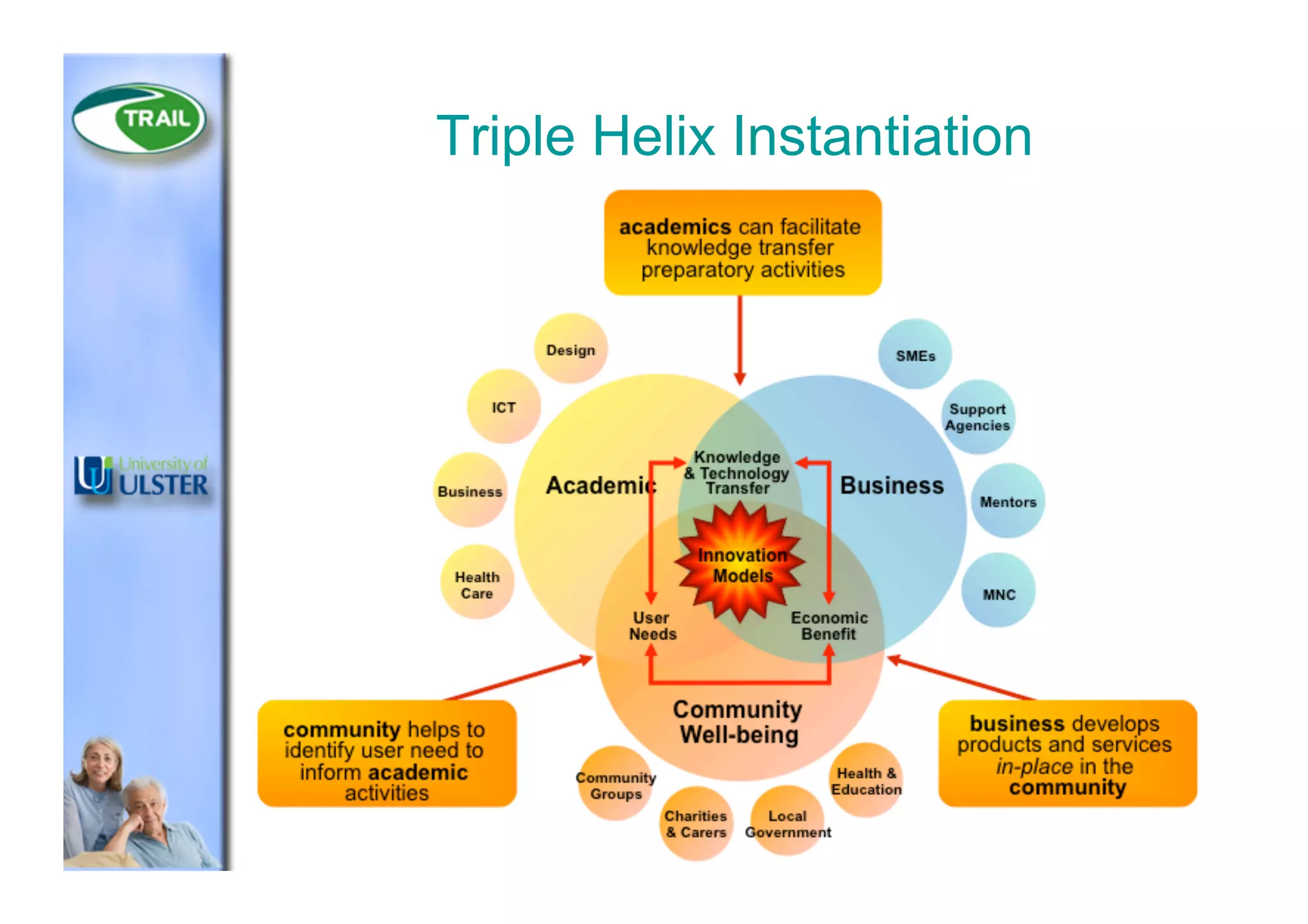
Triple Helix Instantiation
Concluding remarks…
•  Significant body of academic research that supports
the premise that user-driven innovation creates value
in markets and for society.
•  The network of living labs in Europe has been created,
partly based upon this premise
•  But it can be argued that there is a lack of evidence
that demonstrates how such living labs articulate their
value proposition, and
•  How they carry out activities on the ground to work
with users to create the added valued inherent in early
innovation processes.
26
27
Concluding remarks…
•  Living Lab
•  Social programs
•  Demonstrate leadership in Ireland/UK
•  Create roadmaps for service provision innovation for
service evolution
•  Trusted partner in connected health and policy
activities
•  Open European networks up to local healthcare
partners
Concluding remarks…
•  meaningful engagement
•  gathering relevant evidence
•  more evaluation
•  respect all stakeholders
•  and remember, it’s about service innovation (usually)
28
Visualisation
29
A University of Ulster Innovation Lab
…THANKS
md.mulvenna@ulster.ac.uk
Want to learn more?
•  Mulvenna, M.D., Nugent, C.D. (Eds.), (2010) Supporting People with Dementia Using Pervasive
Health Technologies, Series: Advanced Information and Knowledge Processing, 238 pages,
Springer.
•  Mulvenna, M.D., Galbraith, B., Martin, S., (2009) Enriching the Research & Development Process
Using Living Lab Methods: The TRAIL Experience, In: eChallenges-2009 Conference
Proceedings, Paul Cunningham and Miriam Cunningham (Eds), IIMC International Information
Management Corporation.
•  Galbraith, B., Mulvenna, M.D., Martin, S., McGloin, E., 2008) Living Labs: Helping to Meet the
Needs of Ageing People? In: Mann, W.C., Aging, Disability and Independence - Selected Papers
from the 4th International Conference on Aging, Disability and Independence, IOS Press,
Assistive Technology Research Series, Vol. 22, pp. 105-118.
•  Mulvenna, M.D., Wallace, J., Moore, G., Martin, S., Galbraith, B., Haaker, T., Moelaert, F.,
Jansson, M., Bergvall-Kåreborn, B., Castellot, R., Melander-Wikman, A., Bengtsson, J.E.,
Isaksson, L. and Nugent, C. (2010) Towards Sustainable Business Models From Healthcare
Technology Research, International Journal of Computers in Healthcare, Vol. 1, No.1, pp. 20-35.
•  Davies, R.J., Nugent, C.D., Donnelly, M., Hettinga, M., Meiland, F., Moelaert, F., Mulvenna, M.D.,
Bengtsson, J.E., Craig, D., Droes, R.-M. (2009) A User-Driven Approach to Develop a Cognitive
Prosthetic to Address Unmet Needs of People with Mild Dementia, Journal of Pervasive and
Mobile Computing, 5(3) pp. 253-267.
•  Mulvenna, M.D., Astell, A.J., Zheng, H., Wright, T., (Eds.) Proceedings of First International
Workshop on Reminiscence Systems (RSW-2009), Cambridge, UK, 5 September, 2009, CEUR
Workshop Proceedings, ISSN 1613-0073, pp. 1-44, http://ceur-ws.org/Vol-499. 31

Reaching the Voice of the Customer: Experiences in Local and International Test Beds and their Value

  • 1.
    Prof Maurice Mulvenna,University of Ulster 1 Reaching the voice of the customer: experiences in local and international test beds and their value
  • 2.
    Outline •  living labs • trail •  case studies •  issues •  realising the value •  concluding remarks 2
  • 4.
    What’s a ‘LivingLab’? •  Originates from MIT, Boston, MediaLab and School of Architecture and city planning. ‘ Living Labs as a research methodology for sensing, prototyping, validating and refining complex solutions in multiple and evolving real life contexts.’ •  In Europe it has been mentioned in four different contexts: 1.  Bringing laboratory based technology test-beds into real-life user focused environments for validation 2.  Developing mobility services for citizens in a real-life early adapter or normal population communities with existing and close to market technologies. Focus in an user centric co-design/co-creation process and Public Private Partnerships 3.  Virtualising Living Lab as a context sensitive research and development methodology for multi-site and multi-stakeholder environment to study new working environments from Pan-European perspectives 4.  National Initiatives in Finland and Sweden. Dimes as an industry initiative in 4 biggest Finnish cities to validate new mobility services in a real user centric models.
  • 5.
  • 6.
    what we do • Early stage innovation activities encompassing: –  Ideation –  Early research and development, supported by external funders, in many inter-related areas. •  Mid-stage market research and preparation –  Formulating intellectual property and/or know-how –  Finding local commercialisation partners 6
  • 7.
    what we do triplehelix also called… •  participatory culture •  social innovation •  civic culture •  cultural citizenship •  online activism –  Mobilise People –  Witness and Record –  Visualise Your Message –  Amplify Personal Stories –  Just Add Humour –  Investigate and Expose –  How to Use Complex Data –  Use Collective Intelligence –  Let People Ask the Questions –  Manage Your Contacts 7 State Academia Industry Users
  • 8.
    relevance to society • Living Lab –  Lessens risk in innovation –  Speeds up innovation –  Captures real needs at the beginning of the process –  New sources of innovation •  Using ‘lead users’ –  Those that very quickly understand the innovation problem and articulate their needs because they have acute and latent needs –  Ensure higher validity, manage drop-out rates/motivation levels, buy-in and overall can carry out more efficient iterations 8
  • 9.
    activities Characteristic user Identifyingusers Identifying needs Evaluating innovation Person with early stage dementia Health and welfare organisation Face-to-face interviews with people with dementia and their carers Medium scale trials with small numbers of users Elderly, rural dwellers Health and welfare organisation Face-to-face meetings and workshops Medium scale trials with medium number of users People with brain injuries Health and welfare service provider Lead user / small scale workshops for people with brain injuries and their carers Small scale trials with small number of users Elderly people Local council / health and welfare organisation Region-based surveys of older people / workshops Bespoke ‘wellness service model’ assessment People with early stage dementia Health and welfare organisation Workshops and interviews with the people with dementia and the carer Short to medium scale trials with medium numbers of users Young people, often with self-image issues Second-level educational institutes Face-to-face meetings / small scale workshops Uptake of third level educational courses Elderly people Local council / health and welfare organisation Medium scale workshops / users provided with idea capture toolkit Long scale trials with medium numbers of users 9
  • 10.
    BRAIN •  Supported byEuropean Commission’s ICT for Inclusion Unit, under EU FP7 grant agreement No. 224156 •  Academia, industry and service users to develop a Brain-Computer Interface system linked directly to assistive technology and services within the home environment 10
  • 11.
  • 12.
    activities Characteristic user Identifyingusers Identifying needs Evaluating innovation Person with early stage dementia Health and welfare organisation Face-to-face interviews with people with dementia and their carers Medium scale trials with small numbers of users Elderly, rural dwellers Health and welfare organisation Face-to-face meetings and workshops Medium scale trials with medium number of users People with brain injuries Health and welfare service provider Lead user / small scale workshops for people with brain injuries and their carers Small scale trials with small number of users Elderly people Local council / health and welfare organisation Region-based surveys of older people / workshops Bespoke ‘wellness service model’ assessment People with early stage dementia Health and welfare organisation Workshops and interviews with the people with dementia and the carer Short to medium scale trials with medium numbers of users Young people, often with self-image issues Second-level educational institutes Face-to-face meetings / small scale workshops Uptake of third level educational courses Elderly people Local council / health and welfare organisation Medium scale workshops / users provided with idea capture toolkit Long scale trials with medium numbers of users 12
  • 13.
    COGKNOW •  Supported byEuropean Commission’s ICT for Inclusion Unit, under EU FP7 grant agreement No. 034025 •  Academia, industry and health care users working to to develop services that support people with dementia getting through their day 13
  • 14.
    Art of memory • “To Encourage the Translation of Research Findings into Products and Services that will have an Impact upon the Economy and Society” •  Aims –  Assess value of different types of multimedia information (photographs, film, generic media, person-specific media, or ‘shared experience’ media); and –  Evaluate ease of organization and change of media by older people. 14
  • 15.
  • 16.
    16 MyHealth@Age: Improved Healthand Safety for Elderly People MyHealth@Age aims to improve health and safety for elderly people living in urban and rural areas in the Northern Periphery region. Through participatory research in close co- operation with elderly people, healthcare and welfare organizations, ICT-companies and Universities in Northern Ireland, Norway, and Sweden, new products and services are being developed The products and services focus on mobile safety alarms, prescribed self treatment and context aware dynamic social networks. Through consecutive field trials, the products and services will be evaluated and enhanced.
  • 17.
    17 Case study: MAPEERSME - Making Progress and Economic enhancement a Reality for SMEs MaPEeR SME aims to acquire comprehensive insight into the design, implementation and impact of existing SME research and innovation programmes and initiatives at European Union (EU), national and regional level and convey it in the most appropriate way to SME stakeholders and policy- makers. The project will last two years and will involve 15 highly experienced organisations, covering the 27 EU members states plus Bosnia-Herzegovina, in order to ensure the full coverage of the EU programmes and stakeholders.
  • 18.
    18 PARTERRE – electronicparticipation tools for spatial planning & territorial development •  ICT PSP Objective - THEME 3: ICT FOR GOVERNMENT AND GOVERNANCE - Objective 3.5: eParticipation, empower and involve citizens in transparent decision-making in the EU •  Six pilots in five EU •  TRAIL leading user engagement across EU and defining 10-20 studies in Northern Ireland/UK
  • 19.
    Issues •  Working withvulnerable users; •  Managing the tension between users needs and advancing the state of the art; •  Informing and educating the regional government to the benefits of citizen involvement; and •  Addressing problems inherent in inter-disciplinary working 19
  • 20.
    Working with vulnerableusers •  Ensure that the living lab: –  Interacts with vulnerable people in an equitable manner, –  Respecting their needs and wishes ethically, –  Adheres to relevant legislative provision in the field of ethics, –  All stakeholder organisations who are responsible for managing adherence to ethical guidelines do so 20
  • 21.
    Managing the tensionbetween users needs & advancing the state of the art •  Balance of the management of innovation activities. •  Majority of activities funded with support from European and national research and development grants. •  The lab focuses on the early innovation stages: ideation, connection and evaluation; •  degree of ‘user-driven-ness’ v. state-of-the-art advancement. 21
  • 22.
    Informing and educatingthe regional government to the benefits of citizen involvement •  Managing the difficulty experienced in embedding the living lab into the community in the North of Ireland •  The bedding down of the living lab into the community is strategically important. •  Forming long-term linkages with local government and related municipal organisations, against a backdrop of political uncertainty at both regional and local municipal levels. •  There is also evidence in the Northern Ireland region, that there is a related issue arising from a pre- disposition against risk-taking and openness to fresh thinking in innovation. 22
  • 23.
    Addressing problems inherentin inter- disciplinary working •  Practical problems in fostering inter-disciplinary research between different areas of expertise, for example, computing and health sciences. •  “Those whose work becomes more interdisciplinary feel that they are losing their peer group.” –  Linda Katehi, Vice Chancellor for Academic Affairs at the University of Illinois at Urbana-Champaign •  Such human factors were one of the main barriers to inter-disciplinarity.” •  This has been experienced in our living lab as external pressure force academics into ‘discipline silos’. 23
  • 24.
  • 25.
  • 26.
    Concluding remarks… •  Significantbody of academic research that supports the premise that user-driven innovation creates value in markets and for society. •  The network of living labs in Europe has been created, partly based upon this premise •  But it can be argued that there is a lack of evidence that demonstrates how such living labs articulate their value proposition, and •  How they carry out activities on the ground to work with users to create the added valued inherent in early innovation processes. 26
  • 27.
    27 Concluding remarks… •  LivingLab •  Social programs •  Demonstrate leadership in Ireland/UK •  Create roadmaps for service provision innovation for service evolution •  Trusted partner in connected health and policy activities •  Open European networks up to local healthcare partners
  • 28.
    Concluding remarks… •  meaningfulengagement •  gathering relevant evidence •  more evaluation •  respect all stakeholders •  and remember, it’s about service innovation (usually) 28
  • 29.
  • 30.
    A University ofUlster Innovation Lab …THANKS md.mulvenna@ulster.ac.uk
  • 31.
    Want to learnmore? •  Mulvenna, M.D., Nugent, C.D. (Eds.), (2010) Supporting People with Dementia Using Pervasive Health Technologies, Series: Advanced Information and Knowledge Processing, 238 pages, Springer. •  Mulvenna, M.D., Galbraith, B., Martin, S., (2009) Enriching the Research & Development Process Using Living Lab Methods: The TRAIL Experience, In: eChallenges-2009 Conference Proceedings, Paul Cunningham and Miriam Cunningham (Eds), IIMC International Information Management Corporation. •  Galbraith, B., Mulvenna, M.D., Martin, S., McGloin, E., 2008) Living Labs: Helping to Meet the Needs of Ageing People? In: Mann, W.C., Aging, Disability and Independence - Selected Papers from the 4th International Conference on Aging, Disability and Independence, IOS Press, Assistive Technology Research Series, Vol. 22, pp. 105-118. •  Mulvenna, M.D., Wallace, J., Moore, G., Martin, S., Galbraith, B., Haaker, T., Moelaert, F., Jansson, M., Bergvall-Kåreborn, B., Castellot, R., Melander-Wikman, A., Bengtsson, J.E., Isaksson, L. and Nugent, C. (2010) Towards Sustainable Business Models From Healthcare Technology Research, International Journal of Computers in Healthcare, Vol. 1, No.1, pp. 20-35. •  Davies, R.J., Nugent, C.D., Donnelly, M., Hettinga, M., Meiland, F., Moelaert, F., Mulvenna, M.D., Bengtsson, J.E., Craig, D., Droes, R.-M. (2009) A User-Driven Approach to Develop a Cognitive Prosthetic to Address Unmet Needs of People with Mild Dementia, Journal of Pervasive and Mobile Computing, 5(3) pp. 253-267. •  Mulvenna, M.D., Astell, A.J., Zheng, H., Wright, T., (Eds.) Proceedings of First International Workshop on Reminiscence Systems (RSW-2009), Cambridge, UK, 5 September, 2009, CEUR Workshop Proceedings, ISSN 1613-0073, pp. 1-44, http://ceur-ws.org/Vol-499. 31