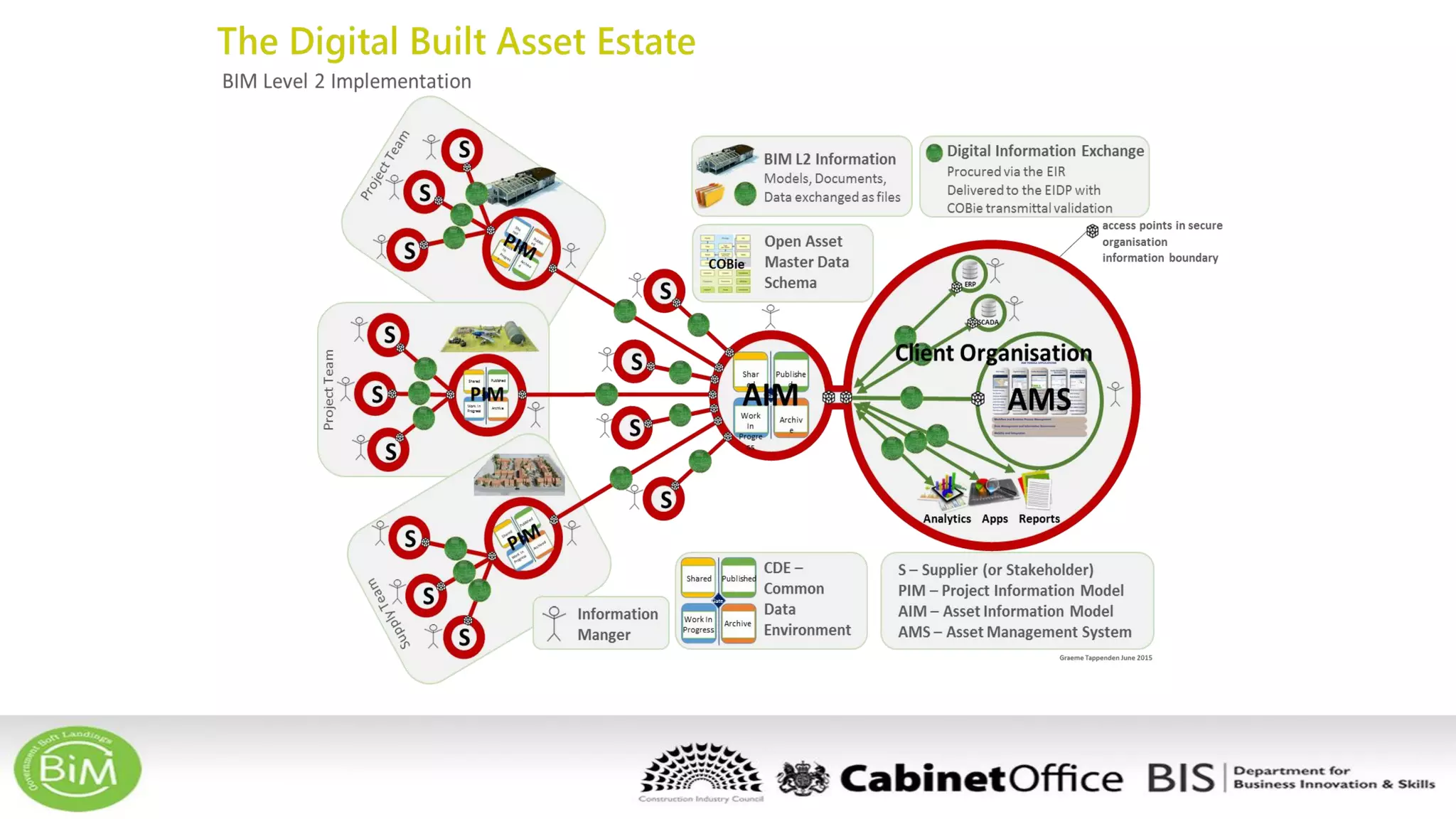
Key Note : Preparing for a Digital built Britain
David Philp - Director BIM – EMEA at AECOM, Head of BIM, UK
BIM Task Group
11th November 2015
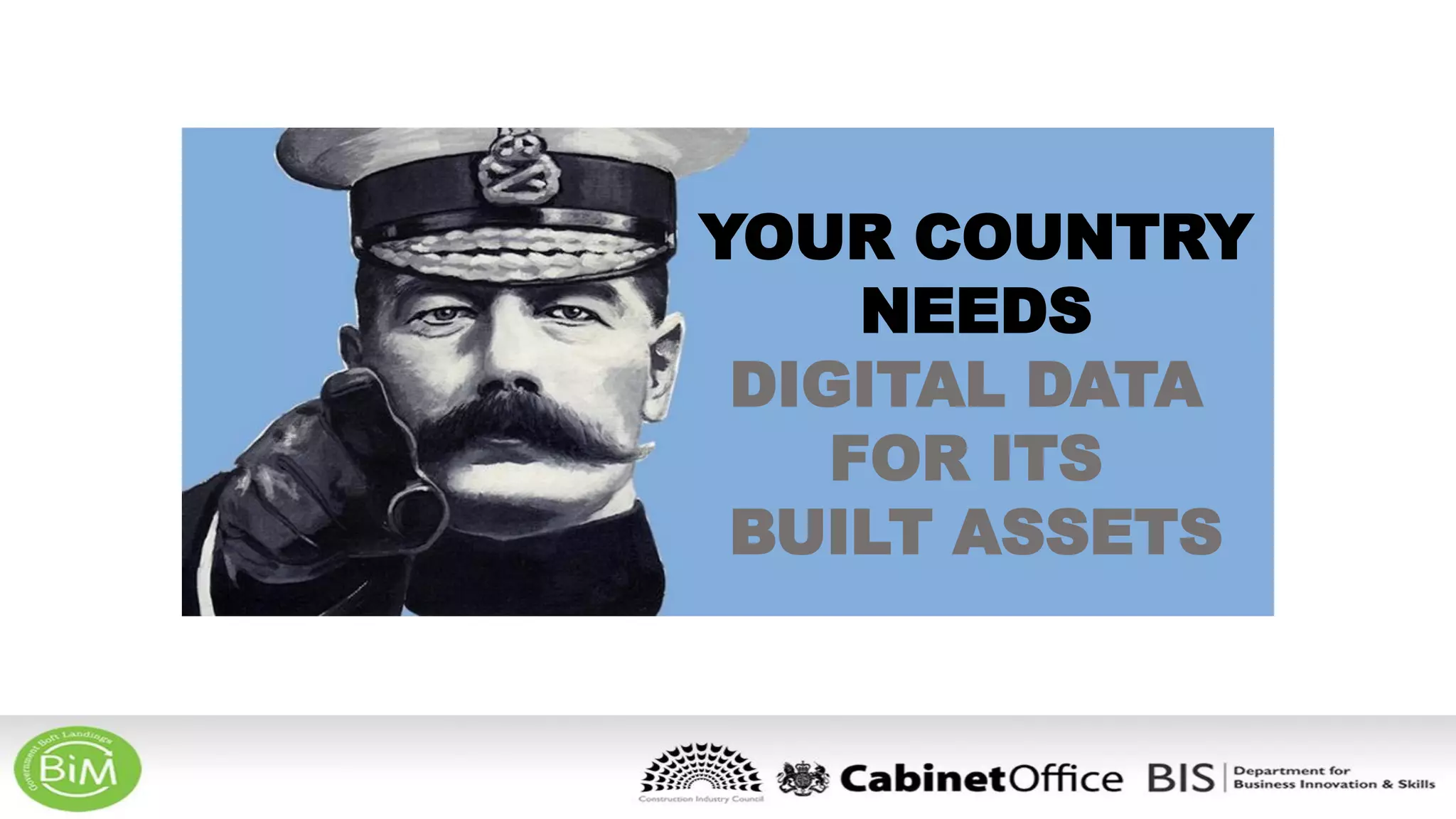
YOUR COUNTRY
NEEDS
DIGITAL DATA
FOR ITS
BUILT ASSETS
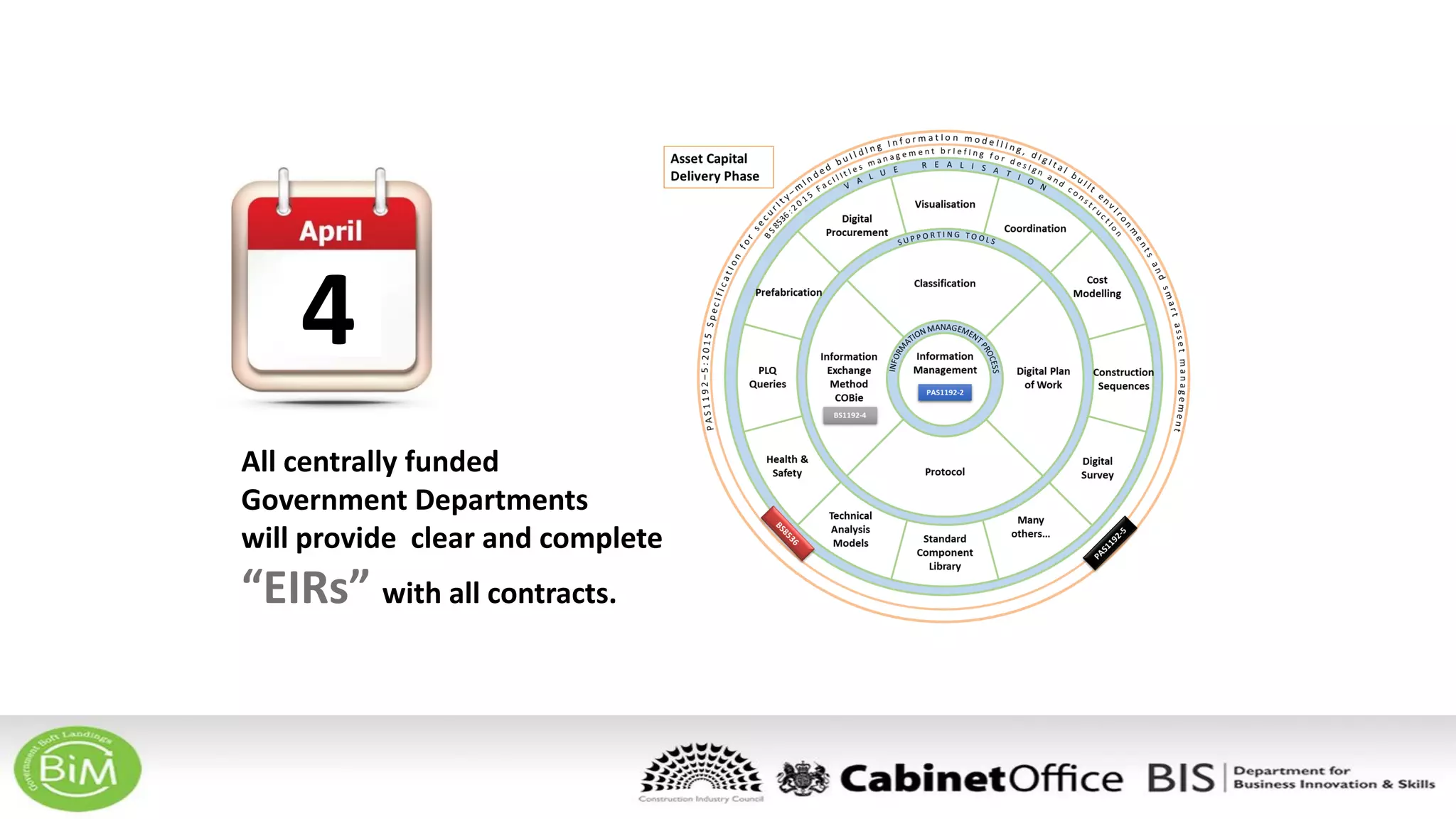
All centrally funded
Government Departments
will provide clear and complete
“EIRs” with all contracts.
4
Level 2
BIM
Initiate
& Setup Feasibilit
y
Assessm
ent
Preferre
d Option
Planning
& Design Delivery
Post
Takeover
Activity
In Use
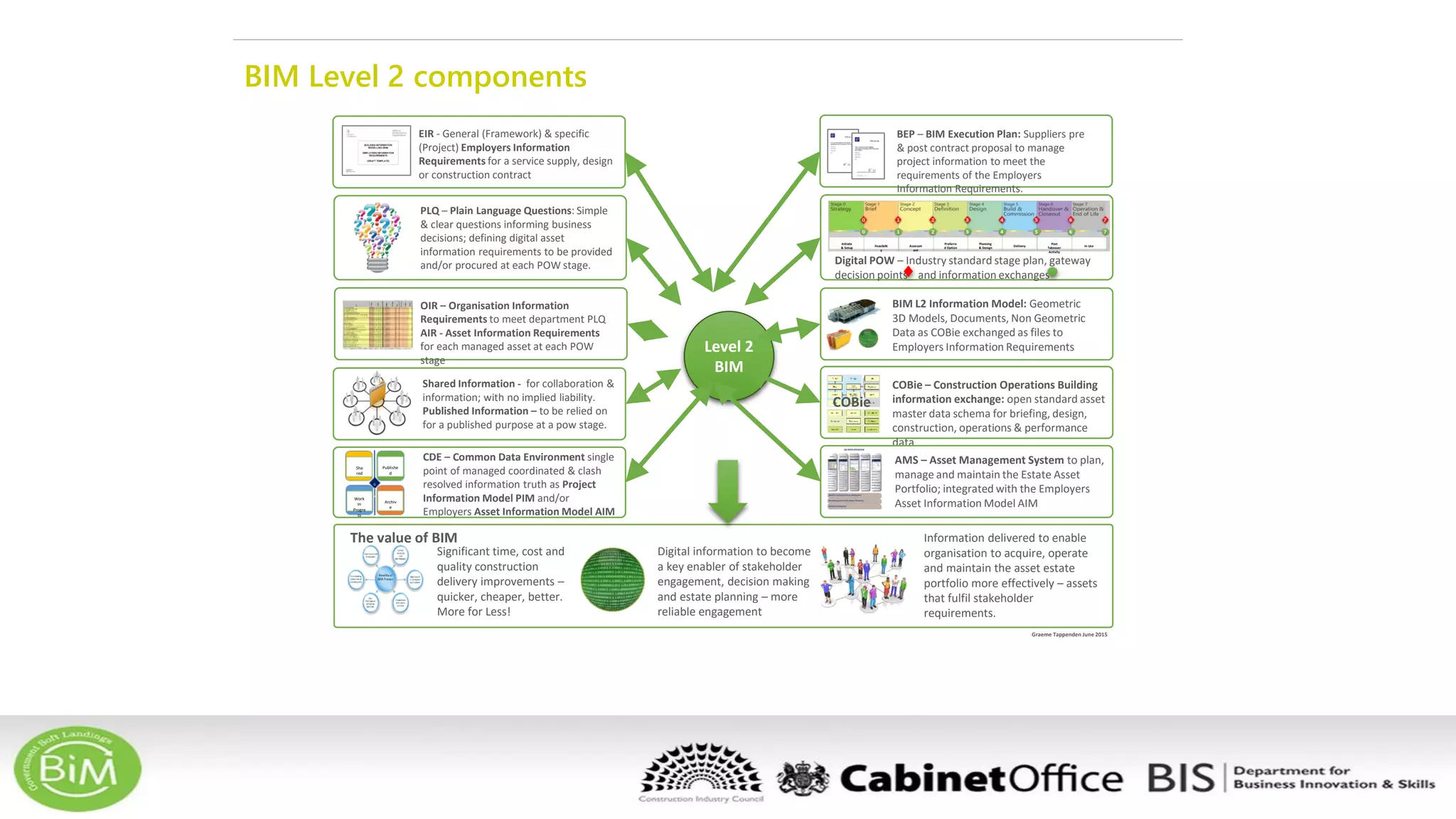
Digital POW – Industry standard stage plan, gateway
decision points and information exchanges
PLQ – Plain Language Questions: Simple
& clear questions informing business
decisions; defining digital asset
information requirements to be provided
and/or procured at each POW stage.
Shared Information - for collaboration &
information; with no implied liability.
Published Information – to be relied on
for a published purpose at a pow stage.
BIM L2 Information Model: Geometric
3D Models, Documents, Non Geometric
Data as COBie exchanged as files to
Employers Information Requirements
Sha
red
Work
In
Progre
ss
Archiv
e
Publishe
d
G
a
t
e
CDE – Common Data Environment single
point of managed coordinated & clash
resolved information truth as Project
Information Model PIM and/or
Employers Asset Information Model AIM
COBie – Construction Operations Building
information exchange: open standard asset
master data schema for briefing, design,
construction, operations & performance
data
COBie
AMS – Asset Management System to plan,
manage and maintain the Estate Asset
Portfolio; integrated with the Employers
Asset Information Model AIM
Significant time, cost and
quality construction
delivery improvements –
quicker, cheaper, better.
More for Less!
Digital information to become
a key enabler of stakeholder
engagement, decision making
and estate planning – more
reliable engagement
Information delivered to enable
organisation to acquire, operate
and maintain the asset estate
portfolio more effectively – assets
that fulfil stakeholder
requirements.
The value of BIM
EIR - General (Framework) & specific
(Project) Employers Information
Requirements for a service supply, design
or construction contract
BEP – BIM Execution Plan: Suppliers pre
& post contract proposal to manage
project information to meet the
requirements of the Employers
Information Requirements.
OIR – Organisation Information
Requirements to meet department PLQ
AIR - Asset Information Requirements
for each managed asset at each POW
stage
BIM Level 2 components
Graeme Tappenden June 2015
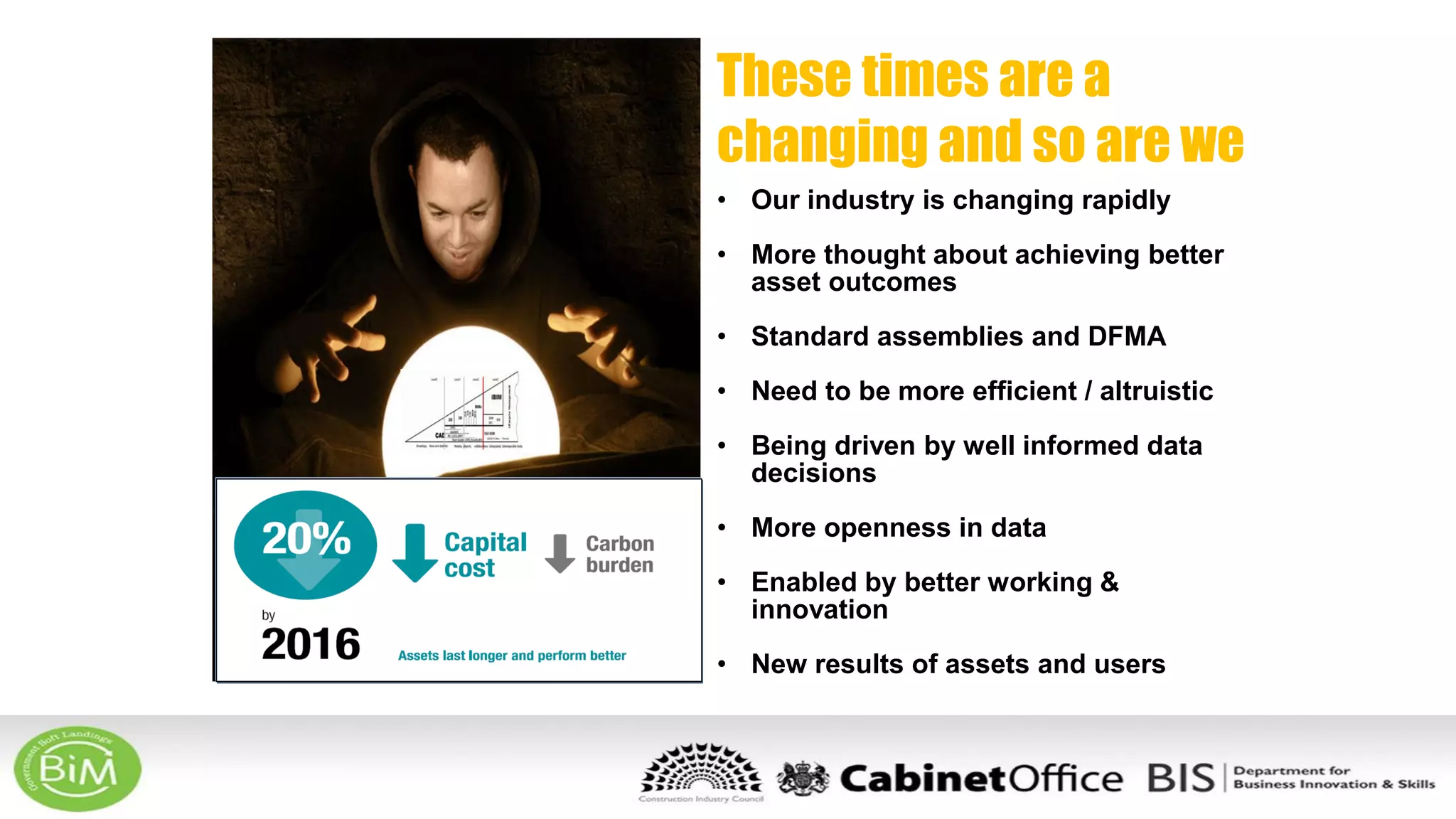
These times are a
changing and so are we
• Our industry is changing rapidly
• More thought about achieving better
asset outcomes
• Standard assemblies and DFMA
• Need to be more efficient / altruistic
• Being driven by well informed data
decisions
• More openness in data
• Enabled by better working &
innovation
• New results of assets and users
BIM / GSL??
Level 2 resolves the methodology of:
• Working in a 3D environment
• Creating structured non-graphical data
• Data verification and validation
• Consistent data exchanges
• Working in a common data environment
• Connecting capex and opex
• Create a solid platform for Level 3
Beyond Level 2
BIM, Procurement through computer readable data
11
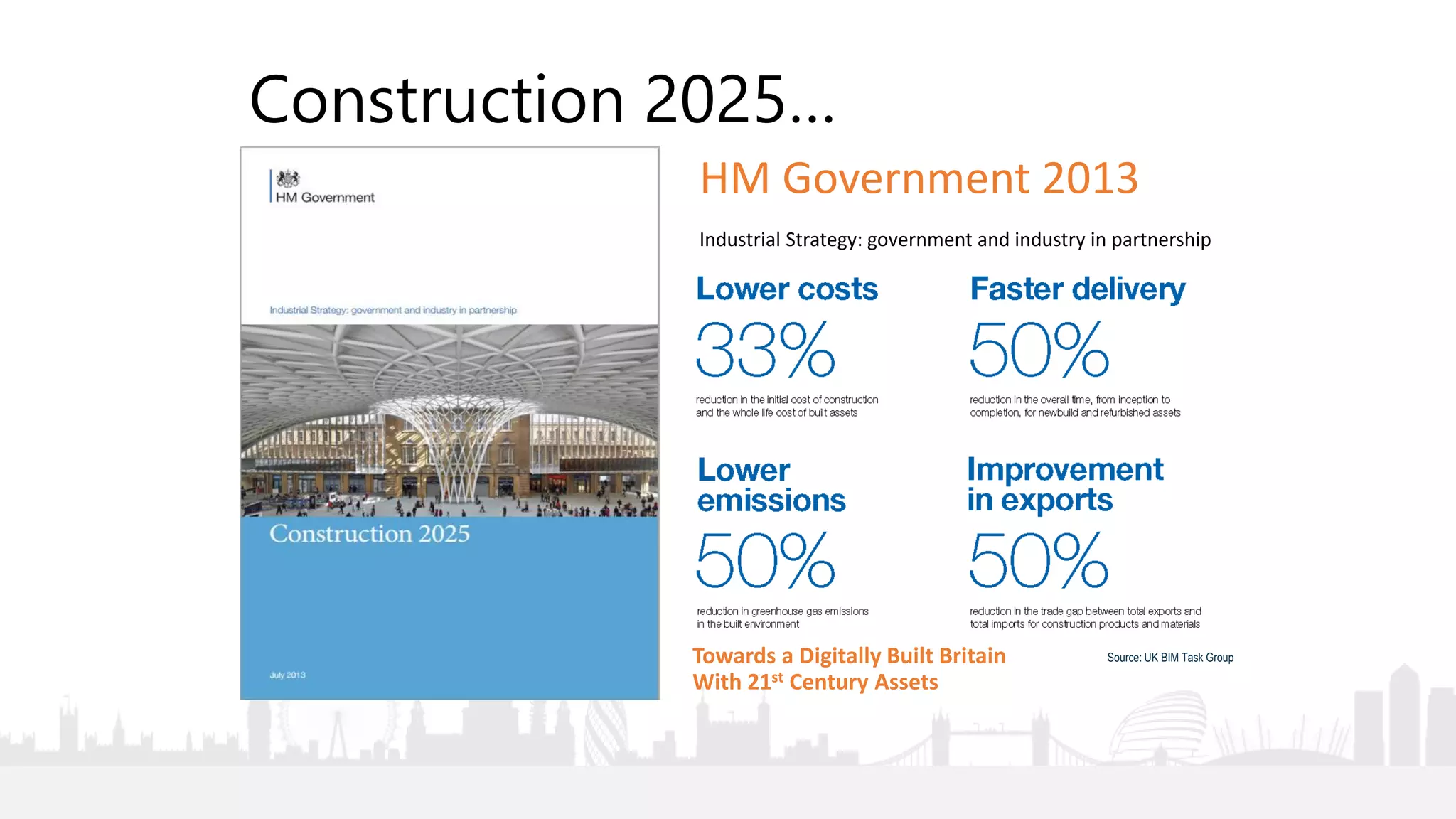
Construction 2025…
HM Government 2013
Industrial Strategy: government and industry in partnership
Towards a Digitally Built Britain
With 21st Century Assets
Source: UK BIM Task Group
12
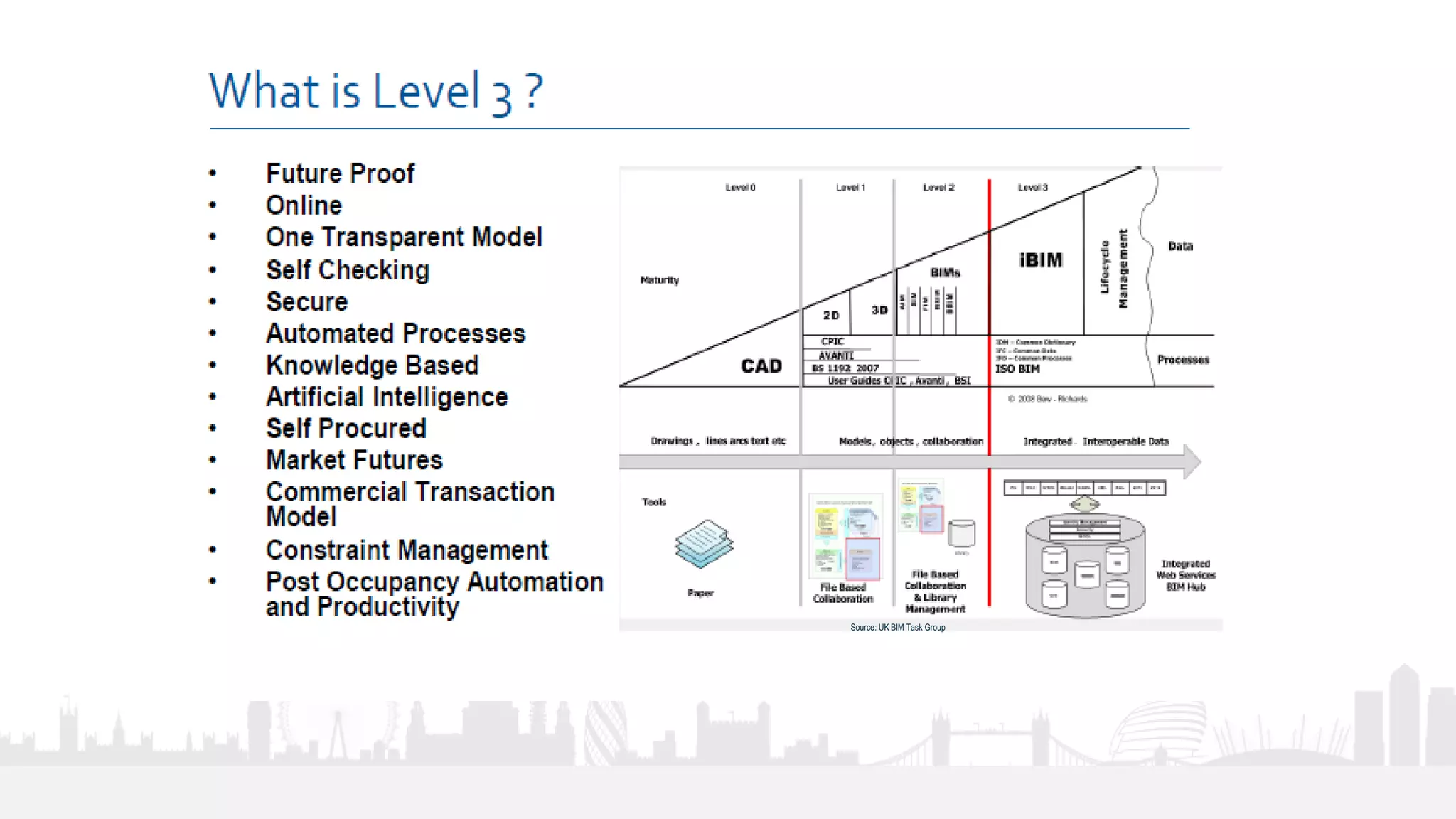
The greatest BIM challenges arise when moving from level 2 BIM to level 3 BIM and the
perceived ‘holy grail’ of the single project model. Level 3 envisages a wholly integrated
model accessed by all members of the project team in real time.
Integrated working!!!
13
Source: UK BIM Task Group
14
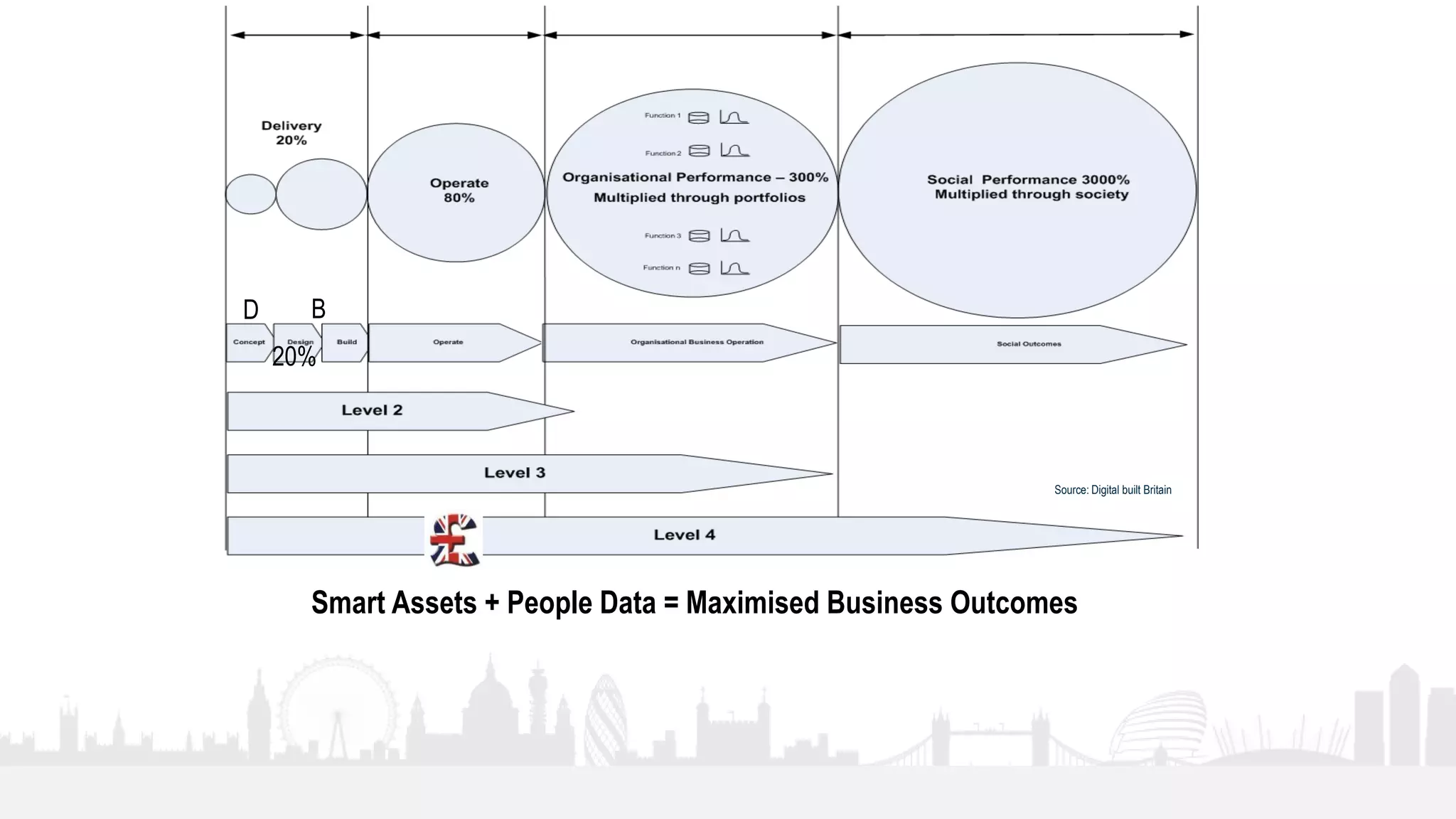
D B
20%
Smart Assets + People Data = Maximised Business Outcomes
Source: Digital built Britain
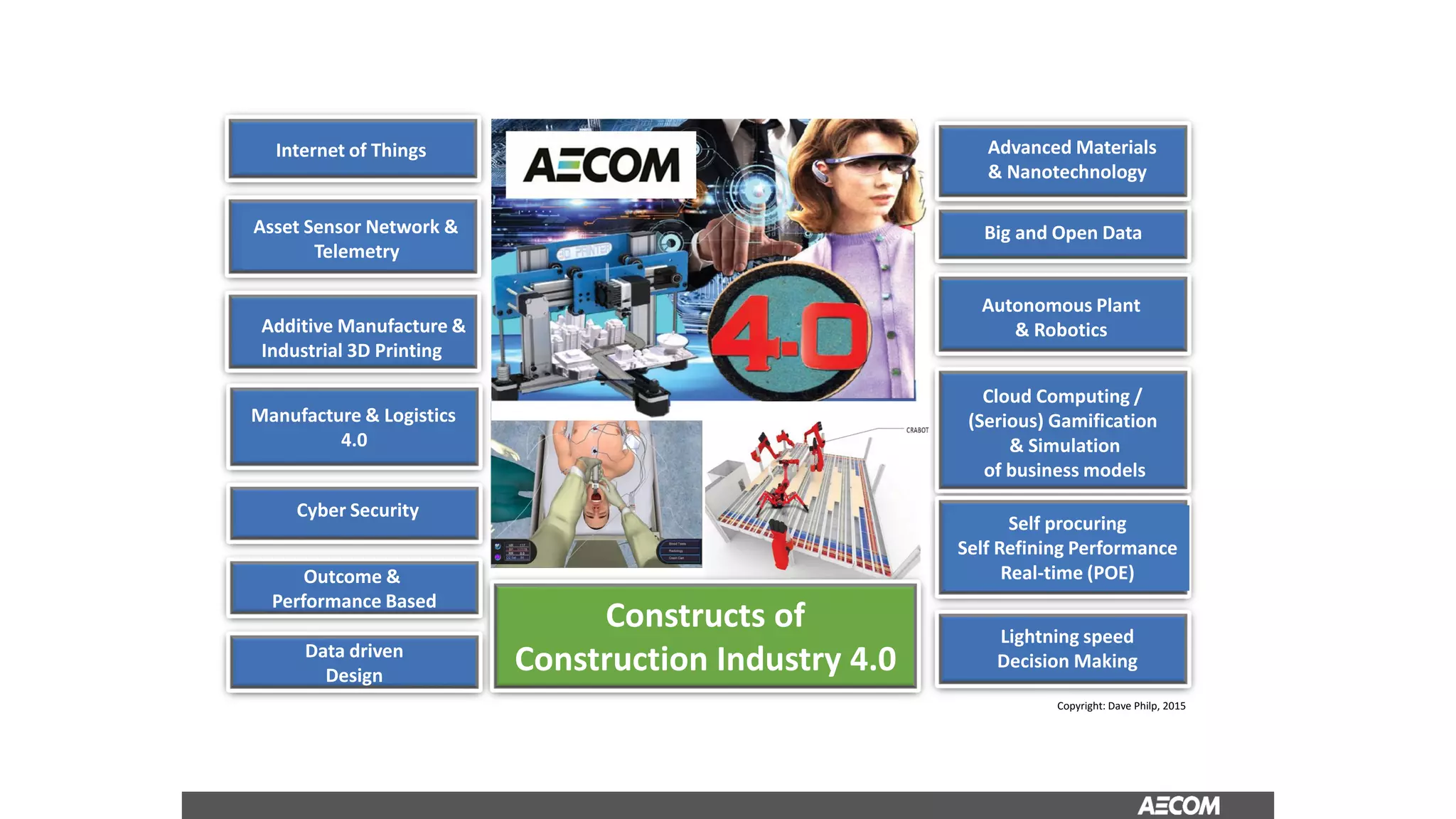
Internet of Things
Asset Sensor Network &
Telemetry
Additive Manufacture &
Industrial 3D Printing
Manufacture & Logistics
4.0
Big and Open Data
Cloud Computing /
(Serious) Gamification
& Simulation
of business models
Cyber Security
Advanced Materials
& Nanotechnology
Autonomous Plant
& Robotics
Self procuring
Self Refining Performance
Real-time (POE)Outcome &
Performance Based
Lightning speed
Decision MakingData driven
Design
Constructs of
Construction Industry 4.0
Copyright: Dave Philp, 2015
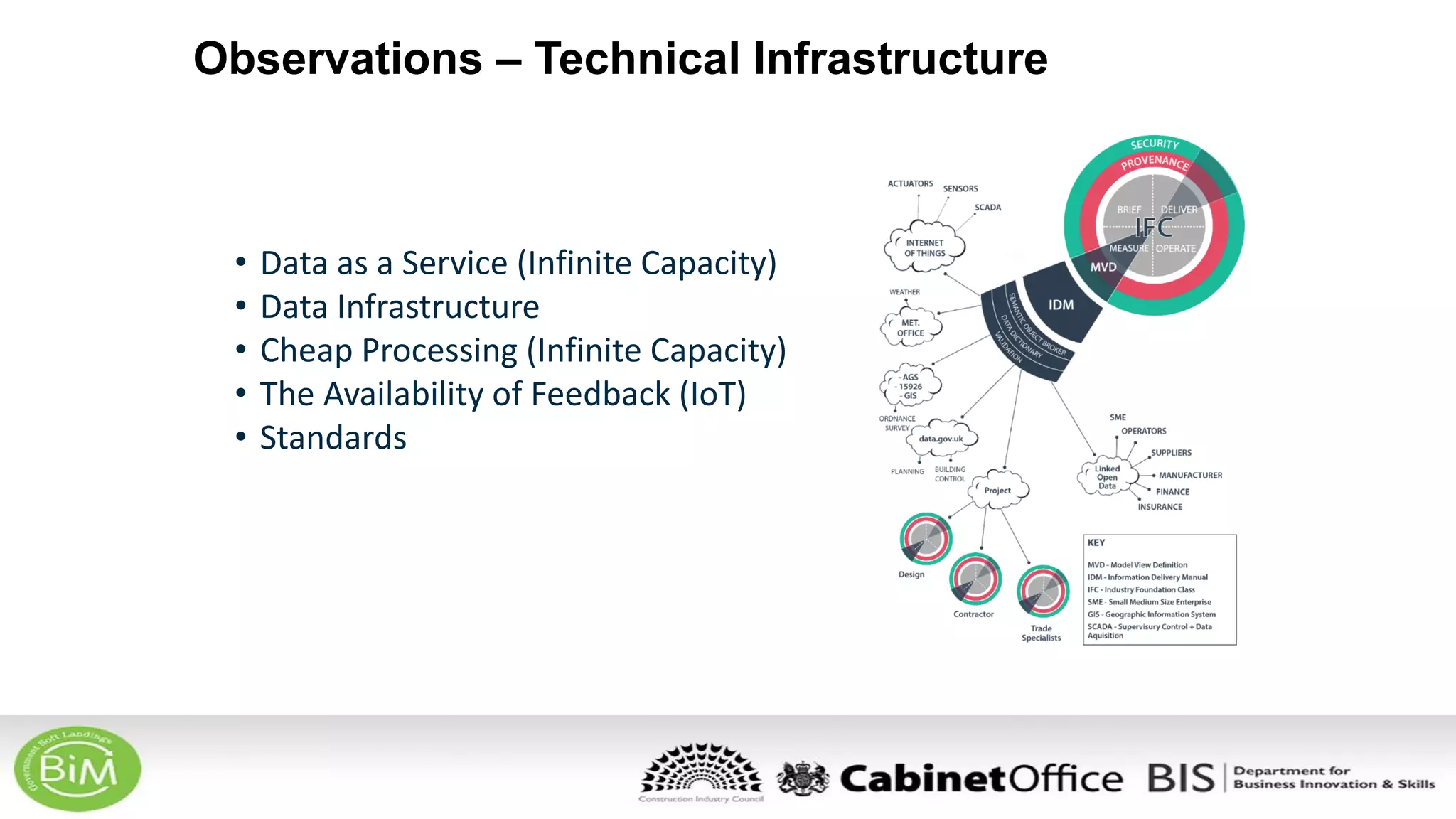
• Data
• Data as a Service (Infinite Capacity)
• Data Infrastructure
• Cheap Processing (Infinite Capacity)
• The Availability of Feedback (IoT)
• Standards
Observations – Technical Infrastructure
17
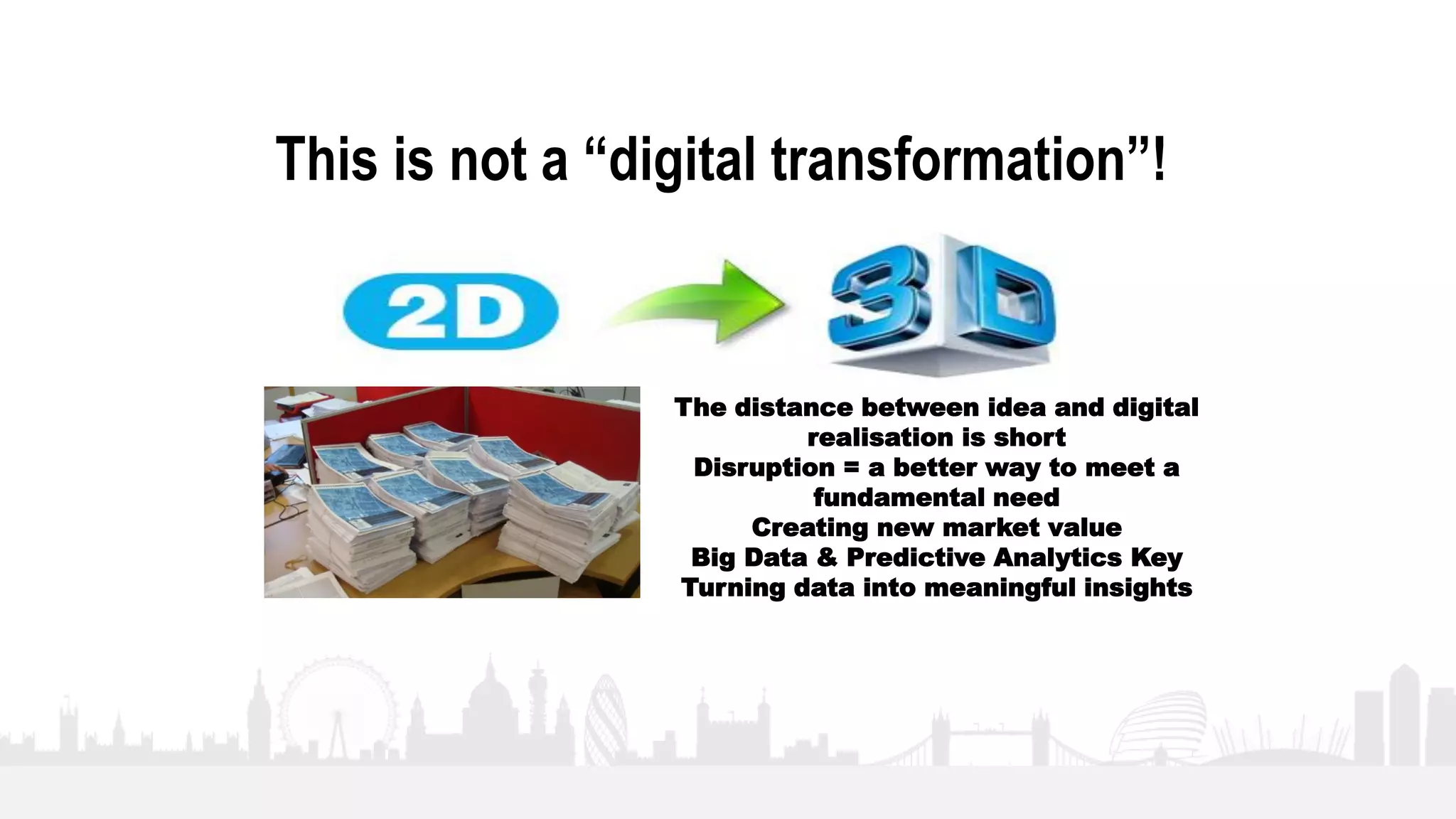
This is not a “digital transformation”!
The distance between idea and digital
realisation is short
Disruption = a better way to meet a
fundamental need
Creating new market value
Big Data & Predictive Analytics Key
Turning data into meaningful insights
18
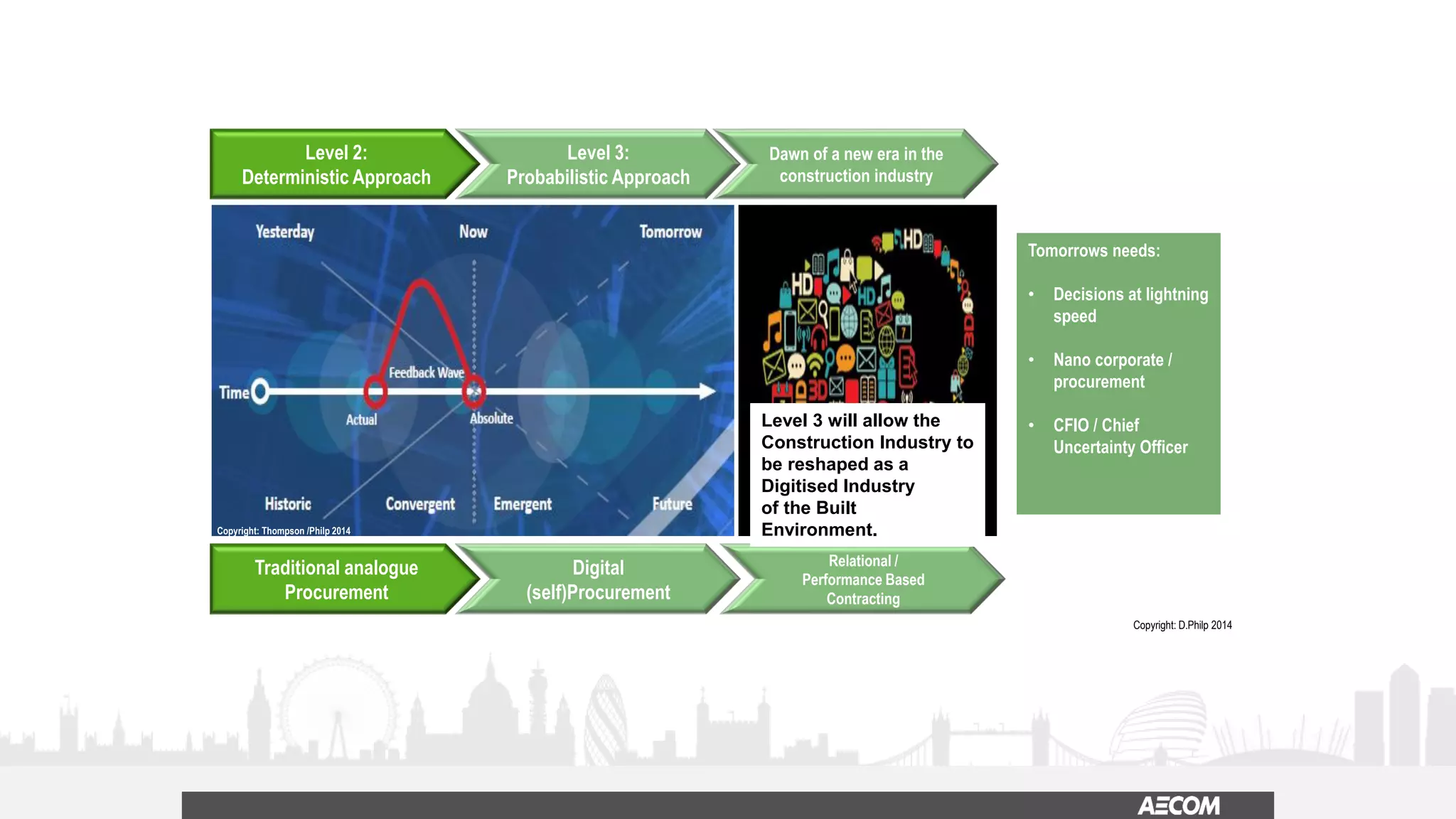
Level 2:
Deterministic Approach
Level 3:
Probabilistic Approach
Traditional analogue
Procurement
Digital
(self)Procurement
Relational /
Performance Based
Contracting
Dawn of a new era in the
construction industry
Copyright: D.Philp 2014
Level 3 will allow the
Construction Industry to
be reshaped as a
Digitised Industry
of the Built
Environment.Copyright: Thompson /Philp 2014
Tomorrows needs:
• Decisions at lightning
speed
• Nano corporate /
procurement
• CFIO / Chief
Uncertainty Officer
19
The Opportunities Addressed by the
Vision of Level 3 BIM
• How we can make this exchange faster and more efficient?
• How can we simplify the process by including geometry and data in the same data package?
• How can the data exchange be made on the web across the world, in any language?
• What can we do with the data generated by the Internet of Things, to improve asset
performance?
20
With level 3 BIM it may be possible for:
• Early rule based design and analysis on environmental performance
minimising iterative design time;
• Cost models to be quickly derived from the model using new costing
interfaces;
• Health and safety aspects associated with the construction and maintenance
of the building to be analysed in parallel with the design; and asset
management, KPI, and other feedback information to be aligned with
intelligent briefing,
• Enabling information in the model to develop during design and to be used
as part of a Soft Landings approach, and to inform and improve future
projects.
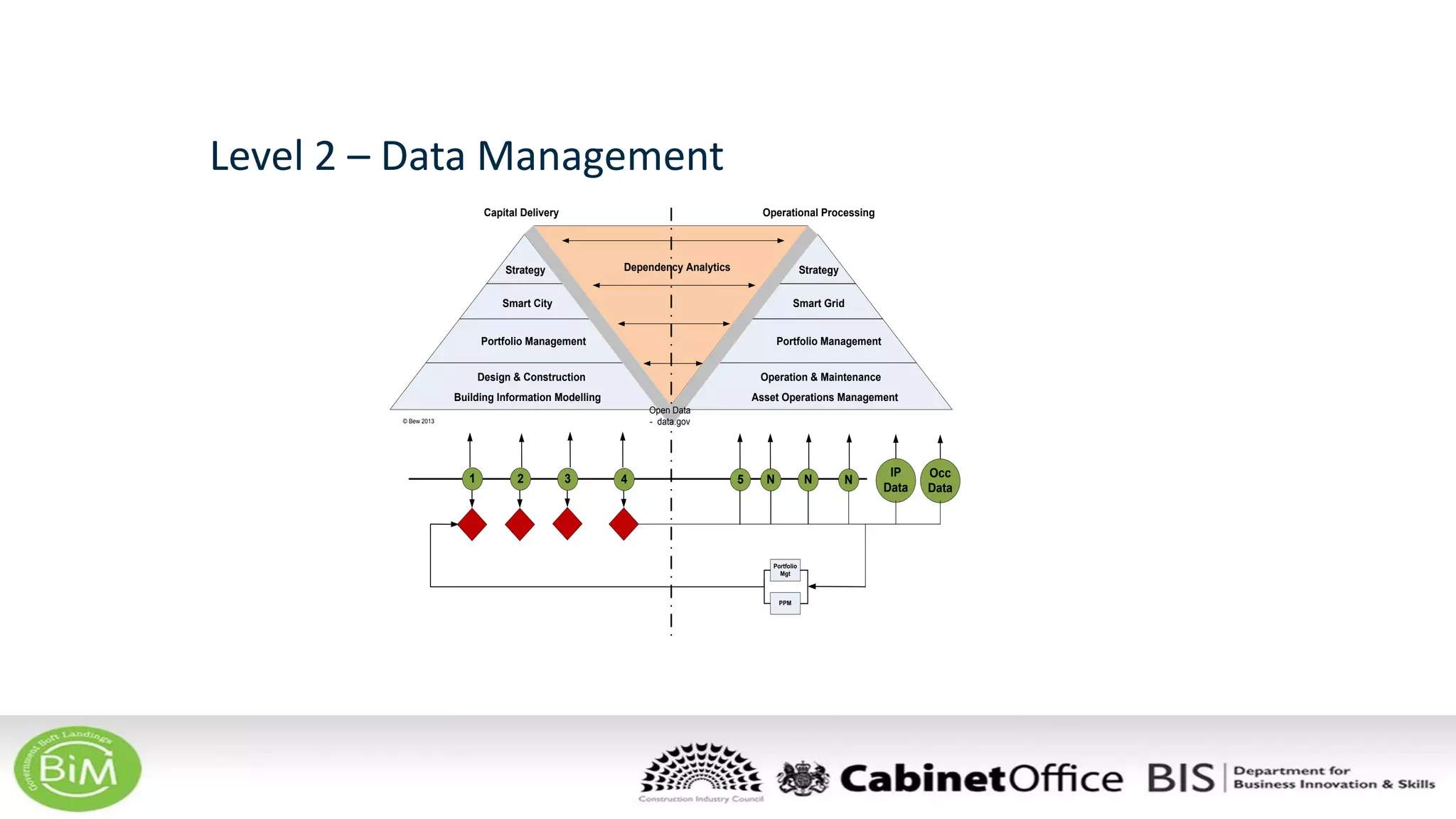
Level 2 – Data Management
Capital Delivery Operational Processing
1 2 3 4 5 N N N
Portfolio
Mgt
PPM
IP
Data
Occ
Data
Dependency Analytics
Building Information Modelling Asset Operations Management
© Bew 2013
Open Data
- data.gov
Design & Construction Operation & Maintenance
Portfolio Management
Smart City
Strategy
Portfolio Management
Smart Grid
Strategy
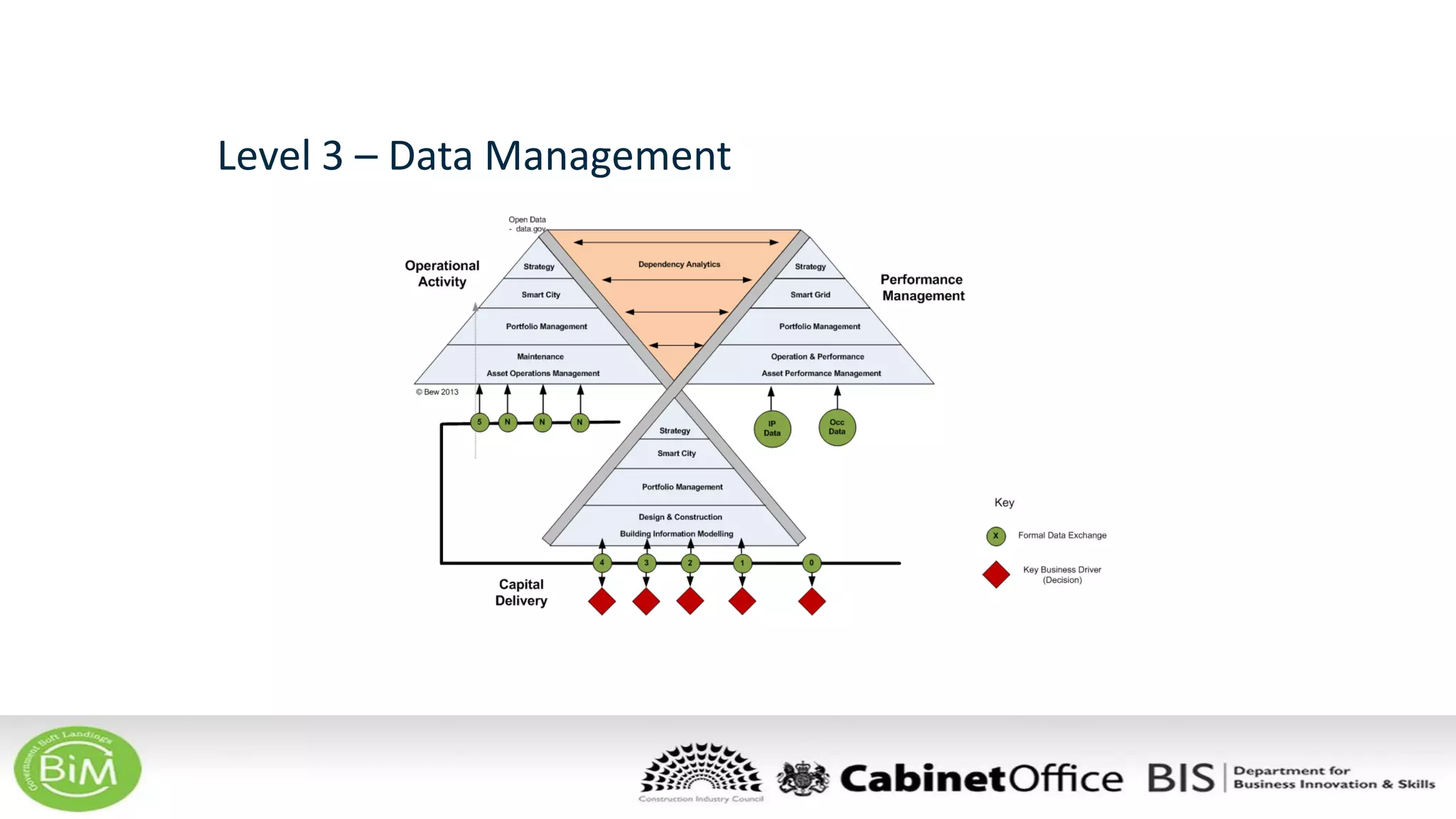
Level 3 – Data Management
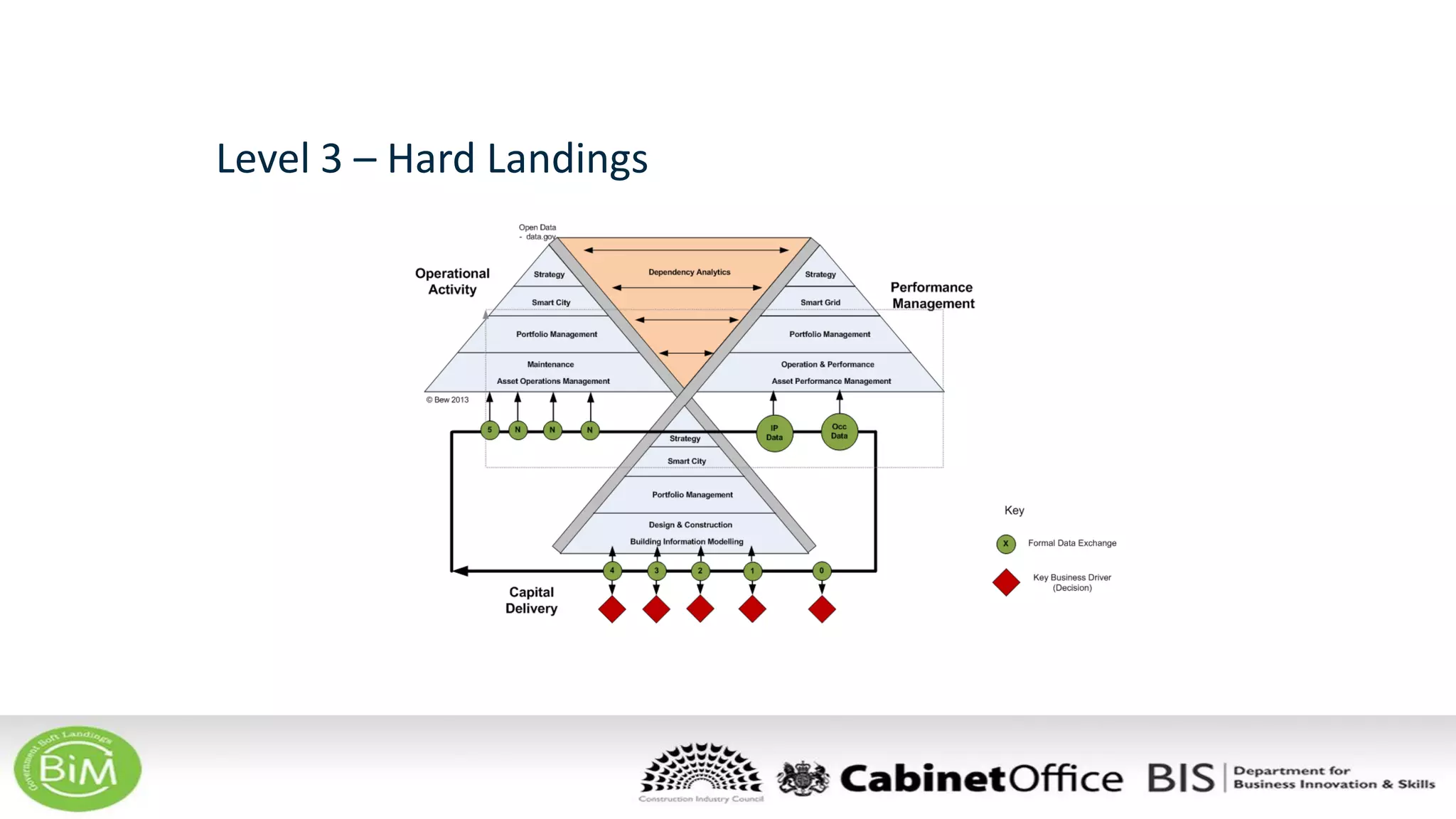
Level 3 – Hard Landings
Dependency Analytics
Asset Operations Management
Open Data
- data.gov
Maintenance
Portfolio Management
Smart City
Strategy
Portfolio Management
Smart Grid
Strategy
D
ependency
A
nalytics
U
singB
IG
D
ata
W
ater
Pow
er
B
uildings
People
Interoperable
Cross Sector Smart Cities &
Grids
Red titles indicate integration with
existing sector “Industrial
Strategies”
Transportation
Open Source & Data to
Encourage innovation and
growth in the technology, HPC
and Build Environment Markets
Performance
Management
Operational
Activity
Building Information Modelling
© Bew 2013
Design & Construction
Portfolio Management
Smart City
Strategy
Capital
Delivery
5 N N N IP
Data
Occ
Data
4 3 2 1 0
Asset Performance Management
Operation & Performance
X
Key
Formal Data Exchange
Key Business Driver
(Decision)
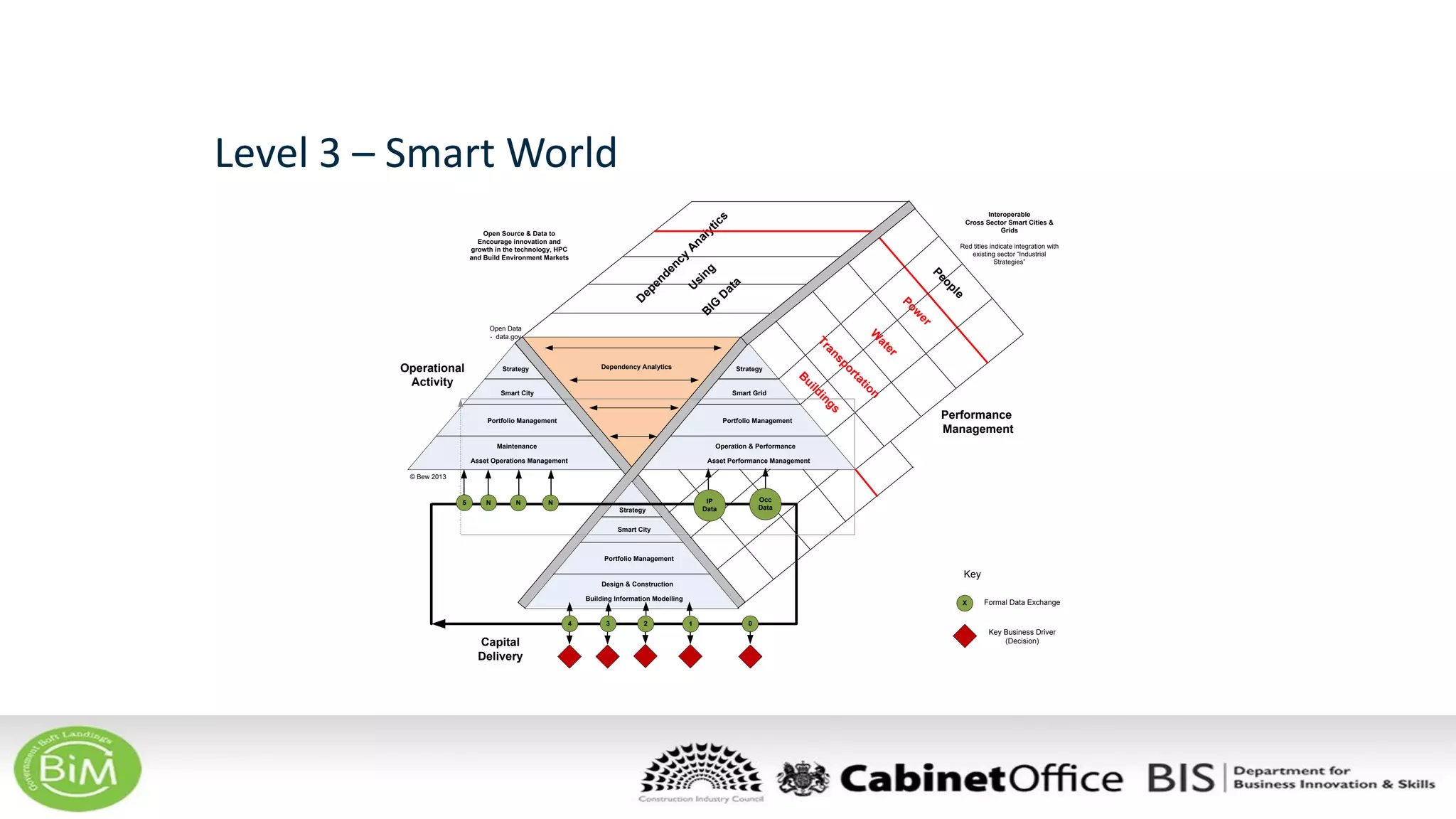
Level 3 – Smart World
25
Source: HS2
26
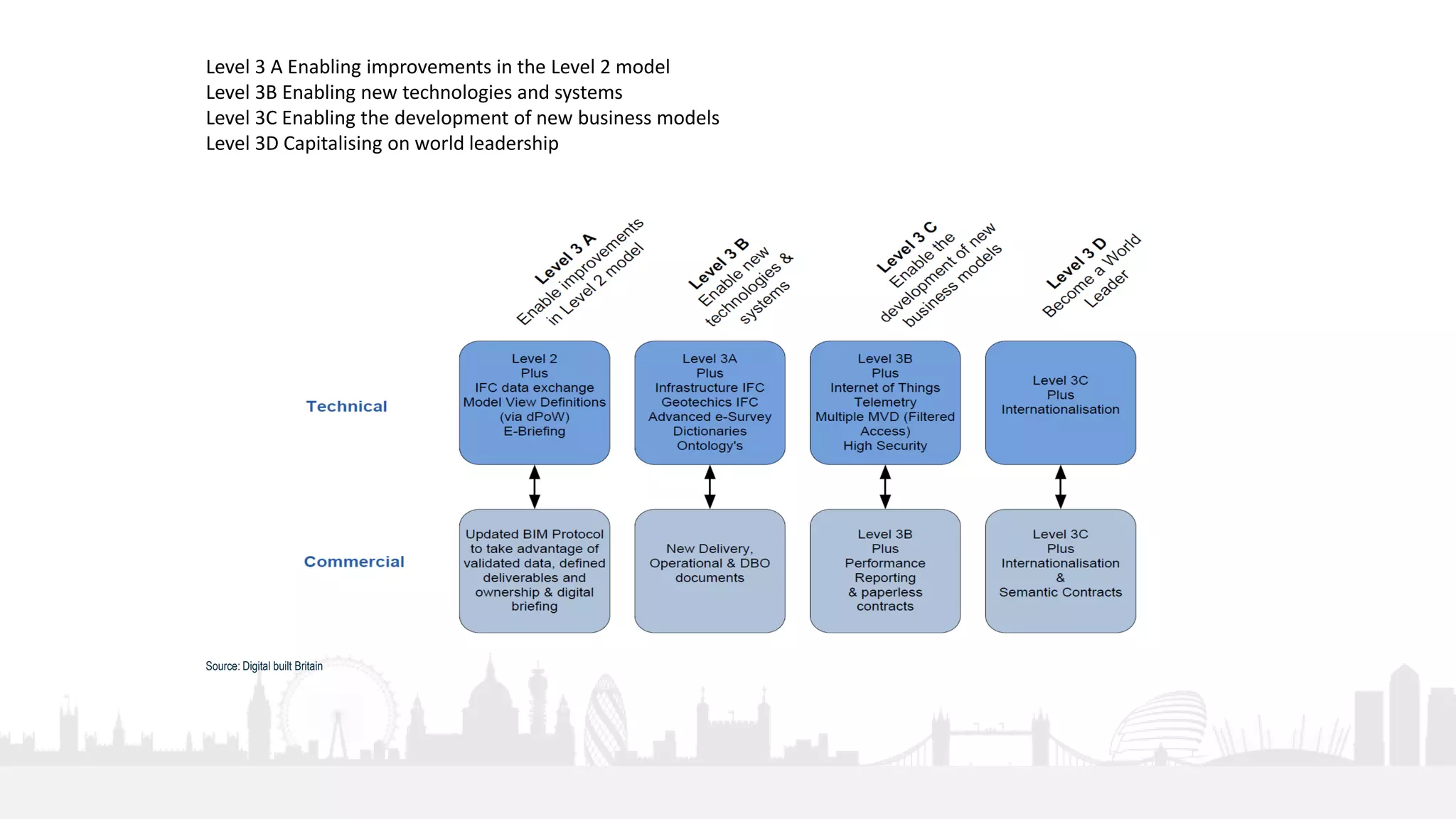
Level 3 A Enabling improvements in the Level 2 model
Level 3B Enabling new technologies and systems
Level 3C Enabling the development of new business models
Level 3D Capitalising on world leadership
Source: Digital built Britain
27
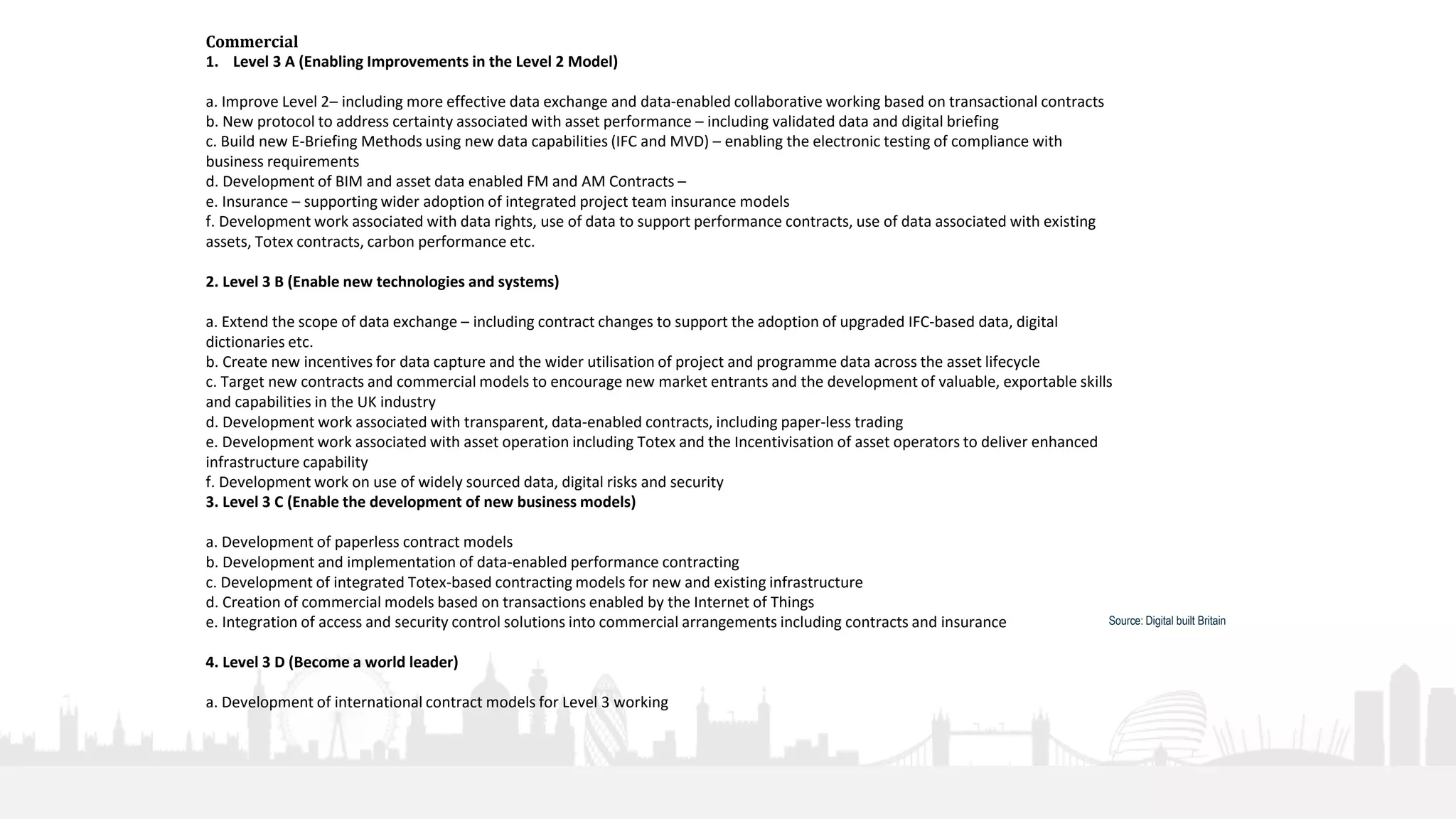
Commercial
1. Level 3 A (Enabling Improvements in the Level 2 Model)
a. Improve Level 2– including more effective data exchange and data-enabled collaborative working based on transactional contracts
b. New protocol to address certainty associated with asset performance – including validated data and digital briefing
c. Build new E-Briefing Methods using new data capabilities (IFC and MVD) – enabling the electronic testing of compliance with
business requirements
d. Development of BIM and asset data enabled FM and AM Contracts –
e. Insurance – supporting wider adoption of integrated project team insurance models
f. Development work associated with data rights, use of data to support performance contracts, use of data associated with existing
assets, Totex contracts, carbon performance etc.
2. Level 3 B (Enable new technologies and systems)
a. Extend the scope of data exchange – including contract changes to support the adoption of upgraded IFC-based data, digital
dictionaries etc.
b. Create new incentives for data capture and the wider utilisation of project and programme data across the asset lifecycle
c. Target new contracts and commercial models to encourage new market entrants and the development of valuable, exportable skills
and capabilities in the UK industry
d. Development work associated with transparent, data-enabled contracts, including paper-less trading
e. Development work associated with asset operation including Totex and the Incentivisation of asset operators to deliver enhanced
infrastructure capability
f. Development work on use of widely sourced data, digital risks and security
3. Level 3 C (Enable the development of new business models)
a. Development of paperless contract models
b. Development and implementation of data-enabled performance contracting
c. Development of integrated Totex-based contracting models for new and existing infrastructure
d. Creation of commercial models based on transactions enabled by the Internet of Things
e. Integration of access and security control solutions into commercial arrangements including contracts and insurance
4. Level 3 D (Become a world leader)
a. Development of international contract models for Level 3 working
Source: Digital built Britain
28
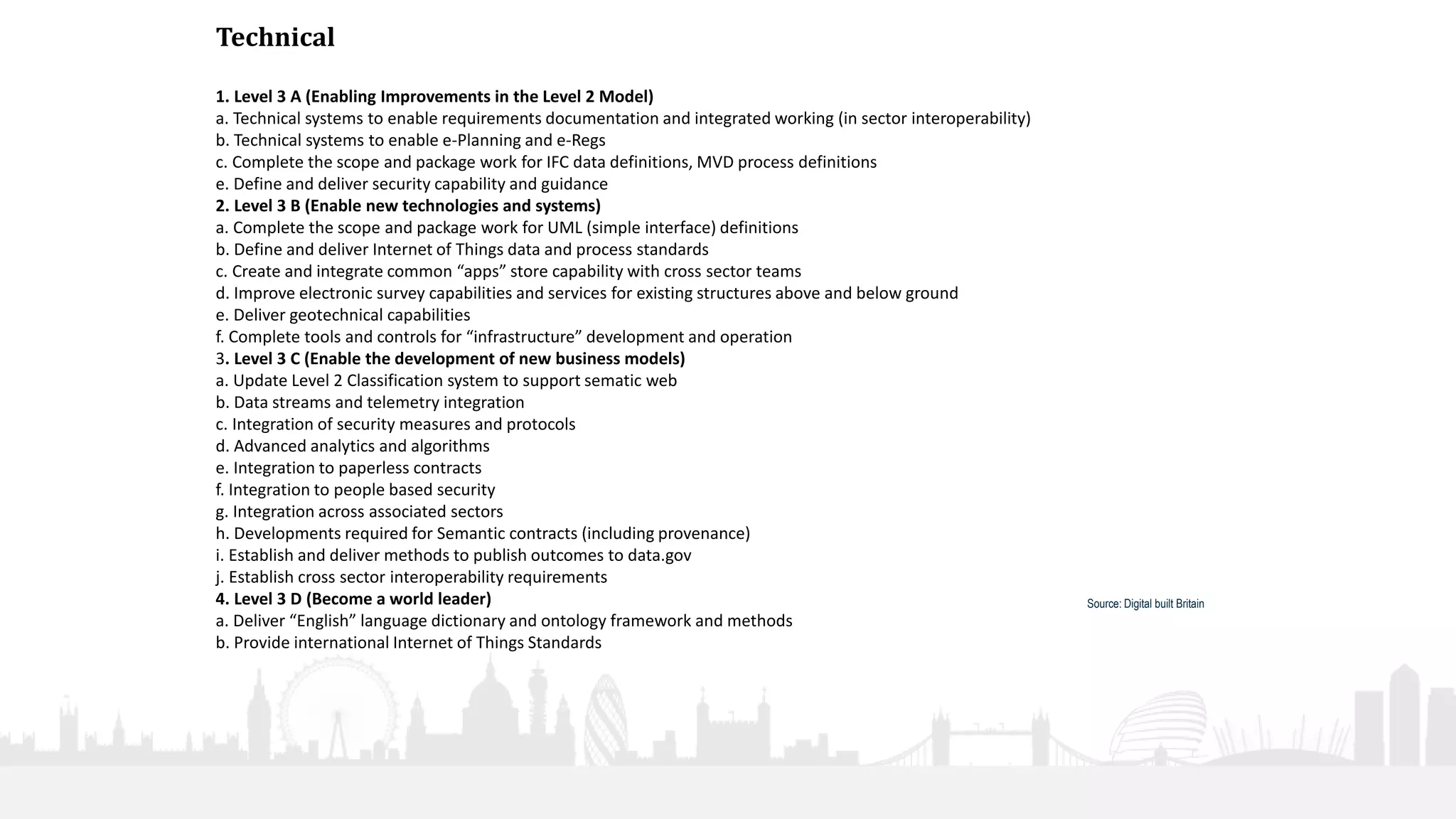
Technical
1. Level 3 A (Enabling Improvements in the Level 2 Model)
a. Technical systems to enable requirements documentation and integrated working (in sector interoperability)
b. Technical systems to enable e-Planning and e-Regs
c. Complete the scope and package work for IFC data definitions, MVD process definitions
e. Define and deliver security capability and guidance
2. Level 3 B (Enable new technologies and systems)
a. Complete the scope and package work for UML (simple interface) definitions
b. Define and deliver Internet of Things data and process standards
c. Create and integrate common “apps” store capability with cross sector teams
d. Improve electronic survey capabilities and services for existing structures above and below ground
e. Deliver geotechnical capabilities
f. Complete tools and controls for “infrastructure” development and operation
3. Level 3 C (Enable the development of new business models)
a. Update Level 2 Classification system to support sematic web
b. Data streams and telemetry integration
c. Integration of security measures and protocols
d. Advanced analytics and algorithms
e. Integration to paperless contracts
f. Integration to people based security
g. Integration across associated sectors
h. Developments required for Semantic contracts (including provenance)
i. Establish and deliver methods to publish outcomes to data.gov
j. Establish cross sector interoperability requirements
4. Level 3 D (Become a world leader)
a. Deliver “English” language dictionary and ontology framework and methods
b. Provide international Internet of Things Standards
Source: Digital built Britain
29
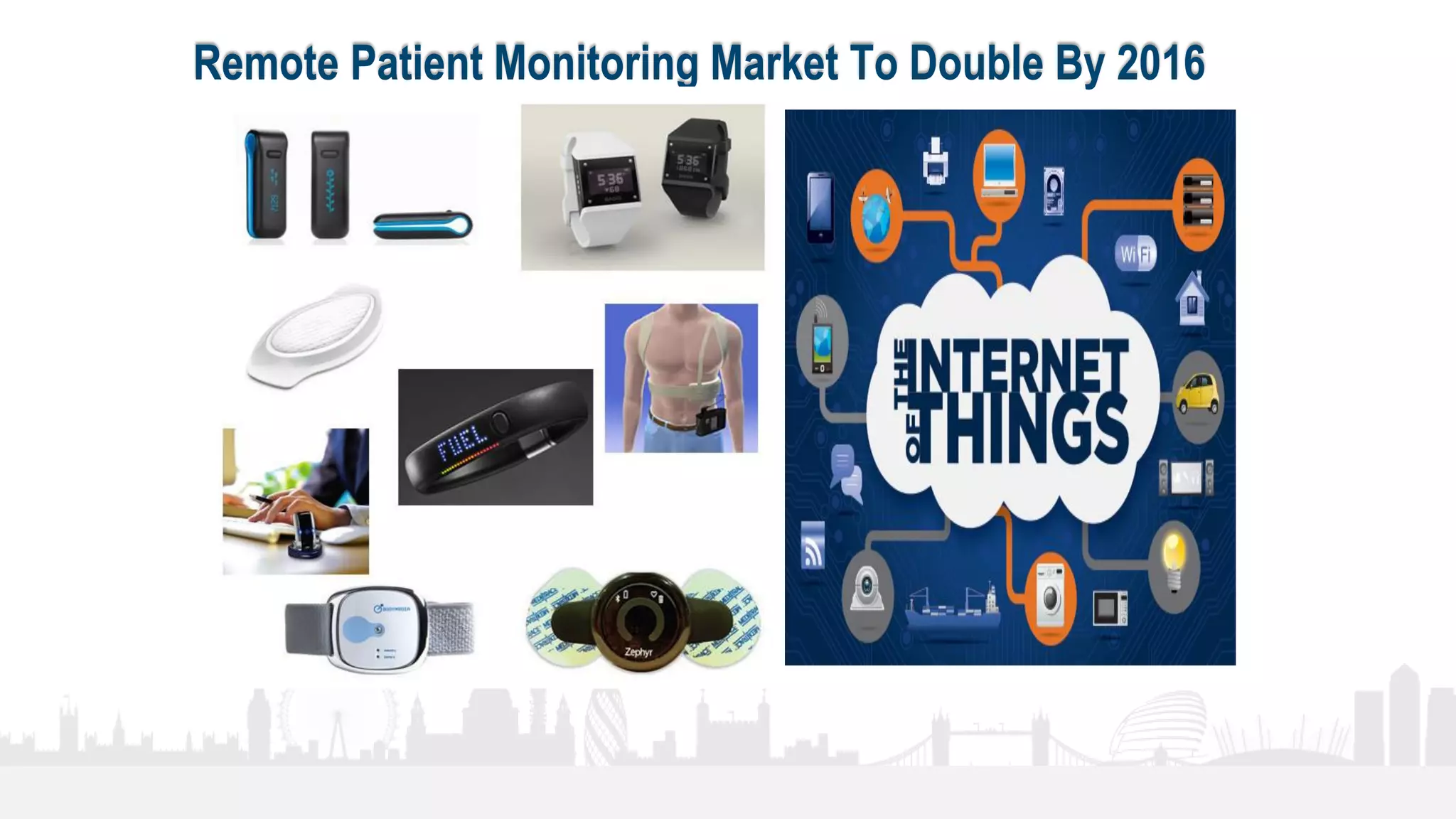
Remote Patient Monitoring Market To Double By 2016
30
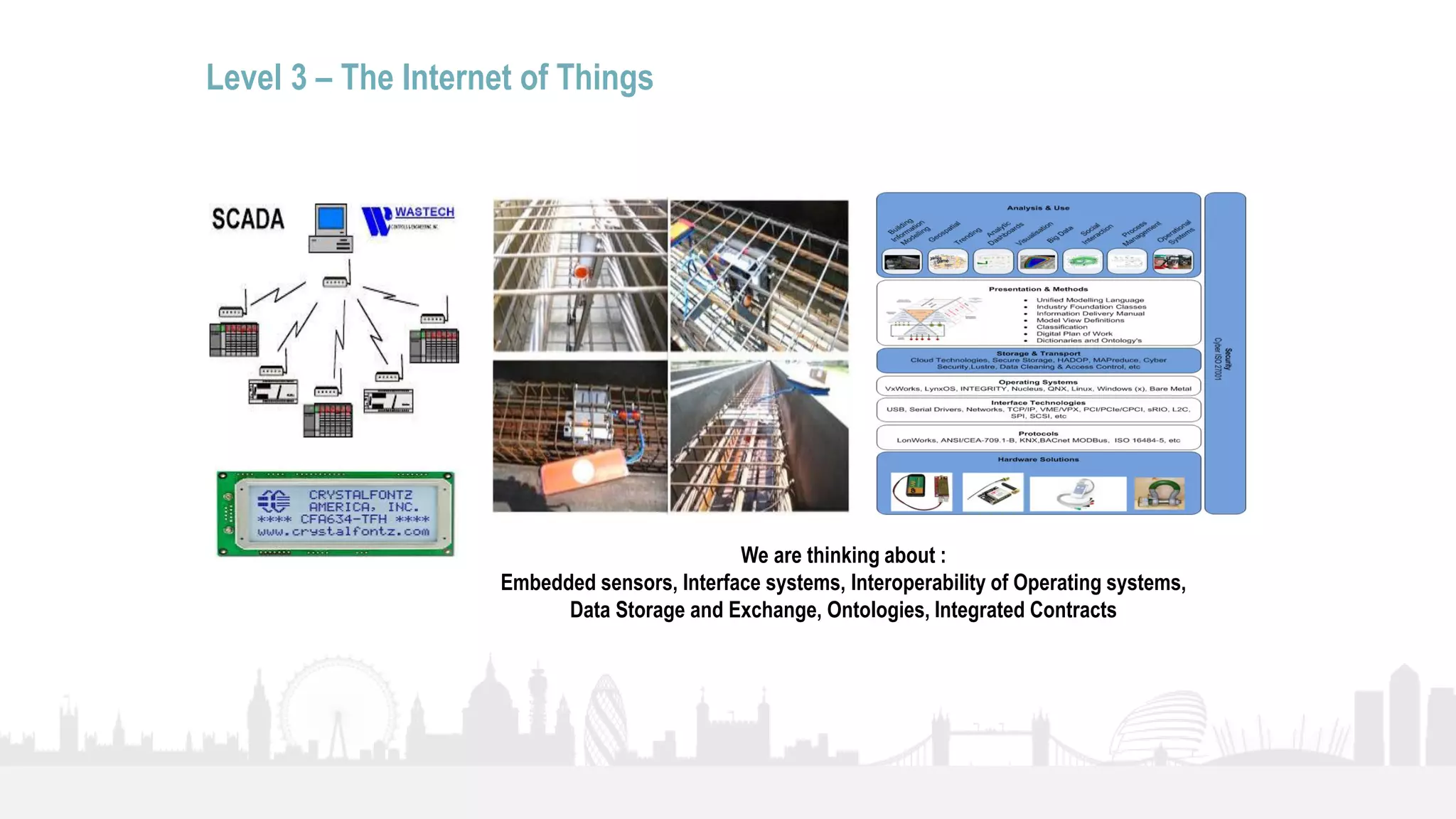
We are thinking about :
Embedded sensors, Interface systems, Interoperability of Operating systems,
Data Storage and Exchange, Ontologies, Integrated Contracts
Level 3 – The Internet of Things
31
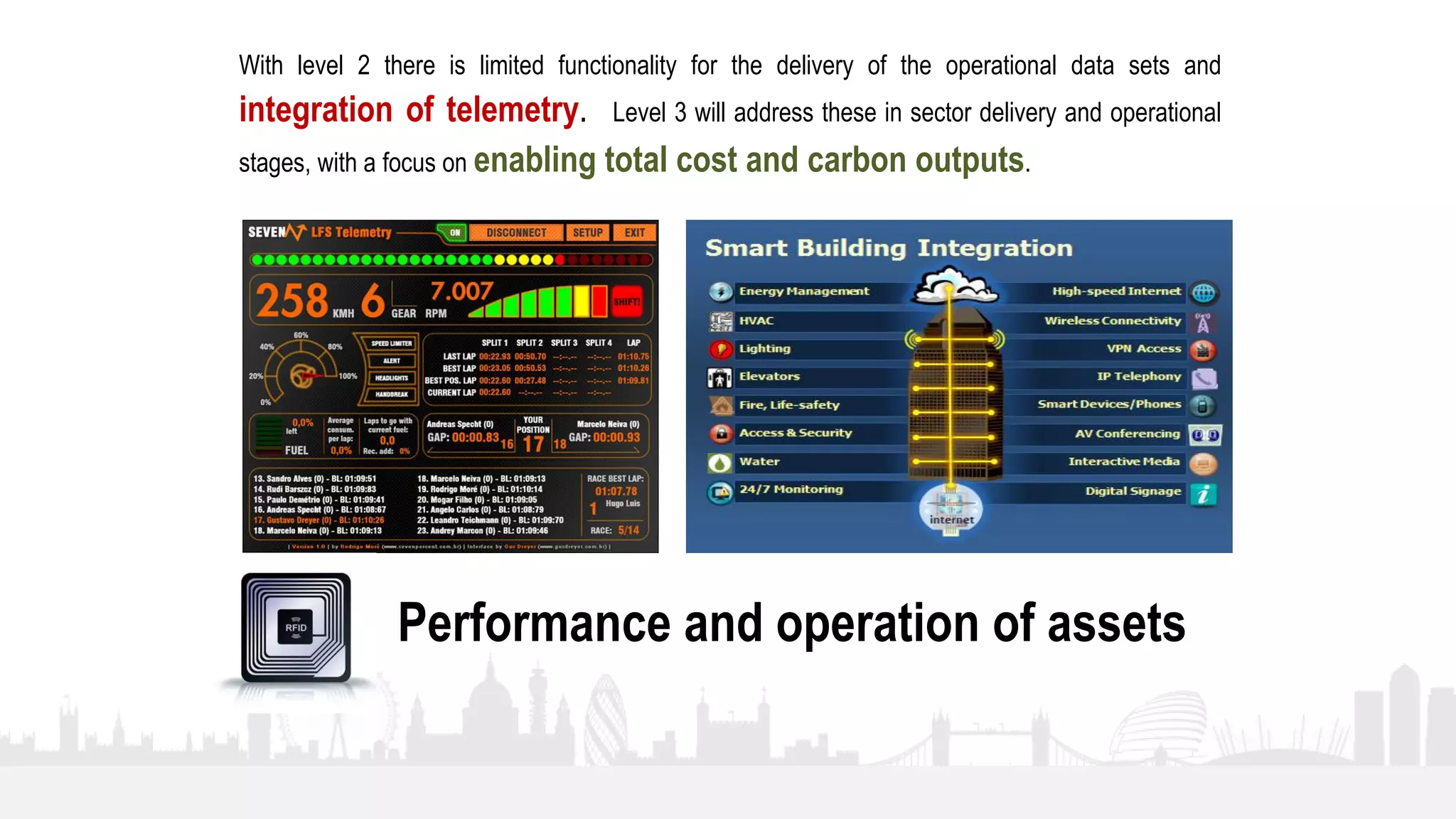
With level 2 there is limited functionality for the delivery of the operational data sets and
integration of telemetry. Level 3 will address these in sector delivery and operational
stages, with a focus on enabling total cost and carbon outputs.
Performance and operation of assets
32
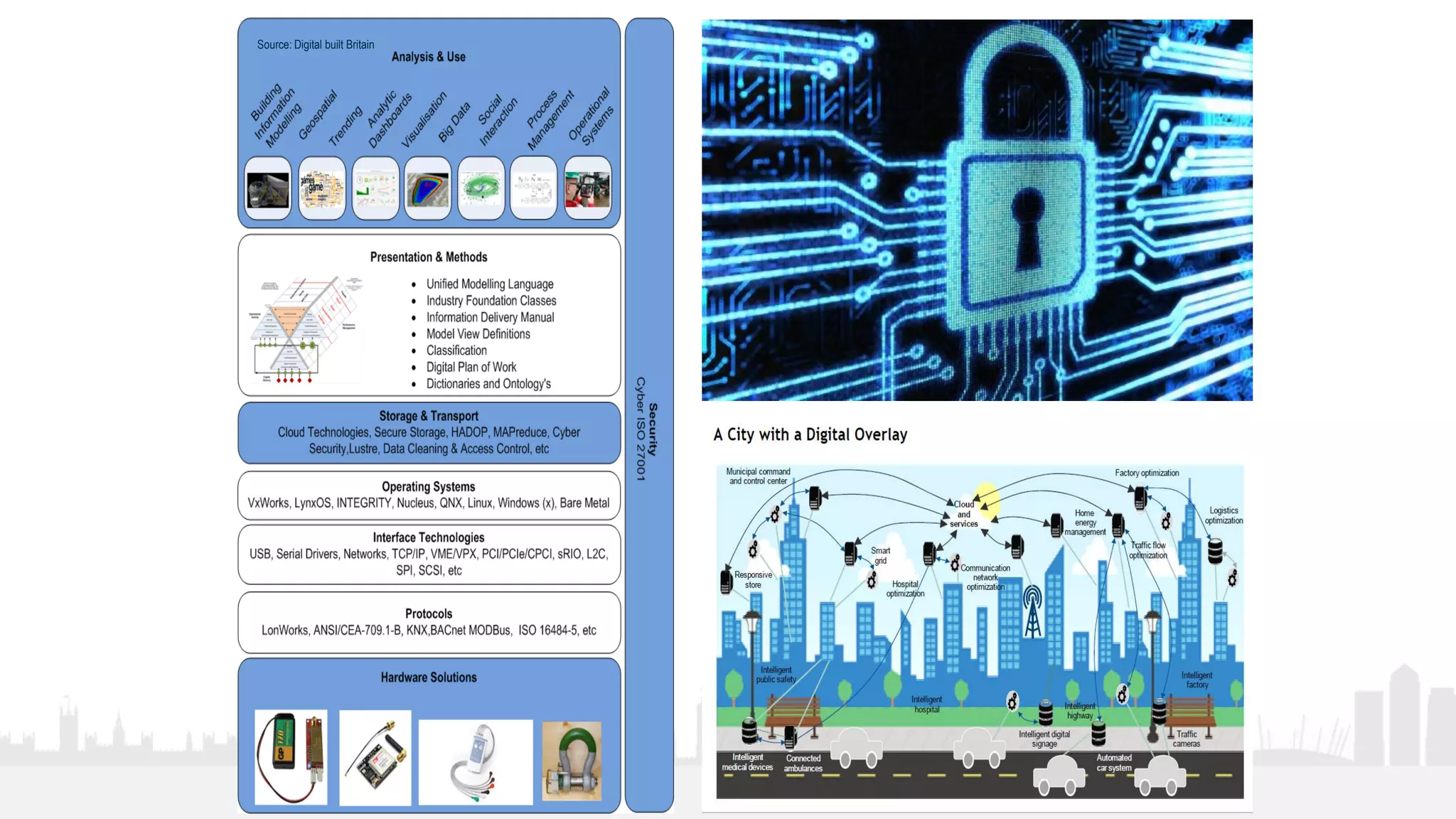
Source: Digital built Britain
33
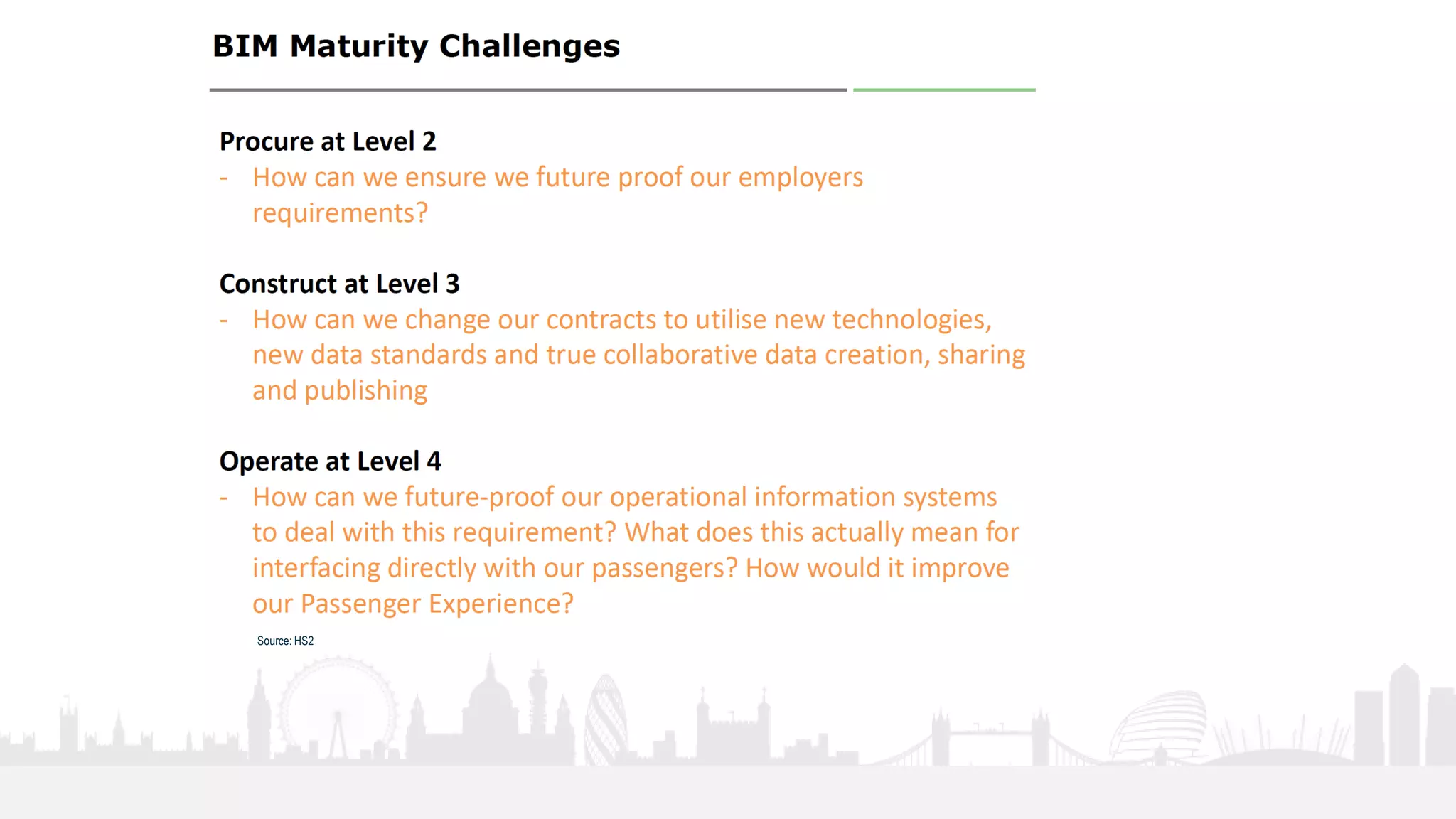
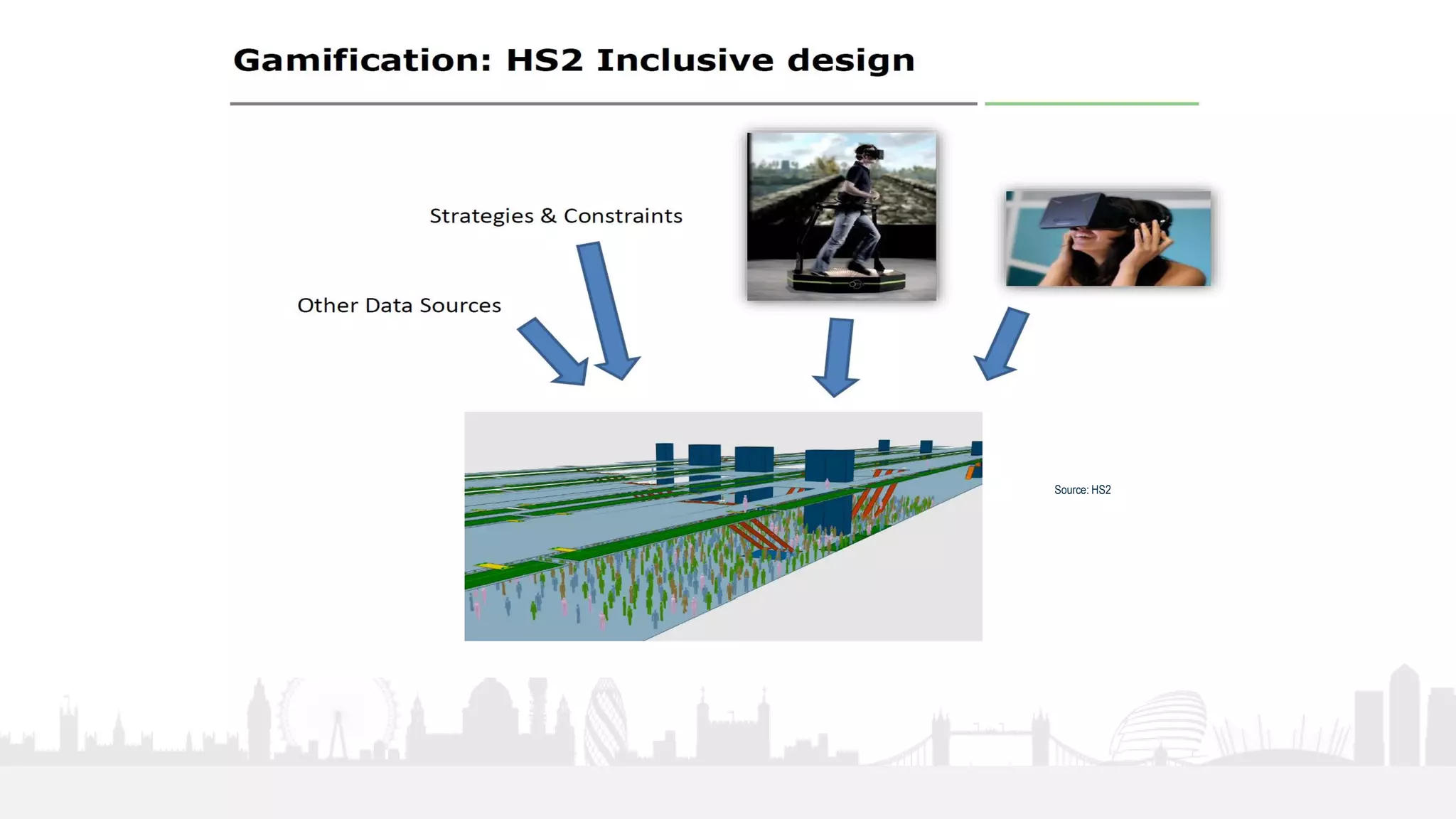
Source: HS2
34
Gamification … In Procurement
Thought: split procurement into areas that run in series and
transparently rank bidders after each area … e.g. H&S, information
management, security, project management etc.
Data-driven procurement and validation against requirements would
ease this process, e.g. schedule that works, is utilising correct WBS,
has correct milestones, is resource-loaded correctly, has got
dependency integrity; digital data requirements against the EIR
through all tiers.
Source: HS2
35
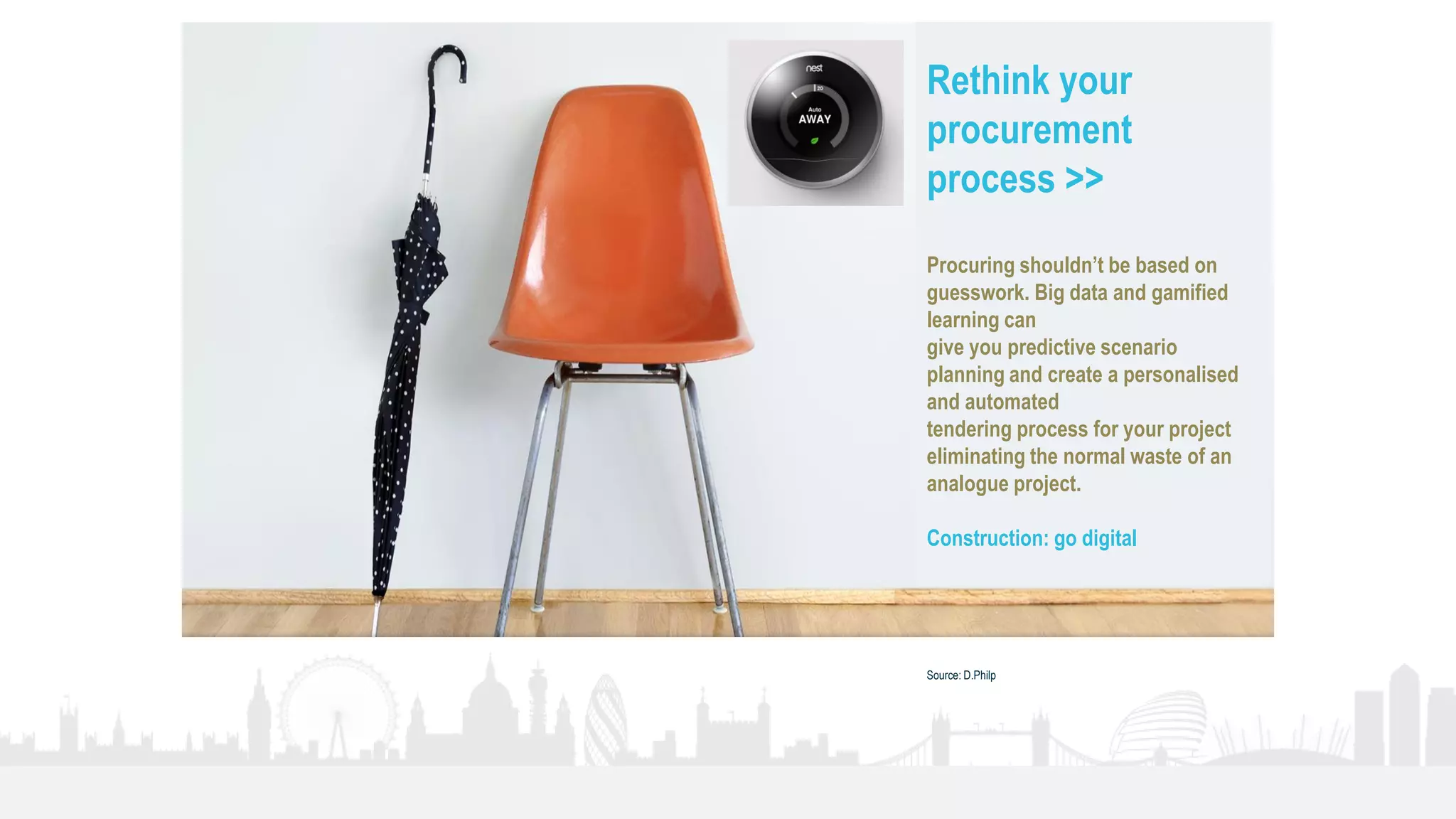
Rethink your
procurement
process >>
Procuring shouldn’t be based on
guesswork. Big data and gamified
learning can
give you predictive scenario
planning and create a personalised
and automated
tendering process for your project
eliminating the normal waste of an
analogue project.
Construction: go digital
Source: D.Philp
36
New Business Models Enabled by Level 3 BIM
.
• The ability to measure “in service” performance and compare it to “as briefed” and “as
delivered” assets - providing the single biggest opportunity to improve both cost and
carbon performance.
• The ability to bring together through open data standards from design, construction and
operations and across market sectors - offering the ability to analyse and create the
learning
• Feedback loops that needs to be able to deliver sustainable long-term improvements in
asset performance.
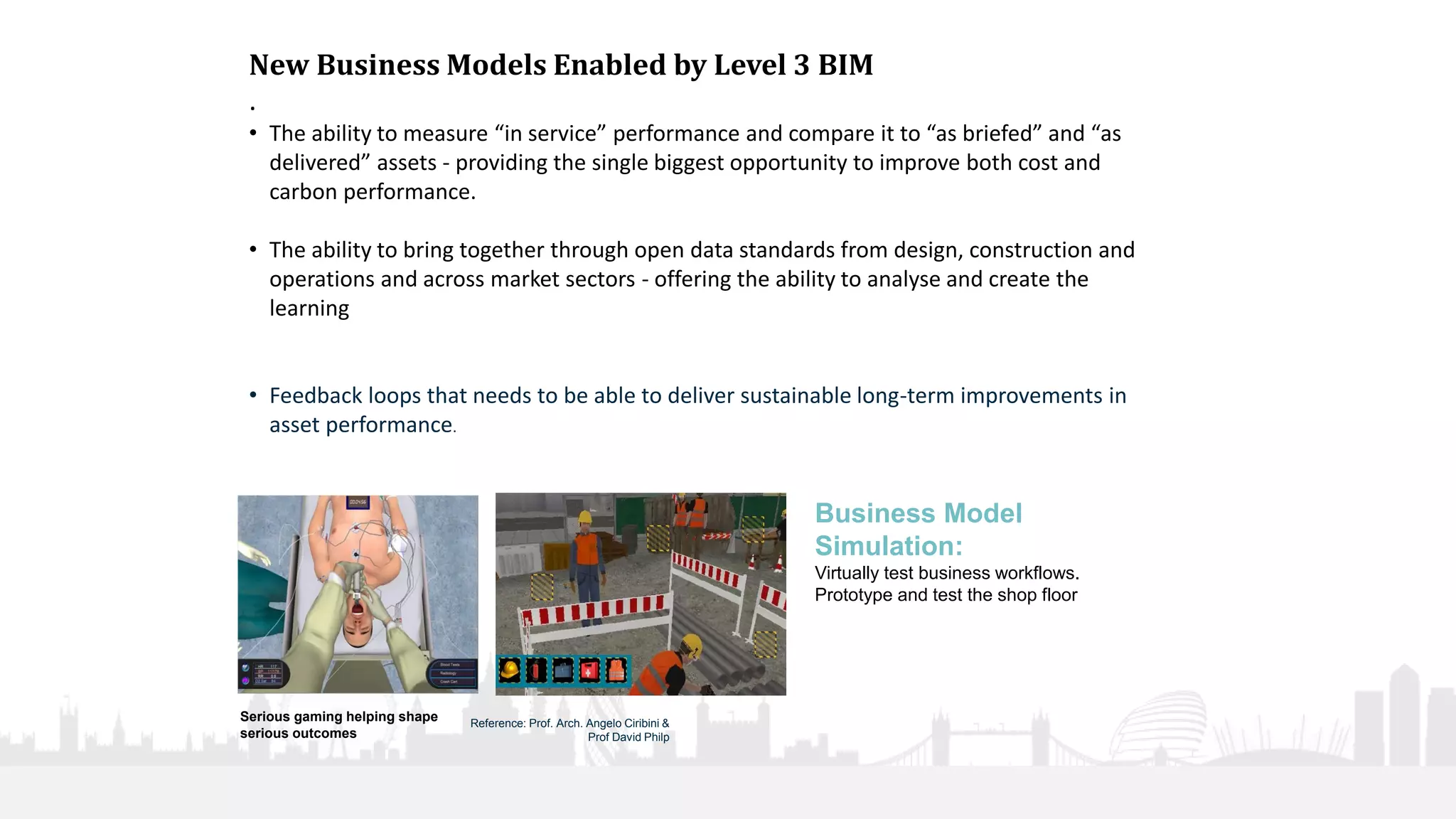
Serious gaming helping shape
serious outcomes
Reference: Prof. Arch. Angelo Ciribini &
Prof David Philp
Business Model
Simulation:
Virtually test business workflows.
Prototype and test the shop floor
37
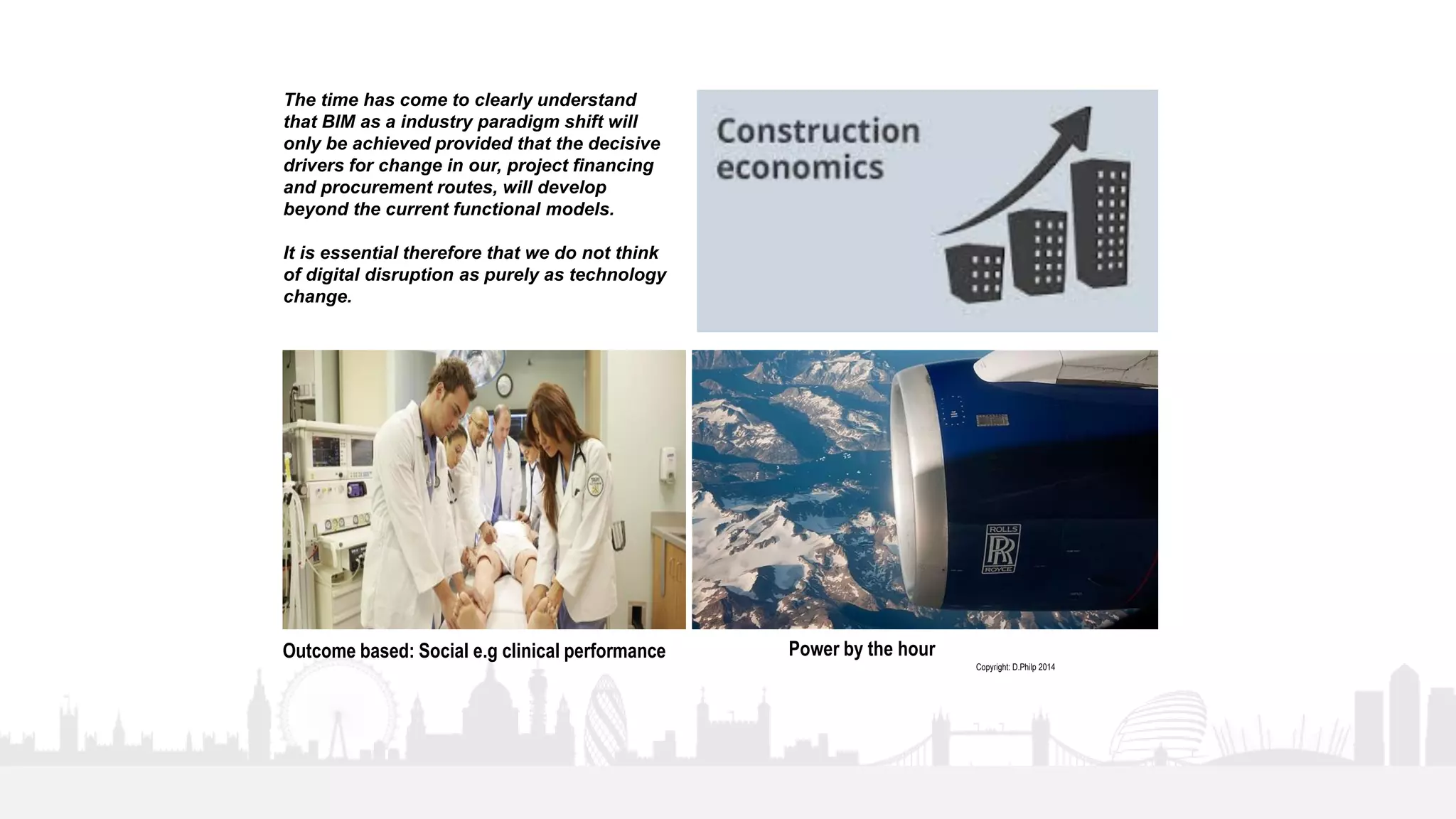
The time has come to clearly understand
that BIM as a industry paradigm shift will
only be achieved provided that the decisive
drivers for change in our, project financing
and procurement routes, will develop
beyond the current functional models.
It is essential therefore that we do not think
of digital disruption as purely as technology
change.
Power by the hourOutcome based: Social e.g clinical performance
Copyright: D.Philp 2014
38
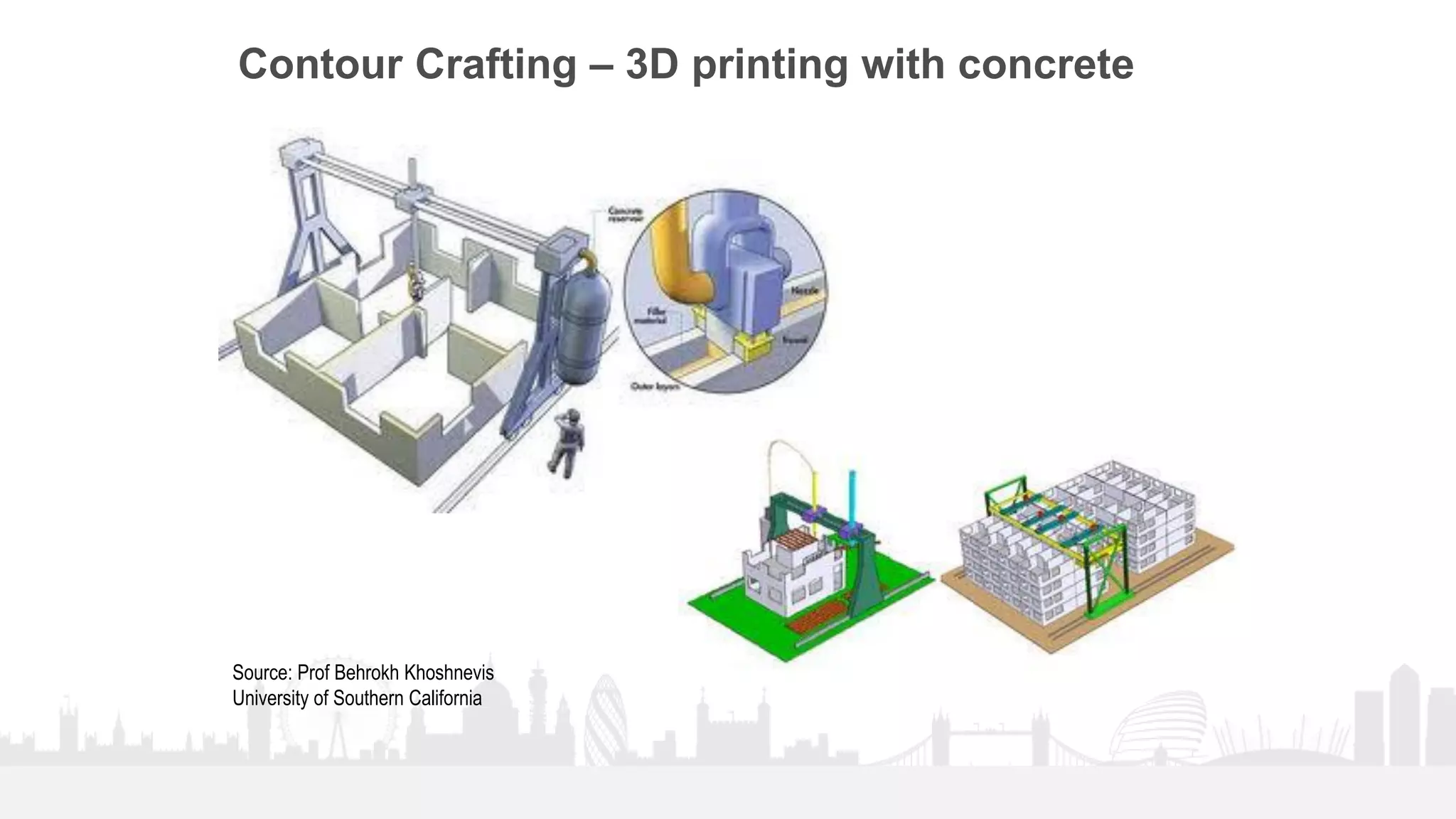
Contour Crafting – 3D printing with concrete
Source: Prof Behrokh Khoshnevis
University of Southern California

ETDP 2015 D2 Key Note Preparing for a Digital Built Britain - David Philp

  • 1.
    Key Note :Preparing for a Digital built Britain David Philp - Director BIM – EMEA at AECOM, Head of BIM, UK BIM Task Group 11th November 2015
  • 2.
  • 4.
    All centrally funded GovernmentDepartments will provide clear and complete “EIRs” with all contracts. 4
  • 6.
    Level 2 BIM Initiate & SetupFeasibilit y Assessm ent Preferre d Option Planning & Design Delivery Post Takeover Activity In Use Digital POW – Industry standard stage plan, gateway decision points and information exchanges PLQ – Plain Language Questions: Simple & clear questions informing business decisions; defining digital asset information requirements to be provided and/or procured at each POW stage. Shared Information - for collaboration & information; with no implied liability. Published Information – to be relied on for a published purpose at a pow stage. BIM L2 Information Model: Geometric 3D Models, Documents, Non Geometric Data as COBie exchanged as files to Employers Information Requirements Sha red Work In Progre ss Archiv e Publishe d G a t e CDE – Common Data Environment single point of managed coordinated & clash resolved information truth as Project Information Model PIM and/or Employers Asset Information Model AIM COBie – Construction Operations Building information exchange: open standard asset master data schema for briefing, design, construction, operations & performance data COBie AMS – Asset Management System to plan, manage and maintain the Estate Asset Portfolio; integrated with the Employers Asset Information Model AIM Significant time, cost and quality construction delivery improvements – quicker, cheaper, better. More for Less! Digital information to become a key enabler of stakeholder engagement, decision making and estate planning – more reliable engagement Information delivered to enable organisation to acquire, operate and maintain the asset estate portfolio more effectively – assets that fulfil stakeholder requirements. The value of BIM EIR - General (Framework) & specific (Project) Employers Information Requirements for a service supply, design or construction contract BEP – BIM Execution Plan: Suppliers pre & post contract proposal to manage project information to meet the requirements of the Employers Information Requirements. OIR – Organisation Information Requirements to meet department PLQ AIR - Asset Information Requirements for each managed asset at each POW stage BIM Level 2 components Graeme Tappenden June 2015
  • 7.
    These times area changing and so are we • Our industry is changing rapidly • More thought about achieving better asset outcomes • Standard assemblies and DFMA • Need to be more efficient / altruistic • Being driven by well informed data decisions • More openness in data • Enabled by better working & innovation • New results of assets and users BIM / GSL??
  • 8.
    Level 2 resolvesthe methodology of: • Working in a 3D environment • Creating structured non-graphical data • Data verification and validation • Consistent data exchanges • Working in a common data environment • Connecting capex and opex • Create a solid platform for Level 3
  • 9.
  • 10.
    BIM, Procurement throughcomputer readable data
  • 11.
    11 Construction 2025… HM Government2013 Industrial Strategy: government and industry in partnership Towards a Digitally Built Britain With 21st Century Assets Source: UK BIM Task Group
  • 12.
    12 The greatest BIMchallenges arise when moving from level 2 BIM to level 3 BIM and the perceived ‘holy grail’ of the single project model. Level 3 envisages a wholly integrated model accessed by all members of the project team in real time. Integrated working!!!
  • 13.
  • 14.
    14 D B 20% Smart Assets+ People Data = Maximised Business Outcomes Source: Digital built Britain
  • 15.
    Internet of Things AssetSensor Network & Telemetry Additive Manufacture & Industrial 3D Printing Manufacture & Logistics 4.0 Big and Open Data Cloud Computing / (Serious) Gamification & Simulation of business models Cyber Security Advanced Materials & Nanotechnology Autonomous Plant & Robotics Self procuring Self Refining Performance Real-time (POE)Outcome & Performance Based Lightning speed Decision MakingData driven Design Constructs of Construction Industry 4.0 Copyright: Dave Philp, 2015
  • 16.
    • Data • Dataas a Service (Infinite Capacity) • Data Infrastructure • Cheap Processing (Infinite Capacity) • The Availability of Feedback (IoT) • Standards Observations – Technical Infrastructure
  • 17.
    17 This is nota “digital transformation”! The distance between idea and digital realisation is short Disruption = a better way to meet a fundamental need Creating new market value Big Data & Predictive Analytics Key Turning data into meaningful insights
  • 18.
    18 Level 2: Deterministic Approach Level3: Probabilistic Approach Traditional analogue Procurement Digital (self)Procurement Relational / Performance Based Contracting Dawn of a new era in the construction industry Copyright: D.Philp 2014 Level 3 will allow the Construction Industry to be reshaped as a Digitised Industry of the Built Environment.Copyright: Thompson /Philp 2014 Tomorrows needs: • Decisions at lightning speed • Nano corporate / procurement • CFIO / Chief Uncertainty Officer
  • 19.
    19 The Opportunities Addressedby the Vision of Level 3 BIM • How we can make this exchange faster and more efficient? • How can we simplify the process by including geometry and data in the same data package? • How can the data exchange be made on the web across the world, in any language? • What can we do with the data generated by the Internet of Things, to improve asset performance?
  • 20.
    20 With level 3BIM it may be possible for: • Early rule based design and analysis on environmental performance minimising iterative design time; • Cost models to be quickly derived from the model using new costing interfaces; • Health and safety aspects associated with the construction and maintenance of the building to be analysed in parallel with the design; and asset management, KPI, and other feedback information to be aligned with intelligent briefing, • Enabling information in the model to develop during design and to be used as part of a Soft Landings approach, and to inform and improve future projects.
  • 21.
    Level 2 –Data Management Capital Delivery Operational Processing 1 2 3 4 5 N N N Portfolio Mgt PPM IP Data Occ Data Dependency Analytics Building Information Modelling Asset Operations Management © Bew 2013 Open Data - data.gov Design & Construction Operation & Maintenance Portfolio Management Smart City Strategy Portfolio Management Smart Grid Strategy
  • 22.
    Level 3 –Data Management
  • 23.
    Level 3 –Hard Landings
  • 24.
    Dependency Analytics Asset OperationsManagement Open Data - data.gov Maintenance Portfolio Management Smart City Strategy Portfolio Management Smart Grid Strategy D ependency A nalytics U singB IG D ata W ater Pow er B uildings People Interoperable Cross Sector Smart Cities & Grids Red titles indicate integration with existing sector “Industrial Strategies” Transportation Open Source & Data to Encourage innovation and growth in the technology, HPC and Build Environment Markets Performance Management Operational Activity Building Information Modelling © Bew 2013 Design & Construction Portfolio Management Smart City Strategy Capital Delivery 5 N N N IP Data Occ Data 4 3 2 1 0 Asset Performance Management Operation & Performance X Key Formal Data Exchange Key Business Driver (Decision) Level 3 – Smart World
  • 25.
  • 26.
    26 Level 3 AEnabling improvements in the Level 2 model Level 3B Enabling new technologies and systems Level 3C Enabling the development of new business models Level 3D Capitalising on world leadership Source: Digital built Britain
  • 27.
    27 Commercial 1. Level 3A (Enabling Improvements in the Level 2 Model) a. Improve Level 2– including more effective data exchange and data-enabled collaborative working based on transactional contracts b. New protocol to address certainty associated with asset performance – including validated data and digital briefing c. Build new E-Briefing Methods using new data capabilities (IFC and MVD) – enabling the electronic testing of compliance with business requirements d. Development of BIM and asset data enabled FM and AM Contracts – e. Insurance – supporting wider adoption of integrated project team insurance models f. Development work associated with data rights, use of data to support performance contracts, use of data associated with existing assets, Totex contracts, carbon performance etc. 2. Level 3 B (Enable new technologies and systems) a. Extend the scope of data exchange – including contract changes to support the adoption of upgraded IFC-based data, digital dictionaries etc. b. Create new incentives for data capture and the wider utilisation of project and programme data across the asset lifecycle c. Target new contracts and commercial models to encourage new market entrants and the development of valuable, exportable skills and capabilities in the UK industry d. Development work associated with transparent, data-enabled contracts, including paper-less trading e. Development work associated with asset operation including Totex and the Incentivisation of asset operators to deliver enhanced infrastructure capability f. Development work on use of widely sourced data, digital risks and security 3. Level 3 C (Enable the development of new business models) a. Development of paperless contract models b. Development and implementation of data-enabled performance contracting c. Development of integrated Totex-based contracting models for new and existing infrastructure d. Creation of commercial models based on transactions enabled by the Internet of Things e. Integration of access and security control solutions into commercial arrangements including contracts and insurance 4. Level 3 D (Become a world leader) a. Development of international contract models for Level 3 working Source: Digital built Britain
  • 28.
    28 Technical 1. Level 3A (Enabling Improvements in the Level 2 Model) a. Technical systems to enable requirements documentation and integrated working (in sector interoperability) b. Technical systems to enable e-Planning and e-Regs c. Complete the scope and package work for IFC data definitions, MVD process definitions e. Define and deliver security capability and guidance 2. Level 3 B (Enable new technologies and systems) a. Complete the scope and package work for UML (simple interface) definitions b. Define and deliver Internet of Things data and process standards c. Create and integrate common “apps” store capability with cross sector teams d. Improve electronic survey capabilities and services for existing structures above and below ground e. Deliver geotechnical capabilities f. Complete tools and controls for “infrastructure” development and operation 3. Level 3 C (Enable the development of new business models) a. Update Level 2 Classification system to support sematic web b. Data streams and telemetry integration c. Integration of security measures and protocols d. Advanced analytics and algorithms e. Integration to paperless contracts f. Integration to people based security g. Integration across associated sectors h. Developments required for Semantic contracts (including provenance) i. Establish and deliver methods to publish outcomes to data.gov j. Establish cross sector interoperability requirements 4. Level 3 D (Become a world leader) a. Deliver “English” language dictionary and ontology framework and methods b. Provide international Internet of Things Standards Source: Digital built Britain
  • 29.
    29 Remote Patient MonitoringMarket To Double By 2016
  • 30.
    30 We are thinkingabout : Embedded sensors, Interface systems, Interoperability of Operating systems, Data Storage and Exchange, Ontologies, Integrated Contracts Level 3 – The Internet of Things
  • 31.
    31 With level 2there is limited functionality for the delivery of the operational data sets and integration of telemetry. Level 3 will address these in sector delivery and operational stages, with a focus on enabling total cost and carbon outputs. Performance and operation of assets
  • 32.
  • 33.
  • 34.
    34 Gamification … InProcurement Thought: split procurement into areas that run in series and transparently rank bidders after each area … e.g. H&S, information management, security, project management etc. Data-driven procurement and validation against requirements would ease this process, e.g. schedule that works, is utilising correct WBS, has correct milestones, is resource-loaded correctly, has got dependency integrity; digital data requirements against the EIR through all tiers. Source: HS2
  • 35.
    35 Rethink your procurement process >> Procuringshouldn’t be based on guesswork. Big data and gamified learning can give you predictive scenario planning and create a personalised and automated tendering process for your project eliminating the normal waste of an analogue project. Construction: go digital Source: D.Philp
  • 36.
    36 New Business ModelsEnabled by Level 3 BIM . • The ability to measure “in service” performance and compare it to “as briefed” and “as delivered” assets - providing the single biggest opportunity to improve both cost and carbon performance. • The ability to bring together through open data standards from design, construction and operations and across market sectors - offering the ability to analyse and create the learning • Feedback loops that needs to be able to deliver sustainable long-term improvements in asset performance. Serious gaming helping shape serious outcomes Reference: Prof. Arch. Angelo Ciribini & Prof David Philp Business Model Simulation: Virtually test business workflows. Prototype and test the shop floor
  • 37.
    37 The time hascome to clearly understand that BIM as a industry paradigm shift will only be achieved provided that the decisive drivers for change in our, project financing and procurement routes, will develop beyond the current functional models. It is essential therefore that we do not think of digital disruption as purely as technology change. Power by the hourOutcome based: Social e.g clinical performance Copyright: D.Philp 2014
  • 38.
    38 Contour Crafting –3D printing with concrete Source: Prof Behrokh Khoshnevis University of Southern California