The Employer’s Information Requirements
and the
Role of the BIM Information Manager
Ashley Beighton
Julian Bullen
Worthing Homes, Meadow Rd.
Innovate UK funded research project
A Housing Forum Demonstration Project
&
Constructing Excellence Innovation in Practice
Project
Graham Clarkson, The Clarkson Alliance
1. Background to our research project
2. Objectives of the research project
3. Involving the supply chain
4. Early findings
5. Lessons Learnt
6. Summary
Content
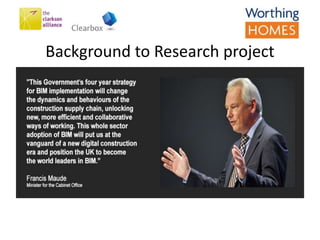
Background to Research project
• Collaboration Partners
– The Clarkson Alliance
– Clearbox, BIMxtra
– Worthing Homes
• Host project – Meadow Rd
• The project comprises the development of 12 new
build 2 bedroom houses of 77 - 79m2 arranged in three
blocks units
• £1.39m
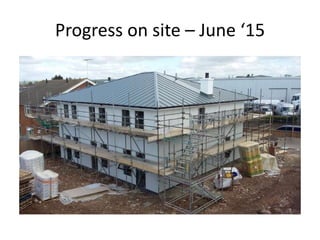
Progress on site – June ‘15
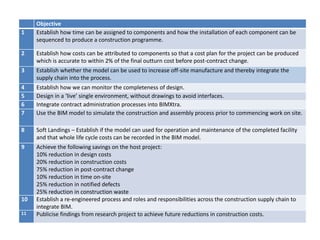
Objective
1 Establish how time can be assigned to components and how the installation of each component can be
sequenced to produce a construction programme.
2 Establish how costs can be attributed to components so that a cost plan for the project can be produced
which is accurate to within 2% of the final outturn cost before post-contract change.
3 Establish whether the model can be used to increase off-site manufacture and thereby integrate the
supply chain into the process.
4 Establish how we can monitor the completeness of design.
5 Design in a ‘live’ single environment, without drawings to avoid interfaces.
6 Integrate contract administration processes into BIMXtra.
7 Use the BIM model to simulate the construction and assembly process prior to commencing work on site.
8 Soft Landings – Establish if the model can used for operation and maintenance of the completed facility
and that whole life cycle costs can be recorded in the BIM model.
9 Achieve the following savings on the host project:
10% reduction in design costs
20% reduction in construction costs
75% reduction in post-contract change
10% reduction in time on-site
25% reduction in notified defects
25% reduction in construction waste
10 Establish a re-engineered process and roles and responsibilities across the construction supply chain to
integrate BIM.
11 Publicise findings from research project to achieve future reductions in construction costs.
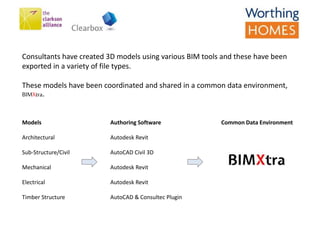
Consultants have created 3D models using various BIM tools and these have been
exported in a variety of file types.
These models have been coordinated and shared in a common data environment,
BIMXtra.
Models
Architectural
Sub-Structure/Civil
Mechanical
Electrical
Timber Structure
Authoring Software
Autodesk Revit
AutoCAD Civil 3D
Autodesk Revit
Autodesk Revit
AutoCAD & Consultec Plugin
Common Data Environment
Models can be viewed by all project stakeholders within a visual environment.
Selection can be made of one or multiple models to enable users to interrogate data
pertinent to them.
Various options within the BIMXtra Highlighter allow a user to view data associated to
objects and to view documents that have been linked to objects.
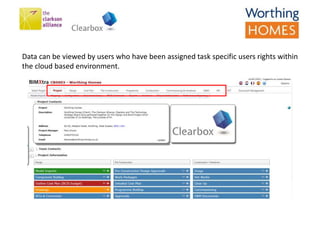
Data can be viewed by users who have been assigned task specific users rights within
the cloud based environment.
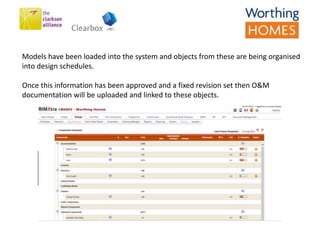
Models have been loaded into the system and objects from these are being organised
into design schedules.
Once this information has been approved and a fixed revision set then O&M
documentation will be uploaded and linked to these objects.
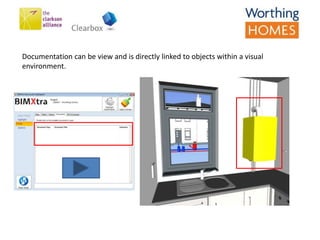
Documentation can be view and is directly linked to objects within a visual
environment.
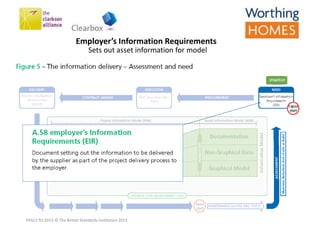
Employer’s Information Requirements
PAS11-92:2013 © The British Standards Institution 2013
Sets out asset information for model
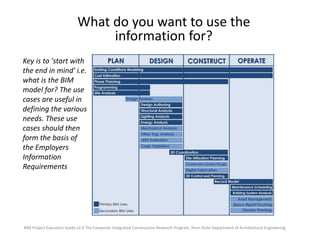
What do you want to use the
information for?
BIM Project Execution Guide v2.0 The Computer Integrated Construction Research Program, Penn State Department of Architectural Engineering
Key is to 'start with
the end in mind' i.e.
what is the BIM
model for? The use
cases are useful in
defining the various
needs. These use
cases should then
form the basis of
the Employers
Information
Requirements
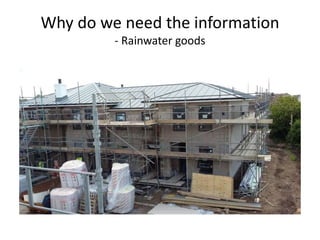
Why do we need the information
- Rainwater goods
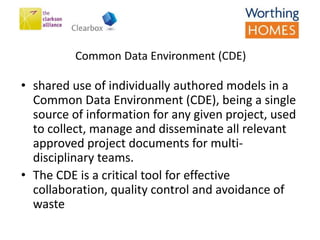
Common Data Environment (CDE)
• shared use of individually authored models in a
Common Data Environment (CDE), being a single
source of information for any given project, used
to collect, manage and disseminate all relevant
approved project documents for multi-
disciplinary teams.
• The CDE is a critical tool for effective
collaboration, quality control and avoidance of
waste
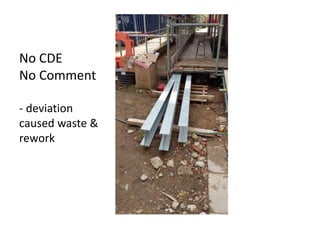
No CDE
No Comment
- deviation
caused waste &
rework
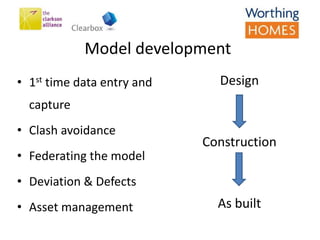
Model development
• 1st time data entry and
capture
• Clash avoidance
• Federating the model
• Deviation & Defects
• Asset management
Design
Construction
As built
Involving the supply chain
• Early Contractor and supplier involvement
– 2 stage tendering – lessons learnt
– Early sub-contractor, supplier and manufacturer
involvement
– BIM objects
– It’s not just about the supply of components it’s
also the supply of information
Early research findings
• Timber frame
– Software compatibility
– Level of detail provided
– All starting from the same base coordinates
• Changing suppliers for cost reasons –
unintended consequences
• Suppliers developing BIM objects for their
product range
• Incorporation of EIR’s in the contract
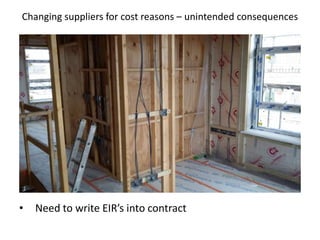
Changing suppliers for cost reasons – unintended consequences
• Need to write EIR’s into contract
off-site manufacture
• the equation of cost of component versus
availability of data needs to be considered. It
maybe that it is worth paying more for
something that has the data available. This
will save drawing time (the architects will not
have to model the object themselves) and also
provide access to O & M date that will reduce
maintenance costs
Lessons learnt
• BIM involves delivering both a physical building
and a virtual building in the form of a BIM model.
• It’s better to design in BIM from the start: if the
planning submission drawings can be extracted
from a BIM model at scheme design stage then
once planning's been obtained there can be a
more seamless transition into the detailed design
stage, with no need for unnecessary rework.
Lessons Learnt
• If there's a need to collect operation and
maintenance information in the BIM model
then early engagement with the asset and/or
facilities managers is key in order to
understand what data needs to be collected
through the design and build process and in
what format so that it can pass seamlessly
into the operation and maintenance phase
• for BIM Level 2 it's preferable if designers have already
gone through the process of at least (a) trialling BIM in
house (lonely BIM) and (b) sharing their BIM models on
a one-to-one basis with other designers
• it's important to understand the team's BIM capability
so that any issues or risks arising can be understood
and mitigated. To facilitate this the BIM Capability
Assessment form should be appended to the EIR and
the BEP contain a Project Implementation Plan setting
out how any issues or risks arising will be mitigated.
Lessons Learnt
BIM Challenges
• Smaller supply chain contractors undertaking limited
design, currently do not have the BIM capabilities
• Manufacturing software does not easily link with design
authoring software e.g. timber frame required some coding
from software engineers to bring through all the data (but
this was overcome by Clearbox writing some code)
• Lots to learn on "first" projects
• Not used to providing more detailed information earlier
which enables design issues to be resolved. Procurement
needs to be reviewed to engage teams earlier in the
process.
• Not all families of objects available with intelligent data
Summary
• BIM has the opportunity to revolutionise our industry
• For any revolution to take place there is a need for us
all to change
• Benefits are significant – 90% reduction in post
contract change
• Improve quality & reduce waste
• Improving buildability
• Moving Construction to an assembly process
• Achieving targets set for 2025 Construction Strategy
BIM, It’s a journey and there’s
still a long way to go
Graham Clarkson
The Clarkson Alliance
01865 355 580
graham@theclarksonalliance.com
@tcaprojects

Innovation in practice presentation 10 06-15

  • 1.
    The Employer’s InformationRequirements and the Role of the BIM Information Manager Ashley Beighton Julian Bullen Worthing Homes, Meadow Rd. Innovate UK funded research project A Housing Forum Demonstration Project & Constructing Excellence Innovation in Practice Project Graham Clarkson, The Clarkson Alliance
  • 2.
    1. Background toour research project 2. Objectives of the research project 3. Involving the supply chain 4. Early findings 5. Lessons Learnt 6. Summary Content
  • 3.
  • 4.
    • Collaboration Partners –The Clarkson Alliance – Clearbox, BIMxtra – Worthing Homes • Host project – Meadow Rd • The project comprises the development of 12 new build 2 bedroom houses of 77 - 79m2 arranged in three blocks units • £1.39m
  • 5.
    Progress on site– June ‘15
  • 6.
    Objective 1 Establish howtime can be assigned to components and how the installation of each component can be sequenced to produce a construction programme. 2 Establish how costs can be attributed to components so that a cost plan for the project can be produced which is accurate to within 2% of the final outturn cost before post-contract change. 3 Establish whether the model can be used to increase off-site manufacture and thereby integrate the supply chain into the process. 4 Establish how we can monitor the completeness of design. 5 Design in a ‘live’ single environment, without drawings to avoid interfaces. 6 Integrate contract administration processes into BIMXtra. 7 Use the BIM model to simulate the construction and assembly process prior to commencing work on site. 8 Soft Landings – Establish if the model can used for operation and maintenance of the completed facility and that whole life cycle costs can be recorded in the BIM model. 9 Achieve the following savings on the host project: 10% reduction in design costs 20% reduction in construction costs 75% reduction in post-contract change 10% reduction in time on-site 25% reduction in notified defects 25% reduction in construction waste 10 Establish a re-engineered process and roles and responsibilities across the construction supply chain to integrate BIM. 11 Publicise findings from research project to achieve future reductions in construction costs.
  • 7.
    Consultants have created3D models using various BIM tools and these have been exported in a variety of file types. These models have been coordinated and shared in a common data environment, BIMXtra. Models Architectural Sub-Structure/Civil Mechanical Electrical Timber Structure Authoring Software Autodesk Revit AutoCAD Civil 3D Autodesk Revit Autodesk Revit AutoCAD & Consultec Plugin Common Data Environment
  • 8.
    Models can beviewed by all project stakeholders within a visual environment. Selection can be made of one or multiple models to enable users to interrogate data pertinent to them. Various options within the BIMXtra Highlighter allow a user to view data associated to objects and to view documents that have been linked to objects.
  • 9.
    Data can beviewed by users who have been assigned task specific users rights within the cloud based environment.
  • 10.
    Models have beenloaded into the system and objects from these are being organised into design schedules. Once this information has been approved and a fixed revision set then O&M documentation will be uploaded and linked to these objects.
  • 11.
    Documentation can beview and is directly linked to objects within a visual environment.
  • 12.
    Employer’s Information Requirements PAS11-92:2013© The British Standards Institution 2013 Sets out asset information for model
  • 13.
    What do youwant to use the information for? BIM Project Execution Guide v2.0 The Computer Integrated Construction Research Program, Penn State Department of Architectural Engineering Key is to 'start with the end in mind' i.e. what is the BIM model for? The use cases are useful in defining the various needs. These use cases should then form the basis of the Employers Information Requirements
  • 14.
    Why do weneed the information - Rainwater goods
  • 15.
    Common Data Environment(CDE) • shared use of individually authored models in a Common Data Environment (CDE), being a single source of information for any given project, used to collect, manage and disseminate all relevant approved project documents for multi- disciplinary teams. • The CDE is a critical tool for effective collaboration, quality control and avoidance of waste
  • 16.
    No CDE No Comment -deviation caused waste & rework
  • 17.
    Model development • 1sttime data entry and capture • Clash avoidance • Federating the model • Deviation & Defects • Asset management Design Construction As built
  • 18.
    Involving the supplychain • Early Contractor and supplier involvement – 2 stage tendering – lessons learnt – Early sub-contractor, supplier and manufacturer involvement – BIM objects – It’s not just about the supply of components it’s also the supply of information
  • 19.
    Early research findings •Timber frame – Software compatibility – Level of detail provided – All starting from the same base coordinates • Changing suppliers for cost reasons – unintended consequences • Suppliers developing BIM objects for their product range • Incorporation of EIR’s in the contract
  • 20.
    Changing suppliers forcost reasons – unintended consequences • Need to write EIR’s into contract
  • 21.
    off-site manufacture • theequation of cost of component versus availability of data needs to be considered. It maybe that it is worth paying more for something that has the data available. This will save drawing time (the architects will not have to model the object themselves) and also provide access to O & M date that will reduce maintenance costs
  • 22.
    Lessons learnt • BIMinvolves delivering both a physical building and a virtual building in the form of a BIM model. • It’s better to design in BIM from the start: if the planning submission drawings can be extracted from a BIM model at scheme design stage then once planning's been obtained there can be a more seamless transition into the detailed design stage, with no need for unnecessary rework.
  • 23.
    Lessons Learnt • Ifthere's a need to collect operation and maintenance information in the BIM model then early engagement with the asset and/or facilities managers is key in order to understand what data needs to be collected through the design and build process and in what format so that it can pass seamlessly into the operation and maintenance phase
  • 24.
    • for BIMLevel 2 it's preferable if designers have already gone through the process of at least (a) trialling BIM in house (lonely BIM) and (b) sharing their BIM models on a one-to-one basis with other designers • it's important to understand the team's BIM capability so that any issues or risks arising can be understood and mitigated. To facilitate this the BIM Capability Assessment form should be appended to the EIR and the BEP contain a Project Implementation Plan setting out how any issues or risks arising will be mitigated. Lessons Learnt
  • 25.
    BIM Challenges • Smallersupply chain contractors undertaking limited design, currently do not have the BIM capabilities • Manufacturing software does not easily link with design authoring software e.g. timber frame required some coding from software engineers to bring through all the data (but this was overcome by Clearbox writing some code) • Lots to learn on "first" projects • Not used to providing more detailed information earlier which enables design issues to be resolved. Procurement needs to be reviewed to engage teams earlier in the process. • Not all families of objects available with intelligent data
  • 26.
    Summary • BIM hasthe opportunity to revolutionise our industry • For any revolution to take place there is a need for us all to change • Benefits are significant – 90% reduction in post contract change • Improve quality & reduce waste • Improving buildability • Moving Construction to an assembly process • Achieving targets set for 2025 Construction Strategy
  • 27.
    BIM, It’s ajourney and there’s still a long way to go Graham Clarkson The Clarkson Alliance 01865 355 580 graham@theclarksonalliance.com @tcaprojects