LOA:TOPIC 1: FINANCIAL STATEMENTS ANALYSIS AY 2021-2022
Management Advisory Services by Karim G. Abitago, CPA Page 1 of 15
COLLEGE OF BUSINESS AND ACCOUNTANCY
FINANCIAL MANAGEMENT
TOPIC 1 – FINANCIAL STATEMENTS ANALYSIS
TOPIC OUTLINE
LECTURE NOTES
BASIC CONCEPTS
Definition
FS Analysis involves careful selection of data from financial statements in order to assess and
evaluate the firm’s past performance, its present condition and future business potentials.
Objectives of FS Analysis
The primary objective of FS Analysis is to determine the extent of firm’s success in attaining its
financial goals in the following areas:
(1) Maximizing profitability
(2) Ability of the firm to pay its obligations
(3) Safety of the investment in the business
(4) Effectiveness and efficiency of management in utilizing the resources entrusted to them
(5) Attain stability in operations.
Problems and Limitations of FS Analysis
(1) The nature of the information
(a) The use of estimates in allocating costs to each period.
(b) Financial data is not adjusted for price changes or inflation/deflation because of cost principle.
(c) Companies have a choice of accounting methods. These differences impact ratios and make it
difficult to compare companies using different methods.
(d) Companies may have different fiscal year ends making comparison difficult if the industry is
cyclical.
(2) The need to look beyond ratios
Ratios or any information generated by FS analysis are not the ultimate goal. The company must
interpret and look beyond this results for a more proper evaluation.
TECHNIQUES IN FS ANALYSIS
(1) HORIZONTAL ANALYSIS
It is the process of analyzing the firms’ financial data across two or more consecutive periods. This is
done through either:
(a) Comparative FS (b) Trend Analysis
FINANCIAL
STATEMENTS
ANALYSIS
Basic
Concepts
Definition
Objectives
Problems and
Limitations
Techniques in
FS Analysis
Horizontal
Analysis
Vertical
Analysis
Financial
Ratios
Liquidity
Ratios
Activity
Ratios
Solvency
Ratios
Profitability
Ratios
Market-test
Ratios
LOA:TOPIC 1: FINANCIAL STATEMENTS ANALYSIS AY 2021-2022
Management Advisory Services by Karim G. Abitago, CPA Page 2 of 15
TREND PERCENTAGES – are index numbers showing relative changes in financial data resulting to
passage of time.
In horizontal analysis, the amount of change and percentage of change should be shown.
PERCENTAGE CHANGE (%) = AMOUNT OF CHANGE / BASE
CAUTION ABOUT THE BASE:
(1) The base may be last year’s or earlier period data, average industry data or even chief
competitors’ data.
(2) The percentage change is NOT computed if the base is ZERO or NEGATIVE.
(2) VERTICAL ANALYSIS
Vertical analysis is a method of financial statement analysis in which each line item is listed as a
percentage of a base figure within the statement. Vertical analysis is the process of comparing figures
in the FS of a single period only.
Proper application of vertical will generate a COMMON-SIZE FINANCIAL STATEMENTS. Common size
financial statements are financial statements that translate peso amounts to percentages in relation
to a chosen base.
NOTE: In vertical analysis, only percentages are shown.
What base to use?
Financial Statement Proper Base
Income Statement Net Sales
Balance Sheet Total Assets
Statement of Cash Flows Total Cash Available
(3) FINANCIAL RATIOS
It is a comparison in fraction, decimal or proportion of two significant figures taken from the financial
statements.
REMINDER IN USING FINANCIAL RATIOS: In comparing balance sheet items with income statement
items in a single ratio, the balance sheet items are being averaged if the beginning and ending
balances are available.
Cautions in using ratios:
(1) Ratios have great disparities from one industry to another.
(2) Conservatism has a bias towards diminishing value of the firm.
(3) Historical cost principle may significantly contribute to a distorted FS Analysis.
Summary of Effect of Transactions in Ratios
Numerator + 0 - 0 + -
Denominator 0 + 0 - - +
Effect on Ratio + - - + + -
Based from the above table, we can say that movements on the numerator have a direct effect on the
ratio while movements on the denominator have an inverse effect on the ratio.
EXCEPTION:
Numerator + - + -
Denominator + - + -
Effect on Ratio + - - +
IF PROPER FRACTION IF IMPROPER FRACTION
LIST OF PROPER FRACTION AND IMPROPER FRACTION RATIOS
PROPER FRACTION IMPROPER FRACTION
Debt Ratio Current Ratio
Equity Ratio Quick Asset Ratio
Profit Margin AR Turnover Ratio
Gross Profit Margin Inventory Turnover Ratio
Return on Sales Asset Turnover Ratio
Return on Assets AP Turnover Ratio
Return on Equity Earnings per Share
Dividend Pay-out Ratio Book Value per Share
Dividend Yield Ratio Times Interest Earned
SUMMARY OF COMMONLY USED FINANCIAL RATIOS
(a) Liquidity ratios: are ratios used in measuring the ability of the firm to meet its currently
maturing obligations.
RATIO FORMULA
Current Ratio
Total Current Assets
Total Current Liabilities
Quick Ratio
Total Quick Assets*
Total Current Liabilities
LOA:TOPIC 1: FINANCIAL STATEMENTS ANALYSIS AY 2021-2022
Management Advisory Services by Karim G. Abitago, CPA Page 3 of 15
*Cash + Marketable Securities + AR
Working Capital
Total Current Assets - Total Current
Liabilities
(b) Activity ratios: are ratios that measure the liquidity of specific assets and efficiency in managing
assets.
RATIO FORMULA
AR Turnover
Net Credit Sales*
Average AR
* Net Sales if not available
Days AR / Ave. Collection Period
360 days / 365 days
AR Turnover
Inventory Turnover (For Merchandising)
Cost of Goods Sold**
Average Inventory
** Sales or Net Sales if not available
FG Inventory Turnover
Cost of Goods Sold**
Average FG Inventory
** Sales or Net Sales if not available
WIP Inventory Turnover
Cost of Goods Manufactured
Average WIP Inventory
RM Inventory Turnover
Raw Materials Used
Average RM Inventory
Days Inventory / Ave. Conversion Period
360 days / 365 days
Inventory Turnover
AP Turnover
Net Credit Purchases***
Ave. Accounts Payable
*** Net Purchases if not available
Days AP / Ave. Payment Period
360 days / 365 days
AP Turnover
Total Assets Turnover
Net Sales
Average Total Assets
Fixed Assets Turnover
Net Sales
Average Fixed Assets
(c) Solvency ratios: are ratios that measure the ability of the firm to pay its long-term financing
and the extent of a firm’s financing.
RATIO FORMULA
Debt Ratio
Total Liabilities
Total Assets
Equity Ratio
Total Equity
Total Assets
Debt to Equity Ratio
Total Liabilities
Total Equity
Leverage Ratio / Equity Multiplier
Total Assets
Total Equity
or
1
Equity Ratio
Times Interest Earned (TIE)
Earnings Before Interest and Taxes (EBIT)
Annual Interest
Basic Earnings Power
Earnings Before Interest and Taxes (EBIT)
Total Assets
(d) Profitability ratios: are ratios that measure the overall performance of the firm.
RATIO FORMULA
Gross Profit Ratio
Gross Profit
Net Sales
Return on Sales / Profit Margin Ratio
Net Income
Net Sales
Return on Assets
Operating Income after Tax*
Average Total Assets
*Net income if cannot be determined
or
Profit Margin x Asset Turnover
LOA:TOPIC 1: FINANCIAL STATEMENTS ANALYSIS AY 2021-2022
Management Advisory Services by Karim G. Abitago, CPA Page 4 of 15
Return on Equity
Net Income
Average Total Equity
or
Profit Margin x Asset Turnover x Leverage Ratio
Earnings per Share
Net Income - Preferred Dividends
Ave. Ordinary Shares Outstanding
Dividends per Share
Annual Dividends
Ave. Ordinary Shares Outstanding
Dividend Pay-out Ratio
Dividends per Share
Earnings per Share
Retention Ratio / Plowback Ratio 1 - Dividend Pay-out Ratio
Book Value per Share
Total Shareholders' Equity
Ave. Ordinary Shares Outstanding
NOTE: Operating income is synonymous to EBIT
(e) Market-test ratios: these ratios are concerned with the return on investment for shareholders, and
with the relationship between return and the value of an investment in company's shares.
RATIO FORMULA
Price - Earnings Ratio
Market Price
Earnings per Share
Dividend Yield Ratio
Dividends per Share
Market Price
Earnings Yield Ratio
Earnings per Share
Market Price
LOA:TOPIC 1: FINANCIAL STATEMENTS ANALYSIS AY 2021-2022
Management Advisory Services by Karim G. Abitago, CPA Page 5 of 15
DISCUSSION EXERCISES
STRAIGHT PROBLEMS:
HORIZONTAL ANALYSIS, VERTICAL ANALYSIS & RATIO ANALYSIS
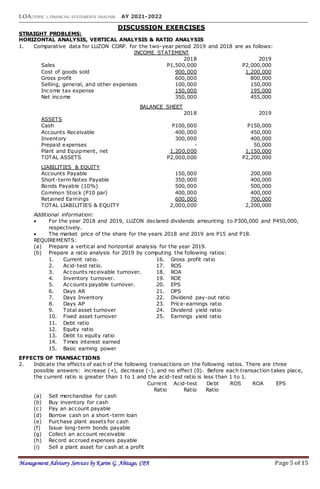
1. Comparative data for LUZON CORP. for the two-year period 2019 and 2018 are as follows:
INCOME STATEMENT
2018 2019
Sales P1,500,000 P2,000,000
Cost of goods sold 900,000 1,200,000
Gross profit 600,000 800,000
Selling, general, and other expenses 100,000 150,000
Income tax expense 150,000 195,000
Net income 350,000 455,000
BALANCE SHEET
2018 2019
ASSETS
Cash P100,000 P150,000
Accounts Receivable 400,000 450,000
Inventory 300,000 400,000
Prepaid expenses - 50,000
Plant and Equipment, net 1,200,000 1,150,000
TOTAL ASSETS P2,000,000 P2,200,000
LIABILITIES & EQUITY
Accounts Payable 150,000 200,000
Short-term Notes Payable 350,000 400,000
Bonds Payable (10%) 500,000 500,000
Common Stock (P10 par) 400,000 400,000
Retained Earnings 600,000 700,000
TOTAL LIABILITIES & EQUITY 2,000,000 2,200,000
Additional information:
 For the year 2018 and 2019, LUZON declared dividends amounting to P300,000 and P450,000,
respectively.
 The market price of the share for the years 2018 and 2019 are P15 and P18.
REQUIREMENTS:
(a) Prepare a vertical and horizontal analysis for the year 2019.
(b) Prepare a ratio analysis for 2019 by computing the following ratios:
1. Current ratio. 16. Gross profit ratio
2. Acid-test ratio. 17. ROS
3. Accounts receivable turnover. 18. ROA
4. Inventory turnover. 19. ROE
5. Accounts payable turnover. 20. EPS
6. Days AR 21. DPS
7. Days Inventory 22. Dividend pay-out ratio
8. Days AP 23. Price-earnings ratio
9. Total asset turnover 24. Dividend yield ratio
10. Fixed asset turnover 25. Earnings yield ratio
11. Debt ratio
12. Equity ratio
13. Debt to equity ratio
14. Times interest earned
15. Basic earning power
EFFECTS OF TRANSACTIONS
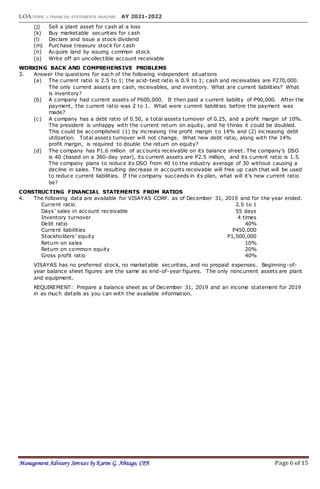
2. Indicate the effects of each of the following transactions on the following ratios. There are three
possible answers: increase (+), decrease (-), and no effect (0). Before each transaction takes place,
the current ratio is greater than 1 to 1 and the acid-test ratio is less than 1 to 1.
Current Acid-test Debt ROS ROA EPS
Ratio Ratio Ratio
(a) Sell merchandise for cash
(b) Buy inventory for cash
(c) Pay an account payable
(d) Borrow cash on a short-term loan
(e) Purchase plant assets for cash
(f) Issue long-term bonds payable
(g) Collect an account receivable
(h) Record accrued expenses payable
(i) Sell a plant asset for cash at a profit
LOA:TOPIC 1: FINANCIAL STATEMENTS ANALYSIS AY 2021-2022
Management Advisory Services by Karim G. Abitago, CPA Page 6 of 15
(j) Sell a plant asset for cash at a loss
(k) Buy marketable securities for cash
(l) Declare and issue a stock dividend
(m) Purchase treasury stock for cash
(n) Acquire land by issuing common stock
(o) Write off an uncollectible account receivable
WORKING BACK AND COMPREHENSIVE PROBLEMS
3. Answer the questions for each of the following independent situations
(a) The current ratio is 2.5 to 1; the acid-test ratio is 0.9 to 1; cash and receivables are P270,000.
The only current assets are cash, receivables, and inventory. What are current liabilities? What
is inventory?
(b) A company had current assets of P600,000. It then paid a current liability of P90,000. After the
payment, the current ratio was 2 to 1. What were current liabilities before the payment was
made?
(c) A company has a debt ratio of 0.50, a total assets turnover of 0.25, and a profit margin of 10%.
The president is unhappy with the current return on equity, and he thinks it could be doubled.
This could be accomplished (1) by increasing the profit margin to 14% and (2) increasing debt
utilization. Total assets turnover will not change. What new debt ratio, along with the 14%
profit margin, is required to double the return on equity?
(d) The company has P1.6 million of accounts receivable on its balance sheet. The company’s DSO
is 40 (based on a 360-day year), its current assets are P2.5 million, and its current ratio is 1.5.
The company plans to reduce its DSO from 40 to the industry average of 30 without causing a
decline in sales. The resulting decrease in accounts receivable will free up cash that will be used
to reduce current liabilities. If the company succeeds in its plan, what will it’s new current ratio
be?
CONSTRUCTING FINANCIAL STATEMENTS FROM RATIOS
4. The following data are available for VISAYAS CORP. as of December 31, 2019 and for the year ended.
Current ratio 2.5 to 1
Days’ sales in account receivable 55 days
Inventory turnover 4 times
Debt ratio 40%
Current liabilities P450,000
Stockholders’ equity P1,500,000
Return on sales 10%
Return on common equity 20%
Gross profit ratio 40%
VISAYAS has no preferred stock, no marketable securities, and no prepaid expenses. Beginning-of-
year balance sheet figures are the same as end-of-year figures. The only noncurrent assets are plant
and equipment.
REQUIREMENT: Prepare a balance sheet as of December 31, 2019 and an income statement for 2019
in as much details as you can with the available information.
LOA:TOPIC 1: FINANCIAL STATEMENTS ANALYSIS AY 2021-2022
Management Advisory Services by Karim G. Abitago, CPA Page 7 of 15
MULTIPLE CHOICE (THEORIES)
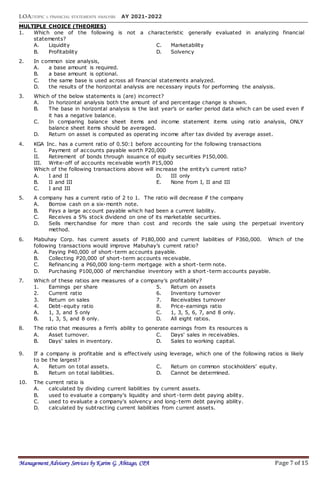
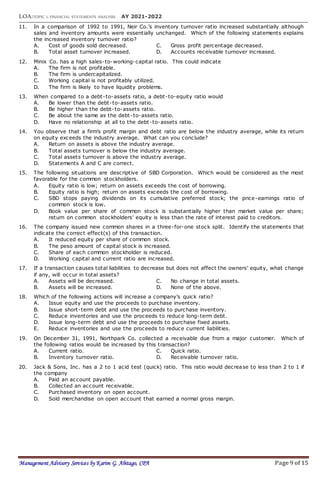
1. Which one of the following is not a characteristic generally evaluated in analyzing financial
statements?
A. Liquidity C. Marketability
B. Profitability D. Solvency
2. In common size analysis,
A. a base amount is required.
B. a base amount is optional.
C. the same base is used across all financial statements analyzed.
D. the results of the horizontal analysis are necessary inputs for performing the analysis.
3. Which of the below statements is (are) incorrect?
A. In horizontal analysis both the amount of and percentage change is shown.
B. The base in horizontal analysis is the last year’s or earlier period data which can be used even if
it has a negative balance.
C. In comparing balance sheet items and income statement items using ratio analysis, ONLY
balance sheet items should be averaged.
D. Return on asset is computed as operating income after tax divided by average asset.
4. KGA Inc. has a current ratio of 0.50:1 before accounting for the following transactions
I. Payment of accounts payable worth P20,000
II. Retirement of bonds through issuance of equity securities P150,000.
III. Write-off of accounts receivable worth P15,000
Which of the following transactions above will increase the entity’s current ratio?
A. I and II D. III only
B. II and III E. None from I, II and III
C. I and III
5. A company has a current ratio of 2 to 1. The ratio will decrease if the company
A. Borrow cash on a six-month note.
B. Pays a large account payable which had been a current liability.
C. Receives a 5% stock dividend on one of its marketable securities.
D. Sells merchandise for more than cost and records the sale using the perpetual inventory
method.
6. Mabuhay Corp. has current assets of P180,000 and current liabilities of P360,000. Which of the
following transactions would improve Mabuhay’s current ratio?
A. Paying P40,000 of short-term accounts payable.
B. Collecting P20,000 of short-term accounts receivable.
C. Refinancing a P60,000 long-term mortgage with a short-term note.
D. Purchasing P100,000 of merchandise inventory with a short-term accounts payable.
7. Which of these ratios are measures of a company’s profitability?
1. Earnings per share 5. Return on assets
2. Current ratio 6. Inventory turnover
3. Return on sales 7. Receivables turnover
4. Debt-equity ratio 8. Price-earnings ratio
A. 1, 3, and 5 only C. 1, 3, 5, 6, 7, and 8 only.
B. 1, 3, 5, and 8 only. D. All eight ratios.
8. The ratio that measures a firm's ability to generate earnings from its resources is
A. Asset turnover. C. Days' sales in receivables.
B. Days' sales in inventory. D. Sales to working capital.
9. If a company is profitable and is effectively using leverage, which one of the following ratios is likely
to be the largest?
A. Return on total assets. C. Return on common stockholders' equity.
B. Return on total liabilities. D. Cannot be determined.
10. The current ratio is
A. calculated by dividing current liabilities by current assets.
B. used to evaluate a company's liquidity and short-term debt paying ability.
C. used to evaluate a company's solvency and long-term debt paying ability.
D. calculated by subtracting current liabilities from current assets.
LOA:TOPIC 1: FINANCIAL STATEMENTS ANALYSIS AY 2021-2022
Management Advisory Services by Karim G. Abitago, CPA Page 8 of 15
QUIZZER (DO-IT-YOURSELF DRILL)
THEORIES
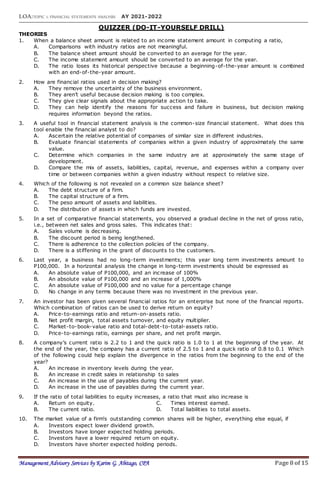
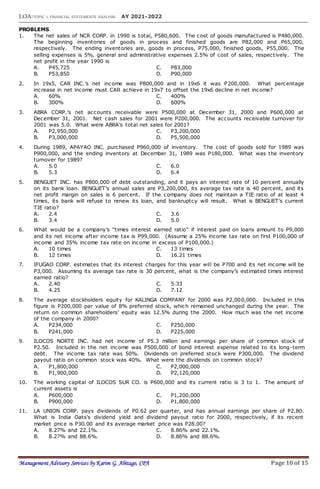
1. When a balance sheet amount is related to an income statement amount in computing a ratio,
A. Comparisons with industry ratios are not meaningful.
B. The balance sheet amount should be converted to an average for the year.
C. The income statement amount should be converted to an average for the year.
D. The ratio loses its historical perspective because a beginning-of-the-year amount is combined
with an end-of-the-year amount.
2. How are financial ratios used in decision making?
A. They remove the uncertainty of the business environment.
B. They aren’t useful because decision making is too complex.
C. They give clear signals about the appropriate action to take.
D. They can help identify the reasons for success and failure in business, but decision making
requires information beyond the ratios.
3. A useful tool in financial statement analysis is the common-size financial statement. What does this
tool enable the financial analyst to do?
A. Ascertain the relative potential of companies of similar size in different industries.
B. Evaluate financial statements of companies within a given industry of approximately the same
value.
C. Determine which companies in the same industry are at approximately the same stage of
development.
D. Compare the mix of assets, liabilities, capital, revenue, and expenses within a company over
time or between companies within a given industry without respect to relative size.
4. Which of the following is not revealed on a common size balance sheet?
A. The debt structure of a firm.
B. The capital structure of a firm.
C. The peso amount of assets and liabilities.
D. The distribution of assets in which funds are invested.
5. In a set of comparative financial statements, you observed a gradual decline in the net of gross ratio,
i.e., between net sales and gross sales. This indicates that:
A. Sales volume is decreasing.
B. The discount period is being lengthened.
C. There is adherence to the collection policies of the company.
D. There is a stiffening in the grant of discounts to the customers.
6. Last year, a business had no long-term investments; this year long term investments amount to
P100,000. In a horizontal analysis the change in long-term investments should be expressed as
A. An absolute value of P100,000, and an increase of 100%
B. An absolute value of P100,000 and an increase of 1,000%
C. An absolute value of P100,000 and no value for a percentage change
D. No change in any terms because there was no investment in the previous year.
7. An investor has been given several financial ratios for an enterprise but none of the financial reports.
Which combination of ratios can be used to derive return on equity?
A. Price-to-earnings ratio and return-on-assets ratio.
B. Net profit margin, total assets turnover, and equity multiplier.
C. Market-to-book-value ratio and total-debt-to-total-assets ratio.
D. Price-to-earnings ratio, earnings per share, and net profit margin.
8. A company’s current ratio is 2.2 to 1 and the quick ratio is 1.0 to 1 at the beginning of the year. At
the end of the year, the company has a current ratio of 2.5 to 1 and a quick ratio of 0.8 to 0.1 Which
of the following could help explain the divergence in the ratios from the beginning to the end of the
year?
A. An increase in inventory levels during the year.
B. An increase in credit sales in relationship to sales
C. An increase in the use of payables during the current year.
D. An increase in the use of payables during the current year.
9. If the ratio of total liabilities to equity increases, a ratio that must also increase is
A. Return on equity. C. Times interest earned.
B. The current ratio. D. Total liabilities to total assets.
10. The market value of a firm's outstanding common shares will be higher, everything else equal, if
A. Investors expect lower dividend growth.
B. Investors have longer expected holding periods.
C. Investors have a lower required return on equity.
D. Investors have shorter expected holding periods.
LOA:TOPIC 1: FINANCIAL STATEMENTS ANALYSIS AY 2021-2022
Management Advisory Services by Karim G. Abitago, CPA Page 9 of 15
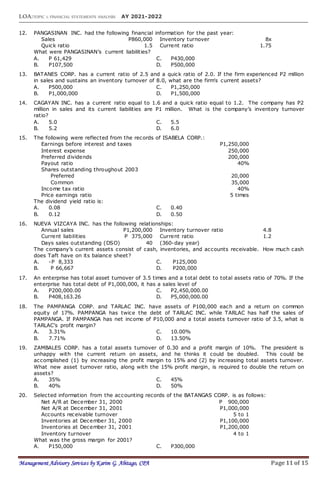
11. In a comparison of 1992 to 1991, Neir Co.’s inventory turnover ratio increased substantially although
sales and inventory amounts were essentially unchanged. Which of the following statements explains
the increased inventory turnover ratio?
A. Cost of goods sold decreased. C. Gross profit percentage decreased.
B. Total asset turnover increased. D. Accounts receivable turnover increased.
12. Minix Co. has a high sales-to-working-capital ratio. This could indicate
A. The firm is not profitable.
B. The firm is undercapitalized.
C. Working capital is not profitably utilized.
D. The firm is likely to have liquidity problems.
13. When compared to a debt-to-assets ratio, a debt-to-equity ratio would
A. Be lower than the debt-to-assets ratio.
B. Be higher than the debt-to-assets ratio.
C. Be about the same as the debt-to-assets ratio.
D. Have no relationship at all to the debt-to-assets ratio.
14. You observe that a firm’s profit margin and debt ratio are below the industry average, while its return
on equity exceeds the industry average. What can you conclude?
A. Return on assets is above the industry average.
B. Total assets turnover is below the industry average.
C. Total assets turnover is above the industry average.
D. Statements A and C are correct.
15. The following situations are descriptive of SBD Corporation. Which would be considered as the most
favorable for the common stockholders.
A. Equity ratio is low; return on assets exceeds the cost of borrowing.
B. Equity ratio is high; return on assets exceeds the cost of borrowing.
C. SBD stops paying dividends on its cumulative preferred stock; the price-earnings ratio of
common stock is low.
D. Book value per share of common stock is substantially higher than market value per share;
return on common stockholders’ equity is less than the rate of interest paid to creditors.
16. The company issued new common shares in a three-for-one stock split. Identify the statements that
indicate the correct effect(s) of this transaction.
A. It reduced equity per share of common stock.
B. The peso amount of capital stock is increased.
C. Share of each common stockholder is reduced.
D. Working capital and current ratio are increased.
17. If a transaction causes total liabilities to decrease but does not affect the owners’ equity, what change
if any, will occur in total assets?
A. Assets will be decreased. C. No change in total assets.
B. Assets will be increased. D. None of the above.
18. Which of the following actions will increase a company’s quick ratio?
A. Issue equity and use the proceeds to purchase inventory.
B. Issue short-term debt and use the proceeds to purchase inventory.
C. Reduce inventories and use the proceeds to reduce long-term debt.
D. Issue long-term debt and use the proceeds to purchase fixed assets.
E. Reduce inventories and use the proceeds to reduce current liabilities.
19. On December 31, 1991, Northpark Co. collected a receivable due from a major customer. Which of
the following ratios would be increased by this transaction?
A. Current ratio. C. Quick ratio.
B. Inventory turnover ratio. D. Receivable turnover ratio.
20. Jack & Sons, Inc. has a 2 to 1 acid test (quick) ratio. This ratio would decrease to less than 2 to 1 if
the company
A. Paid an account payable.
B. Collected an account receivable.
C. Purchased inventory on open account.
D. Sold merchandise on open account that earned a normal gross margin.
LOA:TOPIC 1: FINANCIAL STATEMENTS ANALYSIS AY 2021-2022
Management Advisory Services by Karim G. Abitago, CPA Page 10 of 15
PROBLEMS
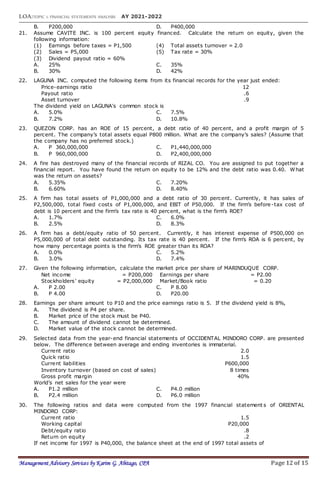
1. The net sales of NCR CORP. in 1990 is total, P580,600. The cost of goods manufactured is P480,000.
The beginning inventories of goods in process and finished goods are P82,000 and P65,000,
respectively. The ending inventories are, goods in process, P75,000, finished goods, P55,000. The
selling expenses is 5%, general and administrative expenses 2.5% of cost of sales, respectively. The
net profit in the year 1990 is
A. P45,725 C. P83,000
B. P53,850 D. P90,000
2. In 19x5, CAR INC.’s net income was P800,000 and in 19x6 it was P200,000. What percentage
increase in net income must CAR achieve in 19x7 to offset the 19x6 decline in net income?
A. 60% C. 400%
B. 300% D. 600%
3. ABRA CORP.’s net accounts receivable were P500,000 at December 31, 2000 and P600,000 at
December 31, 2001. Net cash sales for 2001 were P200,000. The accounts receivable turnover for
2001 was 5.0. What were ABRA’s total net sales for 2001?
A. P2,950,000 C. P3,200,000
B. P3,000,000 D. P5,500,000
4. During 1989, APAYAO INC. purchased P960,000 of inventory. The cost of goods sold for 1989 was
P900,000, and the ending inventory at December 31, 1989 was P180,000. What was the inventory
turnover for 1989?
A. 5.0 C. 6.0
B. 5.3 D. 6.4
5. BENGUET INC. has P800,000 of debt outstanding, and it pays an interest rate of 10 percent annually
on its bank loan. BENGUET’s annual sales are P3,200,000, its average tax rate is 40 percent, and its
net profit margin on sales is 6 percent. If the company does not maintain a TIE ratio of at least 4
times, its bank will refuse to renew its loan, and bankruptcy will result. What is BENGUET’s current
TIE ratio?
A. 2.4 C. 3.6
B. 3.4 D. 5.0
6. What would be a company’s “times interest earned ratio” if interest paid on loans amount to P9,000
and its net income after income tax is P99,000. (Assume a 25% income tax rate on first P100,000 of
income and 35% income tax rate on income in excess of P100,000.)
A. 10 times C. 13 times
B. 12 times D. 16.21 times
7. IFUGAO CORP. estimates that its interest charges for this year will be P700 and its net income will be
P3,000. Assuming its average tax rate is 30 percent, what is the company’s estimated times interest
earned ratio?
A. 2.40 C. 5.33
B. 4.25 D. 7.12
8. The average stockholders equity for KALINGA COMPANY for 2000 was P2,000,000. Included in this
figure is P200,000 par value of 8% preferred stock, which remained unchanged during the year. The
return on common shareholders’ equity was 12.5% during the 2000. How much was the net income
of the company in 2000?
A. P234,000 C. P250,000
B. P241,000 D. P225,000
9. ILOCOS NORTE INC. had net income of P5.3 million and earnings per share of common stock of
P2.50. Included in the net income was P500,000 of bond interest expense related to its long-term
debt. The income tax rate was 50%. Dividends on preferred stock were P300,000. The dividend
payout ratio on common stock was 40%. What were the dividends on common stock?
A. P1,800,000 C. P2,000,000
B. P1,900,000 D. P2,120,000
10. The working capital of ILOCOS SUR CO. is P600,000 and its current ratio is 3 to 1. The amount of
current assets is
A. P600,000 C. P1,200,000
B. P900,000 D. P1,800,000
11. LA UNION CORP. pays dividends of P0.62 per quarter, and has annual earnings per share of P2.80.
What is India Oats's dividend yield and dividend payout ratio for 2000, respectively, if its recent
market price is P30.00 and its average market price was P28.00?
A. 8.27% and 22.1%. C. 8.86% and 22.1%.
B. 8.27% and 88.6%. D. 8.86% and 88.6%.
LOA:TOPIC 1: FINANCIAL STATEMENTS ANALYSIS AY 2021-2022
Management Advisory Services by Karim G. Abitago, CPA Page 11 of 15
12. PANGASINAN INC. had the following financial information for the past year:
Sales P860,000 Inventory turnover 8x
Quick ratio 1.5 Current ratio 1.75
What were PANGASINAN’s current liabilities?
A. P 61,429 C. P430,000
B. P107,500 D. P500,000
13. BATANES CORP. has a current ratio of 2.5 and a quick ratio of 2.0. If the firm experienced P2 million
in sales and sustains an inventory turnover of 8.0, what are the firm's current assets?
A. P500,000 C. P1,250,000
B. P1,000,000 D. P1,500,000
14. CAGAYAN INC. has a current ratio equal to 1.6 and a quick ratio equal to 1.2. The company has P2
million in sales and its current liabilities are P1 million. What is the company’s inventory turnover
ratio?
A. 5.0 C. 5.5
B. 5.2 D. 6.0
15. The following were reflected from the records of ISABELA CORP.:
Earnings before interest and taxes P1,250,000
Interest expense 250,000
Preferred dividends 200,000
Payout ratio 40%
Shares outstanding throughout 2003
Preferred 20,000
Common 35,000
Income tax ratio 40%
Price earnings ratio 5 times
The dividend yield ratio is:
A. 0.08 C. 0.40
B. 0.12 D. 0.50
16. NUEVA VIZCAYA INC. has the following relationships:
Annual sales P1,200,000 Inventory turnover ratio 4.8
Current liabilities P 375,000 Current ratio 1.2
Days sales outstanding (DSO) 40 (360-day year)
The company’s current assets consist of cash, inventories, and accounts receivable. How much cash
does Taft have on its balance sheet?
A. -P 8,333 C. P125,000
B. P 66,667 D. P200,000
17. An enterprise has total asset turnover of 3.5 times and a total debt to total assets ratio of 70%. If the
enterprise has total debt of P1,000,000, it has a sales level of
A. P200,000.00 C. P2,450,000.00
B. P408,163.26 D. P5,000,000.00
18. The PAMPANGA CORP. and TARLAC INC. have assets of P100,000 each and a return on common
equity of 17%. PAMPANGA has twice the debt of TARLAC INC. while TARLAC has half the sales of
PAMPANGA. If PAMPANGA has net income of P10,000 and a total assets turnover ratio of 3.5, what is
TARLAC's profit margin?
A. 3.31% C. 10.00%
B. 7.71% D. 13.50%
19. ZAMBALES CORP. has a total assets turnover of 0.30 and a profit margin of 10%. The president is
unhappy with the current return on assets, and he thinks it could be doubled. This could be
accomplished (1) by increasing the profit margin to 15% and (2) by increasing total assets turnover.
What new asset turnover ratio, along with the 15% profit margin, is required to double the return on
assets?
A. 35% C. 45%
B. 40% D. 50%
20. Selected information from the accounting records of the BATANGAS CORP. is as follows:
Net A/R at December 31, 2000 P 900,000
Net A/R at December 31, 2001 P1,000,000
Accounts receivable turnover 5 to 1
Inventories at December 31, 2000 P1,100,000
Inventories at December 31, 2001 P1,200,000
Inventory turnover 4 to 1
What was the gross margin for 2001?
A. P150,000 C. P300,000
LOA:TOPIC 1: FINANCIAL STATEMENTS ANALYSIS AY 2021-2022
Management Advisory Services by Karim G. Abitago, CPA Page 12 of 15
B. P200,000 D. P400,000
21. Assume CAVITE INC. is 100 percent equity financed. Calculate the return on equity, given the
following information:
(1) Earnings before taxes = P1,500 (4) Total assets turnover = 2.0
(2) Sales = P5,000 (5) Tax rate = 30%
(3) Dividend payout ratio = 60%
A. 25% C. 35%
B. 30% D. 42%
22. LAGUNA INC. computed the following items from its financial records for the year just ended:
Price-earnings ratio 12
Payout ratio .6
Asset turnover .9
The dividend yield on LAGUNA's common stock is
A. 5.0% C. 7.5%
B. 7.2% D. 10.8%
23. QUEZON CORP. has an ROE of 15 percent, a debt ratio of 40 percent, and a profit margin of 5
percent. The company’s total assets equal P800 million. What are the company’s sales? (Assume that
the company has no preferred stock.)
A. P 360,000,000 C. P1,440,000,000
B. P 960,000,000 D. P2,400,000,000
24. A fire has destroyed many of the financial records of RIZAL CO. You are assigned to put together a
financial report. You have found the return on equity to be 12% and the debt ratio was 0.40. What
was the return on assets?
A. 5.35% C. 7.20%
B. 6.60% D. 8.40%
25. A firm has total assets of P1,000,000 and a debt ratio of 30 percent. Currently, it has sales of
P2,500,000, total fixed costs of P1,000,000, and EBIT of P50,000. If the firm’s before-tax cost of
debt is 10 percent and the firm’s tax rate is 40 percent, what is the firm’s ROE?
A. 1.7% C. 6.0%
B. 2.5% D. 8.3%
26. A firm has a debt/equity ratio of 50 percent. Currently, it has interest expense of P500,000 on
P5,000,000 of total debt outstanding. Its tax rate is 40 percent. If the firm’s ROA is 6 percent, by
how many percentage points is the firm’s ROE greater than its ROA?
A. 0.0% C. 5.2%
B. 3.0% D. 7.4%
27. Given the following information, calculate the market price per share of MARINDUQUE CORP.
Net income = P200,000 Earnings per share = P2.00
Stockholders’ equity = P2,000,000 Market/Book ratio = 0.20
A. P 2.00 C. P 8.00
B. P 4.00 D. P20.00
28. Earnings per share amount to P10 and the price earnings ratio is 5. If the dividend yield is 8%,
A. The dividend is P4 per share.
B. Market price of the stock must be P40.
C. The amount of dividend cannot be determined.
D. Market value of the stock cannot be determined.
29. Selected data from the year-end financial statements of OCCIDENTAL MINDORO CORP. are presented
below. The difference between average and ending inventories is immaterial.
Current ratio 2.0
Quick ratio 1.5
Current liabilities P600,000
Inventory turnover (based on cost of sales) 8 times
Gross profit margin 40%
World’s net sales for the year were
A. P1.2 million C. P4.0 million
B. P2.4 million D. P6.0 million
30. The following ratios and data were computed from the 1997 financial statement s of ORIENTAL
MINDORO CORP:
Current ratio 1.5
Working capital P20,000
Debt/equity ratio .8
Return on equity .2
If net income for 1997 is P40,000, the balance sheet at the end of 1997 total assets of
LOA:TOPIC 1: FINANCIAL STATEMENTS ANALYSIS AY 2021-2022
Management Advisory Services by Karim G. Abitago, CPA Page 13 of 15
A. P300,000 C. P360,000
B. P340,000 D. P400,000
31. PALAWAN INC. sells all its merchandise on credit. It has a profit margin of 4 percent, days sales
outstanding equal to 60 days, receivables of P150,000, total assets of P3 million, and a debt ratio of
0.64. What is the firm’s return on equity (ROE)? Assume a 360-day year.
A. 3.3% C. 8.1%
B. 7.1% D. 33.3%
32. ROMBLON CORP. had P24,000,000 in sales last year. The company’s net income was P400,000, its
total assets turnover was 6.0, and the company’s ROE was 15 percent. The company is financed
entirely with debt and common equity. What is the company’s debt ratio?
A. 0.20 C. 0.33
B. 0.30 D. 0.60
33. Last year, ALBAY INC. had a profit margin of 10 percent, total assets turnover of 0.5, and a debt ratio
of 20 percent. (The company finances its assets with debt and common equity; it does not use
preferred stock.) This year, the company’s CFO wants to double ROE. She expects the total assets
turnover will remain at 0.5, while the profit margin and debt ratio will increase enough to double ROE.
Assume that the profit margin is increased to 15 percent, what debt ratio will the company need in
order to double its ROE?
A. 0.30 C. 0.40
B. 0.33 D. 0.45
34. CAMARINES NORTE INC. has the following data:
Assets: P10,000 Interest rate: 10.0%
Debt ratio: 60.0% Total assets turnover: 2.0
Profit margin: 3.0% Tax rate: 40%
What is Lombardi’s TIE ratio?
A. 0.95 C. 2.10
B. 1.75 D. 2.67
35. The CAMARINES SUR INC.’s common stock is currently selling at P100 per share, which represents a
P/E ratio of 10. If the firm has 100 shares of common stock outstanding, a return on equity of 20
percent, and a debt ratio of 60 percent, what is its return on total assets (ROA)?
A. 8.0% C. 12.0%
B. 10.0% D. 16.7%
36. CATANDUANES INC. is experiencing a growth rate of 9% with a return on assets of 12%. If the debt
ratio is 36% and the market price of the stock is P38 per share, what is the return on equity?
A. 7.68% C. 12.0%
B. 9.0% D. 18.75%
Questions 37 through 39 are based on the following information.
The condensed balance sheet as of December 31, 1982 of MASBATE INC. is given below. Figures
shown by a question mark (?) may be computed from the additional information given:
ASSETS LIAB. & STOCKHOLDERS’ EQUITY
Cash P 60,000 Accounts payable P ?
Trade receivable-net ? Current notes payable 40,000
Inventory ? Long-term payable ?
Fixed assets-net 252,000 Common stock 140,000
Retained earnings ?
Total Assets P 480,000 Total L & SHE P 480,000
Additional information:
Current ratio (as of Dec. 31, 1982) 1.9 to 1
Ratio of total liabilities to total stockholders’ equity 1.4
Inventory turnover based on sales and ending inventory 15 times
Inventory turnover based on cost of goods sold and ending inventory 10 times
Gross margin for 1982 P500,000
37. The balance of accounts payable of MASBATE as of December 31, 1982 is
A. P40,000 C. P95,000
B. P80,000 D. P280,000
38. The balance of retained earnings of MASBATE as of December 31, 1982 is
A. P60,000 C. P200,000
B. P140,000 D. P360,000
39. The balance of inventory of MASBATE as of December 31, 1982 is
A. P68,000 C. P168,000
B. P100,000 D. P228,000
LOA:TOPIC 1: FINANCIAL STATEMENTS ANALYSIS AY 2021-2022
Management Advisory Services by Karim G. Abitago, CPA Page 14 of 15
Questions 40 thru 43 are based on the following information.
You are requested to reconstruct the accounts of SORSOGON INC. for analysis. The following data
were made available to you:
Gross margin for 19x8 P472,500
Ending balance of merchandise inventory P300,000
Total stockholders’ equity as of December 31, 19x8 P750,000
Gross margin ratio 35%
Debt to equity ratio 0.8:1
Times interest earned 10
Quick ratio 1.3:1
Ratio of operating expenses to sales 18%
Long-term liabilities consisted of bonds payable with interest rate of 20%
Based on the above information,
40. What was the operating income for 19x8?
A. P205,550 C. P229,500
B. P243,500 D. P472,500
41. How much was the bonds payable?
A. P114,750 C. P370,500
B. P200,750 D. P400,000
42. Total current liabilities would amount to
A. P485,250 C. P600,000
B. P550,00 D. P714,750
43. Total current assets would amount to
A. P580,000 C. P780,000
B. P630,825 D. P930,825
44. AKLAN INC. has current assets totaling P15 million and a current ratio of 2.5 to 1. What is AKLAN’s
current ratio immediately after it has paid P2million of its accounts payable?
A. 2.75 to 1 C. 3.75 to 1
B. 3.25 to 1 D. 4.75 to 1
45. ANTIQUE CORP. has P2 million in current assets, its current ratio is 1.6, and its quick ratio is 1.2. The
company plans to raise funds as additional notes payable and to use these funds to increase
inventory. By how much can ANTIQUE’s short-term debt (notes payable) increase without pushing its
quick ratio below 0.8?
A. P278,000 C. P556,000
B. P333,000 D. P625,000
46. Last year's asset turnover ratio for CAPIZ CORP. was 2.5. This year, sales increased by 20% and
average total assets increased by 10%. What is the new asset turnover ratio?
A. 2.50 C. 2.73
B. 2.59 D. 3.00
47. GUIMARAS INC. has P3 million in total assets, P1.65 million in equity, and a P500,000 capital budget.
To maintain the same debt-equity ratio, how much debt should be incurred?
A. P50,000 C. P275,000
B. P225,000 D. P450,000
48. ILOILO INC.’s bonds have a provision which stipulates that the ratio of senior debt to total assets will
never rise above 45%. The company is at the limit of that ratio and it wishes to issue still another P25
million in senior debt. How much additional equity capital must it raise to comply with this restrictive
provision?
A. P11.25 million. C. P30.56 million.
B. P20.45 million. D. P55.56 million.
49. BOHOL CORP. recently reported net income of P1,500,000. The company has 300,000 shares of
common stock, and it currently trades at P60 a share. The company continues to expand and
anticipates that one year from now its net income will be P2,500,000. Over the next year the
company also anticipates issuing an additional 100,000 shares of stock, so that one year from now
the company will have 400,000 shares of common stock. Assuming the company’s price earnings
ratio remains at its current level, what will be the company’s stock price one year from now?
A. P55 C. P70
B. P60 D. P75
50. CEBU INC. has annual sales of P365 million. The company’s days sales outstanding (calculated on a
365-day basis) is 50, which is well above the industry average of 35. The company has P200 million
LOA:TOPIC 1: FINANCIAL STATEMENTS ANALYSIS AY 2021-2022
Management Advisory Services by Karim G. Abitago, CPA Page 15 of 15
in current assets, P150 million in current liabilities, and P75 million in inventories. The company’s goal
is to reduce its DSO to the industry average without reducing sales. Cash freed up would be used to
repurchase common stock. What will be the current ratio if the company accomplishes its goal?
A. 0.73 C. 1.33
B. 1.23 D. 1.43
51. SIQUIJOR CORP.’s present year ROE remained at last year's 14% level, while the profit margin was
reduced from 8% to 4% and the leverage ratio increased from 1.2 to 1.5. The effects on asset
turnover were to
A. Remain constant. C. Increase from 1.46 to 2.33.
B. Decease from 14.58 to 2.33. D. Increase from 4.76 to 9.60.
52. BILIRAN INC.’s ROE last year was only 5 percent, but its management has developed a new operating
plan designed to improve things. The new plan calls for a total debt ratio of 60 percent, which will
result in interest charges of P8,000 per year. Management projects an EBIT of P26,000 on sales of
P240,000, and it expects to have a total assets turnover ratio of 2.0. Under these conditions, the
average tax rate will be 40 percent. If the changes are made, what return on equity will BILIRAN
earn?
A. 9.00% C. 17.50%
B. 11.25% D. 22.50%
- END OF HANDOUTS -

01 fs analysis

  • 1.
    LOA:TOPIC 1: FINANCIALSTATEMENTS ANALYSIS AY 2021-2022 Management Advisory Services by Karim G. Abitago, CPA Page 1 of 15 COLLEGE OF BUSINESS AND ACCOUNTANCY FINANCIAL MANAGEMENT TOPIC 1 – FINANCIAL STATEMENTS ANALYSIS TOPIC OUTLINE LECTURE NOTES BASIC CONCEPTS Definition FS Analysis involves careful selection of data from financial statements in order to assess and evaluate the firm’s past performance, its present condition and future business potentials. Objectives of FS Analysis The primary objective of FS Analysis is to determine the extent of firm’s success in attaining its financial goals in the following areas: (1) Maximizing profitability (2) Ability of the firm to pay its obligations (3) Safety of the investment in the business (4) Effectiveness and efficiency of management in utilizing the resources entrusted to them (5) Attain stability in operations. Problems and Limitations of FS Analysis (1) The nature of the information (a) The use of estimates in allocating costs to each period. (b) Financial data is not adjusted for price changes or inflation/deflation because of cost principle. (c) Companies have a choice of accounting methods. These differences impact ratios and make it difficult to compare companies using different methods. (d) Companies may have different fiscal year ends making comparison difficult if the industry is cyclical. (2) The need to look beyond ratios Ratios or any information generated by FS analysis are not the ultimate goal. The company must interpret and look beyond this results for a more proper evaluation. TECHNIQUES IN FS ANALYSIS (1) HORIZONTAL ANALYSIS It is the process of analyzing the firms’ financial data across two or more consecutive periods. This is done through either: (a) Comparative FS (b) Trend Analysis FINANCIAL STATEMENTS ANALYSIS Basic Concepts Definition Objectives Problems and Limitations Techniques in FS Analysis Horizontal Analysis Vertical Analysis Financial Ratios Liquidity Ratios Activity Ratios Solvency Ratios Profitability Ratios Market-test Ratios
  • 2.
    LOA:TOPIC 1: FINANCIALSTATEMENTS ANALYSIS AY 2021-2022 Management Advisory Services by Karim G. Abitago, CPA Page 2 of 15 TREND PERCENTAGES – are index numbers showing relative changes in financial data resulting to passage of time. In horizontal analysis, the amount of change and percentage of change should be shown. PERCENTAGE CHANGE (%) = AMOUNT OF CHANGE / BASE CAUTION ABOUT THE BASE: (1) The base may be last year’s or earlier period data, average industry data or even chief competitors’ data. (2) The percentage change is NOT computed if the base is ZERO or NEGATIVE. (2) VERTICAL ANALYSIS Vertical analysis is a method of financial statement analysis in which each line item is listed as a percentage of a base figure within the statement. Vertical analysis is the process of comparing figures in the FS of a single period only. Proper application of vertical will generate a COMMON-SIZE FINANCIAL STATEMENTS. Common size financial statements are financial statements that translate peso amounts to percentages in relation to a chosen base. NOTE: In vertical analysis, only percentages are shown. What base to use? Financial Statement Proper Base Income Statement Net Sales Balance Sheet Total Assets Statement of Cash Flows Total Cash Available (3) FINANCIAL RATIOS It is a comparison in fraction, decimal or proportion of two significant figures taken from the financial statements. REMINDER IN USING FINANCIAL RATIOS: In comparing balance sheet items with income statement items in a single ratio, the balance sheet items are being averaged if the beginning and ending balances are available. Cautions in using ratios: (1) Ratios have great disparities from one industry to another. (2) Conservatism has a bias towards diminishing value of the firm. (3) Historical cost principle may significantly contribute to a distorted FS Analysis. Summary of Effect of Transactions in Ratios Numerator + 0 - 0 + - Denominator 0 + 0 - - + Effect on Ratio + - - + + - Based from the above table, we can say that movements on the numerator have a direct effect on the ratio while movements on the denominator have an inverse effect on the ratio. EXCEPTION: Numerator + - + - Denominator + - + - Effect on Ratio + - - + IF PROPER FRACTION IF IMPROPER FRACTION LIST OF PROPER FRACTION AND IMPROPER FRACTION RATIOS PROPER FRACTION IMPROPER FRACTION Debt Ratio Current Ratio Equity Ratio Quick Asset Ratio Profit Margin AR Turnover Ratio Gross Profit Margin Inventory Turnover Ratio Return on Sales Asset Turnover Ratio Return on Assets AP Turnover Ratio Return on Equity Earnings per Share Dividend Pay-out Ratio Book Value per Share Dividend Yield Ratio Times Interest Earned SUMMARY OF COMMONLY USED FINANCIAL RATIOS (a) Liquidity ratios: are ratios used in measuring the ability of the firm to meet its currently maturing obligations. RATIO FORMULA Current Ratio Total Current Assets Total Current Liabilities Quick Ratio Total Quick Assets* Total Current Liabilities
  • 3.
    LOA:TOPIC 1: FINANCIALSTATEMENTS ANALYSIS AY 2021-2022 Management Advisory Services by Karim G. Abitago, CPA Page 3 of 15 *Cash + Marketable Securities + AR Working Capital Total Current Assets - Total Current Liabilities (b) Activity ratios: are ratios that measure the liquidity of specific assets and efficiency in managing assets. RATIO FORMULA AR Turnover Net Credit Sales* Average AR * Net Sales if not available Days AR / Ave. Collection Period 360 days / 365 days AR Turnover Inventory Turnover (For Merchandising) Cost of Goods Sold** Average Inventory ** Sales or Net Sales if not available FG Inventory Turnover Cost of Goods Sold** Average FG Inventory ** Sales or Net Sales if not available WIP Inventory Turnover Cost of Goods Manufactured Average WIP Inventory RM Inventory Turnover Raw Materials Used Average RM Inventory Days Inventory / Ave. Conversion Period 360 days / 365 days Inventory Turnover AP Turnover Net Credit Purchases*** Ave. Accounts Payable *** Net Purchases if not available Days AP / Ave. Payment Period 360 days / 365 days AP Turnover Total Assets Turnover Net Sales Average Total Assets Fixed Assets Turnover Net Sales Average Fixed Assets (c) Solvency ratios: are ratios that measure the ability of the firm to pay its long-term financing and the extent of a firm’s financing. RATIO FORMULA Debt Ratio Total Liabilities Total Assets Equity Ratio Total Equity Total Assets Debt to Equity Ratio Total Liabilities Total Equity Leverage Ratio / Equity Multiplier Total Assets Total Equity or 1 Equity Ratio Times Interest Earned (TIE) Earnings Before Interest and Taxes (EBIT) Annual Interest Basic Earnings Power Earnings Before Interest and Taxes (EBIT) Total Assets (d) Profitability ratios: are ratios that measure the overall performance of the firm. RATIO FORMULA Gross Profit Ratio Gross Profit Net Sales Return on Sales / Profit Margin Ratio Net Income Net Sales Return on Assets Operating Income after Tax* Average Total Assets *Net income if cannot be determined or Profit Margin x Asset Turnover
  • 4.
    LOA:TOPIC 1: FINANCIALSTATEMENTS ANALYSIS AY 2021-2022 Management Advisory Services by Karim G. Abitago, CPA Page 4 of 15 Return on Equity Net Income Average Total Equity or Profit Margin x Asset Turnover x Leverage Ratio Earnings per Share Net Income - Preferred Dividends Ave. Ordinary Shares Outstanding Dividends per Share Annual Dividends Ave. Ordinary Shares Outstanding Dividend Pay-out Ratio Dividends per Share Earnings per Share Retention Ratio / Plowback Ratio 1 - Dividend Pay-out Ratio Book Value per Share Total Shareholders' Equity Ave. Ordinary Shares Outstanding NOTE: Operating income is synonymous to EBIT (e) Market-test ratios: these ratios are concerned with the return on investment for shareholders, and with the relationship between return and the value of an investment in company's shares. RATIO FORMULA Price - Earnings Ratio Market Price Earnings per Share Dividend Yield Ratio Dividends per Share Market Price Earnings Yield Ratio Earnings per Share Market Price
  • 5.
    LOA:TOPIC 1: FINANCIALSTATEMENTS ANALYSIS AY 2021-2022 Management Advisory Services by Karim G. Abitago, CPA Page 5 of 15 DISCUSSION EXERCISES STRAIGHT PROBLEMS: HORIZONTAL ANALYSIS, VERTICAL ANALYSIS & RATIO ANALYSIS 1. Comparative data for LUZON CORP. for the two-year period 2019 and 2018 are as follows: INCOME STATEMENT 2018 2019 Sales P1,500,000 P2,000,000 Cost of goods sold 900,000 1,200,000 Gross profit 600,000 800,000 Selling, general, and other expenses 100,000 150,000 Income tax expense 150,000 195,000 Net income 350,000 455,000 BALANCE SHEET 2018 2019 ASSETS Cash P100,000 P150,000 Accounts Receivable 400,000 450,000 Inventory 300,000 400,000 Prepaid expenses - 50,000 Plant and Equipment, net 1,200,000 1,150,000 TOTAL ASSETS P2,000,000 P2,200,000 LIABILITIES & EQUITY Accounts Payable 150,000 200,000 Short-term Notes Payable 350,000 400,000 Bonds Payable (10%) 500,000 500,000 Common Stock (P10 par) 400,000 400,000 Retained Earnings 600,000 700,000 TOTAL LIABILITIES & EQUITY 2,000,000 2,200,000 Additional information:  For the year 2018 and 2019, LUZON declared dividends amounting to P300,000 and P450,000, respectively.  The market price of the share for the years 2018 and 2019 are P15 and P18. REQUIREMENTS: (a) Prepare a vertical and horizontal analysis for the year 2019. (b) Prepare a ratio analysis for 2019 by computing the following ratios: 1. Current ratio. 16. Gross profit ratio 2. Acid-test ratio. 17. ROS 3. Accounts receivable turnover. 18. ROA 4. Inventory turnover. 19. ROE 5. Accounts payable turnover. 20. EPS 6. Days AR 21. DPS 7. Days Inventory 22. Dividend pay-out ratio 8. Days AP 23. Price-earnings ratio 9. Total asset turnover 24. Dividend yield ratio 10. Fixed asset turnover 25. Earnings yield ratio 11. Debt ratio 12. Equity ratio 13. Debt to equity ratio 14. Times interest earned 15. Basic earning power EFFECTS OF TRANSACTIONS 2. Indicate the effects of each of the following transactions on the following ratios. There are three possible answers: increase (+), decrease (-), and no effect (0). Before each transaction takes place, the current ratio is greater than 1 to 1 and the acid-test ratio is less than 1 to 1. Current Acid-test Debt ROS ROA EPS Ratio Ratio Ratio (a) Sell merchandise for cash (b) Buy inventory for cash (c) Pay an account payable (d) Borrow cash on a short-term loan (e) Purchase plant assets for cash (f) Issue long-term bonds payable (g) Collect an account receivable (h) Record accrued expenses payable (i) Sell a plant asset for cash at a profit
  • 6.
    LOA:TOPIC 1: FINANCIALSTATEMENTS ANALYSIS AY 2021-2022 Management Advisory Services by Karim G. Abitago, CPA Page 6 of 15 (j) Sell a plant asset for cash at a loss (k) Buy marketable securities for cash (l) Declare and issue a stock dividend (m) Purchase treasury stock for cash (n) Acquire land by issuing common stock (o) Write off an uncollectible account receivable WORKING BACK AND COMPREHENSIVE PROBLEMS 3. Answer the questions for each of the following independent situations (a) The current ratio is 2.5 to 1; the acid-test ratio is 0.9 to 1; cash and receivables are P270,000. The only current assets are cash, receivables, and inventory. What are current liabilities? What is inventory? (b) A company had current assets of P600,000. It then paid a current liability of P90,000. After the payment, the current ratio was 2 to 1. What were current liabilities before the payment was made? (c) A company has a debt ratio of 0.50, a total assets turnover of 0.25, and a profit margin of 10%. The president is unhappy with the current return on equity, and he thinks it could be doubled. This could be accomplished (1) by increasing the profit margin to 14% and (2) increasing debt utilization. Total assets turnover will not change. What new debt ratio, along with the 14% profit margin, is required to double the return on equity? (d) The company has P1.6 million of accounts receivable on its balance sheet. The company’s DSO is 40 (based on a 360-day year), its current assets are P2.5 million, and its current ratio is 1.5. The company plans to reduce its DSO from 40 to the industry average of 30 without causing a decline in sales. The resulting decrease in accounts receivable will free up cash that will be used to reduce current liabilities. If the company succeeds in its plan, what will it’s new current ratio be? CONSTRUCTING FINANCIAL STATEMENTS FROM RATIOS 4. The following data are available for VISAYAS CORP. as of December 31, 2019 and for the year ended. Current ratio 2.5 to 1 Days’ sales in account receivable 55 days Inventory turnover 4 times Debt ratio 40% Current liabilities P450,000 Stockholders’ equity P1,500,000 Return on sales 10% Return on common equity 20% Gross profit ratio 40% VISAYAS has no preferred stock, no marketable securities, and no prepaid expenses. Beginning-of- year balance sheet figures are the same as end-of-year figures. The only noncurrent assets are plant and equipment. REQUIREMENT: Prepare a balance sheet as of December 31, 2019 and an income statement for 2019 in as much details as you can with the available information.
  • 7.
    LOA:TOPIC 1: FINANCIALSTATEMENTS ANALYSIS AY 2021-2022 Management Advisory Services by Karim G. Abitago, CPA Page 7 of 15 MULTIPLE CHOICE (THEORIES) 1. Which one of the following is not a characteristic generally evaluated in analyzing financial statements? A. Liquidity C. Marketability B. Profitability D. Solvency 2. In common size analysis, A. a base amount is required. B. a base amount is optional. C. the same base is used across all financial statements analyzed. D. the results of the horizontal analysis are necessary inputs for performing the analysis. 3. Which of the below statements is (are) incorrect? A. In horizontal analysis both the amount of and percentage change is shown. B. The base in horizontal analysis is the last year’s or earlier period data which can be used even if it has a negative balance. C. In comparing balance sheet items and income statement items using ratio analysis, ONLY balance sheet items should be averaged. D. Return on asset is computed as operating income after tax divided by average asset. 4. KGA Inc. has a current ratio of 0.50:1 before accounting for the following transactions I. Payment of accounts payable worth P20,000 II. Retirement of bonds through issuance of equity securities P150,000. III. Write-off of accounts receivable worth P15,000 Which of the following transactions above will increase the entity’s current ratio? A. I and II D. III only B. II and III E. None from I, II and III C. I and III 5. A company has a current ratio of 2 to 1. The ratio will decrease if the company A. Borrow cash on a six-month note. B. Pays a large account payable which had been a current liability. C. Receives a 5% stock dividend on one of its marketable securities. D. Sells merchandise for more than cost and records the sale using the perpetual inventory method. 6. Mabuhay Corp. has current assets of P180,000 and current liabilities of P360,000. Which of the following transactions would improve Mabuhay’s current ratio? A. Paying P40,000 of short-term accounts payable. B. Collecting P20,000 of short-term accounts receivable. C. Refinancing a P60,000 long-term mortgage with a short-term note. D. Purchasing P100,000 of merchandise inventory with a short-term accounts payable. 7. Which of these ratios are measures of a company’s profitability? 1. Earnings per share 5. Return on assets 2. Current ratio 6. Inventory turnover 3. Return on sales 7. Receivables turnover 4. Debt-equity ratio 8. Price-earnings ratio A. 1, 3, and 5 only C. 1, 3, 5, 6, 7, and 8 only. B. 1, 3, 5, and 8 only. D. All eight ratios. 8. The ratio that measures a firm's ability to generate earnings from its resources is A. Asset turnover. C. Days' sales in receivables. B. Days' sales in inventory. D. Sales to working capital. 9. If a company is profitable and is effectively using leverage, which one of the following ratios is likely to be the largest? A. Return on total assets. C. Return on common stockholders' equity. B. Return on total liabilities. D. Cannot be determined. 10. The current ratio is A. calculated by dividing current liabilities by current assets. B. used to evaluate a company's liquidity and short-term debt paying ability. C. used to evaluate a company's solvency and long-term debt paying ability. D. calculated by subtracting current liabilities from current assets.
  • 8.
    LOA:TOPIC 1: FINANCIALSTATEMENTS ANALYSIS AY 2021-2022 Management Advisory Services by Karim G. Abitago, CPA Page 8 of 15 QUIZZER (DO-IT-YOURSELF DRILL) THEORIES 1. When a balance sheet amount is related to an income statement amount in computing a ratio, A. Comparisons with industry ratios are not meaningful. B. The balance sheet amount should be converted to an average for the year. C. The income statement amount should be converted to an average for the year. D. The ratio loses its historical perspective because a beginning-of-the-year amount is combined with an end-of-the-year amount. 2. How are financial ratios used in decision making? A. They remove the uncertainty of the business environment. B. They aren’t useful because decision making is too complex. C. They give clear signals about the appropriate action to take. D. They can help identify the reasons for success and failure in business, but decision making requires information beyond the ratios. 3. A useful tool in financial statement analysis is the common-size financial statement. What does this tool enable the financial analyst to do? A. Ascertain the relative potential of companies of similar size in different industries. B. Evaluate financial statements of companies within a given industry of approximately the same value. C. Determine which companies in the same industry are at approximately the same stage of development. D. Compare the mix of assets, liabilities, capital, revenue, and expenses within a company over time or between companies within a given industry without respect to relative size. 4. Which of the following is not revealed on a common size balance sheet? A. The debt structure of a firm. B. The capital structure of a firm. C. The peso amount of assets and liabilities. D. The distribution of assets in which funds are invested. 5. In a set of comparative financial statements, you observed a gradual decline in the net of gross ratio, i.e., between net sales and gross sales. This indicates that: A. Sales volume is decreasing. B. The discount period is being lengthened. C. There is adherence to the collection policies of the company. D. There is a stiffening in the grant of discounts to the customers. 6. Last year, a business had no long-term investments; this year long term investments amount to P100,000. In a horizontal analysis the change in long-term investments should be expressed as A. An absolute value of P100,000, and an increase of 100% B. An absolute value of P100,000 and an increase of 1,000% C. An absolute value of P100,000 and no value for a percentage change D. No change in any terms because there was no investment in the previous year. 7. An investor has been given several financial ratios for an enterprise but none of the financial reports. Which combination of ratios can be used to derive return on equity? A. Price-to-earnings ratio and return-on-assets ratio. B. Net profit margin, total assets turnover, and equity multiplier. C. Market-to-book-value ratio and total-debt-to-total-assets ratio. D. Price-to-earnings ratio, earnings per share, and net profit margin. 8. A company’s current ratio is 2.2 to 1 and the quick ratio is 1.0 to 1 at the beginning of the year. At the end of the year, the company has a current ratio of 2.5 to 1 and a quick ratio of 0.8 to 0.1 Which of the following could help explain the divergence in the ratios from the beginning to the end of the year? A. An increase in inventory levels during the year. B. An increase in credit sales in relationship to sales C. An increase in the use of payables during the current year. D. An increase in the use of payables during the current year. 9. If the ratio of total liabilities to equity increases, a ratio that must also increase is A. Return on equity. C. Times interest earned. B. The current ratio. D. Total liabilities to total assets. 10. The market value of a firm's outstanding common shares will be higher, everything else equal, if A. Investors expect lower dividend growth. B. Investors have longer expected holding periods. C. Investors have a lower required return on equity. D. Investors have shorter expected holding periods.
  • 9.
    LOA:TOPIC 1: FINANCIALSTATEMENTS ANALYSIS AY 2021-2022 Management Advisory Services by Karim G. Abitago, CPA Page 9 of 15 11. In a comparison of 1992 to 1991, Neir Co.’s inventory turnover ratio increased substantially although sales and inventory amounts were essentially unchanged. Which of the following statements explains the increased inventory turnover ratio? A. Cost of goods sold decreased. C. Gross profit percentage decreased. B. Total asset turnover increased. D. Accounts receivable turnover increased. 12. Minix Co. has a high sales-to-working-capital ratio. This could indicate A. The firm is not profitable. B. The firm is undercapitalized. C. Working capital is not profitably utilized. D. The firm is likely to have liquidity problems. 13. When compared to a debt-to-assets ratio, a debt-to-equity ratio would A. Be lower than the debt-to-assets ratio. B. Be higher than the debt-to-assets ratio. C. Be about the same as the debt-to-assets ratio. D. Have no relationship at all to the debt-to-assets ratio. 14. You observe that a firm’s profit margin and debt ratio are below the industry average, while its return on equity exceeds the industry average. What can you conclude? A. Return on assets is above the industry average. B. Total assets turnover is below the industry average. C. Total assets turnover is above the industry average. D. Statements A and C are correct. 15. The following situations are descriptive of SBD Corporation. Which would be considered as the most favorable for the common stockholders. A. Equity ratio is low; return on assets exceeds the cost of borrowing. B. Equity ratio is high; return on assets exceeds the cost of borrowing. C. SBD stops paying dividends on its cumulative preferred stock; the price-earnings ratio of common stock is low. D. Book value per share of common stock is substantially higher than market value per share; return on common stockholders’ equity is less than the rate of interest paid to creditors. 16. The company issued new common shares in a three-for-one stock split. Identify the statements that indicate the correct effect(s) of this transaction. A. It reduced equity per share of common stock. B. The peso amount of capital stock is increased. C. Share of each common stockholder is reduced. D. Working capital and current ratio are increased. 17. If a transaction causes total liabilities to decrease but does not affect the owners’ equity, what change if any, will occur in total assets? A. Assets will be decreased. C. No change in total assets. B. Assets will be increased. D. None of the above. 18. Which of the following actions will increase a company’s quick ratio? A. Issue equity and use the proceeds to purchase inventory. B. Issue short-term debt and use the proceeds to purchase inventory. C. Reduce inventories and use the proceeds to reduce long-term debt. D. Issue long-term debt and use the proceeds to purchase fixed assets. E. Reduce inventories and use the proceeds to reduce current liabilities. 19. On December 31, 1991, Northpark Co. collected a receivable due from a major customer. Which of the following ratios would be increased by this transaction? A. Current ratio. C. Quick ratio. B. Inventory turnover ratio. D. Receivable turnover ratio. 20. Jack & Sons, Inc. has a 2 to 1 acid test (quick) ratio. This ratio would decrease to less than 2 to 1 if the company A. Paid an account payable. B. Collected an account receivable. C. Purchased inventory on open account. D. Sold merchandise on open account that earned a normal gross margin.
  • 10.
    LOA:TOPIC 1: FINANCIALSTATEMENTS ANALYSIS AY 2021-2022 Management Advisory Services by Karim G. Abitago, CPA Page 10 of 15 PROBLEMS 1. The net sales of NCR CORP. in 1990 is total, P580,600. The cost of goods manufactured is P480,000. The beginning inventories of goods in process and finished goods are P82,000 and P65,000, respectively. The ending inventories are, goods in process, P75,000, finished goods, P55,000. The selling expenses is 5%, general and administrative expenses 2.5% of cost of sales, respectively. The net profit in the year 1990 is A. P45,725 C. P83,000 B. P53,850 D. P90,000 2. In 19x5, CAR INC.’s net income was P800,000 and in 19x6 it was P200,000. What percentage increase in net income must CAR achieve in 19x7 to offset the 19x6 decline in net income? A. 60% C. 400% B. 300% D. 600% 3. ABRA CORP.’s net accounts receivable were P500,000 at December 31, 2000 and P600,000 at December 31, 2001. Net cash sales for 2001 were P200,000. The accounts receivable turnover for 2001 was 5.0. What were ABRA’s total net sales for 2001? A. P2,950,000 C. P3,200,000 B. P3,000,000 D. P5,500,000 4. During 1989, APAYAO INC. purchased P960,000 of inventory. The cost of goods sold for 1989 was P900,000, and the ending inventory at December 31, 1989 was P180,000. What was the inventory turnover for 1989? A. 5.0 C. 6.0 B. 5.3 D. 6.4 5. BENGUET INC. has P800,000 of debt outstanding, and it pays an interest rate of 10 percent annually on its bank loan. BENGUET’s annual sales are P3,200,000, its average tax rate is 40 percent, and its net profit margin on sales is 6 percent. If the company does not maintain a TIE ratio of at least 4 times, its bank will refuse to renew its loan, and bankruptcy will result. What is BENGUET’s current TIE ratio? A. 2.4 C. 3.6 B. 3.4 D. 5.0 6. What would be a company’s “times interest earned ratio” if interest paid on loans amount to P9,000 and its net income after income tax is P99,000. (Assume a 25% income tax rate on first P100,000 of income and 35% income tax rate on income in excess of P100,000.) A. 10 times C. 13 times B. 12 times D. 16.21 times 7. IFUGAO CORP. estimates that its interest charges for this year will be P700 and its net income will be P3,000. Assuming its average tax rate is 30 percent, what is the company’s estimated times interest earned ratio? A. 2.40 C. 5.33 B. 4.25 D. 7.12 8. The average stockholders equity for KALINGA COMPANY for 2000 was P2,000,000. Included in this figure is P200,000 par value of 8% preferred stock, which remained unchanged during the year. The return on common shareholders’ equity was 12.5% during the 2000. How much was the net income of the company in 2000? A. P234,000 C. P250,000 B. P241,000 D. P225,000 9. ILOCOS NORTE INC. had net income of P5.3 million and earnings per share of common stock of P2.50. Included in the net income was P500,000 of bond interest expense related to its long-term debt. The income tax rate was 50%. Dividends on preferred stock were P300,000. The dividend payout ratio on common stock was 40%. What were the dividends on common stock? A. P1,800,000 C. P2,000,000 B. P1,900,000 D. P2,120,000 10. The working capital of ILOCOS SUR CO. is P600,000 and its current ratio is 3 to 1. The amount of current assets is A. P600,000 C. P1,200,000 B. P900,000 D. P1,800,000 11. LA UNION CORP. pays dividends of P0.62 per quarter, and has annual earnings per share of P2.80. What is India Oats's dividend yield and dividend payout ratio for 2000, respectively, if its recent market price is P30.00 and its average market price was P28.00? A. 8.27% and 22.1%. C. 8.86% and 22.1%. B. 8.27% and 88.6%. D. 8.86% and 88.6%.
  • 11.
    LOA:TOPIC 1: FINANCIALSTATEMENTS ANALYSIS AY 2021-2022 Management Advisory Services by Karim G. Abitago, CPA Page 11 of 15 12. PANGASINAN INC. had the following financial information for the past year: Sales P860,000 Inventory turnover 8x Quick ratio 1.5 Current ratio 1.75 What were PANGASINAN’s current liabilities? A. P 61,429 C. P430,000 B. P107,500 D. P500,000 13. BATANES CORP. has a current ratio of 2.5 and a quick ratio of 2.0. If the firm experienced P2 million in sales and sustains an inventory turnover of 8.0, what are the firm's current assets? A. P500,000 C. P1,250,000 B. P1,000,000 D. P1,500,000 14. CAGAYAN INC. has a current ratio equal to 1.6 and a quick ratio equal to 1.2. The company has P2 million in sales and its current liabilities are P1 million. What is the company’s inventory turnover ratio? A. 5.0 C. 5.5 B. 5.2 D. 6.0 15. The following were reflected from the records of ISABELA CORP.: Earnings before interest and taxes P1,250,000 Interest expense 250,000 Preferred dividends 200,000 Payout ratio 40% Shares outstanding throughout 2003 Preferred 20,000 Common 35,000 Income tax ratio 40% Price earnings ratio 5 times The dividend yield ratio is: A. 0.08 C. 0.40 B. 0.12 D. 0.50 16. NUEVA VIZCAYA INC. has the following relationships: Annual sales P1,200,000 Inventory turnover ratio 4.8 Current liabilities P 375,000 Current ratio 1.2 Days sales outstanding (DSO) 40 (360-day year) The company’s current assets consist of cash, inventories, and accounts receivable. How much cash does Taft have on its balance sheet? A. -P 8,333 C. P125,000 B. P 66,667 D. P200,000 17. An enterprise has total asset turnover of 3.5 times and a total debt to total assets ratio of 70%. If the enterprise has total debt of P1,000,000, it has a sales level of A. P200,000.00 C. P2,450,000.00 B. P408,163.26 D. P5,000,000.00 18. The PAMPANGA CORP. and TARLAC INC. have assets of P100,000 each and a return on common equity of 17%. PAMPANGA has twice the debt of TARLAC INC. while TARLAC has half the sales of PAMPANGA. If PAMPANGA has net income of P10,000 and a total assets turnover ratio of 3.5, what is TARLAC's profit margin? A. 3.31% C. 10.00% B. 7.71% D. 13.50% 19. ZAMBALES CORP. has a total assets turnover of 0.30 and a profit margin of 10%. The president is unhappy with the current return on assets, and he thinks it could be doubled. This could be accomplished (1) by increasing the profit margin to 15% and (2) by increasing total assets turnover. What new asset turnover ratio, along with the 15% profit margin, is required to double the return on assets? A. 35% C. 45% B. 40% D. 50% 20. Selected information from the accounting records of the BATANGAS CORP. is as follows: Net A/R at December 31, 2000 P 900,000 Net A/R at December 31, 2001 P1,000,000 Accounts receivable turnover 5 to 1 Inventories at December 31, 2000 P1,100,000 Inventories at December 31, 2001 P1,200,000 Inventory turnover 4 to 1 What was the gross margin for 2001? A. P150,000 C. P300,000
  • 12.
    LOA:TOPIC 1: FINANCIALSTATEMENTS ANALYSIS AY 2021-2022 Management Advisory Services by Karim G. Abitago, CPA Page 12 of 15 B. P200,000 D. P400,000 21. Assume CAVITE INC. is 100 percent equity financed. Calculate the return on equity, given the following information: (1) Earnings before taxes = P1,500 (4) Total assets turnover = 2.0 (2) Sales = P5,000 (5) Tax rate = 30% (3) Dividend payout ratio = 60% A. 25% C. 35% B. 30% D. 42% 22. LAGUNA INC. computed the following items from its financial records for the year just ended: Price-earnings ratio 12 Payout ratio .6 Asset turnover .9 The dividend yield on LAGUNA's common stock is A. 5.0% C. 7.5% B. 7.2% D. 10.8% 23. QUEZON CORP. has an ROE of 15 percent, a debt ratio of 40 percent, and a profit margin of 5 percent. The company’s total assets equal P800 million. What are the company’s sales? (Assume that the company has no preferred stock.) A. P 360,000,000 C. P1,440,000,000 B. P 960,000,000 D. P2,400,000,000 24. A fire has destroyed many of the financial records of RIZAL CO. You are assigned to put together a financial report. You have found the return on equity to be 12% and the debt ratio was 0.40. What was the return on assets? A. 5.35% C. 7.20% B. 6.60% D. 8.40% 25. A firm has total assets of P1,000,000 and a debt ratio of 30 percent. Currently, it has sales of P2,500,000, total fixed costs of P1,000,000, and EBIT of P50,000. If the firm’s before-tax cost of debt is 10 percent and the firm’s tax rate is 40 percent, what is the firm’s ROE? A. 1.7% C. 6.0% B. 2.5% D. 8.3% 26. A firm has a debt/equity ratio of 50 percent. Currently, it has interest expense of P500,000 on P5,000,000 of total debt outstanding. Its tax rate is 40 percent. If the firm’s ROA is 6 percent, by how many percentage points is the firm’s ROE greater than its ROA? A. 0.0% C. 5.2% B. 3.0% D. 7.4% 27. Given the following information, calculate the market price per share of MARINDUQUE CORP. Net income = P200,000 Earnings per share = P2.00 Stockholders’ equity = P2,000,000 Market/Book ratio = 0.20 A. P 2.00 C. P 8.00 B. P 4.00 D. P20.00 28. Earnings per share amount to P10 and the price earnings ratio is 5. If the dividend yield is 8%, A. The dividend is P4 per share. B. Market price of the stock must be P40. C. The amount of dividend cannot be determined. D. Market value of the stock cannot be determined. 29. Selected data from the year-end financial statements of OCCIDENTAL MINDORO CORP. are presented below. The difference between average and ending inventories is immaterial. Current ratio 2.0 Quick ratio 1.5 Current liabilities P600,000 Inventory turnover (based on cost of sales) 8 times Gross profit margin 40% World’s net sales for the year were A. P1.2 million C. P4.0 million B. P2.4 million D. P6.0 million 30. The following ratios and data were computed from the 1997 financial statement s of ORIENTAL MINDORO CORP: Current ratio 1.5 Working capital P20,000 Debt/equity ratio .8 Return on equity .2 If net income for 1997 is P40,000, the balance sheet at the end of 1997 total assets of
  • 13.
    LOA:TOPIC 1: FINANCIALSTATEMENTS ANALYSIS AY 2021-2022 Management Advisory Services by Karim G. Abitago, CPA Page 13 of 15 A. P300,000 C. P360,000 B. P340,000 D. P400,000 31. PALAWAN INC. sells all its merchandise on credit. It has a profit margin of 4 percent, days sales outstanding equal to 60 days, receivables of P150,000, total assets of P3 million, and a debt ratio of 0.64. What is the firm’s return on equity (ROE)? Assume a 360-day year. A. 3.3% C. 8.1% B. 7.1% D. 33.3% 32. ROMBLON CORP. had P24,000,000 in sales last year. The company’s net income was P400,000, its total assets turnover was 6.0, and the company’s ROE was 15 percent. The company is financed entirely with debt and common equity. What is the company’s debt ratio? A. 0.20 C. 0.33 B. 0.30 D. 0.60 33. Last year, ALBAY INC. had a profit margin of 10 percent, total assets turnover of 0.5, and a debt ratio of 20 percent. (The company finances its assets with debt and common equity; it does not use preferred stock.) This year, the company’s CFO wants to double ROE. She expects the total assets turnover will remain at 0.5, while the profit margin and debt ratio will increase enough to double ROE. Assume that the profit margin is increased to 15 percent, what debt ratio will the company need in order to double its ROE? A. 0.30 C. 0.40 B. 0.33 D. 0.45 34. CAMARINES NORTE INC. has the following data: Assets: P10,000 Interest rate: 10.0% Debt ratio: 60.0% Total assets turnover: 2.0 Profit margin: 3.0% Tax rate: 40% What is Lombardi’s TIE ratio? A. 0.95 C. 2.10 B. 1.75 D. 2.67 35. The CAMARINES SUR INC.’s common stock is currently selling at P100 per share, which represents a P/E ratio of 10. If the firm has 100 shares of common stock outstanding, a return on equity of 20 percent, and a debt ratio of 60 percent, what is its return on total assets (ROA)? A. 8.0% C. 12.0% B. 10.0% D. 16.7% 36. CATANDUANES INC. is experiencing a growth rate of 9% with a return on assets of 12%. If the debt ratio is 36% and the market price of the stock is P38 per share, what is the return on equity? A. 7.68% C. 12.0% B. 9.0% D. 18.75% Questions 37 through 39 are based on the following information. The condensed balance sheet as of December 31, 1982 of MASBATE INC. is given below. Figures shown by a question mark (?) may be computed from the additional information given: ASSETS LIAB. & STOCKHOLDERS’ EQUITY Cash P 60,000 Accounts payable P ? Trade receivable-net ? Current notes payable 40,000 Inventory ? Long-term payable ? Fixed assets-net 252,000 Common stock 140,000 Retained earnings ? Total Assets P 480,000 Total L & SHE P 480,000 Additional information: Current ratio (as of Dec. 31, 1982) 1.9 to 1 Ratio of total liabilities to total stockholders’ equity 1.4 Inventory turnover based on sales and ending inventory 15 times Inventory turnover based on cost of goods sold and ending inventory 10 times Gross margin for 1982 P500,000 37. The balance of accounts payable of MASBATE as of December 31, 1982 is A. P40,000 C. P95,000 B. P80,000 D. P280,000 38. The balance of retained earnings of MASBATE as of December 31, 1982 is A. P60,000 C. P200,000 B. P140,000 D. P360,000 39. The balance of inventory of MASBATE as of December 31, 1982 is A. P68,000 C. P168,000 B. P100,000 D. P228,000
  • 14.
    LOA:TOPIC 1: FINANCIALSTATEMENTS ANALYSIS AY 2021-2022 Management Advisory Services by Karim G. Abitago, CPA Page 14 of 15 Questions 40 thru 43 are based on the following information. You are requested to reconstruct the accounts of SORSOGON INC. for analysis. The following data were made available to you: Gross margin for 19x8 P472,500 Ending balance of merchandise inventory P300,000 Total stockholders’ equity as of December 31, 19x8 P750,000 Gross margin ratio 35% Debt to equity ratio 0.8:1 Times interest earned 10 Quick ratio 1.3:1 Ratio of operating expenses to sales 18% Long-term liabilities consisted of bonds payable with interest rate of 20% Based on the above information, 40. What was the operating income for 19x8? A. P205,550 C. P229,500 B. P243,500 D. P472,500 41. How much was the bonds payable? A. P114,750 C. P370,500 B. P200,750 D. P400,000 42. Total current liabilities would amount to A. P485,250 C. P600,000 B. P550,00 D. P714,750 43. Total current assets would amount to A. P580,000 C. P780,000 B. P630,825 D. P930,825 44. AKLAN INC. has current assets totaling P15 million and a current ratio of 2.5 to 1. What is AKLAN’s current ratio immediately after it has paid P2million of its accounts payable? A. 2.75 to 1 C. 3.75 to 1 B. 3.25 to 1 D. 4.75 to 1 45. ANTIQUE CORP. has P2 million in current assets, its current ratio is 1.6, and its quick ratio is 1.2. The company plans to raise funds as additional notes payable and to use these funds to increase inventory. By how much can ANTIQUE’s short-term debt (notes payable) increase without pushing its quick ratio below 0.8? A. P278,000 C. P556,000 B. P333,000 D. P625,000 46. Last year's asset turnover ratio for CAPIZ CORP. was 2.5. This year, sales increased by 20% and average total assets increased by 10%. What is the new asset turnover ratio? A. 2.50 C. 2.73 B. 2.59 D. 3.00 47. GUIMARAS INC. has P3 million in total assets, P1.65 million in equity, and a P500,000 capital budget. To maintain the same debt-equity ratio, how much debt should be incurred? A. P50,000 C. P275,000 B. P225,000 D. P450,000 48. ILOILO INC.’s bonds have a provision which stipulates that the ratio of senior debt to total assets will never rise above 45%. The company is at the limit of that ratio and it wishes to issue still another P25 million in senior debt. How much additional equity capital must it raise to comply with this restrictive provision? A. P11.25 million. C. P30.56 million. B. P20.45 million. D. P55.56 million. 49. BOHOL CORP. recently reported net income of P1,500,000. The company has 300,000 shares of common stock, and it currently trades at P60 a share. The company continues to expand and anticipates that one year from now its net income will be P2,500,000. Over the next year the company also anticipates issuing an additional 100,000 shares of stock, so that one year from now the company will have 400,000 shares of common stock. Assuming the company’s price earnings ratio remains at its current level, what will be the company’s stock price one year from now? A. P55 C. P70 B. P60 D. P75 50. CEBU INC. has annual sales of P365 million. The company’s days sales outstanding (calculated on a 365-day basis) is 50, which is well above the industry average of 35. The company has P200 million
  • 15.
    LOA:TOPIC 1: FINANCIALSTATEMENTS ANALYSIS AY 2021-2022 Management Advisory Services by Karim G. Abitago, CPA Page 15 of 15 in current assets, P150 million in current liabilities, and P75 million in inventories. The company’s goal is to reduce its DSO to the industry average without reducing sales. Cash freed up would be used to repurchase common stock. What will be the current ratio if the company accomplishes its goal? A. 0.73 C. 1.33 B. 1.23 D. 1.43 51. SIQUIJOR CORP.’s present year ROE remained at last year's 14% level, while the profit margin was reduced from 8% to 4% and the leverage ratio increased from 1.2 to 1.5. The effects on asset turnover were to A. Remain constant. C. Increase from 1.46 to 2.33. B. Decease from 14.58 to 2.33. D. Increase from 4.76 to 9.60. 52. BILIRAN INC.’s ROE last year was only 5 percent, but its management has developed a new operating plan designed to improve things. The new plan calls for a total debt ratio of 60 percent, which will result in interest charges of P8,000 per year. Management projects an EBIT of P26,000 on sales of P240,000, and it expects to have a total assets turnover ratio of 2.0. Under these conditions, the average tax rate will be 40 percent. If the changes are made, what return on equity will BILIRAN earn? A. 9.00% C. 17.50% B. 11.25% D. 22.50% - END OF HANDOUTS -