The Telephone Collection Workshop Top Performance Inc./Credit In Canada October 2005
The Changing Face of Credit
The Changing Face of Credit Scarcity of solid credit information
The Changing Face of Credit Scarcity of ongoing credit information More sophisticated customers
The Changing Face of Credit Scarcity of credit information More sophisticated customers  Better educated
The Changing Face of Credit Scarcity of solid credit information More sophisticated customers  Better educated “Customer-power”
The Changing Face of Credit Scarcity of credit information More sophisticated customers  Better educated “Customer-power” Legal system and costs tend to favour debtor Other creditors taking precedence
It’s Safe To Say That Delinquency Isn’t Going Away
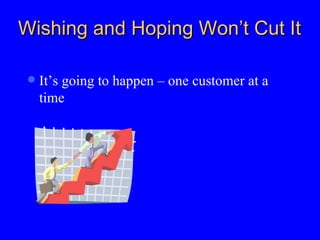
Wishing and Hoping Won’t Cut It  It’s going to happen – one customer at a time
What Hasn’t Changed? Time – the day is exactly the same number of hours Not much automation in billing/collections Mistakes in billing are compounded by automation (computers are stupid!)
Question? Has it simply become good business for some customers to pay on their own terms or wait until suppliers call?
Question? Has it become good business to for customers to pay on their own terms or wait until suppliers call? In other words, terms of sale move from contractual terms to tolerated terms
“My job is to manage my payables – not manage your receivables” “I decide – should I pay late? If so – how late?” - A Controller in Kingston
Problem Areas No real agreement – more implied or by conduct The creditor doesn’t know why – the blurring of “willing and ability” The fear, real or perceived, that if pushed, customer will go to competitor
What We Need To Do Become better communicators Target solutions rather than take a shotgun approach – “willing it” won’t make it happen Work on recurring problems Reduce risk by becoming more credit-conscious – work on financial info Reduce risk – at least in time
Wouldn’t It Be Nice To Know? Did the customer receive our invoice? Did the invoice match their purchase? Was it approved by their buyer? Have they scheduled  invoice for payment? What is the payment schedule date? Are they going to deduct a portion – why? Do they have enough money to pay? Have they paid? When?
The best collection techniques are the preventative ones
When Does Collections Start?
When Does Collections Start? When account goes overdue?
When Does Collections Start? When account goes overdue? When account is opened or sale is made?
Collection of Accounts Starts When they go overdue When you get around to it When the bill is sent When the account is opened
Positioning Starts When Account Is Opened An account properly opened is half-collected
Positioning Starts When Account Is Opened An account properly opened is half-collected The establishment of the rules, the needs of the parties and agreement as to how exceptions will be handled
Positioning Starts When Account Is Opened An account properly opened is half-collected The establishment of the rules, the needs of the parties and agreement as to how exceptions will be handled  It is not unlike trying to train a 10 year old dog – very difficult – better when the animal was a puppy
A Breakdown of Process 1. Opening accounts
A Breakdown of Process 1.  Opening accounts 1.1 Informative stage
A Breakdown of Process 1. Opening accounts 1.1. Informative stage 2. Reminder stage
A Breakdown of Process 1. Opening accounts 1.1. Informative stage 2. Reminder stage 3. Discussion stage
A Breakdown of Process 1. Opening accounts 1.1. Informative stage 2. Reminder stage 3. Discussion stage 4. Recovery stage
Reminder Stage Invoice confirmations Pre-reminders Do early ? ?
Discussion Stage Moves from 1 way to 2 way communication
Discussion Stage Moves from 1 way to 2 way communication  Very different skillsets  - assertiveness - integrity - credibility - problem-solving abilities
Number 1 Reason For Lack of Success No Plan
Instead What Customers Often Get Apologetic/timidity Training that it’s OK to wait until you call – the telephone call is just an invoice notice Sometimes different stories  Occasionally confrontation/aggressiveness Being placed on hold without notice to buyer
Some Other Observations No one aspires to do collection work. Backgrounds/experience and education rarely apply Very few of us had any training other than “battleground experience” or through peer training And… that is not an issue when the collections are routine. Most people have good motivation and desire to other areas
Observations 2 Desire and motivation are not skills Some people bring some natural ability in more than others but… Natural abilities will only take a person so far  When we add an increase to workload and new tasks,  it becomes obvious that training will help you when your charisma runs out.
Evidence of Average Calling same people over and over each month When there are more than 3-4 staff, why are some better than others? Lots of “coasting is evident” 10 years experience is usually more like 2 years of experience multiplied by 5 years of time
Building A Call Preparation Anticipation  Practice
Having Reasons Why Why should I pay?
Three Approaches Direct Assumptive Indirect (with border)
Dealing With Concerns/Objections/Stalls Use tie-down Probe to clarify Go to alternative plan
Payment Plans Get in writing Keep them short  Remember there are other creditors Perhaps think settlement – talk over with boss
‘The secret of success is to do common things uncommonly well.’  – John D Rockefeller
Be The Best! :
 
Needs Analysis Results should be a game plan to be the best Being Five Star is not an accident Every customer contact point has been analyzed, time managed and recurring issues dealt with.
Instructional Method:  Case Study
What Do They Want? Options such as easy ways to pay Help if they need it  Going the extra mile Single-source for information (or at least the same story)  Building a relationship is based on respect and mutual effort – it takes time and effort
Key Skills Checklist  How well do you communicate with customers? Does someone “talk money” with new customers ? Do you attempt to train customers or are they training you? Do you have a plan to decrease delinquency one account at a time? 5.  Do you consider yourself pro-active or re-active?
 

Telephone Collections

  • 1.
    The Telephone CollectionWorkshop Top Performance Inc./Credit In Canada October 2005
  • 2.
  • 3.
    The Changing Faceof Credit Scarcity of solid credit information
  • 4.
    The Changing Faceof Credit Scarcity of ongoing credit information More sophisticated customers
  • 5.
    The Changing Faceof Credit Scarcity of credit information More sophisticated customers Better educated
  • 6.
    The Changing Faceof Credit Scarcity of solid credit information More sophisticated customers Better educated “Customer-power”
  • 7.
    The Changing Faceof Credit Scarcity of credit information More sophisticated customers Better educated “Customer-power” Legal system and costs tend to favour debtor Other creditors taking precedence
  • 8.
    It’s Safe ToSay That Delinquency Isn’t Going Away
  • 9.
    Wishing and HopingWon’t Cut It It’s going to happen – one customer at a time
  • 10.
    What Hasn’t Changed?Time – the day is exactly the same number of hours Not much automation in billing/collections Mistakes in billing are compounded by automation (computers are stupid!)
  • 11.
    Question? Has itsimply become good business for some customers to pay on their own terms or wait until suppliers call?
  • 12.
    Question? Has itbecome good business to for customers to pay on their own terms or wait until suppliers call? In other words, terms of sale move from contractual terms to tolerated terms
  • 13.
    “My job isto manage my payables – not manage your receivables” “I decide – should I pay late? If so – how late?” - A Controller in Kingston
  • 14.
    Problem Areas Noreal agreement – more implied or by conduct The creditor doesn’t know why – the blurring of “willing and ability” The fear, real or perceived, that if pushed, customer will go to competitor
  • 15.
    What We NeedTo Do Become better communicators Target solutions rather than take a shotgun approach – “willing it” won’t make it happen Work on recurring problems Reduce risk by becoming more credit-conscious – work on financial info Reduce risk – at least in time
  • 16.
    Wouldn’t It BeNice To Know? Did the customer receive our invoice? Did the invoice match their purchase? Was it approved by their buyer? Have they scheduled invoice for payment? What is the payment schedule date? Are they going to deduct a portion – why? Do they have enough money to pay? Have they paid? When?
  • 17.
    The best collectiontechniques are the preventative ones
  • 18.
  • 19.
    When Does CollectionsStart? When account goes overdue?
  • 20.
    When Does CollectionsStart? When account goes overdue? When account is opened or sale is made?
  • 21.
    Collection of AccountsStarts When they go overdue When you get around to it When the bill is sent When the account is opened
  • 22.
    Positioning Starts WhenAccount Is Opened An account properly opened is half-collected
  • 23.
    Positioning Starts WhenAccount Is Opened An account properly opened is half-collected The establishment of the rules, the needs of the parties and agreement as to how exceptions will be handled
  • 24.
    Positioning Starts WhenAccount Is Opened An account properly opened is half-collected The establishment of the rules, the needs of the parties and agreement as to how exceptions will be handled It is not unlike trying to train a 10 year old dog – very difficult – better when the animal was a puppy
  • 25.
    A Breakdown ofProcess 1. Opening accounts
  • 26.
    A Breakdown ofProcess 1. Opening accounts 1.1 Informative stage
  • 27.
    A Breakdown ofProcess 1. Opening accounts 1.1. Informative stage 2. Reminder stage
  • 28.
    A Breakdown ofProcess 1. Opening accounts 1.1. Informative stage 2. Reminder stage 3. Discussion stage
  • 29.
    A Breakdown ofProcess 1. Opening accounts 1.1. Informative stage 2. Reminder stage 3. Discussion stage 4. Recovery stage
  • 30.
    Reminder Stage Invoiceconfirmations Pre-reminders Do early ? ?
  • 31.
    Discussion Stage Movesfrom 1 way to 2 way communication
  • 32.
    Discussion Stage Movesfrom 1 way to 2 way communication Very different skillsets - assertiveness - integrity - credibility - problem-solving abilities
  • 33.
    Number 1 ReasonFor Lack of Success No Plan
  • 34.
    Instead What CustomersOften Get Apologetic/timidity Training that it’s OK to wait until you call – the telephone call is just an invoice notice Sometimes different stories Occasionally confrontation/aggressiveness Being placed on hold without notice to buyer
  • 35.
    Some Other ObservationsNo one aspires to do collection work. Backgrounds/experience and education rarely apply Very few of us had any training other than “battleground experience” or through peer training And… that is not an issue when the collections are routine. Most people have good motivation and desire to other areas
  • 36.
    Observations 2 Desireand motivation are not skills Some people bring some natural ability in more than others but… Natural abilities will only take a person so far When we add an increase to workload and new tasks, it becomes obvious that training will help you when your charisma runs out.
  • 37.
    Evidence of AverageCalling same people over and over each month When there are more than 3-4 staff, why are some better than others? Lots of “coasting is evident” 10 years experience is usually more like 2 years of experience multiplied by 5 years of time
  • 38.
    Building A CallPreparation Anticipation Practice
  • 39.
    Having Reasons WhyWhy should I pay?
  • 40.
    Three Approaches DirectAssumptive Indirect (with border)
  • 41.
    Dealing With Concerns/Objections/StallsUse tie-down Probe to clarify Go to alternative plan
  • 42.
    Payment Plans Getin writing Keep them short Remember there are other creditors Perhaps think settlement – talk over with boss
  • 43.
    ‘The secret ofsuccess is to do common things uncommonly well.’ – John D Rockefeller
  • 44.
  • 45.
  • 46.
    Needs Analysis Resultsshould be a game plan to be the best Being Five Star is not an accident Every customer contact point has been analyzed, time managed and recurring issues dealt with.
  • 47.
  • 48.
    What Do TheyWant? Options such as easy ways to pay Help if they need it Going the extra mile Single-source for information (or at least the same story) Building a relationship is based on respect and mutual effort – it takes time and effort
  • 49.
    Key Skills Checklist How well do you communicate with customers? Does someone “talk money” with new customers ? Do you attempt to train customers or are they training you? Do you have a plan to decrease delinquency one account at a time? 5. Do you consider yourself pro-active or re-active?
  • 50.