ESSENTIAL MEDICINES
Definition ofessential medicines
• Essential medicines are those that satisfy
the priority health care needs of the
majority of population.
• They should be available at all times,
• in adequate amounts,
• in appropriate dosage forms,
• With assured quality and adequate information,
• at affordable price.
2.
The concept ofessential medicines
• Only a handful of medicines out of the multitude
available can meet the health care needs of
majority of people in any country
• Many well tested, cheaper medicines are equally
efficacious and safe as compared to their newer
more expensive congeners.
• For optimum utilization of resources, governments
(especially in developing countries) should
concentrate on these Essential Medicines.
3.
WHAT IS ESSENTIALMEDICINE
LIST ?
• As per the WHO, Essential Medicines are those
that satisfy the priority health care needs of the
population.
The list is made with consideration to
• disease prevalence,
• efficacy,
• safety and
• comparative cost-effectiveness of the medicines.
4.
History of theWHO Model List of
Essential medicines
1977 First 'Model List of Essential
Drugs’ was published, ± 200 active
substances.
List is revised every two years by WHO
Expert Committee.
23rd
edition of EML upated on july 2023. this list
contains 1200 recommendations for 591 drugs and
103 therapeutic equivalents
India- “National List of Essential Medicines”
Latest in 2022
5.
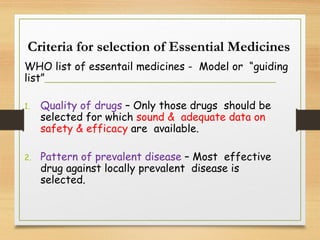
Criteria for selectionof Essential Medicines
WHO list of essentail medicines - Model or “guiding
list”
1. Quality of drugs – Only those drugs should be
selected for which sound & adequate data on
safety & efficacy are available.
2. Pattern of prevalent disease – Most effective
drug against locally prevalent disease is
selected.
6.
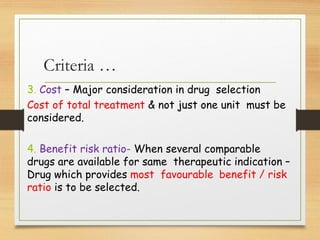
Criteria …
3. Cost– Major consideration in drug selection
Cost of total treatment & not just one unit must be
considered.
4. Benefit risk ratio- When several comparable
drugs are available for same therapeutic indication –
Drug which provides most favourable benefit / risk
ratio is to be selected.
7.
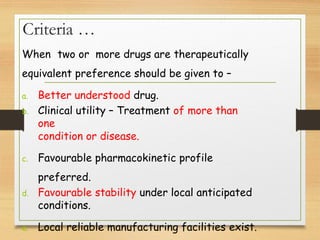
Criteria …
When twoor more drugs are therapeutically
equivalent preference should be given to –
a. Better understood drug.
b. Clinical utility – Treatment of more than
one
condition or disease.
c. Favourable pharmacokinetic profile
preferred.
d. Favourable stability under local anticipated
conditions.
e. Local reliable manufacturing facilities exist.
8.
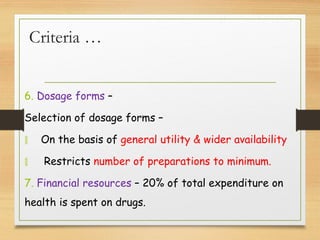
Criteria …
6. Dosageforms –
Selection of dosage forms –
On the basis of general utility & wider availability
Restricts number of preparations to minimum.
7. Financial resources – 20% of total expenditure on
health is spent on drugs.
9.
Criteria …
8.Genetic, Demographic& Environmental
factors.
9. Mortality and morbidity statistics.
10. Local manufacture and storage facilities.
11. Selection of essential medicines should be
a continuous process.
12.Essential medicines should be based on
rationally developed treatment guidelines.
10.
Standing committeeof health care professionals
(competent individuals in fields of medicine,
pharmacology, peripheral health workers) –
for technical advice .
International non proprietary (generic) names for
drugs or pharmaceutical substances should be used
whenever available –
Prescribers should be provided – Cross index of
non-proprietary and proprietarynames
11.
Periodic updating
Mustbe reviewed yearly or whenever necessary.
Must be flexible to accommodate new drugs, new
information on established drugs.
12.
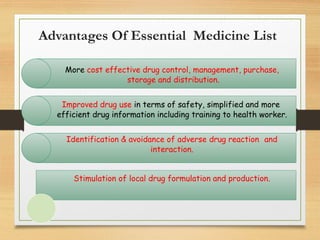
Advantages Of EssentialMedicine List
More cost effective drug control, management, purchase,
storage and distribution.
Improved drug use in terms of safety, simplified and more
efficient drug information including training to health worker.
Identification & avoidance of adverse drug reaction and
interaction.
Stimulation of local drug formulation and production.
13.
Disadvantages of EssentialMedicine List
Reduced freedom of choice.
Creation of monopolies – Favouring a
single drug product.
Lack of interest for drug innovation.
14.
Purpose of theNLEM
• 1. Guide safe and effective treatment of priority disease
conditions of a population
• 2. Promote the rational use of medicines.
• 3. Optimize the available health resources of a country.
• It can also be a guiding document for:
a) State governments to prepare their list of essential medicines
b) Procurement and supply of medicines in the public sector
c) Identifying the ‘MUST KNOW’ domain for the teaching and
training of health care professionals
15.
Strengths
NLEMI givesthe names of all the additions and
deletions as well as detailed lists of medicines in
alphabetical order, classified therapeutic area
and category-wise.
Experts from nearly all specialties were
included in the expert group for the
preparation of the list.
16.
Strengths
Executive summary,salient features of the NLEMI
and the potential uses of the list have been well
written, in simple language, to permit health care
professionals, students and even others like health
activists and media persons to understand what an
essential medicines list is all about.
17.
Take Home Message….
E – Efficacy
S – Safety and suitability
S - Storage and stability
E - Ease of administration ( dosage form)
N - Need of population
T - Total cost
I - Irrational combination to be avoided
A- Availability, Affordability
L - Listing regularly ( updating)