ESSENTIAL
MEDICINES LIST
By
Sai Ananth, Bhavana
Anurag, Saurab
Parihar
1ESSENTIAL MEDICINES LIST
Definition
Essential medicines are those that satisfy the priority
health care needs of the population.
Why EML ?
A limited range of carefully selected essential drugs
leads to
Better health care
Better drug management
Lower costs.
WHAT IS EML ?
2ESSENTIAL MEDICINES LIST
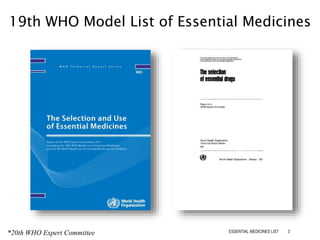
19th WHO Model List of Essential Medicines
*20th WHO Expert Committee 3ESSENTIAL MEDICINES LIST
Essential medicines are selected with due
regard to
 Disease prevalence
 Public health relevance
 Evidence of clinical efficacy
 Safety
 Cost-effectiveness.
CRITERIA OF SELECTION*
*WHO, [Online]. http://www.who.int/topics/essential_medicines/en 4ESSENTIAL MEDICINES LIST
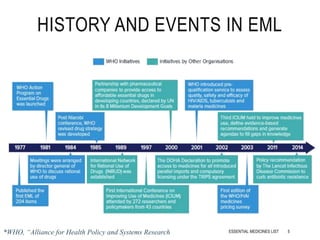
HISTORY AND EVENTS IN EML
*WHO, “Alliance for Health Policy and Systems Research 5ESSENTIAL MEDICINES LIST
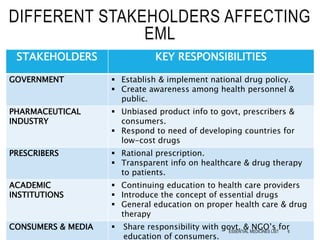
STAKEHOLDERS KEY RESPONSIBILITIES
GOVERNMENT  Establish & implement national drug policy.
 Create awareness among health personnel &
public.
PHARMACEUTICAL
INDUSTRY
 Unbiased product info to govt, prescribers &
consumers.
 Respond to need of developing countries for
low-cost drugs
PRESCRIBERS  Rational prescription.
 Transparent info on healthcare & drug therapy
to patients.
ACADEMIC
INSTITUTIONS
 Continuing education to health care providers
 Introduce the concept of essential drugs
 General education on proper health care & drug
therapy
CONSUMERS & MEDIA  Share responsibility with govt. & NGO’s for
education of consumers.
DIFFERENT STAKEHOLDERS AFFECTING
EML
6ESSENTIAL MEDICINES LIST
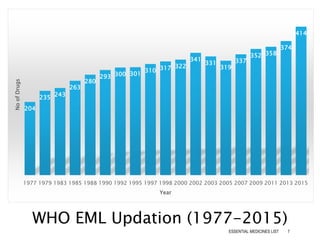
204
235 243
263
280
293 300 301
310 317 322
341
331
319
337
352 358
374
414
1977 1979 1983 1985 1988 1990 1992 1995 1997 1998 2000 2002 2003 2005 2007 2009 2011 2013 2015
NoofDrugs
Year
WHO EML Updation (1977-2015)
7ESSENTIAL MEDICINES LIST
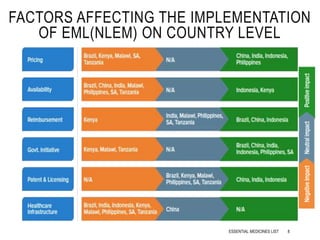
FACTORS AFFECTING THE IMPLEMENTATION
OF EML(NLEM) ON COUNTRY LEVEL
8ESSENTIAL MEDICINES LIST
ESSENTIAL MEDICINES LIST 9
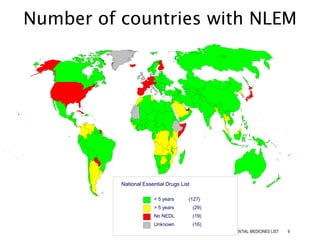
National Essential Drugs List
< 5 years (127)
> 5 years (29)
No NEDL (19)
Unknown (16)
Number of countries with NLEM
AVAILABILITY AND ACCESS OF EML
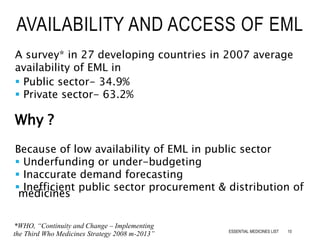
A survey* in 27 developing countries in 2007 average
availability of EML in
 Public sector- 34.9%
 Private sector- 63.2%
Why ?
Because of low availability of EML in public sector
 Underfunding or under-budgeting
 Inaccurate demand forecasting
 Inefficient public sector procurement & distribution of
medicines
*WHO, “Continuity and Change – Implementing
the Third Who Medicines Strategy 2008 m-2013” 10ESSENTIAL MEDICINES LIST
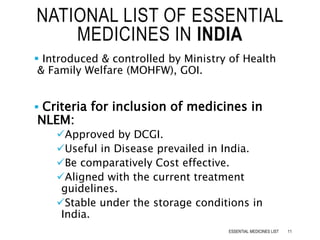
 Introduced & controlled by Ministry of Health
& Family Welfare (MOHFW), GOI.
 Criteria for inclusion of medicines in
NLEM:
Approved by DCGI.
Useful in Disease prevailed in India.
Be comparatively Cost effective.
Aligned with the current treatment
guidelines.
Stable under the storage conditions in
India.
NATIONAL LIST OF ESSENTIAL
MEDICINES IN INDIA
11ESSENTIAL MEDICINES LIST
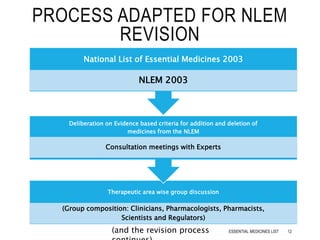
PROCESS ADAPTED FOR NLEM
REVISION
Therapeutic area wise group discussion
(Group composition: Clinicians, Pharmacologists, Pharmacists,
Scientists and Regulators)
Deliberation on Evidence based criteria for addition and deletion of
medicines from the NLEM
Consultation meetings with Experts
National List of Essential Medicines 2003
NLEM 2003
(and the revision process 12ESSENTIAL MEDICINES LIST
 First NLEM 1996 (Revised in 2003)
 NLEM 2011 (348 Drugs)
 NLEM 2015 [376 Drugs(106 added & 70 deleted)]
Category of Drugs(On basis of health care and disease
burden)
 P→ Primary (206)
 S → Secondary (115)
 T → Tertiary (79)(106 additions and 70 deletions)
 Medicines deleted from NLEM-2003 (47 Drugs)
Acenocoumarol, Aminophylline, Benzylpenicillin, Bretylium
Tosylate, Cefuroxime, Clarithromycin….etc.,
 Medicines added in NLEM- 2011 (43 Drugs)
25% Dextrose, Allopurinol, Amoxicillin+Clavulinic acid,
Atorvastatin….etc.,
SALIENT FEATURES OF NLEM
13ESSENTIAL MEDICINES LIST
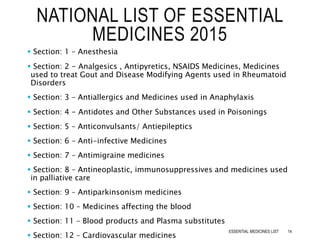
 Section: 1 – Anesthesia
 Section: 2 – Analgesics , Antipyretics, NSAIDS Medicines, Medicines
used to treat Gout and Disease Modifying Agents used in Rheumatoid
Disorders
 Section: 3 – Antiallergics and Medicines used in Anaphylaxis
 Section: 4 – Antidotes and Other Substances used in Poisonings
 Section: 5 – Anticonvulsants/ Antiepileptics
 Section: 6 – Anti-infective Medicines
 Section: 7 – Antimigraine medicines
 Section: 8 – Antineoplastic, immunosuppressives and medicines used
in palliative care
 Section: 9 – Antiparkinsonism medicines
 Section: 10 – Medicines affecting the blood
 Section: 11 – Blood products and Plasma substitutes
 Section: 12 – Cardiovascular medicines
NATIONAL LIST OF ESSENTIAL
MEDICINES 2015
14ESSENTIAL MEDICINES LIST
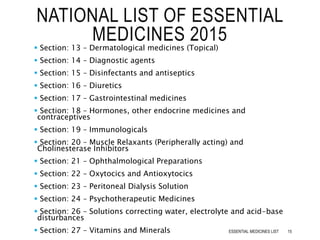
 Section: 13 – Dermatological medicines (Topical)
 Section: 14 – Diagnostic agents
 Section: 15 – Disinfectants and antiseptics
 Section: 16 – Diuretics
 Section: 17 – Gastrointestinal medicines
 Section: 18 – Hormones, other endocrine medicines and
contraceptives
 Section: 19 – Immunologicals
 Section: 20 – Muscle Relaxants (Peripherally acting) and
Cholinesterase Inhibitors
 Section: 21 – Ophthalmological Preparations
 Section: 22 – Oxytocics and Antioxytocics
 Section: 23 – Peritoneal Dialysis Solution
 Section: 24 – Psychotherapeutic Medicines
 Section: 26 – Solutions correcting water, electrolyte and acid-base
disturbances
 Section: 27 – Vitamins and Minerals
NATIONAL LIST OF ESSENTIAL
MEDICINES 2015
15ESSENTIAL MEDICINES LIST
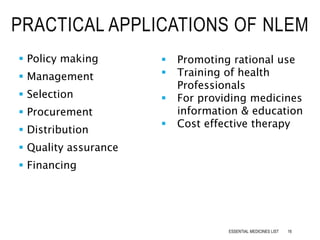
 Policy making
 Management
 Selection
 Procurement
 Distribution
 Quality assurance
 Financing
PRACTICAL APPLICATIONS OF NLEM
 Promoting rational use
 Training of health
Professionals
 For providing medicines
information & education
 Cost effective therapy
16ESSENTIAL MEDICINES LIST
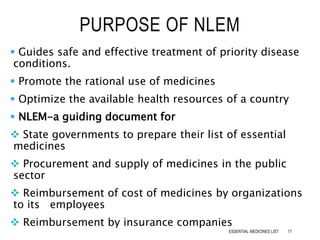
 Guides safe and effective treatment of priority disease
conditions.
 Promote the rational use of medicines
 Optimize the available health resources of a country
 NLEM-a guiding document for
 State governments to prepare their list of essential
medicines
 Procurement and supply of medicines in the public
sector
 Reimbursement of cost of medicines by organizations
to its employees
 Reimbursement by insurance companies
PURPOSE OF NLEM
17ESSENTIAL MEDICINES LIST
THANK YOU

Essential Medicines List

  • 1.
    ESSENTIAL MEDICINES LIST By Sai Ananth,Bhavana Anurag, Saurab Parihar 1ESSENTIAL MEDICINES LIST
  • 2.
    Definition Essential medicines arethose that satisfy the priority health care needs of the population. Why EML ? A limited range of carefully selected essential drugs leads to Better health care Better drug management Lower costs. WHAT IS EML ? 2ESSENTIAL MEDICINES LIST
  • 3.
    19th WHO ModelList of Essential Medicines *20th WHO Expert Committee 3ESSENTIAL MEDICINES LIST
  • 4.
    Essential medicines areselected with due regard to  Disease prevalence  Public health relevance  Evidence of clinical efficacy  Safety  Cost-effectiveness. CRITERIA OF SELECTION* *WHO, [Online]. http://www.who.int/topics/essential_medicines/en 4ESSENTIAL MEDICINES LIST
  • 5.
    HISTORY AND EVENTSIN EML *WHO, “Alliance for Health Policy and Systems Research 5ESSENTIAL MEDICINES LIST
  • 6.
    STAKEHOLDERS KEY RESPONSIBILITIES GOVERNMENT Establish & implement national drug policy.  Create awareness among health personnel & public. PHARMACEUTICAL INDUSTRY  Unbiased product info to govt, prescribers & consumers.  Respond to need of developing countries for low-cost drugs PRESCRIBERS  Rational prescription.  Transparent info on healthcare & drug therapy to patients. ACADEMIC INSTITUTIONS  Continuing education to health care providers  Introduce the concept of essential drugs  General education on proper health care & drug therapy CONSUMERS & MEDIA  Share responsibility with govt. & NGO’s for education of consumers. DIFFERENT STAKEHOLDERS AFFECTING EML 6ESSENTIAL MEDICINES LIST
  • 7.
    204 235 243 263 280 293 300301 310 317 322 341 331 319 337 352 358 374 414 1977 1979 1983 1985 1988 1990 1992 1995 1997 1998 2000 2002 2003 2005 2007 2009 2011 2013 2015 NoofDrugs Year WHO EML Updation (1977-2015) 7ESSENTIAL MEDICINES LIST
  • 8.
    FACTORS AFFECTING THEIMPLEMENTATION OF EML(NLEM) ON COUNTRY LEVEL 8ESSENTIAL MEDICINES LIST
  • 9.
    ESSENTIAL MEDICINES LIST9 National Essential Drugs List < 5 years (127) > 5 years (29) No NEDL (19) Unknown (16) Number of countries with NLEM
  • 10.
    AVAILABILITY AND ACCESSOF EML A survey* in 27 developing countries in 2007 average availability of EML in  Public sector- 34.9%  Private sector- 63.2% Why ? Because of low availability of EML in public sector  Underfunding or under-budgeting  Inaccurate demand forecasting  Inefficient public sector procurement & distribution of medicines *WHO, “Continuity and Change – Implementing the Third Who Medicines Strategy 2008 m-2013” 10ESSENTIAL MEDICINES LIST
  • 11.
     Introduced &controlled by Ministry of Health & Family Welfare (MOHFW), GOI.  Criteria for inclusion of medicines in NLEM: Approved by DCGI. Useful in Disease prevailed in India. Be comparatively Cost effective. Aligned with the current treatment guidelines. Stable under the storage conditions in India. NATIONAL LIST OF ESSENTIAL MEDICINES IN INDIA 11ESSENTIAL MEDICINES LIST
  • 12.
    PROCESS ADAPTED FORNLEM REVISION Therapeutic area wise group discussion (Group composition: Clinicians, Pharmacologists, Pharmacists, Scientists and Regulators) Deliberation on Evidence based criteria for addition and deletion of medicines from the NLEM Consultation meetings with Experts National List of Essential Medicines 2003 NLEM 2003 (and the revision process 12ESSENTIAL MEDICINES LIST
  • 13.
     First NLEM1996 (Revised in 2003)  NLEM 2011 (348 Drugs)  NLEM 2015 [376 Drugs(106 added & 70 deleted)] Category of Drugs(On basis of health care and disease burden)  P→ Primary (206)  S → Secondary (115)  T → Tertiary (79)(106 additions and 70 deletions)  Medicines deleted from NLEM-2003 (47 Drugs) Acenocoumarol, Aminophylline, Benzylpenicillin, Bretylium Tosylate, Cefuroxime, Clarithromycin….etc.,  Medicines added in NLEM- 2011 (43 Drugs) 25% Dextrose, Allopurinol, Amoxicillin+Clavulinic acid, Atorvastatin….etc., SALIENT FEATURES OF NLEM 13ESSENTIAL MEDICINES LIST
  • 14.
     Section: 1– Anesthesia  Section: 2 – Analgesics , Antipyretics, NSAIDS Medicines, Medicines used to treat Gout and Disease Modifying Agents used in Rheumatoid Disorders  Section: 3 – Antiallergics and Medicines used in Anaphylaxis  Section: 4 – Antidotes and Other Substances used in Poisonings  Section: 5 – Anticonvulsants/ Antiepileptics  Section: 6 – Anti-infective Medicines  Section: 7 – Antimigraine medicines  Section: 8 – Antineoplastic, immunosuppressives and medicines used in palliative care  Section: 9 – Antiparkinsonism medicines  Section: 10 – Medicines affecting the blood  Section: 11 – Blood products and Plasma substitutes  Section: 12 – Cardiovascular medicines NATIONAL LIST OF ESSENTIAL MEDICINES 2015 14ESSENTIAL MEDICINES LIST
  • 15.
     Section: 13– Dermatological medicines (Topical)  Section: 14 – Diagnostic agents  Section: 15 – Disinfectants and antiseptics  Section: 16 – Diuretics  Section: 17 – Gastrointestinal medicines  Section: 18 – Hormones, other endocrine medicines and contraceptives  Section: 19 – Immunologicals  Section: 20 – Muscle Relaxants (Peripherally acting) and Cholinesterase Inhibitors  Section: 21 – Ophthalmological Preparations  Section: 22 – Oxytocics and Antioxytocics  Section: 23 – Peritoneal Dialysis Solution  Section: 24 – Psychotherapeutic Medicines  Section: 26 – Solutions correcting water, electrolyte and acid-base disturbances  Section: 27 – Vitamins and Minerals NATIONAL LIST OF ESSENTIAL MEDICINES 2015 15ESSENTIAL MEDICINES LIST
  • 16.
     Policy making Management  Selection  Procurement  Distribution  Quality assurance  Financing PRACTICAL APPLICATIONS OF NLEM  Promoting rational use  Training of health Professionals  For providing medicines information & education  Cost effective therapy 16ESSENTIAL MEDICINES LIST
  • 17.
     Guides safeand effective treatment of priority disease conditions.  Promote the rational use of medicines  Optimize the available health resources of a country  NLEM-a guiding document for  State governments to prepare their list of essential medicines  Procurement and supply of medicines in the public sector  Reimbursement of cost of medicines by organizations to its employees  Reimbursement by insurance companies PURPOSE OF NLEM 17ESSENTIAL MEDICINES LIST
  • 18.