The Difference Between Practice and Research – What the FDA Expects You to Understand Harvey M. Arbit, PharmD, MBA, RAC, CCRP University of Minnesota Director, IND/IDE Assistance Program,  Academic Health Center Adjunct Associate Professor, College of Pharmacy Phone 612-625-0930 Fax 612-625-3956 E-mail  [email_address] www.ahc.umn.edu/research/ind-ide/
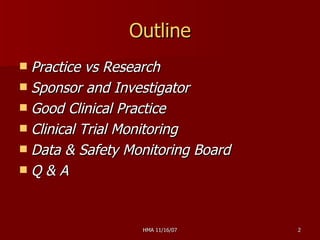
Outline Practice vs Research Sponsor and Investigator Good Clinical Practice Clinical Trial Monitoring Data & Safety Monitoring Board Q & A
Practice vs Research
Clinical Practice ≠ Clinical Research Special  training  is required. Clinical research  must  be conducted according to the written protocol with a full understanding of the risk to the subjects. The laws, regulations and guidelines for clinical research are  detailed  and  specific .
Clinical Investigation (Drug Research) Clinical investigation - any experiment that involves a test article and one or more human subjects.  21 CFR 50.3(c) Clinical investigation – any experiment in which a drug is administered or dispensed to, or used involving, one or more human subjects. For the purposes of this part, an experiment is any use of a drug except for the use of a marketed drug in the course of medical practice.  21 CFR 312.3(b) Practice -  exercise of an occupation or a profession No protocol Administer to all patients Some documentation Not intended to publish Billable to insurance Research  – systematic investigation designed to contribute to generalizable knowledge Protocol Administer to some patients Much documentation Intend to publish Not billable to insurance
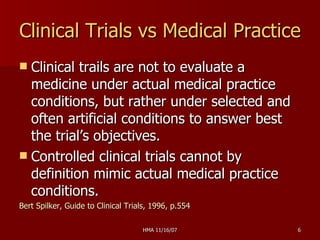
Clinical Trials vs Medical Practice Clinical trails are not to evaluate a medicine under actual medical practice conditions, but rather under selected and often artificial conditions to answer best the trial’s objectives. Controlled clinical trials cannot by definition mimic actual medical practice conditions. Bert Spilker, Guide to Clinical Trials, 1996, p.554
Practice of Medicine The practice of medicine combines both  science  as the evidence base and  art  in the application of this medical knowledge in combination with  intuition  and clinical  judgment  to determine the  treatment  plan for each patient.  (ref. Wikipedia, 2007)
"Off-Label" Use of Marketed Drugs, Biologics and Medical Devices Good medical practice and the best interests of the patient require that physicians use legally available drugs, biologics and devices according to their best knowledge and judgment.  If physicians use a product for an indication not in the approved labeling, they have the responsibility to be well informed about the product, to base its use on firm scientific rationale and on sound medical evidence, and to maintain records of the product's use and effects.  Use of a marketed product in this manner  when the intent is the "practice of medicine"  does not require the submission of an Investigational New Drug Application (IND), Investigational Device Exemption (IDE) or review by an Institutional Review Board (IRB).  However, the institution at which the product will be used may, under its own authority, require IRB review or other institutional oversight.  (FDA Information Sheet Guidance for IRB, CI and S. 1998)
Clinical Trial A comparison test of a  medication  or other medical treatment, versus a  placebo , other medications/devices, or the standard medical treatment for a patient's condition.  Researchers test  hypotheses  and observe what happens, clinical trials can be seen as the application of the  scientific method  to understanding human biology. Clinical trials are closely supervised by appropriate  regulatory  authorities. All studies that involve a medical or therapeutic intervention on patients must be approved by an  ethics committee  before permission is granted to run the trial.  (ref Wikipedia, 2007)
Investigational Use of Marketed Drugs, Biologics and Medical Devices   The investigational use of approved, marketed products differs from “off-label" use.  "Investigational use" suggests the use of an approved product in the context of a clinical study protocol. When the principal intent of the investigational use of a test article is to develop information about the product's safety or efficacy, submission of an IND or IDE may be required.  The clinical investigation of a marketed drug or biologic does not require submission of an IND if all six of the following conditions are met:
Investigational Use of Marketed Drugs, Biologics and Medical Devices (cont.) (i) it is not intended to be reported to FDA in support of a new indication for use or to support any other significant change in the labeling for the drug;  (ii) it is not intended to support a significant change in the advertising for the product;  (iii) it does not involve a route of administration or dosage level, use in a subject population, or other factor that significantly increases the risks (or decreases the acceptability of the risks) associated with the use of the drug product ;  (iv) it is conducted in compliance with the requirements for IRB review and informed consent;  (v) it is conducted in compliance with the requirements concerning the promotion and sale of drugs; and  (vi) it does not intend to invoke exemption from informed consent.  (FDA Information Sheet Guidance for IRB, CI and S. 1998) (IND Exemption Criteria, 21 CFR 312.2(b))
IND Assessment Process When determining if the risk is significantly increased, the parts of the protocol that are examined are those that concern  dose,  schedule,  route of administration, and  patient population.
 
Oncology Drugs Guidance for Industry:  IND Exemptions for Studies of Lawfully Marketed Drugs or Biological Products for the Treatment of Cancer  (Jan. 2004) Focus is on whether risk is significantly altered Discusses a range of potential scenarios and factors that may alter risk
Sponsor and Investigator
http://aapp.org/pdf/HansMayoPresentation.pdf
Sponsor 21 CFR 312.3(b) An individual or company who takes responsibility for and initiates a clinical investigation.  The sponsor does not actually conduct the investigation unless the sponsor is a sponsor-investigator.
Sponsor-Investigator   21 CFR 312.3(b) An individual who both initiates and conducts an investigation.  The term refers only to an individual.  Must comply with the requirements of both an investigator and a sponsor.
Form FDA 1571 Investigational New Drug Application
When a sponsor signs the 1571  he/she agrees to the following: Wait 30 days before beginning the study Not begin or continue the study if placed on clinical hold IRB will be responsible for review and approval of the study Conduct the study in accordance with all applicable regulatory requirements “ WARNING: A willfully false statement is a criminal offense.”
Responsibilities of  Sponsors  and Investigators   21 CFR 312 Subpart D    § 312.50  - General responsibilities of sponsors.     § 312.52  - Transfer of obligations to a contract  research organization.     § 312.53  - Selecting investigators and monitors.     § 312.54  - Emergency research under       § 312.55  - Informing investigators.     § 312.56  - Review of ongoing investigations.     § 312.57  - Recordkeeping and record retention.     § 312.58  - Inspection of sponsor's records and reports.     § 312.59  - Disposition of unused supply of  investigational drug.
Investigator   21 CFR 312.3(b) An individual who actually conducts a clinical investigation.
Form FDA 1572 Statement of Investigator
When an investigator signs the 1572 he/she commits to the following: To conduct the study according to protocol  To personally supervise or conduct the investigation To inform the subjects of the investigational status of the test article To report adverse events to the sponsor To read and understand the Investigator’s Brochure To inform all support personnel of the investigation requirements
1572 (Cont.) To maintain adequate records and make them available for inspection To assure that the IRB is in compliance To assume responsibility for initial and continuing review by the IRB To promptly report study changes and unanticipated risks to the IRB Not make any changes in the research without IRB approval To comply with the requirements regarding the obligations of clinical investigators “ WARNING: A willfully false statement is a criminal offense.”
Responsibilities of  Sponsors and  Investigators   21 CFR 312 Subpart D    § 312.60  - General responsibilities of investigators.     § 312.61  - Control of the investigational drug.     § 312.62  - Investigator recordkeeping and record  retention.     § 312.64  - Investigator reports.     § 312.66  - Assurance of IRB review.     § 312.68  - Inspection of investigator's records and  reports.     § 312.69  - Handling of controlled substances.     § 312.70  - Disqualification of a clinical investigator.
Good Clinical Practice (GCP)
 
 
Protocol elements for IND   21 CFR 312.23(a)(6)(iii) Statement of the objectives Names and qualifications of investigators Inclusion/exclusion criteria and number of subjects Design of the study and methods to minimize bias Dose and duration of exposure Observations/measurements to fulfill objectives Clinical procedures to monitor the effects of the drug to minimize risk
Elements of a Clinical Trial Protocol   (GCP section 6) Background information Trial objectives Trial design Selection and withdrawal of subjects Assessment of efficacy Assessment of safety Statistical plan Access to source documentation, QC/QA, ethics, data handling, record keeping, financial/insurance, publication
Protocol Compliance It doesn’t matter who wrote the protocol – or whether the trial is funded by the DHHS or regulated by FDA –  NO change can be implemented without prior IRB approval  (except to mitigate immediate hazard).  The plan submitted to (and approved by) the IRB cannot be changed without approval. Some changes must also be submitted to the FDA.
Clinical Trial Monitoring
 
Proper Monitoring (FDA Guideline for the Monitoring of Clinical Investigations) To assure  adequate protection of the rights of human subjects and  the safety of all subjects involved in clinical investigations and  the quality and integrity of the resulting data submitted to the FDA.
Purpose of Monitoring   (GCP section 5.18.1) Validity and Accuracy To verify that: Rights and well-being of subjects are protected Reported data are accurate, complete, and verifiable from source documents Conduct of trial is in compliance with approved protocol, GCP, and regulatory requirements
Site/Clinical Monitoring Staff internal to the sponsor or a group under contract to the sponsor generally perform site/clinical monitoring.  They perform “on site” monitoring of individual case histories, assess adherence to the protocol, ensure the ongoing implementation of appropriate data entry and quality control procedures, and in general assess adherence to good clinical practices.  In blinded studies, these monitors remain blinded to study arm assignment.
Focus of Monitoring Visits Informed consent / HIPAA forms Source documents / CRFs Product accountability Protocol adherence AE / Safety reporting
Data & Safety Monitoring Board (DSMB)
DSMB All clinical trials require safety monitoring but not all trials require monitoring by a formal committee external to the trial organizers and investigators. A DSMB is not needed or advised for every clinical study. Several factors are relevant to determining whether or not to establish a DSMB for a particular trial. These relate primarily to safety, practicality, and scientific validity.
DSMB Composition Most DSMBs are composed of  clinicians with expertise in relevant clinical specialties at least one biostatistician knowledgeable about statistical methods for clinical trials  a medical ethicist knowledgeable about the design, conduct, and interpretation of clinical trials
Data Safety Monitoring  GCP 5.5.2 The sponsor may consider establishing an independent data monitoring committee to assess the progress of a clinical trial, including the safety data and the critical efficacy endpoints at intervals, and to recommend to the sponsor whether to continue, modify, or stop a trial.  The data monitoring committee should have written operating procedures and maintain written records of all its meetings.
What FDA Looks For
What FDA Looks For Does the investigator understand and apply the  basic element of quality data ? Attributable, Legible, Contemporaneous, Original, Accurate Can the investigator produce  source data  to corroborate the case report form? Source data – Generally where data are first recorded Must make records available for FDA inspection (to copy and verify)
What FDA Looks For (cont.) Is the drug/device secure and properly stored? Does the handling preserve “blinding” of the study? Is the drug/device administered/used only under the investigator’s personal supervision or under supervision of a sub-investigator responsible to the investigator?
Regulatory Actions Form FDA 483 Warning Letter Notice of Initiation of Disqualification Proceeding and Opportunity to Explain Disqualified/Restricted/Assurances List Administrative Actions List
Summary –  Points of Importance A clinical research career is built on ethics and integrity. Ask a lot of questions before determining if “off-label” use is practice or research. “It depends …” Clinical monitoring is not an option. Signed forms 1571 and 1572 are contracts with the Federal government. The FDA is your partner – like it or not.
IND-IDE Assistance Program (IAP) IAP Director Harvey M. Arbit, PharmD, MBA, RAC, CCRP [email_address] 612-625-0930 IAP website www.ahc.umn.edu/research/ind-ide Are there any Questions ? Thank you !

The difference between practice and research 111607

  • 1.
    The Difference BetweenPractice and Research – What the FDA Expects You to Understand Harvey M. Arbit, PharmD, MBA, RAC, CCRP University of Minnesota Director, IND/IDE Assistance Program, Academic Health Center Adjunct Associate Professor, College of Pharmacy Phone 612-625-0930 Fax 612-625-3956 E-mail [email_address] www.ahc.umn.edu/research/ind-ide/
  • 2.
    Outline Practice vsResearch Sponsor and Investigator Good Clinical Practice Clinical Trial Monitoring Data & Safety Monitoring Board Q & A
  • 3.
  • 4.
    Clinical Practice ≠Clinical Research Special training is required. Clinical research must be conducted according to the written protocol with a full understanding of the risk to the subjects. The laws, regulations and guidelines for clinical research are detailed and specific .
  • 5.
    Clinical Investigation (DrugResearch) Clinical investigation - any experiment that involves a test article and one or more human subjects. 21 CFR 50.3(c) Clinical investigation – any experiment in which a drug is administered or dispensed to, or used involving, one or more human subjects. For the purposes of this part, an experiment is any use of a drug except for the use of a marketed drug in the course of medical practice. 21 CFR 312.3(b) Practice - exercise of an occupation or a profession No protocol Administer to all patients Some documentation Not intended to publish Billable to insurance Research – systematic investigation designed to contribute to generalizable knowledge Protocol Administer to some patients Much documentation Intend to publish Not billable to insurance
  • 6.
    Clinical Trials vsMedical Practice Clinical trails are not to evaluate a medicine under actual medical practice conditions, but rather under selected and often artificial conditions to answer best the trial’s objectives. Controlled clinical trials cannot by definition mimic actual medical practice conditions. Bert Spilker, Guide to Clinical Trials, 1996, p.554
  • 7.
    Practice of MedicineThe practice of medicine combines both science as the evidence base and art in the application of this medical knowledge in combination with intuition and clinical judgment to determine the treatment plan for each patient. (ref. Wikipedia, 2007)
  • 8.
    "Off-Label" Use ofMarketed Drugs, Biologics and Medical Devices Good medical practice and the best interests of the patient require that physicians use legally available drugs, biologics and devices according to their best knowledge and judgment. If physicians use a product for an indication not in the approved labeling, they have the responsibility to be well informed about the product, to base its use on firm scientific rationale and on sound medical evidence, and to maintain records of the product's use and effects. Use of a marketed product in this manner when the intent is the "practice of medicine" does not require the submission of an Investigational New Drug Application (IND), Investigational Device Exemption (IDE) or review by an Institutional Review Board (IRB). However, the institution at which the product will be used may, under its own authority, require IRB review or other institutional oversight. (FDA Information Sheet Guidance for IRB, CI and S. 1998)
  • 9.
    Clinical Trial Acomparison test of a medication or other medical treatment, versus a placebo , other medications/devices, or the standard medical treatment for a patient's condition. Researchers test hypotheses and observe what happens, clinical trials can be seen as the application of the scientific method to understanding human biology. Clinical trials are closely supervised by appropriate regulatory authorities. All studies that involve a medical or therapeutic intervention on patients must be approved by an ethics committee before permission is granted to run the trial. (ref Wikipedia, 2007)
  • 10.
    Investigational Use ofMarketed Drugs, Biologics and Medical Devices The investigational use of approved, marketed products differs from “off-label" use. "Investigational use" suggests the use of an approved product in the context of a clinical study protocol. When the principal intent of the investigational use of a test article is to develop information about the product's safety or efficacy, submission of an IND or IDE may be required. The clinical investigation of a marketed drug or biologic does not require submission of an IND if all six of the following conditions are met:
  • 11.
    Investigational Use ofMarketed Drugs, Biologics and Medical Devices (cont.) (i) it is not intended to be reported to FDA in support of a new indication for use or to support any other significant change in the labeling for the drug; (ii) it is not intended to support a significant change in the advertising for the product; (iii) it does not involve a route of administration or dosage level, use in a subject population, or other factor that significantly increases the risks (or decreases the acceptability of the risks) associated with the use of the drug product ; (iv) it is conducted in compliance with the requirements for IRB review and informed consent; (v) it is conducted in compliance with the requirements concerning the promotion and sale of drugs; and (vi) it does not intend to invoke exemption from informed consent. (FDA Information Sheet Guidance for IRB, CI and S. 1998) (IND Exemption Criteria, 21 CFR 312.2(b))
  • 12.
    IND Assessment ProcessWhen determining if the risk is significantly increased, the parts of the protocol that are examined are those that concern dose, schedule, route of administration, and patient population.
  • 13.
  • 14.
    Oncology Drugs Guidancefor Industry: IND Exemptions for Studies of Lawfully Marketed Drugs or Biological Products for the Treatment of Cancer (Jan. 2004) Focus is on whether risk is significantly altered Discusses a range of potential scenarios and factors that may alter risk
  • 15.
  • 16.
  • 17.
    Sponsor 21 CFR312.3(b) An individual or company who takes responsibility for and initiates a clinical investigation. The sponsor does not actually conduct the investigation unless the sponsor is a sponsor-investigator.
  • 18.
    Sponsor-Investigator 21 CFR 312.3(b) An individual who both initiates and conducts an investigation. The term refers only to an individual. Must comply with the requirements of both an investigator and a sponsor.
  • 19.
    Form FDA 1571Investigational New Drug Application
  • 20.
    When a sponsorsigns the 1571 he/she agrees to the following: Wait 30 days before beginning the study Not begin or continue the study if placed on clinical hold IRB will be responsible for review and approval of the study Conduct the study in accordance with all applicable regulatory requirements “ WARNING: A willfully false statement is a criminal offense.”
  • 21.
    Responsibilities of Sponsors and Investigators 21 CFR 312 Subpart D    § 312.50 - General responsibilities of sponsors.    § 312.52 - Transfer of obligations to a contract research organization.    § 312.53 - Selecting investigators and monitors.    § 312.54 - Emergency research under    § 312.55 - Informing investigators.    § 312.56 - Review of ongoing investigations.    § 312.57 - Recordkeeping and record retention.    § 312.58 - Inspection of sponsor's records and reports.    § 312.59 - Disposition of unused supply of investigational drug.
  • 22.
    Investigator 21 CFR 312.3(b) An individual who actually conducts a clinical investigation.
  • 23.
    Form FDA 1572Statement of Investigator
  • 24.
    When an investigatorsigns the 1572 he/she commits to the following: To conduct the study according to protocol To personally supervise or conduct the investigation To inform the subjects of the investigational status of the test article To report adverse events to the sponsor To read and understand the Investigator’s Brochure To inform all support personnel of the investigation requirements
  • 25.
    1572 (Cont.) Tomaintain adequate records and make them available for inspection To assure that the IRB is in compliance To assume responsibility for initial and continuing review by the IRB To promptly report study changes and unanticipated risks to the IRB Not make any changes in the research without IRB approval To comply with the requirements regarding the obligations of clinical investigators “ WARNING: A willfully false statement is a criminal offense.”
  • 26.
    Responsibilities of Sponsors and Investigators 21 CFR 312 Subpart D    § 312.60 - General responsibilities of investigators.    § 312.61 - Control of the investigational drug.    § 312.62 - Investigator recordkeeping and record retention.    § 312.64 - Investigator reports.    § 312.66 - Assurance of IRB review.    § 312.68 - Inspection of investigator's records and reports.    § 312.69 - Handling of controlled substances.    § 312.70 - Disqualification of a clinical investigator.
  • 27.
  • 28.
  • 29.
  • 30.
    Protocol elements forIND 21 CFR 312.23(a)(6)(iii) Statement of the objectives Names and qualifications of investigators Inclusion/exclusion criteria and number of subjects Design of the study and methods to minimize bias Dose and duration of exposure Observations/measurements to fulfill objectives Clinical procedures to monitor the effects of the drug to minimize risk
  • 31.
    Elements of aClinical Trial Protocol (GCP section 6) Background information Trial objectives Trial design Selection and withdrawal of subjects Assessment of efficacy Assessment of safety Statistical plan Access to source documentation, QC/QA, ethics, data handling, record keeping, financial/insurance, publication
  • 32.
    Protocol Compliance Itdoesn’t matter who wrote the protocol – or whether the trial is funded by the DHHS or regulated by FDA – NO change can be implemented without prior IRB approval (except to mitigate immediate hazard). The plan submitted to (and approved by) the IRB cannot be changed without approval. Some changes must also be submitted to the FDA.
  • 33.
  • 34.
  • 35.
    Proper Monitoring (FDAGuideline for the Monitoring of Clinical Investigations) To assure adequate protection of the rights of human subjects and the safety of all subjects involved in clinical investigations and the quality and integrity of the resulting data submitted to the FDA.
  • 36.
    Purpose of Monitoring (GCP section 5.18.1) Validity and Accuracy To verify that: Rights and well-being of subjects are protected Reported data are accurate, complete, and verifiable from source documents Conduct of trial is in compliance with approved protocol, GCP, and regulatory requirements
  • 37.
    Site/Clinical Monitoring Staffinternal to the sponsor or a group under contract to the sponsor generally perform site/clinical monitoring. They perform “on site” monitoring of individual case histories, assess adherence to the protocol, ensure the ongoing implementation of appropriate data entry and quality control procedures, and in general assess adherence to good clinical practices. In blinded studies, these monitors remain blinded to study arm assignment.
  • 38.
    Focus of MonitoringVisits Informed consent / HIPAA forms Source documents / CRFs Product accountability Protocol adherence AE / Safety reporting
  • 39.
    Data & SafetyMonitoring Board (DSMB)
  • 40.
    DSMB All clinicaltrials require safety monitoring but not all trials require monitoring by a formal committee external to the trial organizers and investigators. A DSMB is not needed or advised for every clinical study. Several factors are relevant to determining whether or not to establish a DSMB for a particular trial. These relate primarily to safety, practicality, and scientific validity.
  • 41.
    DSMB Composition MostDSMBs are composed of clinicians with expertise in relevant clinical specialties at least one biostatistician knowledgeable about statistical methods for clinical trials a medical ethicist knowledgeable about the design, conduct, and interpretation of clinical trials
  • 42.
    Data Safety Monitoring GCP 5.5.2 The sponsor may consider establishing an independent data monitoring committee to assess the progress of a clinical trial, including the safety data and the critical efficacy endpoints at intervals, and to recommend to the sponsor whether to continue, modify, or stop a trial. The data monitoring committee should have written operating procedures and maintain written records of all its meetings.
  • 43.
  • 44.
    What FDA LooksFor Does the investigator understand and apply the basic element of quality data ? Attributable, Legible, Contemporaneous, Original, Accurate Can the investigator produce source data to corroborate the case report form? Source data – Generally where data are first recorded Must make records available for FDA inspection (to copy and verify)
  • 45.
    What FDA LooksFor (cont.) Is the drug/device secure and properly stored? Does the handling preserve “blinding” of the study? Is the drug/device administered/used only under the investigator’s personal supervision or under supervision of a sub-investigator responsible to the investigator?
  • 46.
    Regulatory Actions FormFDA 483 Warning Letter Notice of Initiation of Disqualification Proceeding and Opportunity to Explain Disqualified/Restricted/Assurances List Administrative Actions List
  • 47.
    Summary – Points of Importance A clinical research career is built on ethics and integrity. Ask a lot of questions before determining if “off-label” use is practice or research. “It depends …” Clinical monitoring is not an option. Signed forms 1571 and 1572 are contracts with the Federal government. The FDA is your partner – like it or not.
  • 48.
    IND-IDE Assistance Program(IAP) IAP Director Harvey M. Arbit, PharmD, MBA, RAC, CCRP [email_address] 612-625-0930 IAP website www.ahc.umn.edu/research/ind-ide Are there any Questions ? Thank you !