LATE PHASE
CLINICAL OPERATIONS
David Selkirk
9 yrs working for large pharma
10 yrs working for mid-size CRO
Core skills
• executive leadership
• operational excellence - late phase focus
• business development
• international perspective
ABOUT THE PRESENTER
AGENDA	
Landscape
Regulations
HTAs
Operations
Vendors
The Future
LANDSCAPE
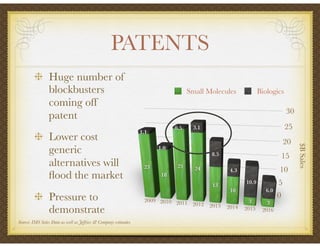
PATENTS
Huge number of
blockbusters
coming off
patent
Lower cost
generic
alternatives will
flood the market
Pressure to
demonstrate
Small Molecules Biologics
Source: IMS Sales Data as well as Jeffries & Company estimates
REAL WORLD
“The conditions under which products are
examined for regulatory approval, are generally not
the conditions under which they are actually
used...” (ISPOR 2010)
Evaluate how the real world impacts the safety and
efficacy of a therapy
Value of the therapy in terms of economics and
outcomes that matter to patients
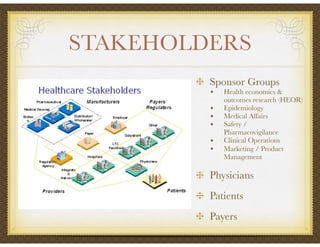
STAKEHOLDERS
Sponsor Groups
• Health economics &
outcomes research (HEOR)
• Epidemiology
• Medical Affairs
• Safety /
Pharmacovigilance
• Clinical Operations
• Marketing / Product
Management
Physicians
Patients
Payers
COMPARATIVE EFFECTIVENESS
RESEARCH (CER)
No standard definition, but general consensus
Comparison of one treatment to one or more other
treatment
Comparison of treatments is not limited to
medications, i.e. outcomes, healthcare utilization,
QoL, etc.
Inclusive of both risks & benefits
REGULATIONS
INTERNATIONAL
REQUIREMENTS
FDA Amendment Act (FDAAA) enacted in
2007, giving significant new powers to the
FDA for inspection & follow-up
Volume 9A of The Rules Governing
Medicincal Products in the European
Union - Guidelines on Pharmacovigilance
for Medical Products for Human use
MIHARI Project in Japan is collected post-
marketing surveillance data from multiple
sources, eg. claims databases, clinical trials,
ADRs, etc.
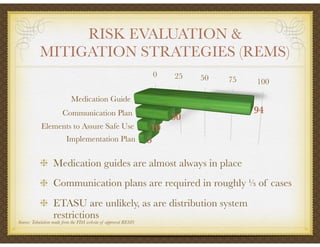
RISK EVALUATION &
MITIGATION STRATEGIES (REMS)
Medication guides are almost always in place
Communication plans are required in roughly ⅓ of cases
ETASU are unlikely, as are distribution system
restrictions
Source: Tabulation made from the FDA website of approved REMS
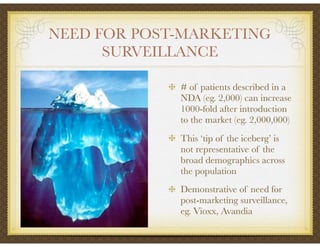
NEED FOR POST-MARKETING
SURVEILLANCE
# of patients described in a
NDA (eg. 2,000) can increase
1000-fold after introduction
to the market (eg. 2,000,000)
This ‘tip of the iceberg’ is
not representative of the
broad demographics across
the population
Demonstrative of need for
post-marketing surveillance,
eg. Vioxx, Avandia
HEALTH
TECHNOLOGY
ASSESSMENT
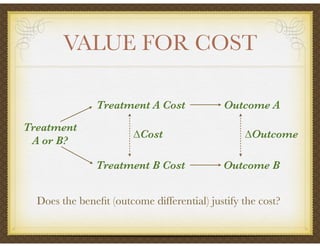
VALUE FOR COST
Treatment
A or B?
Treatment A Cost
Treatment B Cost Outcome B
Outcome A
∆Cost ∆Outcome
Does the benefit (outcome differential) justify the cost?
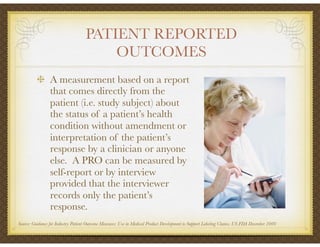
PATIENT REPORTED
OUTCOMES
A measurement based on a report
that comes directly from the
patient (i.e. study subject) about
the status of a patient’s health
condition without amendment or
interpretation of the patient’s
response by a clinician or anyone
else. A PRO can be measured by
self-report or by interview
provided that the interviewer
records only the patient’s
response.
Source: Guidance for Industry Patient Outcome Measures: Use in Medical Product Development to Support Labeling Claims. US FDA December 2009
OUTCOMES
Life expectancy / survival
Relief of symptoms
Improved patient functionality (eg. independence,
ability to work, social activity, exercise, cognition,
etc.)
Better side-effect profile
Convenience / mode of delivery
Health-related quality of life
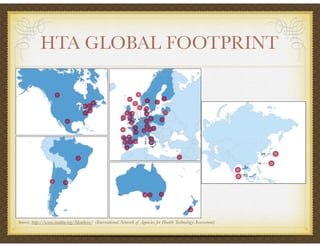
HTA GLOBAL FOOTPRINT
Source: http://www.inahta.org/Members/ (International Network of Agencies for Health Technology Assessment)
NICE
National Institute for Clinical Excellence (UK)
Produces guidance on public health, health
technologies (i.e. pharmaceuticals, interventional
procedures, devices & diagnostics) and clinical practice
Makes recommendations based on clinical efficacy
relative to the cost involved
All activities underpinned by the need for transparency,
collaboration & involvement of stakeholders
http://www.nice.org.uk/
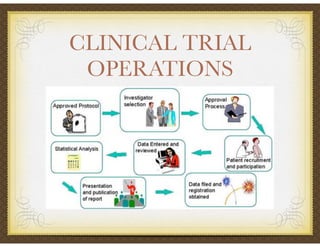
CLINICAL TRIAL
OPERATIONS
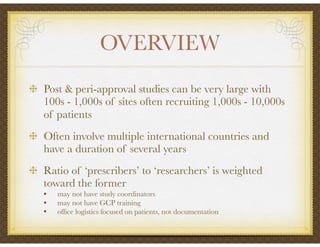
OVERVIEW
Post & peri-approval studies can be very large with
100s - 1,000s of sites often recruiting 1,000s - 10,000s
of patients
Often involve multiple international countries and
have a duration of several years
Ratio of ‘prescribers’ to ‘researchers’ is weighted
toward the former
• may not have study coordinators
• may not have GCP training
• office logistics focused on patients, not documentation
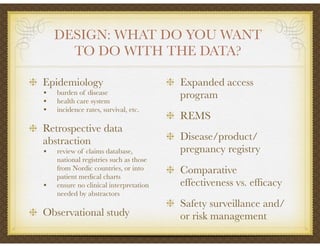
DESIGN: WHAT DO YOU WANT
TO DO WITH THE DATA?
Epidemiology
• burden of disease
• health care system
• incidence rates, survival, etc.
Retrospective data
abstraction
• review of claims database,
national registries such as those
from Nordic countries, or into
patient medical charts
• ensure no clinical interpretation
needed by abstractors
Observational study
Expanded access
program
REMS
Disease/product/
pregnancy registry
Comparative
effectiveness vs. efficacy
Safety surveillance and/
or risk management
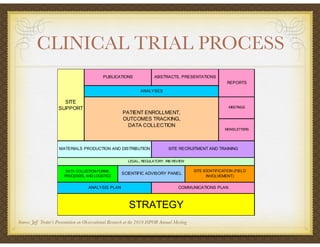
CLINICAL TRIAL PROCESS
tegic"goals"
udy?
"how"the"
ould"be"
al"Studies:"
perational!Plan!from!the!Bottom!Up
REPORTS
PATIENT ENROLLMENT,
OUTCOMES TRACKING,
DATA COLLECTION
SITE
SUPPORT
ANALYSES
PUBLICATIONS ABSTRACTS, PRESENTATIONS
MEETINGS
n"budget"and"ROI
arch"goals?
w"if"you’ve"
?
rics"(impacted"
)
LEGAL, REGULATORY, IRB REVIEW
MATERIALS PRODUCTION AND DISTRIBUTION SITE RECRUITMENT AND TRAINING
NEWSLETTERS
STRATEGY
ANALYSIS PLAN COMMUNICATIONS PLAN
DATA COLLECTION FORMS,
PROCESSES, AND LOGISTICS
SCIENTIFIC ADVISORY PANEL
SITE IDENTIFICATION (FIELD
INVOLVEMENT)
Source: Jeff Trotter’s Presentation on Observational Research at the 2010 ISPOR Annual Meeting
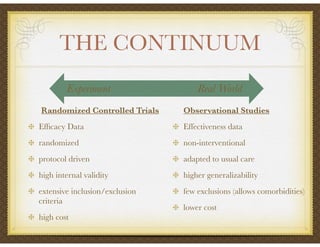
THE CONTINUUM
Randomized Controlled Trials
Efficacy Data
randomized
protocol driven
high internal validity
extensive inclusion/exclusion
criteria
high cost
Observational Studies
Effectiveness data
non-interventional
adapted to usual care
higher generalizability
few exclusions (allows comorbidities)
lower cost
Experiment Real World
STREAMLINED DATA
COLLECTION & CLEANING
Tight focus on collecting only the endpoints specified in the
protocol
• avoid the ‘nice to know’ trap
High utilization of drop-down menus and check boxes, with
little to no free text
Pre-programmed disease and concomitant medication
choices
Data management plan specifying authority to make simple
revisions to data
• edit checks must be simple and few in number
• must be able to deal with missing or incongruous data that is commonplace with PRO
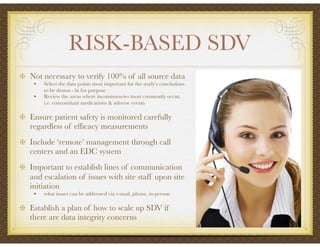
RISK-BASED SDV
Not necessary to verify 100% of all source data
• Select the data points most important for the study’s conclusions
to be drawn - fit for purpose
• Review the areas where inconsistencies most commonly occur,
i.e. concomitant medications & adverse events
Ensure patient safety is monitored carefully
regardless of efficacy measurements
Include ‘remote’ management through call
centers and an EDC system
Important to establish lines of communication
and escalation of issues with site staff upon site
initiation
• what issues can be addressed via e-mail, phone, in-person
Establish a plan of how to scale up SDV if
there are data integrity concerns
MOTIVATION
Consider motivation for both the Investigator and for the
patients to become involved
• there may be no medical benefit for patients to participate, so focus on removing the
barriers to enrollment, i.e. reimburse mileage & parking, hotels for out-of-town
patients, etc.
• collect names of relatives who consent to be contacted if patient is unresponsive
• compensation offered to PIs is generally low so the data collection process must be in
alignment with their clinical practice
Publication can be an attractive possibility for some site staff
Sponsorship of industry symposia and/or memberships
Retention is important in multiple year trials
• vouchers have been used for on-line redemption of various products
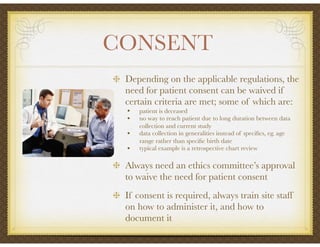
CONSENT	
Depending on the applicable regulations, the
need for patient consent can be waived if
certain criteria are met; some of which are:
• patient is deceased
• no way to reach patient due to long duration between data
collection and current study
• data collection in generalities instead of specifics, eg. age
range rather than specific birth date
• typical example is a retrospective chart review
Always need an ethics committee’s approval
to waive the need for patient consent
If consent is required, always train site staff
on how to administer it, and how to
document it
VENDORS
CONTRACT RESEARCH
ORGANIZATIONS
Very large multinational clinical trial operation
corporations that are growing with preferred
provider relationships in place with large
multinational sponsor organizations
Mid-sized CROs are specializing in niche markets,
i.e. late phase, device, early phase, etc.
Others include central labs, electronic database
providers, call centers, IVRS, packaging/labelling/
distribution,
ELECTRONIC DATA CAPTURE
Validated, 21CFR11-compliant system
Rapid & cost-effective set-up
Library of forms available to minimize
design time & cost
Multi-language capabilities - Asian
characters
eLearning capabilities built-in and
available on demand
Allow for mid-study changes in CRF
for protocol amendments
Real-time report generation, ideally
allowing customized data searches
Connection with EHR (electronic
health records)
THE FUTURE
ACCOUNTABILITY	
Data collection, analysis, interpretation and
publication to be done independently of the sponsor
• Clinical trial management
• Statistical analysis
• DSMB
• Clinical study report
Who takes responsibility; NIH, regulator, HTAs,
AHRQ, IQWiG, others?
Make data available for academia/regulators to
perform meta-analysis
EVOLUTION
Much larger trials incorporating a much broader base of patients,
necessary for market approval?
Sponsors will still fund the research but decision-making to be done
independently?
Full transparency of all exchanges with the sponsor?
Media scrutiny and perhaps sensationalization of results?
PUBLICATION
Is it feasible to publish all clinical trial results funded
by commercial sponsors?
• Not all results are scientifically interesting
• Not all submissions are accepted for publication
• Submissions are expensive and consume sponsor staff time
Establish a standard that commercial sponsors submit
clinical trial results at least xx times?
Post protocols & study data on medical journal
websites
THANK YOU
Email: davidselkirk2000@yahoo.com
LinkedIn: http://ca.linkedin.com/in/davidselkirk

Late Phase Presentation

  • 1.
  • 2.
    David Selkirk 9 yrsworking for large pharma 10 yrs working for mid-size CRO Core skills • executive leadership • operational excellence - late phase focus • business development • international perspective ABOUT THE PRESENTER
  • 3.
  • 4.
  • 5.
    PATENTS Huge number of blockbusters comingoff patent Lower cost generic alternatives will flood the market Pressure to demonstrate Small Molecules Biologics Source: IMS Sales Data as well as Jeffries & Company estimates
  • 6.
    REAL WORLD “The conditionsunder which products are examined for regulatory approval, are generally not the conditions under which they are actually used...” (ISPOR 2010) Evaluate how the real world impacts the safety and efficacy of a therapy Value of the therapy in terms of economics and outcomes that matter to patients
  • 7.
    STAKEHOLDERS Sponsor Groups • Healtheconomics & outcomes research (HEOR) • Epidemiology • Medical Affairs • Safety / Pharmacovigilance • Clinical Operations • Marketing / Product Management Physicians Patients Payers
  • 8.
    COMPARATIVE EFFECTIVENESS RESEARCH (CER) Nostandard definition, but general consensus Comparison of one treatment to one or more other treatment Comparison of treatments is not limited to medications, i.e. outcomes, healthcare utilization, QoL, etc. Inclusive of both risks & benefits
  • 9.
  • 10.
    INTERNATIONAL REQUIREMENTS FDA Amendment Act(FDAAA) enacted in 2007, giving significant new powers to the FDA for inspection & follow-up Volume 9A of The Rules Governing Medicincal Products in the European Union - Guidelines on Pharmacovigilance for Medical Products for Human use MIHARI Project in Japan is collected post- marketing surveillance data from multiple sources, eg. claims databases, clinical trials, ADRs, etc.
  • 11.
    RISK EVALUATION & MITIGATIONSTRATEGIES (REMS) Medication guides are almost always in place Communication plans are required in roughly ⅓ of cases ETASU are unlikely, as are distribution system restrictions Source: Tabulation made from the FDA website of approved REMS
  • 12.
    NEED FOR POST-MARKETING SURVEILLANCE #of patients described in a NDA (eg. 2,000) can increase 1000-fold after introduction to the market (eg. 2,000,000) This ‘tip of the iceberg’ is not representative of the broad demographics across the population Demonstrative of need for post-marketing surveillance, eg. Vioxx, Avandia
  • 13.
  • 14.
    VALUE FOR COST Treatment Aor B? Treatment A Cost Treatment B Cost Outcome B Outcome A ∆Cost ∆Outcome Does the benefit (outcome differential) justify the cost?
  • 15.
    PATIENT REPORTED OUTCOMES A measurementbased on a report that comes directly from the patient (i.e. study subject) about the status of a patient’s health condition without amendment or interpretation of the patient’s response by a clinician or anyone else. A PRO can be measured by self-report or by interview provided that the interviewer records only the patient’s response. Source: Guidance for Industry Patient Outcome Measures: Use in Medical Product Development to Support Labeling Claims. US FDA December 2009
  • 16.
    OUTCOMES Life expectancy /survival Relief of symptoms Improved patient functionality (eg. independence, ability to work, social activity, exercise, cognition, etc.) Better side-effect profile Convenience / mode of delivery Health-related quality of life
  • 17.
    HTA GLOBAL FOOTPRINT Source:http://www.inahta.org/Members/ (International Network of Agencies for Health Technology Assessment)
  • 18.
    NICE National Institute forClinical Excellence (UK) Produces guidance on public health, health technologies (i.e. pharmaceuticals, interventional procedures, devices & diagnostics) and clinical practice Makes recommendations based on clinical efficacy relative to the cost involved All activities underpinned by the need for transparency, collaboration & involvement of stakeholders http://www.nice.org.uk/
  • 19.
  • 20.
    OVERVIEW Post & peri-approvalstudies can be very large with 100s - 1,000s of sites often recruiting 1,000s - 10,000s of patients Often involve multiple international countries and have a duration of several years Ratio of ‘prescribers’ to ‘researchers’ is weighted toward the former • may not have study coordinators • may not have GCP training • office logistics focused on patients, not documentation
  • 21.
    DESIGN: WHAT DOYOU WANT TO DO WITH THE DATA? Epidemiology • burden of disease • health care system • incidence rates, survival, etc. Retrospective data abstraction • review of claims database, national registries such as those from Nordic countries, or into patient medical charts • ensure no clinical interpretation needed by abstractors Observational study Expanded access program REMS Disease/product/ pregnancy registry Comparative effectiveness vs. efficacy Safety surveillance and/ or risk management
  • 22.
    CLINICAL TRIAL PROCESS tegic"goals" udy? "how"the" ould"be" al"Studies:" perational!Plan!from!the!Bottom!Up REPORTS PATIENTENROLLMENT, OUTCOMES TRACKING, DATA COLLECTION SITE SUPPORT ANALYSES PUBLICATIONS ABSTRACTS, PRESENTATIONS MEETINGS n"budget"and"ROI arch"goals? w"if"you’ve" ? rics"(impacted" ) LEGAL, REGULATORY, IRB REVIEW MATERIALS PRODUCTION AND DISTRIBUTION SITE RECRUITMENT AND TRAINING NEWSLETTERS STRATEGY ANALYSIS PLAN COMMUNICATIONS PLAN DATA COLLECTION FORMS, PROCESSES, AND LOGISTICS SCIENTIFIC ADVISORY PANEL SITE IDENTIFICATION (FIELD INVOLVEMENT) Source: Jeff Trotter’s Presentation on Observational Research at the 2010 ISPOR Annual Meeting
  • 23.
    THE CONTINUUM Randomized ControlledTrials Efficacy Data randomized protocol driven high internal validity extensive inclusion/exclusion criteria high cost Observational Studies Effectiveness data non-interventional adapted to usual care higher generalizability few exclusions (allows comorbidities) lower cost Experiment Real World
  • 24.
    STREAMLINED DATA COLLECTION &CLEANING Tight focus on collecting only the endpoints specified in the protocol • avoid the ‘nice to know’ trap High utilization of drop-down menus and check boxes, with little to no free text Pre-programmed disease and concomitant medication choices Data management plan specifying authority to make simple revisions to data • edit checks must be simple and few in number • must be able to deal with missing or incongruous data that is commonplace with PRO
  • 25.
    RISK-BASED SDV Not necessaryto verify 100% of all source data • Select the data points most important for the study’s conclusions to be drawn - fit for purpose • Review the areas where inconsistencies most commonly occur, i.e. concomitant medications & adverse events Ensure patient safety is monitored carefully regardless of efficacy measurements Include ‘remote’ management through call centers and an EDC system Important to establish lines of communication and escalation of issues with site staff upon site initiation • what issues can be addressed via e-mail, phone, in-person Establish a plan of how to scale up SDV if there are data integrity concerns
  • 26.
    MOTIVATION Consider motivation forboth the Investigator and for the patients to become involved • there may be no medical benefit for patients to participate, so focus on removing the barriers to enrollment, i.e. reimburse mileage & parking, hotels for out-of-town patients, etc. • collect names of relatives who consent to be contacted if patient is unresponsive • compensation offered to PIs is generally low so the data collection process must be in alignment with their clinical practice Publication can be an attractive possibility for some site staff Sponsorship of industry symposia and/or memberships Retention is important in multiple year trials • vouchers have been used for on-line redemption of various products
  • 27.
    CONSENT Depending on theapplicable regulations, the need for patient consent can be waived if certain criteria are met; some of which are: • patient is deceased • no way to reach patient due to long duration between data collection and current study • data collection in generalities instead of specifics, eg. age range rather than specific birth date • typical example is a retrospective chart review Always need an ethics committee’s approval to waive the need for patient consent If consent is required, always train site staff on how to administer it, and how to document it
  • 28.
  • 29.
    CONTRACT RESEARCH ORGANIZATIONS Very largemultinational clinical trial operation corporations that are growing with preferred provider relationships in place with large multinational sponsor organizations Mid-sized CROs are specializing in niche markets, i.e. late phase, device, early phase, etc. Others include central labs, electronic database providers, call centers, IVRS, packaging/labelling/ distribution,
  • 30.
    ELECTRONIC DATA CAPTURE Validated,21CFR11-compliant system Rapid & cost-effective set-up Library of forms available to minimize design time & cost Multi-language capabilities - Asian characters eLearning capabilities built-in and available on demand Allow for mid-study changes in CRF for protocol amendments Real-time report generation, ideally allowing customized data searches Connection with EHR (electronic health records)
  • 31.
  • 32.
    ACCOUNTABILITY Data collection, analysis,interpretation and publication to be done independently of the sponsor • Clinical trial management • Statistical analysis • DSMB • Clinical study report Who takes responsibility; NIH, regulator, HTAs, AHRQ, IQWiG, others? Make data available for academia/regulators to perform meta-analysis
  • 33.
    EVOLUTION Much larger trialsincorporating a much broader base of patients, necessary for market approval? Sponsors will still fund the research but decision-making to be done independently? Full transparency of all exchanges with the sponsor? Media scrutiny and perhaps sensationalization of results?
  • 34.
    PUBLICATION Is it feasibleto publish all clinical trial results funded by commercial sponsors? • Not all results are scientifically interesting • Not all submissions are accepted for publication • Submissions are expensive and consume sponsor staff time Establish a standard that commercial sponsors submit clinical trial results at least xx times? Post protocols & study data on medical journal websites
  • 35.
    THANK YOU Email: davidselkirk2000@yahoo.com LinkedIn:http://ca.linkedin.com/in/davidselkirk