Blog resource: http://tinyurl.com/l363hk                      Click4Biology: http://click4biology.info/c4b/10/gene10.htm <br />Cite all sources using the CSE method (or ISO 690 Numerical in Word. Highlight all objective 1 command terms in yellow and complete these before class. Highlight all objective 2 and 3 command terms in green – these will be part of the discussions in class. After class, go back and review them. <br />Complete the self-assessment rubric before submitting to Moodle. Avoid printing this if possible. <br />Define polygenic inheritance.
Distinguish between polygenic inheritance and multiple alleles.
List one human and one plant example of polygenic inheritance.

Essential Biology 10.3 Polygenic Inhertance (AHL)

  • 1.
    Blog resource: http://tinyurl.com/l363hk Click4Biology: http://click4biology.info/c4b/10/gene10.htm <br />Cite all sources using the CSE method (or ISO 690 Numerical in Word. Highlight all objective 1 command terms in yellow and complete these before class. Highlight all objective 2 and 3 command terms in green – these will be part of the discussions in class. After class, go back and review them. <br />Complete the self-assessment rubric before submitting to Moodle. Avoid printing this if possible. <br />Define polygenic inheritance.
  • 2.
    Distinguish between polygenicinheritance and multiple alleles.
  • 3.
  • 4.
    List one humanand one plant example of polygenic inheritance.
  • 5.
  • 6.
    Polygenic inheritance givesrise to continuous variation within a population.
  • 7.
    Explain what thismeans, using skin colour as an example.
  • 8.
  • 9.
  • 10.
  • 11.
  • 12.
    Assume that twogenes (A and B) are responsible for inheritance of skin colour, with two alleles each and that they are unlinked. The dominant alleles code for melanin production.
  • 13.
    Calculate the numberof possible genotypes.
  • 14.
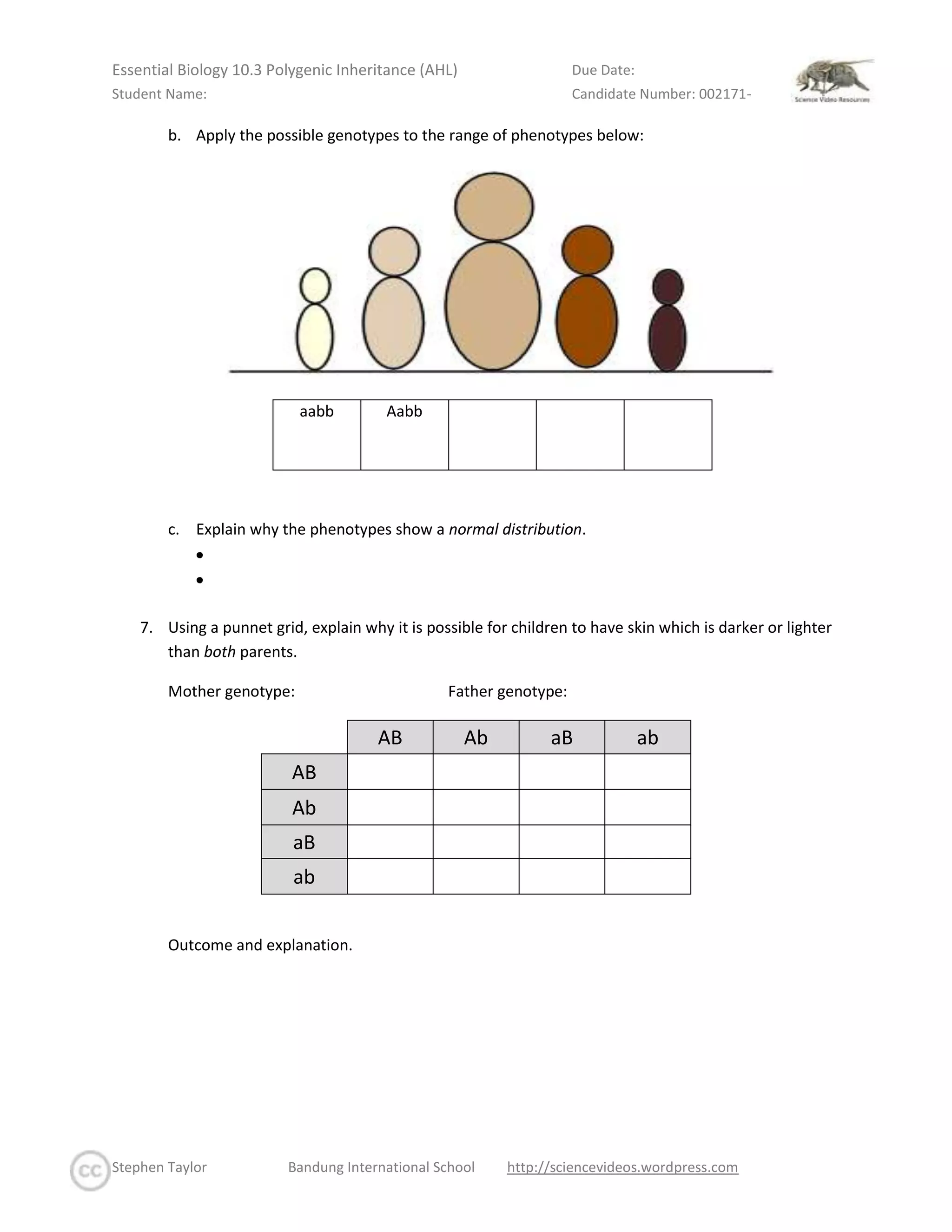
    Apply the possiblegenotypes to the range of phenotypes below:
  • 15.
  • 16.
  • 17.
  • 18.
  • 19.
    Explain why thephenotypes show a normal distribution.
  • 20.
  • 21.
  • 22.
    Using a punnetgrid, explain why it is possible for children to have skin which is darker or lighter than both parents. Mother genotype:Father genotype:<br />ABAbaBabABAbaBabOutcome and explanation. <br />Compare the advantages and disadvantages of light and dark skin.
  • 23.
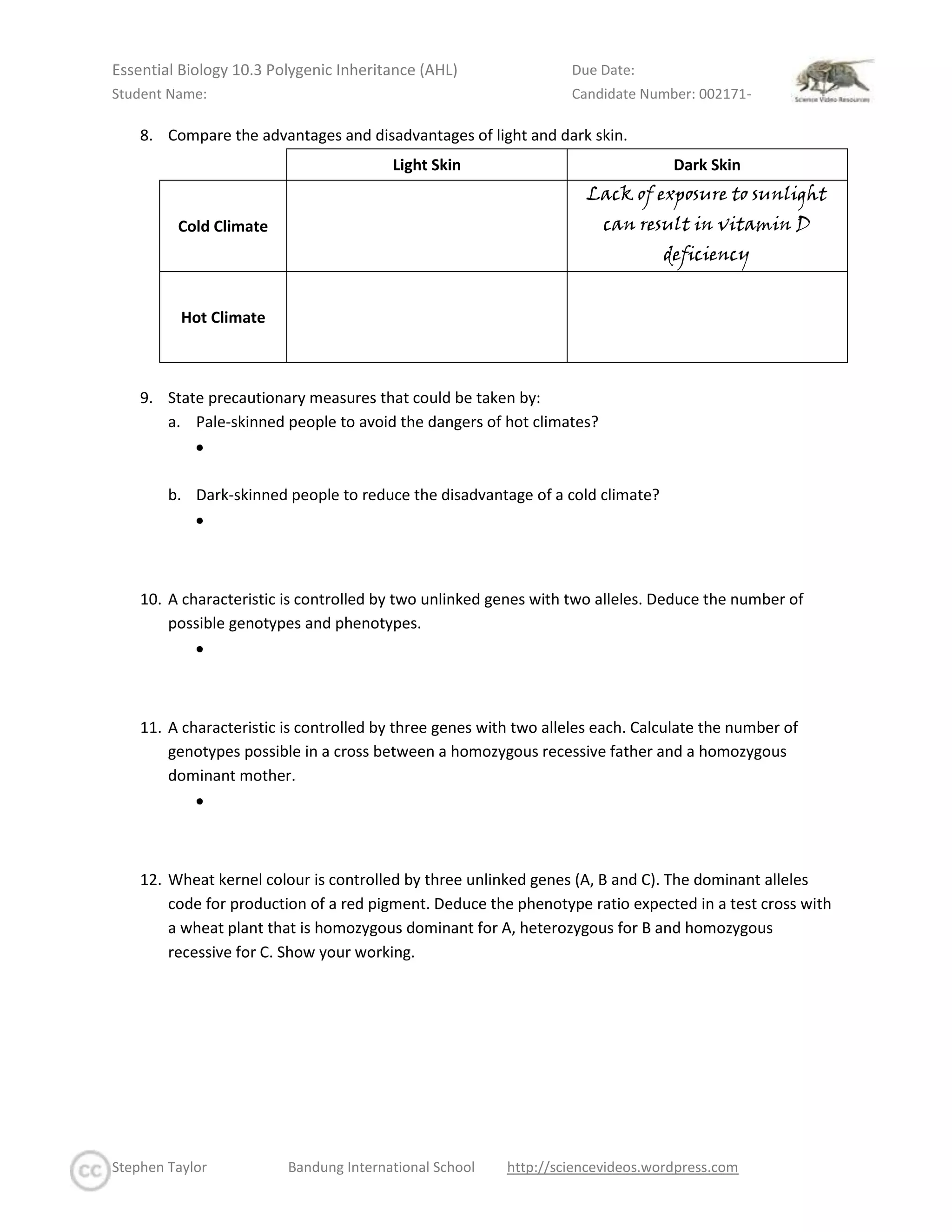
    Light SkinDark SkinColdClimateLack of exposure to sunlight can result in vitamin D deficiencyHot Climate
  • 24.
    State precautionary measuresthat could be taken by:
  • 25.
    Pale-skinned people toavoid the dangers of hot climates?
  • 26.
  • 27.
    Dark-skinned people toreduce the disadvantage of a cold climate?
  • 28.
    A characteristic iscontrolled by two unlinked genes with two alleles. Deduce the number of possible genotypes and phenotypes.
  • 29.
    A characteristic iscontrolled by three genes with two alleles each. Calculate the number of genotypes possible in a cross between a homozygous recessive father and a homozygous dominant mother.
  • 30.
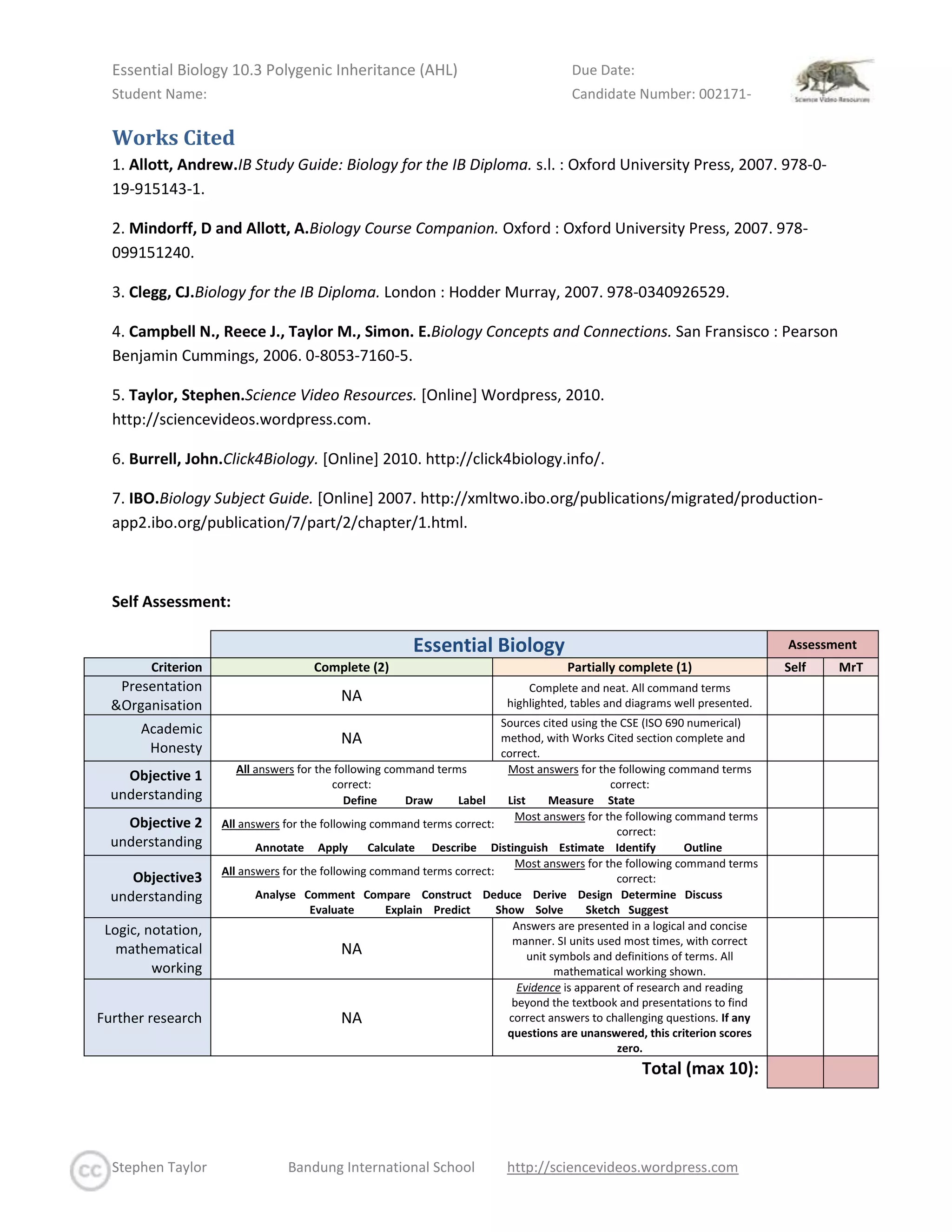
    Wheat kernel colouris controlled by three unlinked genes (A, B and C). The dominant alleles code for production of a red pigment. Deduce the phenotype ratio expected in a test cross with a wheat plant that is homozygous dominant for A, heterozygous for B and homozygous recessive for C. Show your working. Works Cited BIBLIOGRAPHY 1. Allott, Andrew. IB Study Guide: Biology for the IB Diploma. s.l. : Oxford University Press, 2007. 978-0-19-915143-1.2. Mindorff, D and Allott, A. Biology Course Companion. Oxford : Oxford University Press, 2007. 978-099151240.3. Clegg, CJ. Biology for the IB Diploma. London : Hodder Murray, 2007. 978-0340926529.4. Campbell N., Reece J., Taylor M., Simon. E. Biology Concepts and Connections. San Fransisco : Pearson Benjamin Cummings, 2006. 0-8053-7160-5.5. Taylor, Stephen. Science Video Resources. [Online] Wordpress, 2010. http://sciencevideos.wordpress.com.6. Burrell, John. Click4Biology. [Online] 2010. http://click4biology.info/.7. IBO. Biology Subject Guide. [Online] 2007. http://xmltwo.ibo.org/publications/migrated/production-app2.ibo.org/publication/7/part/2/chapter/1.html.<br />Self Assessment:<br />Essential BiologyAssessmentCriterionComplete (2)Partially complete (1)SelfMrTPresentation & OrganisationNAComplete and neat. All command terms highlighted, tables and diagrams well presented. Academic HonestyNASources cited using the CSE (ISO 690 numerical) method, with Works Cited section complete and correct. Objective 1 understandingAll answers for the following command terms correct:Most answers for the following command terms correct:Define Draw Label List Measure StateObjective 2 understandingAll answers for the following command terms correct:Most answers for the following command terms correct:Annotate Apply Calculate Describe Distinguish Estimate Identify OutlineObjective3understandingAll answers for the following command terms correct:Most answers for the following command terms correct:Analyse Comment Compare Construct Deduce Derive Design Determine DiscussEvaluate Explain Predict Show Solve Sketch SuggestLogic, notation, mathematical workingNAAnswers are presented in a logical and concise manner. SI units used most times, with correct unit symbols and definitions of terms. All mathematical working shown.Further researchNAEvidence is apparent of research and reading beyond the textbook and presentations to find correct answers to challenging questions. If any questions are unanswered, this criterion scores zero. Total (max 10):<br />