The origins of ESP
1 The origins of ESP This development was accelerated by the Oil Crises of the early 1970s,
which resulted in a massive flow of funds and Western expertise into
the oil-rich countries. English suddenly beca me big business and
commercial pressures began to exert an influence. Time and money
constraints created a need for cost-effective courses with clearly defined
goals.
The general effect of all this development was to exert pressure on
the language teaching profession to deliver the required goods. Whereas
English had previously decided its own destiny, it now became subject
to the wishes, needs and demands of people other than language
teachers. English had become accountable to the scrutiny of the wider
world and the traditional leisurely and purpose-free stroll through the
landscape of the English language seemed no longer appropriate in the
harsher realities of the market place.
We will now discuss in a little more detail the struggle for
existence.
(Charles Darwin: The Origin ofSpecies)
As with most developments in human activity, ESP was not a planned
and coherent movement, but rather a phenomenon that grew out of a
number of converging trends. These trends have operated in a variety
of ways around the world, but we can identify three main reasons
common to the emergence of all ESP. 2 A revolution in linguistics
1 The demands of a Brave New World At the same time as the demand was growing for English courses tailored
to specific needs, influential new ideas began to emerge in the study of
language. Traditionally the aim of linguistics had been to describe rhe
rules of English usage, that is, the grammar. However the new studies
shifted attention away from defining the formal features of language
usage to discovering the ways in which language is actually used in real
communication (Widdowson, 1978). One finding of this research was
that the language we speak and write varies considerably, and in a
number of different ways, from one context to another. In English
I~nguage teaching this gave rise to the view that there are important
dlfferen.ces between, say, the English of commerce and that of engineering.
These Ideas married up naturally with the development of English
cou.rses for specific groups of learners. The idea was simple: if language
vanes ~rom one situation of use to another, it should be possible to
determine the features of specific situations and then make these features
the basis of the learners' course.
~w~les (1985) presents an article by C. L. Barber on the nature of
SClentlfic English which was published as early as 1962. But it was the
~ate 1960s and early 1970S which saw the greatest expansion of research
l~tO the nature of particular varieties of English - for example, descrip-
tions of written scientific and technical English by Ewer and Latorre
(1969), Swales (1971), Selinker and Trimble (1976) and others. Most of
the work at this time was in the area of English for Science and
T echnology (EST) and for a time ESP and EST were regarded as almost
synonymous. But there were studies in other fields too, such as the
The end of the Second World War in 1945 heralded an age of enormous
and unprecedented expansion in scientific, technical and economic
activity on an international scale. This expansion created a world unified
and dominated by two forces - technology and commerce - which in
their relentless progress soon generated a demand for an international
language. For various reasons, most notably the economic power of the
United States in the post-war world, this role fell to English.
The effect was to create a whole new mass of people wanting to learn
English, not for the pleasure or prestige of knowing the language, but
beca use English was the key to the international currencies of technology
and commerce. Previously the reasons for learning English (or any other
language) had not been well defined. A knowledge of a foreign language
had been gene rally regarded as a sign of a well-rounded education, but
few had really questioned why it was necessary. Learning a language
was, so to speak, its own justification. But as English beca me the
accepted internationallanguage of technology and commerce, it created
a new generation of learners who knew specifically why they were
learning a language - businessmen and -women who wanted to sell their
products, mechanics who had to read instruction manuals, doctors who
needed to keep up with developments in their field and a whole range of
students whose course of study included textbooks and journals only
available in English. All these and many others needed English and, most
importantly, they knew why they needed it.
6
What is ESP?
analysis of doctor-patient communication by andlin, Bruton and
Learher (1976).
In short, the view gained ground that the nglish needed by a
particular group of learners could be identified by analysing the
linguistic characteristics of their specialist area of work or study. 'Tell
me what you need English for and I will tell you the English that you
need' beca me the guiding principie of ESP.
2 The development of ESP
3 Focus on the learner
The best laid schemes o' mice and men
Gang aft a-gley.
New developments in educational psychology also contributed to the
rise of ESP, by emphasising the central importance of the learners and
their attitudes to learning (e.g. Rodgers, 1969). Learners were seen to
have different needs and interests, which would have an importanr
influence on their motivation to learn and therefore on the effectiveness
of their learning. This lent support to the development of courses in
which 'relevance' to the learners' needs and interests was paramount.
The standard way of achieving this was to take texts from the learners'
specialist area - texts about Biology for Biology students etc. The
.assumption underlying this approach was that the c1ear relevance of the
English course to their needs would improve the learners' motivation
and thereby make learning better and faster.
(Robert Burns)
The growth of ESP, then, was brought about by a combination of three
important factors: the expansion of demand for English to suit particular
needs and developments in the fields of linguistics and educational
psychology. All three factors seemed to point towards the need for
increased specialisation in language learning.
From its early beginnings in the 1960s ESP has undergone three main
phases of development. Ir is now in a fourth phase with a fi.fth phase
starting to emerge. We shall describe each of the five phases In greater
detail in later chapters, but it will provide a useful perspective to give
a brief summary here. Ir should be pointed out first of all that ESP is
not a monolithic universal phenomenon. ESP has developed at different
speeds in different countries, and examples of all the approaches we shall
describe can be found operating somewhere in the world at the present
time. Our summary must, therefore, be very general in its focus.
Ir will be noticeable in the following overview that one area of activity
has been particularly important in the development of ESP. This is the
area usually known as EST (English for Science and Technology). Swales
(1985) in fact uses the development of EST to illustrate the development
of ESP in general:
'With one or two exceptions ... English for Scienceand Technology has always
serand continues to set the trend in theoretical discussion, in ways of analysing
language, and in the variety of actual teaching materials.'
We have not restricted our own illustrations to EST in this book, but
we still need to acknowledge, as Swales does, the pre-eminent position
of EST in the ESP story.
Tasks
1 Why was ESP introduced in your country or teaching institution?
What kinds of ESP are taught?
2 'Tell me what you need English for and I will tell you the English
that you need' (p. 8). How justifiable do you think this c1aim is for
ESP?
1 The concept of speciallanguage: register analysis
This stage took place mainly in the 1960s and early 1970S and was
associated in particular with the work of Peter Strevens (Halliday,
McIntosh and Strevens, 1964), Jack Ewer (Ewer and Latorre, 1969) and
john Swales (1971). Operating on the basic principie that the English
of, say, Electrical Engineering constituted a specific register different
from that of, say, Biology or of General English, the aim of the analysis
3 'The c1ear relevance of the English cour e to their needs would
improve the learners' motivation and thereby make learning better
and faster' (p. 8).
a) Give three ways in which 'relevance' can b achieved.
b) In what ways can motivation affect langu g learning?
8 9
What is ESP? The development of ESP
was to identify the grammatical and lexical features of these registers.
Teaching materials then took these linguistic features as their syllabus.
A good example of such a syllabus is that of A Course in Basic Scientific
English by Ewer and Latorre (1969) (see below p. 26).
In fact, as Ewer and Latorre's syllabus shows, register analysis
revealed that there was very little that was distinctive in the seotence
grammar of Scientific English beyond a tendency to favour particular
forms such as the present simple tense, the passive voice and nominal
compounds. lt did not, for example, reveal any forms that were nor
found in General English. But we must be wary of making unfair
criticismo Although there was an academic interest in the nature of
registers of English per se, the main motive behind register analyses such
as Ewer and Latorre's was the pedagogic one of making the ESP course
more relevant to learners' needs. The aim was to produce a syllabus
which gave high priority ro the language forms students would meet in
their Science studies and in turn would give low priority to forms they
would not meet. Ewer and Hughes-Davies (1971), forexample, compared
the language of the texts their Science students had to read with rhe
language of some widely used school textbooks. They found thar the
school textbooks neglected some of the language forms commonly found
in Science texts, for example, compound nouns, passives, conditionals,
anomalous finites (i.e. modal verbs). Their conclusion was that the ESP
course should, therefore, give precedence to these forms.
sentences, but only by one which develops a knowledge of how sentences are
used in rhe performance of different communicative acts.'
Register analysis had focussed on sentence grammar, but now attention
shifted to understanding how sentences were combined in discourse to
produce mea?ing. The con~ern of research, th~refore, ~as .to. identify
rhe organisatlOnal patterns m texts and to specify the linguistic means
by which these patterns are signaIled. These patterns would then form
the syIlabus of the ESP course. The Rhetorical Process Chart below (from
EST: A Discourse Approach by Louis Trimble (1985)) is representa tive
of this approach:
Level Description of level
A. The objectives of the total discourse
EXAMPLES: 1. Detailing an experiment
2. Making a recommendation
3. Presenting new hypotheses or theory
4. Presenting other types 01EST inlormation
B. The general rhetorical functions that develop the objectives of
LevelA
EXAMPLES: 1. Stating purpose
2. Reporting past research
3. Stating the problem
4. Presenting inlormation on apparatus used in
an experiment -
a) Description
b) Operation
5. Presenting inlormation on experimental
procedures2 Beyond the sentence: rhetorical or discourse
analysis C. The specific rhetorical functions that develop the general
rhetorical functions of Level B
EXAMPLES: 1. Description: physical, lunction, and process
2. Delinition
3. Classilication
4. Instructions
5. Visual-verbal relationships
There were, as we shaIl see, serious flaws in the register analysis-based
syIlabus, but, as it happened, register analysis as a research procedure
was rapidly overtaken by developments in the world of linguistics.
Whereas in the first stage of its development, ESP had focussed on
language at the sentence level, the second phase of development shifted
attention to the level above the sentence, as ESP became closely involved
with the emerging field of discourse or rhetorical analysis. The leading
lights in this movement were Henry Widdowson in Britain and the
so-called Washington School of Larry Selinker, Louis Trimble, John
Lackstrom and Mary Todd-Trimble in the United States.
The basic hypothesis of this stage is succinctly expressed by Allen and
Widdowson (1974):
D. The rhetorical techniques that pro vide relationships within and
between the rhetorical units of Level C
EXAMPLES: 1. Orders
1. Time order
2. Space order
3. Causality and result
11. Pat1ems
1. Causality and result
2. Order 01importance
3. Comparison and contrast
4. Analogy
5. Exemplilication
6. IIlustration
'We take the view that the difficulties which the students encounter arise nor so
much frorn a defective knowledge of the system of English, but from an
unfamiliarity with English use, and that consequently their needs cannot be
met by a course which simply pravides further practice in the composition of Figure 2: Rhetorical Process Chart
10
11
What is ESP? The deuelopment of ESP
As in stage 1 there was a more or less tacit assumption in this approach
that the rhetorical patterns of text organisation differed significantly
between specialist areas of use: the rhetorical structure of science texts
was regarded as different from that of commercial texts, for example.
However, this point was never very clearly examined (see Swales, 1985,
pp. 70-1) and indeed paradoxically, the results of the research into the
discourse of subject-specific academic texts were also used to make
observations about discourse in general (Widdowson, 1978).
The typical teaching materials based on the discourse approach taught
students to recognise textual patterns and discourse markers mainly by
means of text-diagramming exercises (see below p. 36). The English in
Focus series (OUP) is a good example of this approach.
4 Skills and strategies
We noted that in the first two stages of the development of ESP all the
analysis had been of the surface forms of the language (whether at
sentence level, as in register analysis, or above, as in discourse analysis).
The target situation analysis approach did not really change this,
because in its analysis of learner need it stilllooked mainly at the surface
linguistic features of the target situation.
The fourth stage of ESP has seen an attempt to look below the surface
and to consider not the language itself but the thinking processes that
underlie language use. There is no dominant figure in this movement,
although we might mention the work of Francoise Grellet (1981),
Christine Nuttall (1982) and Charles Alderson and Sandy Urquhart
(1984) as having made significant contributions to work on reading
skills. Most of the work in the area of skills and strategies, however,
has been done close to the ground in schemes such as the National ESP
Project in Brazil (see below p. 172) and the University of Malaya ESP
Project (see ELT Documents 107 and Skills [or Learning published by
Nelson and the University of Malaya Press).
Both these projects were set up to cope with study situations where
the medium of instruction is the mother tongue but students need to read
a number of specialist texts which are available only in English. The
projects have, therefore, concentrated their efforts on reading
strategies. *
The principal idea behind the skills-centred approach is that underlying
alllanguage use there are common reasoning and interpreting processes,
which, regardless of the surface forms, enable us to extract meaning from
discourse. There is, therefore, no need to focus closely on the surface
forms of the language. The focus should rather be on the underlying
interpretive strategies, which enable the learner to cope with the surface
forms, for example guessing the meaning of words from context, using
visual layout to determine the type of text, exploiting cognates (i.e.
words which are similar in the mother tongue and the target language)
etc, A focus on specific subject registers is unnecessary in this approach,
beca use the underlying processes are not specific to any subject register.
'It was argued that reading ski lis are not language-specific but universal and
that there is a core of language (for example, certain structures of argument
~nd forms of presentation) which can be identified as "academic" and which
IS nor subject-specific.' (Chitravelu, 1980)
3 Target situation analysis
The stage that we come ro consider now did not really add anything
new to the range of knowledge about ESP. What it aimed to do was to
take the existing knowledge and set it on a more scientific basis, by
establishing procedures for relating language analysis more closely to
learners' reasons for learning. Given that the purpose of an ESP course
is to enable learners to function adequately in a target situation, that
is, the situation in which the learners will use the language they are
learning, then the ESP course design process should proceed by first
identifying the target situation and then carrying out a rigorous analysis
of the linguistic features of that situation. The identified features will
form the syllabus of the ESP course. This process is usually known as
needs analysis. However, we prefer to take Chambers' (1980) term of
'target situation analysis', since it is a more accurate description of the
process concerned.
The most thorough explanation of target situation analysis is the
system set out by John Munby in Communicatiue Syllabus Design
(1978). The Munby model produces a detailed profile of the learners'
needs in terms of communication purposes, communicative setting, the
means of communication, language skills, functions, structures etc. (see
below p. 55)·
The target situation analysis stage marked a certain 'coming of age'
for ESP. What had previously been done very much in a piecemeal way,
was now systematised and learner need was apparently placed at the
centre of the course design process. It proved in the event to be a false
dawn. As we shall see in the following chapters, the concept of needs
that it was based on was far too simple.
• It is .inreresring ro note, however, rhar not all such projecrs have such a focus. The ESP project
ar King Mongkut's lnsrirure of Technology in Bangkok, Thailand, for example, has ro cope with
a very similar srudy siruarion, bur rhe focus here is on rhe full range of skills (reading, writing,
hstening, speaking).
12 13
What is ESP? The deuelopment of ESP
As has been noted, in terms of materials this approach generally puts
the emphasis on reading or listening strategies. The characteristic
exercises get the learners to reflect on and analyse how meaning is
produced in and retrieved from written or spoken discourse. T aking
their cue from cognitive learning theories (see below p. 43), rhe language
learners are treated as thinking beings who can be asked to observe and
verbalise the interpretive processes they employ in language use.
4 An information leaflet about the Brazilian ESP Project summarises its
aims as follows :
5 A learning-centred approach
"The "specific purpose" most common within the participant universities is
rhe reading of specialist literature in English. Consequently there is a
consensus within the project to focus on the teaching of reading strategies
with the use of authentic materials and the use of the native language in
spoken classroom discourse. The teaching of grammar is based on the
minimum necessary for understanding academic texts. The emphasis is
largely on a general course content to cover common problems (such as
reading strategies), rather than specific courses according to the student's
subject specialism (e.g. "English for Engineers ").'
a) Why do you think this approach has been adopted?
b) Do you think that the approach is a justifiable response to the needs
of the students ?
e) How do you think students and teachers will react to this
approach?
In outlining the origins ofESP (pp. 6-8), we identified three forces, which
we might characterise as need, new ideas about language and new ideas
about learning. It should have become clear that in its subsequent
development, however, scant attention has been paid to the last of these
forces -Iearning. All of the stages outlined so far have been funda-
mentally flawed, in that they are all based on descriptions of language
use. Whether this description is of surface forms, as in the case of register
analysis, or of underlying processes, as in the skills and strategies
approach, the concern in each case is with describing what people do
with language. But our concern in ESP is not with language use - although
this will help to define the course objectives. Our concern is with
language Learning. We cannot simply assume that describing and
exemplifying what people do with language will enable someone to learn
it. If that were so, we would need to do no more than read a grammar
book and a dictionary in order to learn a language. A truly val id
approach to ESP must be based on an understanding of the processes
of language Learning.
This brings us to the fifth stage of ESP development - the learning-
centred approach, which will form the subject of this book. The
importance and the implications of the distinction that we have made
between language use and language Learning will hopefully become clear
as we proceed through the following chapters.
Tasks
1 Which of the stages outlined above has your country experienced ? Has
it developed in a completely different way?
2 Why do you think EST has set the trends in the development of ESP?
3 How far would you agree with Widdowson and Allen's assertion
(pp. IO-Il) ?
15
ESP: approach not product
3 ESP: approach not product Eng/i:5h»»EngLish English for Eng/ish for Eng/¡5h ~gLhi~hta:
g~(~Jk7e~ffl¡¡l)JlélJiane5 ~(t ~vEnglt:;h for VI! /;- CAP Coceee.s  EOP
E¡ffj;!J[ AI(~'t~5eSEAV/ ~~~,,~t~ E¡AP ¡1'
PUrp05e5 ) ¡ V EOP 15 clso known 0.5 1
,(EAP) Engli.5hlbr E.VP(~n9li5hfor l
 x Busmes5. ond ~~o.t~~;'tl~:~~al EngLish lar
En t h lo Econorn/cs En9lish Cl5 Q. SoCIO¿ oC/ences
S
.'9/5 ,_~ ~Bé) Se.c.ond. Lo.n3va.,ge..). 'ÉSS)
aence ara l' ~ 1" {'.J.
7eclmolog!l , ApUL
(EST) I 7trttary
-. Eng/¡jh for seCOndar.!l~~
~ ~ Speclfic ¿:::; (tJS:H¡gh :5chool.)
Purposes . lL ~primQry /y
(ESP) 1,fud~e~5f~r~I /~
exo.mpurpo5es.~./
~ ~ V qeneraL
VaI'tOu5 brancht!s English E5L can be
M~~
~ (qE) d¡"tded in
:& / bhe ecrne w~
~ Eng(ish as a a.s E F L -¿-
rorelgn Languoge ~
'other 70ngue r ng.t 05 a
(EMT) ~ Second Language
~ ~ ~(E5L)
~ Enoli:Jh Lr;mguage ~
~~~ ~7eaChlrrn9 .(ELT~ In Amer~can ELT
l' the domlnant
j.. branch b E.5L
LOflJ.uOfe 7eaChÚlJ'
)/' (~
1B~~YlT~WN
17
Beware that you do not lose the substance by grasping at the
shadow.
(Aesop: 'The Fable of rhe Dog and rhe Shadow ')
The survey above shows that in its relatively brief history there have been
several major shifts in the development of ESP both in theory and
practice. However, we have tried to show that, in spite of their
differences, the successive stages have all concentrated on the linguistic
aspect of ESP: they are all essentially language-centred approaches. In
later chapters we shalllook in greater detail at how this has shaped the
way in which people see ESP. For now let us return to the question posed
at the beginning of this section: 'What is ESP ?' T o answer this question
fully, we need first of all to establish a context which will help us to see
how ESP at the present time relates to the rest of ELT. What exactly
is the status of the citizens of ESP and its satellite settlements in relation
to the general world of ELT ?
In the tirne-honoured manner of linguistics, we shall represent the
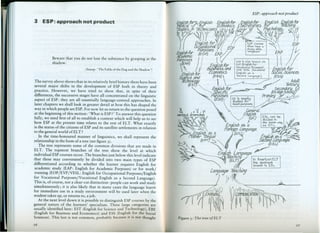
relationship in the form of a tree (see figure 3).
The tree represents some of the common divisions that are made in
ELT. The topmost branches of the tree show the level at which
individual ESP courses occur. The branches just below rhis level indicate
that these may conveniently be divided into two main types of ESP
differentiated according to wherher the learner requires English for
academic study (EAP: English for Academic Purposes) or for workj
training (EOP jEVP jVESL: English for Occupational PurposesjEnglish
for Vocational PurposesjVocational English as a Second Language).
This is, of course, not a clear-cut distinction: people can work and study
simultaneously; it is also likely that in many cases the language learnt
for immediate use in a study environment will be used later when the
student takes up, or returns to, a job.
At the next level down it is possible to distinguish ESP courses by the
general nature of the learners' specialism. Three large categories are
usually identified here: EST (English for Science and Technology), EBE
(English for Business and Economics) and ESS (English for the Social
Sciences). This last is not common, probably beca use ir is not thought Figure 3: The tree of EL T
16
What is ESP?
to differ significantly from more traditional humanities-based General
English.
As we go down the tree, we can see that ESP is just one branch of
EFL/ESL, which are themselves the main branches of English Language
Teaching in general. ELT, in turn is one variety of the many possible
kinds of language teaching.
But, of course, there is more ro a tree than is visible above ground:
a tree cannot survive without roots. The roots which nourish the tree
of ELT are communication and learning.
The analogy of a tree can help us to get a bit closer to a definition
of ESP not so much by showing what ESP is, but rather by showing what
ESP isn't.
a) ESP is not a matter of teaching 'specialised varieties' of English. The
fact that language is used for a specific purpose does not imply that
it is a special form of the language, different in kind from other forms.
Certainly, there are some features which can be identified as 'typical'
of a particular context of use and which, therefore, the learner is more
likely to meet in the target situation. But these differences should not
be allowed to obscure the far larger area of common ground thar
underlies all English use, and indeed, alllanguage use.
b) ESP is not just a matter of Science words and grammar for Scientists,
Hotel words and grammar for Hotel staff and so on. When we look
at a tree, we see the leaves and branches, but there is much more to
the tree than just these - much of it hidden from view inside and
beneath the tree. The lea ves do not just hang in the air: they are
supported by a complex underlying structure. In the same way there
is much more to communication than just the surface features that
we read and hear. We need to distinguish, as Chomsky did with
regard to grammar, between performance and competence, that is
between what people actually do with the language and the range of
knowledge and abilities which enables thern to do it (Hutchinson and
Waters, 1981).
e) ESP is not different in kind from any other form of language teaching,
in that it should be based in the first instance on principies of effective
and efficient learning. Though the content of learning may vary there
is no reason to suppose that the processes of learning should be any
different for the ESP learner than for the General English learner.
There is, in other words, no such thing as an ESP methodology,
merely methodologies that have been applied in ESP classrooms, but
could just as well have been used in the learning of any kind of
English.
So what is ESP? Having stressed the commonality of language and
learning, how does ESP differ from other forms of ELT ? To answer this,
I8
ESP: approacb not product
ESP rnust be seen as an approach not as a producto ESP is not a particular
kind of language or methodology, nor does it consist of a particular type
of teaching material. Understood properly, it is an approach to language
learning, which is based on learner need. The foundation of all ESP is
rhe simple question: Why does this learner need to learn a foreign
language? From this question will flow a whole host of further questions,
some of which will relate to the learners themselves, some to the nature
of rhe language the learners will need to opera te, some to the given
learning contexto But this whole analysis derives from an initial identified
need on the part of the learner to learn a language. ESP, then, is an
approach to language teaching in which all decisions as to content and
method are based on the learner's reason for learning.
Conclusion
In this section we have identified the main factors in the origins of ESP
and given a brief overview of its development. We have noted rhat the
linguistic factor has tended to dominate this development with an
emphasis on the analysis of the nature of specific varieties of language
use. Probably this has been a necessary stage, but now there is a need
for a wider view that focusses less on differences and more on what
various specialisms have in common. As "the tree of ELT' shows, what
they ha ve in common is that they are all primarily concerned with
communication and learning. ESP should properly be seen not as any
particular language product but as an approach to language teaching
which is directed by specific and apparent reasons for learning.
Tasks
1 Our tree gives only a few examples of ESP courses. Complete the
branches at the top, by adding other courses.
2 What differences would you expect to find between an EOP course
and an EAP course for doctors? In what ways do you think
occupational and academic needs differ ?
3 All language teaching should be based on learner needs. Thus in
theory there is no difference between ESP and General English
teaching; in practice, however, there is a great deal of difference. How
far would you agree with this statement? What differences, either in
theory or in practice do you think there are?
I9

Esp

  • 1.
    The origins ofESP 1 The origins of ESP This development was accelerated by the Oil Crises of the early 1970s, which resulted in a massive flow of funds and Western expertise into the oil-rich countries. English suddenly beca me big business and commercial pressures began to exert an influence. Time and money constraints created a need for cost-effective courses with clearly defined goals. The general effect of all this development was to exert pressure on the language teaching profession to deliver the required goods. Whereas English had previously decided its own destiny, it now became subject to the wishes, needs and demands of people other than language teachers. English had become accountable to the scrutiny of the wider world and the traditional leisurely and purpose-free stroll through the landscape of the English language seemed no longer appropriate in the harsher realities of the market place. We will now discuss in a little more detail the struggle for existence. (Charles Darwin: The Origin ofSpecies) As with most developments in human activity, ESP was not a planned and coherent movement, but rather a phenomenon that grew out of a number of converging trends. These trends have operated in a variety of ways around the world, but we can identify three main reasons common to the emergence of all ESP. 2 A revolution in linguistics 1 The demands of a Brave New World At the same time as the demand was growing for English courses tailored to specific needs, influential new ideas began to emerge in the study of language. Traditionally the aim of linguistics had been to describe rhe rules of English usage, that is, the grammar. However the new studies shifted attention away from defining the formal features of language usage to discovering the ways in which language is actually used in real communication (Widdowson, 1978). One finding of this research was that the language we speak and write varies considerably, and in a number of different ways, from one context to another. In English I~nguage teaching this gave rise to the view that there are important dlfferen.ces between, say, the English of commerce and that of engineering. These Ideas married up naturally with the development of English cou.rses for specific groups of learners. The idea was simple: if language vanes ~rom one situation of use to another, it should be possible to determine the features of specific situations and then make these features the basis of the learners' course. ~w~les (1985) presents an article by C. L. Barber on the nature of SClentlfic English which was published as early as 1962. But it was the ~ate 1960s and early 1970S which saw the greatest expansion of research l~tO the nature of particular varieties of English - for example, descrip- tions of written scientific and technical English by Ewer and Latorre (1969), Swales (1971), Selinker and Trimble (1976) and others. Most of the work at this time was in the area of English for Science and T echnology (EST) and for a time ESP and EST were regarded as almost synonymous. But there were studies in other fields too, such as the The end of the Second World War in 1945 heralded an age of enormous and unprecedented expansion in scientific, technical and economic activity on an international scale. This expansion created a world unified and dominated by two forces - technology and commerce - which in their relentless progress soon generated a demand for an international language. For various reasons, most notably the economic power of the United States in the post-war world, this role fell to English. The effect was to create a whole new mass of people wanting to learn English, not for the pleasure or prestige of knowing the language, but beca use English was the key to the international currencies of technology and commerce. Previously the reasons for learning English (or any other language) had not been well defined. A knowledge of a foreign language had been gene rally regarded as a sign of a well-rounded education, but few had really questioned why it was necessary. Learning a language was, so to speak, its own justification. But as English beca me the accepted internationallanguage of technology and commerce, it created a new generation of learners who knew specifically why they were learning a language - businessmen and -women who wanted to sell their products, mechanics who had to read instruction manuals, doctors who needed to keep up with developments in their field and a whole range of students whose course of study included textbooks and journals only available in English. All these and many others needed English and, most importantly, they knew why they needed it. 6
  • 2.
    What is ESP? analysisof doctor-patient communication by andlin, Bruton and Learher (1976). In short, the view gained ground that the nglish needed by a particular group of learners could be identified by analysing the linguistic characteristics of their specialist area of work or study. 'Tell me what you need English for and I will tell you the English that you need' beca me the guiding principie of ESP. 2 The development of ESP 3 Focus on the learner The best laid schemes o' mice and men Gang aft a-gley. New developments in educational psychology also contributed to the rise of ESP, by emphasising the central importance of the learners and their attitudes to learning (e.g. Rodgers, 1969). Learners were seen to have different needs and interests, which would have an importanr influence on their motivation to learn and therefore on the effectiveness of their learning. This lent support to the development of courses in which 'relevance' to the learners' needs and interests was paramount. The standard way of achieving this was to take texts from the learners' specialist area - texts about Biology for Biology students etc. The .assumption underlying this approach was that the c1ear relevance of the English course to their needs would improve the learners' motivation and thereby make learning better and faster. (Robert Burns) The growth of ESP, then, was brought about by a combination of three important factors: the expansion of demand for English to suit particular needs and developments in the fields of linguistics and educational psychology. All three factors seemed to point towards the need for increased specialisation in language learning. From its early beginnings in the 1960s ESP has undergone three main phases of development. Ir is now in a fourth phase with a fi.fth phase starting to emerge. We shall describe each of the five phases In greater detail in later chapters, but it will provide a useful perspective to give a brief summary here. Ir should be pointed out first of all that ESP is not a monolithic universal phenomenon. ESP has developed at different speeds in different countries, and examples of all the approaches we shall describe can be found operating somewhere in the world at the present time. Our summary must, therefore, be very general in its focus. Ir will be noticeable in the following overview that one area of activity has been particularly important in the development of ESP. This is the area usually known as EST (English for Science and Technology). Swales (1985) in fact uses the development of EST to illustrate the development of ESP in general: 'With one or two exceptions ... English for Scienceand Technology has always serand continues to set the trend in theoretical discussion, in ways of analysing language, and in the variety of actual teaching materials.' We have not restricted our own illustrations to EST in this book, but we still need to acknowledge, as Swales does, the pre-eminent position of EST in the ESP story. Tasks 1 Why was ESP introduced in your country or teaching institution? What kinds of ESP are taught? 2 'Tell me what you need English for and I will tell you the English that you need' (p. 8). How justifiable do you think this c1aim is for ESP? 1 The concept of speciallanguage: register analysis This stage took place mainly in the 1960s and early 1970S and was associated in particular with the work of Peter Strevens (Halliday, McIntosh and Strevens, 1964), Jack Ewer (Ewer and Latorre, 1969) and john Swales (1971). Operating on the basic principie that the English of, say, Electrical Engineering constituted a specific register different from that of, say, Biology or of General English, the aim of the analysis 3 'The c1ear relevance of the English cour e to their needs would improve the learners' motivation and thereby make learning better and faster' (p. 8). a) Give three ways in which 'relevance' can b achieved. b) In what ways can motivation affect langu g learning? 8 9
  • 3.
    What is ESP?The development of ESP was to identify the grammatical and lexical features of these registers. Teaching materials then took these linguistic features as their syllabus. A good example of such a syllabus is that of A Course in Basic Scientific English by Ewer and Latorre (1969) (see below p. 26). In fact, as Ewer and Latorre's syllabus shows, register analysis revealed that there was very little that was distinctive in the seotence grammar of Scientific English beyond a tendency to favour particular forms such as the present simple tense, the passive voice and nominal compounds. lt did not, for example, reveal any forms that were nor found in General English. But we must be wary of making unfair criticismo Although there was an academic interest in the nature of registers of English per se, the main motive behind register analyses such as Ewer and Latorre's was the pedagogic one of making the ESP course more relevant to learners' needs. The aim was to produce a syllabus which gave high priority ro the language forms students would meet in their Science studies and in turn would give low priority to forms they would not meet. Ewer and Hughes-Davies (1971), forexample, compared the language of the texts their Science students had to read with rhe language of some widely used school textbooks. They found thar the school textbooks neglected some of the language forms commonly found in Science texts, for example, compound nouns, passives, conditionals, anomalous finites (i.e. modal verbs). Their conclusion was that the ESP course should, therefore, give precedence to these forms. sentences, but only by one which develops a knowledge of how sentences are used in rhe performance of different communicative acts.' Register analysis had focussed on sentence grammar, but now attention shifted to understanding how sentences were combined in discourse to produce mea?ing. The con~ern of research, th~refore, ~as .to. identify rhe organisatlOnal patterns m texts and to specify the linguistic means by which these patterns are signaIled. These patterns would then form the syIlabus of the ESP course. The Rhetorical Process Chart below (from EST: A Discourse Approach by Louis Trimble (1985)) is representa tive of this approach: Level Description of level A. The objectives of the total discourse EXAMPLES: 1. Detailing an experiment 2. Making a recommendation 3. Presenting new hypotheses or theory 4. Presenting other types 01EST inlormation B. The general rhetorical functions that develop the objectives of LevelA EXAMPLES: 1. Stating purpose 2. Reporting past research 3. Stating the problem 4. Presenting inlormation on apparatus used in an experiment - a) Description b) Operation 5. Presenting inlormation on experimental procedures2 Beyond the sentence: rhetorical or discourse analysis C. The specific rhetorical functions that develop the general rhetorical functions of Level B EXAMPLES: 1. Description: physical, lunction, and process 2. Delinition 3. Classilication 4. Instructions 5. Visual-verbal relationships There were, as we shaIl see, serious flaws in the register analysis-based syIlabus, but, as it happened, register analysis as a research procedure was rapidly overtaken by developments in the world of linguistics. Whereas in the first stage of its development, ESP had focussed on language at the sentence level, the second phase of development shifted attention to the level above the sentence, as ESP became closely involved with the emerging field of discourse or rhetorical analysis. The leading lights in this movement were Henry Widdowson in Britain and the so-called Washington School of Larry Selinker, Louis Trimble, John Lackstrom and Mary Todd-Trimble in the United States. The basic hypothesis of this stage is succinctly expressed by Allen and Widdowson (1974): D. The rhetorical techniques that pro vide relationships within and between the rhetorical units of Level C EXAMPLES: 1. Orders 1. Time order 2. Space order 3. Causality and result 11. Pat1ems 1. Causality and result 2. Order 01importance 3. Comparison and contrast 4. Analogy 5. Exemplilication 6. IIlustration 'We take the view that the difficulties which the students encounter arise nor so much frorn a defective knowledge of the system of English, but from an unfamiliarity with English use, and that consequently their needs cannot be met by a course which simply pravides further practice in the composition of Figure 2: Rhetorical Process Chart 10 11
  • 4.
    What is ESP?The deuelopment of ESP As in stage 1 there was a more or less tacit assumption in this approach that the rhetorical patterns of text organisation differed significantly between specialist areas of use: the rhetorical structure of science texts was regarded as different from that of commercial texts, for example. However, this point was never very clearly examined (see Swales, 1985, pp. 70-1) and indeed paradoxically, the results of the research into the discourse of subject-specific academic texts were also used to make observations about discourse in general (Widdowson, 1978). The typical teaching materials based on the discourse approach taught students to recognise textual patterns and discourse markers mainly by means of text-diagramming exercises (see below p. 36). The English in Focus series (OUP) is a good example of this approach. 4 Skills and strategies We noted that in the first two stages of the development of ESP all the analysis had been of the surface forms of the language (whether at sentence level, as in register analysis, or above, as in discourse analysis). The target situation analysis approach did not really change this, because in its analysis of learner need it stilllooked mainly at the surface linguistic features of the target situation. The fourth stage of ESP has seen an attempt to look below the surface and to consider not the language itself but the thinking processes that underlie language use. There is no dominant figure in this movement, although we might mention the work of Francoise Grellet (1981), Christine Nuttall (1982) and Charles Alderson and Sandy Urquhart (1984) as having made significant contributions to work on reading skills. Most of the work in the area of skills and strategies, however, has been done close to the ground in schemes such as the National ESP Project in Brazil (see below p. 172) and the University of Malaya ESP Project (see ELT Documents 107 and Skills [or Learning published by Nelson and the University of Malaya Press). Both these projects were set up to cope with study situations where the medium of instruction is the mother tongue but students need to read a number of specialist texts which are available only in English. The projects have, therefore, concentrated their efforts on reading strategies. * The principal idea behind the skills-centred approach is that underlying alllanguage use there are common reasoning and interpreting processes, which, regardless of the surface forms, enable us to extract meaning from discourse. There is, therefore, no need to focus closely on the surface forms of the language. The focus should rather be on the underlying interpretive strategies, which enable the learner to cope with the surface forms, for example guessing the meaning of words from context, using visual layout to determine the type of text, exploiting cognates (i.e. words which are similar in the mother tongue and the target language) etc, A focus on specific subject registers is unnecessary in this approach, beca use the underlying processes are not specific to any subject register. 'It was argued that reading ski lis are not language-specific but universal and that there is a core of language (for example, certain structures of argument ~nd forms of presentation) which can be identified as "academic" and which IS nor subject-specific.' (Chitravelu, 1980) 3 Target situation analysis The stage that we come ro consider now did not really add anything new to the range of knowledge about ESP. What it aimed to do was to take the existing knowledge and set it on a more scientific basis, by establishing procedures for relating language analysis more closely to learners' reasons for learning. Given that the purpose of an ESP course is to enable learners to function adequately in a target situation, that is, the situation in which the learners will use the language they are learning, then the ESP course design process should proceed by first identifying the target situation and then carrying out a rigorous analysis of the linguistic features of that situation. The identified features will form the syllabus of the ESP course. This process is usually known as needs analysis. However, we prefer to take Chambers' (1980) term of 'target situation analysis', since it is a more accurate description of the process concerned. The most thorough explanation of target situation analysis is the system set out by John Munby in Communicatiue Syllabus Design (1978). The Munby model produces a detailed profile of the learners' needs in terms of communication purposes, communicative setting, the means of communication, language skills, functions, structures etc. (see below p. 55)· The target situation analysis stage marked a certain 'coming of age' for ESP. What had previously been done very much in a piecemeal way, was now systematised and learner need was apparently placed at the centre of the course design process. It proved in the event to be a false dawn. As we shall see in the following chapters, the concept of needs that it was based on was far too simple. • It is .inreresring ro note, however, rhar not all such projecrs have such a focus. The ESP project ar King Mongkut's lnsrirure of Technology in Bangkok, Thailand, for example, has ro cope with a very similar srudy siruarion, bur rhe focus here is on rhe full range of skills (reading, writing, hstening, speaking). 12 13
  • 5.
    What is ESP?The deuelopment of ESP As has been noted, in terms of materials this approach generally puts the emphasis on reading or listening strategies. The characteristic exercises get the learners to reflect on and analyse how meaning is produced in and retrieved from written or spoken discourse. T aking their cue from cognitive learning theories (see below p. 43), rhe language learners are treated as thinking beings who can be asked to observe and verbalise the interpretive processes they employ in language use. 4 An information leaflet about the Brazilian ESP Project summarises its aims as follows : 5 A learning-centred approach "The "specific purpose" most common within the participant universities is rhe reading of specialist literature in English. Consequently there is a consensus within the project to focus on the teaching of reading strategies with the use of authentic materials and the use of the native language in spoken classroom discourse. The teaching of grammar is based on the minimum necessary for understanding academic texts. The emphasis is largely on a general course content to cover common problems (such as reading strategies), rather than specific courses according to the student's subject specialism (e.g. "English for Engineers ").' a) Why do you think this approach has been adopted? b) Do you think that the approach is a justifiable response to the needs of the students ? e) How do you think students and teachers will react to this approach? In outlining the origins ofESP (pp. 6-8), we identified three forces, which we might characterise as need, new ideas about language and new ideas about learning. It should have become clear that in its subsequent development, however, scant attention has been paid to the last of these forces -Iearning. All of the stages outlined so far have been funda- mentally flawed, in that they are all based on descriptions of language use. Whether this description is of surface forms, as in the case of register analysis, or of underlying processes, as in the skills and strategies approach, the concern in each case is with describing what people do with language. But our concern in ESP is not with language use - although this will help to define the course objectives. Our concern is with language Learning. We cannot simply assume that describing and exemplifying what people do with language will enable someone to learn it. If that were so, we would need to do no more than read a grammar book and a dictionary in order to learn a language. A truly val id approach to ESP must be based on an understanding of the processes of language Learning. This brings us to the fifth stage of ESP development - the learning- centred approach, which will form the subject of this book. The importance and the implications of the distinction that we have made between language use and language Learning will hopefully become clear as we proceed through the following chapters. Tasks 1 Which of the stages outlined above has your country experienced ? Has it developed in a completely different way? 2 Why do you think EST has set the trends in the development of ESP? 3 How far would you agree with Widdowson and Allen's assertion (pp. IO-Il) ? 15
  • 6.
    ESP: approach notproduct 3 ESP: approach not product Eng/i:5h»»EngLish English for Eng/ish for Eng/¡5h ~gLhi~hta: g~(~Jk7e~ffl¡¡l)JlélJiane5 ~(t ~vEnglt:;h for VI! /;- CAP Coceee.s EOP E¡ffj;!J[ AI(~'t~5eSEAV/ ~~~,,~t~ E¡AP ¡1' PUrp05e5 ) ¡ V EOP 15 clso known 0.5 1 ,(EAP) Engli.5hlbr E.VP(~n9li5hfor l x Busmes5. ond ~~o.t~~;'tl~:~~al EngLish lar En t h lo Econorn/cs En9lish Cl5 Q. SoCIO¿ oC/ences S .'9/5 ,_~ ~Bé) Se.c.ond. Lo.n3va.,ge..). 'ÉSS) aence ara l' ~ 1" {'.J. 7eclmolog!l , ApUL (EST) I 7trttary -. Eng/¡jh for seCOndar.!l~~ ~ ~ Speclfic ¿:::; (tJS:H¡gh :5chool.) Purposes . lL ~primQry /y (ESP) 1,fud~e~5f~r~I /~ exo.mpurpo5es.~./ ~ ~ V qeneraL VaI'tOu5 brancht!s English E5L can be M~~ ~ (qE) d¡"tded in :& / bhe ecrne w~ ~ Eng(ish as a a.s E F L -¿- rorelgn Languoge ~ 'other 70ngue r ng.t 05 a (EMT) ~ Second Language ~ ~ ~(E5L) ~ Enoli:Jh Lr;mguage ~ ~~~ ~7eaChlrrn9 .(ELT~ In Amer~can ELT l' the domlnant j.. branch b E.5L LOflJ.uOfe 7eaChÚlJ' )/' (~ 1B~~YlT~WN 17 Beware that you do not lose the substance by grasping at the shadow. (Aesop: 'The Fable of rhe Dog and rhe Shadow ') The survey above shows that in its relatively brief history there have been several major shifts in the development of ESP both in theory and practice. However, we have tried to show that, in spite of their differences, the successive stages have all concentrated on the linguistic aspect of ESP: they are all essentially language-centred approaches. In later chapters we shalllook in greater detail at how this has shaped the way in which people see ESP. For now let us return to the question posed at the beginning of this section: 'What is ESP ?' T o answer this question fully, we need first of all to establish a context which will help us to see how ESP at the present time relates to the rest of ELT. What exactly is the status of the citizens of ESP and its satellite settlements in relation to the general world of ELT ? In the tirne-honoured manner of linguistics, we shall represent the relationship in the form of a tree (see figure 3). The tree represents some of the common divisions that are made in ELT. The topmost branches of the tree show the level at which individual ESP courses occur. The branches just below rhis level indicate that these may conveniently be divided into two main types of ESP differentiated according to wherher the learner requires English for academic study (EAP: English for Academic Purposes) or for workj training (EOP jEVP jVESL: English for Occupational PurposesjEnglish for Vocational PurposesjVocational English as a Second Language). This is, of course, not a clear-cut distinction: people can work and study simultaneously; it is also likely that in many cases the language learnt for immediate use in a study environment will be used later when the student takes up, or returns to, a job. At the next level down it is possible to distinguish ESP courses by the general nature of the learners' specialism. Three large categories are usually identified here: EST (English for Science and Technology), EBE (English for Business and Economics) and ESS (English for the Social Sciences). This last is not common, probably beca use ir is not thought Figure 3: The tree of EL T 16
  • 7.
    What is ESP? todiffer significantly from more traditional humanities-based General English. As we go down the tree, we can see that ESP is just one branch of EFL/ESL, which are themselves the main branches of English Language Teaching in general. ELT, in turn is one variety of the many possible kinds of language teaching. But, of course, there is more ro a tree than is visible above ground: a tree cannot survive without roots. The roots which nourish the tree of ELT are communication and learning. The analogy of a tree can help us to get a bit closer to a definition of ESP not so much by showing what ESP is, but rather by showing what ESP isn't. a) ESP is not a matter of teaching 'specialised varieties' of English. The fact that language is used for a specific purpose does not imply that it is a special form of the language, different in kind from other forms. Certainly, there are some features which can be identified as 'typical' of a particular context of use and which, therefore, the learner is more likely to meet in the target situation. But these differences should not be allowed to obscure the far larger area of common ground thar underlies all English use, and indeed, alllanguage use. b) ESP is not just a matter of Science words and grammar for Scientists, Hotel words and grammar for Hotel staff and so on. When we look at a tree, we see the leaves and branches, but there is much more to the tree than just these - much of it hidden from view inside and beneath the tree. The lea ves do not just hang in the air: they are supported by a complex underlying structure. In the same way there is much more to communication than just the surface features that we read and hear. We need to distinguish, as Chomsky did with regard to grammar, between performance and competence, that is between what people actually do with the language and the range of knowledge and abilities which enables thern to do it (Hutchinson and Waters, 1981). e) ESP is not different in kind from any other form of language teaching, in that it should be based in the first instance on principies of effective and efficient learning. Though the content of learning may vary there is no reason to suppose that the processes of learning should be any different for the ESP learner than for the General English learner. There is, in other words, no such thing as an ESP methodology, merely methodologies that have been applied in ESP classrooms, but could just as well have been used in the learning of any kind of English. So what is ESP? Having stressed the commonality of language and learning, how does ESP differ from other forms of ELT ? To answer this, I8 ESP: approacb not product ESP rnust be seen as an approach not as a producto ESP is not a particular kind of language or methodology, nor does it consist of a particular type of teaching material. Understood properly, it is an approach to language learning, which is based on learner need. The foundation of all ESP is rhe simple question: Why does this learner need to learn a foreign language? From this question will flow a whole host of further questions, some of which will relate to the learners themselves, some to the nature of rhe language the learners will need to opera te, some to the given learning contexto But this whole analysis derives from an initial identified need on the part of the learner to learn a language. ESP, then, is an approach to language teaching in which all decisions as to content and method are based on the learner's reason for learning. Conclusion In this section we have identified the main factors in the origins of ESP and given a brief overview of its development. We have noted rhat the linguistic factor has tended to dominate this development with an emphasis on the analysis of the nature of specific varieties of language use. Probably this has been a necessary stage, but now there is a need for a wider view that focusses less on differences and more on what various specialisms have in common. As "the tree of ELT' shows, what they ha ve in common is that they are all primarily concerned with communication and learning. ESP should properly be seen not as any particular language product but as an approach to language teaching which is directed by specific and apparent reasons for learning. Tasks 1 Our tree gives only a few examples of ESP courses. Complete the branches at the top, by adding other courses. 2 What differences would you expect to find between an EOP course and an EAP course for doctors? In what ways do you think occupational and academic needs differ ? 3 All language teaching should be based on learner needs. Thus in theory there is no difference between ESP and General English teaching; in practice, however, there is a great deal of difference. How far would you agree with this statement? What differences, either in theory or in practice do you think there are? I9