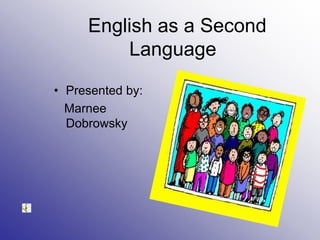
English as a Second
Language
• Presented by:
Marnee
Dobrowsky
Overview
Topic: ESL Program Review and Development for Adult Educators
Audience: Regular classroom teachers, administrators, specialty area teachers, and
counselors, parents
Purpose: *To acquire knowledge and determine teaching methods for the culturally
diverse student and
classroom environment. To collaborate with peers and extend the learning theories
into the
classroom. This overview will allow for a better understanding on how to integrate a
variety of
activities and content lessons into the curriculum, become familiar with state
mandates and TESOL
standards, and implement several teaching techniques into a diverse classroom.
Topics: *What is English as a Second Language Overview (Terminology)
*Identification Procedures for ESL Students
* Placement of ESL Students (W-APT Evaluations/WIDA ACCESS TESTS)
*Implementing the Program (Expectations of Teachers)
*Techniques, Materials, and Accommodations
*Ways to collaborate and how to integrate ESL and Content
*Exiting and Monitoring the ESL student
What is English as a Second
Language?
• ESL or ELL may
stand for English as
Second Language or
English Language
Learners
• Students that have a
primary language
other than English
can be serviced in all
states
• This is available in all
grade levels, K-12.
Concerns for the ESL
Teacher
Concerns for the Classroom
Teacher
Identifying ESL Students
Home Language
Surveys
Home language
Other than
English
Only identify easy
Words and
sentences
Limited English
schooling
All students must
bring back
a completed home
language
survey to be
viewed for
possible
evaluation.
Placement of ESL Students
• W-APT WIDA
Placement
Evaluations
• Levels of abilities
• Time and grouping
of students
• Try to ideally
replace Language
Arts or Foreign
Language classes
• After determining
proficiency of
Reading, Writing,
Speaking, and
Listening skills,
placement will occur.
• Students serviced in
an ESL program are
given the WIDA
ACCESS yearly to
determine proficiency
levels and progress
towards exiting
Implementing the ESL
Program
• Creating schedules
• Choosing ESL curriculum
• Choosing grade level curriculum
• Collaborating with content area
teachers
• Collaborating with administration
Bringing the Expertise Together
• Mainstream
> Content Knowledge
> Availability of a variety
of learning materials
> Class management
Techniques
• ESL Teacher
> Strategies for
differentiation
> Cultural
knowledge
> Language
Acquisition Theory
> Learning
expectations
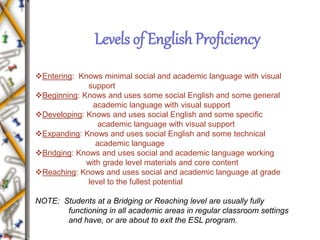
Levels of English Proficiency
Entering: Knows minimal social and academic language with visual
support
Beginning: Knows and uses some social English and some general
academic language with visual support
Developing: Knows and uses social English and some specific
academic language with visual support
Expanding: Knows and uses social English and some technical
academic language
Bridging: Knows and uses social and academic language working
with grade level materials and core content
Reaching: Knows and uses social and academic language at grade
level to the fullest potential
NOTE: Students at a Bridging or Reaching level are usually fully
functioning in all academic areas in regular classroom settings
and have, or are about to exit the ESL program.
Teaching Strategies
READING
-Organized in content-based
thematic units
-Multilevel reading groups
(Leveled Readers)
-Whole language with phonics
components
WRITING
-Teach the writing process -Use journal responses
-Use language experience
Approach
-Combine drawing and writing
Assessment in Collaborative Settings
• TESTING OPTIONS
 Performance rather
than score based
 Word banks, for open-
ended, cloze, and
multiple choice
 Teacher modified
tests
 Multiple test forms
 “Think Aloud”
reflections
• GRADING OPTIONS
 Double Grading (ESL
and Mainstream
 Portfolio Assessments
 Rubrics
 Performance
Checklists
 Oral, rather than
pencil and paper
tasks
 Observation
checklists
Techniques to Accommodate ESL Students
• Review packets and Book
• Allow for extended time
• Modify tests and
assignments ( **See Case
Studies)
• Grading procedures
• Authentic ways of
assessment
• Modeling/Variety of
activities
• Interactive Websites
(Hand-out)
Evaluation Example
(Vocabulary Strips)
FORECAST NOUN
The weather forecast called for warm temperatures
and sunny skies.
Curriculum
Implementation
Align to PA and
TESOL standards
Lesson plans and
Objectives for
Each grouping
Integrate content
And technology
Report cards,
Progress reports,
Monitoring
TESOL’s Goals and Standards for PreK-
12 Students
Goal One: To use English to communicate in social
settings
*Participate in social interactions
*Personal expression-spoken and written
*Use appropriate learning strategies and styles
TESOL’s Goals and Standards for PreK-
12 Students
Goal Two: To use English to achieve academically in all content
areas of instruction
*Interact in the classroom
*Obtain, process, construct, and provide subject matter information
in spoken and written forms
*Use grade level and appropriate learning strategies
TESOL’s Goals and Standards for PreK-
12 Students
Goal Three: To use English in socially and culturally appropriate ways
*Use appropriate language variety, register, and genre according to setting,
audience, and purpose
*Use appropriate nonverbal communication for audience, purpose, and
setting.
*Use appropriate learning strategies to extend sociolinguistic and socialcultural
competence
TESOL STANDARDS CAN BE FOUND AT:
http://www.gisd.k12.nm.us/standards/esl/
http://www.helpforschools.com/ELLKBase/guidelines/ESLStandardsforPreK12.shtml
Collaboration with Staff and Parents
• Communication Logs
• Conduct ESL staff
development
• Parent involvement
• Open communication with
administrators
• Report cards and progress
reports
• Work together on goals
and objectives
UNDERSTANDING BICS AND CALPS
“BICS”- Basic Interpersonal Communication Skills
 Conversational fluency
 Functional level after about two years
“CALPS”- Cognitive Academic Language Proficiency
 Grade appropriate academic fluency in second language
 At least five years to be functional with native speakers in content
area
 Failure to account BICS/CALPS---
 Result in discriminatory assessments of bilingual students
 Premature exit from language support programs to mainstream
classes
Materials
• Hands-on
manipulatives
• Use of technology
• Models, designs,
and examples
• Relate to real
experiences
• Phonics
• Hampton-Brown or
Scott Foresman core
themed curriculum
• Supplement materials
• Vocabulary
• Graphic Organizers
• Rubrics
• Authentic
Assessments
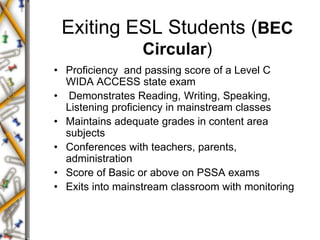
Exiting ESL Students (BEC
Circular)
• Proficiency and passing score of a Level C
WIDA ACCESS state exam
• Demonstrates Reading, Writing, Speaking,
Listening proficiency in mainstream classes
• Maintains adequate grades in content area
subjects
• Conferences with teachers, parents,
administration
• Score of Basic or above on PSSA exams
• Exits into mainstream classroom with monitoring
Monitoring ESL Students
• Monitoring forms for
elementary and secondary
• Obtain grades and
progress for each nine
weeks from content area
teachers in each subject
• Adequate content area
grades
• Standardized tests
• Contact with student,
counselors, and teachers
• Score of Basic or
Proficient on PSSA exams
Benefits for ESL and
Mainstream Teachers
• Support
• Collaboration
• Team Work
• Professional Growth and
development
• Sharing responsibility
• Students learn from two
experts
• Meeting the diversity of all
student learning needs
• Evidence of student
progress and growth
Bibliography
Ariza, E., Morales-Jones, C., Yahya, N., & Zanuddin, H. (2002). Fundamentals of Teaching English to
Speakers of Other Languages in K-12 Mainstream Classrooms. Dubuque: Kendall/Hunt Publishing.
Brockett, R. & Merriam, S. (1997). The Profession and Practice of Adult Education. San Francisco:
Jossey-Bass.
Educating Students with Limited English Proficiency (LEP) and English Language Learners (ELL).
(2001). (n.a.) Retrieved from http://www.pde.psu.edu/BECattach/PC426lep&ell.html
O’Malley, J.M., & Pierce, L.V. (1996). Authentic Assessment for English Language Learners: Practical
Approaches for Teachers. Cleveland: Addison Wesley Publishing.
Ovando, J. Collier, V. P. & Combs, M. C. (2003). Bilingual and ESL Classrooms: Teaching in
Multicultural Contexts. McGraw-Hill Publishing.
TIP-Theories. (n.d.) Retrieved on November 10, 2005 from http://tip.psychology.org

English_as_a_Second_Language2.ppt

  • 1.
    English as aSecond Language • Presented by: Marnee Dobrowsky
  • 2.
    Overview Topic: ESL ProgramReview and Development for Adult Educators Audience: Regular classroom teachers, administrators, specialty area teachers, and counselors, parents Purpose: *To acquire knowledge and determine teaching methods for the culturally diverse student and classroom environment. To collaborate with peers and extend the learning theories into the classroom. This overview will allow for a better understanding on how to integrate a variety of activities and content lessons into the curriculum, become familiar with state mandates and TESOL standards, and implement several teaching techniques into a diverse classroom. Topics: *What is English as a Second Language Overview (Terminology) *Identification Procedures for ESL Students * Placement of ESL Students (W-APT Evaluations/WIDA ACCESS TESTS) *Implementing the Program (Expectations of Teachers) *Techniques, Materials, and Accommodations *Ways to collaborate and how to integrate ESL and Content *Exiting and Monitoring the ESL student
  • 3.
    What is Englishas a Second Language? • ESL or ELL may stand for English as Second Language or English Language Learners • Students that have a primary language other than English can be serviced in all states • This is available in all grade levels, K-12.
  • 4.
    Concerns for theESL Teacher
  • 5.
    Concerns for theClassroom Teacher
  • 6.
    Identifying ESL Students HomeLanguage Surveys Home language Other than English Only identify easy Words and sentences Limited English schooling All students must bring back a completed home language survey to be viewed for possible evaluation.
  • 7.
    Placement of ESLStudents • W-APT WIDA Placement Evaluations • Levels of abilities • Time and grouping of students • Try to ideally replace Language Arts or Foreign Language classes • After determining proficiency of Reading, Writing, Speaking, and Listening skills, placement will occur. • Students serviced in an ESL program are given the WIDA ACCESS yearly to determine proficiency levels and progress towards exiting
  • 8.
    Implementing the ESL Program •Creating schedules • Choosing ESL curriculum • Choosing grade level curriculum • Collaborating with content area teachers • Collaborating with administration
  • 9.
    Bringing the ExpertiseTogether • Mainstream > Content Knowledge > Availability of a variety of learning materials > Class management Techniques • ESL Teacher > Strategies for differentiation > Cultural knowledge > Language Acquisition Theory > Learning expectations
  • 10.
    Levels of EnglishProficiency Entering: Knows minimal social and academic language with visual support Beginning: Knows and uses some social English and some general academic language with visual support Developing: Knows and uses social English and some specific academic language with visual support Expanding: Knows and uses social English and some technical academic language Bridging: Knows and uses social and academic language working with grade level materials and core content Reaching: Knows and uses social and academic language at grade level to the fullest potential NOTE: Students at a Bridging or Reaching level are usually fully functioning in all academic areas in regular classroom settings and have, or are about to exit the ESL program.
  • 11.
    Teaching Strategies READING -Organized incontent-based thematic units -Multilevel reading groups (Leveled Readers) -Whole language with phonics components WRITING -Teach the writing process -Use journal responses -Use language experience Approach -Combine drawing and writing
  • 12.
    Assessment in CollaborativeSettings • TESTING OPTIONS  Performance rather than score based  Word banks, for open- ended, cloze, and multiple choice  Teacher modified tests  Multiple test forms  “Think Aloud” reflections • GRADING OPTIONS  Double Grading (ESL and Mainstream  Portfolio Assessments  Rubrics  Performance Checklists  Oral, rather than pencil and paper tasks  Observation checklists
  • 13.
    Techniques to AccommodateESL Students • Review packets and Book • Allow for extended time • Modify tests and assignments ( **See Case Studies) • Grading procedures • Authentic ways of assessment • Modeling/Variety of activities • Interactive Websites (Hand-out)
  • 14.
    Evaluation Example (Vocabulary Strips) FORECASTNOUN The weather forecast called for warm temperatures and sunny skies.
  • 15.
    Curriculum Implementation Align to PAand TESOL standards Lesson plans and Objectives for Each grouping Integrate content And technology Report cards, Progress reports, Monitoring
  • 16.
    TESOL’s Goals andStandards for PreK- 12 Students Goal One: To use English to communicate in social settings *Participate in social interactions *Personal expression-spoken and written *Use appropriate learning strategies and styles
  • 17.
    TESOL’s Goals andStandards for PreK- 12 Students Goal Two: To use English to achieve academically in all content areas of instruction *Interact in the classroom *Obtain, process, construct, and provide subject matter information in spoken and written forms *Use grade level and appropriate learning strategies
  • 18.
    TESOL’s Goals andStandards for PreK- 12 Students Goal Three: To use English in socially and culturally appropriate ways *Use appropriate language variety, register, and genre according to setting, audience, and purpose *Use appropriate nonverbal communication for audience, purpose, and setting. *Use appropriate learning strategies to extend sociolinguistic and socialcultural competence TESOL STANDARDS CAN BE FOUND AT: http://www.gisd.k12.nm.us/standards/esl/ http://www.helpforschools.com/ELLKBase/guidelines/ESLStandardsforPreK12.shtml
  • 19.
    Collaboration with Staffand Parents • Communication Logs • Conduct ESL staff development • Parent involvement • Open communication with administrators • Report cards and progress reports • Work together on goals and objectives
  • 20.
    UNDERSTANDING BICS ANDCALPS “BICS”- Basic Interpersonal Communication Skills  Conversational fluency  Functional level after about two years “CALPS”- Cognitive Academic Language Proficiency  Grade appropriate academic fluency in second language  At least five years to be functional with native speakers in content area  Failure to account BICS/CALPS---  Result in discriminatory assessments of bilingual students  Premature exit from language support programs to mainstream classes
  • 21.
    Materials • Hands-on manipulatives • Useof technology • Models, designs, and examples • Relate to real experiences • Phonics • Hampton-Brown or Scott Foresman core themed curriculum • Supplement materials • Vocabulary • Graphic Organizers • Rubrics • Authentic Assessments
  • 22.
    Exiting ESL Students(BEC Circular) • Proficiency and passing score of a Level C WIDA ACCESS state exam • Demonstrates Reading, Writing, Speaking, Listening proficiency in mainstream classes • Maintains adequate grades in content area subjects • Conferences with teachers, parents, administration • Score of Basic or above on PSSA exams • Exits into mainstream classroom with monitoring
  • 23.
    Monitoring ESL Students •Monitoring forms for elementary and secondary • Obtain grades and progress for each nine weeks from content area teachers in each subject • Adequate content area grades • Standardized tests • Contact with student, counselors, and teachers • Score of Basic or Proficient on PSSA exams
  • 24.
    Benefits for ESLand Mainstream Teachers • Support • Collaboration • Team Work • Professional Growth and development • Sharing responsibility • Students learn from two experts • Meeting the diversity of all student learning needs • Evidence of student progress and growth
  • 25.
    Bibliography Ariza, E., Morales-Jones,C., Yahya, N., & Zanuddin, H. (2002). Fundamentals of Teaching English to Speakers of Other Languages in K-12 Mainstream Classrooms. Dubuque: Kendall/Hunt Publishing. Brockett, R. & Merriam, S. (1997). The Profession and Practice of Adult Education. San Francisco: Jossey-Bass. Educating Students with Limited English Proficiency (LEP) and English Language Learners (ELL). (2001). (n.a.) Retrieved from http://www.pde.psu.edu/BECattach/PC426lep&ell.html O’Malley, J.M., & Pierce, L.V. (1996). Authentic Assessment for English Language Learners: Practical Approaches for Teachers. Cleveland: Addison Wesley Publishing. Ovando, J. Collier, V. P. & Combs, M. C. (2003). Bilingual and ESL Classrooms: Teaching in Multicultural Contexts. McGraw-Hill Publishing. TIP-Theories. (n.d.) Retrieved on November 10, 2005 from http://tip.psychology.org