CURRICULUM GUIDELINES
María Jambrina Pérez
Content
1.- Project
2.- Teaching through topics
3.- Developing social skills
4.- Literacy skills
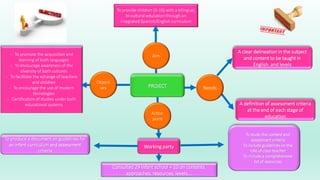
PROJECT
To provide children (3-16) with a bilingual,
bi-cultural education through an
integrated Spanish/English curriculum
Working party
A clear delineation in the subject
and content to be taught in
English, and levels
- To promote the acquisition and
learning of both languages
- To encourage awareness of the
diversity of both cultures
- To facilitate the xchange of teachers
and children
- To encourage the use of modern
tecnologies
- Certification of studies under both
educational systems
Consulted 29 infant school + 10 on contents,
approaches, resources, levels,…
- To study the content and
assessment criteria
- To include guidelines on the
role of class teacher
- To include a comprehensive
list of resources
To produce a document on guidelines for
an infant curriculum and assessment
criteria
A definition of assessment criteria
at the end of each stage of
education
Aim
Action
point
Needs
Objecti
ves
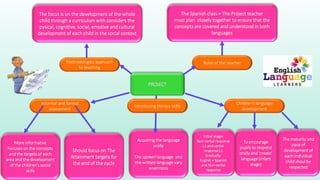
PROJECT
Roles of the teacherMethodologica approach
to teaching
Informal and formal
assessment
The focus is on the development of the whole
child through a curriculum with considers the
pysical, cognitive, social, emotive and cultural
development of each child in the social context
Children’s language
development
The maturity and
pace of
development of
each individual
child shoul be
respected
Acquiring the language
orally
The spoken language and
the written language vary
enormous
To encourage
pupils to respond
orally and ‘create’
language (infant
stage)
Initial stages
Non-verbal response
L2 and verbal
response L1
Gradually:
English + Spanish
and Non-verbal
response
The Spanish class + The Project teacher
must plan closely together to ensure that the
concepts are covered and understood in both
languages
More informative
Focuses on the concepts
and the targets of each
area and the development
of the children’s social
skills
Should focus on The
Attainment targets for
the end of the cycle
Introducing literacy skills
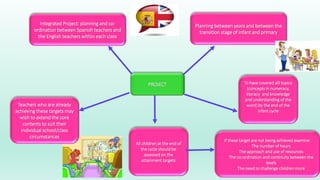
PROJECT
Integrated Project: planning and co-
ordination between Spanish teachers and
the English teachers within each class
If these target are not being achieved examine:
- The number of hours
- The approach and use of resources
- The co-ordination and continuity between the
levels
- The need to challenge children more
All children at the end of
the cycle should be
assessed on the
attainment targets
Planning between years and between the
transition stage of infant and primary
To have covered alll topics
(concepts in numeracy,
literacy and knowledge
and understanding of the
word) by the end of the
infant cycle
Teachers who are already
achieving these targets may
wish to extend the core
contents to suit their
individual school/class
circumstances
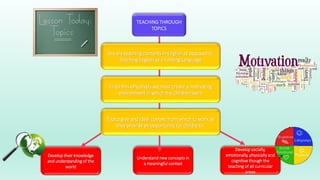
TEACHING THROUGH
TOPICS
Develop their knowledge
and understanding of the
world
Understand new concepts in
a meaningful context
Develop socially,
emotionally, physically and
cognitive though the
teaching of all curricular
areas
We are teaching contents in English as opposed to
Teaching English as a Foreing Language
To do this effectively we must create a motivating
environment in which the children learn
Topics give and ideal context from which to work as
they provide an opportunity for childre to:
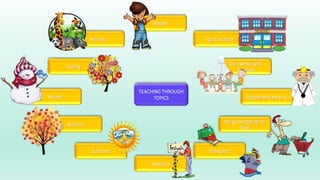
TEACHING THROUGH
TOPICS
Myself
I go to school
Our homes and
families
People who help us
We go shopping for
food
Transport
Festivals
Summer
Autumn
Winter
Spring
Animals
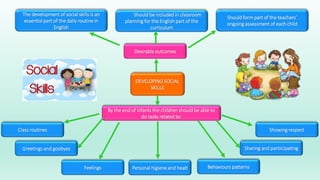
DEVELOPING SOCIAL
SKILLS
Desirable outcomes
By the end of Infants the children should be able to
do tasks related to:
The development of social skills is an
essentisl part of the daily routine in
English
Greetings and goobyes
Feelings Personal higiene and healt Behaviours patterns
Class routines
Sharing and partiicipating
Showing respect
Should be included in classroom
planning for the English part of the
curriculum
Should form part of the teachers’
ongoing assessment of each child
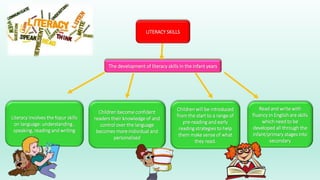
LITERACY SKILLS
The development of literacy skills in the infant years
Literacy involves the fopur skills
on language: understanding ,
speaking, reading and writing
Children become confident
readers their knowledge of and
control over the language
becomes more individual and
personalised
Read and write with
fluency in English are skills
which need to be
developed all through the
infant/primary stages into
secondary
Children will be introduced
from the start to a range of
pre-reading and early
reading strategies to help
them make sense of what
they read.
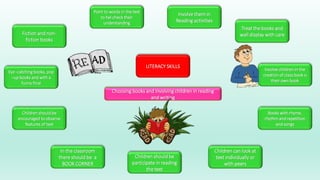
LITERACY SKILLS
Choosing books and involving children in reading
and writing
Fiction and non-
fiction books
In the classroom
there should be a
BOOK CORNER
Children can look at
text individually or
with peers
Eye -catching books, pop
–up books and with a
funny final
Children should be
encouraged to observe
features of text
Books with rhyme,
rhythm and repetition
and songs
Children should be
participate in reading
the text
Involve children in the
creation of class book o
their own book
Treat the books and
wall display with care
Involve them in
Reading activities
Point to words in the text
to hel check their
understanding
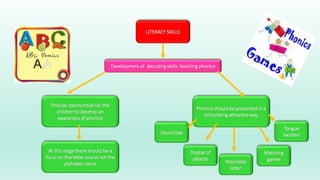
LITERACY SKILLS
Development of decoding skills: teaching phonics
Provide oportunities for the
children to develop an
awareness of phonics
Phonics should be presented in a
stimulating attractive way
At this stage there should be a
focus on the letter sound not the
alphabet name
Sound box
Display of
objects
Washable
letter
Matching
games
Tongue
twisters
LITERACY SKILLS
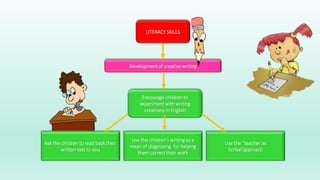
Development of creative writing
Encourage children to
experiment with writing
creatively in English
Ask the children to read back their
written text to you
Use the children’s writing as a
mean of diagnosing for helping
them correct their work
Use the “teacher as
Scribe”approach

Curriculum guidelines

  • 1.
  • 2.
    Content 1.- Project 2.- Teachingthrough topics 3.- Developing social skills 4.- Literacy skills
  • 3.
    PROJECT To provide children(3-16) with a bilingual, bi-cultural education through an integrated Spanish/English curriculum Working party A clear delineation in the subject and content to be taught in English, and levels - To promote the acquisition and learning of both languages - To encourage awareness of the diversity of both cultures - To facilitate the xchange of teachers and children - To encourage the use of modern tecnologies - Certification of studies under both educational systems Consulted 29 infant school + 10 on contents, approaches, resources, levels,… - To study the content and assessment criteria - To include guidelines on the role of class teacher - To include a comprehensive list of resources To produce a document on guidelines for an infant curriculum and assessment criteria A definition of assessment criteria at the end of each stage of education Aim Action point Needs Objecti ves
  • 4.
    PROJECT Roles of theteacherMethodologica approach to teaching Informal and formal assessment The focus is on the development of the whole child through a curriculum with considers the pysical, cognitive, social, emotive and cultural development of each child in the social context Children’s language development The maturity and pace of development of each individual child shoul be respected Acquiring the language orally The spoken language and the written language vary enormous To encourage pupils to respond orally and ‘create’ language (infant stage) Initial stages Non-verbal response L2 and verbal response L1 Gradually: English + Spanish and Non-verbal response The Spanish class + The Project teacher must plan closely together to ensure that the concepts are covered and understood in both languages More informative Focuses on the concepts and the targets of each area and the development of the children’s social skills Should focus on The Attainment targets for the end of the cycle Introducing literacy skills
  • 5.
    PROJECT Integrated Project: planningand co- ordination between Spanish teachers and the English teachers within each class If these target are not being achieved examine: - The number of hours - The approach and use of resources - The co-ordination and continuity between the levels - The need to challenge children more All children at the end of the cycle should be assessed on the attainment targets Planning between years and between the transition stage of infant and primary To have covered alll topics (concepts in numeracy, literacy and knowledge and understanding of the word) by the end of the infant cycle Teachers who are already achieving these targets may wish to extend the core contents to suit their individual school/class circumstances
  • 6.
    TEACHING THROUGH TOPICS Develop theirknowledge and understanding of the world Understand new concepts in a meaningful context Develop socially, emotionally, physically and cognitive though the teaching of all curricular areas We are teaching contents in English as opposed to Teaching English as a Foreing Language To do this effectively we must create a motivating environment in which the children learn Topics give and ideal context from which to work as they provide an opportunity for childre to:
  • 7.
    TEACHING THROUGH TOPICS Myself I goto school Our homes and families People who help us We go shopping for food Transport Festivals Summer Autumn Winter Spring Animals
  • 8.
    DEVELOPING SOCIAL SKILLS Desirable outcomes Bythe end of Infants the children should be able to do tasks related to: The development of social skills is an essentisl part of the daily routine in English Greetings and goobyes Feelings Personal higiene and healt Behaviours patterns Class routines Sharing and partiicipating Showing respect Should be included in classroom planning for the English part of the curriculum Should form part of the teachers’ ongoing assessment of each child
  • 9.
    LITERACY SKILLS The developmentof literacy skills in the infant years Literacy involves the fopur skills on language: understanding , speaking, reading and writing Children become confident readers their knowledge of and control over the language becomes more individual and personalised Read and write with fluency in English are skills which need to be developed all through the infant/primary stages into secondary Children will be introduced from the start to a range of pre-reading and early reading strategies to help them make sense of what they read.
  • 10.
    LITERACY SKILLS Choosing booksand involving children in reading and writing Fiction and non- fiction books In the classroom there should be a BOOK CORNER Children can look at text individually or with peers Eye -catching books, pop –up books and with a funny final Children should be encouraged to observe features of text Books with rhyme, rhythm and repetition and songs Children should be participate in reading the text Involve children in the creation of class book o their own book Treat the books and wall display with care Involve them in Reading activities Point to words in the text to hel check their understanding
  • 11.
    LITERACY SKILLS Development ofdecoding skills: teaching phonics Provide oportunities for the children to develop an awareness of phonics Phonics should be presented in a stimulating attractive way At this stage there should be a focus on the letter sound not the alphabet name Sound box Display of objects Washable letter Matching games Tongue twisters
  • 12.
    LITERACY SKILLS Development ofcreative writing Encourage children to experiment with writing creatively in English Ask the children to read back their written text to you Use the children’s writing as a mean of diagnosing for helping them correct their work Use the “teacher as Scribe”approach