Al Yaqdhan Al Atbi
Sultanate of Oman
• Summarizing the study
• Results
• Applicability of the study
• Conclusion
• Recent HF guidelines and recommendations
emphasized the importance of immediate diagnosis
and treatment of patients presenting with AHF.
(Ponikowski P, et al; 2016)
• A delay in initiating heart failure therapy was
associated with modestly higher risk for in-hospital
mortality and longer length of stay.
(Wong YW et al 2013)
(Maisel AS et al, 2008)
• In patients with AHF, the efficacy of any treatment
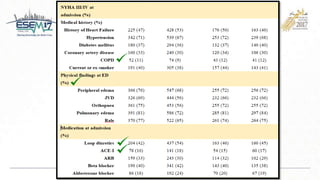
may be time-dependent.
(Mebazaa A, et al; 2010)
(Peacock WF, et al; 2009)
– To determine the prognostic impact of time to
treatments for AHF performed in the acute
phase.
– Evaluated the association between time-to-
diuretic treatment and clinical outcome
• Prospective, multicenter, observational cohort study
• Study period:
– August 2014 to December 2015
• Study sites:
– 20 participating hospitals
• Eligible participants
– AHFS patients who are admitted via emergency
department.
– The AHFS is diagnosed according to Framingham criteria.
– Over 20 years old.
– AHFS was diagnosed within 3 hours after arriving to ED
and physical exam was taken by medical staff
• Exclusion criteria were:
– Treatment with an IV drug before ED arrival.
– Previous heart transplantation.
– On either chronic peritoneal dialysis or hemodialysis
– Acute myocarditis.
– BNP level < 100 pg/mL or N-terminal-proBNP level < 300
pg/mL at baseline.
– Acute coronary syndrome require emergent revascularization.
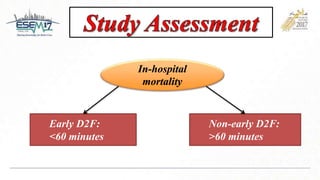
Early D2F:
<60 minutes
Non-early D2F:
>60 minutes
In-hospital
mortality
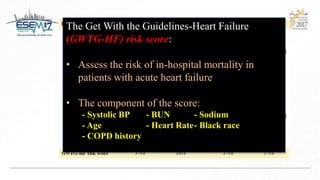
The Get With the Guidelines-Heart Failure
(GWTG-HF) risk score:
• Assess the risk of in-hospital mortality in
patients with acute heart failure
• The component of the score:
- Systolic BP - BUN - Sodium
- Age - Heart Rate- Black race
- COPD history
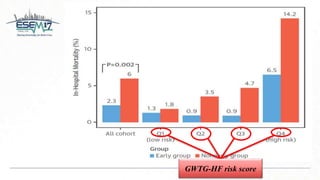
GWTG-HF risk score
• Prospective and multicenter study
• No patient was lost to follow-up for in-hospital
outcome.
• Good sample size.
• Cohort study
• Type I error:
– GWTG-HF risk score was slightly lower in the early treatment group
• No data about the cause of HF exacerbation.
• Association between D2F time and long-term
prognosis
“Patients with AHF and prominent congestive symptoms
were more likely to be treated early with IV furosemide”
“Treatment with IV furosemide within 60 min was
independently associated with better in-hospital
Survival”
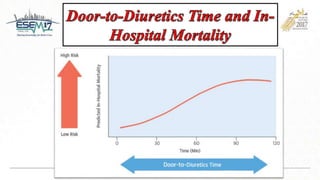
This study confirms the association between in-hospital
mortality and the time of initiating IV diuretics.
Based on current evidence, acute heart failure therapy
should be initiated as soon as the diagnosis is
established.
IN ACUE HEART FAILURE:
• Mebazaa A, Pang PS, Tavares M, et al. The impact of early standard therapy on dyspnoea in patients with acute heart failure:
the URGENTdyspnoea study. Eur Heart J 2010;31:832–41.
• Maisel AS, Peacock WF, McMullin N, et al. Timing of immunoreactive B-type natriuretic peptide levels and treatment delay in
acute decompensated heart failure: an ADHERE (Acute Decompensated Heart Failure National Registry) analysis. J Am Coll
Cardiol 2008;52:534–40.
• Peacock WF, Emerman C, Costanzo MR, Diercks DB, Lopatin M, Fonarow GC. Early vasoactive drugs improve heart failure
outcomes. Congest Heart Fail 2009;15:256–64.
• Ponikowski P, Voors AA, Anker SD, et al. 2016 ESC Guidelines for the diagnosis and treatment of acute and chronic heart
failure. Eur J Heart Fail 2016;18:891–975.
• GWTG-Heart Failure Risk Score - MDCalc [Internet]. [cited 2017 Dec 5]. Available from: https://www.mdcalc.com/gwtg-
heart-failure-risk-score#evidence

Esem17 ppt 16x9

  • 2.
    Al Yaqdhan AlAtbi Sultanate of Oman
  • 3.
    • Summarizing thestudy • Results • Applicability of the study • Conclusion
  • 5.
    • Recent HFguidelines and recommendations emphasized the importance of immediate diagnosis and treatment of patients presenting with AHF. (Ponikowski P, et al; 2016) • A delay in initiating heart failure therapy was associated with modestly higher risk for in-hospital mortality and longer length of stay. (Wong YW et al 2013) (Maisel AS et al, 2008)
  • 6.
    • In patientswith AHF, the efficacy of any treatment may be time-dependent. (Mebazaa A, et al; 2010) (Peacock WF, et al; 2009)
  • 7.
    – To determinethe prognostic impact of time to treatments for AHF performed in the acute phase. – Evaluated the association between time-to- diuretic treatment and clinical outcome
  • 8.
    • Prospective, multicenter,observational cohort study • Study period: – August 2014 to December 2015 • Study sites: – 20 participating hospitals
  • 9.
    • Eligible participants –AHFS patients who are admitted via emergency department. – The AHFS is diagnosed according to Framingham criteria. – Over 20 years old. – AHFS was diagnosed within 3 hours after arriving to ED and physical exam was taken by medical staff
  • 10.
    • Exclusion criteriawere: – Treatment with an IV drug before ED arrival. – Previous heart transplantation. – On either chronic peritoneal dialysis or hemodialysis – Acute myocarditis. – BNP level < 100 pg/mL or N-terminal-proBNP level < 300 pg/mL at baseline. – Acute coronary syndrome require emergent revascularization.
  • 11.
    Early D2F: <60 minutes Non-earlyD2F: >60 minutes In-hospital mortality
  • 16.
    The Get Withthe Guidelines-Heart Failure (GWTG-HF) risk score: • Assess the risk of in-hospital mortality in patients with acute heart failure • The component of the score: - Systolic BP - BUN - Sodium - Age - Heart Rate- Black race - COPD history
  • 17.
  • 20.
    • Prospective andmulticenter study • No patient was lost to follow-up for in-hospital outcome. • Good sample size.
  • 21.
    • Cohort study •Type I error: – GWTG-HF risk score was slightly lower in the early treatment group • No data about the cause of HF exacerbation. • Association between D2F time and long-term prognosis
  • 22.
    “Patients with AHFand prominent congestive symptoms were more likely to be treated early with IV furosemide” “Treatment with IV furosemide within 60 min was independently associated with better in-hospital Survival”
  • 23.
    This study confirmsthe association between in-hospital mortality and the time of initiating IV diuretics. Based on current evidence, acute heart failure therapy should be initiated as soon as the diagnosis is established.
  • 24.
    IN ACUE HEARTFAILURE:
  • 25.
    • Mebazaa A,Pang PS, Tavares M, et al. The impact of early standard therapy on dyspnoea in patients with acute heart failure: the URGENTdyspnoea study. Eur Heart J 2010;31:832–41. • Maisel AS, Peacock WF, McMullin N, et al. Timing of immunoreactive B-type natriuretic peptide levels and treatment delay in acute decompensated heart failure: an ADHERE (Acute Decompensated Heart Failure National Registry) analysis. J Am Coll Cardiol 2008;52:534–40. • Peacock WF, Emerman C, Costanzo MR, Diercks DB, Lopatin M, Fonarow GC. Early vasoactive drugs improve heart failure outcomes. Congest Heart Fail 2009;15:256–64. • Ponikowski P, Voors AA, Anker SD, et al. 2016 ESC Guidelines for the diagnosis and treatment of acute and chronic heart failure. Eur J Heart Fail 2016;18:891–975. • GWTG-Heart Failure Risk Score - MDCalc [Internet]. [cited 2017 Dec 5]. Available from: https://www.mdcalc.com/gwtg- heart-failure-risk-score#evidence

Editor's Notes

  • #6 Wong YW, Fonarow GC, Mi X, Peacock WF, Mills RM, Curtis LH, et al. Early intravenous heart failure therapy and outcomes among older patients hospitalized for acute decompensated heart failure: findings from the Acute Decompensated Heart Failure Registry Emergency Module (ADHERE-EM). Am Heart J. 2013 Aug;166(2):349–56.
  • #9 Open label study: both the researchers and participants know which treatment is being administered unavoidable under some circumstances, such as comparing the effectiveness of a medication to intensive physical therapy sessions.
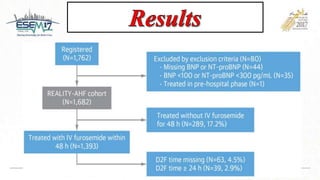
  • #10 Patients with missing Btype natriuretic peptide (BNP) or N-terminalproBNP (NT-proBNP) data, and patients with a BNP level <100 pg/ml or NT-proBNP level <300 pg/ml at baseline were also excluded
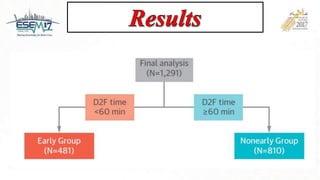
  • #12 accordance with published recommendations of the European Society of Cardiology regarding early and prehospital management of AHF, we defined early and nonearly treatment groups using the D2F time with a cutoff of 60 min (8).
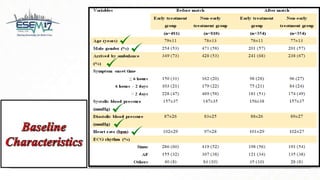
  • #15 To control confounding as much as possible, propensity score matching was also performed as a sensitivity analysis.
  • #16 Patients in the early treatment group were more likely to arrive by ambulance; acute onset of symptoms, higher blood pressure, and heart rate sinus rhythm more signs of congestion
  • #18 Arriving by ambulance and the presence of signs and symptoms of congestion, including orthopnea, jugular venous distension, angiotensin II receptor blocker prescription at admission, and a high heart rate, were independently associated with a shorter D2F time. During the index hospitalization, 11 patients (2.3%) in the early treatment group and 49 (6%) in the nonearly treatment group died (p ¼ 0.002) Although the mortality rate increased as GWTG-HF risk score increased in both groups (p for trend <0.05 for both groups), a lower mortality rate in the early treatment group compared with that for the nonearly treatment group was consistently observed across all quartiles, with the absolute risk difference increasing as GWTG-HF risk score quartile rose (p for trend ¼ 0.027) (Figure 2).
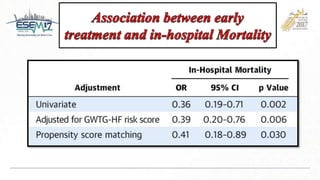
  • #19 Association between early treatment and 30-day mortality from the index hospitalization because there was variability in the length of hospital stay Early treatment was associated with a lower 30-day mortality; however, the p value did not reach statistical significance in multivariable logistic regression analysis after adjusting for the GWTG-HF risk score or in the propensity score matching analysis
  • #20 Restricted cubic spline modeling with 4 knots was used because this model showed a better goodness-of-fit compared with that for the linear model and restricted 3-knot cubic spline model The solid blue line represents the estimated probability of in-hospital mortality, the light blue shaded area is 95% confidence interval, and the gray shaded area is a density plot showing the distribution of observed door-to-furosemide time. The association between D2F time and predicted in-hospital mortality was not linear, and predicted mortality steeply increased in the first approximately 100 min from ED arrival and leveled off afterwards