RIMT-COA
SIRHIND SIDE
MANDI GOBINDGARH
BACH-507
BUILDING SERVICES-II
SUBMITTED BY: SUBMITTED TO:
Akansha Batra(02) AR.KIRANPREET KAUR
Angadveer singh(05)
Arpit Mehta(08)
Diksha chugh(15)
ISHMINDER SINGH(35)
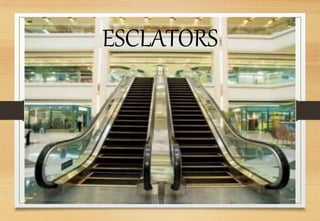
ESCLATORS
INTRODUCTION
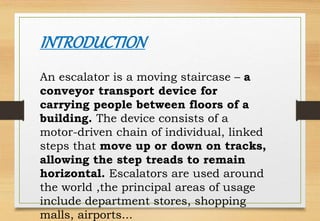
An escalator is a moving staircase – a
conveyor transport device for
carrying people between floors of a
building. The device consists of a
motor-driven chain of individual, linked
steps that move up or down on tracks,
allowing the step treads to remain
horizontal. Escalators are used around
the world ,the principal areas of usage
include department stores, shopping
malls, airports...
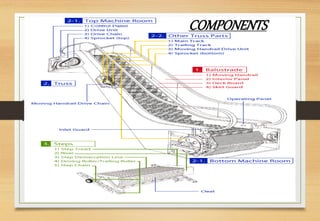
COMPONENTS
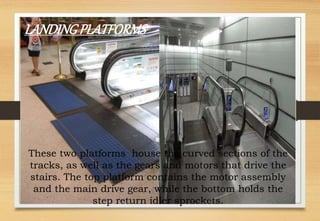
These two platforms house the curved sections of the
tracks, as well as the gears and motors that drive the
stairs. The top platform contains the motor assembly
and the main drive gear, while the bottom holds the
step return idler sprockets.
LANDINGPLATFORMS
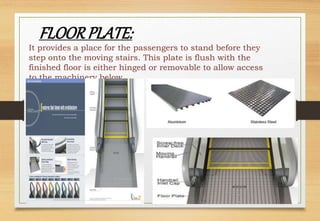
It provides a place for the passengers to stand before they
step onto the moving stairs. This plate is flush with the
finished floor is either hinged or removable to allow access
to the machinery below.
FLOORPLATE:
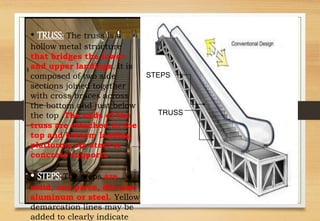
• TRUSS: The truss is a
hollow metal structure
that bridges the lower
and upper landings. It is
composed of two side
sections joined together
with cross braces across
the bottom and just below
the top .The ends of the
truss are attached to the
top and bottom landing
platforms via steel or
concrete supports.
• STEPS: The steps are
solid, one piece, die-cast
aluminum or steel. Yellow
demarcation lines may be
added to clearly indicate
TRUSS
STEPS
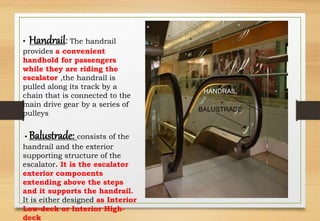
• Handrail: The handrail
provides a convenient
handhold for passengers
while they are riding the
escalator ,the handrail is
pulled along its track by a
chain that is connected to the
main drive gear by a series of
pulleys
• Balustrade: consists of the
handrail and the exterior
supporting structure of the
escalator. It is the escalator
exterior components
extending above the steps
and it supports the handrail.
It is either designed as Interior
Low-deck or Interior High-
deck
HANDRAIL
BALUSTRADE
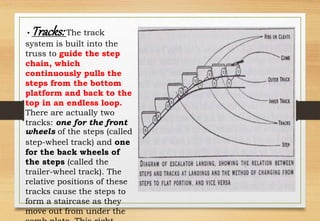
• Tracks:The track
system is built into the
truss to guide the step
chain, which
continuously pulls the
steps from the bottom
platform and back to the
top in an endless loop.
There are actually two
tracks: one for the front
wheels of the steps (called
step-wheel track) and one
for the back wheels of
the steps (called the
trailer-wheel track). The
relative positions of these
tracks cause the steps to
form a staircase as they
move out from under the
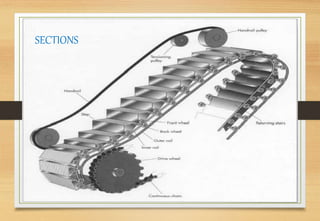
SECTIONS
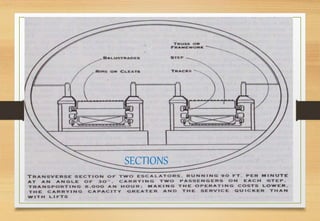
SECTIONS
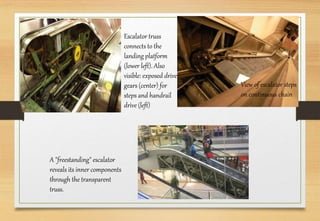
A "freestanding" escalator
reveals its inner components
through the transparent
truss.
Escalator truss
connects to the
landing platform
(lower left). Also
visible: exposed drive
gears (center) for
steps and handrail
drive (left)
View of escalator steps
on continuous chain
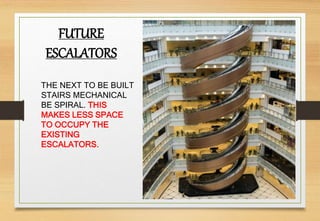
THE NEXT TO BE BUILT
STAIRS MECHANICAL
BE SPIRAL. THIS
MAKES LESS SPACE
TO OCCUPY THE
EXISTING
ESCALATORS.
FUTURE
ESCALATORS
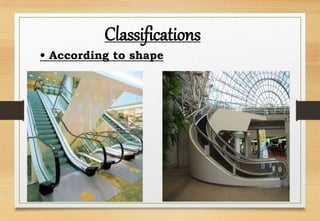
Classifications
• According to shape
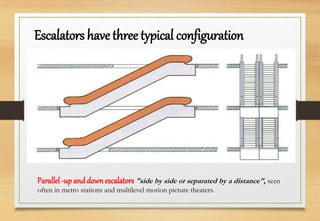
Escalators have three typical configuration
options:
Parallel-upanddownescalators"side
by side or separated by a distance", seen often in metro stations and
multilevel motion picture theaters .
Parallel-up and down escalators "side by side or separated by a distance", seen
often in metro stations and multilevel motion picture theaters.
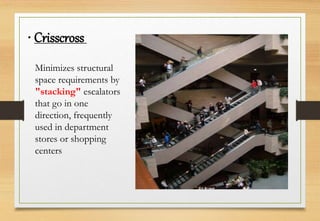
Minimizes structural
space requirements by
"stacking" escalators
that go in one
direction, frequently
used in department
stores or shopping
centers
• Crisscross
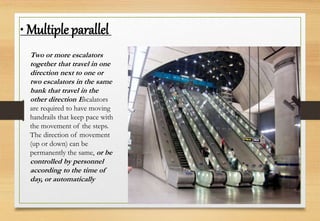
Two or more escalators
together that travel in one
direction next to one or
two escalators in the same
bank that travel in the
other direction Escalators
are required to have moving
handrails that keep pace with
the movement of the steps.
The direction of movement
(up or down) can be
permanently the same, or be
controlled by personnel
according to the time of
day, or automatically
• Multiple parallel
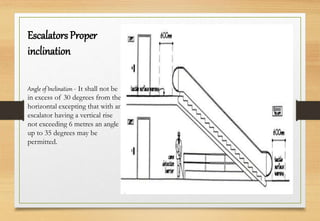
Escalators Proper
inclination
Angle of Inclination - It shall not be
in excess of 30 degrees from the
horizontal excepting that with an
escalator having a vertical rise
not exceeding 6 metres an angle
up to 35 degrees may be
permitted.
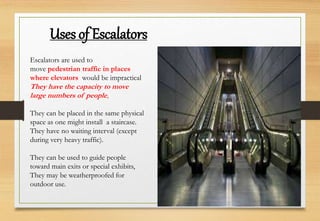
Escalators are used to
move pedestrian traffic in places
where elevators would be impractical
They have the capacity to move
large numbers of people,
They can be placed in the same physical
space as one might install a staircase.
They have no waiting interval (except
during very heavy traffic).
They can be used to guide people
toward main exits or special exhibits,
They may be weatherproofed for
outdoor use.
Uses of Escalators
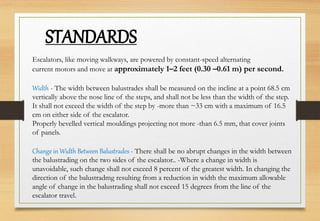
Escalators, like moving walkways, are powered by constant-speed alternating
current motors and move at approximately 1–2 feet (0.30 –0.61 m) per second.
Width - The width between balustrades shall be measured on the incline at a point 68.5 cm
vertically above the nose line of the steps, and shall not be less than the width of the step.
It shall not exceed the width of the step by -more than ~33 cm with a maximum of 16.5
cm on either side of the escalator.
Properly bevelled vertical mouldings projecting not more -than 6.5 mm, that cover joints
of panels.
Change in Width Between Balustrades - There shall be no abrupt changes in the width between
the balustrading on the two sides of the escalator.. -Where a change in width is
unavoidable, such change shall not exceed 8 percent of the greatest width. In changing the
direction of the balustradmg resulting from a reduction in width the maximum allowable
angle of change in the balustrading shall not exceed 15 degrees from the line of the
escalator travel.
STANDARDS
STANDARDS
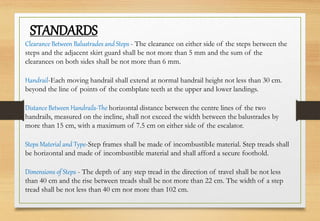
Clearance Between Balustrades andSteps - The clearance on either side of the steps between the
steps and the adjacent skirt guard shall be not more than 5 mm and the sum of the
clearances on both sides shall be not more than 6 mm.
Handrail-Each moving handrail shall extend at normal handrail height not less than 30 cm.
beyond the line of points of the combplate teeth at the upper and lower landings.
Distance Between Handrails-The horizontal distance between the centre lines of the two
handrails, measured on the incline, shall not exceed the width between the balustrades by
more than 15 cm, with a maximum of 7.5 cm on either side of the escalator.
Steps Material and Type-Step frames shall be made of incombustibIe material. Step treads shall
be horizontal and made of incombustible material and shall afford a secure foothold.
Dimensions of Steps - The depth of any step tread in the direction of travel shall be not less
than 40 cm and the rise between treads shall be not more than 22 cm. The width of a step
tread shall be not less than 40 cm nor more than 102 cm.
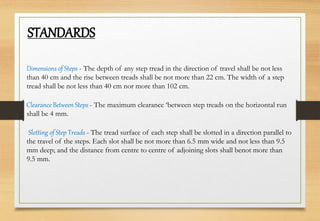
Dimensions of Steps - The depth of any step tread in the direction of travel shall be not less
than 40 cm and the rise between treads shall be not more than 22 cm. The width of a step
tread shall be not less than 40 cm nor more than 102 cm.
Clearance Between Steps - The maximum clearance ‘between step treads on the horizontal run
shall be 4 mm.
Slotting of Step Treads - The tread surface of each step shall be slotted in a direction parallel to
the travel of the steps. Each slot shall be not more than 6.5 mm wide and not less than 9.5
mm deep; and the distance from centre to centre of adjoining slots shall benot more than
9.5 mm.
STANDARDS
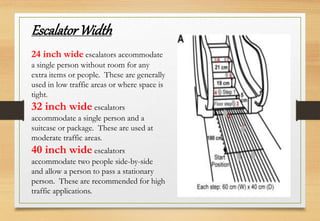
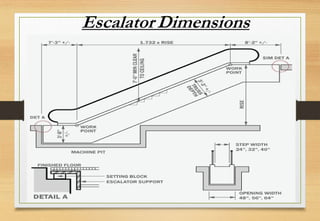
24 inch wide escalators accommodate
a single person without room for any
extra items or people. These are generally
used in low traffic areas or where space is
tight.
32 inch wide escalators
accommodate a single person and a
suitcase or package. These are used at
moderate traffic areas.
40 inch wide escalators
accommodate two people side-by-side
and allow a person to pass a stationary
person. These are recommended for high
traffic applications.
EscalatorWidth
Escalator Dimensions
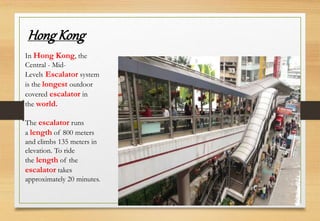
In Hong Kong, the
Central - Mid-
Levels Escalator system
is the longest outdoor
covered escalator in
the world.
The escalator runs
a length of 800 meters
and climbs 135 meters in
elevation. To ride
the length of the
escalator takes
approximately 20 minutes.
Hong Kong
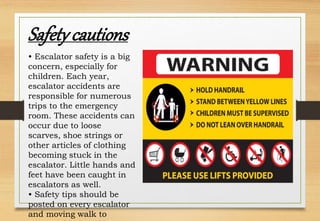
• Escalator safety is a big
concern, especially for
children. Each year,
escalator accidents are
responsible for numerous
trips to the emergency
room. These accidents can
occur due to loose
scarves, shoe strings or
other articles of clothing
becoming stuck in the
escalator. Little hands and
feet have been caught in
escalators as well.
• Safety tips should be
posted on every escalator
and moving walk to
Safety cautions
Esaclators

Esaclators

  • 1.
    RIMT-COA SIRHIND SIDE MANDI GOBINDGARH BACH-507 BUILDINGSERVICES-II SUBMITTED BY: SUBMITTED TO: Akansha Batra(02) AR.KIRANPREET KAUR Angadveer singh(05) Arpit Mehta(08) Diksha chugh(15) ISHMINDER SINGH(35)
  • 2.
  • 3.
    INTRODUCTION An escalator isa moving staircase – a conveyor transport device for carrying people between floors of a building. The device consists of a motor-driven chain of individual, linked steps that move up or down on tracks, allowing the step treads to remain horizontal. Escalators are used around the world ,the principal areas of usage include department stores, shopping malls, airports...
  • 4.
  • 5.
    These two platformshouse the curved sections of the tracks, as well as the gears and motors that drive the stairs. The top platform contains the motor assembly and the main drive gear, while the bottom holds the step return idler sprockets. LANDINGPLATFORMS
  • 6.
    It provides aplace for the passengers to stand before they step onto the moving stairs. This plate is flush with the finished floor is either hinged or removable to allow access to the machinery below. FLOORPLATE:
  • 7.
    • TRUSS: Thetruss is a hollow metal structure that bridges the lower and upper landings. It is composed of two side sections joined together with cross braces across the bottom and just below the top .The ends of the truss are attached to the top and bottom landing platforms via steel or concrete supports. • STEPS: The steps are solid, one piece, die-cast aluminum or steel. Yellow demarcation lines may be added to clearly indicate TRUSS STEPS
  • 8.
    • Handrail: Thehandrail provides a convenient handhold for passengers while they are riding the escalator ,the handrail is pulled along its track by a chain that is connected to the main drive gear by a series of pulleys • Balustrade: consists of the handrail and the exterior supporting structure of the escalator. It is the escalator exterior components extending above the steps and it supports the handrail. It is either designed as Interior Low-deck or Interior High- deck HANDRAIL BALUSTRADE
  • 9.
    • Tracks:The track systemis built into the truss to guide the step chain, which continuously pulls the steps from the bottom platform and back to the top in an endless loop. There are actually two tracks: one for the front wheels of the steps (called step-wheel track) and one for the back wheels of the steps (called the trailer-wheel track). The relative positions of these tracks cause the steps to form a staircase as they move out from under the
  • 10.
  • 11.
  • 12.
    A "freestanding" escalator revealsits inner components through the transparent truss. Escalator truss connects to the landing platform (lower left). Also visible: exposed drive gears (center) for steps and handrail drive (left) View of escalator steps on continuous chain
  • 13.
    THE NEXT TOBE BUILT STAIRS MECHANICAL BE SPIRAL. THIS MAKES LESS SPACE TO OCCUPY THE EXISTING ESCALATORS. FUTURE ESCALATORS
  • 14.
  • 15.
    Escalators have threetypical configuration options: Parallel-upanddownescalators"side by side or separated by a distance", seen often in metro stations and multilevel motion picture theaters . Parallel-up and down escalators "side by side or separated by a distance", seen often in metro stations and multilevel motion picture theaters.
  • 16.
    Minimizes structural space requirementsby "stacking" escalators that go in one direction, frequently used in department stores or shopping centers • Crisscross
  • 17.
    Two or moreescalators together that travel in one direction next to one or two escalators in the same bank that travel in the other direction Escalators are required to have moving handrails that keep pace with the movement of the steps. The direction of movement (up or down) can be permanently the same, or be controlled by personnel according to the time of day, or automatically • Multiple parallel
  • 18.
    Escalators Proper inclination Angle ofInclination - It shall not be in excess of 30 degrees from the horizontal excepting that with an escalator having a vertical rise not exceeding 6 metres an angle up to 35 degrees may be permitted.
  • 19.
    Escalators are usedto move pedestrian traffic in places where elevators would be impractical They have the capacity to move large numbers of people, They can be placed in the same physical space as one might install a staircase. They have no waiting interval (except during very heavy traffic). They can be used to guide people toward main exits or special exhibits, They may be weatherproofed for outdoor use. Uses of Escalators
  • 20.
    Escalators, like movingwalkways, are powered by constant-speed alternating current motors and move at approximately 1–2 feet (0.30 –0.61 m) per second. Width - The width between balustrades shall be measured on the incline at a point 68.5 cm vertically above the nose line of the steps, and shall not be less than the width of the step. It shall not exceed the width of the step by -more than ~33 cm with a maximum of 16.5 cm on either side of the escalator. Properly bevelled vertical mouldings projecting not more -than 6.5 mm, that cover joints of panels. Change in Width Between Balustrades - There shall be no abrupt changes in the width between the balustrading on the two sides of the escalator.. -Where a change in width is unavoidable, such change shall not exceed 8 percent of the greatest width. In changing the direction of the balustradmg resulting from a reduction in width the maximum allowable angle of change in the balustrading shall not exceed 15 degrees from the line of the escalator travel. STANDARDS
  • 21.
    STANDARDS Clearance Between BalustradesandSteps - The clearance on either side of the steps between the steps and the adjacent skirt guard shall be not more than 5 mm and the sum of the clearances on both sides shall be not more than 6 mm. Handrail-Each moving handrail shall extend at normal handrail height not less than 30 cm. beyond the line of points of the combplate teeth at the upper and lower landings. Distance Between Handrails-The horizontal distance between the centre lines of the two handrails, measured on the incline, shall not exceed the width between the balustrades by more than 15 cm, with a maximum of 7.5 cm on either side of the escalator. Steps Material and Type-Step frames shall be made of incombustibIe material. Step treads shall be horizontal and made of incombustible material and shall afford a secure foothold. Dimensions of Steps - The depth of any step tread in the direction of travel shall be not less than 40 cm and the rise between treads shall be not more than 22 cm. The width of a step tread shall be not less than 40 cm nor more than 102 cm.
  • 22.
    Dimensions of Steps- The depth of any step tread in the direction of travel shall be not less than 40 cm and the rise between treads shall be not more than 22 cm. The width of a step tread shall be not less than 40 cm nor more than 102 cm. Clearance Between Steps - The maximum clearance ‘between step treads on the horizontal run shall be 4 mm. Slotting of Step Treads - The tread surface of each step shall be slotted in a direction parallel to the travel of the steps. Each slot shall be not more than 6.5 mm wide and not less than 9.5 mm deep; and the distance from centre to centre of adjoining slots shall benot more than 9.5 mm. STANDARDS
  • 23.
    24 inch wideescalators accommodate a single person without room for any extra items or people. These are generally used in low traffic areas or where space is tight. 32 inch wide escalators accommodate a single person and a suitcase or package. These are used at moderate traffic areas. 40 inch wide escalators accommodate two people side-by-side and allow a person to pass a stationary person. These are recommended for high traffic applications. EscalatorWidth
  • 24.
  • 25.
    In Hong Kong,the Central - Mid- Levels Escalator system is the longest outdoor covered escalator in the world. The escalator runs a length of 800 meters and climbs 135 meters in elevation. To ride the length of the escalator takes approximately 20 minutes. Hong Kong
  • 26.
    • Escalator safetyis a big concern, especially for children. Each year, escalator accidents are responsible for numerous trips to the emergency room. These accidents can occur due to loose scarves, shoe strings or other articles of clothing becoming stuck in the escalator. Little hands and feet have been caught in escalators as well. • Safety tips should be posted on every escalator and moving walk to Safety cautions