ESCALATORS
1
TRANSPORTATION SYSTEM IN HIGH - RISE BUILDING
• The high-rise building is generally defined as one that is taller than the maximum height which people are willing
to walk up, it thus requires mechanical vertical transportation.
• The building or structure used as a residential and/or office building. In some areas they may be referred to as
"MDU" standing for "Multi Dwelling Unit".
• High-rise buildings became possible with the invention of the elevator (lift) and cheaper
, more abundant building
materials.
2
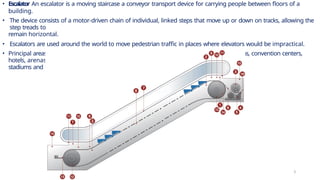
• Escalator An escalator is a moving staircase a conveyor transport device for carrying people between floors of a
building.
• The device consists of a motor-driven chain of individual, linked steps that move up or down on tracks, allowing the
step treads to
remain horizontal.
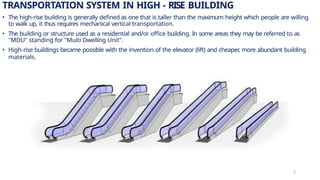
• Escalators are used around the world to move pedestrian traffic in places where elevators would be impractical.
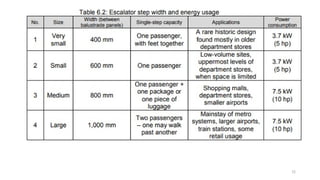
• Principal areas of usage include department stores, shopping malls, airports, transit systems, convention centers,
hotels, arenas,
stadiums and public buildings.
3
• The Advantages and Disadvantages of Escalators, like moving walkways, are often powered by constant-speed
alternating current
motors and move at approximately 0.3 - 0.6 m per second.
• The typical angle of inclination of an escalator to the horizontal floor level is 30 degrees with a standard
rise[clarification needed] up to about 18 m.
• Modern escalators have single-piece aluminum or stainless steel steps that move on a system of tracks in a
continuous loop.Advantages Disadvantages
Have the capacity to transport
large number of people at
shorter time.
Only convenient for short vertical
distance, better to use lifts for
lengthier vertical distance
Faster mode of transportation for
short vertical distances
Takes up space to install
Can be placed/substituted as normal
staircase even during malfunction.
Higher risk of injuries
No waiting internal except during
heavy traffic
May be weather – proved for outdoor
use
Moves at a constant speed at
approximately 0.3-0.6m per second
with a standard rise up to about 18m
4
D e s i g n a n d L a y o u t C o n s i d e r a t i o n
o f E s c a l a
t o r
Handrails- Escalators are required to have moving handrails that keep pace with the
movement of the
steps. This helps riders steady themselves, especially when stepping onto the moving stairs.
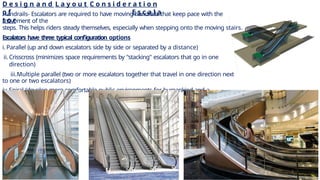
Escalators have three typical configuration options
i.Parallel (up and down escalators side by side or separated by a distance)
ii.Crisscross (minimizes space requirements by "stacking" escalators that go in one
direction)
iii.Multiple parallel (two or more escalators together that travel in one direction next
to one or two escalators)
iv.Spiral (develop more comfortable public environments for humankind and a
pioneering
technology)
5
• A number of factors affect escalator design
1. P h y s i c a l r e q u i r e m e n t s - Physical factors like the vertical and horizontal distance to be spanned
must be considered. These factors will determine the pitch of the escalator and its actual length. The ability of the
building infrastructure to support the heavy components is also a critical physical concern.
2. L o c a t i o n - Location is important because escalators should be situated where they can be easily seen by the
general public. In
department stores, customers should be able to view the merchandise easily.
3. Tr a f f i c p a t t e r n s - Up and down escalator traffic should be physically separated and should not lead into
confined spaces. Traffic patterns must also be anticipated in escalator design. In some buildings, the objective is
simply to move people from one floor to another
, but in others there may be a more specific requirement, such as
funneling visitors towards a main exit or exhibit. The number of passengers is important because escalators are
designed to carry a certain maximum number of people.
4. S a f e t y c o n s i d e r a t i o n s - Escalators help in controlling traffic flow of people. For example, an
escalator to an exit effectively discourages most people from using it as an entrance, and may reduce security
concerns. Similarly, escalators often are used as the exit of airport security checkpoints. Such an egress point
would generally be staffed to prevent its use as an entrance, as well. It is preferred that staircases be located
adjacent to the escalator if the escalator is the primary means of transport between floors. It may also be
necessary to provide an elevator lift adjacent to an escalator for wheelchairs and disabled persons.
5. A e s t h e t i c p r e f e r e n c e s - Consideration should be given to the aesthetics of the escalator
. The
architects and designers can choose from a wide range of styles and colors for the handrails and balustrades.
6
Escalator Component
Landing platforms
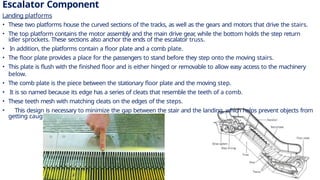
• These two platforms house the curved sections of the tracks, as well as the gears and motors that drive the stairs.
• The top platform contains the motor assembly and the main drive gear
, while the bottom holds the step return
idler sprockets. These sections also anchor the ends of the escalator truss.
• In addition, the platforms contain a floor plate and a comb plate.
• The floor plate provides a place for the passengers to stand before they step onto the moving stairs.
• This plate is flush with the finished floor and is either hinged or removable to allow easy access to the machinery
below.
• The comb plate is the piece between the stationary floor plate and the moving step.
• It is so named because its edge has a series of cleats that resemble the teeth of a comb.
• These teeth mesh with matching cleats on the edges of the steps.
• This design is necessary to minimize the gap between the stair and the landing, which helps prevent objects from
getting caught in the gap.
7
Truss :
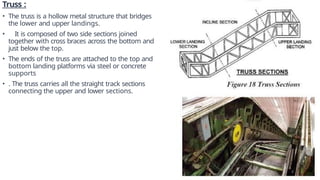
• The truss is a hollow metal structure that bridges
the lower and upper landings.
• It is composed of two side sections joined
together with cross braces across the bottom and
just below the top.
• The ends of the truss are attached to the top and
bottom landing platforms via steel or concrete
supports
• . The truss carries all the straight track sections
connecting the upper and lower sections.
8
T r a c k s
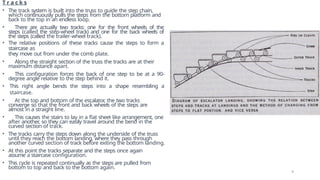
• The track system is built into the truss to guide the step chain,
which continuously pulls the steps from the bottom platform and
back to the top in an endless loop.
• There are actually two tracks: one for the front wheels of the
steps (called the step-wheel track) and one for the back wheels of
the steps (called the trailer-wheel track).
• The relative positions of these tracks cause the steps to form a
staircase as
they move out from under the comb plate.
• Along the straight section of the truss the tracks are at their
maximum distance apart.
• This configuration forces the back of one step to be at a 90-
degree angle relative to the step behind it.
• This right angle bends the steps into a shape resembling a
staircase.
• At the top and bottom of the escalator
, the two tracks
converge so that the front and back wheels of the steps are
almost in a straight line.
• This causes the stairs to lay in a flat sheet like arrangement, one
after another
, so they can easily travel around the bend in the
curved section of track.
• The tracks carry the steps down along the underside of the truss
until they reach the bottom landing, where they pass through
another curved section of track before exiting the bottom landing.
• At this point the tracks separate and the steps once again
assume a staircase configuration.
• This cycle is repeated continually as the steps are pulled from
bottom to top and back to the bottom again.
9
Steps
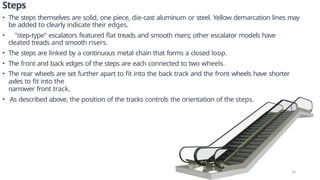
• The steps themselves are solid, one piece, die-cast aluminum or steel. Yellow demarcation lines may
be added to clearly indicate their edges.
• "step-type" escalators featured flat treads and smooth risers; other escalator models have
cleated treads and smooth risers.
• The steps are linked by a continuous metal chain that forms a closed loop.
• The front and back edges of the steps are each connected to two wheels.
• The rear wheels are set further apart to fit into the back track and the front wheels have shorter
axles to fit into the
narrower front track.
• As described above, the position of the tracks controls the orientation of the steps.
10
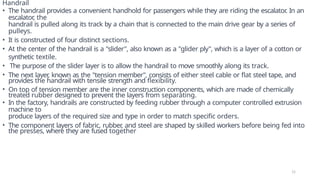
Handrail
• The handrail provides a convenient handhold for passengers while they are riding the escalator
. In an
escalator
, the
handrail is pulled along its track by a chain that is connected to the main drive gear by a series of
pulleys.
• It is constructed of four distinct sections.
• At the center of the handrail is a "slider", also known as a "glider ply", which is a layer of a cotton or
synthetic textile.
• The purpose of the slider layer is to allow the handrail to move smoothly along its track.
• The next layer
, known as the "tension member", consists of either steel cable or flat steel tape, and
provides the handrail with tensile strength and flexibility.
• On top of tension member are the inner construction components, which are made of chemically
treated rubber designed to prevent the layers from separating.
• In the factory, handrails are constructed by feeding rubber through a computer controlled extrusion
machine to
produce layers of the required size and type in order to match specific orders.
• The component layers of fabric, rubber
, and steel are shaped by skilled workers before being fed into
the presses, where they are fused together
11
12
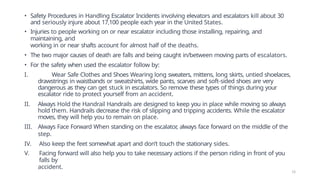
• Safety Procedures in Handling Escalator Incidents involving elevators and escalators kill about 30
and seriously injure about 17,100 people each year in the United States.
• Injuries to people working on or near escalator including those installing, repairing, and
maintaining, and
working in or near shafts account for almost half of the deaths.
• The two major causes of death are falls and being caught in/between moving parts of escalators.
• For the safety when used the escalator follow by:
I. Wear Safe Clothes and Shoes Wearing long sweaters, mittens, long skirts, untied shoelaces,
drawstrings in waistbands or sweatshirts, wide pants, scarves and soft-sided shoes are very
dangerous as they can get stuck in escalators. So remove these types of things during your
escalator ride to protect yourself from an accident.
II. Always Hold the Handrail Handrails are designed to keep you in place while moving so always
hold them. Handrails decrease the risk of slipping and tripping accidents. While the escalator
moves, they will help you to remain on place.
III. Always Face Forward When standing on the escalator
, always face forward on the middle of the
step.
IV. Also keep the feet somewhat apart and don’t touch the stationary sides.
V. Facing forward will also help you to take necessary actions if the person riding in front of you
falls by
accident.
13
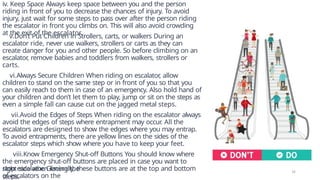
iv. Keep Space Always keep space between you and the person
riding in front of you to decrease the chances of injury. To avoid
injury, just wait for some steps to pass over after the person riding
the escalator in front you climbs on. This will also avoid crowding
at the exit of the escalator.
v.Don’t Put Children in Strollers, carts, or walkers During an
escalator ride, never use walkers, strollers or carts as they can
create danger for you and other people. So before climbing on an
escalator
, remove babies and toddlers from walkers, strollers or
carts.
vi.Always Secure Children When riding on escalator
, allow
children to stand on the same step or in front of you so that you
can easily reach to them in case of an emergency. Also hold hand of
your children and don’t let them to play, jump or sit on the steps as
even a simple fall can cause cut on the jagged metal steps.
vii.Avoid the Edges of Steps When riding on the escalator always
avoid the edges of steps where entrapment may occur
. All the
escalators are designed to show the edges where you may entrap.
To avoid entrapments, there are yellow lines on the sides of the
escalator steps which show where you have to keep your feet.
viii.Know Emergency Shut-off Buttons You should know where
the emergency shut-off buttons are placed in case you want to
stop escalator. Generally, these buttons are at the top and bottom
of escalators on the
right side when facing the
steps.
14
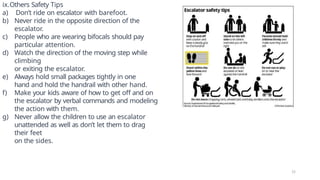
ix.Others Safety Tips
a) Don’t ride on escalator with barefoot.
b) Never ride in the opposite direction of the
escalator.
c) People who are wearing bifocals should pay
particular attention.
d) Watch the direction of the moving step while
climbing
or exiting the escalator.
e) Always hold small packages tightly in one
hand and hold the handrail with other hand.
f) Make your kids aware of how to get off and on
the escalator by verbal commands and modeling
the action with them.
g) Never allow the children to use an escalator
unattended as well as don’t let them to drag
their feet
on the sides.
15
16
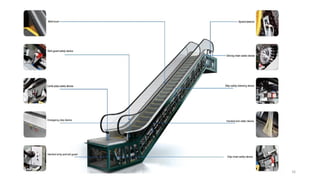
• Green light : takes care of the passengers riding safety.
• Non reversing safety device: stops escalator if the direction of the operation is reversed.
• Handrail static device: prevents static energy with handrail rollers instead blocking static
electricity.
• Driving Chain safety Device: stops escalator if the driving chain breaks
• Step safety switch: stops escalator if the steps are acting abnormal.
• Emergency stop device: in an emergency , stop the escalator immediately, if pressed.
• Skirt guard safety device: stop escalator if objects are caught between step and skirt.
• Comb plate safety switch: stop escalator if objects re caught between comb plate and
step thread.
• Entry switch: stop escalator if hand or object is pulled into the handrail inlet.
• Step chain safety device: stops the escalator is the step chain breaks or becomes loose.
• Step roller safety device: stops escalator if steps are operating in abnormal manner. 17
Module 3 – MECHANICAL TRANSPORTATION SYSTEMS IN BUILDINGS
3.2
Escal
ators
and
Trav
elato
rs
3.2.1 Introduction
Escalators and travelators are mechanical devices designed to transport people vertically or horizontally within buildings, providing convenient and efficient means of
transportation.
A brief history of escalators and travelators:
Escalators:
Escalators were invented by Jesse W. Reno in 1891, who called them "inclined elevators." The first working escalator was
installed in Coney Island, New York, as an amusement ride. However, it was Charles D. Seeberger who further developed
and commercialized the concept, leading to the widespread use of escalators in public spaces and buildings.
Over the years, escalator technology evolved with various improvements and advancements. In 1899, George A. Wheeler
introduced the step-type escalator, which had a continuous loop of flat steps. In 1900, the Otis Elevator Company purchased the
rights to the escalator and further refined its design and safety features.
Since then, escalators have become a common feature in many buildings, including shopping malls, airports, train stations, and
commercial complexes. They provide a convenient and efficient way for people to move between different floors.
Travelators:
Travelators, also known as moving walkways, are horizontal transportation systems that
assist people in moving over relatively long distances without exerting much physical
effort. The concept of travelators evolved from escalators.
In 1893, the first moving walkway was introduced at the Chicago World's Fair. However, it
was not until the 1950s that the travelator concept gained popularity and became a
significant feature in public transportation systems.
The development of travelators led to different variations,
such as bidirectional walkways, curved walkways, and inclined walkways. They are commonly found in airports, train stations, convention centers, and large public spaces where
people need to cover long distances quickly and comfortably.
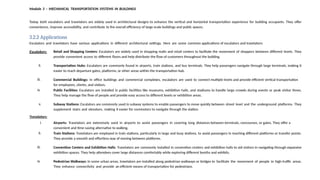
Figure 12: Image of an Escalator
Figure 13: Image of a Travelator
Module 3 – MECHANICAL TRANSPORTATION SYSTEMS IN BUILDINGS
Today, both escalators and travelators are widely used in architectural designs to enhance the vertical and horizontal transportation experience for building occupants. They offer
convenience, improve accessibility, and contribute to the overall efficiency of large-scale buildings and public spaces.
3.2.2 Applications
Escalators and travelators have various applications in different architectural settings. Here are some common applications of escalators and travelators:
Escalators:
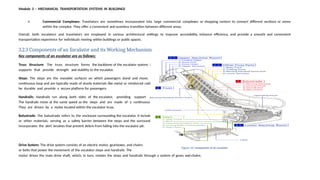
i. Retail and Shopping Centers: Escalators are widely used in shopping malls and retail centers to facilitate the movement of shoppers between different levels. They
provide convenient access to different floors and help distribute the flow of customers throughout the building.
ii. Transportation Hubs: Escalators are commonly found in airports, train stations, and bus terminals. They help passengers navigate through large terminals, making it
easier to reach departure gates, platforms, or other areas within the transportation hub.
iii. Commercial Buildings: In office buildings and commercial complexes, escalators are used to connect multiple levels and provide efficient vertical transportation
for employees, clients, and visitors.
iv. Public Facilities: Escalators are installed in public facilities like museums, exhibition halls, and stadiums to handle large crowds during events or peak visitor times.
They help manage the flow of people and provide easy access to different levels or exhibition areas.
v. Subway Stations: Escalators are commonly used in subway systems to enable passengers to move quickly between street level and the underground platforms. They
supplement stairs and elevators, making it easier for commuters to navigate through the station.
Travelators:
i. Airports: Travelators are extensively used in airports to assist passengers in covering long distances between terminals, concourses, or gates. They offer a
convenient and time-saving alternative to walking.
ii. Train Stations: Travelators are employed in train stations, particularly in large and busy stations, to assist passengers in reaching different platforms or transfer points.
They provide a smooth and effortless way of moving between platforms.
iii. Convention Centers and Exhibition Halls: Travelators are commonly installed in convention centers and exhibition halls to aid visitors in navigating through expansive
exhibition spaces. They help attendees cover large distances comfortably while exploring different booths and exhibits.
iv. Pedestrian Walkways: In some urban areas, travelators are installed along pedestrian walkways or bridges to facilitate the movement of people in high-traffic areas.
They enhance connectivity and provide an efficient means of transportation for pedestrians.
Module 3 – MECHANICAL TRANSPORTATION SYSTEMS IN BUILDINGS
v. Commercial Complexes: Travelators are sometimes incorporated into large commercial complexes or shopping centers to connect different sections or zones
within the complex. They offer a convenient and seamless transition between different areas.
Overall, both escalators and travelators are employed in various architectural settings to improve accessibility, enhance efficiency, and provide a smooth and convenient
transportation experience for individuals moving within buildings or public spaces.
3.2.3 Components of an Escalator and its Working Mechanism
Key components of an escalator are as follows:
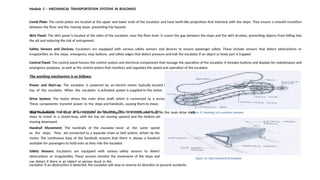
Truss Structure: The truss structure forms the backbone of the escalator system. It consists of metal beams and
supports that provide strength and stability to the escalator.
Steps: The steps are the movable surfaces on which passengers stand and move. They are linked together in a
continuous loop and are typically made of sturdy materials like metal or reinforced rubber. The steps are designed to
be durable and provide a secure platform for passengers.
Handrails: Handrails run along both sides of the escalator, providing support and stability for passengers.
The handrails move at the same speed as the steps and are made of a continuous loop of rubberized material.
They are driven by a motor located within the escalator truss.
Balustrade: The balustrade refers to the enclosure surrounding the escalator. It includes panels made of glass, metal,
or other materials, serving as a safety barrier between the steps and the surrounding area. The balustrade also
incorporates the skirt brushes that prevent debris from falling into the escalator pit.
Drive System: The drive system consists of an electric motor, gearboxes, and chains
or belts that power the movement of the escalator steps and handrails. The
motor drives the main drive shaft, which, in turn, rotates the steps and handrails through a system of gears and chains.
Figure 14: Components of an escalator
Module 3 – MECHANICAL TRANSPORTATION SYSTEMS IN BUILDINGS
Comb Plate: The comb plates are located at the upper and lower ends of the escalator and have teeth-like projections that interlock with the steps. They ensure a smooth transition
between the floor and the moving steps, preventing trip hazards.
Skirt Panel: The skirt panel is located at the sides of the escalator, near the floor level. It covers the gap between the steps and the skirt brushes, preventing objects from falling into
the pit and reducing the risk of entrapment.
Safety Sensors and Devices: Escalators are equipped with various safety sensors and devices to ensure passenger safety. These include sensors that detect obstructions or
irregularities on the steps, emergency stop buttons, and safety edges that detect pressure and halt the escalator if an object or body part is trapped.
Control Panel: The control panel houses the control system and electrical components that manage the operation of the escalator. It includes buttons and displays for maintenance and
emergency purposes, as well as the control system that monitors and regulates the speed and operation of the escalator.
The working mechanism is as follows:
Power and Start-up: The escalator is powered by an electric motor, typically located in the machine room or at the
top of the escalator. When the escalator is activated, power is supplied to the motor.
Drive System: The motor drives the main drive shaft, which is connected to a series of gears and chains or belts.
These components transmit power to the steps and handrails, causing them to move.
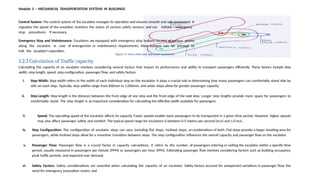
Step Movement: The steps of an escalator are linked together in a continuous loop. As the main drive shaft
rotates, it drives a chain or belt connected to the steps. This movement causes the
steps to travel in a closed loop, with the top set moving upward and the bottom set
moving downward.
Handrail Movement: The handrails of the escalator move at the same speed
as the steps. They are connected to a separate chain or belt system, driven by the
motor. The continuous loop of the handrails ensures that there is always a handrail
available for passengers to hold onto as they ride the escalator.
Safety Sensors: Escalators are equipped with various safety sensors to detect
obstructions or irregularities. These sensors monitor the movement of the steps and
can detect if there is an object or person stuck in the
escalator. If an obstruction is detected, the escalator will stop or reverse its direction to prevent accidents.
Figure 15: Workings of a escalator overview
Figure 16: Step movement of escalator
iii. Speed: The operating speed of the escalator affects its capacity. Faster speeds enable more passengers to be transported in a given time period. However, higher speeds
may also affect passenger safety and comfort. The typical speed range for escalators is between 0.5 meters per second (m/s) and 1.0 m/s.
iv. Step Configuration: The configuration of escalator steps can vary, including flat steps, inclined steps, or combinations of both. Flat steps provide a larger standing area for
passengers, while inclined steps allow for a smoother transition between steps. The step configuration influences the overall capacity and passenger flow on the escalator.
v. Passenger Flow: Passenger flow is a crucial factor in capacity calculations. It refers to the number of passengers entering or exiting the escalator within a specific time
period, usually measured in passengers per minute (PPM) or passengers per hour (PPH). Estimating passenger flow involves considering factors such as building occupancy,
peak traffic periods, and expected user demand.
vi. Safety Factors: Safety considerations are essential when calculating the capacity of an escalator. Safety factors account for unexpected variations in passenger flow, the
need for emergency evacuation routes, and
Module 3 – MECHANICAL TRANSPORTATION SYSTEMS IN BUILDINGS
Control System: The control system of the escalator manages its operation and ensures smooth and safe movement. It
regulates the speed of the escalator, monitors the status of various safety sensors, and can initiate emergency
stop procedures if necessary.
Emergency Stop and Maintenance: Escalators are equipped with emergency stop buttons located at various points
along the escalator. In case of emergencies or maintenance requirements, these buttons can be pressed to
halt the escalator's operation.
Figure 17: Drive chain and step chain mechanism
3.2.3 Calculation of Traffic capacity
Calculating the capacity of an escalator involves considering several factors that impact its performance and ability to transport passengers efficiently. These factors include step
width, step length, speed, step configuration, passenger flow, and safety factors.
i. Step Width: Step width refers to the width of each individual step on the escalator. It plays a crucial role in determining how many passengers can comfortably stand side by
side on each step. Typically, step widths range from 600mm to 1,000mm, and wider steps allow for greater passenger capacity.
ii. Step Length: Step length is the distance between the front edge of one step and the front edge of the next step. Longer step lengths provide more space for passengers to
comfortably stand. The step length is an important consideration for calculating the effective width available for passengers.
Module 3 – MECHANICAL TRANSPORTATION SYSTEMS IN BUILDINGS
compliance with safety regulations. Including safety factors in capacity calculations ensures that the escalator can handle potential peak demand while maintaining passenger
safety.
vii. Code and Standards: Capacity calculations for escalators also consider local building codes and standards specific to escalator design and operation. These codes
provide guidelines on factors such as step width, step length, speed, and safety requirements to ensure that the escalator meets industry standards and
regulations.
By considering these factors in capacity calculations, architects, engineers, and designers can determine the appropriate size, speed, and configuration of escalators to
efficiently transport passengers in buildings. This ensures that the escalators can handle the expected passenger flow, while also meeting safety standards and providing a
comfortable user experience.
3.2.4 Location and arrangement of escalators and travelators
Determining the location and arrangements of escalators and travelators at the architectural planning stage involves considering factors such as building design, user flow,
accessibility, space constraints, and aesthetic integration.
Step-by-step approach to determining their placement is as follows:
i. Analyze User Flow: Study the intended flow of people within the building to identify key areas where vertical or horizontal transportation is required. Consider factors such
as entrances, exits, main circulation routes, gathering areas, and areas with high user density. Determine the primary paths that users will take and identify the most
efficient locations for escalators or travelators.
ii. Evaluate Space Constraints: Assess the available space within the building to determine the feasibility of installing escalators or travelators. Consider factors such as floor
plans, vertical heights, structural limitations, and the footprint required for the transportation systems. Take note of any obstructions or architectural features that may
impact the placement of escalators or travelators.
iii. Consider Accessibility Requirements: Ensure compliance with accessibility regulations and guidelines. Identify areas that require accessibility solutions, such as
wheelchair ramps or elevators in addition to or instead of escalators or travelators. Ensure that the chosen locations for escalators or travelators provide easy access
for all users, including those with disabilities.
iv. Integrate with Architectural Design: Seek a balance between functional requirements and architectural aesthetics. Collaborate with architects and designers to integrate
the escalators or travelators seamlessly into the building's overall design concept. Consider factors such as materials, finishes, lighting, and spatial relationships to
create a visually appealing and harmonious integration.
v. Optimize Traffic Flow: Design the arrangement of escalators or travelators to optimize user traffic flow and minimize congestion. Consider factors such as the capacity of the
transportation systems, anticipated user flow, and the desired level of service. Place escalators or travelators at strategic points along primary circulation routes to
facilitate efficient movement between floors or across long distances.
Module 3 – MECHANICAL TRANSPORTATION SYSTEMS IN BUILDINGS
vi. Enhance Visibility and Wayfinding: Ensure that the escalators or travelators are easily visible and identifiable to users. Consider sightlines, signage, and visual cues to
guide users to the transportation systems. Incorporate clear wayfinding elements to indicate the locations of escalators or travelators, making it intuitive for users to find and
access them.
vii. Safety Considerations: Prioritize safety in the placement of escalators or travelators. Ensure sufficient space for users to enter and exit the systems safely. Consider the
proximity to other building elements, such as walls, columns, or staircases, to prevent any hazards or obstructions. Follow safety codes and regulations specific to
escalator and travelator design and installation.
viii. Collaborate with Experts: Engage with specialized consultants or manufacturers who have expertise in escalator and travelator design. They can provide valuable
input on factors such as technical requirements, spatial constraints, and code compliance. Collaborating with experts ensures that the chosen locations and
arrangements align with industry best practices and safety standards.
By following these steps and considering the unique requirements and constraints of the building, architects and designers can strategically determine the location and
arrangements of escalators and travelators during the architectural planning stage. This will help create efficient, accessible, and visually appealing transportation systems that
enhance the overall user experience within the building.
END

M3 ESCALATORS BUILDING SERVICES III ARCHITECTURE

  • 1.
  • 2.
    TRANSPORTATION SYSTEM INHIGH - RISE BUILDING • The high-rise building is generally defined as one that is taller than the maximum height which people are willing to walk up, it thus requires mechanical vertical transportation. • The building or structure used as a residential and/or office building. In some areas they may be referred to as "MDU" standing for "Multi Dwelling Unit". • High-rise buildings became possible with the invention of the elevator (lift) and cheaper , more abundant building materials. 2
  • 3.
    • Escalator Anescalator is a moving staircase a conveyor transport device for carrying people between floors of a building. • The device consists of a motor-driven chain of individual, linked steps that move up or down on tracks, allowing the step treads to remain horizontal. • Escalators are used around the world to move pedestrian traffic in places where elevators would be impractical. • Principal areas of usage include department stores, shopping malls, airports, transit systems, convention centers, hotels, arenas, stadiums and public buildings. 3

  • 4.
    • The Advantagesand Disadvantages of Escalators, like moving walkways, are often powered by constant-speed alternating current motors and move at approximately 0.3 - 0.6 m per second. • The typical angle of inclination of an escalator to the horizontal floor level is 30 degrees with a standard rise[clarification needed] up to about 18 m. • Modern escalators have single-piece aluminum or stainless steel steps that move on a system of tracks in a continuous loop.Advantages Disadvantages Have the capacity to transport large number of people at shorter time. Only convenient for short vertical distance, better to use lifts for lengthier vertical distance Faster mode of transportation for short vertical distances Takes up space to install Can be placed/substituted as normal staircase even during malfunction. Higher risk of injuries No waiting internal except during heavy traffic May be weather – proved for outdoor use Moves at a constant speed at approximately 0.3-0.6m per second with a standard rise up to about 18m 4
  • 5.
    D e si g n a n d L a y o u t C o n s i d e r a t i o n o f E s c a l a t o r Handrails- Escalators are required to have moving handrails that keep pace with the movement of the steps. This helps riders steady themselves, especially when stepping onto the moving stairs. Escalators have three typical configuration options i.Parallel (up and down escalators side by side or separated by a distance) ii.Crisscross (minimizes space requirements by "stacking" escalators that go in one direction) iii.Multiple parallel (two or more escalators together that travel in one direction next to one or two escalators) iv.Spiral (develop more comfortable public environments for humankind and a pioneering technology) 5
  • 6.
    • A numberof factors affect escalator design 1. P h y s i c a l r e q u i r e m e n t s - Physical factors like the vertical and horizontal distance to be spanned must be considered. These factors will determine the pitch of the escalator and its actual length. The ability of the building infrastructure to support the heavy components is also a critical physical concern. 2. L o c a t i o n - Location is important because escalators should be situated where they can be easily seen by the general public. In department stores, customers should be able to view the merchandise easily. 3. Tr a f f i c p a t t e r n s - Up and down escalator traffic should be physically separated and should not lead into confined spaces. Traffic patterns must also be anticipated in escalator design. In some buildings, the objective is simply to move people from one floor to another , but in others there may be a more specific requirement, such as funneling visitors towards a main exit or exhibit. The number of passengers is important because escalators are designed to carry a certain maximum number of people. 4. S a f e t y c o n s i d e r a t i o n s - Escalators help in controlling traffic flow of people. For example, an escalator to an exit effectively discourages most people from using it as an entrance, and may reduce security concerns. Similarly, escalators often are used as the exit of airport security checkpoints. Such an egress point would generally be staffed to prevent its use as an entrance, as well. It is preferred that staircases be located adjacent to the escalator if the escalator is the primary means of transport between floors. It may also be necessary to provide an elevator lift adjacent to an escalator for wheelchairs and disabled persons. 5. A e s t h e t i c p r e f e r e n c e s - Consideration should be given to the aesthetics of the escalator . The architects and designers can choose from a wide range of styles and colors for the handrails and balustrades. 6
  • 7.
    Escalator Component Landing platforms •These two platforms house the curved sections of the tracks, as well as the gears and motors that drive the stairs. • The top platform contains the motor assembly and the main drive gear , while the bottom holds the step return idler sprockets. These sections also anchor the ends of the escalator truss. • In addition, the platforms contain a floor plate and a comb plate. • The floor plate provides a place for the passengers to stand before they step onto the moving stairs. • This plate is flush with the finished floor and is either hinged or removable to allow easy access to the machinery below. • The comb plate is the piece between the stationary floor plate and the moving step. • It is so named because its edge has a series of cleats that resemble the teeth of a comb. • These teeth mesh with matching cleats on the edges of the steps. • This design is necessary to minimize the gap between the stair and the landing, which helps prevent objects from getting caught in the gap. 7
  • 8.
    Truss : • Thetruss is a hollow metal structure that bridges the lower and upper landings. • It is composed of two side sections joined together with cross braces across the bottom and just below the top. • The ends of the truss are attached to the top and bottom landing platforms via steel or concrete supports • . The truss carries all the straight track sections connecting the upper and lower sections. 8
  • 9.
    T r ac k s • The track system is built into the truss to guide the step chain, which continuously pulls the steps from the bottom platform and back to the top in an endless loop. • There are actually two tracks: one for the front wheels of the steps (called the step-wheel track) and one for the back wheels of the steps (called the trailer-wheel track). • The relative positions of these tracks cause the steps to form a staircase as they move out from under the comb plate. • Along the straight section of the truss the tracks are at their maximum distance apart. • This configuration forces the back of one step to be at a 90- degree angle relative to the step behind it. • This right angle bends the steps into a shape resembling a staircase. • At the top and bottom of the escalator , the two tracks converge so that the front and back wheels of the steps are almost in a straight line. • This causes the stairs to lay in a flat sheet like arrangement, one after another , so they can easily travel around the bend in the curved section of track. • The tracks carry the steps down along the underside of the truss until they reach the bottom landing, where they pass through another curved section of track before exiting the bottom landing. • At this point the tracks separate and the steps once again assume a staircase configuration. • This cycle is repeated continually as the steps are pulled from bottom to top and back to the bottom again. 9
  • 10.
    Steps • The stepsthemselves are solid, one piece, die-cast aluminum or steel. Yellow demarcation lines may be added to clearly indicate their edges. • "step-type" escalators featured flat treads and smooth risers; other escalator models have cleated treads and smooth risers. • The steps are linked by a continuous metal chain that forms a closed loop. • The front and back edges of the steps are each connected to two wheels. • The rear wheels are set further apart to fit into the back track and the front wheels have shorter axles to fit into the narrower front track. • As described above, the position of the tracks controls the orientation of the steps. 10
  • 11.
    Handrail • The handrailprovides a convenient handhold for passengers while they are riding the escalator . In an escalator , the handrail is pulled along its track by a chain that is connected to the main drive gear by a series of pulleys. • It is constructed of four distinct sections. • At the center of the handrail is a "slider", also known as a "glider ply", which is a layer of a cotton or synthetic textile. • The purpose of the slider layer is to allow the handrail to move smoothly along its track. • The next layer , known as the "tension member", consists of either steel cable or flat steel tape, and provides the handrail with tensile strength and flexibility. • On top of tension member are the inner construction components, which are made of chemically treated rubber designed to prevent the layers from separating. • In the factory, handrails are constructed by feeding rubber through a computer controlled extrusion machine to produce layers of the required size and type in order to match specific orders. • The component layers of fabric, rubber , and steel are shaped by skilled workers before being fed into the presses, where they are fused together 11
  • 12.
  • 13.
    • Safety Proceduresin Handling Escalator Incidents involving elevators and escalators kill about 30 and seriously injure about 17,100 people each year in the United States. • Injuries to people working on or near escalator including those installing, repairing, and maintaining, and working in or near shafts account for almost half of the deaths. • The two major causes of death are falls and being caught in/between moving parts of escalators. • For the safety when used the escalator follow by: I. Wear Safe Clothes and Shoes Wearing long sweaters, mittens, long skirts, untied shoelaces, drawstrings in waistbands or sweatshirts, wide pants, scarves and soft-sided shoes are very dangerous as they can get stuck in escalators. So remove these types of things during your escalator ride to protect yourself from an accident. II. Always Hold the Handrail Handrails are designed to keep you in place while moving so always hold them. Handrails decrease the risk of slipping and tripping accidents. While the escalator moves, they will help you to remain on place. III. Always Face Forward When standing on the escalator , always face forward on the middle of the step. IV. Also keep the feet somewhat apart and don’t touch the stationary sides. V. Facing forward will also help you to take necessary actions if the person riding in front of you falls by accident. 13
  • 14.
    iv. Keep SpaceAlways keep space between you and the person riding in front of you to decrease the chances of injury. To avoid injury, just wait for some steps to pass over after the person riding the escalator in front you climbs on. This will also avoid crowding at the exit of the escalator. v.Don’t Put Children in Strollers, carts, or walkers During an escalator ride, never use walkers, strollers or carts as they can create danger for you and other people. So before climbing on an escalator , remove babies and toddlers from walkers, strollers or carts. vi.Always Secure Children When riding on escalator , allow children to stand on the same step or in front of you so that you can easily reach to them in case of an emergency. Also hold hand of your children and don’t let them to play, jump or sit on the steps as even a simple fall can cause cut on the jagged metal steps. vii.Avoid the Edges of Steps When riding on the escalator always avoid the edges of steps where entrapment may occur . All the escalators are designed to show the edges where you may entrap. To avoid entrapments, there are yellow lines on the sides of the escalator steps which show where you have to keep your feet. viii.Know Emergency Shut-off Buttons You should know where the emergency shut-off buttons are placed in case you want to stop escalator. Generally, these buttons are at the top and bottom of escalators on the right side when facing the steps. 14
  • 15.
    ix.Others Safety Tips a)Don’t ride on escalator with barefoot. b) Never ride in the opposite direction of the escalator. c) People who are wearing bifocals should pay particular attention. d) Watch the direction of the moving step while climbing or exiting the escalator. e) Always hold small packages tightly in one hand and hold the handrail with other hand. f) Make your kids aware of how to get off and on the escalator by verbal commands and modeling the action with them. g) Never allow the children to use an escalator unattended as well as don’t let them to drag their feet on the sides. 15
  • 16.
  • 17.
    • Green light: takes care of the passengers riding safety. • Non reversing safety device: stops escalator if the direction of the operation is reversed. • Handrail static device: prevents static energy with handrail rollers instead blocking static electricity. • Driving Chain safety Device: stops escalator if the driving chain breaks • Step safety switch: stops escalator if the steps are acting abnormal. • Emergency stop device: in an emergency , stop the escalator immediately, if pressed. • Skirt guard safety device: stop escalator if objects are caught between step and skirt. • Comb plate safety switch: stop escalator if objects re caught between comb plate and step thread. • Entry switch: stop escalator if hand or object is pulled into the handrail inlet. • Step chain safety device: stops the escalator is the step chain breaks or becomes loose. • Step roller safety device: stops escalator if steps are operating in abnormal manner. 17
  • 18.
    Module 3 –MECHANICAL TRANSPORTATION SYSTEMS IN BUILDINGS 3.2 Escal ators and Trav elato rs 3.2.1 Introduction Escalators and travelators are mechanical devices designed to transport people vertically or horizontally within buildings, providing convenient and efficient means of transportation. A brief history of escalators and travelators: Escalators: Escalators were invented by Jesse W. Reno in 1891, who called them "inclined elevators." The first working escalator was installed in Coney Island, New York, as an amusement ride. However, it was Charles D. Seeberger who further developed and commercialized the concept, leading to the widespread use of escalators in public spaces and buildings. Over the years, escalator technology evolved with various improvements and advancements. In 1899, George A. Wheeler introduced the step-type escalator, which had a continuous loop of flat steps. In 1900, the Otis Elevator Company purchased the rights to the escalator and further refined its design and safety features. Since then, escalators have become a common feature in many buildings, including shopping malls, airports, train stations, and commercial complexes. They provide a convenient and efficient way for people to move between different floors. Travelators: Travelators, also known as moving walkways, are horizontal transportation systems that assist people in moving over relatively long distances without exerting much physical effort. The concept of travelators evolved from escalators. In 1893, the first moving walkway was introduced at the Chicago World's Fair. However, it was not until the 1950s that the travelator concept gained popularity and became a significant feature in public transportation systems. The development of travelators led to different variations, such as bidirectional walkways, curved walkways, and inclined walkways. They are commonly found in airports, train stations, convention centers, and large public spaces where people need to cover long distances quickly and comfortably. Figure 12: Image of an Escalator Figure 13: Image of a Travelator
  • 19.
    Module 3 –MECHANICAL TRANSPORTATION SYSTEMS IN BUILDINGS Today, both escalators and travelators are widely used in architectural designs to enhance the vertical and horizontal transportation experience for building occupants. They offer convenience, improve accessibility, and contribute to the overall efficiency of large-scale buildings and public spaces. 3.2.2 Applications Escalators and travelators have various applications in different architectural settings. Here are some common applications of escalators and travelators: Escalators: i. Retail and Shopping Centers: Escalators are widely used in shopping malls and retail centers to facilitate the movement of shoppers between different levels. They provide convenient access to different floors and help distribute the flow of customers throughout the building. ii. Transportation Hubs: Escalators are commonly found in airports, train stations, and bus terminals. They help passengers navigate through large terminals, making it easier to reach departure gates, platforms, or other areas within the transportation hub. iii. Commercial Buildings: In office buildings and commercial complexes, escalators are used to connect multiple levels and provide efficient vertical transportation for employees, clients, and visitors. iv. Public Facilities: Escalators are installed in public facilities like museums, exhibition halls, and stadiums to handle large crowds during events or peak visitor times. They help manage the flow of people and provide easy access to different levels or exhibition areas. v. Subway Stations: Escalators are commonly used in subway systems to enable passengers to move quickly between street level and the underground platforms. They supplement stairs and elevators, making it easier for commuters to navigate through the station. Travelators: i. Airports: Travelators are extensively used in airports to assist passengers in covering long distances between terminals, concourses, or gates. They offer a convenient and time-saving alternative to walking. ii. Train Stations: Travelators are employed in train stations, particularly in large and busy stations, to assist passengers in reaching different platforms or transfer points. They provide a smooth and effortless way of moving between platforms. iii. Convention Centers and Exhibition Halls: Travelators are commonly installed in convention centers and exhibition halls to aid visitors in navigating through expansive exhibition spaces. They help attendees cover large distances comfortably while exploring different booths and exhibits. iv. Pedestrian Walkways: In some urban areas, travelators are installed along pedestrian walkways or bridges to facilitate the movement of people in high-traffic areas. They enhance connectivity and provide an efficient means of transportation for pedestrians.
  • 20.
    Module 3 –MECHANICAL TRANSPORTATION SYSTEMS IN BUILDINGS v. Commercial Complexes: Travelators are sometimes incorporated into large commercial complexes or shopping centers to connect different sections or zones within the complex. They offer a convenient and seamless transition between different areas. Overall, both escalators and travelators are employed in various architectural settings to improve accessibility, enhance efficiency, and provide a smooth and convenient transportation experience for individuals moving within buildings or public spaces. 3.2.3 Components of an Escalator and its Working Mechanism Key components of an escalator are as follows: Truss Structure: The truss structure forms the backbone of the escalator system. It consists of metal beams and supports that provide strength and stability to the escalator. Steps: The steps are the movable surfaces on which passengers stand and move. They are linked together in a continuous loop and are typically made of sturdy materials like metal or reinforced rubber. The steps are designed to be durable and provide a secure platform for passengers. Handrails: Handrails run along both sides of the escalator, providing support and stability for passengers. The handrails move at the same speed as the steps and are made of a continuous loop of rubberized material. They are driven by a motor located within the escalator truss. Balustrade: The balustrade refers to the enclosure surrounding the escalator. It includes panels made of glass, metal, or other materials, serving as a safety barrier between the steps and the surrounding area. The balustrade also incorporates the skirt brushes that prevent debris from falling into the escalator pit. Drive System: The drive system consists of an electric motor, gearboxes, and chains or belts that power the movement of the escalator steps and handrails. The motor drives the main drive shaft, which, in turn, rotates the steps and handrails through a system of gears and chains. Figure 14: Components of an escalator
  • 21.
    Module 3 –MECHANICAL TRANSPORTATION SYSTEMS IN BUILDINGS Comb Plate: The comb plates are located at the upper and lower ends of the escalator and have teeth-like projections that interlock with the steps. They ensure a smooth transition between the floor and the moving steps, preventing trip hazards. Skirt Panel: The skirt panel is located at the sides of the escalator, near the floor level. It covers the gap between the steps and the skirt brushes, preventing objects from falling into the pit and reducing the risk of entrapment. Safety Sensors and Devices: Escalators are equipped with various safety sensors and devices to ensure passenger safety. These include sensors that detect obstructions or irregularities on the steps, emergency stop buttons, and safety edges that detect pressure and halt the escalator if an object or body part is trapped. Control Panel: The control panel houses the control system and electrical components that manage the operation of the escalator. It includes buttons and displays for maintenance and emergency purposes, as well as the control system that monitors and regulates the speed and operation of the escalator. The working mechanism is as follows: Power and Start-up: The escalator is powered by an electric motor, typically located in the machine room or at the top of the escalator. When the escalator is activated, power is supplied to the motor. Drive System: The motor drives the main drive shaft, which is connected to a series of gears and chains or belts. These components transmit power to the steps and handrails, causing them to move. Step Movement: The steps of an escalator are linked together in a continuous loop. As the main drive shaft rotates, it drives a chain or belt connected to the steps. This movement causes the steps to travel in a closed loop, with the top set moving upward and the bottom set moving downward. Handrail Movement: The handrails of the escalator move at the same speed as the steps. They are connected to a separate chain or belt system, driven by the motor. The continuous loop of the handrails ensures that there is always a handrail available for passengers to hold onto as they ride the escalator. Safety Sensors: Escalators are equipped with various safety sensors to detect obstructions or irregularities. These sensors monitor the movement of the steps and can detect if there is an object or person stuck in the escalator. If an obstruction is detected, the escalator will stop or reverse its direction to prevent accidents. Figure 15: Workings of a escalator overview Figure 16: Step movement of escalator
  • 22.
    iii. Speed: Theoperating speed of the escalator affects its capacity. Faster speeds enable more passengers to be transported in a given time period. However, higher speeds may also affect passenger safety and comfort. The typical speed range for escalators is between 0.5 meters per second (m/s) and 1.0 m/s. iv. Step Configuration: The configuration of escalator steps can vary, including flat steps, inclined steps, or combinations of both. Flat steps provide a larger standing area for passengers, while inclined steps allow for a smoother transition between steps. The step configuration influences the overall capacity and passenger flow on the escalator. v. Passenger Flow: Passenger flow is a crucial factor in capacity calculations. It refers to the number of passengers entering or exiting the escalator within a specific time period, usually measured in passengers per minute (PPM) or passengers per hour (PPH). Estimating passenger flow involves considering factors such as building occupancy, peak traffic periods, and expected user demand. vi. Safety Factors: Safety considerations are essential when calculating the capacity of an escalator. Safety factors account for unexpected variations in passenger flow, the need for emergency evacuation routes, and Module 3 – MECHANICAL TRANSPORTATION SYSTEMS IN BUILDINGS Control System: The control system of the escalator manages its operation and ensures smooth and safe movement. It regulates the speed of the escalator, monitors the status of various safety sensors, and can initiate emergency stop procedures if necessary. Emergency Stop and Maintenance: Escalators are equipped with emergency stop buttons located at various points along the escalator. In case of emergencies or maintenance requirements, these buttons can be pressed to halt the escalator's operation. Figure 17: Drive chain and step chain mechanism 3.2.3 Calculation of Traffic capacity Calculating the capacity of an escalator involves considering several factors that impact its performance and ability to transport passengers efficiently. These factors include step width, step length, speed, step configuration, passenger flow, and safety factors. i. Step Width: Step width refers to the width of each individual step on the escalator. It plays a crucial role in determining how many passengers can comfortably stand side by side on each step. Typically, step widths range from 600mm to 1,000mm, and wider steps allow for greater passenger capacity. ii. Step Length: Step length is the distance between the front edge of one step and the front edge of the next step. Longer step lengths provide more space for passengers to comfortably stand. The step length is an important consideration for calculating the effective width available for passengers.
  • 23.
    Module 3 –MECHANICAL TRANSPORTATION SYSTEMS IN BUILDINGS compliance with safety regulations. Including safety factors in capacity calculations ensures that the escalator can handle potential peak demand while maintaining passenger safety. vii. Code and Standards: Capacity calculations for escalators also consider local building codes and standards specific to escalator design and operation. These codes provide guidelines on factors such as step width, step length, speed, and safety requirements to ensure that the escalator meets industry standards and regulations. By considering these factors in capacity calculations, architects, engineers, and designers can determine the appropriate size, speed, and configuration of escalators to efficiently transport passengers in buildings. This ensures that the escalators can handle the expected passenger flow, while also meeting safety standards and providing a comfortable user experience. 3.2.4 Location and arrangement of escalators and travelators Determining the location and arrangements of escalators and travelators at the architectural planning stage involves considering factors such as building design, user flow, accessibility, space constraints, and aesthetic integration. Step-by-step approach to determining their placement is as follows: i. Analyze User Flow: Study the intended flow of people within the building to identify key areas where vertical or horizontal transportation is required. Consider factors such as entrances, exits, main circulation routes, gathering areas, and areas with high user density. Determine the primary paths that users will take and identify the most efficient locations for escalators or travelators. ii. Evaluate Space Constraints: Assess the available space within the building to determine the feasibility of installing escalators or travelators. Consider factors such as floor plans, vertical heights, structural limitations, and the footprint required for the transportation systems. Take note of any obstructions or architectural features that may impact the placement of escalators or travelators. iii. Consider Accessibility Requirements: Ensure compliance with accessibility regulations and guidelines. Identify areas that require accessibility solutions, such as wheelchair ramps or elevators in addition to or instead of escalators or travelators. Ensure that the chosen locations for escalators or travelators provide easy access for all users, including those with disabilities. iv. Integrate with Architectural Design: Seek a balance between functional requirements and architectural aesthetics. Collaborate with architects and designers to integrate the escalators or travelators seamlessly into the building's overall design concept. Consider factors such as materials, finishes, lighting, and spatial relationships to create a visually appealing and harmonious integration. v. Optimize Traffic Flow: Design the arrangement of escalators or travelators to optimize user traffic flow and minimize congestion. Consider factors such as the capacity of the transportation systems, anticipated user flow, and the desired level of service. Place escalators or travelators at strategic points along primary circulation routes to facilitate efficient movement between floors or across long distances.
  • 24.
    Module 3 –MECHANICAL TRANSPORTATION SYSTEMS IN BUILDINGS vi. Enhance Visibility and Wayfinding: Ensure that the escalators or travelators are easily visible and identifiable to users. Consider sightlines, signage, and visual cues to guide users to the transportation systems. Incorporate clear wayfinding elements to indicate the locations of escalators or travelators, making it intuitive for users to find and access them. vii. Safety Considerations: Prioritize safety in the placement of escalators or travelators. Ensure sufficient space for users to enter and exit the systems safely. Consider the proximity to other building elements, such as walls, columns, or staircases, to prevent any hazards or obstructions. Follow safety codes and regulations specific to escalator and travelator design and installation. viii. Collaborate with Experts: Engage with specialized consultants or manufacturers who have expertise in escalator and travelator design. They can provide valuable input on factors such as technical requirements, spatial constraints, and code compliance. Collaborating with experts ensures that the chosen locations and arrangements align with industry best practices and safety standards. By following these steps and considering the unique requirements and constraints of the building, architects and designers can strategically determine the location and arrangements of escalators and travelators during the architectural planning stage. This will help create efficient, accessible, and visually appealing transportation systems that enhance the overall user experience within the building. END