Elevators
ELECTRICTRACTIONELEVATORS
HYDRAULIC ELEVATORS
By : Rajat Nainwal
Historyof lifts
 Since the day of pyramids hand powered lifts and hoists were there
 Hand powered winches were used in China to lift water
 In colosseum lifts were used to lift gladiators and wild animals.
 Otis Elisha Graves was an American who invented first lift with an
automatic safety device in 1854 and demonstrated in Crystal
Palace.
 150 years later, the basic components of a typical lift installation
remains the same.
 Mechanical parts such as machine, suspension system, guide shoes
and rails, gearing sheave, car and counterweight are the same.
 Changes- drive control, signaling, monitoring
 In the past lift services were almost an afterthought with Machine
rooms located in out of way places.
 Today lifts are regarded as one of the building’s main services.
Lift capacity and performance
A detailed analysis of the morning peak traffic-up peak traffic , down peak traffic and
inter floor traffic is required for taking a decision regarding the system to be
installed.
Three sets of data are required for the calculation of lift performance
1. Building data
 No of floors
 Distance between floors
2. Lift system data
 No of cars
 Rated capacity
 Flight times between floors
 Door opening times
 Door closing times
 Traffic control systems
3. Passenger data
 No of passengers boarding form specific floors
 No of passengers alighting at specific floors
 Traffic mode- uni or multi directional
 Time required for passengers to leave or enter the cars
Quantity of service
 No of people to use the lift system in the defined
period of time is the handling capacity, and is the
quantity of service
 The number of occupants vary according ot the
purpose of the building- residential, commercial,
institutional
 The quality of accommodation – more space for
occupant for more prestigious spaces.
Quantity of service
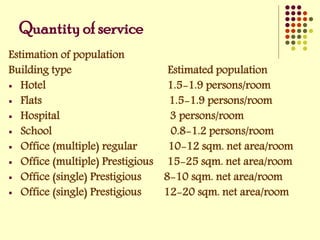
Estimation of population
Building type Estimated population
 Hotel 1.5-1.9 persons/room
 Flats 1.5-1.9 persons/room
 Hospital 3 persons/room
 School 0.8-1.2 persons/room
 Office (multiple) regular 10-12 sqm. net area/room
 Office (multiple) Prestigious 15-25 sqm. net area/room
 Office (single) Prestigious 8-10 sqm. net area/room
 Office (single) Prestigious 12-20 sqm. net area/room
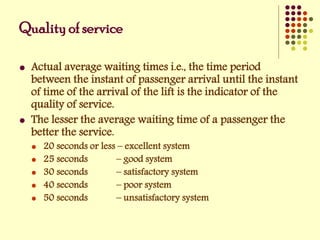
Qualityof service
 Actual average waiting times i.e., the time period
between the instant of passenger arrival until the instant
of time of the arrival of the lift is the indicator of the
quality of service.
 The lesser the average waiting time of a passenger the
better the service.
 20 seconds or less – excellent system
 25 seconds – good system
 30 seconds – satisfactory system
 40 seconds – poor system
 50 seconds – unsatisfactory system
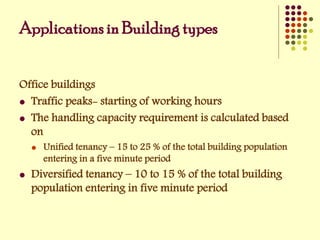
Applications in Building types
Office buildings
 Traffic peaks- starting of working hours
 The handling capacity requirement is calculated based
on
 Unified tenancy – 15 to 25 % of the total building population
entering in a five minute period
 Diversified tenancy – 10 to 15 % of the total building
population entering in five minute period
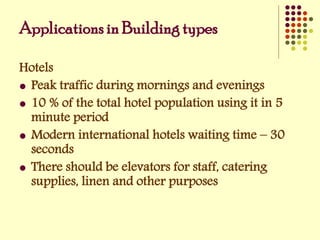
Hotels
 Peak traffic during mornings and evenings
 10 % of the total hotel population using it in 5
minute period
 Modern international hotels waiting time – 30
seconds
 There should be elevators for staff, catering
supplies, linen and other purposes
Applications in Building types
Residential
 Peak traffic density usually occurs in the early
morning, but peak will vary both in time and span
and in intensity
 Peak traffic value-6% of total building population
 Should be safe and easy to access
 Children and elderly and physically challenged
should be provided with convenient and safe means
of transport
Applications in Building types
Specialized buildings
 Leisure centres, shopping malls, retail
developments, air terminals, entertainment centres-
specialized buildings.
 Vertical transport facilities-Elevators and Escalators.
 Panoramic elevators used –for aesthetic reasons and
to provide viewing platforms.
Applications in Building types
Hospitals
 The lifts serve two functions – transportation of
patients, staff and public.
 The waiting time for bed lifts should be
minimum for emergencies
 Should provide for smooth ride, levels of
acceleration and jerks should be kept low.
 The lift groups for visitors should perform well
during visiting hours.
Applications in Building types
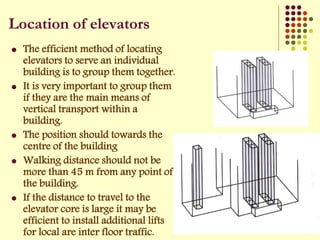
Location of elevators
 The efficient method of locating
elevators to serve an individual
building is to group them together.
 It is very important to group them
if they are the main means of
vertical transport within a
building.
 The position should towards the
centre of the building
 Walking distance should not be
more than 45 m from any point of
the building.
 If the distance to travel to the
elevator core is large it may be
efficient to install additional lifts
for local are inter floor traffic.
Grouping of elevators
 A group of elevators should be designed to be located
close to each other.
 Minimize the walking distance between lifts.
 Waiting passengers can react quickly and access cars
swiftly.
 Lobby areas the main ones should not be in the path of
the passageways.
 There should not be any confusion between waiting
passengers and passers by should be avoided by having
separate lobby areas
GROUPING OF ELEVATORS
Elevators- operation mode
Down collective operation-one car
Down collective operation-Two cars
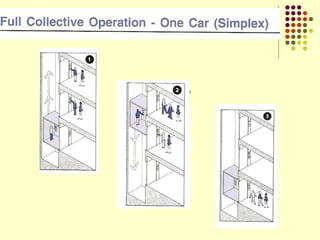
Full collective operation-one car
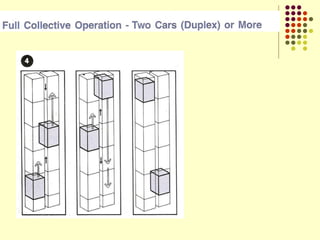
Full collective operation-Twocars
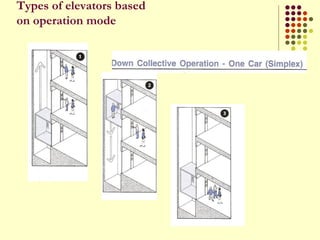
Down collective operation-one car
 The car normally rests at the main floor
 Main floor has – “UP” call button
 Floors above have- “Down” call button
 When more than one landing call received’ the car will
travel to the highest call and comes down
 This system is suitable only for light traffic
 Interfloor traffic is poorly served by this system.
 Eg. Residential buildings
Elevators- operation mode
Types of elevators based
on operation mode
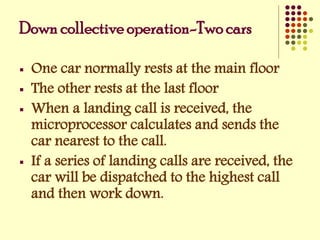
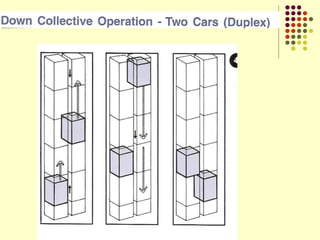
Down collective operation-Two cars
 One car normally rests at the main floor
 The other rests at the last floor
 When a landing call is received, the
microprocessor calculates and sends the
car nearest to the call.
 If a series of landing calls are received, the
car will be dispatched to the highest call
and then work down.
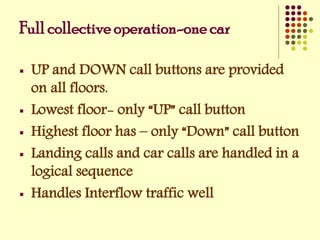
Full collective operation-one car
 UP and DOWN call buttons are provided
on all floors.
 Lowest floor- only “UP” call button
 Highest floor has – only “Down” call button
 Landing calls and car calls are handled in a
logical sequence
 Handles Interflow traffic well
Full collective operation-Twocars
 One car normally rests at the main floor
 The other rests at the last floor
 When a landing call is received, the
microprocessor calculates and sends the
car nearest to the call.
 Each car responds to its own car calls in
logical sequence
Comfort of lifts
 Passengers judge a lift on the basis of the following
Mechanical safety
 The motion of the doors should be smooth and safety
devices should be provided to ensure that passengers
entering or leaving the lift car will not be hurt if the
doors start to close.
 The leveling of the car to the landing floor should not
constitute a tripping hazard and should allow easy
movement of trolleys and wheelchairs.
Comfort
 The ride between floors should have acceptable levels of
acceleration, jerks and vibration should be kept to a
minimum
 Quiet operation of doors
 Noise levels at landings should also be minimal
Service
 Passengers waiting time should be minimum
Comfort of lifts
Elevator types
Based on working principle:
 Electric Traction elevators
 Hydraulic elevators
Based on the building type:
 Passenger elevators
 Panoramic elevators
 Hospital elevators
 Automobile elevators
 Freight elevators
 Home elevators
 Dumbwaiters
Types of lifts-Based on working
principle
 Traction
 Hydraulic
 Traction- Geared traction
- Gearless traction
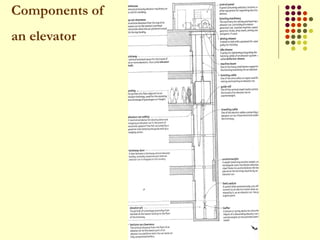
components of an elevator
 an elevator car,
 a counterweight,
 drive means including a drive motor connected to a
drive sheave, drive sheave having a periphery rotatable
about a drive axis,
 cable groove means on the periphery of sheave which
defines at least one cable groove,
 and a cable interconnecting elevator car and
counterweight while disposed about drive sheave
Components of
an elevator
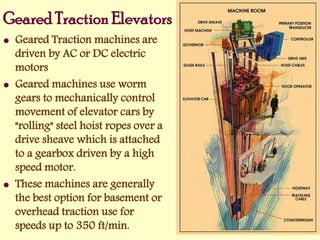
Geared Traction Elevators
 Geared Traction machines are
driven by AC or DC electric
motors
 Geared machines use worm
gears to mechanically control
movement of elevator cars by
"rolling" steel hoist ropes over a
drive sheave which is attached
to a gearbox driven by a high
speed motor.
 These machines are generally
the best option for basement or
overhead traction use for
speeds up to 350 ft/min.
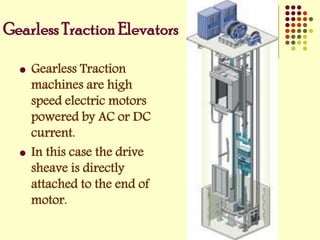
 Gearless Traction
machines are high
speed electric motors
powered by AC or DC
current.
 In this case the drive
sheave is directly
attached to the end of
motor.
Gearless Traction Elevators
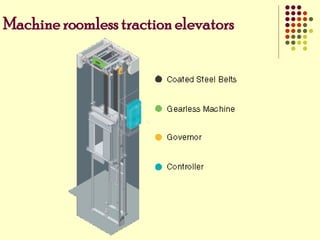
Machine roomless traction elevators
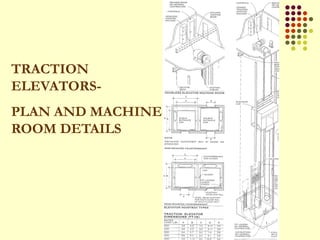
TRACTION
ELEVATORS-
PLAN AND MACHINE
ROOM DETAILS
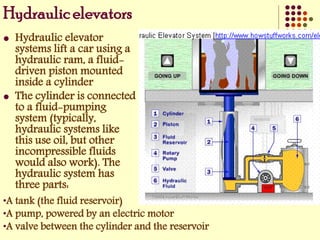
Hydraulic elevators
 Hydraulic elevator
systems lift a car using a
hydraulic ram, a fluid-
driven piston mounted
inside a cylinder
 The cylinder is connected
to a fluid-pumping
system (typically,
hydraulic systems like
this use oil, but other
incompressible fluids
would also work). The
hydraulic system has
three parts:
•A tank (the fluid reservoir)
•A pump, powered by an electric motor
•A valve between the cylinder and the reservoir
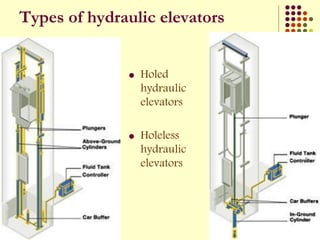
Types of hydraulic elevators
 Holed
hydraulic
elevators
 Holeless
hydraulic
elevators
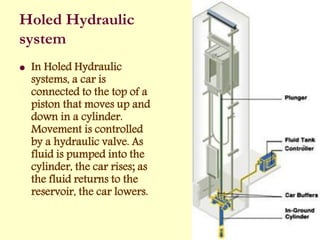
Holed Hydraulic
system
 In Holed Hydraulic
systems, a car is
connected to the top of a
piston that moves up and
down in a cylinder.
Movement is controlled
by a hydraulic valve. As
fluid is pumped into the
cylinder, the car rises; as
the fluid returns to the
reservoir, the car lowers.
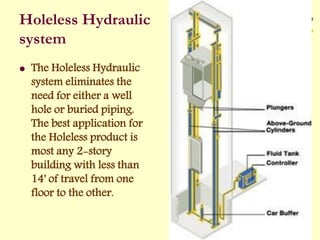
Holeless Hydraulic
system
 The Holeless Hydraulic
system eliminates the
need for either a well
hole or buried piping.
The best application for
the Holeless product is
most any 2-story
building with less than
14' of travel from one
floor to the other.
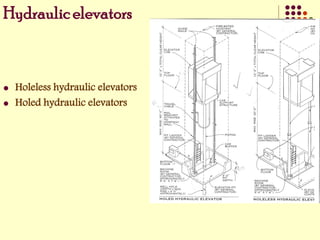
Hydraulic elevators
 Holeless hydraulic elevators
 Holed hydraulic elevators
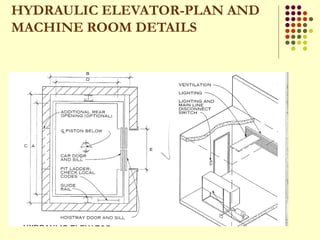
HYDRAULIC ELEVATOR-PLAN AND
MACHINE ROOM DETAILS
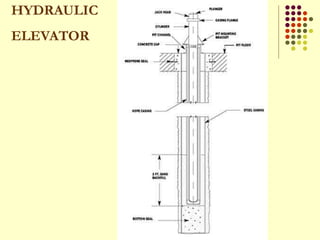
HYDRAULIC
ELEVATOR
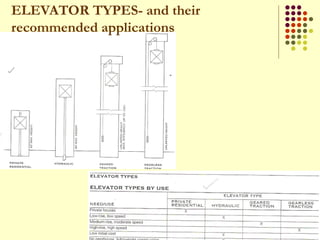
ELEVATOR TYPES- and their
recommended applications
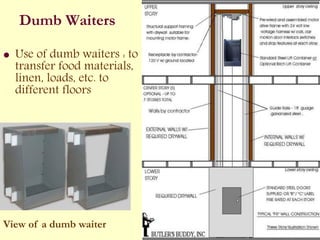
Dumb Waiters
 Use of dumb waiters : to
transfer food materials,
linen, loads, etc. to
different floors
View of a dumb waiter
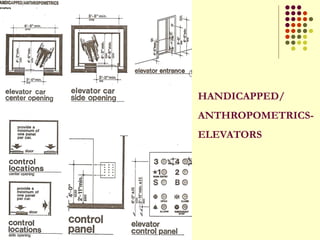
HANDICAPPED/
ANTHROPOMETRICS-
ELEVATORS

Elevators and its types

  • 1.
  • 2.
    Historyof lifts  Sincethe day of pyramids hand powered lifts and hoists were there  Hand powered winches were used in China to lift water  In colosseum lifts were used to lift gladiators and wild animals.  Otis Elisha Graves was an American who invented first lift with an automatic safety device in 1854 and demonstrated in Crystal Palace.  150 years later, the basic components of a typical lift installation remains the same.  Mechanical parts such as machine, suspension system, guide shoes and rails, gearing sheave, car and counterweight are the same.  Changes- drive control, signaling, monitoring  In the past lift services were almost an afterthought with Machine rooms located in out of way places.  Today lifts are regarded as one of the building’s main services.
  • 3.
    Lift capacity andperformance A detailed analysis of the morning peak traffic-up peak traffic , down peak traffic and inter floor traffic is required for taking a decision regarding the system to be installed. Three sets of data are required for the calculation of lift performance 1. Building data  No of floors  Distance between floors 2. Lift system data  No of cars  Rated capacity  Flight times between floors  Door opening times  Door closing times  Traffic control systems 3. Passenger data  No of passengers boarding form specific floors  No of passengers alighting at specific floors  Traffic mode- uni or multi directional  Time required for passengers to leave or enter the cars
  • 4.
    Quantity of service No of people to use the lift system in the defined period of time is the handling capacity, and is the quantity of service  The number of occupants vary according ot the purpose of the building- residential, commercial, institutional  The quality of accommodation – more space for occupant for more prestigious spaces.
  • 5.
    Quantity of service Estimationof population Building type Estimated population  Hotel 1.5-1.9 persons/room  Flats 1.5-1.9 persons/room  Hospital 3 persons/room  School 0.8-1.2 persons/room  Office (multiple) regular 10-12 sqm. net area/room  Office (multiple) Prestigious 15-25 sqm. net area/room  Office (single) Prestigious 8-10 sqm. net area/room  Office (single) Prestigious 12-20 sqm. net area/room
  • 6.
    Qualityof service  Actualaverage waiting times i.e., the time period between the instant of passenger arrival until the instant of time of the arrival of the lift is the indicator of the quality of service.  The lesser the average waiting time of a passenger the better the service.  20 seconds or less – excellent system  25 seconds – good system  30 seconds – satisfactory system  40 seconds – poor system  50 seconds – unsatisfactory system
  • 7.
    Applications in Buildingtypes Office buildings  Traffic peaks- starting of working hours  The handling capacity requirement is calculated based on  Unified tenancy – 15 to 25 % of the total building population entering in a five minute period  Diversified tenancy – 10 to 15 % of the total building population entering in five minute period
  • 8.
    Hotels  Peak trafficduring mornings and evenings  10 % of the total hotel population using it in 5 minute period  Modern international hotels waiting time – 30 seconds  There should be elevators for staff, catering supplies, linen and other purposes Applications in Building types
  • 9.
    Residential  Peak trafficdensity usually occurs in the early morning, but peak will vary both in time and span and in intensity  Peak traffic value-6% of total building population  Should be safe and easy to access  Children and elderly and physically challenged should be provided with convenient and safe means of transport Applications in Building types
  • 10.
    Specialized buildings  Leisurecentres, shopping malls, retail developments, air terminals, entertainment centres- specialized buildings.  Vertical transport facilities-Elevators and Escalators.  Panoramic elevators used –for aesthetic reasons and to provide viewing platforms. Applications in Building types
  • 11.
    Hospitals  The liftsserve two functions – transportation of patients, staff and public.  The waiting time for bed lifts should be minimum for emergencies  Should provide for smooth ride, levels of acceleration and jerks should be kept low.  The lift groups for visitors should perform well during visiting hours. Applications in Building types
  • 12.
    Location of elevators The efficient method of locating elevators to serve an individual building is to group them together.  It is very important to group them if they are the main means of vertical transport within a building.  The position should towards the centre of the building  Walking distance should not be more than 45 m from any point of the building.  If the distance to travel to the elevator core is large it may be efficient to install additional lifts for local are inter floor traffic.
  • 13.
    Grouping of elevators A group of elevators should be designed to be located close to each other.  Minimize the walking distance between lifts.  Waiting passengers can react quickly and access cars swiftly.  Lobby areas the main ones should not be in the path of the passageways.  There should not be any confusion between waiting passengers and passers by should be avoided by having separate lobby areas
  • 14.
  • 15.
    Elevators- operation mode Downcollective operation-one car Down collective operation-Two cars Full collective operation-one car Full collective operation-Twocars
  • 16.
    Down collective operation-onecar  The car normally rests at the main floor  Main floor has – “UP” call button  Floors above have- “Down” call button  When more than one landing call received’ the car will travel to the highest call and comes down  This system is suitable only for light traffic  Interfloor traffic is poorly served by this system.  Eg. Residential buildings Elevators- operation mode
  • 17.
    Types of elevatorsbased on operation mode
  • 18.
    Down collective operation-Twocars  One car normally rests at the main floor  The other rests at the last floor  When a landing call is received, the microprocessor calculates and sends the car nearest to the call.  If a series of landing calls are received, the car will be dispatched to the highest call and then work down.
  • 20.
    Full collective operation-onecar  UP and DOWN call buttons are provided on all floors.  Lowest floor- only “UP” call button  Highest floor has – only “Down” call button  Landing calls and car calls are handled in a logical sequence  Handles Interflow traffic well
  • 22.
    Full collective operation-Twocars One car normally rests at the main floor  The other rests at the last floor  When a landing call is received, the microprocessor calculates and sends the car nearest to the call.  Each car responds to its own car calls in logical sequence
  • 24.
    Comfort of lifts Passengers judge a lift on the basis of the following Mechanical safety  The motion of the doors should be smooth and safety devices should be provided to ensure that passengers entering or leaving the lift car will not be hurt if the doors start to close.  The leveling of the car to the landing floor should not constitute a tripping hazard and should allow easy movement of trolleys and wheelchairs.
  • 25.
    Comfort  The ridebetween floors should have acceptable levels of acceleration, jerks and vibration should be kept to a minimum  Quiet operation of doors  Noise levels at landings should also be minimal Service  Passengers waiting time should be minimum Comfort of lifts
  • 26.
    Elevator types Based onworking principle:  Electric Traction elevators  Hydraulic elevators Based on the building type:  Passenger elevators  Panoramic elevators  Hospital elevators  Automobile elevators  Freight elevators  Home elevators  Dumbwaiters
  • 27.
    Types of lifts-Basedon working principle  Traction  Hydraulic  Traction- Geared traction - Gearless traction
  • 28.
    components of anelevator  an elevator car,  a counterweight,  drive means including a drive motor connected to a drive sheave, drive sheave having a periphery rotatable about a drive axis,  cable groove means on the periphery of sheave which defines at least one cable groove,  and a cable interconnecting elevator car and counterweight while disposed about drive sheave
  • 29.
  • 30.
    Geared Traction Elevators Geared Traction machines are driven by AC or DC electric motors  Geared machines use worm gears to mechanically control movement of elevator cars by "rolling" steel hoist ropes over a drive sheave which is attached to a gearbox driven by a high speed motor.  These machines are generally the best option for basement or overhead traction use for speeds up to 350 ft/min.
  • 31.
     Gearless Traction machinesare high speed electric motors powered by AC or DC current.  In this case the drive sheave is directly attached to the end of motor. Gearless Traction Elevators
  • 32.
  • 33.
  • 34.
    Hydraulic elevators  Hydraulicelevator systems lift a car using a hydraulic ram, a fluid- driven piston mounted inside a cylinder  The cylinder is connected to a fluid-pumping system (typically, hydraulic systems like this use oil, but other incompressible fluids would also work). The hydraulic system has three parts: •A tank (the fluid reservoir) •A pump, powered by an electric motor •A valve between the cylinder and the reservoir
  • 35.
    Types of hydraulicelevators  Holed hydraulic elevators  Holeless hydraulic elevators
  • 36.
    Holed Hydraulic system  InHoled Hydraulic systems, a car is connected to the top of a piston that moves up and down in a cylinder. Movement is controlled by a hydraulic valve. As fluid is pumped into the cylinder, the car rises; as the fluid returns to the reservoir, the car lowers.
  • 37.
    Holeless Hydraulic system  TheHoleless Hydraulic system eliminates the need for either a well hole or buried piping. The best application for the Holeless product is most any 2-story building with less than 14' of travel from one floor to the other.
  • 38.
    Hydraulic elevators  Holelesshydraulic elevators  Holed hydraulic elevators
  • 39.
  • 40.
  • 41.
    ELEVATOR TYPES- andtheir recommended applications
  • 42.
    Dumb Waiters  Useof dumb waiters : to transfer food materials, linen, loads, etc. to different floors View of a dumb waiter
  • 43.