BUILDING MATERIALS AND
CONSTRUCTION V
MODULE 02-Escalators | 25 | 11 | 2021
MODULE 02 | 25 | 11 | 2021
ESCALATORS …
• The Need – Escalators
• Introduction
• Historical Development
• Operating Mechanism
• Major Components and Mechanism
• Design Standards
• Electrical / Safety controls
THE NEED …
• Imagine a metropolitan city without having shopping malls
, departmental stores , metro stations , airports or
stadiums ?
• The average split of traffic that uses vertical transportation
in a departmental store is Stairs 2% , Lifts 8% , Escalators
90% .
• The escalators has become an integral part of the urban
landscape around the world to move pedestrian traffic in
places were elevators would be impractical.
MODULE 02 | 25 | 11 | 2021
INTRODUCTION …
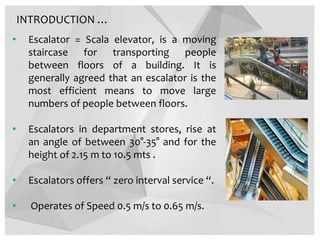
• Escalator = Scala elevator, is a moving
staircase for transporting people
between floors of a building. It is
generally agreed that an escalator is the
most efficient means to move large
numbers of people between floors.
• Escalators in department stores, rise at
an angle of between 30°-35° and for the
height of 2.15 m to 10.5 mts .
• Escalators offers “ zero interval service “.
• Operates of Speed 0.5 m/s to 0.65 m/s.
HISTORICAL DEVELOPMENT …
• 1896 : Jesse Reno, a graduate of Lehigh
University, produced the first working
escalator called as the "inclined
elevator“ and installed it alongside the
Old Iron Pier at Coney Island, New York.
• 1897 : The escalator as we know now
was later re-designed by Charles
Seeberger, who created the name
'escalator' from the word 'scala', which
is Latin for steps and the word
'elevator', which had already been
invented.
Inclined elevator
Early step like tread
• 1899 : Charles Seeberger, together with
the Otis Elevator Company produced the
first commercial escalator in the Otis
factory in Yonkers, N.Y.
• 1900 : The Seeberger Otis first wooden
step type escalator won first prize at the
Paris Exposition Universelle in France..
• 1902: Jesse Reno's Coney Island ride
success made Jesse Reno into "the"
escalator designer and he founded the
Reno Electric Stairways and Conveyors
company.
At Paris exposition
In NY and London used
for Public Transportation
• 1910 : Otis Elevator Company bought
Charles Seeberger company .
• 1911 : Otis Elevator Company bought Jesse
Reno company also , and started
dominating the escalator production.
• 1920 : Otis engineers, led by David
Lindquist, combined and improved the
Jesse Reno and Charles Seeberger
escalator designs, and created the
cleated, level steps of the modern
escalator in use today.
• 1950 : “ Escalator “ became the common
term for moving stairways.
MAJOR COMPONENTS AND MECHANISM …
• The two platforms top and bottom,
houses the curved sections of the tracks,
as well as the gears and motors that drive
the stairs.
• The top platform contains the motor
assembly and the main drive gear, while
the bottom holds the step return idler
sprockets.
Landing Platforms
Top Platform
Bottom Platform
Floor Plate
• It provides a place for the passengers to
stand before they step onto the moving
stairs.
• This plate is flush with the finished floor
and is either hinged or removable to
allow easy access to the machinery
below.
Comb plate
• The comb plate is the piece between the
stationary floor plate and the moving
step.
• Comb plate is necessary to minimize the
gap between the stair and landing, which
helps prevent objects from getting
caught in the gap.
Floor plate Comb plate
Comb plate
The Truss
• The truss is a hollow metal structure that
bridges the lower and upper landings.
• It is composed of two side sections joined
together with cross braces across the
bottom and just below the top.
• The ends of the truss are attached to the
top and bottom landing platforms via
steel or concrete supports. The truss
carries all the straight track .
Steps
• The steps are solid, one piece, die-cast
aluminum or steel.
• The steps are linked by a continuous
metal chain that forms a closed loop. The
front and back edges of the steps are
each connected to two wheels.
• The rear wheels are set further apart to
fit into the back track and the front
wheels have shorter axles to fit into the
narrower front track.
• These are basically moving platform with
yellow demarcation on which escalator
passengers ride.
Handrail
• The handrail provides a convenient
handhold for passengers while they are
riding the escalator ,the handrail is pulled
along its track by a chain that is
connected to the main drive gear by a
series of pulleys.
Balustrade
• Balustrade consists of the handrail and
the exterior supporting structure of the
escalator.
• It is the escalator exterior components
extending above the steps and it
supports the handrail. It is either
designed as Interior Low-deck or Interior
High-deck.
Tracks / Rails / chains
• The track system is built into the truss to
guide the step chain, which continuously
pulls the steps from the bottom
platform and back to the top in an
endless loop.
• There are actually two tracks / Rails :
one for the front wheels of the steps
(called the step-wheel track) and one for
the back wheels of the steps (called the
trailer-wheel track). Tracks
Exterior high deck Interior low deck
• The relative positions of these tracks cause the steps to form a
staircase as they move out from under the comb plate. This
right angle bends the steps into a shape resembling a staircase.
Rails / Tracks / chains
OPERATING MECHANISM …
• The operating mechanism has three components: the drive
machine ie the electric motor , the step drive system and the
handrail drive system.
• The truss and the electric motor at the top of escalator, runs the
four gears that all escalators have two drive gears on either side at
the top and two return gears on either side at the bottom.
• The gears have chains that loop around the gears and run down
each side of the escalator then they are connected to each step.
• These chains help the steps make their way up, or down, the
escalator, where the handrails that riders use for balance and safety
on their ride up or down .
• The handrails are long rubber loops connected to the two drive
gears at the top of the escalator and powered by the same electric
motor that powers the steps.
DESIGN STANDARDS …
• Physical requirements
• Location
• Traffic patterns
• Safety considerations
• Aesthetic preferences.
Factors affect escalator design
• As per standard, the width of the step to be used is 600 mm (for
one person), 800 mm (for one-to-two people) and 1000 mm (for
two people width)
Physical requirements
• 30° inclination : This inclination provides the highest traveling
comfort and maximum safety for the user.
• 35° inclination : This inclination is the most efficient solution as it
requires less space and can be implemented more cost-effectively.
However, this inclination is perceived as too steep if rises exceed 5
m , particularly in downward travel.
Inclination
Lesser the inclination , high travelling comfort
• Cot 30 degree = 1.732 , Cot 35 = 1.428
Types of Arrangements
• Due to the spatial separation
of the upward and downward
directions, users have to walk
past specially placed
merchandise displays.
• Relatively inconvenient for the
users and also for the mall
managers to manage the
traffic in-between both .
• Can be combined with
stairways ( for downward
direction ) .
One way Traffic – Single
Two way Traffic : Parallel
• Single or Multiple
• This arrangement is used
mainly in malls , department
stores and public
transportation buildings were
having heavy traffic volumes.
• When there are three or more
escalators ( Multiple) , it
should be possible to reverse
the direction of travel
depending on the traffic flow.
Two way Traffic : Criss – Cross
• This type of installation is the
one used most frequently as it
allows customers to travel
quickly to the upper floors
without any waiting time.
• Depending on how the
escalators are positioned, the
store fitter can open up the
view onto the shop floor to
stimulate customer interest in
the goods on display.
• Used in Offices , Malls etc
Typical Escalators – 35 degree
Inclination
Spiral / Helical ( info – not in the syllabus )
• The world's first practical spiral
escalator was modeled by
Mitsubishi electric corporation
and was installed in Osaka, Japan,
in 1985.
• Used to enhance the architectural
beauty and to save floor space.
ELECTRICAL / SAFETY CONTROLS …
• Escalator safety is a big concern,
especially for children. These
accidents can occur due to loose
scarves, shoe strings or other
articles of clothing becoming
stuck in the escalator.
• Special sari guard has been built
in some escalators in India.
• Emergency stop button will be
installed on the top and bottom
platforms for safety .
• Motion sensors for reducing the
power consumption .
Motion sensors
Emergency button
Safety Indications
TRAVELATORS ( MOVING WALKWAYS ) …
• Introduction
• Major Components
• Design Standards
• Electrical / Safety controls
INTRODUCTION …
• A moving walkway or Travelators is a
slow moving conveyor mechanism that
transports people across a horizontal or
inclined planes.
• A moving walkway can be used in
airports , Subways and supermarkets to
move people along with suitcases,
trolleys or shopping cart, or baby
carriage etc more conveniently than
escalators.
• They can be installed in pairs ( for two
ways ) or single ( one way ).
Supermarket – People with
trolley
Two way traffic
• Moving walkways can be used by
standing or walking on them , which
makes the travel much faster.
• The walkway accelerates passengers
smoothly from 0.65m to 2m/s. The
travelers who walk, rather than stand
still, can reach speeds of 3.3m/s .
• Transport height from 2.30 m to max.
7.50 m.
Two way traffic
Raised moving walkways
MAJOR COMPONENTS …
• Pallet type : A continuous series of flat
metal plates join together to form a
walkway . Most have a metal surface,
though some models have a rubber
surface for extra traction.
• Moving belt : These are generally built
with mesh metal belts or rubber
walking surfaces over metal rollers. The
walking surface may have a solid feel or
a "bouncy" feel.
Type by Build
Pallet type
Moving belt type
Types of pallet
DESIGN STANDARDS …
Width of walkways
• The width for one person with
shopping trolley should be 800
mm .
• The width for two persons with
shopping trolley should be 1000
mm or 1200 mm ( but 1000 mm is
been widely used ).
Inclination
• Inclinations of 10°, 11° and 12° are the common international standard
for inclined moving walks.
• 10° inclination provides the most comfortable ride and 12°
inclination is used whenever the space available is limited.
• Horizontal moving walks can generally be provided for inclinations
between 0° and 6°.
Length of moving walkways
• Length of moving walkways can be from 30 mts to 300 mts .
• For planning considerations, the length can be calculated by the
formula given ,
• Cot 10 degree = 5.6713 , Cot 11 = 5.1446 , Cot 12 = 4.7046
Types of Arrangements ( for inclined only – same
arrangement like escalators)
• Parallel : Used mainly in
department stores and
public transportation
buildings with heavy
traffic flow.
• Multiple Parallel : Used to
connect two levels and
direction can be adjusted
to suit traffic flow.
• Criss – cross : This
arrangement allows
customers to travel
quickly to upper floors
without any waiting time.
• Single (walk around) :
Customers have to walk
past strategically placed
merchandise displays.
ELECTRICAL / SAFETY CONTROLS …
Comb lights
Maintenance control station
( installed in both ends )
Emergency stop
Button with controls
no access - Goods ,
wheelchairs , walker castor
Access - Trolleys and
child strollers
THANK YOU
|
http://buckylab.blogspot.in/2012/11/how-it-works-escalators.html
READING …

BMC S5 - MODULE 02 - ESCALATORS.pptx

  • 1.
    BUILDING MATERIALS AND CONSTRUCTIONV MODULE 02-Escalators | 25 | 11 | 2021
  • 2.
    MODULE 02-Escalators |25 | 11 | 2021
  • 3.
    MODULE 02 |25 | 11 | 2021 ESCALATORS … • The Need – Escalators • Introduction • Historical Development • Operating Mechanism • Major Components and Mechanism • Design Standards • Electrical / Safety controls
  • 4.
    THE NEED … •Imagine a metropolitan city without having shopping malls , departmental stores , metro stations , airports or stadiums ? • The average split of traffic that uses vertical transportation in a departmental store is Stairs 2% , Lifts 8% , Escalators 90% . • The escalators has become an integral part of the urban landscape around the world to move pedestrian traffic in places were elevators would be impractical. MODULE 02 | 25 | 11 | 2021
  • 5.
    INTRODUCTION … • Escalator= Scala elevator, is a moving staircase for transporting people between floors of a building. It is generally agreed that an escalator is the most efficient means to move large numbers of people between floors. • Escalators in department stores, rise at an angle of between 30°-35° and for the height of 2.15 m to 10.5 mts . • Escalators offers “ zero interval service “. • Operates of Speed 0.5 m/s to 0.65 m/s.
  • 6.
    HISTORICAL DEVELOPMENT … •1896 : Jesse Reno, a graduate of Lehigh University, produced the first working escalator called as the "inclined elevator“ and installed it alongside the Old Iron Pier at Coney Island, New York. • 1897 : The escalator as we know now was later re-designed by Charles Seeberger, who created the name 'escalator' from the word 'scala', which is Latin for steps and the word 'elevator', which had already been invented. Inclined elevator Early step like tread
  • 7.
    • 1899 :Charles Seeberger, together with the Otis Elevator Company produced the first commercial escalator in the Otis factory in Yonkers, N.Y. • 1900 : The Seeberger Otis first wooden step type escalator won first prize at the Paris Exposition Universelle in France.. • 1902: Jesse Reno's Coney Island ride success made Jesse Reno into "the" escalator designer and he founded the Reno Electric Stairways and Conveyors company. At Paris exposition In NY and London used for Public Transportation
  • 8.
    • 1910 :Otis Elevator Company bought Charles Seeberger company . • 1911 : Otis Elevator Company bought Jesse Reno company also , and started dominating the escalator production. • 1920 : Otis engineers, led by David Lindquist, combined and improved the Jesse Reno and Charles Seeberger escalator designs, and created the cleated, level steps of the modern escalator in use today. • 1950 : “ Escalator “ became the common term for moving stairways.
  • 9.
    MAJOR COMPONENTS ANDMECHANISM …
  • 10.
    • The twoplatforms top and bottom, houses the curved sections of the tracks, as well as the gears and motors that drive the stairs. • The top platform contains the motor assembly and the main drive gear, while the bottom holds the step return idler sprockets. Landing Platforms Top Platform Bottom Platform
  • 11.
    Floor Plate • Itprovides a place for the passengers to stand before they step onto the moving stairs. • This plate is flush with the finished floor and is either hinged or removable to allow easy access to the machinery below. Comb plate • The comb plate is the piece between the stationary floor plate and the moving step. • Comb plate is necessary to minimize the gap between the stair and landing, which helps prevent objects from getting caught in the gap. Floor plate Comb plate Comb plate
  • 12.
    The Truss • Thetruss is a hollow metal structure that bridges the lower and upper landings. • It is composed of two side sections joined together with cross braces across the bottom and just below the top. • The ends of the truss are attached to the top and bottom landing platforms via steel or concrete supports. The truss carries all the straight track .
  • 13.
    Steps • The stepsare solid, one piece, die-cast aluminum or steel. • The steps are linked by a continuous metal chain that forms a closed loop. The front and back edges of the steps are each connected to two wheels. • The rear wheels are set further apart to fit into the back track and the front wheels have shorter axles to fit into the narrower front track. • These are basically moving platform with yellow demarcation on which escalator passengers ride.
  • 14.
    Handrail • The handrailprovides a convenient handhold for passengers while they are riding the escalator ,the handrail is pulled along its track by a chain that is connected to the main drive gear by a series of pulleys. Balustrade • Balustrade consists of the handrail and the exterior supporting structure of the escalator. • It is the escalator exterior components extending above the steps and it supports the handrail. It is either designed as Interior Low-deck or Interior High-deck.
  • 15.
    Tracks / Rails/ chains • The track system is built into the truss to guide the step chain, which continuously pulls the steps from the bottom platform and back to the top in an endless loop. • There are actually two tracks / Rails : one for the front wheels of the steps (called the step-wheel track) and one for the back wheels of the steps (called the trailer-wheel track). Tracks Exterior high deck Interior low deck
  • 16.
    • The relativepositions of these tracks cause the steps to form a staircase as they move out from under the comb plate. This right angle bends the steps into a shape resembling a staircase. Rails / Tracks / chains
  • 17.
    OPERATING MECHANISM … •The operating mechanism has three components: the drive machine ie the electric motor , the step drive system and the handrail drive system.
  • 19.
    • The trussand the electric motor at the top of escalator, runs the four gears that all escalators have two drive gears on either side at the top and two return gears on either side at the bottom. • The gears have chains that loop around the gears and run down each side of the escalator then they are connected to each step. • These chains help the steps make their way up, or down, the escalator, where the handrails that riders use for balance and safety on their ride up or down . • The handrails are long rubber loops connected to the two drive gears at the top of the escalator and powered by the same electric motor that powers the steps.
  • 20.
    DESIGN STANDARDS … •Physical requirements • Location • Traffic patterns • Safety considerations • Aesthetic preferences. Factors affect escalator design
  • 21.
    • As perstandard, the width of the step to be used is 600 mm (for one person), 800 mm (for one-to-two people) and 1000 mm (for two people width) Physical requirements
  • 22.
    • 30° inclination: This inclination provides the highest traveling comfort and maximum safety for the user. • 35° inclination : This inclination is the most efficient solution as it requires less space and can be implemented more cost-effectively. However, this inclination is perceived as too steep if rises exceed 5 m , particularly in downward travel. Inclination Lesser the inclination , high travelling comfort
  • 23.
    • Cot 30degree = 1.732 , Cot 35 = 1.428
  • 24.
    Types of Arrangements •Due to the spatial separation of the upward and downward directions, users have to walk past specially placed merchandise displays. • Relatively inconvenient for the users and also for the mall managers to manage the traffic in-between both . • Can be combined with stairways ( for downward direction ) . One way Traffic – Single
  • 25.
    Two way Traffic: Parallel • Single or Multiple • This arrangement is used mainly in malls , department stores and public transportation buildings were having heavy traffic volumes. • When there are three or more escalators ( Multiple) , it should be possible to reverse the direction of travel depending on the traffic flow.
  • 26.
    Two way Traffic: Criss – Cross • This type of installation is the one used most frequently as it allows customers to travel quickly to the upper floors without any waiting time. • Depending on how the escalators are positioned, the store fitter can open up the view onto the shop floor to stimulate customer interest in the goods on display. • Used in Offices , Malls etc
  • 27.
    Typical Escalators –35 degree Inclination
  • 28.
    Spiral / Helical( info – not in the syllabus ) • The world's first practical spiral escalator was modeled by Mitsubishi electric corporation and was installed in Osaka, Japan, in 1985. • Used to enhance the architectural beauty and to save floor space.
  • 30.
    ELECTRICAL / SAFETYCONTROLS … • Escalator safety is a big concern, especially for children. These accidents can occur due to loose scarves, shoe strings or other articles of clothing becoming stuck in the escalator. • Special sari guard has been built in some escalators in India. • Emergency stop button will be installed on the top and bottom platforms for safety . • Motion sensors for reducing the power consumption . Motion sensors Emergency button
  • 31.
  • 32.
    TRAVELATORS ( MOVINGWALKWAYS ) … • Introduction • Major Components • Design Standards • Electrical / Safety controls
  • 33.
    INTRODUCTION … • Amoving walkway or Travelators is a slow moving conveyor mechanism that transports people across a horizontal or inclined planes. • A moving walkway can be used in airports , Subways and supermarkets to move people along with suitcases, trolleys or shopping cart, or baby carriage etc more conveniently than escalators. • They can be installed in pairs ( for two ways ) or single ( one way ). Supermarket – People with trolley Two way traffic
  • 34.
    • Moving walkwayscan be used by standing or walking on them , which makes the travel much faster. • The walkway accelerates passengers smoothly from 0.65m to 2m/s. The travelers who walk, rather than stand still, can reach speeds of 3.3m/s . • Transport height from 2.30 m to max. 7.50 m. Two way traffic Raised moving walkways
  • 35.
  • 36.
    • Pallet type: A continuous series of flat metal plates join together to form a walkway . Most have a metal surface, though some models have a rubber surface for extra traction. • Moving belt : These are generally built with mesh metal belts or rubber walking surfaces over metal rollers. The walking surface may have a solid feel or a "bouncy" feel. Type by Build Pallet type Moving belt type Types of pallet
  • 37.
    DESIGN STANDARDS … Widthof walkways • The width for one person with shopping trolley should be 800 mm . • The width for two persons with shopping trolley should be 1000 mm or 1200 mm ( but 1000 mm is been widely used ).
  • 38.
    Inclination • Inclinations of10°, 11° and 12° are the common international standard for inclined moving walks. • 10° inclination provides the most comfortable ride and 12° inclination is used whenever the space available is limited. • Horizontal moving walks can generally be provided for inclinations between 0° and 6°.
  • 39.
    Length of movingwalkways • Length of moving walkways can be from 30 mts to 300 mts . • For planning considerations, the length can be calculated by the formula given , • Cot 10 degree = 5.6713 , Cot 11 = 5.1446 , Cot 12 = 4.7046
  • 40.
    Types of Arrangements( for inclined only – same arrangement like escalators) • Parallel : Used mainly in department stores and public transportation buildings with heavy traffic flow. • Multiple Parallel : Used to connect two levels and direction can be adjusted to suit traffic flow.
  • 41.
    • Criss –cross : This arrangement allows customers to travel quickly to upper floors without any waiting time. • Single (walk around) : Customers have to walk past strategically placed merchandise displays.
  • 42.
    ELECTRICAL / SAFETYCONTROLS … Comb lights Maintenance control station ( installed in both ends ) Emergency stop Button with controls no access - Goods , wheelchairs , walker castor Access - Trolleys and child strollers
  • 43.