Procoagulant And Inflammatory Response of
Virus-Infected Monocyes
Provided by:
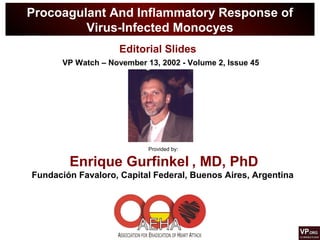
Enrique Gurfinkel , MD, PhD
Fundación Favaloro, Capital Federal, Buenos Aires, Argentina
Editorial Slides
VP Watch – November 13, 2002 - Volume 2, Issue 45
Introduction
• Atherosclerosis is thought to be an inflammatory
disease, but its origin still remains unanswered.
• Chronic low-grade inflammation and combination
of classical risk factors, plus novel risk factors
such as the infectious burden seem to contribute
to promote atherosclerosis.
Introduction
• Monocytes play a prominent role in
inflammation, coagulation and the ability to
produce tissue factor and cytokines.
• All of these factors, particularly the production of
cytokines may contribute to acute coronary
syndromes by eliciting plaque instability.
Background
• During viral infections monocytes predominantly
produce inflammatory cytokines.
• In addition, continuing viral infection may sustain
excess tissue factor production and exhaust the
inhibitory effects of tissue factor pathway
inhibitor.
As highlighted in VP Watch of this week,
• Bouwman and co-workers tried to establish
whether virus-infected monocytes initiate
coagulation.
And
• To detect if the production of cytokines by
monocytes may contribute to the chronic
process of atherosclerosis in an in-vitro model.
Methods
• Isolation of monocytes:
monocytes obtained from fresh
blood of healthy volunteers.
Methods
• Preparation of virus stocks: Human embryonic
lung, human epidermoid larynx carcinoma, and
LLC-MK2 cells were cultured in Eagles´s
minimum essential medium with Earle´s salts.
• A clinical isolete of CMV was propagated in HEL
cells
• Chlamydia pneumoniae strain AR 39 was
propagated in HEP-2 cells
• Influenza A HIN1 86 Singapore was propagated
in LLC-MK2 cells
Methods
• Coagulation assay: Normal pooled plasma
was prepared from the blood of nine
healthy donors.
• Cytokine assays: IL 6, 8, and 10 were
measured in the supernatants of virus-
infected monocytes.
It appeared that all strains could infect monocytes, but in all cases the infection
was below 5% when undiluted virus stocks were used.
 Fluorescence microscopy images of virus-
infected monocytes. Magnification 200x after
overnight incubation; Red background: uninfected
monocytes. Green areas: virus-infected monocytes
stained with FITC-labeled anti-virus antibodies.
(a) CMV, specific staining of CMV in the nuclei
of the infected cells. (b) Influenza A, smooth
staining pattern of influenza A in monocytes. (c)
Cp, more dense staining pattern of Cp in the
cytoplasm of monocytes.
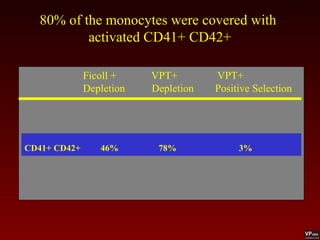
80% of the monocytes were covered with
activated CD41+ CD42+
Ficoll + VPT+ VPT+
Depletion Depletion Positive Selection
CD41+ CD42+ 46% 78% 3%
CMV and Cp, like influenza, reduced the clotting time.
The inititation of coagulation by virus-infected monocyes
was a result of the expression of TF.
Clottingtime(seconds)
Uninfected monocytes Infected monocytes
140+-22.1 s
333+-22.1s
Infection with CMV and Cp induced the production of
modest levels of IL6 and IL8, whereas infection with influenza A
strongly stimulated the production of IL6 and 8.
IL-6IL-8(pgml)
CMV & Cp
IL 6
1000
IL-8
H1N1
2000
Discussion
• The results of the present study
indicate that only small quantities of an
infectious virus are needed to stimulate
monocytes to exert considerable
immunological effects.
Conclussions
• The procoagulant activity of virus-
infected monocytes is TF-dependent.
• Influenza infection induced a
pronounced expression of IL-6 and IL-
8, which could be associated with
plaque rupture.
Questions
• Is there any differences between the
bacterial and viral infectious burden in
promoting procoagulant activity?
• Is it plausible to think that this could
explain a systemic pro-thrombotic
process after infection?
1. Buja LM. Does atherosclerosis have an infectious etiology? Circulation 1996;94:872.
2. Burch GE, Tsui CY, Harb JM. Pathologic changes of aorta and coronary arteries of mice
infected with Coxsackie B virus. Proc Soc Exp Biol Medl 1971;137:657–61.
3. Mosorin et al. Detection of Chlamydia pneumoniae-Reactive T lymphocytes in human
atherosclerotic plaques of the carotid artery. Arterioscl Thromb Vasc Biol 2000;20:1061–7.
4. Blankenberg S, Rupprecht HJ, Bickel C, Espinola-Klein C, Rippin G et al.
Cytomegalovirus infection with interleukine 6 response predicts cardiac mortality
in patients with coronary artery disease. Circulation 2001;103 (24):2915–21.
5. Visseren FLJ, Bouwman JJM, Bouter KP, Diepersloot RJA, de Groot Ph, Erkelens DW. Procoagulant
activity of endothelial cells after infection with respiratory viruses. Thromb Haemost 2000;84 (2):319–24.
6. Frostegard J, Ulfgren A, Nyberg P, Hedin U, Swedenborg J et al. Cytokine expression in advanced
human atherosclerotic plaques: dominance of pro-inflammatory (Th1) and macrophage stimulating
cytokines. Atherosclerosis 1999;145:33–43.
7. Neumann FJ, Ott I, Marx N, Luther T, Kenngott S et al.
Effect of human recombinant Interleukin-6 and Interleukin-8 on Monocyte Procoagulant activity.
Arteriosclerosis Thromb Vasc Biol 1997;17:3399–405.
8. Bouwman J. J. M. et al,. Eur J Clin Invest 2002; 32 (10): 759-766
References

Es v2n45

  • 1.
    Procoagulant And InflammatoryResponse of Virus-Infected Monocyes Provided by: Enrique Gurfinkel , MD, PhD Fundación Favaloro, Capital Federal, Buenos Aires, Argentina Editorial Slides VP Watch – November 13, 2002 - Volume 2, Issue 45
  • 2.
    Introduction • Atherosclerosis isthought to be an inflammatory disease, but its origin still remains unanswered. • Chronic low-grade inflammation and combination of classical risk factors, plus novel risk factors such as the infectious burden seem to contribute to promote atherosclerosis.
  • 3.
    Introduction • Monocytes playa prominent role in inflammation, coagulation and the ability to produce tissue factor and cytokines. • All of these factors, particularly the production of cytokines may contribute to acute coronary syndromes by eliciting plaque instability.
  • 4.
    Background • During viralinfections monocytes predominantly produce inflammatory cytokines. • In addition, continuing viral infection may sustain excess tissue factor production and exhaust the inhibitory effects of tissue factor pathway inhibitor.
  • 5.
    As highlighted inVP Watch of this week, • Bouwman and co-workers tried to establish whether virus-infected monocytes initiate coagulation. And • To detect if the production of cytokines by monocytes may contribute to the chronic process of atherosclerosis in an in-vitro model.
  • 6.
    Methods • Isolation ofmonocytes: monocytes obtained from fresh blood of healthy volunteers.
  • 7.
    Methods • Preparation ofvirus stocks: Human embryonic lung, human epidermoid larynx carcinoma, and LLC-MK2 cells were cultured in Eagles´s minimum essential medium with Earle´s salts. • A clinical isolete of CMV was propagated in HEL cells • Chlamydia pneumoniae strain AR 39 was propagated in HEP-2 cells • Influenza A HIN1 86 Singapore was propagated in LLC-MK2 cells
  • 8.
    Methods • Coagulation assay:Normal pooled plasma was prepared from the blood of nine healthy donors. • Cytokine assays: IL 6, 8, and 10 were measured in the supernatants of virus- infected monocytes.
  • 9.
    It appeared thatall strains could infect monocytes, but in all cases the infection was below 5% when undiluted virus stocks were used.  Fluorescence microscopy images of virus- infected monocytes. Magnification 200x after overnight incubation; Red background: uninfected monocytes. Green areas: virus-infected monocytes stained with FITC-labeled anti-virus antibodies. (a) CMV, specific staining of CMV in the nuclei of the infected cells. (b) Influenza A, smooth staining pattern of influenza A in monocytes. (c) Cp, more dense staining pattern of Cp in the cytoplasm of monocytes.
  • 10.
    80% of themonocytes were covered with activated CD41+ CD42+ Ficoll + VPT+ VPT+ Depletion Depletion Positive Selection CD41+ CD42+ 46% 78% 3%
  • 11.
    CMV and Cp,like influenza, reduced the clotting time. The inititation of coagulation by virus-infected monocyes was a result of the expression of TF. Clottingtime(seconds) Uninfected monocytes Infected monocytes 140+-22.1 s 333+-22.1s
  • 12.
    Infection with CMVand Cp induced the production of modest levels of IL6 and IL8, whereas infection with influenza A strongly stimulated the production of IL6 and 8. IL-6IL-8(pgml) CMV & Cp IL 6 1000 IL-8 H1N1 2000
  • 13.
    Discussion • The resultsof the present study indicate that only small quantities of an infectious virus are needed to stimulate monocytes to exert considerable immunological effects.
  • 14.
    Conclussions • The procoagulantactivity of virus- infected monocytes is TF-dependent. • Influenza infection induced a pronounced expression of IL-6 and IL- 8, which could be associated with plaque rupture.
  • 15.
    Questions • Is thereany differences between the bacterial and viral infectious burden in promoting procoagulant activity? • Is it plausible to think that this could explain a systemic pro-thrombotic process after infection?
  • 16.
    1. Buja LM.Does atherosclerosis have an infectious etiology? Circulation 1996;94:872. 2. Burch GE, Tsui CY, Harb JM. Pathologic changes of aorta and coronary arteries of mice infected with Coxsackie B virus. Proc Soc Exp Biol Medl 1971;137:657–61. 3. Mosorin et al. Detection of Chlamydia pneumoniae-Reactive T lymphocytes in human atherosclerotic plaques of the carotid artery. Arterioscl Thromb Vasc Biol 2000;20:1061–7. 4. Blankenberg S, Rupprecht HJ, Bickel C, Espinola-Klein C, Rippin G et al. Cytomegalovirus infection with interleukine 6 response predicts cardiac mortality in patients with coronary artery disease. Circulation 2001;103 (24):2915–21. 5. Visseren FLJ, Bouwman JJM, Bouter KP, Diepersloot RJA, de Groot Ph, Erkelens DW. Procoagulant activity of endothelial cells after infection with respiratory viruses. Thromb Haemost 2000;84 (2):319–24. 6. Frostegard J, Ulfgren A, Nyberg P, Hedin U, Swedenborg J et al. Cytokine expression in advanced human atherosclerotic plaques: dominance of pro-inflammatory (Th1) and macrophage stimulating cytokines. Atherosclerosis 1999;145:33–43. 7. Neumann FJ, Ott I, Marx N, Luther T, Kenngott S et al. Effect of human recombinant Interleukin-6 and Interleukin-8 on Monocyte Procoagulant activity. Arteriosclerosis Thromb Vasc Biol 1997;17:3399–405. 8. Bouwman J. J. M. et al,. Eur J Clin Invest 2002; 32 (10): 759-766 References