Let’s Begin Our Green
Journey with EVS
-Dr. Karishma Chaudhary
 World Environment Day?
 Earth Day?
 A bit about World Environment Day, it was first held in 1974 and is celebrated
every year on June 5 to encourage awareness and action for the protection of
the environment. It stood for raising awareness about issues related to the
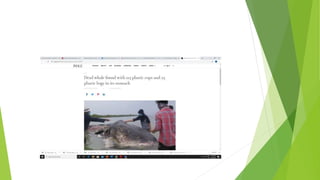
environment like air pollution, marine pollution, global warming, human
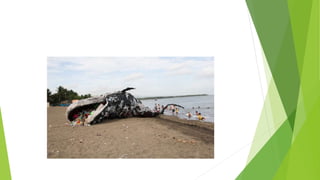
overpopulation, etc.
 Every year on April 22, Earth Day marks the anniversary of the birth of the
modern environmental movement started in 1970.
What can we do????
 Humans are an integral part of the nature and therefore if we continue
destruction we are in a way setting ourselves up for destruction.
 It is ironic that we have created a separateness between humans and the
natural world and we think that somehow we can control nature to prevent it
from going astray.
 NDD or Nature Deficit Disorder. In the information age our lives are now
controlled by cell phones and social media. We spend less time in nature and
that is leading to many diseases and ailments that did not exist 15–20 years
ago. As per the author, nature has some inherent healing properties and helps
with our overall well being.
 Climate change is one of the outcomes of our way of life. Consumption and
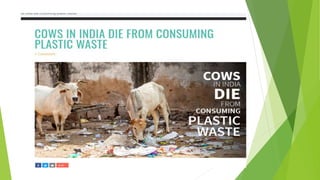

waste disposal has increased significantly. In the face of danger, humans may
perish but nature will find a way out. Here are some thoughts I have:
• Reduce consumption and wastage.
• Reduce burning of fossil fuels
• Protect lakes, forests and endangered animals/plants including bees
• Engage with nature and promote awareness
• Protect trees / plants and do not destroy in the name of industrialization.
• Promote and create natural habitats
• Reduce pollution of air / water / soil and find ways for organic growth.
• Preserve / store water as it is one of the key ingredients for survival for all
beings
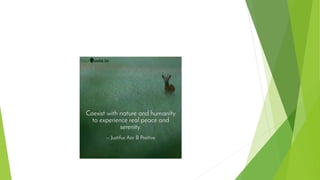
Co- Exist
1.exist at the same time or in the same place.
"dwarf mammoths may have survived in north-east Siberia to coexist with the Egyptian pharaohs"
•(of nations or peoples) exist in harmony despite different ideologies or interests.
"the task of diplomacy was to help different states to coexist“
It’s time to bridge the gap between urban development and nature. Who’s ready
to get started?

Coexisting with nature-
 Wild animals are at risk in many places throughout the world.
Their habitats are shrinking due to expanding human
habitation, agriculture, mining, and industrialisation.
 Scientists are conducting field research into solutions how
humans and animals can live better with each other. They
conclude that we can conserve nature to a much greater
extent if we let go of unlimited economic growth. How do you
think we can best protect nature?
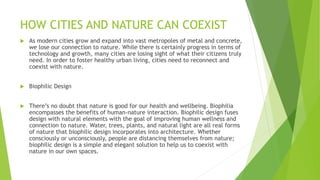
HOW CITIES AND NATURE CAN COEXIST
 As modern cities grow and expand into vast metropoles of metal and concrete,
we lose our connection to nature. While there is certainly progress in terms of
technology and growth, many cities are losing sight of what their citizens truly
need. In order to foster healthy urban living, cities need to reconnect and
coexist with nature.
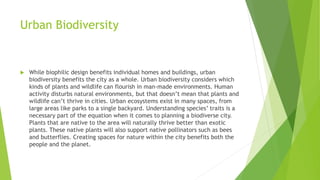
 Biophilic Design
 There’s no doubt that nature is good for our health and wellbeing. Biophilia
encompasses the benefits of human-nature interaction. Biophilic design fuses
design with natural elements with the goal of improving human wellness and
connection to nature. Water, trees, plants, and natural light are all real forms
of nature that biophilic design incorporates into architecture. Whether
consciously or unconsciously, people are distancing themselves from nature;
biophilic design is a simple and elegant solution to help us to coexist with
nature in our own spaces.
Urban Biodiversity
 While biophilic design benefits individual homes and buildings, urban
biodiversity benefits the city as a whole. Urban biodiversity considers which
kinds of plants and wildlife can flourish in man-made environments. Human
activity disturbs natural environments, but that doesn’t mean that plants and
wildlife can’t thrive in cities. Urban ecosystems exist in many spaces, from
large areas like parks to a single backyard. Understanding species’ traits is a
necessary part of the equation when it comes to planning a biodiverse city.
Plants that are native to the area will naturally thrive better than exotic
plants. These native plants will also support native pollinators such as bees
and butterflies. Creating spaces for nature within the city benefits both the
people and the planet.
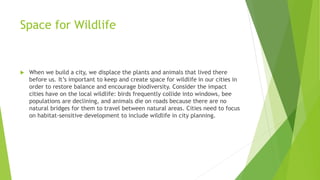
Space for Wildlife
 When we build a city, we displace the plants and animals that lived there
before us. It’s important to keep and create space for wildlife in our cities in
order to restore balance and encourage biodiversity. Consider the impact
cities have on the local wildlife: birds frequently collide into windows, bee
populations are declining, and animals die on roads because there are no
natural bridges for them to travel between natural areas. Cities need to focus
on habitat-sensitive development to include wildlife in city planning.
Naam Batao??
 https://www.youtube.com/watch?v=U1jtd3MrFQM
 https://www.youtube.com/watch?v=GJPxv20PLe0
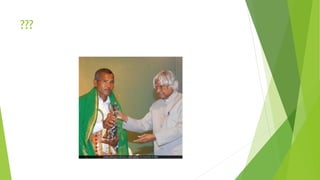
???
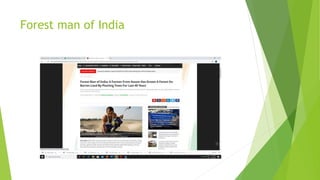
Forest man of India
 This is a story of passion and perseverance, this is the story of the Padma
Shree Awardee, Forest Man Of India, who has single handedly converted a
barren land into a dense forest
 What does it take to transform a
barren land into a forest? Apart from
plants, it takes someone to take
charge, work hard and demonstrate
the will to continue planting and
caring for the trees, against all odds.
 56 year-old Padma-Shree Awardee,
Jadav Molai
Payeng is a farmer from
Assam’s Jorhat who is also known as
The Forest Man of India.
Forest man of India
 Mr. Payeng was 16 years old in 1979, when he witnessed a large number of
snakes that had died due to excessive heat after floods washed them onto the
tree-less sandbar.
 “I had to do something about it. Not just snakes, all kinds of forest animals had
disappeared from this area due to frequent flooding. I thought the only thing I
can do is to plant trees and that is how I started, by planting around 20 bamboo
seedlings on that very sandbar”- Payeng
 The Forest Man began his journey when the social forestry division of
Golaghat district launched a scheme of tree plantation on 200 hectares at
Aruna Chapori situated at a distance of 5 km from Kokilamukh in Jorhat
district. He said,
 I was one of the first few farmers who worked on that project when it began.
Even though it got over in five years, I stayed back while others left and
looked after the plants. I also continued to plant more trees on my own.
 While his personal life also progressed with marriage and five kids, Mr. Payeng
did not forget about his mission of planting trees. For 35 years, he would walk
for 20 minutes, hop on a boat to cross the river, then walk another two hours to
reach that very sand-bar, where he would plant trees every day for three
months a year.
 Where there is a will, there is a way, they say. Mr Peyang’s will led him to the
way and today the barren land, where he once witnessed hundreds of dead
snakes due to floods and deforestation, is a forest spread across 550 acres,
thanks to his relentless efforts. The forest has been named as Molai Reserve,
the word ‘Molai’ being his middle name.
Saalumarada Thimmakka- The Tree
Mother
 At the age of 40, she wanted to end
her life as she could not conceive.
She started planting banyan trees
along with her husband and found a
purpose in it. Both Thimmakka and
her husband started with 10 banyan
saplings on either side of the road
along a stretch of 4 km in the first
year. They took care of the plants just
like their children. Every year, the
count of these trees kept increasing.
Till date, there have been more than
8000 other trees grown by her and
her husband. Growing banyan trees
was challenging in a place that was
relatively dry.
 https://www.youtube.com/watch?v=AHY45HSB-e8
 One might think that growing trees is not a big deal but one would know the
reality of it only when they do it on their own.
 Thimmakka and her husband used to carry four pails of water for a distance of
4 km to water the saplings.
 They used whatever little resources they had to plant trees. In order to get
sufficient water for the trees, they started to plant the trees during monsoon. In
this way, they could get sufficient rainwater for the saplings and the trees would
have invariably taken root by the onset of the next monsoon.
 This became Thimmakka’s daily routine for many years though it did not help in
her financial condition.
 Although Thimmakka did not receive a formal education, her work has been
honored with the National Citizen’s Award of India. She has been recognized by
the Government of India and was recently conferred with the Padma Shri award
in 2019, which is the highest civilian award in the Republic of India. There is
also an environmental organization named after her in the U.S. called
Thimmakka’s Resources for Environmental Education. Saalumarada
Thimmakka is an individual who has brought worldwide recognition to the state
of Karnataka through her incredible and massive environmental services.
 Lecture 2-
 What are the Sustainable Development Goals?
 The Sustainable Development Goals (SDGs), also known as the Global Goals, were
adopted by all United Nations Member States in 2015 as a universal call to action to
end poverty, protect the planet and ensure that all people enjoy peace and
prosperity by 2030.
 The 17 SDGs are integrated—that is, they recognize that action in one area will
affect outcomes in others, and that development must balance social, economic and
environmental sustainability.
 Through the pledge to Leave No One Behind, countries have committed to fast-
track progress for those furthest behind first. That is why the SDGs are designed to
bring the world to several life-changing ‘zeros’, including zero poverty, hunger, AIDS
and discrimination against women and girls.
 Everyone is needed to reach these ambitious targets. The creativity, knowhow,
technology and financial resources from all of society is necessary to achieve the
SDGs in every context.
Plastic Plastic Everywhere…
Es   lecture 1
Es   lecture 1
Es   lecture 1
Es   lecture 1
Es   lecture 1
Es   lecture 1
Es   lecture 1
Es   lecture 1
Es   lecture 1
Es   lecture 1
Es   lecture 1
Es   lecture 1
Es   lecture 1
Es   lecture 1
Es   lecture 1
Es   lecture 1
Es   lecture 1
Es   lecture 1

Es lecture 1

  • 1.
    Let’s Begin OurGreen Journey with EVS -Dr. Karishma Chaudhary
  • 3.
     World EnvironmentDay?  Earth Day?
  • 4.
     A bitabout World Environment Day, it was first held in 1974 and is celebrated every year on June 5 to encourage awareness and action for the protection of the environment. It stood for raising awareness about issues related to the environment like air pollution, marine pollution, global warming, human overpopulation, etc.
  • 5.
     Every yearon April 22, Earth Day marks the anniversary of the birth of the modern environmental movement started in 1970.
  • 10.
    What can wedo????  Humans are an integral part of the nature and therefore if we continue destruction we are in a way setting ourselves up for destruction.  It is ironic that we have created a separateness between humans and the natural world and we think that somehow we can control nature to prevent it from going astray.  NDD or Nature Deficit Disorder. In the information age our lives are now controlled by cell phones and social media. We spend less time in nature and that is leading to many diseases and ailments that did not exist 15–20 years ago. As per the author, nature has some inherent healing properties and helps with our overall well being.
  • 11.
     Climate changeis one of the outcomes of our way of life. Consumption and waste disposal has increased significantly. In the face of danger, humans may perish but nature will find a way out. Here are some thoughts I have: • Reduce consumption and wastage. • Reduce burning of fossil fuels • Protect lakes, forests and endangered animals/plants including bees • Engage with nature and promote awareness • Protect trees / plants and do not destroy in the name of industrialization. • Promote and create natural habitats • Reduce pollution of air / water / soil and find ways for organic growth. • Preserve / store water as it is one of the key ingredients for survival for all beings
  • 12.
    Co- Exist 1.exist atthe same time or in the same place. "dwarf mammoths may have survived in north-east Siberia to coexist with the Egyptian pharaohs" •(of nations or peoples) exist in harmony despite different ideologies or interests. "the task of diplomacy was to help different states to coexist“ It’s time to bridge the gap between urban development and nature. Who’s ready to get started?
  • 13.
     Coexisting with nature- Wild animals are at risk in many places throughout the world. Their habitats are shrinking due to expanding human habitation, agriculture, mining, and industrialisation.  Scientists are conducting field research into solutions how humans and animals can live better with each other. They conclude that we can conserve nature to a much greater extent if we let go of unlimited economic growth. How do you think we can best protect nature?
  • 15.
    HOW CITIES ANDNATURE CAN COEXIST  As modern cities grow and expand into vast metropoles of metal and concrete, we lose our connection to nature. While there is certainly progress in terms of technology and growth, many cities are losing sight of what their citizens truly need. In order to foster healthy urban living, cities need to reconnect and coexist with nature.  Biophilic Design  There’s no doubt that nature is good for our health and wellbeing. Biophilia encompasses the benefits of human-nature interaction. Biophilic design fuses design with natural elements with the goal of improving human wellness and connection to nature. Water, trees, plants, and natural light are all real forms of nature that biophilic design incorporates into architecture. Whether consciously or unconsciously, people are distancing themselves from nature; biophilic design is a simple and elegant solution to help us to coexist with nature in our own spaces.
  • 16.
    Urban Biodiversity  Whilebiophilic design benefits individual homes and buildings, urban biodiversity benefits the city as a whole. Urban biodiversity considers which kinds of plants and wildlife can flourish in man-made environments. Human activity disturbs natural environments, but that doesn’t mean that plants and wildlife can’t thrive in cities. Urban ecosystems exist in many spaces, from large areas like parks to a single backyard. Understanding species’ traits is a necessary part of the equation when it comes to planning a biodiverse city. Plants that are native to the area will naturally thrive better than exotic plants. These native plants will also support native pollinators such as bees and butterflies. Creating spaces for nature within the city benefits both the people and the planet.
  • 17.
    Space for Wildlife When we build a city, we displace the plants and animals that lived there before us. It’s important to keep and create space for wildlife in our cities in order to restore balance and encourage biodiversity. Consider the impact cities have on the local wildlife: birds frequently collide into windows, bee populations are declining, and animals die on roads because there are no natural bridges for them to travel between natural areas. Cities need to focus on habitat-sensitive development to include wildlife in city planning.
  • 18.
  • 19.
  • 20.
  • 21.
    Forest man ofIndia  This is a story of passion and perseverance, this is the story of the Padma Shree Awardee, Forest Man Of India, who has single handedly converted a barren land into a dense forest
  • 22.
     What doesit take to transform a barren land into a forest? Apart from plants, it takes someone to take charge, work hard and demonstrate the will to continue planting and caring for the trees, against all odds.  56 year-old Padma-Shree Awardee, Jadav Molai Payeng is a farmer from Assam’s Jorhat who is also known as The Forest Man of India.
  • 23.
  • 24.
     Mr. Payengwas 16 years old in 1979, when he witnessed a large number of snakes that had died due to excessive heat after floods washed them onto the tree-less sandbar.  “I had to do something about it. Not just snakes, all kinds of forest animals had disappeared from this area due to frequent flooding. I thought the only thing I can do is to plant trees and that is how I started, by planting around 20 bamboo seedlings on that very sandbar”- Payeng
  • 25.
     The ForestMan began his journey when the social forestry division of Golaghat district launched a scheme of tree plantation on 200 hectares at Aruna Chapori situated at a distance of 5 km from Kokilamukh in Jorhat district. He said,  I was one of the first few farmers who worked on that project when it began. Even though it got over in five years, I stayed back while others left and looked after the plants. I also continued to plant more trees on my own.
  • 26.
     While hispersonal life also progressed with marriage and five kids, Mr. Payeng did not forget about his mission of planting trees. For 35 years, he would walk for 20 minutes, hop on a boat to cross the river, then walk another two hours to reach that very sand-bar, where he would plant trees every day for three months a year.  Where there is a will, there is a way, they say. Mr Peyang’s will led him to the way and today the barren land, where he once witnessed hundreds of dead snakes due to floods and deforestation, is a forest spread across 550 acres, thanks to his relentless efforts. The forest has been named as Molai Reserve, the word ‘Molai’ being his middle name.
  • 27.
    Saalumarada Thimmakka- TheTree Mother  At the age of 40, she wanted to end her life as she could not conceive. She started planting banyan trees along with her husband and found a purpose in it. Both Thimmakka and her husband started with 10 banyan saplings on either side of the road along a stretch of 4 km in the first year. They took care of the plants just like their children. Every year, the count of these trees kept increasing. Till date, there have been more than 8000 other trees grown by her and her husband. Growing banyan trees was challenging in a place that was relatively dry.
  • 28.
  • 29.
     One mightthink that growing trees is not a big deal but one would know the reality of it only when they do it on their own.  Thimmakka and her husband used to carry four pails of water for a distance of 4 km to water the saplings.  They used whatever little resources they had to plant trees. In order to get sufficient water for the trees, they started to plant the trees during monsoon. In this way, they could get sufficient rainwater for the saplings and the trees would have invariably taken root by the onset of the next monsoon.  This became Thimmakka’s daily routine for many years though it did not help in her financial condition.
  • 30.
     Although Thimmakkadid not receive a formal education, her work has been honored with the National Citizen’s Award of India. She has been recognized by the Government of India and was recently conferred with the Padma Shri award in 2019, which is the highest civilian award in the Republic of India. There is also an environmental organization named after her in the U.S. called Thimmakka’s Resources for Environmental Education. Saalumarada Thimmakka is an individual who has brought worldwide recognition to the state of Karnataka through her incredible and massive environmental services.
  • 32.
  • 34.
     What arethe Sustainable Development Goals?  The Sustainable Development Goals (SDGs), also known as the Global Goals, were adopted by all United Nations Member States in 2015 as a universal call to action to end poverty, protect the planet and ensure that all people enjoy peace and prosperity by 2030.  The 17 SDGs are integrated—that is, they recognize that action in one area will affect outcomes in others, and that development must balance social, economic and environmental sustainability.  Through the pledge to Leave No One Behind, countries have committed to fast- track progress for those furthest behind first. That is why the SDGs are designed to bring the world to several life-changing ‘zeros’, including zero poverty, hunger, AIDS and discrimination against women and girls.  Everyone is needed to reach these ambitious targets. The creativity, knowhow, technology and financial resources from all of society is necessary to achieve the SDGs in every context.
  • 35.