Eero Siljander VALLUM / BI DEPARTMENT
VTL, VTM, IPMAD 2020-10, October.
CREDIT SCORING MODELS – SMALL LITERATURE REVIEW .V3
SHORT SUMMARY:
Currentmodelsandprograms(R,Python):the baseline or standardmethodforcreditscoringby
statistical methodsislogisticregression(LR). Newmethodsincludeneural networks(ANN),genetic
algorithms(GA),non-parametricmethods(discriminantanalysis(LDA),K-nearestneighborscoring
(whichisa non-parametricmethod),roughestimation(RE),decisiontree (DT) algorithmC4.5or
CART.Most oftenatleast2-3 methodsare usedandcompared.The leastisto compare LR models
withdifferentfixed- andrandomparameterandpanel datamodels.Mostoftenusedmethods
currentlyare LR, ANN,GA,DT. Each of these have theirprosandcons.Proportional hazardand
Weibull hazardare usedforSME data by Rabobank.DeloitteusesLRforB2C consumercreditdata.
You can do manyof these withRstudios,Python.
Proof of-Case (Stata):a) Statasoftware offersinaddition neural networks,partial creditscoring
models(EMoptimization) andItem-response &Raschmodels.The advantage withStataisthat you
can calculate derivativesandelasticityof X-variables.b) Thatisa change% inprobabilityof defaultor
otherY-variable withrespecttoone%change incontinuesX(income say) orc) classificationvariable
X (marital status,numberof creditcardsetc.),d) we getresultsintoExcel andPdf-tables,e) we can
applyBaysestimationinadditiontoMLE and mathematical techniques.We getHighValue Addedby
adoptingthisSoftware!See P) belowformore detailsatthe endof thispaper.
Goal: Maximize discriminatorypowerof X-variableswithrespecttoY-variables.Findright
explanatoryX-variables.Targetondefault-risk,bankruptcyrisk,
TARGET FOR ANALYSIS:
1) We wantto maximize discriminatorypowerof X-variableswithrespecttoY-variables,
2) We wantto minimize Type IIerror(1- Type II error = Right classificationof defaulters,inpercent,
%),
3) maximize Log-likelihoodorminimize MSE-errorforstatistical methods.
4) Maximize areaunderROC-curve.
5) Minimize model ERRORRATES,whethermathematical orstatistical.
Thiscan be inmany casesall done at the same time usingbestfittingstatistical ormathematical
modelsandcomparingbasedonthese TARGETS above.
Emergingmodels:Neural networkswithmultidimensional-layers(SVM),Bayesianinference (BI) of
creditworthinessprobabilities (priorandposteriordistributions)andAIC/BIC-informationcriterion
to compare goodness-of-fitof statistical models.Propensityscore matching(commoneconometrics
method) couldbe yetanothermethodtobe tried(notfoundinliterature reviewed).A good
reference forpropensityscore matchingisUusitalo&Korkeamäki 2003 (Employmenteffectsof a
payroll tax cut – Evidence fromaregional tax exemptionexperiment).The ideaistomatch X-
variablessothatdifferentgroupscanbe comparedbasedon similarityasopposedtodiscriminant
that isbaseline increditscoringdecision(creditworthyvsnon-creditworthy). Whatthingsunite
“good” riskfor example.Orderedlogit(OLR) andRandomParameterLogit(RPL) modelsshouldbe
triedoutbecause theyare newin standardmethods.
There are twocreditmodelingdomains:1) Origination score usedtopredictwhethertogive aloan
to someone 2) Behavioral modelsusedtopredictcustomerhistoryandbehaviorrelatedvariablesto
predictcollectionorline of creditperformance laterinthe life of loanproduct.
Data: our data is inthe range N=10 000 – 100 000 etc.This isdescribedindetail inHand& Henley
1997 althoughtheirmethodsare obsoleteandratherold.Data usedinthe researchliterature
usuallyconsistsof (somewhatunfortunately)about1 000 – 4 000 observationsof which70-90 % are
“good” riskcreditand 5-30 % “bad” creditrisk.Whennewestandinsome sense “most-fashionable”
geneticalgorithmsare usedtheyworkbestinthe situationwhere“bad”and“good” riskare 50-50
%. Howeverthisisquite rare instandardcreditrating. Data Qualityisabsolutelykeyforgood
Results! Inmostof the academicresearchitis not as goodas hoped.
Missingdata andoutlieranalysisare coveredindetail Hand&Henley1997. Alsoin Deloitte’spaper.
We needtoreplace missingdatabysome methods(ordropdata as lastresort).Outlierdetectionby
explorativeanalysisandboxplotsiskeyinpreliminaryphase of analysis.Inregressionanalysisitis
well knownthatinfluential observationscanchange resultstosome extentinanot-wished
direction.
Y-values:Desai et.al.1997 go through3 modesmostextensively(”good”,”intermediate”and”bad”
riske.g.creditworthiness,fringe.casesanddefaulters.).Inotherresearchusuallyonlycreditworthy
(non-default)“good”riskandnon-creditworthy(default) “bad”riskare examined.HandandHenley
(1997) describe indetail whatcreditscoringandcreditratingcan be usedfor inALL aspects.Models
can be continuesscore-cards(continuesY) ordiscrete outcome Y(creditworthyvs.non-
creditworthy).
X-values:Desai et.al.1997 and Hand & Henley1997 go throughX-valuesorAttributesor
Characteristic.MostresearchpapersreviewedcategorizeanddiscretizecontinuosX-variables.For
example incomeorage are put intogroups.
Missingvalues:Hand & Henley1997 tacle thisand X’sindepth.Missingvaluesare alsoreviewed
extensivelyinthe Deloitte paper.One canreplace themwithvarioustechniquesandboxplot
outliers.See DeloitteandHand& Henley.
Results:basedonthe reviewedliterature workextremelywellthe statisticalmodelspredictabout
70-80 %of DEFAULT RISK correctly.Howeverforhighcreditworthiness(“good”risk) orsome-trouble
of pay“intermediate”riskthe modelsworklesswell (50-60% correct prediction) Thisisagood value
accordingto statisticsprofessorSeppoMustonen(Multivariete methods-book,Univof Helsinki,
1995) whoisa specialistof discriminantanalysisandAImethods. Itishard to go above 90 % correct
prediction evenwithoriginal population data.We are alwaysworking with sampledata.Thisisthe
mostimportantriskwhenconsideringprofit.Thisisusuallyachievedinthe heterogenous(general)
population.Inpractice,variableimportance rankingsinLRmodels canbe usedto testone way
interactioneffects andaddthemto logitmodels,resultinginperformance whichmatchesor
sometimesoutperformsrandomforests
Howeverwhenpopulationishomogenous(forexamplea) only teachersor b) only telephone
company employees) the modelscansometimesgive onlyatbest50 % correct predictionfor “good”
or “intermediate”riskthe correctpredictionisinmostcasesat bestevenwithANN anddifferent
optimizationmethods.The errorrate of predictionvariesinarecentpaperwithAustralianand
Germandata from 10 to 40 %.
Papersreviewed:literature searchbyGoogle onterms“creditscoring”and“statistical methods”.
Thisleadsto papersinthe range of 10 pieceswhere logisticregressionandneural networksand
non-parametricmethodsare discussed.Sorteddescendingbyrelevancebelowexcept forpaperN)
that shouldbe starting pointfor any readingof the creditscoring literature.
5 KEY PRINCIPLESFOUNDIN LITERATURE
1. “A creditscoringmodel isjustone of the factorsused inevaluatingacreditapplication.
Assessmentbya creditexpertremainsthe decisivefactor” – Deloitte,riskscorers,2016.
2. “For CreditCompanyprofititismostimportantto classifyRightthose inRiskof Default” -Ophal
et.al.,2017.
3. “It isimportantto getevena 0,1 % increase inthe fittingof the model,e-g-probabilitiesof
defaultandcreditworthiness”-Almostall academicresearchpapers.
4. “Experimentwithmanystatistical methods(ANN,LDA,GA,k-nearestneigh.) andcompare the
ROC,AUC, correct classificationof customersbyPROBABILITYresultsholdinglogisticregression
LR as baseline”-industrystandard,Deloitte,2016.
5. “Compare expertcreditdecisionwithcreditscoringstatistical decision –same or not, if not
Why?” -Deloitte,2016.
EVALUATION OFPAPERS
In thisdocumentwe reportthe keyFindingsof eachreportor researchpaperas follows.The focus:
1. Data and its keyattributes usedinthe researchpaperinquestion(Possiblya
subjective evaluationof quality).
2. Statistical methods: a) logisticregression(LR),b) neural network(NN)andother
neural networkstype models(SVM’s,randomforest,decisiontree),c) genetic
algoritmmethod(GA),d) multivariate anddiscriminantanalysis(inexplanatoryphase)
e) basicdescriptivesf) informationvalue IV(x) g)
3. Validityof methodse.g. statistical testingof model and its variables:other
technical details(outliers,leverage,Mahalanobisdistance,heteroskedasticity,non-
normality,misspecificationof model).Misspecification meansthatourtestsand
distributionsare notvalidwhichleadsatworstto invalidstatisticalinference.
Inputtingmissingdatabyforexample k-meansmethodorEM-methodor
intrapolation.
4. ExplainedY (“good”,“intermediate”,and“bad” loans) and X-variables(attributes,
charasteristics of customers) used.
5. Conclusionsand results on each researchpaper presented.Reservationsto
results.
I) Rating of creditscoringin a) “good” e.g.regularlypayingcustomers=non-defaulters
b) ((fringe customers e.g. “intermediate”)) andc) non-loanedcustomerore.g. “bad”
customers=defaulters. Mostpapersdivide credit intocreditworthy and non-
creditworthy.This is a dichotomy.
II) Howevercontinuesscoringcardscanbe usedalsoandare used. These apply
thresholdand cut-offvalues for continuosranges of Y-variable/s.
III) Some papersdiscussautomatizationwithStatisticscomparedtomanual credit
decisions. Forexample Hand& Henley(1997). WhenFAST DECISION (asisthe case)
are neededthe LRor ANN algorithmprovidesthe initialdecisionINSTANTLY.These
StatisticsalgorithmandLR model decisionare usuallyHIGHLYACCURATEIN
SCREENINGDEFAULTERS and NON-CREDITWORTHYapplicants.
6. Critique ofresearch paper. (our opinion)
7. Usefulness.(ouropinion) (Ourpersonal valuationof the qualityof the paperand
rating 1-5 stars (1 poor,5 excellent)).
THE RESEARCH PAPERS
A) Credit scoring – Case study indata analytics
by NikosSkantzosand NicolasCastelein at Deloitte, 2016.
1. x-data(2 categories,goodand bad loans) andy-data(2 categories,goodandbad loans)
presentedinbarchart and table.The ratioof badand good loans(B/G) is11 % and 8 % for
x1 and x2 data. For y1 it is15 % and y2 4 %.Informationvaluesare IV(x)=0.0064 and
IV(y)=0.158.Overall there are Nx1=775 obs,Nx2=325 obs,Ny1=630 obs,Ny2=470 obs.
2. Logisticregressionmultivariate (LR),IV(x)andIV(y) informationvalue.Takingintoaccount
nonlinearx-variablesandinteractionsof x-variables(x1*2,x2*2,x1*x2,….) inLR model.This
shouldbe testedusingWald,Likelihoodratiotests.
3. Ratingloandecisions=creditscoringintotwo categoriesy1=default=1,y0=non-default=0.
Splittingthe dataintoA) TRAININGDATA B) FITTINGDATA.
4. ROC-CURVEanalysis“ReceiverOperatingCharacteristic”. Predictionpowerof LRmodels.
AreaunderROC-curve > acceptable >70 % obs, 80 % obsgoodprediction,verygood> 85 %
obs.Confusionmatrix (threshold:>60 acceptable,Good> 70 %,VeryGood> 85 %).
5. Conclusionsare thatROC curve,Informationvalue(IV(x)) andConfusionmatrix with
60,70,80 % correct predictionlevelsshouldbe used.
6. ES, VS,WE SAY: 5-STAR researchpaper-> note outlieranalysisof Boxplotsandleverage.
HeteroskedasticityiswithWhite-robuststandarderrorsinregressionmodels.
7. We have nowadaysRANDOMPARAMETERLOGISTIC MODELS ANDMULTINOMIAL AND
ORDERED LOGIT REGRESSION that performmuchmore betterthanthese.STATA CAN
PROVIDETHESE !
B) Credit-scoringmodelsinthe credit unionenvironmentusingneural networks and genetic
algorithms.
V.S.Desai,D.G. Conway,J.N.Crook,G.A.OverstreetJnr,IMA Journalof Math Appsin Bus& Ind
(1997:8:323-346)
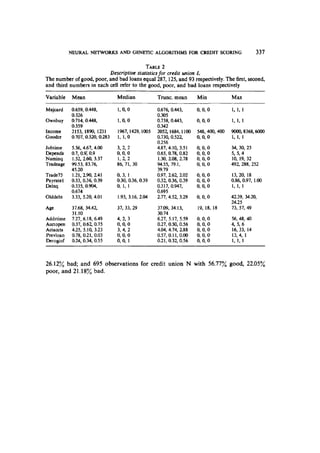
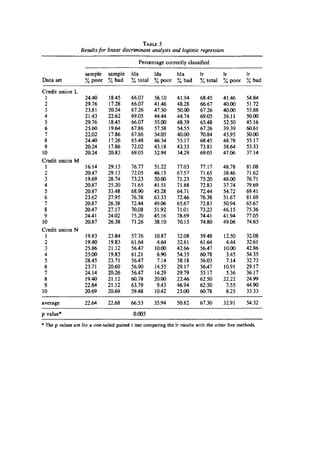
1. CreditunionsM,N, L (3 creditcompanies).Mare more or lessgeneral populationpeople.L
are teachers.N are telephone companyemployees.The sample sizesare Nm=918 obs,
Nn=853 obs,Nl=962 obs.
2. Statistical methodsare descriptive analysis(mean,median,CV),logisticregression(LR)
neural networksusingmultilayerperceptrons(CMPL) andgeneticalgoritmsfordiscriminant
analysis(GA).Neural networkarchitecture(MLP),Logisticregression(LR),lineardiscriminant
analysis(LDA),geneticanalysisof LDA.
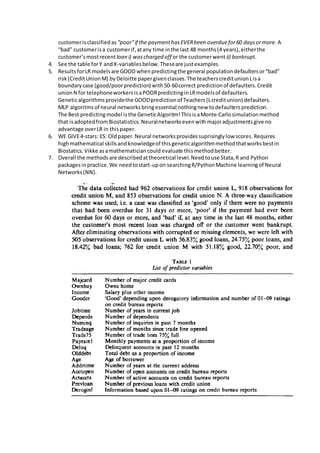
3. Customersare “good”,“poor” and “bad” customersdependingontheirbillingpayment
habits.The aimis to classifyasmanyas possible correctlybystatistical methods.
Thismeansfor example;numberof customersobserved“good”denominatorandpredicted
numberof customers“good”nominator= (#predicted “good”/#observed “good”,%).And
observed“bad”denominatorandpredicted“bad”nominator(#predicted “bad”/#observed
“bad”,%).The percentage of relations
e.g.the class of “good” customersisdividedintotwoclassesof “good”and“poor”. A
DEFINITIONS:“good”customerhasNOpaymentsthatareoverdue31daysor more.A
customeris classifiedas “poor”if the paymenthasEVERbeen overduefor60 daysormore. A
“bad” customerisa customerif,atany time inthe last 48 months(4 years),eitherthe
customer’smostrecent loan i) wascharged off or the customerwent ii) bankrupt.
4. See the table forY andX-variablesbelow.Theseare justexamples.
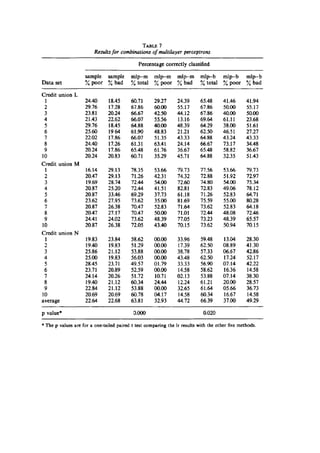
5. ResultsforLR modelsare GOOD whenpredictingthe general populationdefaultersor“bad”
risk(CreditUnionM) byDeloitte papergivenclasses.The teacherscreditunionLisa
boundarycase (good/poorprediction) with50-60correct predictionof defaulters.Credit
unionN for telephoneworkersisaPOORpredictinginLRmodelsof defaulters.
Geneticalgorithmsprovidethe GOODpredictionof Teachers(Lcreditunion) defaulters.
MLP algoritmsof neural networksbringessential nothingnew todefaultersprediction.
The Best predictingmodel isthe GeneticAlgoritm!ThisisaMonte Carlosimulationmethod
that isadoptedfromBiostatistics.Neuralnetworksevenwithmajoradjustmentsgive no
advantage overLR in thispaper.
6. WE GIVE4-stars: ES: Oldpaper.Neural networksprovidessuprisinglylow scores.Requires
highmathematical skillsandknowledgeof thisgeneticalgorithmmethodthatworksbestin
Biostatics.Vikke asamathematiciancould evaluate thismethodbetter.
7. Overall the methodsare describedattheoretical level.Needtouse Stata,R and Python
packagesinpractice.We needtostart-upon searchingR/PythonMachine learningof Neural
Networks(NN).
C) Will machinelearningandhyperparameter optimizationbecomea game changerfor
credit scoring?Paper presented at the XV Conferenceon Credit Scoring,Edinburgh,
Scotland.
Authors: KnutOpdal,Rikard Bohm,ThomasHill, 2017.
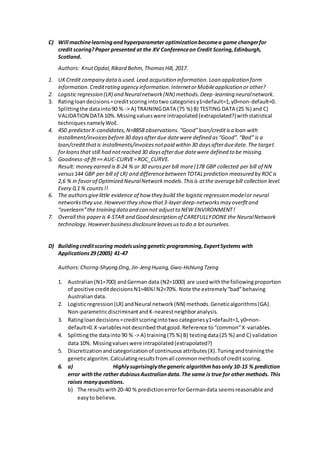
1. UKCredit company dataisused.Lead acquisition information.Loan application form
information.Creditrating agency information.InternetorMobileapplication or other?
2. Logistic regression (LR) and Neuralnetwork(NN) methods.Deep-learning neuralnetwork.
3. Ratingloandecisions=creditscoring intotwo categoriesy1=default=1,y0=non-default=0.
Splittingthe datainto90 % -> A) TRAININGDATA (75 %) B) TESTING DATA (25 %) and C)
VALIDATION DATA 10%.Missingvalueswere intrapolated(extrapolated?)withstatistical
techniquesnamelyWoE.
4. 450 predictorX-candidates,N=8858 observations.“Good”loan/creditisa loan with
installment/invoicesbefore30 daysafterdue datewere defined as“Good”.“Bad” is a
loan/creditthatis installments/invoicesnotpaid within 30 daysafterduedate.The target
forloansthat still had notreached 30 daysafterdue datewere defined to be missing.
5. Goodness-of-fit== AUC-CURVE=ROC_CURVE.
Result: money earned is 8-24 % or 30 eurosper bill more(178 GBP collected per bill of NN
versus144 GBP per bill of LR) and differencebetween TOTALprediction measured by ROCis
2,6 % in favorof Optimized NeuralNetworkmodels.Thisis atthe averagebill collection level.
Every 0,1 % counts!!
6. The authorsgivelittle evidence of how they build the logistic regression modelor neural
networksthey use.Howeverthey show that3-layer deep-networksmay overfitand
“overlearn”the training dataand can not adjustto NEW ENVIRONMENT!
7. Overall this paperis 4-STAR and Good description of CAREFULLYDONE the NeuralNetwork
technology.Howeverbusinessdisclosureleavesusto do a lot ourselves.
D) Buildingcreditscoring modelsusinggenetic programming,ExpertSystems with
Applications29 (2005) 41-47
Authors:Chorng-Shyong Ong,Jin-Jeng Huang,Gwo-Hshiung Tzeng
1. Australian(N1=700) andGerman data (N2=1000) are usedwiththe followingproportion
of positive creditdecisionsN1=46%!N2=70%. Note the extremely“bad”behaving
Australiandata.
2. Logisticregression(LR) andNeural network(NN) methods.Geneticalgorithms(GA).
Non-parametricdiscriminantandK-nearestneighboranalysis.
3. Ratingloandecisions=creditscoringintotwo categoriesy1=default=1,y0=non-
default=0.X-variablesnotdescribedthatgood.Reference to“common”X-variables.
4. Splittingthe datainto 90 % -> A) training(75 %) B) testingdata(25 %) and C) validation
data 10%. Missingvalueswere intrapolated(extrapolated?)
5. Discretizationandcategorizationof continuousattributes(X).Tuningandtrainingthe
geneticalgoritm.Calculatingresultsfromall commonmethodsof creditscoring.
6. a) Highlysuprisinglythegeneric algorithmhasonly 10-15 % prediction
error withthe rather dubiousAustraliandata.The same is true for other methods. This
raises manyquestions.
b) The resultswith20-40 % predictionerrorforGermandata seemsreasonable and
easyto believe.
c) Thispaperpresentsmanymethodsbutthe qualityof the data ruinsitall for
Australiandata.Germandata ok.
E) Neural network credit scoringmodels,Computers& OperationsResearch 27 (2000) 1131-
1152
Author:David West
1. The data consistsof Australiandata(N=700) andGerman data (N=1000). For some
reasonthe data is describednotmuch.Howeverthe openingof the paperisvery
extensive anddescribesthe companydefaultvs.individual defaultriskaswell as
researchdone upto 21st
century.
2. Methodsinclude 5ANN-methods,LDA islineardiscriminantanalysis,LRlogistic
regression,k-nearestneighbormethod,kernel-densityestimationanddecisiontrees.
Overall MOSTcreditscoringmethodsare testedinthispaper.ThisisGood NEWS !
The Bad newsisthatthere issome concern overthe qualityof the data.
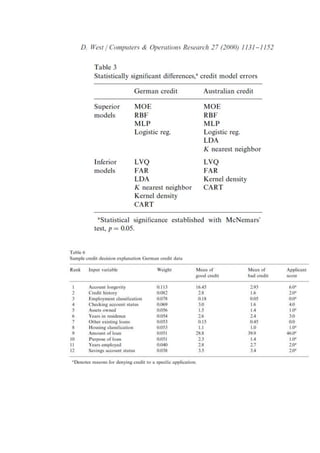
3. X-variablesare describedverywell intable 6(MUST SEE). The Y variable isthe standard
(0,1)-variable “good”riske.g.creditworthy andnotcreditworthy“bad”risk.
4. SplittingdataintoTRAININGANDTEST DATA thenusing10-runs inANN’sestimation.
5. Mixture-expertANN’sandradial-basisANN’sperformbeste.g.give BESTprediction.
LogisticregressionLRisfoundto be mostaccurate of the traditional methods.Of the
more reliable Germandataitcan be saidthat LR’s andANN’scompete “head-to-head”.
The 1950’s parametricand non-parametricmethodsdonotperformpoorlybut
traditional LDA,kernel-densitylagsignificantlybehindLRand ANN.
6. Critiqueis concerningthe data whichis kept quite candid(especiallythe Australian
data).
7. Thispaper4,5 -STARin that itdescribesthe theory,methodsandliterature extremely
well.Mustreadfor someone wantingtolearncreditscoring! Look at Germandata
results,please,thank you !
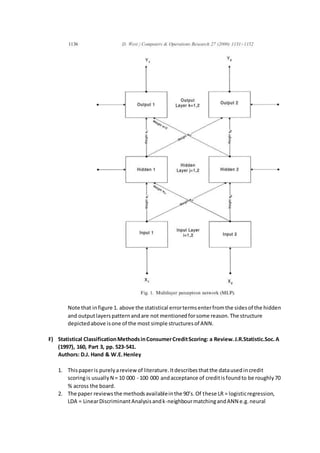
Note that infigure 1. above the statistical errortermsenterfromthe sidesof the hidden
and outputlayerspatternandare not mentionedforsome reason.The structure
depictedabove isone of the most simple structuresof ANN.
F) Statistical ClassificationMethodsinConsumerCreditScoring: a Review.J.R.Statistic.Soc.A
(1997), 160, Part 3, pp. 523-541.
Authors: D.J. Hand & W.E.Henley
1. Thispaperis purelyareview of literature.Itdescribesthatthe datausedincredit
scoringis usuallyN = 10 000 - 100 000 andacceptance of creditisfoundto be roughly70
% across the board.
2. The paper reviewsthe methodsavailableinthe 90’s.Of these LR = logisticregression,
LDA = LinearDiscriminantAnalysisandk-neighbourmatchingandANN e.g.neural
networkshave survivedbesttoourday (see:Deloittecompany,2016; West2000;
Ophdal 2017).
3. InformationcriteriaIV(x) andROC-curve introduced.These are the measuresof correct
prediction.Define also COR=# correctlypredictednumberof obs/# All observations=
correctlypredictedpercent.Then ErrorRate = 1 – COR, percent.
4. X-variablesare reviewedonlyalittle.The emphasisisonmethodsandreviewing90’s
literature.Backthenthe standardtechniqueswereLDA andOLS regression.Decision
tree techniquesalso.
5. Promotingk-nearestneighbormethod.The differenceiscreditscoringwithrespectLRis
howeverquite small0.68 % e.g.underone percentinN=5000 observations.Thisis35
people gettingacreditmore.The acceptance rate is70 % so 3 500 people getcredit.
The authors consider70 % a “loose criterion”andconsiderthe change incrementaldue
to populationdrift(fringe customersatstake).
6. EconomicBoomsand Busts cause populationdriftbetween“good”and“bad” creditand
changesinlegal institutionalso.Therefore inpractice we betterscore cardsor needover
1 % predictioninsmall populationsthe authorsconclude.
7. Critique:In large populationsa0,1 % issignificant(N=100 000)  100 personsgetting
credit. The authorsstart their paper with thispopulationsizebut then reduce it.
8. 3-STAR paper.Most of the techniquesare from90’s but the descriptionof a) credit
scoringand b) creditrating problemisdone inanexcellentmanner.
G) Comprehensible CreditScoringModelsUsingRule Extraction From
Support Vector Machines,David Martens, Bart Baesens,Tony Van Gestel,JanVanthienen,
K.U.Leuven,Dept.of DecisionSciencesand InformationManagement,
Naamsestraat 69, B-3000 Leuven,Belgium.
1. The data is Australiancreditscoringdata(N=690) and Benelux countrymid-size
companybankruptcydata (N=844). There isconcernwithAustraliandataqualityin
otherpapersinthe fieldof study.
2. The paper presentsthe “state-of-the-art”methodsthatare emergingincreditscoring
literature concerningAIandMachine Learning.These are relatedtoSupportVector
Machine algorithms(SVM’s).The authorstake accountof the complexityof these
models.Therefore theyare notevidentoreasyto presenttonon-experts.
3. Standardcorrectionof prediction(COR) percent(orErrorrate = 1 - COR percent).
4. X-variablesare lagof paymentsandsolvencyratesof companiesandbalance of
paymentsforbankruptcy.ForcreditscoringX’sare not discussedingreatdetail.Y-
variablesare probabilityof bankruptcyanddefaulting.
5. The modelsperformance iscompared.ItisfoundthatSVM-modelsperformbest
followedbyLR models.
6. Critique:dataqualitycouldbe betterforcreditscoringwithlargerthanN>>690.
7. 5-STAR paperindescribingnewest(andmostcompex) methodsinthe fieldof creditand
bankruptcyscoring.
NOTE:
“”“ Andrews,DiederichandTickle [1] propose aclassificationschemeforneural network
rule extractiontechniquesthatcaneasilybe extendedtoSVMs,andisbasedon the
followingcriteria:
1. Translucencyof the extractionalgorithmwithrespecttothe underlyingneural
network;
2. Expressive powerof the extractedrulesortrees;
3. Specializedtrainingregimeof the neural network;
4. Qualityof the extractedrules;
5. Algorithmiccomplexityof the extractionalgorithm.””” -quote frompaper.
H) Investigationand improvementofmulti-layerperceptronneural networks for credit scoring,
Zongyuan Zhaoa, Shuxiang Xua Byeong, HoKangbMir Md, Jahangir Kabira YunlingLiuc, Rainer
Wasingera.
School of EngineeringandICT,Universityof Tasmania,Launceston,Tasmania,Australia
School of EngineeringandICT,Universityof Tasmania,Hobart,Tasmania,Australia
College of InformationandElectrical Engineering,ChinaAgriculturalUniversity,Beijing,China.
Highlights
• TheypresentanAverage RandomChoosingmethodwhichincreases0.04 classificationaccuracy.
• InvestigatedifferentMLPmodelsandget the bestmodel withaccuracyof 87%.
• Accuracy increaseswhenthe modelhasmore hiddenneurons.
Abstract
Multi-LayerPerceptron(MLP) neural networksare widelyusedinautomaticcreditscoringsystems
withhighaccuracy and efficiency.Thispaperpresentsahigheraccuracy creditscoringmodel based
on MLP neural networksthathave beentrainedwiththe backpropagationalgorithm.Ourwork
focusesonenhancingcreditscoringmodelsinthree aspects:(i)tooptimise the datadistributionin
datasetsusinga newmethodcalledAverageRandomChoosing;(ii) tocompare effectsof training–
validation–testinstance numbers;and(iii) tofindthe mostsuitable numberof hiddenunits.We
trained34 models20 timeswithdifferentinitial weightsandtraininginstances.Eachmodel has6 to
39 hiddenunitswithone hiddenlayer.Usingthe well-knownGermancreditdatasetwe provide test
resultsanda comparisonbetweenmodels,andwe geta model withaclassification accuracyof 87%,
which is higherby 5% than the best resultreported inthe relevantliterature of recentyears. We
have alsoprovedthat ouroptimisationof datasetstructure canincrease amodel’saccuracy
significantlyincomparisonwithtraditionalmethods.Finally,we summarisethe tendencyof scoring
accuracy of modelswhenthe numberof hiddenunitsincreases.The resultsof thisworkcanbe
appliednotonlytocreditscoring,butalsoto other MLP neural networkapplications,especially
whenthe distributionof instancesinadatasetisimbalanced.
7. RECENT ANDMODERN RESEARCHPAPERWITH GOOD QUALITY DATA.THIS PAPER
COULD NOT BE OBTAINEDMORE DUE TO FEE POLICY.BEHIND MOVINGWALL.
I) RANDOM FOREST (DECISIONTREE = DT) MODELS BY SHARMA - SOME RESULTS
https://cran.r-project.org/doc/contrib/Sharma-CreditScoring.pdf
AndPPT-slidesetfrominternetwhere Mile worldrecordandSharma’srandomforest
calculationpresented.Canbe easilyobtainedviaGoogle.Here iskeyresulttable for
accuracy in percent.Note thatthe differencesinmodelspredictionare quite small.
The largestdifferenceis0,9 % betweenrandomforestwithinteractionandlogitwith
interactionterms.Basedona small numberof methodsobserveditisaverage quality
researchpaper(3-star).Critique:Eagerwordstomarketownmodel.
J) A betterComparison Summary of CreditScoring Classification.(IJACSA) International
Journal Of AdvancedComputer Science and Applications,Vol.8, No.7,2017. Sharjeel
Imtiaz, AllanJ. Brimicombe.
1. Data is fromTaiwanUCI website for2006. It isfinancial stressdataalso.Atthe time
there wasa banking/creditcrisisinTaiwan.Fittingthe modelsindisturbingtimes.
2. ANN-1(single-layerdefaultmodel),ANN-H(minimumhiddenlayersmodel),ANN-L
(linearmodel withoutanyactivationfunction)modelsare mainmodelse.g.neural
networks.These 5hiddennodes,2hiddenlayersand19 inputparametersare tested
to findbestmodel.(gradual incrementmethod).These are comparedwithlogistic
regression (LR) withRANDOMEFFECTS(panel dataor RandomCoefficients)and
Decisiontree (DT). Decisiontreesare:default,Pruning,boosting10 %,Boosting100
%.
3. AUC-curve =(ROC-curve) andErrorrate analysis.There isfavoringof errorrate
analysisasthe authors claimthisto be a bettermethod.Imputationof missing
valueswith K-meansmethod.The errorrate is(1 - the rate correct predictionrate)
inthe data. The authorspresentactuallythe correctpredictionrate!
4. Y is standardtwo-dichotomous(0=no-default,1=default).X’sincategorical nominal
are SEX,EDUCATION,MARITAL STATUS. Categorical April toSeptember(Py_0to
Pay_6),Continuesare AGE,Amountof givencredit(Limit_BAL), Amountof bill
statement(BILL_AMT1 to BILL_AMT6), Amountof previouspayment(PAY_AMT1to
PAY_AMT6).
5. Conclusions:ANN-Lmodel ismarginallyfoundtobe the bestmodel (+0,1 % betterin
ROC,+0,2 %by Error Rate than RandomEffectsLR).Best decisiontree model is
Boosting10 %model DT-model whichis -2,67% percentworse inerror rate than
ANN-L.
6. Critique:dataisnot presentedwell (businesssecret?).
7. Usefulness:4.Quickjumpfrom introductiontoresults.Itisinterestingtosee that
whenimputingmissingvalues(K-meansprocedure)intothe datathe bestmodels
are ANN-linearandLogisticRegression.Whenno-imputationof missingvaluesdone
the bestmethodforstatistical analysisisDecisiontree with10% Boosting
technique.
CONFERENCEPAPERS
K) A CreditScoring Model Based on Alternative Mobile Data for Financial Inclusion
by Xinhai Liu,Ti Wang, Wei Ding, Yanjun Liu and Qiuyan Xu. Edinburgh credit scoringand creditcontrol
conference 2017.
1. alternative datalike mobile data. Inthe papertheyusedcall detail record(CRDR) andbilling
data. Otherpossibilitiesare payment,facility,e-commerce andsocial networkdata.They
extracted15 featuresfromthe mobile phone datatodescribe behaviorandsocioeconomic
status.The featuresare notdescribedinthe paper.The defaultof consumersisdefinedas
the 30 days past due during12 monthsperformance window.The observationtimewindow
for mobile phone behavioristhree months.Atlast,the KSvalue isaround42 in the
evaluationtest.
2. inthe papermobile phone datawasmatchedthe financial data(creditdefault) usingcross-
training.EstimationmethodisbinaryclassificationusingLR.
4. goodand bad loan.
5. paperdoesn’tshowanyresults.
6. value of the paperis minimal andprovidesonlyanidea.
7. usefulness:3
L) Will machine learningand hyperparameteroptimizationbecome a game changer for credit
scoring? by Knut Opdal,Rikard Bohm and Thomas Hill.Edinburgh creditscoringand creditcontrol
conference 2017.
1. leadacquisition(channel,leadprice,other leadinfo),
data providedonthe applicationform(demographicinformation,employmentstatusand
salaryetc.),
creditinformation(Experian,Equifax,CallCredit),
other data (the method/device usedforapplication,date andtime of application)
2. machine learningalgorithms(stochasticgradientboostinganddeeplearningneural
networks) withhyperparameteroptimization.Theycomparedthese toindustrystandard
logisticregressiononWeight-OfEvidence (WoE) transformedpredictors.
3. The «last» 10% of the paid-outloanswere usedasout-of-time validationsample.Forall
analyses75% of the remainingobservationswereusedfortrainingand25% fortesting.
The trainingand testingsampleswerestratifiedbytargetanda genericscore tomake sure
the trainingsetwas representative.
4. Installment/invoicesnotpaidwithin30days afterdue date were definedas“Bad”.
Installments/invoicesbefore 30days afterdue date were definedas“Good”.The target for
loansthat still hadnotreached30 days afterdue date were definedtobe missing.
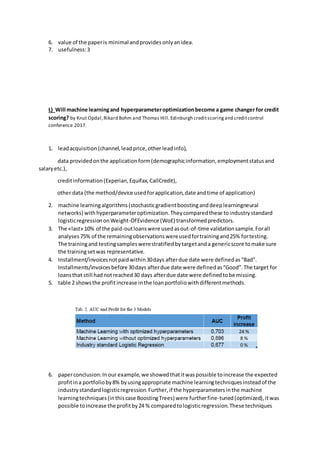
5. table 2 showsthe profitincrease inthe loanportfoliowithdifferentmethods.
6. paperconclusion:Inour example,we showedthatitwaspossible toincrease the expected
profitina portfolioby8% byusingappropriate machine learningtechniquesinsteadof the
industrystandardlogisticregression.Further,if the hyperparametersinthe machine
learningtechniques(inthiscase BoostingTrees) were furtherfine-tuned(optimized),itwas
possible toincrease the profitby24 % comparedtologisticregression.These techniques
have potential tobe a game changer,but we believemanybankswill continue touse logistic
regressionasbefore,andtherefore we donotbelieve thatitwill have abigenoughimpact
to qualifytobe calleda game changer.On the otherside,we dobelievethatthere will be
banksthat will embrace these methodsandbe able toproduce scorecardswithhigher
performance.These bankswill be more competitive andincrease theirprofit.We therefore
thinkthese methodswill playanimportantrole forthe bankingsectorinthe time tocome.
7. Usefulness:4
M) Piecewise LogisticRegression:anApplicationin CreditScoring,
by Raymond Anderson, Standard Bank of South Africa,Edinburgh credit scoringand creditcontrol
conference 2015.
1. high-riskportfolio,where riskappetite hadbeenreinedinsubstantiallyoverthe period
underconsideration.
2. Piecewise LR
3. There are three casesthat we will be comparingin thispaper,all of whichuse the weightsof
evidence:
a. Base Case,whichreferstothe standardapproachfor logisticregression,withone
variable percharacteristic;
b. Piecewise,where there maybe one ormore variables(pieces)forthe characteristic,
where each“piece”mayrepresentone ormore coarse classes;
c. Dummy,where there isaseparate variable (piece) foreachcoarse class,each
containingthe weightof evidence if the characteristiciswithinthe group,andzeroif
not
5. The resultsof thisanalysisindicate thatbettercreditscoringmodelscanbe builtusing
piecewise logisticregressionthanthe same regressionusingasingle variableper
characteristic(Base Case) orattribute (Dummy).The Gini coefficientsare higher,whilethe
correlationsandvariance inflationfactorsare lower.Atthe same time,the modelsare more
robust,beingbetterable tohandle achangingriskenvironment.
In the current instance,we are lookingsolelyatlogisticregression.Althoughthe typical uses
of WOE and dummieshave beenpresentedabove,theycanbe andare usedincombination
inlogisticregression.Itisonlythe variable “x”valuesthatchange dependinguponhow the
variable hasbeentransformed.
7. usefulness:2
N) Creditscoring,statistical techniques,and evaluationcriteria: a review of the literature.
IntelligentsystemsandAccounting, Finance & Management,2011, 18 (2-3) pp. 59-88.
Authors:Abdou.H.,PointonJ.
1. Data isliterature review dataof 214 articles.Most articlesdatais confinedtoN=1 000 –
10 000 observationsdata.There are few creditscoringpaperswithoverN > 10 000 customers.
Thisis due to the limitationof academicwriterstogetprivate companydata. SELECTION BIAS is
always presentbecause we don’t know of the people who we don’t give credit to. We have to
getthisdata from Asiakastieto(creditunionrater) orsome otherratingagency.
2. All relevantstatistical methodsin the literature.IncludingANN,K-nearestneighbor,Markov
chains,Decisiontrees(DT),GenericalgorithmsGA,RandomForestsalgorithms,Logisticand
ProbitregressionLR,OLS,discriminantLDA,kernerfuntions,COXHAZARDregression,
multivariate methods,non-parametricdecisiontrees(DT).
Result:NO UNIVERSAL BEST METHOD EXISTS. Alwaysdivide datainto1) training2) testingand
3) validationparts.ThenPILOTyourresultsbefore usingtheminreal-worldsituations.Compare
the resultsof at least2 to 3 DIFFERENT STATISTICALORMATHEMATICAL METHODS.
3. Meters,“goodness-of-fit”:ACCrating(average creditscoredright),ROC-curve rating,
Confusionmatrix,Type IIerror,Type Ierror, Costof misspecification,Errorrate.
4. Y-variablesare lineartestscore measure ordiscrete (2-classor3-class) classificationof
creditscore into “good”,“intermediate” and“bad” risks.The dangerof neglectingpeople
withsome delaysintheirpaymentbuttakingcare of theirloansisWARNED about.There is
profitmarginhere thata simplistic“black-white”classificationof creditworthy“the goods”
and uncreditworthy“the bads”presents.Inreality there isscope for a “gray”-area where
paymentsmaybe (abit) late orneedsome (minorcost) arrangement.Thisispointedoutby
the authors as improvingourmodels.
X-variablesare: age,marital status,dependents,havingatelephone,havinghome
mortgage,havingcar loan,havinga creditcard, numberof creditcards, total amountof
credit,total amountof income,loanduration,education,occupation,yearinwork,time at
presentaddress,postal code,bankaccounts,numberof bankaccounts,purpose of loan,
guarantees.UsuallyX-variablesusedincategorical variables,butnumbercrunchallows
continuity!!
5. The resultsare that there isno “one-fits-all”methodof statisticsormathematicsthatworks
inall situations,countries,environments,economies,culturesetc.Alsoexpertopinion
shouldnotbe discountedorrebuffedwhenstatisticalmodelsare built.The FIN,SWE,NOR,
DEN environmentsare different.
6. Critique:once again the qualityof dataisnot adequate andsmall sample resultsare usedto
infermanythings.Whensample size increase thenANN andLRmethodsare marginally
differentorequal good-in-fit.We alwayshave totryout several methodsandcompare
results.
7. Useful:5. Like saidthe authorshave done a tremendousjobof goingthrough 214 articles.
O) Survival analysis in CreditScoring – A framework for PD estimation
Author:R. Man, RabobankInternational,2014-09-05
1. Data ishighqualitybankruptcydataand large with877 defaults.There are thousandsof
observations.B2Cdataon retail n=16383. SME corporate bankruptcydatan=14953. Simulated
data n=1000. Modelsare calculatedfor0-1 year,0-2 yearand 0-3 year risk.
2. Methodsincludedare Survival analysiswithKaplan-Meierhazard,Cox-proportionalhazard
models(PH),Weibull modelsof hazards,logisticregressionanalysis.WoE(weightof evidence)-
estimatorof discriminatorypowerbetween“good” and“bad” loans.There isa LOT of
descriptionof “How-to-Do-IT”.Thismeansthere isagooddescriptionof methodsindetail.
3. Goodnessof fitis measuredbyROC-curve.InformationvalueIV(x).Goodrate &Bad rate of
loanspredictedright.WoEscore.
4. Y1 variable isthe “time to default”indays,weeks,hours,months.The betteraccuracythe
better.These are forecastedbysurvival modelsthathave proportionalornon-linearhazard
curves.EvenATF – acceleratedfailure timemodels.h(t) =hazardfunction,S(t)=survival function.
The Y2 variable isalsojust 1=defaultor 0=survival.The resultsof differentmodelsare compared.
Logistictransformation,Logranktransformation,Statistical Optimal Approach(Seepage 49).
X-variablesare discussedindetail.Theyvaryfromconsumertobusinessdata.See appendix.
5. The resultsare that survival modelsdowell inpredictingbankruptcyratesfordifferenttime
periods.Furthermore itispossible toforecastfuture bankruptciesbasedonhistorical dataat
differenttime intervals.These are the advantagesof survival analysis.
6. Critique:toomuchtime andeffortisput onidentifyingx-variablesclasses.We shoulduse
more continuesvariablesinthe future because computingpowerpermitsthiswell !
7. RabobankpaperwhichusesBigData andstandard LR and PH methods.Must read!
P) EM-procedure, Stata, irt pcm — Partial creditmodel.
I) irt pcm fitspartial creditmodels(PCMs) toordinal items.Inthe PCM,itemsvaryin
theirdifficultybutshare the same discriminationparameter.irtgpcmfitsgeneralizedpartial
creditmodels(GPCMs) toordinal items.Inthe GPCM, all itemsvaryintheirdifficultyand
discrimination.
Quickstart
PCMfor ordinal itemso1to o5
irt pcm o1-o5
PlotCCCsfor o1
irtgraphicc o1
Menu
Statistics> IRT (itemresponse theory)
Page 105., Stata IC 14.2 manual.
II)irtpcm postestimation — Postestimationtoolsforirtpcm
The followingpostestimationcommandsare of special interestafterirtpcmand irtgpcm:
CommandDescription
estatreportreport estimatedIRTparameters
irtgraphicc plotitem characteristiccurve (ICC)
irtgraphiif plotiteminformationfunction(IIF)
irtgraphtcc plottestcharacteristiccurve (TCC)
irtgraphtif plottest informationfunction(TIF)
The followingstandardpostestimationcommandsare alsoavailable:
Command Description
estatic Akaike’sandSchwarz’sBayesianinformationcriteria(AICandBIC)
estatsummarize summarystatisticsforthe estimationsample
estatvce variance–covariance matrix of the estimators(VCE)
estat(svy) postestimationstatisticsforsurveydata
estimatescatalogingestimationresults
lincompointestimates,standarderrors,testing,andinference forlinear
combinationsof coefficients
lrtestlikelihood-ratiotest
nlcompointestimates,standarderrors,testing,andinference fornonlinear
combinationsof coefficients
predictpredictions
predictnl pointestimates,standarderrors,testing,andinference forgeneralized
predictions
testWald testsof simple andcomposite linearhypotheses
testnl Waldtestsof nonlinearhypotheses
lrtestis not appropriate withsvyestimationresults.
Page 115, Stata 14.2 IC manual.

Es credit scoring_2020

  • 1.
    Eero Siljander VALLUM/ BI DEPARTMENT VTL, VTM, IPMAD 2020-10, October. CREDIT SCORING MODELS – SMALL LITERATURE REVIEW .V3 SHORT SUMMARY: Currentmodelsandprograms(R,Python):the baseline or standardmethodforcreditscoringby statistical methodsislogisticregression(LR). Newmethodsincludeneural networks(ANN),genetic algorithms(GA),non-parametricmethods(discriminantanalysis(LDA),K-nearestneighborscoring (whichisa non-parametricmethod),roughestimation(RE),decisiontree (DT) algorithmC4.5or CART.Most oftenatleast2-3 methodsare usedandcompared.The leastisto compare LR models withdifferentfixed- andrandomparameterandpanel datamodels.Mostoftenusedmethods currentlyare LR, ANN,GA,DT. Each of these have theirprosandcons.Proportional hazardand Weibull hazardare usedforSME data by Rabobank.DeloitteusesLRforB2C consumercreditdata. You can do manyof these withRstudios,Python. Proof of-Case (Stata):a) Statasoftware offersinaddition neural networks,partial creditscoring models(EMoptimization) andItem-response &Raschmodels.The advantage withStataisthat you can calculate derivativesandelasticityof X-variables.b) Thatisa change% inprobabilityof defaultor otherY-variable withrespecttoone%change incontinuesX(income say) orc) classificationvariable X (marital status,numberof creditcardsetc.),d) we getresultsintoExcel andPdf-tables,e) we can applyBaysestimationinadditiontoMLE and mathematical techniques.We getHighValue Addedby adoptingthisSoftware!See P) belowformore detailsatthe endof thispaper. Goal: Maximize discriminatorypowerof X-variableswithrespecttoY-variables.Findright explanatoryX-variables.Targetondefault-risk,bankruptcyrisk, TARGET FOR ANALYSIS: 1) We wantto maximize discriminatorypowerof X-variableswithrespecttoY-variables, 2) We wantto minimize Type IIerror(1- Type II error = Right classificationof defaulters,inpercent, %), 3) maximize Log-likelihoodorminimize MSE-errorforstatistical methods. 4) Maximize areaunderROC-curve. 5) Minimize model ERRORRATES,whethermathematical orstatistical. Thiscan be inmany casesall done at the same time usingbestfittingstatistical ormathematical modelsandcomparingbasedonthese TARGETS above. Emergingmodels:Neural networkswithmultidimensional-layers(SVM),Bayesianinference (BI) of creditworthinessprobabilities (priorandposteriordistributions)andAIC/BIC-informationcriterion to compare goodness-of-fitof statistical models.Propensityscore matching(commoneconometrics method) couldbe yetanothermethodtobe tried(notfoundinliterature reviewed).A good reference forpropensityscore matchingisUusitalo&Korkeamäki 2003 (Employmenteffectsof a payroll tax cut – Evidence fromaregional tax exemptionexperiment).The ideaistomatch X- variablessothatdifferentgroupscanbe comparedbasedon similarityasopposedtodiscriminant that isbaseline increditscoringdecision(creditworthyvsnon-creditworthy). Whatthingsunite “good” riskfor example.Orderedlogit(OLR) andRandomParameterLogit(RPL) modelsshouldbe triedoutbecause theyare newin standardmethods.
  • 2.
    There are twocreditmodelingdomains:1)Origination score usedtopredictwhethertogive aloan to someone 2) Behavioral modelsusedtopredictcustomerhistoryandbehaviorrelatedvariablesto predictcollectionorline of creditperformance laterinthe life of loanproduct. Data: our data is inthe range N=10 000 – 100 000 etc.This isdescribedindetail inHand& Henley 1997 althoughtheirmethodsare obsoleteandratherold.Data usedinthe researchliterature usuallyconsistsof (somewhatunfortunately)about1 000 – 4 000 observationsof which70-90 % are “good” riskcreditand 5-30 % “bad” creditrisk.Whennewestandinsome sense “most-fashionable” geneticalgorithmsare usedtheyworkbestinthe situationwhere“bad”and“good” riskare 50-50 %. Howeverthisisquite rare instandardcreditrating. Data Qualityisabsolutelykeyforgood Results! Inmostof the academicresearchitis not as goodas hoped. Missingdata andoutlieranalysisare coveredindetail Hand&Henley1997. Alsoin Deloitte’spaper. We needtoreplace missingdatabysome methods(ordropdata as lastresort).Outlierdetectionby explorativeanalysisandboxplotsiskeyinpreliminaryphase of analysis.Inregressionanalysisitis well knownthatinfluential observationscanchange resultstosome extentinanot-wished direction. Y-values:Desai et.al.1997 go through3 modesmostextensively(”good”,”intermediate”and”bad” riske.g.creditworthiness,fringe.casesanddefaulters.).Inotherresearchusuallyonlycreditworthy (non-default)“good”riskandnon-creditworthy(default) “bad”riskare examined.HandandHenley (1997) describe indetail whatcreditscoringandcreditratingcan be usedfor inALL aspects.Models can be continuesscore-cards(continuesY) ordiscrete outcome Y(creditworthyvs.non- creditworthy). X-values:Desai et.al.1997 and Hand & Henley1997 go throughX-valuesorAttributesor Characteristic.MostresearchpapersreviewedcategorizeanddiscretizecontinuosX-variables.For example incomeorage are put intogroups. Missingvalues:Hand & Henley1997 tacle thisand X’sindepth.Missingvaluesare alsoreviewed extensivelyinthe Deloitte paper.One canreplace themwithvarioustechniquesandboxplot outliers.See DeloitteandHand& Henley. Results:basedonthe reviewedliterature workextremelywellthe statisticalmodelspredictabout 70-80 %of DEFAULT RISK correctly.Howeverforhighcreditworthiness(“good”risk) orsome-trouble of pay“intermediate”riskthe modelsworklesswell (50-60% correct prediction) Thisisagood value accordingto statisticsprofessorSeppoMustonen(Multivariete methods-book,Univof Helsinki, 1995) whoisa specialistof discriminantanalysisandAImethods. Itishard to go above 90 % correct prediction evenwithoriginal population data.We are alwaysworking with sampledata.Thisisthe mostimportantriskwhenconsideringprofit.Thisisusuallyachievedinthe heterogenous(general) population.Inpractice,variableimportance rankingsinLRmodels canbe usedto testone way interactioneffects andaddthemto logitmodels,resultinginperformance whichmatchesor sometimesoutperformsrandomforests Howeverwhenpopulationishomogenous(forexamplea) only teachersor b) only telephone company employees) the modelscansometimesgive onlyatbest50 % correct predictionfor “good” or “intermediate”riskthe correctpredictionisinmostcasesat bestevenwithANN anddifferent optimizationmethods.The errorrate of predictionvariesinarecentpaperwithAustralianand Germandata from 10 to 40 %. Papersreviewed:literature searchbyGoogle onterms“creditscoring”and“statistical methods”. Thisleadsto papersinthe range of 10 pieceswhere logisticregressionandneural networksand non-parametricmethodsare discussed.Sorteddescendingbyrelevancebelowexcept forpaperN) that shouldbe starting pointfor any readingof the creditscoring literature.
  • 3.
    5 KEY PRINCIPLESFOUNDINLITERATURE 1. “A creditscoringmodel isjustone of the factorsused inevaluatingacreditapplication. Assessmentbya creditexpertremainsthe decisivefactor” – Deloitte,riskscorers,2016. 2. “For CreditCompanyprofititismostimportantto classifyRightthose inRiskof Default” -Ophal et.al.,2017. 3. “It isimportantto getevena 0,1 % increase inthe fittingof the model,e-g-probabilitiesof defaultandcreditworthiness”-Almostall academicresearchpapers. 4. “Experimentwithmanystatistical methods(ANN,LDA,GA,k-nearestneigh.) andcompare the ROC,AUC, correct classificationof customersbyPROBABILITYresultsholdinglogisticregression LR as baseline”-industrystandard,Deloitte,2016. 5. “Compare expertcreditdecisionwithcreditscoringstatistical decision –same or not, if not Why?” -Deloitte,2016. EVALUATION OFPAPERS In thisdocumentwe reportthe keyFindingsof eachreportor researchpaperas follows.The focus: 1. Data and its keyattributes usedinthe researchpaperinquestion(Possiblya subjective evaluationof quality). 2. Statistical methods: a) logisticregression(LR),b) neural network(NN)andother neural networkstype models(SVM’s,randomforest,decisiontree),c) genetic algoritmmethod(GA),d) multivariate anddiscriminantanalysis(inexplanatoryphase) e) basicdescriptivesf) informationvalue IV(x) g) 3. Validityof methodse.g. statistical testingof model and its variables:other technical details(outliers,leverage,Mahalanobisdistance,heteroskedasticity,non- normality,misspecificationof model).Misspecification meansthatourtestsand distributionsare notvalidwhichleadsatworstto invalidstatisticalinference. Inputtingmissingdatabyforexample k-meansmethodorEM-methodor intrapolation. 4. ExplainedY (“good”,“intermediate”,and“bad” loans) and X-variables(attributes, charasteristics of customers) used. 5. Conclusionsand results on each researchpaper presented.Reservationsto results. I) Rating of creditscoringin a) “good” e.g.regularlypayingcustomers=non-defaulters b) ((fringe customers e.g. “intermediate”)) andc) non-loanedcustomerore.g. “bad” customers=defaulters. Mostpapersdivide credit intocreditworthy and non- creditworthy.This is a dichotomy. II) Howevercontinuesscoringcardscanbe usedalsoandare used. These apply thresholdand cut-offvalues for continuosranges of Y-variable/s. III) Some papersdiscussautomatizationwithStatisticscomparedtomanual credit decisions. Forexample Hand& Henley(1997). WhenFAST DECISION (asisthe case) are neededthe LRor ANN algorithmprovidesthe initialdecisionINSTANTLY.These StatisticsalgorithmandLR model decisionare usuallyHIGHLYACCURATEIN SCREENINGDEFAULTERS and NON-CREDITWORTHYapplicants. 6. Critique ofresearch paper. (our opinion)
  • 4.
    7. Usefulness.(ouropinion) (Ourpersonalvaluationof the qualityof the paperand rating 1-5 stars (1 poor,5 excellent)). THE RESEARCH PAPERS A) Credit scoring – Case study indata analytics by NikosSkantzosand NicolasCastelein at Deloitte, 2016. 1. x-data(2 categories,goodand bad loans) andy-data(2 categories,goodandbad loans) presentedinbarchart and table.The ratioof badand good loans(B/G) is11 % and 8 % for x1 and x2 data. For y1 it is15 % and y2 4 %.Informationvaluesare IV(x)=0.0064 and IV(y)=0.158.Overall there are Nx1=775 obs,Nx2=325 obs,Ny1=630 obs,Ny2=470 obs. 2. Logisticregressionmultivariate (LR),IV(x)andIV(y) informationvalue.Takingintoaccount nonlinearx-variablesandinteractionsof x-variables(x1*2,x2*2,x1*x2,….) inLR model.This shouldbe testedusingWald,Likelihoodratiotests. 3. Ratingloandecisions=creditscoringintotwo categoriesy1=default=1,y0=non-default=0. Splittingthe dataintoA) TRAININGDATA B) FITTINGDATA. 4. ROC-CURVEanalysis“ReceiverOperatingCharacteristic”. Predictionpowerof LRmodels. AreaunderROC-curve > acceptable >70 % obs, 80 % obsgoodprediction,verygood> 85 % obs.Confusionmatrix (threshold:>60 acceptable,Good> 70 %,VeryGood> 85 %). 5. Conclusionsare thatROC curve,Informationvalue(IV(x)) andConfusionmatrix with 60,70,80 % correct predictionlevelsshouldbe used. 6. ES, VS,WE SAY: 5-STAR researchpaper-> note outlieranalysisof Boxplotsandleverage. HeteroskedasticityiswithWhite-robuststandarderrorsinregressionmodels. 7. We have nowadaysRANDOMPARAMETERLOGISTIC MODELS ANDMULTINOMIAL AND ORDERED LOGIT REGRESSION that performmuchmore betterthanthese.STATA CAN PROVIDETHESE ! B) Credit-scoringmodelsinthe credit unionenvironmentusingneural networks and genetic algorithms. V.S.Desai,D.G. Conway,J.N.Crook,G.A.OverstreetJnr,IMA Journalof Math Appsin Bus& Ind (1997:8:323-346) 1. CreditunionsM,N, L (3 creditcompanies).Mare more or lessgeneral populationpeople.L are teachers.N are telephone companyemployees.The sample sizesare Nm=918 obs, Nn=853 obs,Nl=962 obs. 2. Statistical methodsare descriptive analysis(mean,median,CV),logisticregression(LR) neural networksusingmultilayerperceptrons(CMPL) andgeneticalgoritmsfordiscriminant analysis(GA).Neural networkarchitecture(MLP),Logisticregression(LR),lineardiscriminant analysis(LDA),geneticanalysisof LDA. 3. Customersare “good”,“poor” and “bad” customersdependingontheirbillingpayment habits.The aimis to classifyasmanyas possible correctlybystatistical methods. Thismeansfor example;numberof customersobserved“good”denominatorandpredicted numberof customers“good”nominator= (#predicted “good”/#observed “good”,%).And observed“bad”denominatorandpredicted“bad”nominator(#predicted “bad”/#observed “bad”,%).The percentage of relations e.g.the class of “good” customersisdividedintotwoclassesof “good”and“poor”. A DEFINITIONS:“good”customerhasNOpaymentsthatareoverdue31daysor more.A
  • 5.
    customeris classifiedas “poor”ifthe paymenthasEVERbeen overduefor60 daysormore. A “bad” customerisa customerif,atany time inthe last 48 months(4 years),eitherthe customer’smostrecent loan i) wascharged off or the customerwent ii) bankrupt. 4. See the table forY andX-variablesbelow.Theseare justexamples. 5. ResultsforLR modelsare GOOD whenpredictingthe general populationdefaultersor“bad” risk(CreditUnionM) byDeloitte papergivenclasses.The teacherscreditunionLisa boundarycase (good/poorprediction) with50-60correct predictionof defaulters.Credit unionN for telephoneworkersisaPOORpredictinginLRmodelsof defaulters. Geneticalgorithmsprovidethe GOODpredictionof Teachers(Lcreditunion) defaulters. MLP algoritmsof neural networksbringessential nothingnew todefaultersprediction. The Best predictingmodel isthe GeneticAlgoritm!ThisisaMonte Carlosimulationmethod that isadoptedfromBiostatistics.Neuralnetworksevenwithmajoradjustmentsgive no advantage overLR in thispaper. 6. WE GIVE4-stars: ES: Oldpaper.Neural networksprovidessuprisinglylow scores.Requires highmathematical skillsandknowledgeof thisgeneticalgorithmmethodthatworksbestin Biostatics.Vikke asamathematiciancould evaluate thismethodbetter. 7. Overall the methodsare describedattheoretical level.Needtouse Stata,R and Python packagesinpractice.We needtostart-upon searchingR/PythonMachine learningof Neural Networks(NN).
  • 9.
    C) Will machinelearningandhyperparameteroptimizationbecomea game changerfor credit scoring?Paper presented at the XV Conferenceon Credit Scoring,Edinburgh, Scotland. Authors: KnutOpdal,Rikard Bohm,ThomasHill, 2017. 1. UKCredit company dataisused.Lead acquisition information.Loan application form information.Creditrating agency information.InternetorMobileapplication or other? 2. Logistic regression (LR) and Neuralnetwork(NN) methods.Deep-learning neuralnetwork. 3. Ratingloandecisions=creditscoring intotwo categoriesy1=default=1,y0=non-default=0. Splittingthe datainto90 % -> A) TRAININGDATA (75 %) B) TESTING DATA (25 %) and C) VALIDATION DATA 10%.Missingvalueswere intrapolated(extrapolated?)withstatistical techniquesnamelyWoE. 4. 450 predictorX-candidates,N=8858 observations.“Good”loan/creditisa loan with installment/invoicesbefore30 daysafterdue datewere defined as“Good”.“Bad” is a loan/creditthatis installments/invoicesnotpaid within 30 daysafterduedate.The target forloansthat still had notreached 30 daysafterdue datewere defined to be missing. 5. Goodness-of-fit== AUC-CURVE=ROC_CURVE. Result: money earned is 8-24 % or 30 eurosper bill more(178 GBP collected per bill of NN versus144 GBP per bill of LR) and differencebetween TOTALprediction measured by ROCis 2,6 % in favorof Optimized NeuralNetworkmodels.Thisis atthe averagebill collection level. Every 0,1 % counts!! 6. The authorsgivelittle evidence of how they build the logistic regression modelor neural networksthey use.Howeverthey show that3-layer deep-networksmay overfitand “overlearn”the training dataand can not adjustto NEW ENVIRONMENT! 7. Overall this paperis 4-STAR and Good description of CAREFULLYDONE the NeuralNetwork technology.Howeverbusinessdisclosureleavesusto do a lot ourselves. D) Buildingcreditscoring modelsusinggenetic programming,ExpertSystems with Applications29 (2005) 41-47 Authors:Chorng-Shyong Ong,Jin-Jeng Huang,Gwo-Hshiung Tzeng 1. Australian(N1=700) andGerman data (N2=1000) are usedwiththe followingproportion of positive creditdecisionsN1=46%!N2=70%. Note the extremely“bad”behaving Australiandata. 2. Logisticregression(LR) andNeural network(NN) methods.Geneticalgorithms(GA). Non-parametricdiscriminantandK-nearestneighboranalysis. 3. Ratingloandecisions=creditscoringintotwo categoriesy1=default=1,y0=non- default=0.X-variablesnotdescribedthatgood.Reference to“common”X-variables. 4. Splittingthe datainto 90 % -> A) training(75 %) B) testingdata(25 %) and C) validation data 10%. Missingvalueswere intrapolated(extrapolated?) 5. Discretizationandcategorizationof continuousattributes(X).Tuningandtrainingthe geneticalgoritm.Calculatingresultsfromall commonmethodsof creditscoring. 6. a) Highlysuprisinglythegeneric algorithmhasonly 10-15 % prediction error withthe rather dubiousAustraliandata.The same is true for other methods. This raises manyquestions. b) The resultswith20-40 % predictionerrorforGermandata seemsreasonable and easyto believe.
  • 10.
    c) Thispaperpresentsmanymethodsbutthe qualityofthe data ruinsitall for Australiandata.Germandata ok. E) Neural network credit scoringmodels,Computers& OperationsResearch 27 (2000) 1131- 1152 Author:David West 1. The data consistsof Australiandata(N=700) andGerman data (N=1000). For some reasonthe data is describednotmuch.Howeverthe openingof the paperisvery extensive anddescribesthe companydefaultvs.individual defaultriskaswell as researchdone upto 21st century. 2. Methodsinclude 5ANN-methods,LDA islineardiscriminantanalysis,LRlogistic regression,k-nearestneighbormethod,kernel-densityestimationanddecisiontrees. Overall MOSTcreditscoringmethodsare testedinthispaper.ThisisGood NEWS ! The Bad newsisthatthere issome concern overthe qualityof the data. 3. X-variablesare describedverywell intable 6(MUST SEE). The Y variable isthe standard (0,1)-variable “good”riske.g.creditworthy andnotcreditworthy“bad”risk. 4. SplittingdataintoTRAININGANDTEST DATA thenusing10-runs inANN’sestimation. 5. Mixture-expertANN’sandradial-basisANN’sperformbeste.g.give BESTprediction. LogisticregressionLRisfoundto be mostaccurate of the traditional methods.Of the more reliable Germandataitcan be saidthat LR’s andANN’scompete “head-to-head”. The 1950’s parametricand non-parametricmethodsdonotperformpoorlybut traditional LDA,kernel-densitylagsignificantlybehindLRand ANN. 6. Critiqueis concerningthe data whichis kept quite candid(especiallythe Australian data). 7. Thispaper4,5 -STARin that itdescribesthe theory,methodsandliterature extremely well.Mustreadfor someone wantingtolearncreditscoring! Look at Germandata results,please,thank you !
  • 12.
    Note that infigure1. above the statistical errortermsenterfromthe sidesof the hidden and outputlayerspatternandare not mentionedforsome reason.The structure depictedabove isone of the most simple structuresof ANN. F) Statistical ClassificationMethodsinConsumerCreditScoring: a Review.J.R.Statistic.Soc.A (1997), 160, Part 3, pp. 523-541. Authors: D.J. Hand & W.E.Henley 1. Thispaperis purelyareview of literature.Itdescribesthatthe datausedincredit scoringis usuallyN = 10 000 - 100 000 andacceptance of creditisfoundto be roughly70 % across the board. 2. The paper reviewsthe methodsavailableinthe 90’s.Of these LR = logisticregression, LDA = LinearDiscriminantAnalysisandk-neighbourmatchingandANN e.g.neural
  • 13.
    networkshave survivedbesttoourday (see:Deloittecompany,2016;West2000; Ophdal 2017). 3. InformationcriteriaIV(x) andROC-curve introduced.These are the measuresof correct prediction.Define also COR=# correctlypredictednumberof obs/# All observations= correctlypredictedpercent.Then ErrorRate = 1 – COR, percent. 4. X-variablesare reviewedonlyalittle.The emphasisisonmethodsandreviewing90’s literature.Backthenthe standardtechniqueswereLDA andOLS regression.Decision tree techniquesalso. 5. Promotingk-nearestneighbormethod.The differenceiscreditscoringwithrespectLRis howeverquite small0.68 % e.g.underone percentinN=5000 observations.Thisis35 people gettingacreditmore.The acceptance rate is70 % so 3 500 people getcredit. The authors consider70 % a “loose criterion”andconsiderthe change incrementaldue to populationdrift(fringe customersatstake). 6. EconomicBoomsand Busts cause populationdriftbetween“good”and“bad” creditand changesinlegal institutionalso.Therefore inpractice we betterscore cardsor needover 1 % predictioninsmall populationsthe authorsconclude. 7. Critique:In large populationsa0,1 % issignificant(N=100 000)  100 personsgetting credit. The authorsstart their paper with thispopulationsizebut then reduce it. 8. 3-STAR paper.Most of the techniquesare from90’s but the descriptionof a) credit scoringand b) creditrating problemisdone inanexcellentmanner. G) Comprehensible CreditScoringModelsUsingRule Extraction From Support Vector Machines,David Martens, Bart Baesens,Tony Van Gestel,JanVanthienen, K.U.Leuven,Dept.of DecisionSciencesand InformationManagement, Naamsestraat 69, B-3000 Leuven,Belgium. 1. The data is Australiancreditscoringdata(N=690) and Benelux countrymid-size companybankruptcydata (N=844). There isconcernwithAustraliandataqualityin otherpapersinthe fieldof study. 2. The paper presentsthe “state-of-the-art”methodsthatare emergingincreditscoring literature concerningAIandMachine Learning.These are relatedtoSupportVector Machine algorithms(SVM’s).The authorstake accountof the complexityof these models.Therefore theyare notevidentoreasyto presenttonon-experts. 3. Standardcorrectionof prediction(COR) percent(orErrorrate = 1 - COR percent). 4. X-variablesare lagof paymentsandsolvencyratesof companiesandbalance of paymentsforbankruptcy.ForcreditscoringX’sare not discussedingreatdetail.Y- variablesare probabilityof bankruptcyanddefaulting. 5. The modelsperformance iscompared.ItisfoundthatSVM-modelsperformbest followedbyLR models. 6. Critique:dataqualitycouldbe betterforcreditscoringwithlargerthanN>>690. 7. 5-STAR paperindescribingnewest(andmostcompex) methodsinthe fieldof creditand bankruptcyscoring. NOTE: “”“ Andrews,DiederichandTickle [1] propose aclassificationschemeforneural network rule extractiontechniquesthatcaneasilybe extendedtoSVMs,andisbasedon the followingcriteria: 1. Translucencyof the extractionalgorithmwithrespecttothe underlyingneural
  • 14.
    network; 2. Expressive powerofthe extractedrulesortrees; 3. Specializedtrainingregimeof the neural network; 4. Qualityof the extractedrules; 5. Algorithmiccomplexityof the extractionalgorithm.””” -quote frompaper. H) Investigationand improvementofmulti-layerperceptronneural networks for credit scoring, Zongyuan Zhaoa, Shuxiang Xua Byeong, HoKangbMir Md, Jahangir Kabira YunlingLiuc, Rainer Wasingera. School of EngineeringandICT,Universityof Tasmania,Launceston,Tasmania,Australia School of EngineeringandICT,Universityof Tasmania,Hobart,Tasmania,Australia College of InformationandElectrical Engineering,ChinaAgriculturalUniversity,Beijing,China. Highlights • TheypresentanAverage RandomChoosingmethodwhichincreases0.04 classificationaccuracy. • InvestigatedifferentMLPmodelsandget the bestmodel withaccuracyof 87%. • Accuracy increaseswhenthe modelhasmore hiddenneurons. Abstract Multi-LayerPerceptron(MLP) neural networksare widelyusedinautomaticcreditscoringsystems withhighaccuracy and efficiency.Thispaperpresentsahigheraccuracy creditscoringmodel based on MLP neural networksthathave beentrainedwiththe backpropagationalgorithm.Ourwork focusesonenhancingcreditscoringmodelsinthree aspects:(i)tooptimise the datadistributionin datasetsusinga newmethodcalledAverageRandomChoosing;(ii) tocompare effectsof training– validation–testinstance numbers;and(iii) tofindthe mostsuitable numberof hiddenunits.We trained34 models20 timeswithdifferentinitial weightsandtraininginstances.Eachmodel has6 to 39 hiddenunitswithone hiddenlayer.Usingthe well-knownGermancreditdatasetwe provide test resultsanda comparisonbetweenmodels,andwe geta model withaclassification accuracyof 87%, which is higherby 5% than the best resultreported inthe relevantliterature of recentyears. We have alsoprovedthat ouroptimisationof datasetstructure canincrease amodel’saccuracy significantlyincomparisonwithtraditionalmethods.Finally,we summarisethe tendencyof scoring accuracy of modelswhenthe numberof hiddenunitsincreases.The resultsof thisworkcanbe appliednotonlytocreditscoring,butalsoto other MLP neural networkapplications,especially whenthe distributionof instancesinadatasetisimbalanced. 7. RECENT ANDMODERN RESEARCHPAPERWITH GOOD QUALITY DATA.THIS PAPER COULD NOT BE OBTAINEDMORE DUE TO FEE POLICY.BEHIND MOVINGWALL.
  • 15.
    I) RANDOM FOREST(DECISIONTREE = DT) MODELS BY SHARMA - SOME RESULTS https://cran.r-project.org/doc/contrib/Sharma-CreditScoring.pdf AndPPT-slidesetfrominternetwhere Mile worldrecordandSharma’srandomforest calculationpresented.Canbe easilyobtainedviaGoogle.Here iskeyresulttable for accuracy in percent.Note thatthe differencesinmodelspredictionare quite small. The largestdifferenceis0,9 % betweenrandomforestwithinteractionandlogitwith interactionterms.Basedona small numberof methodsobserveditisaverage quality researchpaper(3-star).Critique:Eagerwordstomarketownmodel. J) A betterComparison Summary of CreditScoring Classification.(IJACSA) International Journal Of AdvancedComputer Science and Applications,Vol.8, No.7,2017. Sharjeel Imtiaz, AllanJ. Brimicombe. 1. Data is fromTaiwanUCI website for2006. It isfinancial stressdataalso.Atthe time there wasa banking/creditcrisisinTaiwan.Fittingthe modelsindisturbingtimes.
  • 16.
    2. ANN-1(single-layerdefaultmodel),ANN-H(minimumhiddenlayersmodel),ANN-L (linearmodel withoutanyactivationfunction)modelsaremainmodelse.g.neural networks.These 5hiddennodes,2hiddenlayersand19 inputparametersare tested to findbestmodel.(gradual incrementmethod).These are comparedwithlogistic regression (LR) withRANDOMEFFECTS(panel dataor RandomCoefficients)and Decisiontree (DT). Decisiontreesare:default,Pruning,boosting10 %,Boosting100 %. 3. AUC-curve =(ROC-curve) andErrorrate analysis.There isfavoringof errorrate analysisasthe authors claimthisto be a bettermethod.Imputationof missing valueswith K-meansmethod.The errorrate is(1 - the rate correct predictionrate) inthe data. The authorspresentactuallythe correctpredictionrate! 4. Y is standardtwo-dichotomous(0=no-default,1=default).X’sincategorical nominal are SEX,EDUCATION,MARITAL STATUS. Categorical April toSeptember(Py_0to Pay_6),Continuesare AGE,Amountof givencredit(Limit_BAL), Amountof bill statement(BILL_AMT1 to BILL_AMT6), Amountof previouspayment(PAY_AMT1to PAY_AMT6). 5. Conclusions:ANN-Lmodel ismarginallyfoundtobe the bestmodel (+0,1 % betterin ROC,+0,2 %by Error Rate than RandomEffectsLR).Best decisiontree model is Boosting10 %model DT-model whichis -2,67% percentworse inerror rate than ANN-L. 6. Critique:dataisnot presentedwell (businesssecret?). 7. Usefulness:4.Quickjumpfrom introductiontoresults.Itisinterestingtosee that whenimputingmissingvalues(K-meansprocedure)intothe datathe bestmodels are ANN-linearandLogisticRegression.Whenno-imputationof missingvaluesdone the bestmethodforstatistical analysisisDecisiontree with10% Boosting technique. CONFERENCEPAPERS K) A CreditScoring Model Based on Alternative Mobile Data for Financial Inclusion by Xinhai Liu,Ti Wang, Wei Ding, Yanjun Liu and Qiuyan Xu. Edinburgh credit scoringand creditcontrol conference 2017. 1. alternative datalike mobile data. Inthe papertheyusedcall detail record(CRDR) andbilling data. Otherpossibilitiesare payment,facility,e-commerce andsocial networkdata.They extracted15 featuresfromthe mobile phone datatodescribe behaviorandsocioeconomic status.The featuresare notdescribedinthe paper.The defaultof consumersisdefinedas the 30 days past due during12 monthsperformance window.The observationtimewindow for mobile phone behavioristhree months.Atlast,the KSvalue isaround42 in the evaluationtest. 2. inthe papermobile phone datawasmatchedthe financial data(creditdefault) usingcross- training.EstimationmethodisbinaryclassificationusingLR. 4. goodand bad loan. 5. paperdoesn’tshowanyresults.
  • 17.
    6. value ofthe paperis minimal andprovidesonlyanidea. 7. usefulness:3 L) Will machine learningand hyperparameteroptimizationbecome a game changer for credit scoring? by Knut Opdal,Rikard Bohm and Thomas Hill.Edinburgh creditscoringand creditcontrol conference 2017. 1. leadacquisition(channel,leadprice,other leadinfo), data providedonthe applicationform(demographicinformation,employmentstatusand salaryetc.), creditinformation(Experian,Equifax,CallCredit), other data (the method/device usedforapplication,date andtime of application) 2. machine learningalgorithms(stochasticgradientboostinganddeeplearningneural networks) withhyperparameteroptimization.Theycomparedthese toindustrystandard logisticregressiononWeight-OfEvidence (WoE) transformedpredictors. 3. The «last» 10% of the paid-outloanswere usedasout-of-time validationsample.Forall analyses75% of the remainingobservationswereusedfortrainingand25% fortesting. The trainingand testingsampleswerestratifiedbytargetanda genericscore tomake sure the trainingsetwas representative. 4. Installment/invoicesnotpaidwithin30days afterdue date were definedas“Bad”. Installments/invoicesbefore 30days afterdue date were definedas“Good”.The target for loansthat still hadnotreached30 days afterdue date were definedtobe missing. 5. table 2 showsthe profitincrease inthe loanportfoliowithdifferentmethods. 6. paperconclusion:Inour example,we showedthatitwaspossible toincrease the expected profitina portfolioby8% byusingappropriate machine learningtechniquesinsteadof the industrystandardlogisticregression.Further,if the hyperparametersinthe machine learningtechniques(inthiscase BoostingTrees) were furtherfine-tuned(optimized),itwas possible toincrease the profitby24 % comparedtologisticregression.These techniques
  • 18.
    have potential tobea game changer,but we believemanybankswill continue touse logistic regressionasbefore,andtherefore we donotbelieve thatitwill have abigenoughimpact to qualifytobe calleda game changer.On the otherside,we dobelievethatthere will be banksthat will embrace these methodsandbe able toproduce scorecardswithhigher performance.These bankswill be more competitive andincrease theirprofit.We therefore thinkthese methodswill playanimportantrole forthe bankingsectorinthe time tocome. 7. Usefulness:4 M) Piecewise LogisticRegression:anApplicationin CreditScoring, by Raymond Anderson, Standard Bank of South Africa,Edinburgh credit scoringand creditcontrol conference 2015. 1. high-riskportfolio,where riskappetite hadbeenreinedinsubstantiallyoverthe period underconsideration. 2. Piecewise LR 3. There are three casesthat we will be comparingin thispaper,all of whichuse the weightsof evidence: a. Base Case,whichreferstothe standardapproachfor logisticregression,withone variable percharacteristic; b. Piecewise,where there maybe one ormore variables(pieces)forthe characteristic, where each“piece”mayrepresentone ormore coarse classes; c. Dummy,where there isaseparate variable (piece) foreachcoarse class,each containingthe weightof evidence if the characteristiciswithinthe group,andzeroif not 5. The resultsof thisanalysisindicate thatbettercreditscoringmodelscanbe builtusing piecewise logisticregressionthanthe same regressionusingasingle variableper characteristic(Base Case) orattribute (Dummy).The Gini coefficientsare higher,whilethe correlationsandvariance inflationfactorsare lower.Atthe same time,the modelsare more robust,beingbetterable tohandle achangingriskenvironment. In the current instance,we are lookingsolelyatlogisticregression.Althoughthe typical uses of WOE and dummieshave beenpresentedabove,theycanbe andare usedincombination inlogisticregression.Itisonlythe variable “x”valuesthatchange dependinguponhow the variable hasbeentransformed. 7. usefulness:2
  • 19.
    N) Creditscoring,statistical techniques,andevaluationcriteria: a review of the literature. IntelligentsystemsandAccounting, Finance & Management,2011, 18 (2-3) pp. 59-88. Authors:Abdou.H.,PointonJ. 1. Data isliterature review dataof 214 articles.Most articlesdatais confinedtoN=1 000 – 10 000 observationsdata.There are few creditscoringpaperswithoverN > 10 000 customers. Thisis due to the limitationof academicwriterstogetprivate companydata. SELECTION BIAS is always presentbecause we don’t know of the people who we don’t give credit to. We have to getthisdata from Asiakastieto(creditunionrater) orsome otherratingagency. 2. All relevantstatistical methodsin the literature.IncludingANN,K-nearestneighbor,Markov chains,Decisiontrees(DT),GenericalgorithmsGA,RandomForestsalgorithms,Logisticand ProbitregressionLR,OLS,discriminantLDA,kernerfuntions,COXHAZARDregression, multivariate methods,non-parametricdecisiontrees(DT). Result:NO UNIVERSAL BEST METHOD EXISTS. Alwaysdivide datainto1) training2) testingand 3) validationparts.ThenPILOTyourresultsbefore usingtheminreal-worldsituations.Compare the resultsof at least2 to 3 DIFFERENT STATISTICALORMATHEMATICAL METHODS. 3. Meters,“goodness-of-fit”:ACCrating(average creditscoredright),ROC-curve rating, Confusionmatrix,Type IIerror,Type Ierror, Costof misspecification,Errorrate. 4. Y-variablesare lineartestscore measure ordiscrete (2-classor3-class) classificationof creditscore into “good”,“intermediate” and“bad” risks.The dangerof neglectingpeople withsome delaysintheirpaymentbuttakingcare of theirloansisWARNED about.There is profitmarginhere thata simplistic“black-white”classificationof creditworthy“the goods” and uncreditworthy“the bads”presents.Inreality there isscope for a “gray”-area where paymentsmaybe (abit) late orneedsome (minorcost) arrangement.Thisispointedoutby the authors as improvingourmodels. X-variablesare: age,marital status,dependents,havingatelephone,havinghome mortgage,havingcar loan,havinga creditcard, numberof creditcards, total amountof credit,total amountof income,loanduration,education,occupation,yearinwork,time at presentaddress,postal code,bankaccounts,numberof bankaccounts,purpose of loan, guarantees.UsuallyX-variablesusedincategorical variables,butnumbercrunchallows continuity!! 5. The resultsare that there isno “one-fits-all”methodof statisticsormathematicsthatworks inall situations,countries,environments,economies,culturesetc.Alsoexpertopinion shouldnotbe discountedorrebuffedwhenstatisticalmodelsare built.The FIN,SWE,NOR, DEN environmentsare different. 6. Critique:once again the qualityof dataisnot adequate andsmall sample resultsare usedto infermanythings.Whensample size increase thenANN andLRmethodsare marginally differentorequal good-in-fit.We alwayshave totryout several methodsandcompare results. 7. Useful:5. Like saidthe authorshave done a tremendousjobof goingthrough 214 articles.
  • 20.
    O) Survival analysisin CreditScoring – A framework for PD estimation Author:R. Man, RabobankInternational,2014-09-05 1. Data ishighqualitybankruptcydataand large with877 defaults.There are thousandsof observations.B2Cdataon retail n=16383. SME corporate bankruptcydatan=14953. Simulated data n=1000. Modelsare calculatedfor0-1 year,0-2 yearand 0-3 year risk. 2. Methodsincludedare Survival analysiswithKaplan-Meierhazard,Cox-proportionalhazard models(PH),Weibull modelsof hazards,logisticregressionanalysis.WoE(weightof evidence)- estimatorof discriminatorypowerbetween“good” and“bad” loans.There isa LOT of descriptionof “How-to-Do-IT”.Thismeansthere isagooddescriptionof methodsindetail. 3. Goodnessof fitis measuredbyROC-curve.InformationvalueIV(x).Goodrate &Bad rate of loanspredictedright.WoEscore. 4. Y1 variable isthe “time to default”indays,weeks,hours,months.The betteraccuracythe better.These are forecastedbysurvival modelsthathave proportionalornon-linearhazard curves.EvenATF – acceleratedfailure timemodels.h(t) =hazardfunction,S(t)=survival function. The Y2 variable isalsojust 1=defaultor 0=survival.The resultsof differentmodelsare compared. Logistictransformation,Logranktransformation,Statistical Optimal Approach(Seepage 49). X-variablesare discussedindetail.Theyvaryfromconsumertobusinessdata.See appendix. 5. The resultsare that survival modelsdowell inpredictingbankruptcyratesfordifferenttime periods.Furthermore itispossible toforecastfuture bankruptciesbasedonhistorical dataat differenttime intervals.These are the advantagesof survival analysis. 6. Critique:toomuchtime andeffortisput onidentifyingx-variablesclasses.We shoulduse more continuesvariablesinthe future because computingpowerpermitsthiswell ! 7. RabobankpaperwhichusesBigData andstandard LR and PH methods.Must read! P) EM-procedure, Stata, irt pcm — Partial creditmodel. I) irt pcm fitspartial creditmodels(PCMs) toordinal items.Inthe PCM,itemsvaryin theirdifficultybutshare the same discriminationparameter.irtgpcmfitsgeneralizedpartial creditmodels(GPCMs) toordinal items.Inthe GPCM, all itemsvaryintheirdifficultyand discrimination. Quickstart PCMfor ordinal itemso1to o5 irt pcm o1-o5 PlotCCCsfor o1 irtgraphicc o1 Menu Statistics> IRT (itemresponse theory) Page 105., Stata IC 14.2 manual. II)irtpcm postestimation — Postestimationtoolsforirtpcm The followingpostestimationcommandsare of special interestafterirtpcmand irtgpcm: CommandDescription
  • 21.
    estatreportreport estimatedIRTparameters irtgraphicc plotitemcharacteristiccurve (ICC) irtgraphiif plotiteminformationfunction(IIF) irtgraphtcc plottestcharacteristiccurve (TCC) irtgraphtif plottest informationfunction(TIF) The followingstandardpostestimationcommandsare alsoavailable: Command Description estatic Akaike’sandSchwarz’sBayesianinformationcriteria(AICandBIC) estatsummarize summarystatisticsforthe estimationsample estatvce variance–covariance matrix of the estimators(VCE) estat(svy) postestimationstatisticsforsurveydata estimatescatalogingestimationresults lincompointestimates,standarderrors,testing,andinference forlinear combinationsof coefficients lrtestlikelihood-ratiotest nlcompointestimates,standarderrors,testing,andinference fornonlinear combinationsof coefficients predictpredictions predictnl pointestimates,standarderrors,testing,andinference forgeneralized predictions testWald testsof simple andcomposite linearhypotheses testnl Waldtestsof nonlinearhypotheses lrtestis not appropriate withsvyestimationresults. Page 115, Stata 14.2 IC manual.