Download to read offline

![International Research Journal of Engineering and Technology (IRJET) e-ISSN: 2395-0056
Volume: 09 Issue: 05 | May 2022 www.irjet.net p-ISSN: 2395-0072
© 2022, IRJET | Impact Factor value: 7.529 | ISO 9001:2008 Certified Journal | Page 1416
8. FUTURE SCOPE: -
We agreed that because our credit scoring model achieved
a high level of accuracy and gained the trust of
Microfinance institutions as a reliable tool, they would
tend to input even more accurate and detailed data, even
for attributes that we had to fill in with unknown values
during the pre-processing phase. This will allow us to
rebuild the model in the near future and construct a new,
improved model with the same or better accuracy. Do you
know what your credit rating is? Have you been denied
credit for no apparent reason? A credit file exists for
anybody who has ever borrowed money to apply for a
credit card, purchase a vehicle, a house, or any other
personal loan.
9. CONCLUSION:-
This study is based on a real initiative whose main goal
was to help financial companies manage credit risk. Many
issues confront financial firms. Apart from the danger of
allowing a loan to a client who may default, they have little
chance of earning by denying loans to a borrower who is
capable of meeting his commitments. As a result, several
financial institutions have adopted this strategy. Credit
scoring models, which are capable of detecting hidden
trends in very large databases and classifying consumers
as default or nondefault, have recently been introduced.
The Credit Scoring System proved to be very accurate,
identifying 100% of default consumers. It's important to
remember that the paper's goal is to survey the various
credit risk classifiers. Various types of classifiers including
ensemble classifiers are described in this study.
REFRENCES
[1] Pandey, T.N., Jagadev, A.K., Choudhury, D. and
Dehuri, S., ‘Machinelearning-based classifiers
ensemble for credit risk assessment’, Int. J.
Electronic Finance, Vol. 7(3/4), pp.227–249, 2013.
[2] Shih, K-H., Hung, H-F., Lin, B., ‘Construction of
classification models for credit policies in banks’,
Int. J. of Electronic Finance, Vol. 4(1), pp.1–18,
2010.
[3] Sokolova, M., Lapalme, G., ‘A systematic analysis of
performance measures for classification tasks’,
Journal of Information Processing and
Management, Vol. 45, pp.427–437, 2009
[4] Trilok Nath Pandey, Alok Kumar Jagadev, Suman
Kumar Mohapatra, Satchidananda Dehuri, ‘Credit
Risk Analysis using Machine Learning Classifiers’
International Conference on Energy ,
Communication , Data Analytics and Soft
Computing (ICECDS-2017)
[5] Huang, G.B., Chen, L., Siew, C.K., ‘ Universal
approximation using incremental networks with
random hidden computation nodes’, . IEEE Trans
Neural Networks, Vol. 17(4), pp. 1243-1289, 2006
[6] Jain, A., Kumar, A.M., ‘ Hybrid neural network
models for hydrologic time series Forecasting’,
Applied Soft Computing, Vol. 7 (2), pp. 585–
592, 2007.
[7] Hui, Xiang., Yang, S.G., ’Using clustering-based
bagging ensemble for credit scoring’. Business
Management and Electronic Information (BMEI),
2011 International Conference on. Vol. 3. IEEE,
2011.
[8] Dietterich, T.G., ‘Experimental comparison of three
methods for constructing ensembles of decision
trees: bagging, boosting, and randomization’,
Machine Learning, Vol. 40, pp.139–157, 2000.
[9] Huang, J., Chen, H., Hsu, C.J., ‘Credit rating analysis
with SVM and neural network : A market
comparative study’, Decision Support System, Vol.
37, pp. 543-558, 2004
[10] https://en.wikipedia.org
[11] https://www.javatpoint.com
[12] https://towardsdatascience.com
[13] https://www.google.com
[14] https://www.investopedia.com
[15] https://www.geeksforgeeks.org
[16] Bask, A., Merisalo-Ratanen, H., Tinnila, M. and
Lauraeus, T., ‘Towards e-banking: the evolution of
business models in financial services’,
International Journal of Electronic Finance, Vol.
5(4), pp. 333– 356,2011.](https://image.slidesharecdn.com/irjet-v9i5329-220930112832-53561f3e/85/MACHINE-LEARNING-CLASSIFIERS-TO-ANALYZE-CREDIT-RISK-5-320.jpg)
![© 2022, IRJET | Impact Factor value: 7.529 | ISO 9001:2008 Certified Journal | Page 1417
[17] Bekhet, H.A., Al-alak, B.A., ‘Measuring e-statement
quality impact on customer satisfaction and
loyalty’, International Journal of Electronic
Finance, Vol. 5(4), pp.299–315, 2011.
[18] Curran, K., Orr, J., ‘Integrating geolocation into
electronic finance applications for additional
security’, International Journal of Electronic
Finance, Vol. 5(3), pp.272–285,2011.
BIOGRAPHY
Jyoti Tiwari - She is currently Student of B.
Tech Final Year, Dept. of computer science
engineering, Rameshwaram Institute of
Technology and Management, Lucknow and
working on the project Machine ‘Learning
Classifiers To Analyze Credit Risk.’
Pratiti- She is currently Student of B. Tech
Final Year, Dept. of computer science
engineering, Rameshwaram Institute of
Technology and Management, Lucknow and
working on the project Machine ‘Learning
Classifiers To Analyze Credit Risk.’
Pragalbh Mishra - He is currently Student
of B. Tech Final Year, Dept. of computer
science engineering, Rameshwaram
Institute of Technology and Management,
Lucknow and working on on the project
‘Machine Learning Classifiers To Analyze
Credit Risk.’
Sarthak Tiwari - He is currently Student
of B. Tech project Machine Learning
Classifiers to Analyze Credit Risk Final
Year, Dept. of Mechanical engineering,
Rameshwaram Institute of Technology and
Management, Lucknow and working on
the project ‘Machine Learning Classifiers
To Analyze Credit Risk.’
Shyam Dwivedi - He is currently working
as an Assistant Professor and Head of
Department in Rameshwaram Institute of
Technology & Management, Lucknow,
India. He is M. Tech – 2012 BIT Mesra,
Ranchi, he has a teaching experience of 10
years and 1-year in TCS Industrial
experience
International Research Journal of Engineering and Technology (IRJET) e-ISSN: 2395-0056
Volume: 09 Issue: 05 | May 2022 www.irjet.net p-ISSN: 2395-0072](https://image.slidesharecdn.com/irjet-v9i5329-220930112832-53561f3e/85/MACHINE-LEARNING-CLASSIFIERS-TO-ANALYZE-CREDIT-RISK-6-320.jpg)

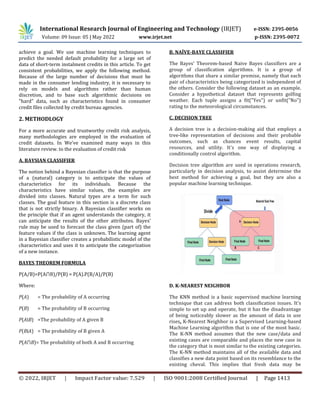
This document discusses using machine learning classifiers to analyze credit risk. It examines various machine learning techniques for credit risk analysis, including Bayesian classifiers, naive Bayes, decision trees, k-nearest neighbors, multilayer perceptrons, support vector machines, and ensemble methods like bagging and boosting. Two credit datasets from the UCI machine learning repository were used to test the accuracy of these classifiers. The results showed decision trees had the highest accuracy at 89.9% and 71.25% on the two datasets, while k-nearest neighbors had the lowest. Future work could involve rebuilding the models with more accurate data to improve performance. The objective of credit risk analysis is to help banks and financial institutions balance approving loans to creditworthy borrowers


