Numerical Methods:
Introduction, Accuracy, Errors
ADVANCED ENGINEERING MATHEMATICS: LESSON 5
PREPARED BY: ENGR. APRIL JOY F. AGUADO
COLLEGE OF ENGINEERING AND ARCHITECTURE
What is a Numerical Analysis?
➢ Numerical Analysis is a branch of
mathematics which deals with the
approximate solutions of
mathematical problems.
2
What are numerical methods?
➢ Are methods of obtaining solution by subjecting the
original problem to a series of steps or repetitions.
➢ Numerical Methods develop accurate and fast
approximations to problems whose exact solutions
are difficult to find because of their complexity.
3
Common Ways to Express Error
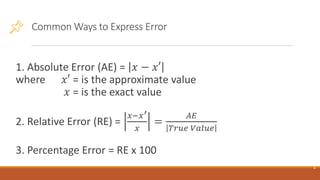
1. Absolute Error (AE) = 𝑥 − 𝑥′
where 𝑥′ = is the approximate value
𝑥 = is the exact value
2. Relative Error (RE) =
𝑥−𝑥′
𝑥
=
𝐴𝐸
𝑇𝑟𝑢𝑒 𝑉𝑎𝑙𝑢𝑒
3. Percentage Error = RE x 100
4
Accuracy vs Precision
➢ Accuracy – is the closeness of values to its true
value.
➢ Precision – is the closeness of values to each
other.
5
Sources of Error
➢ Modeling Error
o Blunders
o Formulation Error
o Data Uncertainty
➢ Numerical Error
o Round-off Error
o Truncation Error
6
Round-off Error
➢ Round-off error – error created due to
approximate representation of numbers
7
Truncation Error
➢ Truncation Error – is an error due to truncating a process involving
infinite number of steps to finite number of steps
➢ Error due to numerical approximation method
o Limiting infinite series to finite number of terms
o Limiting infinite number of iterations for finite number of
iterations
o Taking finite step size instead of infinitesimal step size (numerical
differentiation and numerical integration)
8
Truncating an infinite series
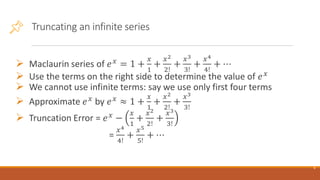
➢ Maclaurin series of 𝑒𝑥 = 1 +
𝑥
1
+
𝑥2
2!
+
𝑥3
3!
+
𝑥4
4!
+ ⋯
➢ Use the terms on the right side to determine the value of 𝑒𝑥
➢ We cannot use infinite terms: say we use only first four terms
➢ Approximate 𝑒𝑥
by 𝑒𝑥
≈ 1 +
𝑥
1
+
𝑥2
2!
+
𝑥3
3!
➢ Truncation Error = 𝑒𝑥
−
𝑥
1
+
𝑥2
2!
+
𝑥3
3!
=
𝑥4
4!
+
𝑥5
5!
+ ⋯
9
Truncating an infinite series
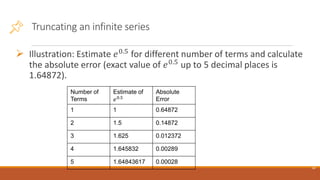
➢ Illustration: Estimate 𝑒0.5
for different number of terms and calculate
the absolute error (exact value of 𝑒0.5 up to 5 decimal places is
1.64872).
10
Number of
Terms
Estimate of
𝑒0.5
Absolute
Error
1 1 0.64872
2 1.5 0.14872
3 1.625 0.012372
4 1.645832 0.00289
5 1.64843617 0.00028
Truncation Error Integration
11
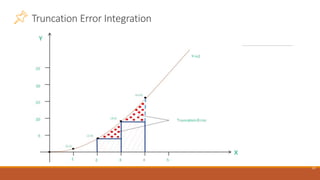
Truncation Error in Integration
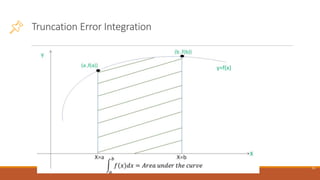
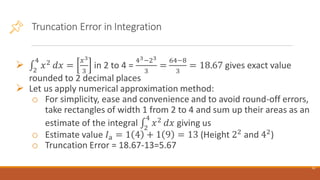
➢ ‫׬‬2
4
𝑥2
𝑑𝑥 =
𝑥3
3
in 2 to 4 =
43−23
3
=
64−8
3
= 18.67 gives exact value
rounded to 2 decimal places
➢ Let us apply numerical approximation method:
o For simplicity, ease and convenience and to avoid round-off errors,
take rectangles of width 1 from 2 to 4 and sum up their areas as an
estimate of the integral ‫׬‬2
4
𝑥2 𝑑𝑥 giving us
o Estimate value 𝐼a = 1 4 + 1 9 = 13 (Height 22 and 42)
o Truncation Error = 18.67-13=5.67
12
Truncation Error Integration
13
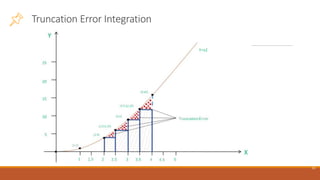
Truncation Error in Integration
➢ What would happen, if we rework the same example with smaller
width? (smaller size and increase the number of steps)
➢ Let number of subintervals now in [2,4] be 4 instead of just 2
➢ Width of each rectangle would be now 0.5
➢ Heights would be 4, 6.25, 9, 12.5
➢ 𝐼𝑎 = 0.5 4 + 6.25 + 9 + 12.25 = 15.75
➢ Truncation error = 18.67-15.75=2.92 (reduction from 5.67 to 2.92)
14
Truncation Error Integration
15
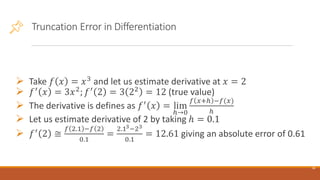
Truncation Error in Differentiation
➢ Take 𝑓 𝑥 = 𝑥3
and let us estimate derivative at 𝑥 = 2
➢ 𝑓′
𝑥 = 3𝑥2
; 𝑓′
2 = 3 22
= 12 (true value)
➢ The derivative is defines as 𝑓′
𝑥 = lim
ℎ→0
𝑓 𝑥+ℎ −𝑓(𝑥)
ℎ
➢ Let us estimate derivative of 2 by taking ℎ = 0.1
➢ 𝑓′
2 ≅
𝑓 2.1 −𝑓 2
0.1
=
2.13−23
0.1
= 12.61 giving an absolute error of 0.61
16
Truncation Error Differentiation
17
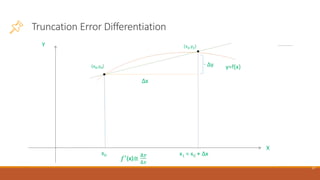
Truncation Error in Differentiation
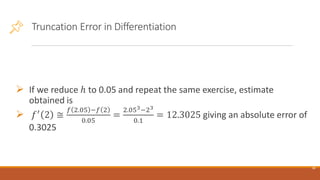
➢ If we reduce ℎ to 0.05 and repeat the same exercise, estimate
obtained is
➢ 𝑓′
2 ≅
𝑓 2.05 −𝑓 2
0.05
=
2.053−23
0.1
= 12.3025 giving an absolute error of
0.3025
18
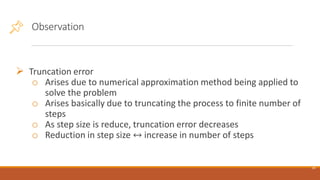
Observation
➢ Truncation error
o Arises due to numerical approximation method being applied to
solve the problem
o Arises basically due to truncating the process to finite number of
steps
o As step size is reduce, truncation error decreases
o Reduction in step size ↔ increase in number of steps
19
20
ALL is WELL. TRUST the PROCESS.
KEEP FIGHTING, FUTURE ENGINEERS!
-
Ma’am A

Introduction-Accuracy-and-Errors.pdf

  • 1.
    Numerical Methods: Introduction, Accuracy,Errors ADVANCED ENGINEERING MATHEMATICS: LESSON 5 PREPARED BY: ENGR. APRIL JOY F. AGUADO COLLEGE OF ENGINEERING AND ARCHITECTURE
  • 2.
    What is aNumerical Analysis? ➢ Numerical Analysis is a branch of mathematics which deals with the approximate solutions of mathematical problems. 2
  • 3.
    What are numericalmethods? ➢ Are methods of obtaining solution by subjecting the original problem to a series of steps or repetitions. ➢ Numerical Methods develop accurate and fast approximations to problems whose exact solutions are difficult to find because of their complexity. 3
  • 4.
    Common Ways toExpress Error 1. Absolute Error (AE) = 𝑥 − 𝑥′ where 𝑥′ = is the approximate value 𝑥 = is the exact value 2. Relative Error (RE) = 𝑥−𝑥′ 𝑥 = 𝐴𝐸 𝑇𝑟𝑢𝑒 𝑉𝑎𝑙𝑢𝑒 3. Percentage Error = RE x 100 4
  • 5.
    Accuracy vs Precision ➢Accuracy – is the closeness of values to its true value. ➢ Precision – is the closeness of values to each other. 5
  • 6.
    Sources of Error ➢Modeling Error o Blunders o Formulation Error o Data Uncertainty ➢ Numerical Error o Round-off Error o Truncation Error 6
  • 7.
    Round-off Error ➢ Round-offerror – error created due to approximate representation of numbers 7
  • 8.
    Truncation Error ➢ TruncationError – is an error due to truncating a process involving infinite number of steps to finite number of steps ➢ Error due to numerical approximation method o Limiting infinite series to finite number of terms o Limiting infinite number of iterations for finite number of iterations o Taking finite step size instead of infinitesimal step size (numerical differentiation and numerical integration) 8
  • 9.
    Truncating an infiniteseries ➢ Maclaurin series of 𝑒𝑥 = 1 + 𝑥 1 + 𝑥2 2! + 𝑥3 3! + 𝑥4 4! + ⋯ ➢ Use the terms on the right side to determine the value of 𝑒𝑥 ➢ We cannot use infinite terms: say we use only first four terms ➢ Approximate 𝑒𝑥 by 𝑒𝑥 ≈ 1 + 𝑥 1 + 𝑥2 2! + 𝑥3 3! ➢ Truncation Error = 𝑒𝑥 − 𝑥 1 + 𝑥2 2! + 𝑥3 3! = 𝑥4 4! + 𝑥5 5! + ⋯ 9
  • 10.
    Truncating an infiniteseries ➢ Illustration: Estimate 𝑒0.5 for different number of terms and calculate the absolute error (exact value of 𝑒0.5 up to 5 decimal places is 1.64872). 10 Number of Terms Estimate of 𝑒0.5 Absolute Error 1 1 0.64872 2 1.5 0.14872 3 1.625 0.012372 4 1.645832 0.00289 5 1.64843617 0.00028
  • 11.
  • 12.
    Truncation Error inIntegration ➢ ‫׬‬2 4 𝑥2 𝑑𝑥 = 𝑥3 3 in 2 to 4 = 43−23 3 = 64−8 3 = 18.67 gives exact value rounded to 2 decimal places ➢ Let us apply numerical approximation method: o For simplicity, ease and convenience and to avoid round-off errors, take rectangles of width 1 from 2 to 4 and sum up their areas as an estimate of the integral ‫׬‬2 4 𝑥2 𝑑𝑥 giving us o Estimate value 𝐼a = 1 4 + 1 9 = 13 (Height 22 and 42) o Truncation Error = 18.67-13=5.67 12
  • 13.
  • 14.
    Truncation Error inIntegration ➢ What would happen, if we rework the same example with smaller width? (smaller size and increase the number of steps) ➢ Let number of subintervals now in [2,4] be 4 instead of just 2 ➢ Width of each rectangle would be now 0.5 ➢ Heights would be 4, 6.25, 9, 12.5 ➢ 𝐼𝑎 = 0.5 4 + 6.25 + 9 + 12.25 = 15.75 ➢ Truncation error = 18.67-15.75=2.92 (reduction from 5.67 to 2.92) 14
  • 15.
  • 16.
    Truncation Error inDifferentiation ➢ Take 𝑓 𝑥 = 𝑥3 and let us estimate derivative at 𝑥 = 2 ➢ 𝑓′ 𝑥 = 3𝑥2 ; 𝑓′ 2 = 3 22 = 12 (true value) ➢ The derivative is defines as 𝑓′ 𝑥 = lim ℎ→0 𝑓 𝑥+ℎ −𝑓(𝑥) ℎ ➢ Let us estimate derivative of 2 by taking ℎ = 0.1 ➢ 𝑓′ 2 ≅ 𝑓 2.1 −𝑓 2 0.1 = 2.13−23 0.1 = 12.61 giving an absolute error of 0.61 16
  • 17.
  • 18.
    Truncation Error inDifferentiation ➢ If we reduce ℎ to 0.05 and repeat the same exercise, estimate obtained is ➢ 𝑓′ 2 ≅ 𝑓 2.05 −𝑓 2 0.05 = 2.053−23 0.1 = 12.3025 giving an absolute error of 0.3025 18
  • 19.
    Observation ➢ Truncation error oArises due to numerical approximation method being applied to solve the problem o Arises basically due to truncating the process to finite number of steps o As step size is reduce, truncation error decreases o Reduction in step size ↔ increase in number of steps 19
  • 20.
    20 ALL is WELL.TRUST the PROCESS. KEEP FIGHTING, FUTURE ENGINEERS! - Ma’am A