ERP Systems Implementation
INTRODUCTION- ERP SOFTWARE SOLUTION Enterprise   Resource Planning  – An information system (multi-module  application software) that integrates all manufacturing  and related applications for an entire enterprise.  Different ERP Software solutions vendors –  BAAN, –  RAMCO OnDemand ERP, –  Oracle, –  People soft, –  JD Edwards, –  SAP, etc SAP is the market leader in ERP Software solutions.
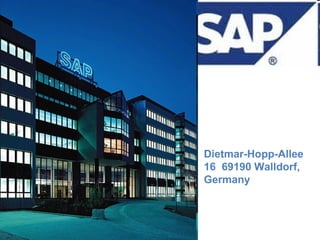
Dietmar-Hopp-Allee 16  69190 Walldorf, Germany
S.A.P The name SAP being a German company, is acronym  for “Systeme Anwendungen, Produkte in der  Datenverarbeitung”. This is translated into English as   “ System ,Applications and Products in Data Processing ”
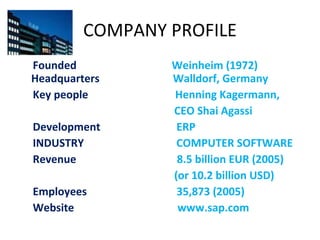
COMPANY PROFILE Founded  Weinheim (1972)   Headquarters  Walldorf, Germany Key people  Henning Kagermann, CEO Shai Agassi Development  ERP INDUSTRY   COMPUTER SOFTWARE Revenue   8.5 billion EUR (2005) (or 10.2 billion USD) Employees   35,873 (2005) Website  www.sap.com
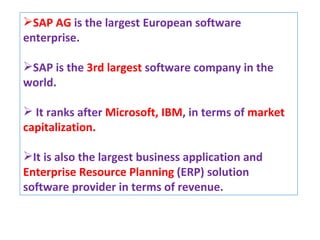
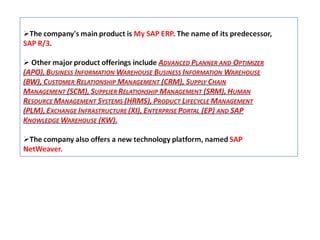
SAP AG  is the largest European software enterprise. SAP is the  3rd largest  software company in the world. It ranks after  Microsoft, IBM , in terms of  market capitalization. It is also the largest business application and  Enterprise Resource Planning  (ERP) solution software provider in terms of revenue.
 
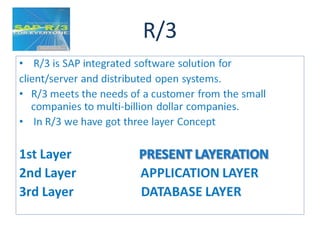
R/3
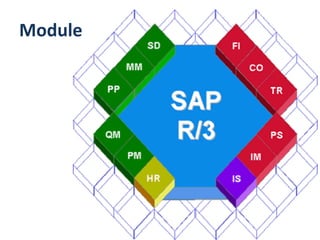
Module
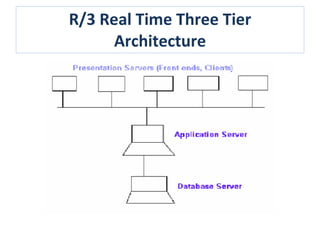
R/3 Real Time Three Tier Architecture
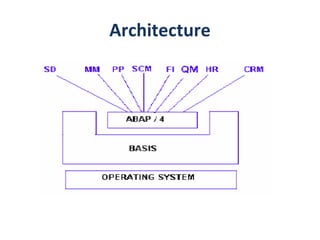
Architecture
BASIS BASIS  is similar to a kernel for R/3. It provides the runtime environment for ABAP/4 programs. Basis is essential to run ABAP/4 programs. It is  a collection of R/3 system programs that present you with an interface
ABAP ABAP  stands for Advanced Business Application Programming / 4th Generation Language •  ABAP/4  cannot run directly on an operating system. It requires a set of programs to load, interpret, and buffer its input and output.
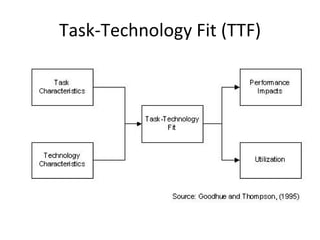
Task-Technology Fit (TTF)
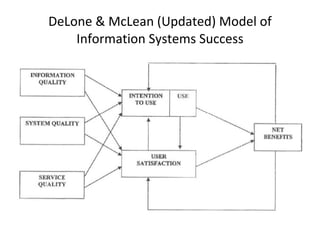
DeLone & McLean (Updated) Model of Information Systems Success
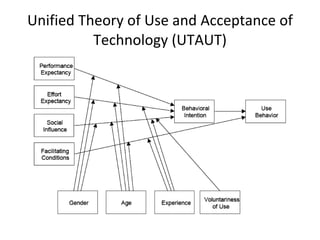
Unified Theory of Use and Acceptance of Technology (UTAUT)
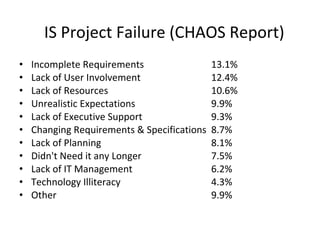
IS Project Failure (CHAOS Report) Incomplete Requirements 13.1% Lack of User Involvement 12.4% Lack of Resources 10.6% Unrealistic Expectations 9.9% Lack of Executive Support 9.3% Changing Requirements & Specifications 8.7% Lack of Planning 8.1% Didn't Need it any Longer 7.5% Lack of IT Management 6.2% Technology Illiteracy 4.3% Other 9.9%
Lessons for ERP Systems … "Those who fail to learn history are doomed to repeat it"  (Winston Churchill) In the field of MIS, “issues seen as ‘new’ turn out to have long roots” (Keen, 1991) What of ERP Systems ? ERP systems are large scale, expensive projects ERP systems may involve dramatic changes to work practices and organisational processes They are not “quick fix” solutions and need to be implemented with care POOR DUMP SAP LET BE THE LESSON
It’s All About the Requirements ! “ In nearly every software project that fails to meet performance and cost goals, requirements inadequacies play a major and expensive role in project failure”  (Alford & Lawson, 1979) “ The hardest single part of building a software system is deciding precisely what to build.  No other part of the conceptual work is as difficult as establishing the detailed technical requirements ... No other part of the work so cripples the resulting system if done wrong.”  (Brooks, 1987) Build the correct system (product) + Build the system correctly (process)
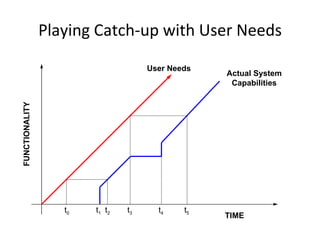
Playing Catch-up with User Needs FUNCTIONALITY TIME User Needs Actual System Capabilities t 0 t 1 t 3 t 2 t 5 t 4
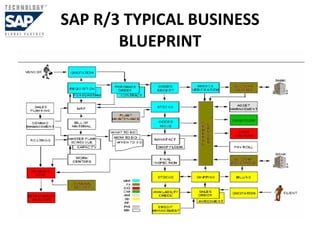
SAP R/3 TYPICAL BUSINESS BLUEPRINT
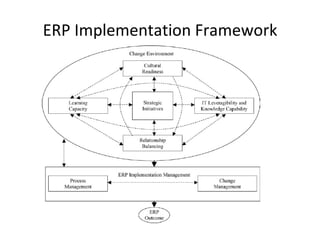
ERP Implementation Framework
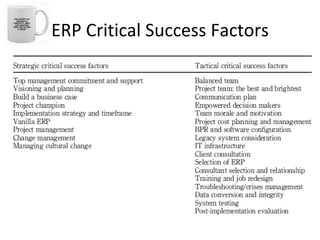
ERP Critical Success Factors
THANK YOU

ERP systems implementation

  • 1.
  • 2.
    INTRODUCTION- ERP SOFTWARESOLUTION Enterprise Resource Planning – An information system (multi-module application software) that integrates all manufacturing and related applications for an entire enterprise. Different ERP Software solutions vendors – BAAN, – RAMCO OnDemand ERP, – Oracle, – People soft, – JD Edwards, – SAP, etc SAP is the market leader in ERP Software solutions.
  • 3.
  • 4.
    S.A.P The nameSAP being a German company, is acronym for “Systeme Anwendungen, Produkte in der Datenverarbeitung”. This is translated into English as “ System ,Applications and Products in Data Processing ”
  • 5.
    COMPANY PROFILE Founded Weinheim (1972) Headquarters Walldorf, Germany Key people Henning Kagermann, CEO Shai Agassi Development ERP INDUSTRY COMPUTER SOFTWARE Revenue 8.5 billion EUR (2005) (or 10.2 billion USD) Employees 35,873 (2005) Website www.sap.com
  • 6.
    SAP AG is the largest European software enterprise. SAP is the 3rd largest software company in the world. It ranks after Microsoft, IBM , in terms of market capitalization. It is also the largest business application and Enterprise Resource Planning (ERP) solution software provider in terms of revenue.
  • 7.
  • 8.
  • 9.
  • 10.
    R/3 Real TimeThree Tier Architecture
  • 11.
  • 12.
    BASIS BASIS is similar to a kernel for R/3. It provides the runtime environment for ABAP/4 programs. Basis is essential to run ABAP/4 programs. It is a collection of R/3 system programs that present you with an interface
  • 13.
    ABAP ABAP stands for Advanced Business Application Programming / 4th Generation Language • ABAP/4 cannot run directly on an operating system. It requires a set of programs to load, interpret, and buffer its input and output.
  • 14.
  • 15.
    DeLone & McLean(Updated) Model of Information Systems Success
  • 16.
    Unified Theory ofUse and Acceptance of Technology (UTAUT)
  • 17.
    IS Project Failure(CHAOS Report) Incomplete Requirements 13.1% Lack of User Involvement 12.4% Lack of Resources 10.6% Unrealistic Expectations 9.9% Lack of Executive Support 9.3% Changing Requirements & Specifications 8.7% Lack of Planning 8.1% Didn't Need it any Longer 7.5% Lack of IT Management 6.2% Technology Illiteracy 4.3% Other 9.9%
  • 18.
    Lessons for ERPSystems … "Those who fail to learn history are doomed to repeat it" (Winston Churchill) In the field of MIS, “issues seen as ‘new’ turn out to have long roots” (Keen, 1991) What of ERP Systems ? ERP systems are large scale, expensive projects ERP systems may involve dramatic changes to work practices and organisational processes They are not “quick fix” solutions and need to be implemented with care POOR DUMP SAP LET BE THE LESSON
  • 19.
    It’s All Aboutthe Requirements ! “ In nearly every software project that fails to meet performance and cost goals, requirements inadequacies play a major and expensive role in project failure” (Alford & Lawson, 1979) “ The hardest single part of building a software system is deciding precisely what to build. No other part of the conceptual work is as difficult as establishing the detailed technical requirements ... No other part of the work so cripples the resulting system if done wrong.” (Brooks, 1987) Build the correct system (product) + Build the system correctly (process)
  • 20.
    Playing Catch-up withUser Needs FUNCTIONALITY TIME User Needs Actual System Capabilities t 0 t 1 t 3 t 2 t 5 t 4
  • 21.
    SAP R/3 TYPICALBUSINESS BLUEPRINT
  • 22.
  • 23.
  • 24.

Editor's Notes

  • #18 Standish Group International (1995) CHAOS Report
  • #19 Keen, P. G. W. (1991) Relevance and Rigor in Information Systems Research: Improving Quality, Confidence, Cohesion and Impact. In Nisson, H.-E. et al. (eds), Information Systems Research: Contemporary Approaches and Emergent Traditions, pp. 27-49. Elsevier Science Publishers.
  • #21 At time t0, the need for a system is recognised and development commences, with relatively incomplete knowledge of the real user needs at that time. By t1, an operational system has been produced, but not only does it fail to satisfy user needs at t1, it fails even to satisfy needs as specified at t0. The system is then subjected to a series of maintenance enhancements between t1 and t3, which enable it to satisfy the original needs (at t2). At time t3, the cost of reworking the system is so great that it is decided to rebuild from scratch. This redevelopment is complete by t4, and the cycle recommences. Davis, A.M., Bersoff, E. H. & Comer, E. R. (1988) A Strategy for Comparing Alternative Software Development Lifecycle Models, IEEE Transactions on Software Engineering , 14(10) October Xeno’s Paradox: the tortoise is given a significant headstart; once the hare has covered the initial distance that separated him from the tortoise, the tortoise is no longer there and has moved a little further; again, once the hare covers that marginal distance, the tortoise has moved a little further still, so how does he ever catch the tortoise ? (easily dispelled by Newton’s Laws of Motion)
  • #23 Motwani, J., Subramanian, R. & Gopalakrishna, P. (2005) Critical factors for successful ERP implementation: Exploratory findings from four case studies. Computers in Industry. 56(6), 529-544.
  • #24 Finney, S. & Corbett, M. (2007) ERP implementation: a compilation and analysis of critical success factors. Business Process Management Journal. 13(3), 329-347.