INFORMATION TECHNOLOGY FOR MANAGERS

Module 5

Business Applications

Dr.Veena.A
PESIT, Bangalore

Business Processes and Information Systems

Business processes

   •   Is a set of logically related activities for accomplishing a specific business results.

   •   Manner in which work is organized, coordinated, and focused to produce a valuable product
       or service

   •   Unique ways to coordinate work, information, and knowledge

   •   Ways in which management chooses to coordinate work

   •   Concrete work flows of material, information, and knowledge—sets of activities

   •   Performance of a firm depends on how well the business processes are designed and
       coordinated

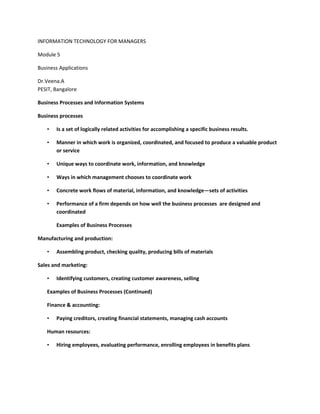
       Examples of Business Processes

Manufacturing and production:

   •   Assembling product, checking quality, producing bills of materials

Sales and marketing:

   •   Identifying customers, creating customer awareness, selling

   Examples of Business Processes (Continued)

   Finance & accounting:

   •   Paying creditors, creating financial statements, managing cash accounts

   Human resources:

   •   Hiring employees, evaluating performance, enrolling employees in benefits plans
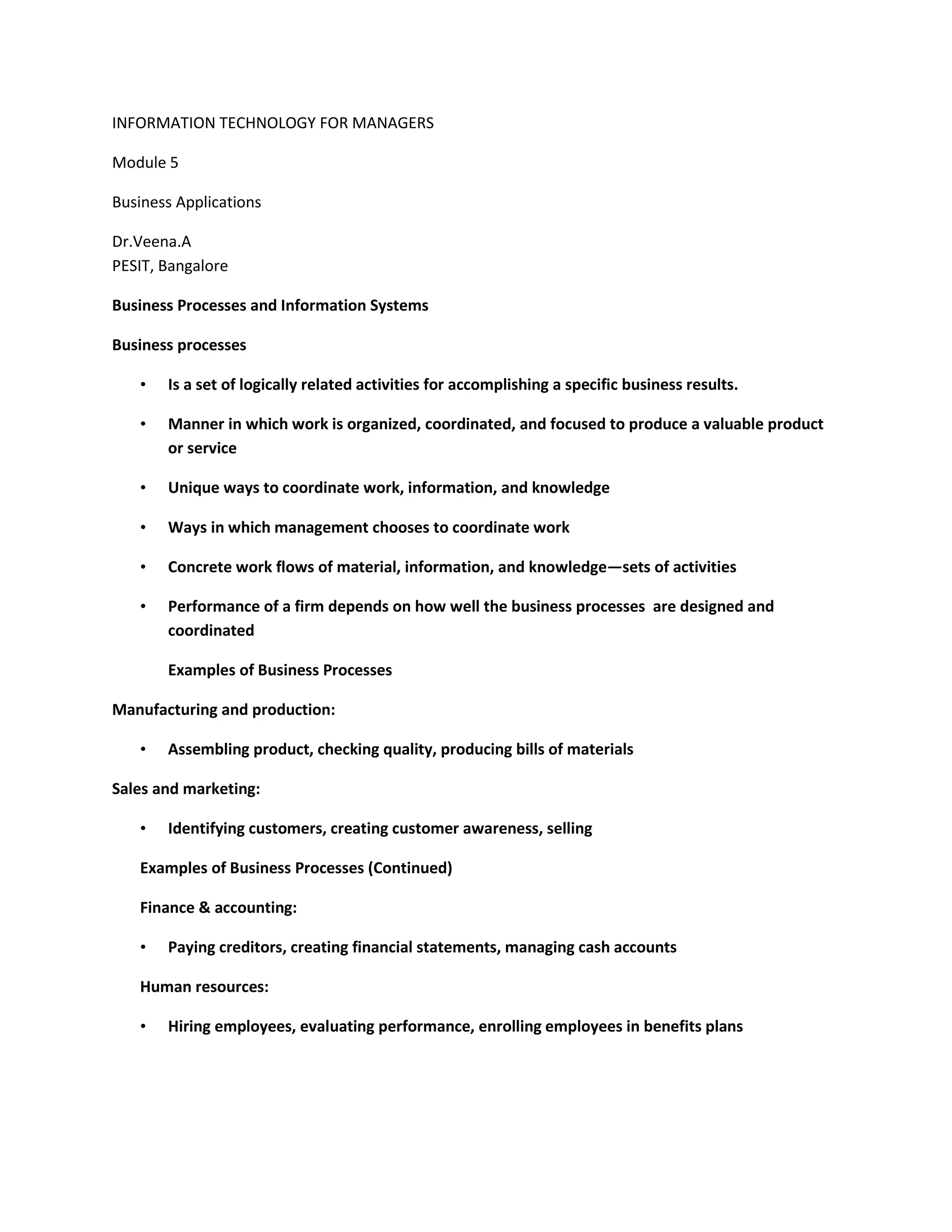
EXAMPLE of Sales and Marketing System

Sales and Marketing Systems

Major functions of systems:

•   Sales management, market research, promotion, pricing new products

Major application systems:

•   Sales order info system, market research system, pricing system
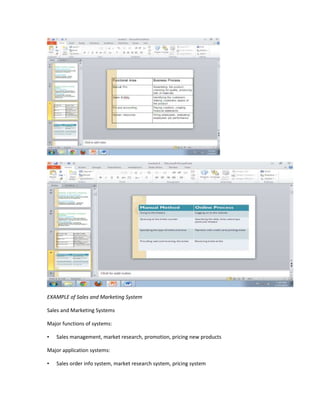
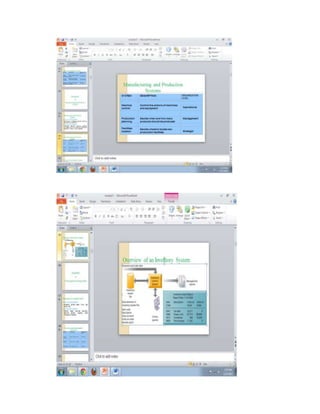
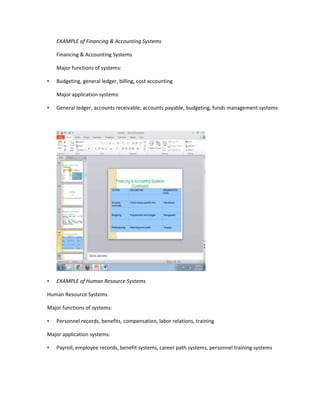
EXAMPLE of Manufacturing and Production Systems

    Manufacturing and Production Systems

    Major functions of systems:

•   Scheduling, purchasing, shipping, receiving, engineering, operations

    Major application systems:

•   Materials resource planning systems, purchase order control systems, engineering systems,
    Inventory control systems
EXAMPLE of Financing & Accounting Systems

    Financing & Accounting Systems

    Major functions of systems:

•   Budgeting, general ledger, billing, cost accounting

    Major application systems:

•   General ledger, accounts receivable, accounts payable, budgeting, funds management systems


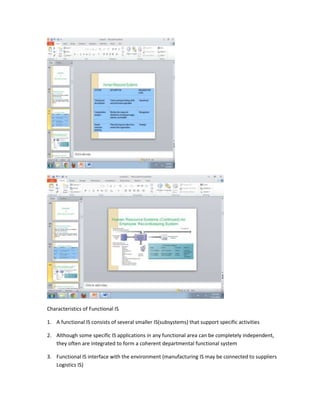
•   EXAMPLE of Human Resource Systems

Human Resource Systems

Major functions of systems:

•   Personnel records, benefits, compensation, labor relations, training

Major application systems:

•   Payroll, employee records, benefit systems, career path systems, personnel training systems
Characteristics of Functional IS

1. A functional IS consists of several smaller IS(subsystems) that support specific activities

2. Although some specific IS applications in any functional area can be completely independent,
   they often are integrated to form a coherent departmental functional system

3. Functional IS interface with the environment (manufacturing IS may be connected to suppliers
   Logistics IS)
4. Functional IS interface with each other to form the organization wide information system


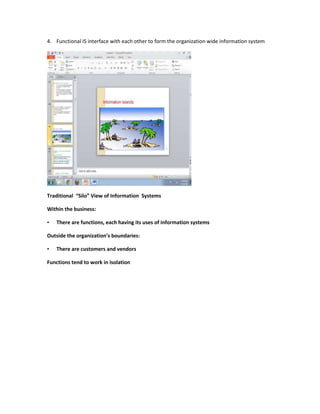
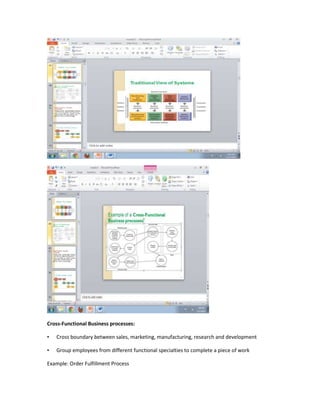
Traditional “Silo” View of Information Systems

Within the business:

•   There are functions, each having its uses of information systems

Outside the organization’s boundaries:

•   There are customers and vendors

Functions tend to work in isolation
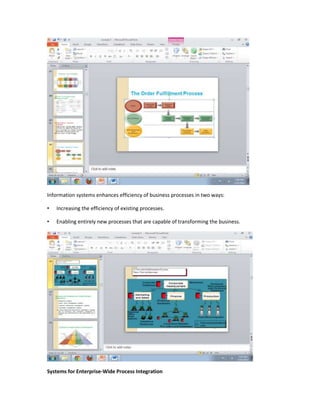
Cross-Functional Business processes:

•   Cross boundary between sales, marketing, manufacturing, research and development

•   Group employees from different functional specialties to complete a piece of work

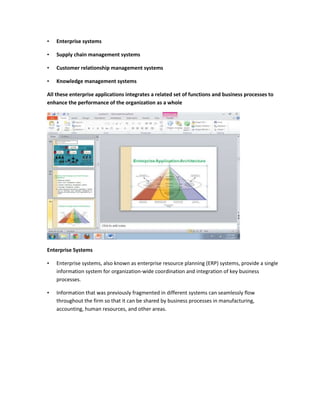
Example: Order Fulfillment Process
Information systems enhances efficiency of business processes in two ways:

•   Increasing the efficiency of existing processes.

•   Enabling entirely new processes that are capable of transforming the business.


Systems for Enterprise-Wide Process Integration
•   Enterprise systems

•   Supply chain management systems

•   Customer relationship management systems

•   Knowledge management systems

All these enterprise applications integrates a related set of functions and business processes to
enhance the performance of the organization as a whole


Enterprise Systems

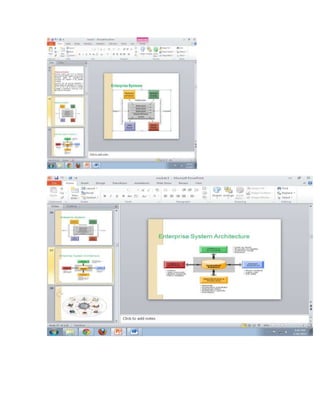
•   Enterprise systems, also known as enterprise resource planning (ERP) systems, provide a single
    information system for organization-wide coordination and integration of key business
    processes.

•   Information that was previously fragmented in different systems can seamlessly flow
    throughout the firm so that it can be shared by business processes in manufacturing,
    accounting, human resources, and other areas.
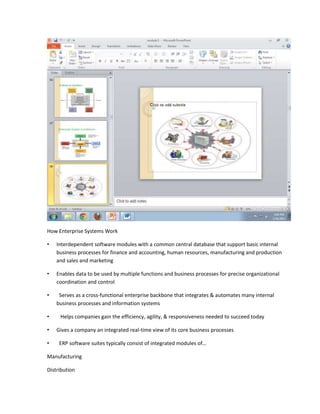
How Enterprise Systems Work

•   Interdependent software modules with a common central database that support basic internal
    business processes for finance and accounting, human resources, manufacturing and production
    and sales and marketing

•   Enables data to be used by multiple functions and business processes for precise organizational
    coordination and control

•    Serves as a cross-functional enterprise backbone that integrates & automates many internal
    business processes and information systems

•    Helps companies gain the efficiency, agility, & responsiveness needed to succeed today

•   Gives a company an integrated real-time view of its core business processes

•    ERP software suites typically consist of integrated modules of…

Manufacturing

Distribution
Sales

Accounting

Human Resource Management

Reasons for the growth of ERP market

ď‚—   To enable improved business performance

        â—¦    Cycle time reduction

        â—¦    Inventory reduction

        â—¦    Order fulfillment improvement

ď‚—   To support business growth requirements

        â—¦    New product/product lines, new customers

        â—¦    Global requirements including multiple languages and currencies

ď‚—   To provide flexible, integrated, real time decision support

ď‚—   To take advantage of untapped mid-market


Selection of ERP

ď‚—   ERP procurement & successful implementation are very costly affairs

ď‚—   Implementation involves risk, risk is due to changes, benefits are not immediate

ď‚—   Investment ?

ď‚—   Is a strategic decision- long term decision, difficult to get reversed

ERP selection

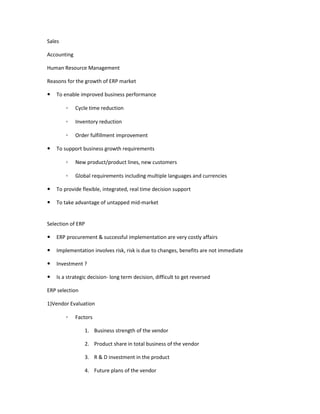
1)Vendor Evaluation

        â—¦    Factors

                1. Business strength of the vendor

                2. Product share in total business of the vendor

                3. R & D investment in the product

                4. Future plans of the vendor
5. Market reach & resource strength of the vendor


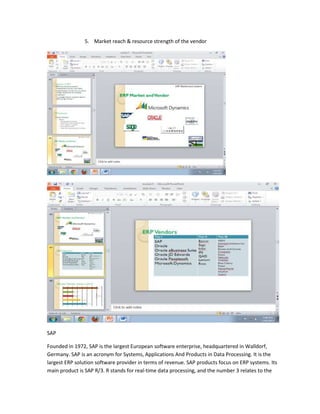
SAP

Founded in 1972, SAP is the largest European software enterprise, headquartered in Walldorf,
Germany. SAP is an acronym for Systems, Applications And Products in Data Processing. It is the
largest ERP solution software provider in terms of revenue. SAP products focus on ERP systems. Its
main product is SAP R/3. R stands for real-time data processing, and the number 3 relates to the
three-tier application architecture of its database, application server and client. There are over
91,500 SAP installations at more than 28,000 companies. Over 12 million people in more than 120
countries use SAP products.

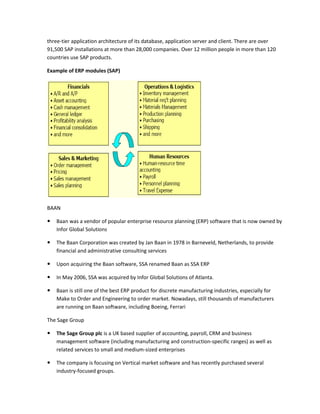
Example of ERP modules (SAP)


BAAN

ď‚—   Baan was a vendor of popular enterprise resource planning (ERP) software that is now owned by
    Infor Global Solutions

ď‚—   The Baan Corporation was created by Jan Baan in 1978 in Barneveld, Netherlands, to provide
    financial and administrative consulting services

ď‚—   Upon acquiring the Baan software, SSA renamed Baan as SSA ERP

ď‚—   In May 2006, SSA was acquired by Infor Global Solutions of Atlanta.

ď‚—   Baan is still one of the best ERP product for discrete manufacturing industries, especially for
    Make to Order and Engineering to order market. Nowadays, still thousands of manufacturers
    are running on Baan software, including Boeing, Ferrari

The Sage Group

ď‚—   The Sage Group plc is a UK based supplier of accounting, payroll, CRM and business
    management software (including manufacturing and construction-specific ranges) as well as
    related services to small and medium-sized enterprises

ď‚—   The company is focusing on Vertical market software and has recently purchased several
    industry-focused groups.
Microsoft Dynamics

Is a line of software for business made by Microsoft

   Microsoft Dynamics AX is Microsoft’s flagship enterprise resource planning software system.

ď‚—   Microsoft Retail Management System: (RMS) is an electronic point-of-sale (EPOS) software
    solution for retailers.

ď‚—   Microsoft Dynamics GP is a mid-market business accounting software package that runs on top
    of a Microsoft SQL Server database.

ď‚—   Microsoft Dynamics NAV: The product is part of the Microsoft Dynamics family, and intended to
    assist with finance, manufacturing, customer relationship management, supply chains, analytics
    and electronic commerce for small and medium-sized enterprises.

ď‚—   Microsoft Dynamics SL : Microsoft Dynamics SL provides businesses functionality in finance,
    project accounting, manufacturing, field service, supply chains, analytics, and electronic
    commerce and is primarily targeted for Small and Medium-sized Enterprises.

QAD

ď‚—   QAD produces Enterprise Resource Planning software. The software is targeted to 6 main
    industries: Automotive, Consumer Products, Electronics, Food and Beverage, Industrial
    Products, and Life Sciences.

ď‚—   QAD Enterprise Application provides single-site companies and multinational organizations with
    a fully integrated, core enterprise solution.

ERP Market and Vendors


The market is estimated at INR 400.2 bn and is anticipated to achieve a CAGR of 25% to reach INR
983.4 bn by 2015

2)Technology evaluation
◦   Client server architecture & its implementation – two tier or three tier

        â—¦   Front end tools & back end data based management system tools for the data, process
            & presentation management

        â—¦   Interface mechanism; data transfer, real time access

        â—¦   Use of case tools, screen generators, report writers & screen painter

◦   Technology evaluation (contd…)

        â—¦   Support system technologies like bar coding, EDI, imaging, communication & network

        â—¦   Downloading to PC based package, MS-office, etc

        â—¦   Hardware - Software configuration management

Difficulty in selecting ERP

ď‚—   Selection is difficult by an internal, better to approach the external consultants

ď‚—   ERP package may be cheaper, but may not fulfill the requirement

ď‚—   Some take a lot of time in implementation

ď‚—   Validated information on the vendor

ď‚—   Objective of the organization may not be clear
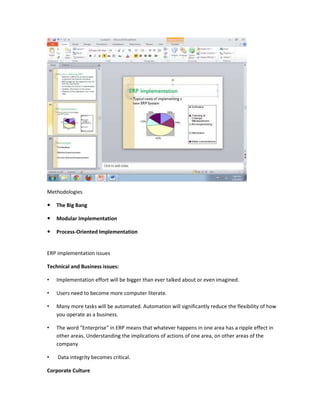
Methodologies

ď‚—   The Big Bang

ď‚—   Modular Implementation

ď‚—   Process-Oriented Implementation


ERP implementation issues

Technical and Business issues:

•   Implementation effort will be bigger than ever talked about or even imagined.

•   Users need to become more computer literate.

•   Many more tasks will be automated. Automation will significantly reduce the flexibility of how
    you operate as a business.

•   The word "Enterprise" in ERP means that whatever happens in one area has a ripple effect in
    other areas. Understanding the implications of actions of one area, on other areas of the
    company

•   Data integrity becomes critical.

Corporate Culture
Corporate Culture is a combination of two things.

•   The type of people who are employed by a company. Their personal values, skills, habits etc.

•   The way the organization works. The focus, decision making process, attitude to staff, stability,
    etc.

Change Management


    Change Management is about setting expectations that lessen the pain of change. People
involved in a change expect to go from A to B. Perhaps where they are actually going is to C. Change
Management is about getting them used to the idea that C is the real destination.

Critical success factors for ERP implementation

•   Status of legacy systems

•   Impact of new ERP system on their business processes

•   Whether all the business processes are well defined and could be delivered thro’ ERP system

•   Whether to go for a complete integrated system or to implement any one ERP module for the
    time being

•   Duration of the ERP project and expected service from the ERP system to the customers.

•   Level of cooperation from the top management throughout the project.

•   Resource availability

    Benefits of Enterprise Systems

•   Help to unify the firm’s structure and organization: One organization

•   Management: Firm wide knowledge-based management processes

•   Technology: Unified platform

•   Business: More efficient operations & customer-driven business processes

        •   Quality and efficiency- customer service, production, & distribution

        •   Decreased Costs-Reductions in transaction processing costs

        •   Decision support--Provides cross-functional information on business performance to
            assist managers in making better decisions
•   Enterprise agility--Results in more flexible organizational structures, managerial
            responsibilities, and work roles

•   Challenges of Enterprise Systems

•   Difficult to build: Require fundamental changes in the way the business operates

•   Technology: Require complex pieces of software and large investments of time, money, and
    expertise

    Potential risks

ď‚—   Difficult to implement

ď‚—   Inflexible

ď‚—   Where to buy

ď‚—   What to buy

ď‚—   How to implement

    Hidden cost

ď‚—   Training

ď‚—   Integration and testing

ď‚—   Data conversion

ď‚—   Data analysis

ď‚—   Implementation

•   Colgate took 1 to 5 days to acquire an order,2 days to process the order

    Now, order acquisition and processing takes 4 hrs

•   Distribution planning and picking used to take 4 days-------now it is 14 hrs

•   Order to delivery time has been cut in half

•   ACC Limited,

•   14 manufacturing plants,

•   30 ready mix concrete plants,

•   20 sales units,
•   54 zonal offices ,

•   Distribution network comprises -160 warehouses,

•   9000 distributors,

•   50,000 retail outlets

    Supply Chain Management

•   Network of organizations and business processes for procuring raw materials, transforming into
    products, and distributing them to customers

•   Integrates supplier, manufacturer, distributor customer.

•   Materials, information, and payments flow through the supply chain in both directions.

•   Goal is to create a fast, efficient, & low-cost network of business relationships.

•   A cross-functional inter enterprise system that uses IT to help support & manage the links
    between some of a company’s key business processes and those of its suppliers, customers, &
    business partners

•   Network of organizations and business processes

•   Helps in procurement of materials, transformation of raw materials into intermediate and
    finished products

•   Helps in distribution of the finished products to customers

•   Includes reverse logistics - returned items flow in the reverse direction from the buyer back to
    the seller

•   Coordination of business processes to speed information, product, and fund flows up and down
    a supply chain to reduce time, redundant effort, and inventory costs
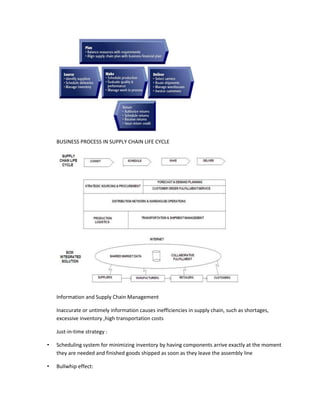
Supply Chain Processes

    SCOR (Supply Chain Operations Reference Model)

•   Plan: Balancing demand and supply to meet sourcing, production, and delivery requirements

•   Source: Procurement of goods and services needed to create a product or service

•   Make: Processes that transform a product into a finished state

•   Deliver: Processes to manage order transportation and distribution

•   Return: Processes associated with product returns and post delivery customer support

    Key Supply Chain Management Processes
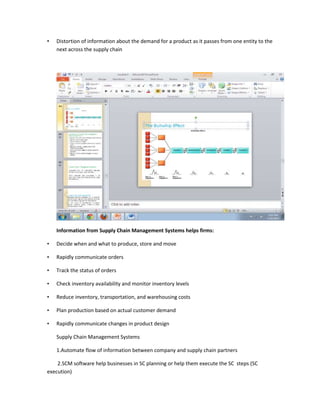
BUSINESS PROCESS IN SUPPLY CHAIN LIFE CYCLE


    Information and Supply Chain Management

    Inaccurate or untimely information causes inefficiencies in supply chain, such as shortages,
    excessive inventory ,high transportation costs

    Just-in-time strategy :

•   Scheduling system for minimizing inventory by having components arrive exactly at the moment
    they are needed and finished goods shipped as soon as they leave the assembly line

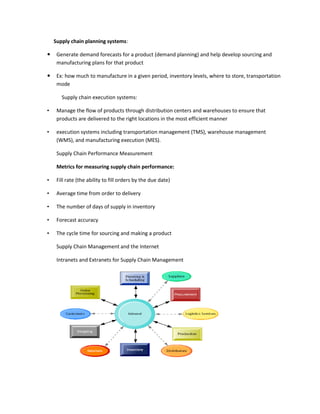
•   Bullwhip effect:
•   Distortion of information about the demand for a product as it passes from one entity to the
    next across the supply chain


    Information from Supply Chain Management Systems helps firms:

•   Decide when and what to produce, store and move

•   Rapidly communicate orders

•   Track the status of orders

•   Check inventory availability and monitor inventory levels

•   Reduce inventory, transportation, and warehousing costs

•   Plan production based on actual customer demand

•   Rapidly communicate changes in product design

    Supply Chain Management Systems

    1.Automate flow of information between company and supply chain partners

    2.SCM software help businesses in SC planning or help them execute the SC steps (SC
execution)
Supply chain planning systems:

ď‚—    Generate demand forecasts for a product (demand planning) and help develop sourcing and
     manufacturing plans for that product

ď‚—    Ex: how much to manufacture in a given period, inventory levels, where to store, transportation
     mode

       Supply chain execution systems:

•    Manage the flow of products through distribution centers and warehouses to ensure that
     products are delivered to the right locations in the most efficient manner

•    execution systems including transportation management (TMS), warehouse management
     (WMS), and manufacturing execution (MES).

     Supply Chain Performance Measurement

     Metrics for measuring supply chain performance:

•    Fill rate (the ability to fill orders by the due date)

•    Average time from order to delivery

•    The number of days of supply in inventory

•    Forecast accuracy

•    The cycle time for sourcing and making a product

     Supply Chain Management and the Internet

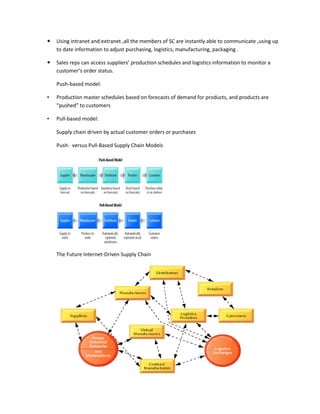
     Intranets and Extranets for Supply Chain Management
ď‚—   Using intranet and extranet ,all the members of SC are instantly able to communicate ,using up
    to date information to adjust purchasing, logistics, manufacturing, packaging .

   Sales reps can access suppliers’ production schedules and logistics information to monitor a
    customer’s order status.

    Push-based model:

•   Production master schedules based on forecasts of demand for products, and products are
    “pushed” to customers

•   Pull-based model:

    Supply chain driven by actual customer orders or purchases

    Push- versus Pull-Based Supply Chain Models


    The Future Internet-Driven Supply Chain
Business Value of Supply Chain Management Systems

•   Improved customer service and responsiveness

•   Cash utilization

        •   Faster, more accurate order processing

        •   Reductions in inventory levels,

        •   Quicker time to market

        •   Lower transaction and materials costs

        •   Strategic relationships with suppliers

        •   Achieve agility and responsiveness in meeting the demand and needs of the business
            partners.

•   It costs six times more to sell to a new customer than to sell to an existing one

•   A company can boost its profits 85 percent by increasing its annual customer retention by only 5
    percent

•   75 percent of the complaining customers will do business with the company again if it quickly
    takes care of a service problem.

•   Sales representatives can view the complete customer record, including support cases, billing
    issues and more

•   Warehouse managers can instantly view approved sales orders on their Dashboards

•   Accounting personnel are able to view support issues when calling customers to collect
    payments.

    Customer Relationship Management (CRM)

•   Focuses on coordinating all of the business process surrounding the firms interactions with its
    customers in sales, marketing and service to optimize revenue, customer satisfaction and
    customer retention.

•   Manages all ways used by firms to deal with existing and potential new customers

•   Business and technology discipline for managing customer relationships to optimize revenue,
    profitability, customer satisfaction and customer retention.

•   Provides end-to-end customer care from receipt of an order through product delivery

•   Provides a unified view of customer across the company
•   Provides customer-facing employees with a single, complete view of every customer at every
    touch point and across all channels

•   Provides the customer with a single, complete view of the company and its extended channels

    CRM systems:

•   Capture and integrate customer data from all over the organization

•   Consolidate and analyze the data

•   Distribute results to various systems and customer touch points across the enterprise

    Customer Relationship Management (CRM) Software

•   Can range from niche tools that perform limited functions to large-scale enterprise applications

•   Can link to other major enterprise applications, such as supply chain management

•   CRM software vendors include Siebel systems and clarify, also Enterprise software vendors SAP
    ,oracle

    Major application components of (CRM) Software

o   Sales Force Automation (SFA)-help sales staff increase their productivity by focusing sales effort
    s on the most profitable customers .

o   Provides contact information ,product information and product configuration

o   Can assemble information about customer’s past purchases.

o   Increases each sales person’s efficiency in reducing the cost per sale

        o   Sales -

                o     Provides sales reps with software tools & company data sources needed to
                      support & manage their sales activities.

                o     enabling them to check on all aspects of all customer’s account status and
                      history before scheduling their sales call.

      Ex: would alert a bank rep to call customers who make large deposits to sell investment
    services

    Cross-selling--- that of selling an additional product or service to an existing customer.

    Up selling--- is a sales technique whereby a salesperson induces the customer to purchase more
    expensive items, upgrades, or other add-ons in an attempt to make a more profitable sale
•   Marketing & Fulfillment

               ď‚–   Helps accomplish direct marketing campaigns by automating tasks-----qualifying
                   leads for target market

               ď‚–   Helps to capture & manage prospect & customer response data

                  Analyze customer and business value of a company’s direct marketing
                   campaigns

               ď‚–   Helps in fulfillment by quickly scheduling sales contacts & providing appropriate
                   information on products & services to them.

       •   Contact & Account Management

               ď‚–   Helps capture and track relevant data about past and planned contacts with
                   customers.

               ď‚–   Information is captured from all customer touch points ,such as telephone, e-
                   mail ,retail stores ,personal contact etc

       •   Customer Service and Support

               ď‚–   Helps create, assign, & manage requests for service by customers

                       •   Call center software-route calls to customer support agents

                       •   Help desk software-assists customer service reps in helping customers

•   Retention and Loyalty Programs

       •   Helps the company identify, reward, and market to their most loyal and profitable
           customers

       •   CRM analytical software includes data mining tools and data ware houses,

       •   Tools are used to identify profitable and loyal customers
Business Value of Customer Relationship Management Systems

•   Increased customer satisfaction

•   Increased revenue from identifying most profitable customers and segments for marketing

•   More effective marketing and reduced direct marketing costs

•   Lower costs for customer acquisition and retention

•   Reduce churn rate

•   Cost per sale


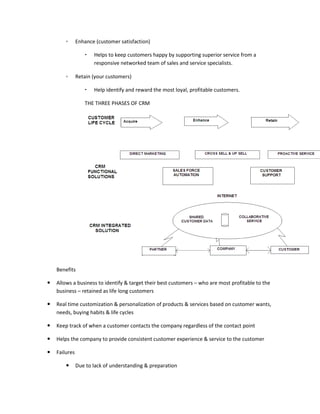
    Three Phases of CRM

        â—¦   Acquire (new customers)

                ď‚–   By doing a superior job of contact management, sales prospecting, selling, direct
                    marketing, & fulfillment.
â—¦      Enhance (customer satisfaction)

                  ď‚–   Helps to keep customers happy by supporting superior service from a
                      responsive networked team of sales and service specialists.

        â—¦      Retain (your customers)

                  ď‚–   Help identify and reward the most loyal, profitable customers.

                  THE THREE PHASES OF CRM


    Benefits

   Allows a business to identify & target their best customers – who are most profitable to the
    business – retained as life long customers

ď‚—   Real time customization & personalization of products & services based on customer wants,
    needs, buying habits & life cycles

ď‚—   Keep track of when a customer contacts the company regardless of the contact point

ď‚—   Helps the company to provide consistent customer experience & service to the customer

ď‚—   Failures

        ď‚—      Due to lack of understanding & preparation
-CRM is not everything

    NetSuite is the on-demand CRM Software on cloud that gives a real-time 360 degree view of
    customers.

•   Sales Force Automation (SFA),

•   Marketing Automation,

•   Customer Support and Service,

•   Sales Performance Management,

•   Order management,

•   Partner Management

•   Trends

       •     Operational CRM

       •     Analytical CRM

       •     Collaborative CRM

       •     Portal-based CRM
Itm 5

Itm 5

  • 1.
    INFORMATION TECHNOLOGY FORMANAGERS Module 5 Business Applications Dr.Veena.A PESIT, Bangalore Business Processes and Information Systems Business processes • Is a set of logically related activities for accomplishing a specific business results. • Manner in which work is organized, coordinated, and focused to produce a valuable product or service • Unique ways to coordinate work, information, and knowledge • Ways in which management chooses to coordinate work • Concrete work flows of material, information, and knowledge—sets of activities • Performance of a firm depends on how well the business processes are designed and coordinated Examples of Business Processes Manufacturing and production: • Assembling product, checking quality, producing bills of materials Sales and marketing: • Identifying customers, creating customer awareness, selling Examples of Business Processes (Continued) Finance & accounting: • Paying creditors, creating financial statements, managing cash accounts Human resources: • Hiring employees, evaluating performance, enrolling employees in benefits plans
  • 2.
    EXAMPLE of Salesand Marketing System Sales and Marketing Systems Major functions of systems: • Sales management, market research, promotion, pricing new products Major application systems: • Sales order info system, market research system, pricing system
  • 3.
    EXAMPLE of Manufacturingand Production Systems Manufacturing and Production Systems Major functions of systems: • Scheduling, purchasing, shipping, receiving, engineering, operations Major application systems: • Materials resource planning systems, purchase order control systems, engineering systems, Inventory control systems
  • 5.
    EXAMPLE of Financing& Accounting Systems Financing & Accounting Systems Major functions of systems: • Budgeting, general ledger, billing, cost accounting Major application systems: • General ledger, accounts receivable, accounts payable, budgeting, funds management systems • EXAMPLE of Human Resource Systems Human Resource Systems Major functions of systems: • Personnel records, benefits, compensation, labor relations, training Major application systems: • Payroll, employee records, benefit systems, career path systems, personnel training systems
  • 6.
    Characteristics of FunctionalIS 1. A functional IS consists of several smaller IS(subsystems) that support specific activities 2. Although some specific IS applications in any functional area can be completely independent, they often are integrated to form a coherent departmental functional system 3. Functional IS interface with the environment (manufacturing IS may be connected to suppliers Logistics IS)
  • 7.
    4. Functional ISinterface with each other to form the organization wide information system Traditional “Silo” View of Information Systems Within the business: • There are functions, each having its uses of information systems Outside the organization’s boundaries: • There are customers and vendors Functions tend to work in isolation
  • 8.
    Cross-Functional Business processes: • Cross boundary between sales, marketing, manufacturing, research and development • Group employees from different functional specialties to complete a piece of work Example: Order Fulfillment Process
  • 9.
    Information systems enhancesefficiency of business processes in two ways: • Increasing the efficiency of existing processes. • Enabling entirely new processes that are capable of transforming the business. Systems for Enterprise-Wide Process Integration
  • 10.
    • Enterprise systems • Supply chain management systems • Customer relationship management systems • Knowledge management systems All these enterprise applications integrates a related set of functions and business processes to enhance the performance of the organization as a whole Enterprise Systems • Enterprise systems, also known as enterprise resource planning (ERP) systems, provide a single information system for organization-wide coordination and integration of key business processes. • Information that was previously fragmented in different systems can seamlessly flow throughout the firm so that it can be shared by business processes in manufacturing, accounting, human resources, and other areas.
  • 12.
    How Enterprise SystemsWork • Interdependent software modules with a common central database that support basic internal business processes for finance and accounting, human resources, manufacturing and production and sales and marketing • Enables data to be used by multiple functions and business processes for precise organizational coordination and control • Serves as a cross-functional enterprise backbone that integrates & automates many internal business processes and information systems • Helps companies gain the efficiency, agility, & responsiveness needed to succeed today • Gives a company an integrated real-time view of its core business processes • ERP software suites typically consist of integrated modules of… Manufacturing Distribution
  • 13.
    Sales Accounting Human Resource Management Reasonsfor the growth of ERP market ď‚— To enable improved business performance â—¦ Cycle time reduction â—¦ Inventory reduction â—¦ Order fulfillment improvement ď‚— To support business growth requirements â—¦ New product/product lines, new customers â—¦ Global requirements including multiple languages and currencies ď‚— To provide flexible, integrated, real time decision support ď‚— To take advantage of untapped mid-market Selection of ERP ď‚— ERP procurement & successful implementation are very costly affairs ď‚— Implementation involves risk, risk is due to changes, benefits are not immediate ď‚— Investment ? ď‚— Is a strategic decision- long term decision, difficult to get reversed ERP selection 1)Vendor Evaluation â—¦ Factors 1. Business strength of the vendor 2. Product share in total business of the vendor 3. R & D investment in the product 4. Future plans of the vendor
  • 14.
    5. Market reach& resource strength of the vendor SAP Founded in 1972, SAP is the largest European software enterprise, headquartered in Walldorf, Germany. SAP is an acronym for Systems, Applications And Products in Data Processing. It is the largest ERP solution software provider in terms of revenue. SAP products focus on ERP systems. Its main product is SAP R/3. R stands for real-time data processing, and the number 3 relates to the
  • 15.
    three-tier application architectureof its database, application server and client. There are over 91,500 SAP installations at more than 28,000 companies. Over 12 million people in more than 120 countries use SAP products. Example of ERP modules (SAP) BAAN ď‚— Baan was a vendor of popular enterprise resource planning (ERP) software that is now owned by Infor Global Solutions ď‚— The Baan Corporation was created by Jan Baan in 1978 in Barneveld, Netherlands, to provide financial and administrative consulting services ď‚— Upon acquiring the Baan software, SSA renamed Baan as SSA ERP ď‚— In May 2006, SSA was acquired by Infor Global Solutions of Atlanta. ď‚— Baan is still one of the best ERP product for discrete manufacturing industries, especially for Make to Order and Engineering to order market. Nowadays, still thousands of manufacturers are running on Baan software, including Boeing, Ferrari The Sage Group ď‚— The Sage Group plc is a UK based supplier of accounting, payroll, CRM and business management software (including manufacturing and construction-specific ranges) as well as related services to small and medium-sized enterprises ď‚— The company is focusing on Vertical market software and has recently purchased several industry-focused groups.
  • 16.
    Microsoft Dynamics Is aline of software for business made by Microsoft  Microsoft Dynamics AX is Microsoft’s flagship enterprise resource planning software system.  Microsoft Retail Management System: (RMS) is an electronic point-of-sale (EPOS) software solution for retailers.  Microsoft Dynamics GP is a mid-market business accounting software package that runs on top of a Microsoft SQL Server database.  Microsoft Dynamics NAV: The product is part of the Microsoft Dynamics family, and intended to assist with finance, manufacturing, customer relationship management, supply chains, analytics and electronic commerce for small and medium-sized enterprises.  Microsoft Dynamics SL : Microsoft Dynamics SL provides businesses functionality in finance, project accounting, manufacturing, field service, supply chains, analytics, and electronic commerce and is primarily targeted for Small and Medium-sized Enterprises. QAD  QAD produces Enterprise Resource Planning software. The software is targeted to 6 main industries: Automotive, Consumer Products, Electronics, Food and Beverage, Industrial Products, and Life Sciences.  QAD Enterprise Application provides single-site companies and multinational organizations with a fully integrated, core enterprise solution. ERP Market and Vendors The market is estimated at INR 400.2 bn and is anticipated to achieve a CAGR of 25% to reach INR 983.4 bn by 2015 2)Technology evaluation
  • 17.
    ◦ Client server architecture & its implementation – two tier or three tier ◦ Front end tools & back end data based management system tools for the data, process & presentation management ◦ Interface mechanism; data transfer, real time access ◦ Use of case tools, screen generators, report writers & screen painter ◦ Technology evaluation (contd…) ◦ Support system technologies like bar coding, EDI, imaging, communication & network ◦ Downloading to PC based package, MS-office, etc ◦ Hardware - Software configuration management Difficulty in selecting ERP  Selection is difficult by an internal, better to approach the external consultants  ERP package may be cheaper, but may not fulfill the requirement  Some take a lot of time in implementation  Validated information on the vendor  Objective of the organization may not be clear
  • 18.
    Methodologies  The Big Bang  Modular Implementation  Process-Oriented Implementation ERP implementation issues Technical and Business issues: • Implementation effort will be bigger than ever talked about or even imagined. • Users need to become more computer literate. • Many more tasks will be automated. Automation will significantly reduce the flexibility of how you operate as a business. • The word "Enterprise" in ERP means that whatever happens in one area has a ripple effect in other areas. Understanding the implications of actions of one area, on other areas of the company • Data integrity becomes critical. Corporate Culture
  • 19.
    Corporate Culture isa combination of two things. • The type of people who are employed by a company. Their personal values, skills, habits etc. • The way the organization works. The focus, decision making process, attitude to staff, stability, etc. Change Management Change Management is about setting expectations that lessen the pain of change. People involved in a change expect to go from A to B. Perhaps where they are actually going is to C. Change Management is about getting them used to the idea that C is the real destination. Critical success factors for ERP implementation • Status of legacy systems • Impact of new ERP system on their business processes • Whether all the business processes are well defined and could be delivered thro’ ERP system • Whether to go for a complete integrated system or to implement any one ERP module for the time being • Duration of the ERP project and expected service from the ERP system to the customers. • Level of cooperation from the top management throughout the project. • Resource availability Benefits of Enterprise Systems • Help to unify the firm’s structure and organization: One organization • Management: Firm wide knowledge-based management processes • Technology: Unified platform • Business: More efficient operations & customer-driven business processes • Quality and efficiency- customer service, production, & distribution • Decreased Costs-Reductions in transaction processing costs • Decision support--Provides cross-functional information on business performance to assist managers in making better decisions
  • 20.
    • Enterprise agility--Results in more flexible organizational structures, managerial responsibilities, and work roles • Challenges of Enterprise Systems • Difficult to build: Require fundamental changes in the way the business operates • Technology: Require complex pieces of software and large investments of time, money, and expertise Potential risks  Difficult to implement  Inflexible  Where to buy  What to buy  How to implement Hidden cost  Training  Integration and testing  Data conversion  Data analysis  Implementation • Colgate took 1 to 5 days to acquire an order,2 days to process the order Now, order acquisition and processing takes 4 hrs • Distribution planning and picking used to take 4 days-------now it is 14 hrs • Order to delivery time has been cut in half • ACC Limited, • 14 manufacturing plants, • 30 ready mix concrete plants, • 20 sales units,
  • 21.
    • 54 zonal offices , • Distribution network comprises -160 warehouses, • 9000 distributors, • 50,000 retail outlets Supply Chain Management • Network of organizations and business processes for procuring raw materials, transforming into products, and distributing them to customers • Integrates supplier, manufacturer, distributor customer. • Materials, information, and payments flow through the supply chain in both directions. • Goal is to create a fast, efficient, & low-cost network of business relationships. • A cross-functional inter enterprise system that uses IT to help support & manage the links between some of a company’s key business processes and those of its suppliers, customers, & business partners • Network of organizations and business processes • Helps in procurement of materials, transformation of raw materials into intermediate and finished products • Helps in distribution of the finished products to customers • Includes reverse logistics - returned items flow in the reverse direction from the buyer back to the seller • Coordination of business processes to speed information, product, and fund flows up and down a supply chain to reduce time, redundant effort, and inventory costs
  • 23.
    Supply Chain Processes SCOR (Supply Chain Operations Reference Model) • Plan: Balancing demand and supply to meet sourcing, production, and delivery requirements • Source: Procurement of goods and services needed to create a product or service • Make: Processes that transform a product into a finished state • Deliver: Processes to manage order transportation and distribution • Return: Processes associated with product returns and post delivery customer support Key Supply Chain Management Processes
  • 24.
    BUSINESS PROCESS INSUPPLY CHAIN LIFE CYCLE Information and Supply Chain Management Inaccurate or untimely information causes inefficiencies in supply chain, such as shortages, excessive inventory ,high transportation costs Just-in-time strategy : • Scheduling system for minimizing inventory by having components arrive exactly at the moment they are needed and finished goods shipped as soon as they leave the assembly line • Bullwhip effect:
  • 25.
    • Distortion of information about the demand for a product as it passes from one entity to the next across the supply chain Information from Supply Chain Management Systems helps firms: • Decide when and what to produce, store and move • Rapidly communicate orders • Track the status of orders • Check inventory availability and monitor inventory levels • Reduce inventory, transportation, and warehousing costs • Plan production based on actual customer demand • Rapidly communicate changes in product design Supply Chain Management Systems 1.Automate flow of information between company and supply chain partners 2.SCM software help businesses in SC planning or help them execute the SC steps (SC execution)
  • 26.
    Supply chain planningsystems:  Generate demand forecasts for a product (demand planning) and help develop sourcing and manufacturing plans for that product  Ex: how much to manufacture in a given period, inventory levels, where to store, transportation mode Supply chain execution systems: • Manage the flow of products through distribution centers and warehouses to ensure that products are delivered to the right locations in the most efficient manner • execution systems including transportation management (TMS), warehouse management (WMS), and manufacturing execution (MES). Supply Chain Performance Measurement Metrics for measuring supply chain performance: • Fill rate (the ability to fill orders by the due date) • Average time from order to delivery • The number of days of supply in inventory • Forecast accuracy • The cycle time for sourcing and making a product Supply Chain Management and the Internet Intranets and Extranets for Supply Chain Management
  • 27.
     Using intranet and extranet ,all the members of SC are instantly able to communicate ,using up to date information to adjust purchasing, logistics, manufacturing, packaging .  Sales reps can access suppliers’ production schedules and logistics information to monitor a customer’s order status. Push-based model: • Production master schedules based on forecasts of demand for products, and products are “pushed” to customers • Pull-based model: Supply chain driven by actual customer orders or purchases Push- versus Pull-Based Supply Chain Models The Future Internet-Driven Supply Chain
  • 28.
    Business Value ofSupply Chain Management Systems • Improved customer service and responsiveness • Cash utilization • Faster, more accurate order processing • Reductions in inventory levels, • Quicker time to market • Lower transaction and materials costs • Strategic relationships with suppliers • Achieve agility and responsiveness in meeting the demand and needs of the business partners. • It costs six times more to sell to a new customer than to sell to an existing one • A company can boost its profits 85 percent by increasing its annual customer retention by only 5 percent • 75 percent of the complaining customers will do business with the company again if it quickly takes care of a service problem. • Sales representatives can view the complete customer record, including support cases, billing issues and more • Warehouse managers can instantly view approved sales orders on their Dashboards • Accounting personnel are able to view support issues when calling customers to collect payments. Customer Relationship Management (CRM) • Focuses on coordinating all of the business process surrounding the firms interactions with its customers in sales, marketing and service to optimize revenue, customer satisfaction and customer retention. • Manages all ways used by firms to deal with existing and potential new customers • Business and technology discipline for managing customer relationships to optimize revenue, profitability, customer satisfaction and customer retention. • Provides end-to-end customer care from receipt of an order through product delivery • Provides a unified view of customer across the company
  • 29.
    • Provides customer-facing employees with a single, complete view of every customer at every touch point and across all channels • Provides the customer with a single, complete view of the company and its extended channels CRM systems: • Capture and integrate customer data from all over the organization • Consolidate and analyze the data • Distribute results to various systems and customer touch points across the enterprise Customer Relationship Management (CRM) Software • Can range from niche tools that perform limited functions to large-scale enterprise applications • Can link to other major enterprise applications, such as supply chain management • CRM software vendors include Siebel systems and clarify, also Enterprise software vendors SAP ,oracle Major application components of (CRM) Software o Sales Force Automation (SFA)-help sales staff increase their productivity by focusing sales effort s on the most profitable customers . o Provides contact information ,product information and product configuration o Can assemble information about customer’s past purchases. o Increases each sales person’s efficiency in reducing the cost per sale o Sales - o Provides sales reps with software tools & company data sources needed to support & manage their sales activities. o enabling them to check on all aspects of all customer’s account status and history before scheduling their sales call. Ex: would alert a bank rep to call customers who make large deposits to sell investment services Cross-selling--- that of selling an additional product or service to an existing customer. Up selling--- is a sales technique whereby a salesperson induces the customer to purchase more expensive items, upgrades, or other add-ons in an attempt to make a more profitable sale
  • 30.
    • Marketing & Fulfillment  Helps accomplish direct marketing campaigns by automating tasks-----qualifying leads for target market  Helps to capture & manage prospect & customer response data  Analyze customer and business value of a company’s direct marketing campaigns  Helps in fulfillment by quickly scheduling sales contacts & providing appropriate information on products & services to them. • Contact & Account Management  Helps capture and track relevant data about past and planned contacts with customers.  Information is captured from all customer touch points ,such as telephone, e- mail ,retail stores ,personal contact etc • Customer Service and Support  Helps create, assign, & manage requests for service by customers • Call center software-route calls to customer support agents • Help desk software-assists customer service reps in helping customers • Retention and Loyalty Programs • Helps the company identify, reward, and market to their most loyal and profitable customers • CRM analytical software includes data mining tools and data ware houses, • Tools are used to identify profitable and loyal customers
  • 31.
    Business Value ofCustomer Relationship Management Systems • Increased customer satisfaction • Increased revenue from identifying most profitable customers and segments for marketing • More effective marketing and reduced direct marketing costs • Lower costs for customer acquisition and retention • Reduce churn rate • Cost per sale Three Phases of CRM ◦ Acquire (new customers)  By doing a superior job of contact management, sales prospecting, selling, direct marketing, & fulfillment.
  • 32.
    ◦ Enhance (customer satisfaction)  Helps to keep customers happy by supporting superior service from a responsive networked team of sales and service specialists. ◦ Retain (your customers)  Help identify and reward the most loyal, profitable customers. THE THREE PHASES OF CRM Benefits  Allows a business to identify & target their best customers – who are most profitable to the business – retained as life long customers  Real time customization & personalization of products & services based on customer wants, needs, buying habits & life cycles  Keep track of when a customer contacts the company regardless of the contact point  Helps the company to provide consistent customer experience & service to the customer  Failures  Due to lack of understanding & preparation
  • 33.
    -CRM is noteverything NetSuite is the on-demand CRM Software on cloud that gives a real-time 360 degree view of customers. • Sales Force Automation (SFA), • Marketing Automation, • Customer Support and Service, • Sales Performance Management, • Order management, • Partner Management • Trends • Operational CRM • Analytical CRM • Collaborative CRM • Portal-based CRM