Ergonomics –
Valve Human Factors
     Engineering

Managing the Physical Force
 Operators are Required to
          Apply
Dale Rhodes, MSPH, CIH
Goals
Reduce/ eliminate worker overexertion
injuries
Reduce/ eliminate worker repetitive motion
injuries
Reduce predictable and controllable risks
preventing reaching 0 recordable injuries.
Knowledge Required
1. What valve turning forces are required?
2. What is the safe strength capacity of the
   lowest 95th percentile of the work force?
3. What variables can be controlled to
   reduce force requirements to meet #2?
4. What tools and design features need to
   be used to control the variables?
Valve Actuators
Automatic actuators:
– used to operate valves automatically and/or remotely.
– Automatic actuators typically use pneumatic, electric
  or hydraulic power to actuate a valve shaft.
Manual actuators:
– levers or wheels used to transfer physical force from
  the human operator to valve shaft directly or through
  mechanical gearing or hydraulics.
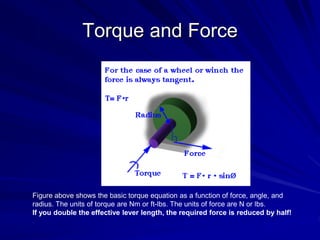
Torque and Force
Valve Stem Torque Requirements
Actuator force output requirements
 – must be sufficient to overcome valve static friction and dynamic
   torque.
Static friction:
 – developed in the metal-to-metal surfaces, seats, and seals.
Dynamic torque:
 – unbalanced force of the process acting on the plug, disc, or ball.
Valve torque requirements:
 – supplied by the manufacturer and based on pressure drop
   across the valve. A minimum of 10-20% safety factor should be
   applied to the maximum predicted force requirement to insure
   reliable operation.
Manufacturer Standards
Manufactures Standardization Society of the
Valve and Fittings Industry, Inc. – “Guidelines for
the Operation of Valves SP-91”
– Typical Operator defined as capable of applying
  150# of force based on a 12 inch lever.
– Valve designs standards allow for up to 240# of
  required force (18” hand wheel) depending on
  wheel size
– Do suppliers even belong to or subscribe to this
  minimal protective standard?
Real World – Required Valve Force
 Few field studies of required valve turning
 forces exist
 1992 study; 217 random chemical plant
 valves – 93% could be cracked open with
 a 3 ft long wrench using 100# or less
 force. 7% could not!
Real World - People
1995 study 250 male & female college students, data for
optimal valve orientation, 16” wheel
– Males could apply 123 – 127.5# peak force by hand
– Females could apply 73 – 100# peak force by hand
1997 study
– males could only apply 45 – 55# of sustained force by hand
  when turning a valve through 60 deg/sec.

Typical real world required manual valve actuation force
is a miss-match with human capabilities.
= Injuries which = not meeting safety metrics goals
Human Operator Force Capability
Variables Affecting Force an Operator can Apply:
  whether a wheel, lever or T-lever hand control is used
  the shape of that control and effective lever length or
  wheel diameter.
  the horizontal and vertical position of the valve with
  respect to the operator
  the distance from the operators vertical line of balance.
  the angle of the valve control with respect to the horizon

Adjustments need to be made in maximum acceptable
  valve actuation force for each of these factors.
Grip Strength Factors
Grip strength magnitude affects the torque that can be
transferred to the hand control and valve stem.
For small single hand operated valves, triangular rather
than traditional round handle shapes reduce gripping
force required by a factor of three for a given amount of
applied torque. Square, star, oval and other non-round
shapes are also advantageous to application of force.
Max. grip strength for small single hand operated valves
with round handles is achieved when the diameter in
kept near average palm grip size of 8 to 9 cm (3 to 3.25”)
with gloved hand.
For larger rim grip valve wheels, the maximum grip
strength is achieved when the rim profile diameter is
about 32 mm (1.25”) for gloved hands.
Gripping aids like wide bumps and spokes improve
applied wheel force by reducing grip effort.
Work Practices Risk Factors
Reduce force required. Use protocols that decrease
physical risk and use body mechanics to greatest
advantage. (Safety in Motion).

Always ramp up applied hand/arm force slowly to a valve
handle rather than instantly. Force increase = 26%.

Common practice of sudden high force     sudden injury

Use “grippy” gloves that increase grip allowing more
efficient force transfer (up to 15% increase)

Use wrenches! This decreases force required (torque vs.
force formula)
Human Force Capabilities as
Function of Large Valve Location
             5th Percentile force in Lbs for 57
             random male subjects
             Presented as a function of valve
             wheel height and angle.
             Hand to valve wheel turning


             Other data indicates female
             strength at 45% of male values.
Valve Location Factor
Valve angle and layout can contribute
greatly to ease or difficulty in turning the
valve
Leave adequate room for valve wrench
use for both large wheel valves and small
“hand” valves!!
Small hand valves have different
orientation considerations than large
valves
“Hand” Valve Positioning
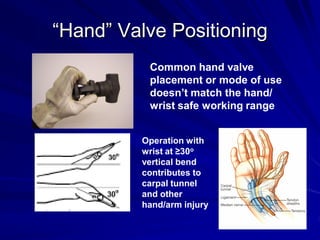
          Common hand valve
          placement or mode of use
          doesn’t match the hand/
          wrist safe working range


         Operation with
         wrist at ≥30o
         vertical bend
         contributes to
         carpal tunnel
         and other
         hand/arm injury
“Hand” Valve Positioning


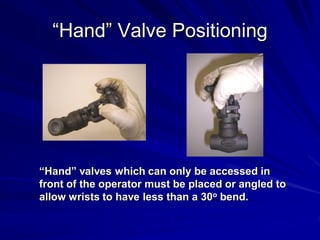
“Hand” valves which can only be accessed in
front of the operator must be placed or angled to
allow wrists to have less than a 30o bend.
“Hand” Valve Positioning


If at all possible a small handled “hand” valve
should be oriented so the stem forms a near 90o
angle with the extended arm.
The ideal small handle can be grasped like a
comfortable hand shake.
“Hand” Valve Positioning
         Turning a small handled valve
         without use of assist tools
         always presents some repetitive
         motion or strain injury risks.
         – Wrist bending during turning motion
         – Excessive turning force
         Provide valve wrenches
         Provide room around valves to
         use wrenches
         Avoid creating other body
         positioning issues
         Train operators to reduce risks
Help for Small Hand Valves


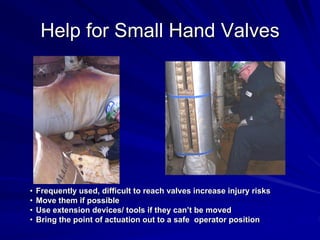
•   Frequently used, difficult to reach valves increase injury risks
•   Move them if possible
•   Use extension devices/ tools if they can’t be moved
•   Bring the point of actuation out to a safe operator position
Help for Valves
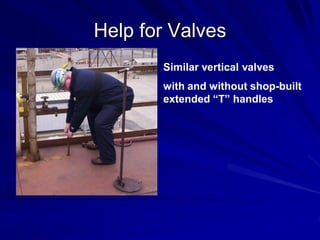
       Similar vertical valves
       with and without shop-built
       extended “T” handles
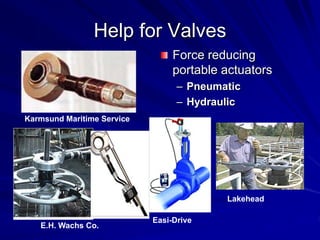
Help for Valves
                                 Force reducing
                                 portable actuators
                                  – Pneumatic
                                  – Hydraulic
Karmsund Maritime Service


                                          Lakehead

                            Easi-Drive
   E.H. Wachs Co.
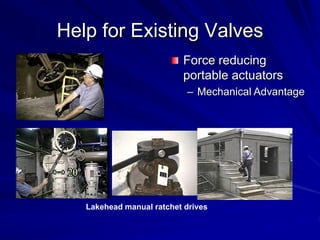
Help for Existing Valves
                           Force reducing
                           portable actuators
                           – Mechanical Advantage


   Lakehead manual ratchet drives
Help for Existing Valves
          Force reducing, simple
          leverage
           Valve wheel wrenches
           Lever handled valves
           Assure good footing, non-slip
           platforms
           Use where space permits
           (potential knuckle busters)

Ergonomics Valve Human Factors Engineering

  • 1.
    Ergonomics – Valve HumanFactors Engineering Managing the Physical Force Operators are Required to Apply Dale Rhodes, MSPH, CIH
  • 2.
    Goals Reduce/ eliminate workeroverexertion injuries Reduce/ eliminate worker repetitive motion injuries Reduce predictable and controllable risks preventing reaching 0 recordable injuries.
  • 3.
    Knowledge Required 1. Whatvalve turning forces are required? 2. What is the safe strength capacity of the lowest 95th percentile of the work force? 3. What variables can be controlled to reduce force requirements to meet #2? 4. What tools and design features need to be used to control the variables?
  • 4.
    Valve Actuators Automatic actuators: –used to operate valves automatically and/or remotely. – Automatic actuators typically use pneumatic, electric or hydraulic power to actuate a valve shaft. Manual actuators: – levers or wheels used to transfer physical force from the human operator to valve shaft directly or through mechanical gearing or hydraulics.
  • 5.
  • 6.
    Valve Stem TorqueRequirements Actuator force output requirements – must be sufficient to overcome valve static friction and dynamic torque. Static friction: – developed in the metal-to-metal surfaces, seats, and seals. Dynamic torque: – unbalanced force of the process acting on the plug, disc, or ball. Valve torque requirements: – supplied by the manufacturer and based on pressure drop across the valve. A minimum of 10-20% safety factor should be applied to the maximum predicted force requirement to insure reliable operation.
  • 7.
    Manufacturer Standards Manufactures StandardizationSociety of the Valve and Fittings Industry, Inc. – “Guidelines for the Operation of Valves SP-91” – Typical Operator defined as capable of applying 150# of force based on a 12 inch lever. – Valve designs standards allow for up to 240# of required force (18” hand wheel) depending on wheel size – Do suppliers even belong to or subscribe to this minimal protective standard?
  • 8.
    Real World –Required Valve Force Few field studies of required valve turning forces exist 1992 study; 217 random chemical plant valves – 93% could be cracked open with a 3 ft long wrench using 100# or less force. 7% could not!
  • 9.
    Real World -People 1995 study 250 male & female college students, data for optimal valve orientation, 16” wheel – Males could apply 123 – 127.5# peak force by hand – Females could apply 73 – 100# peak force by hand 1997 study – males could only apply 45 – 55# of sustained force by hand when turning a valve through 60 deg/sec. Typical real world required manual valve actuation force is a miss-match with human capabilities. = Injuries which = not meeting safety metrics goals
  • 10.
    Human Operator ForceCapability Variables Affecting Force an Operator can Apply: whether a wheel, lever or T-lever hand control is used the shape of that control and effective lever length or wheel diameter. the horizontal and vertical position of the valve with respect to the operator the distance from the operators vertical line of balance. the angle of the valve control with respect to the horizon Adjustments need to be made in maximum acceptable valve actuation force for each of these factors.
  • 11.
    Grip Strength Factors Gripstrength magnitude affects the torque that can be transferred to the hand control and valve stem. For small single hand operated valves, triangular rather than traditional round handle shapes reduce gripping force required by a factor of three for a given amount of applied torque. Square, star, oval and other non-round shapes are also advantageous to application of force. Max. grip strength for small single hand operated valves with round handles is achieved when the diameter in kept near average palm grip size of 8 to 9 cm (3 to 3.25”) with gloved hand. For larger rim grip valve wheels, the maximum grip strength is achieved when the rim profile diameter is about 32 mm (1.25”) for gloved hands. Gripping aids like wide bumps and spokes improve applied wheel force by reducing grip effort.
  • 12.
    Work Practices RiskFactors Reduce force required. Use protocols that decrease physical risk and use body mechanics to greatest advantage. (Safety in Motion). Always ramp up applied hand/arm force slowly to a valve handle rather than instantly. Force increase = 26%. Common practice of sudden high force sudden injury Use “grippy” gloves that increase grip allowing more efficient force transfer (up to 15% increase) Use wrenches! This decreases force required (torque vs. force formula)
  • 13.
    Human Force Capabilitiesas Function of Large Valve Location 5th Percentile force in Lbs for 57 random male subjects Presented as a function of valve wheel height and angle. Hand to valve wheel turning Other data indicates female strength at 45% of male values.
  • 14.
    Valve Location Factor Valveangle and layout can contribute greatly to ease or difficulty in turning the valve Leave adequate room for valve wrench use for both large wheel valves and small “hand” valves!! Small hand valves have different orientation considerations than large valves
  • 15.
    “Hand” Valve Positioning Common hand valve placement or mode of use doesn’t match the hand/ wrist safe working range Operation with wrist at ≥30o vertical bend contributes to carpal tunnel and other hand/arm injury
  • 16.
    “Hand” Valve Positioning “Hand”valves which can only be accessed in front of the operator must be placed or angled to allow wrists to have less than a 30o bend.
  • 17.
    “Hand” Valve Positioning Ifat all possible a small handled “hand” valve should be oriented so the stem forms a near 90o angle with the extended arm. The ideal small handle can be grasped like a comfortable hand shake.
  • 18.
    “Hand” Valve Positioning Turning a small handled valve without use of assist tools always presents some repetitive motion or strain injury risks. – Wrist bending during turning motion – Excessive turning force Provide valve wrenches Provide room around valves to use wrenches Avoid creating other body positioning issues Train operators to reduce risks
  • 19.
    Help for SmallHand Valves • Frequently used, difficult to reach valves increase injury risks • Move them if possible • Use extension devices/ tools if they can’t be moved • Bring the point of actuation out to a safe operator position
  • 20.
    Help for Valves Similar vertical valves with and without shop-built extended “T” handles
  • 21.
    Help for Valves Force reducing portable actuators – Pneumatic – Hydraulic Karmsund Maritime Service Lakehead Easi-Drive E.H. Wachs Co.
  • 22.
    Help for ExistingValves Force reducing portable actuators – Mechanical Advantage Lakehead manual ratchet drives
  • 23.
    Help for ExistingValves Force reducing, simple leverage Valve wheel wrenches Lever handled valves Assure good footing, non-slip platforms Use where space permits (potential knuckle busters)