Ergonomics  - Environment Part 2 –  physiological   aspects
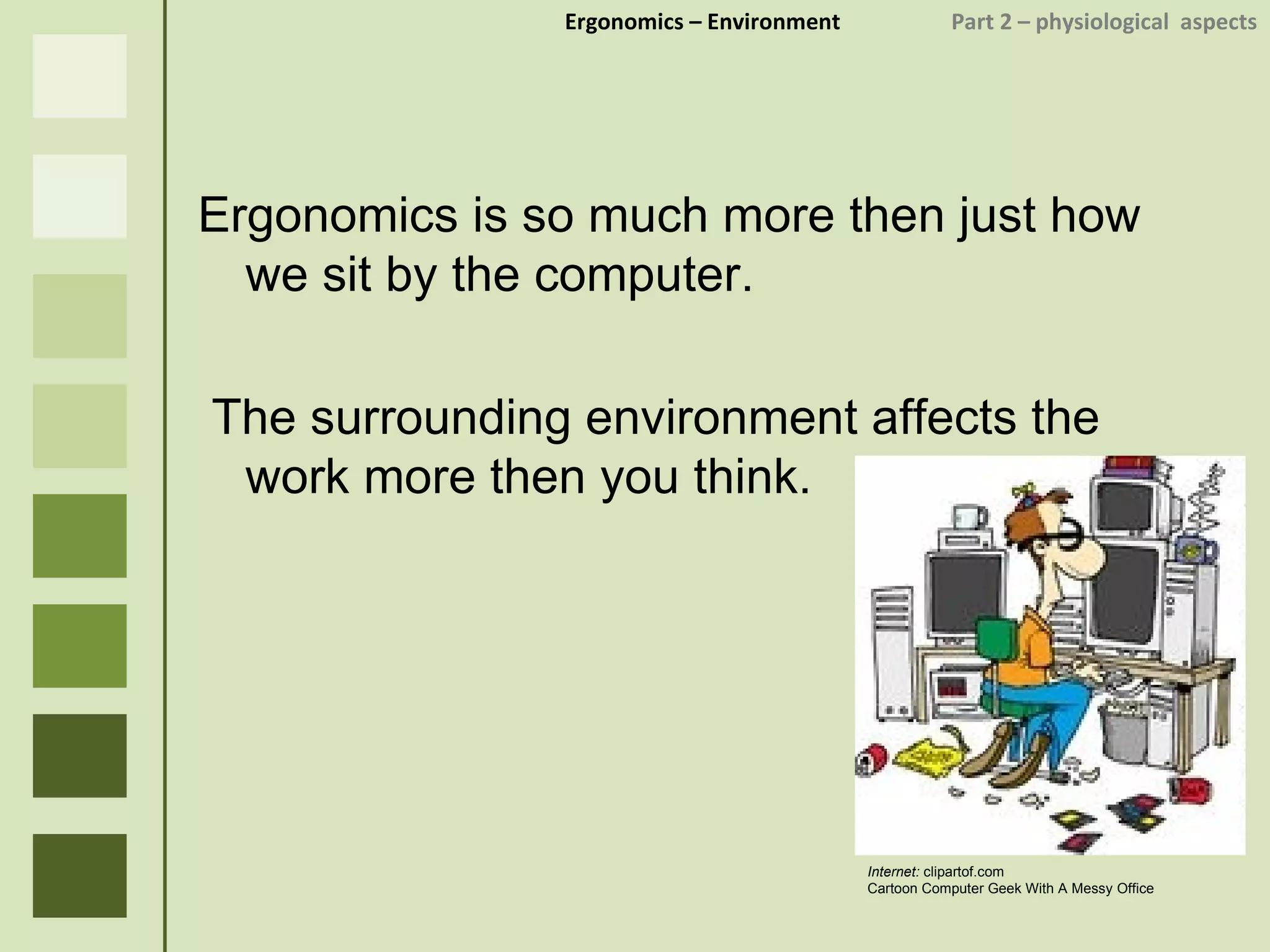
Ergonomics  – Environment    Part 2 –  physiological  aspects Ergonomics is so much more then just how we sit by the computer. The surrounding environment affects the work more then you think. Internet:  clipartof.com Cartoon Computer Geek With A Messy Office
Ergonomics  – Environment    Part 2 –  physiological  aspects Light Sound Vibrations Air Temperature These physiological subjects are very important for the human being in the work environment. All of the subjects above, affects persons in different ways. Some in a bad way and can lead to different sicknesses. This means–  bad ergonomics
Ergonomics  – Environment    Part 2 –  physiological  aspects Light Why is our sight unique?  The eye can/have… Interpret different eye visions Color seeing Detail seeing Night vision Depth perception Contrast perception Internet:  http://www.clker.com/clipart-23244.html
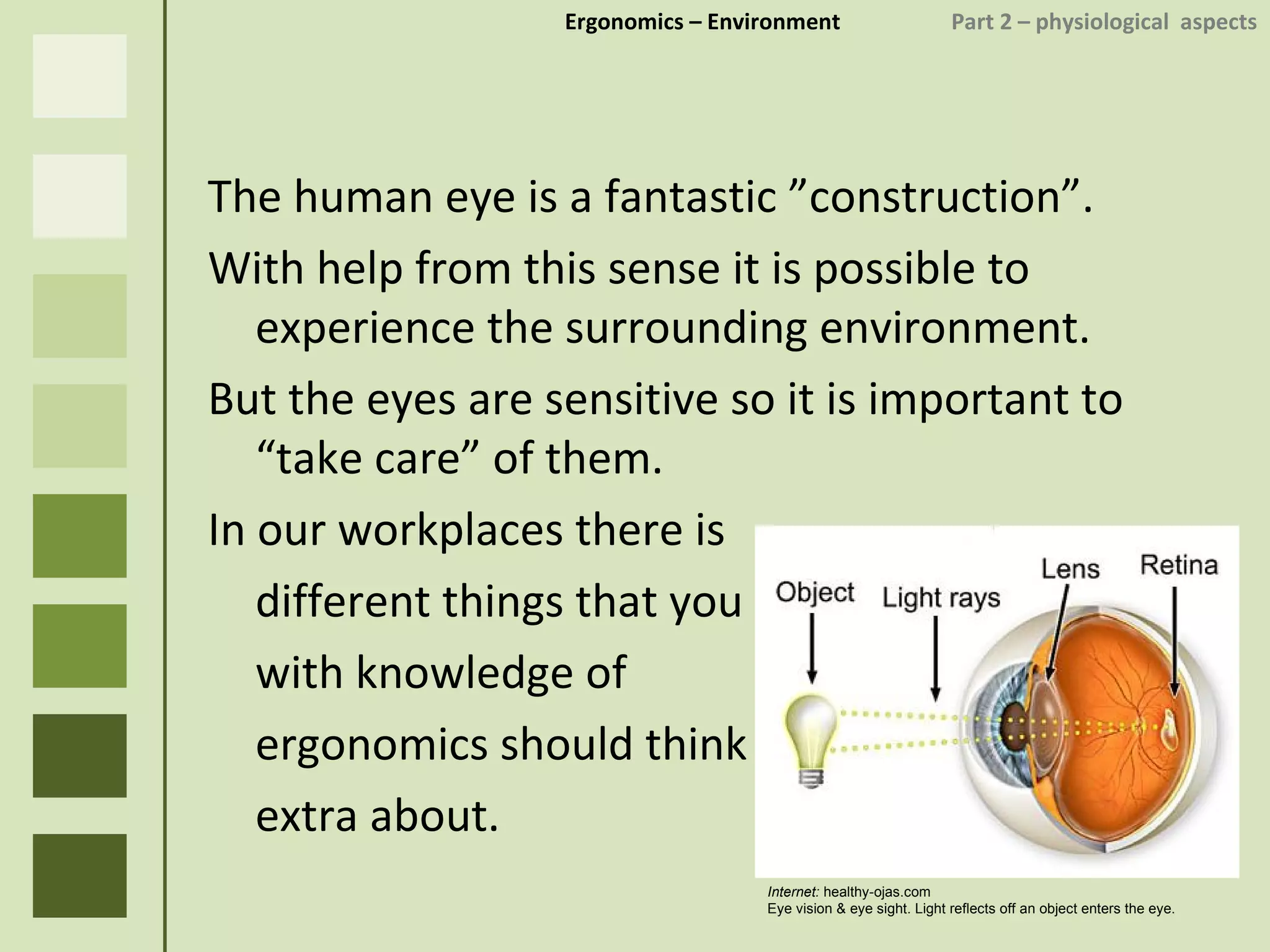
Ergonomics  – Environment    Part 2 –  physiological  aspects The human eye is a fantastic ”construction”.  With help from this sense it is possible to experience the surrounding environment. But the eyes are sensitive so it is important to “take care” of them. In our workplaces there is different things that you with knowledge of  ergonomics should think extra about. Internet:  healthy-ojas.com Eye vision & eye sight. Light reflects off an object enters the eye.
Ergonomics  – Environment    Part 2 –  physiological  aspects Affects the environment Computer work Dry eyes Head ache ” Vulture neck” Industrial work with many particles in the air Dry office air Air-condition Smoking Fumes etc.
Ergonomics  – Environment    Part 2 –  physiological  aspects You have about 3600 eye movements/ h Things to think about at computer screen work Distance for the eye Screen settings Light settings
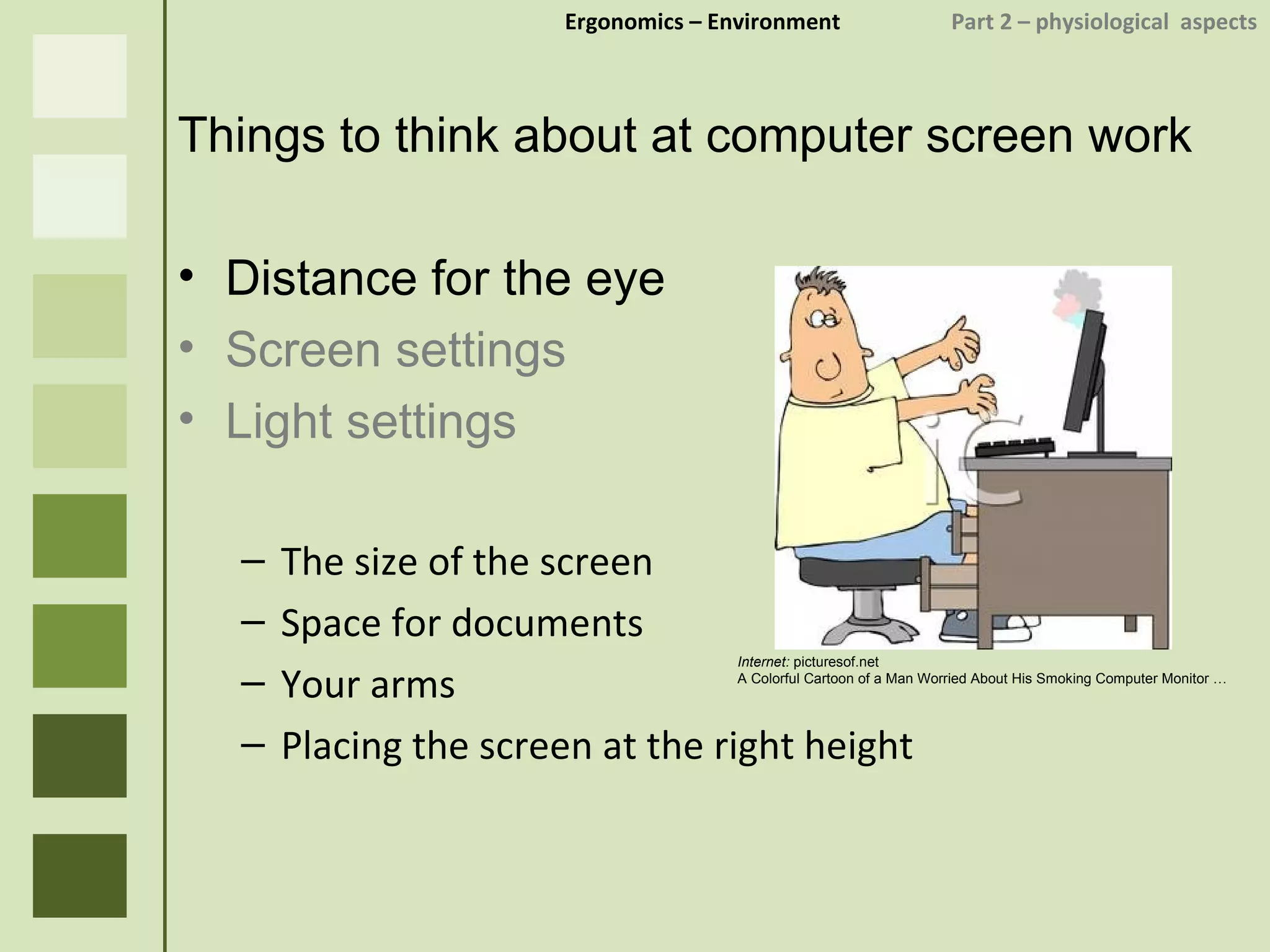
Ergonomics  – Environment    Part 2 –  physiological  aspects Things to think about at computer screen work Distance for the eye Screen settings Light settings The size of the screen Space for documents Your arms Placing the screen at the right height Internet:  picturesof.net A Colorful Cartoon of a Man Worried About His Smoking Computer Monitor …
Ergonomics  – Environment    Part 2 –  physiological  aspects Things to think about at computer screen work Distance for the eye Screen settings Light settings Free from flicker Free from reflections and mirroring Clear text and contrast Light background and dark signs Easily be adjusted Good readability
Ergonomics  – Environment    Part 2 –  physiological  aspects Things to think about at computer screen work Distance for the eye Screen settings Light settings Light-coloured room The light and the workplace should be coordinated Appropriate contrast between screen and surrounding environment Considering the worker’s need
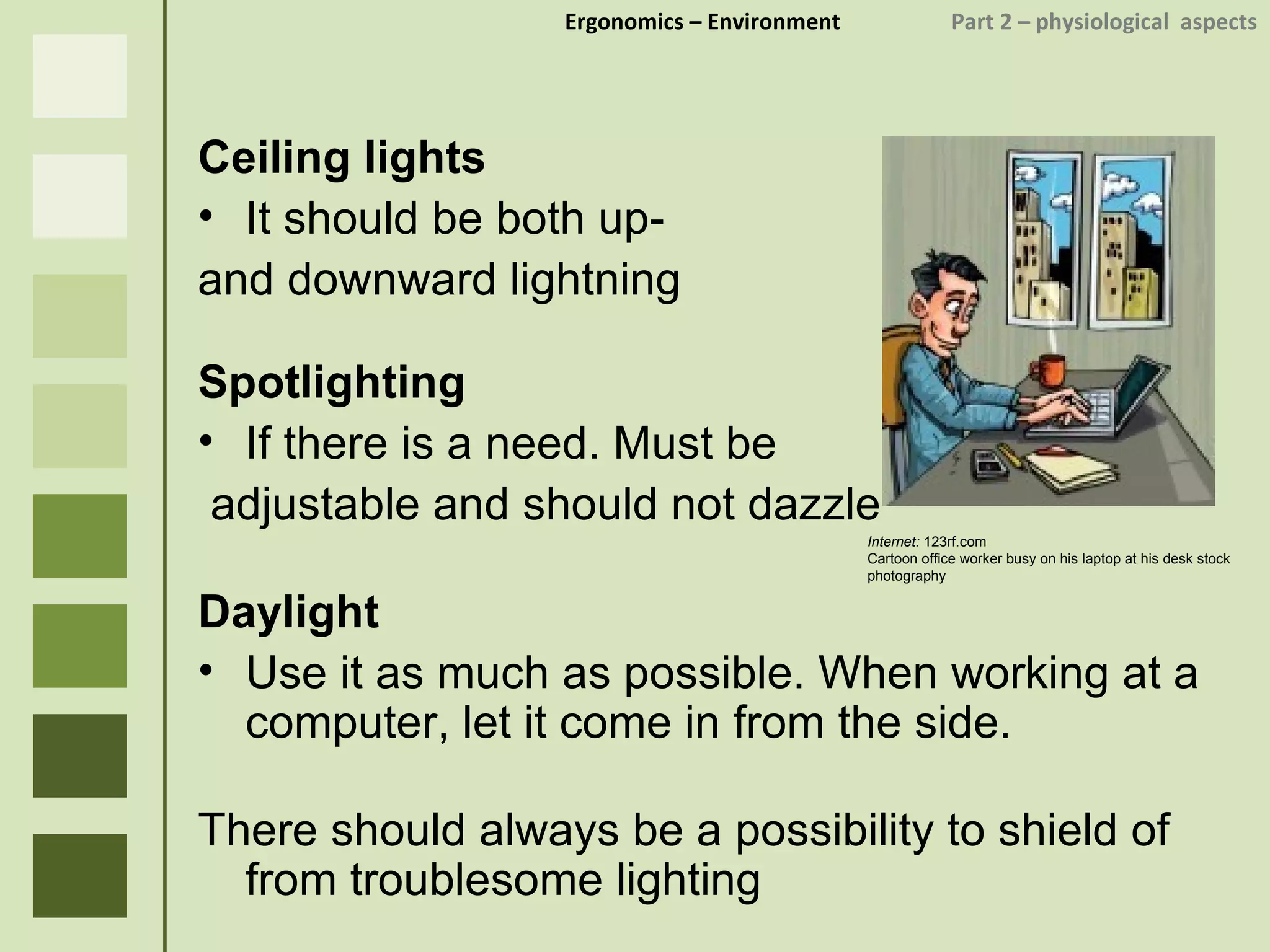
Ergonomics  – Environment    Part 2 –  physiological  aspects Ceiling lights It should be both up-  and downward lightning Spotlighting If there is a need. Must be adjustable and should not dazzle Daylight Use it as much as possible. When working at a computer, let it come in from the side. There should always be a possibility to shield of from troublesome lighting Internet:  123rf.com Cartoon office worker busy on his laptop at his desk stock photography
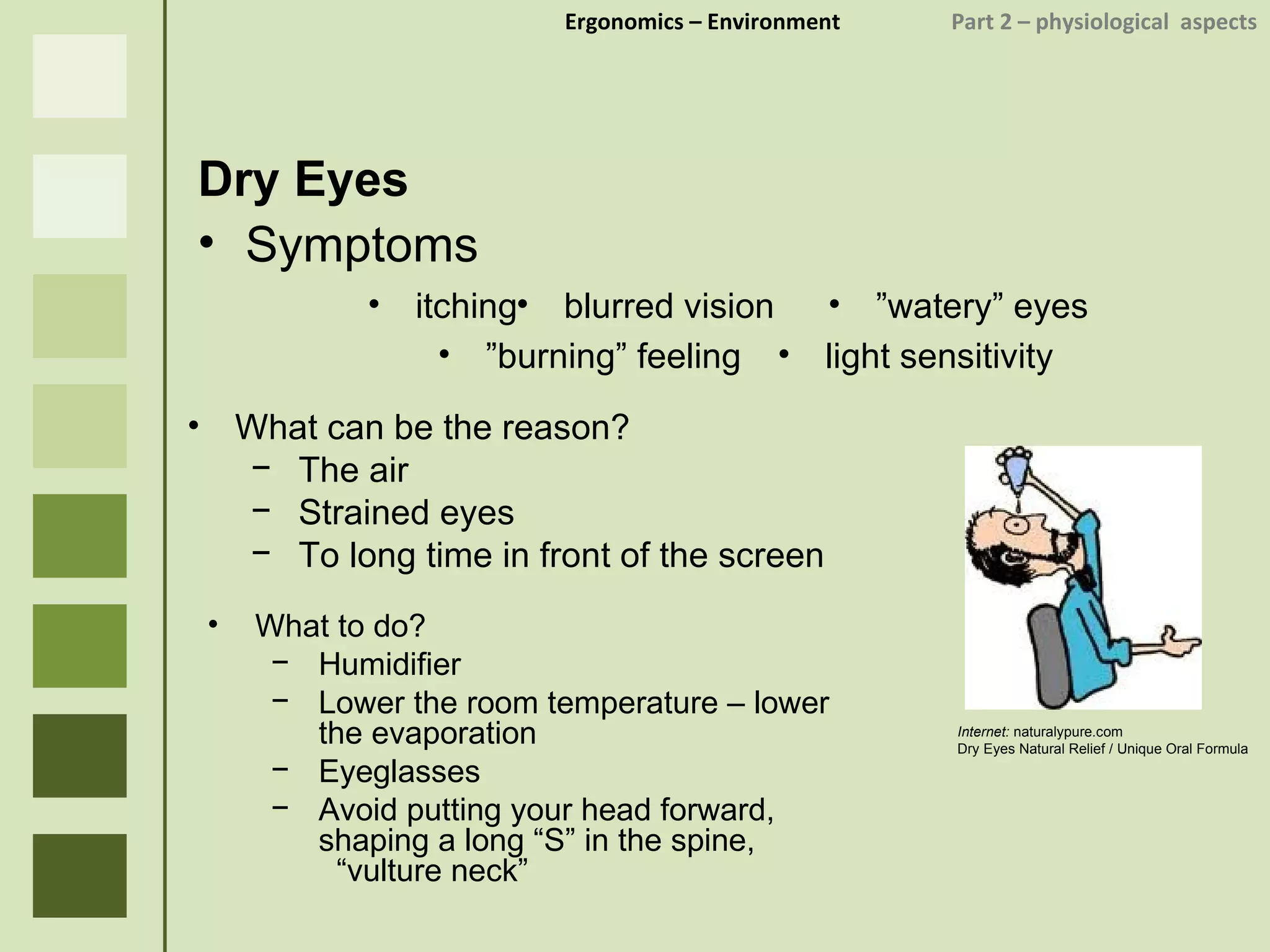
Ergonomics  – Environment    Part 2 –  physiological  aspects Dry Eyes Symptoms Internet:  naturalypure.com Dry Eyes Natural Relief / Unique Oral Formula blurred vision  ” watery” eyes  light sensitivity  ” burning” feeling  itching What can be the reason? The air Strained eyes To long time in front of the screen What to do? Humidifier Lower the room temperature – lower the evaporation  Eyeglasses Avoid putting your head forward, shaping a long “S” in the spine,  “vulture neck”
Ergonomics  – Environment    Part 2 –  physiological  aspects Glasses The employer is only paying for the glasses if your work requires special glasses Work goggles is a work tool, which belongs to the employer. But it is a labour law! If the private glasses are not enough for your tasks, the employer can help you. If there is a need of visual aids to help performing the work, the employer should provide this.
Ergonomics  – Environment    Part 2 –  physiological  aspects Good advices regarding light/eye ergonomics! Good ventilation Not to hot or cold Screen position at least an arms length from the body The top half of the screen should be in eyes height. Let the eyes take a break from the screen every 15 minute, and focus on something further away during 1-2 minutes. (eye muscles relax) Blink quickly a few times to hydrate the eyes
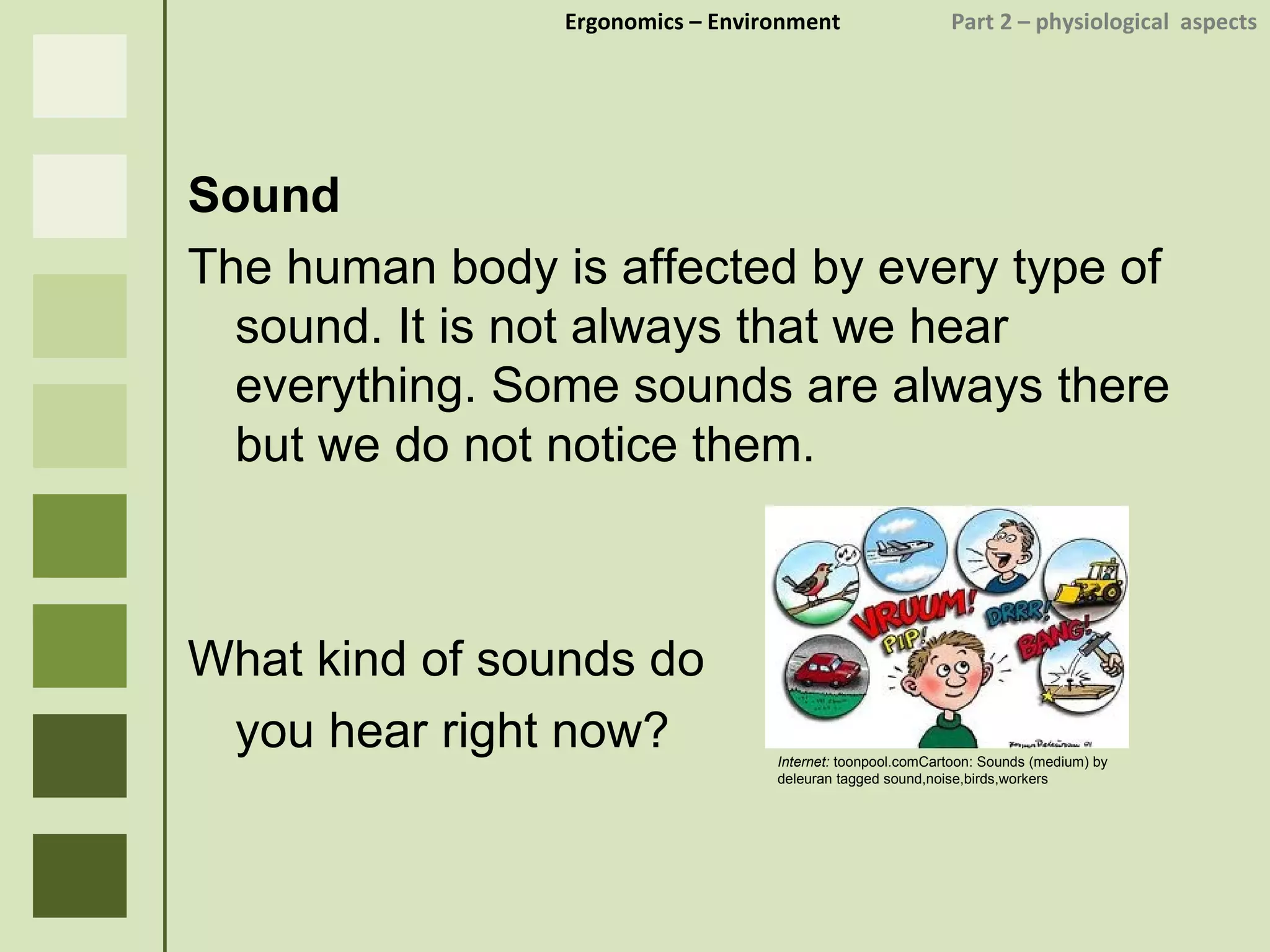
Ergonomics  – Environment    Part 2 –  physiological  aspects Sound The human body is affected by every type of sound. It is not always that we hear everything. Some sounds are always there but we do not notice them. What kind of sounds do you hear right now? Internet:  toonpool.comCartoon: Sounds (medium) by deleuran tagged sound,noise,birds,workers
Ergonomics  – Environment    Part 2 –  physiological  aspects Every day exposure Traffic Ventilation system Music Telephone Computer work Is there some sounds that is not mentioned ? Birds in the nature Disco, Concerts Neighbours Work colleagues
Ergonomics  – Environment    Part 2 –  physiological  aspects Health affects Degraded hearing Ringing in the ears Sleep disorder Degraded learning capacity (Plausible –higher risk for heart diseases) Sensitive groups Children and youths Persons with already degraded hearing Elderly
Ergonomics  – Environment    Part 2 –  physiological  aspects How do we prevent hearing disorders? It is the employers obligation to provide the workers with hearing protectors. This is often used at construction work. It is important to mention that hearing protectors is a temporary solution. The primary aim is to lower the total sound around noisy workplaces.
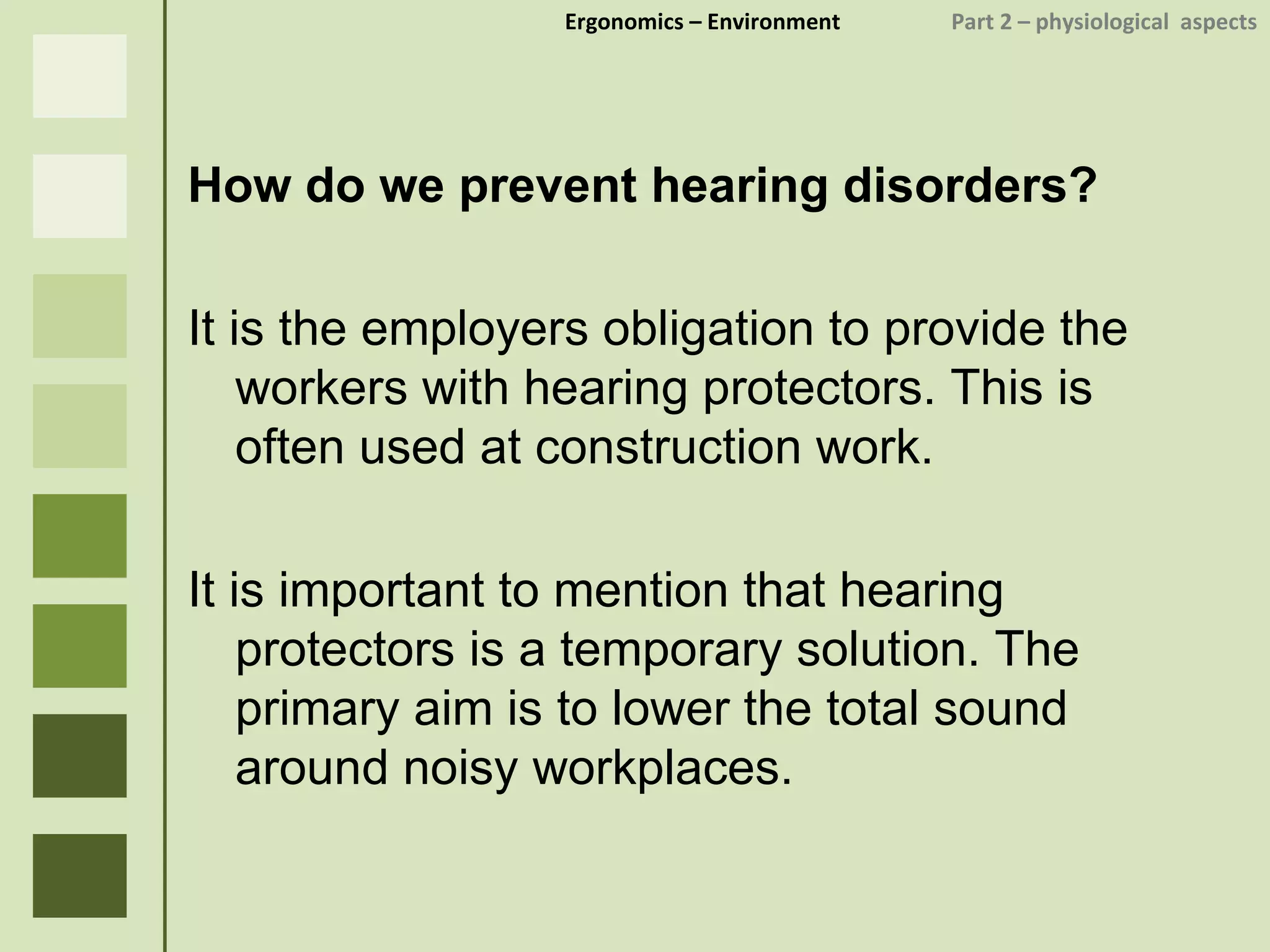
Ergonomics  – Environment    Part 2 –  physiological  aspects How do we prevent hearing disorders? By using different fabrics and materials that can absorb sound. It is important to notice that the sound levels have increased in places that previous used to be quiet. Why do you think that is? Have you given it a thought at your workplace? Internet:  rummuser.com
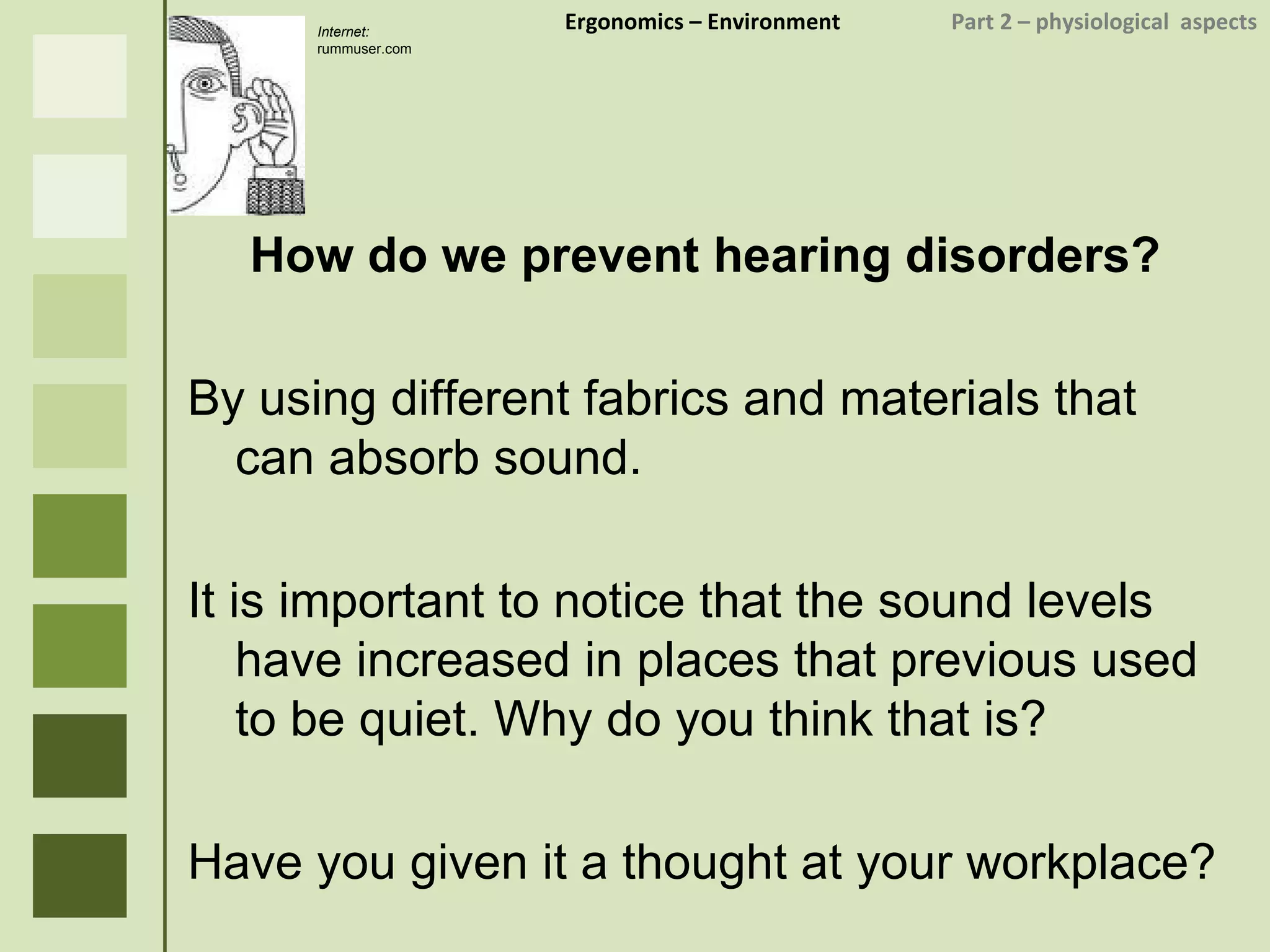
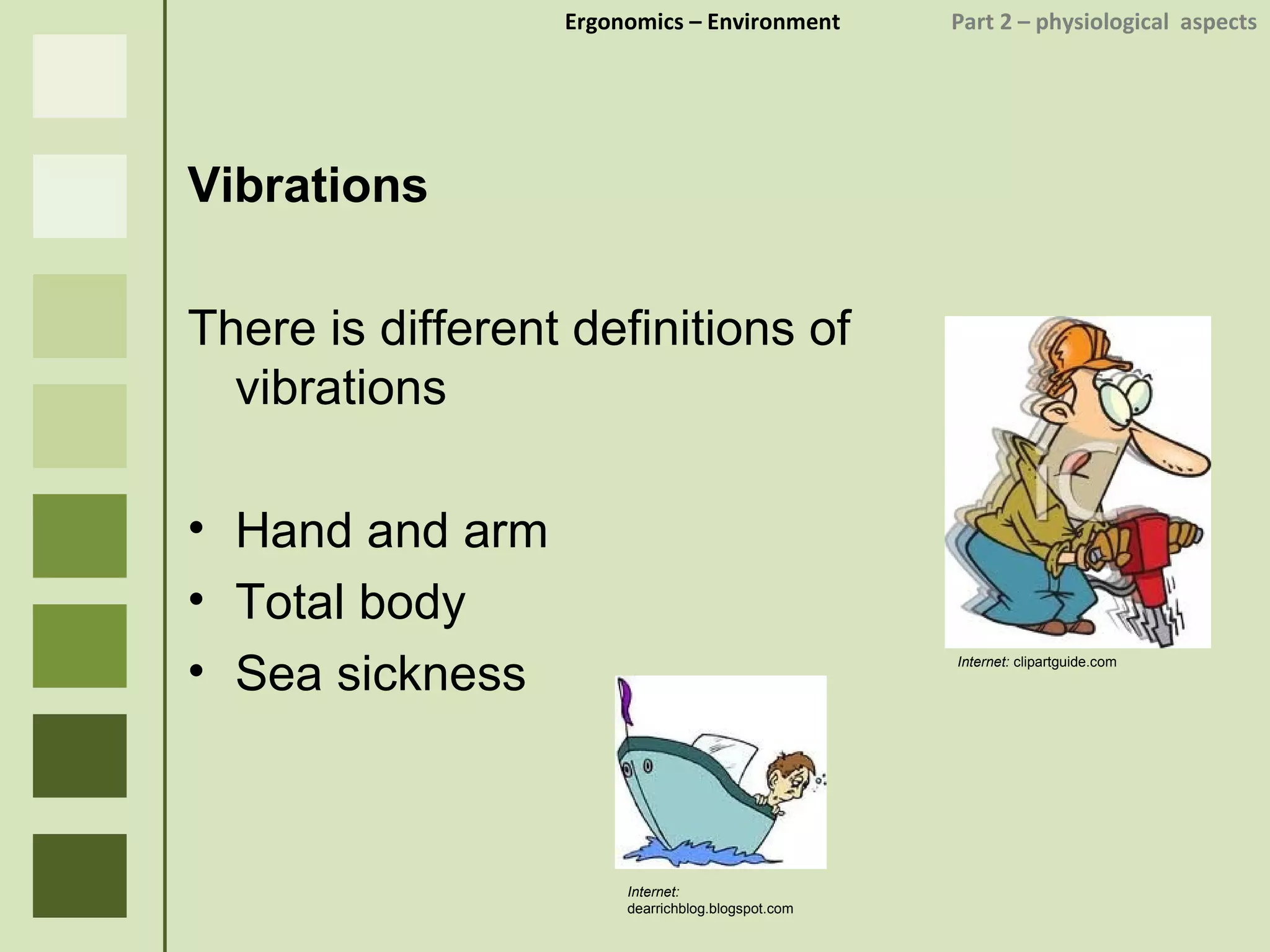
Ergonomics  – Environment    Part 2 –  physiological  aspects Vibrations There is different definitions of vibrations Hand and arm Total body Sea sickness Internet:  clipartguide.com Internet:  dearrichblog.blogspot.com
Ergonomics  – Environment    Part 2 –  physiological  aspects Hand and arm vibrations Energy to the body thru hand held tools Chainsaw, Drilling machine, Pneumatic tools Total Body Vibrations Energy to the body thru seat or floor Affect the whole body Truck-, Bus-, Tractor driver
Ergonomics  – Environment    Part 2 –  physiological  aspects How much vibration exposure is needed before the human body is affected? This vary from person to person, how sensitive for vibrations they are. Depending on how long the body has been exposed to vibrations, the damages on the body vary.
Ergonomics  – Environment    Part 2 –  physiological  aspects The affect on the human body Increased energy consumption Increased muscle activity Increased strain on discs If the muscles are fatigue, the vibrations increases and increase the strain on discs and can lead to back pain.
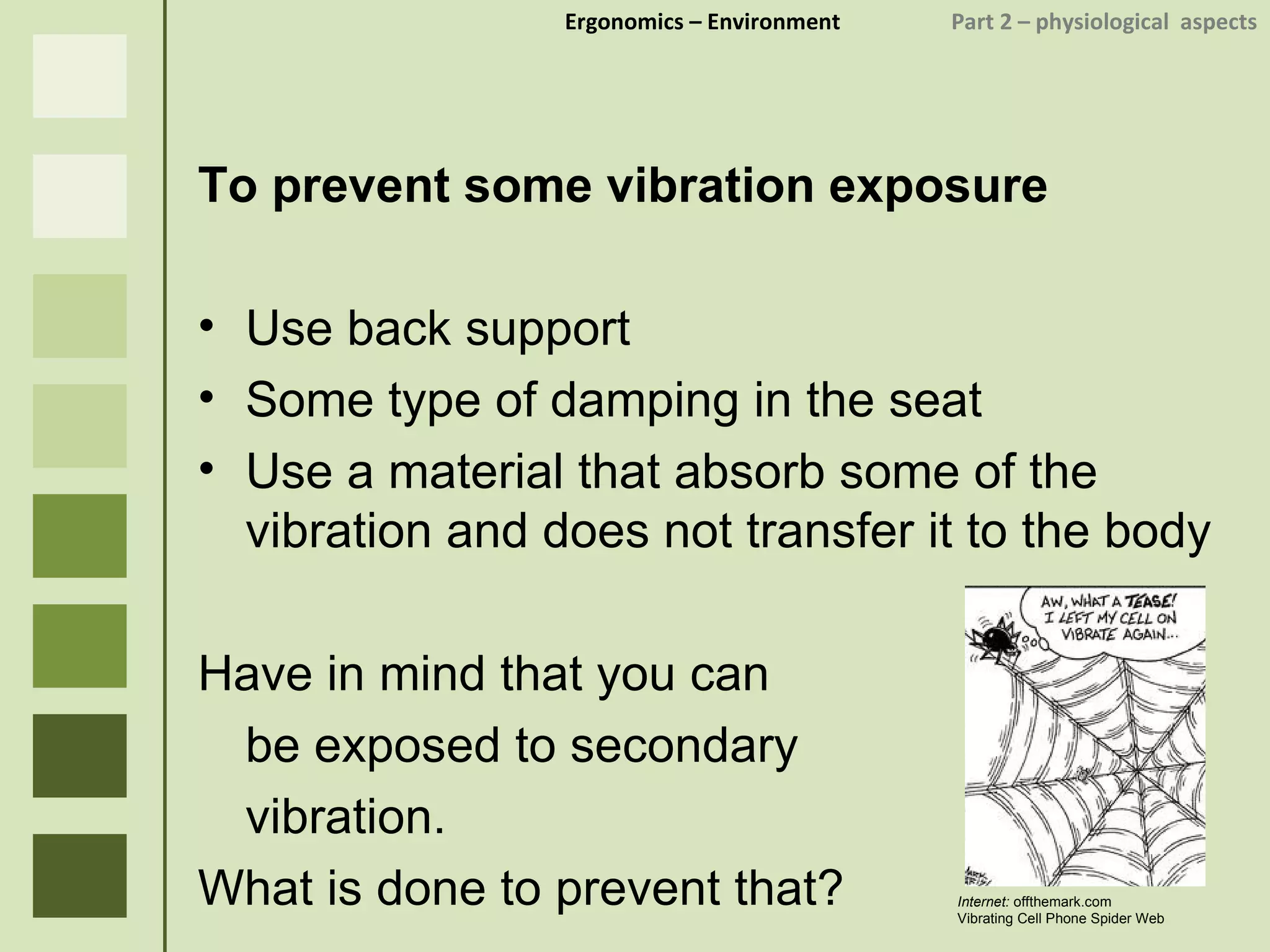
Ergonomics  – Environment    Part 2 –  physiological  aspects To prevent some vibration exposure Use back support Some type of damping in the seat Use a material that absorb some of the vibration and does not transfer it to the body Have in mind that you can  be exposed to secondary vibration.  What is done to prevent that? Internet:  offthemark.com Vibrating Cell Phone Spider Web
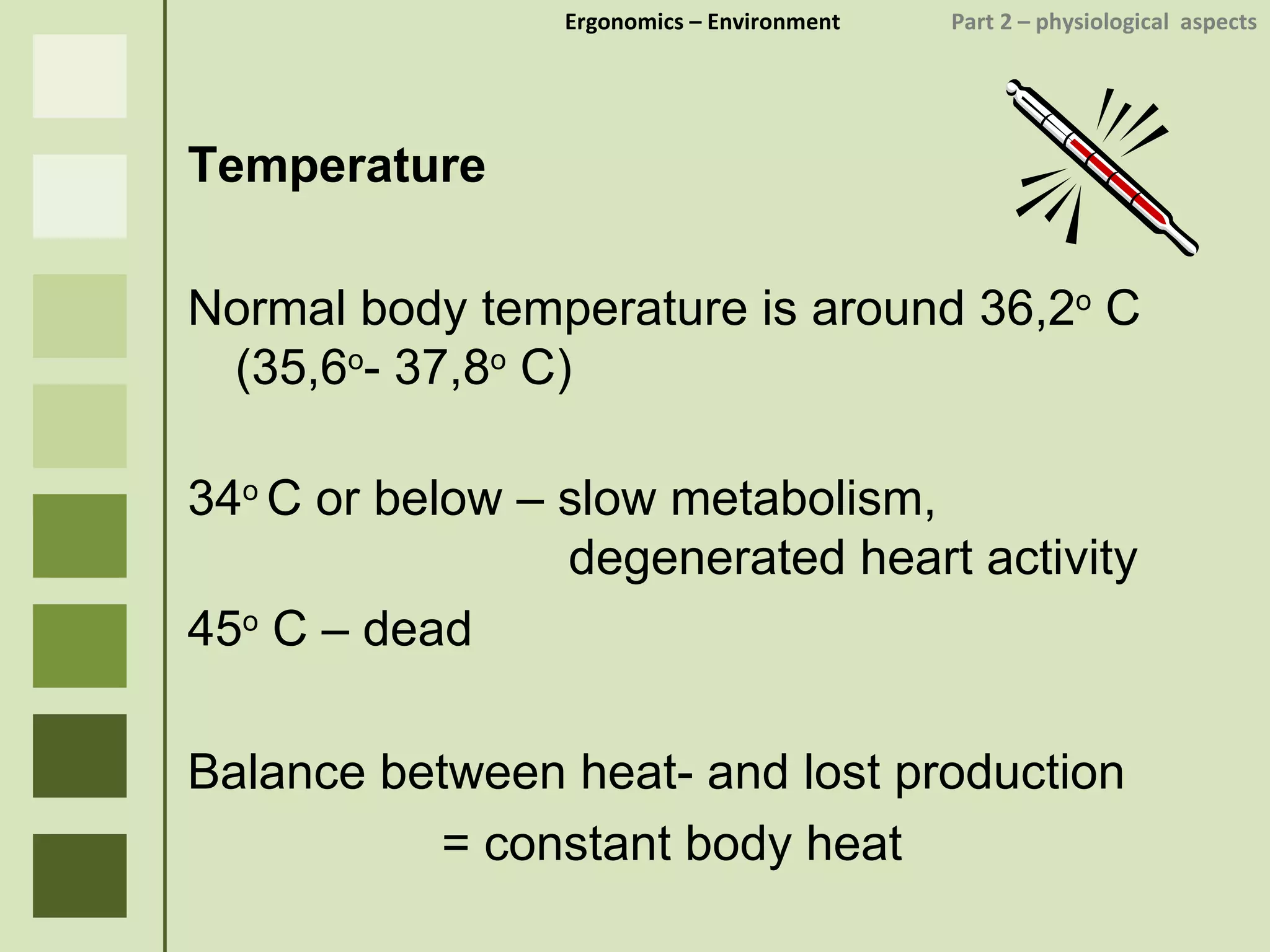
Ergonomics  – Environment    Part 2 –  physiological  aspects Temperature Normal body temperature is around 36,2 o  C  (35,6 o - 37,8 o  C) 34 o  C or below – slow metabolism, degenerated heart activity 45 o  C – dead Balance between heat- and lost production  = constant body heat
Ergonomics  – Environment    Part 2 –  physiological  aspects All tissues produces heat, this is because of all particles that are in motion produces kinetic energy which is generating heat. When you are resting, most heat is used in liver, heart and brain and the endocrine organs. When you are being physically active the muscles increase the heat production. When finished the activity, the heat production normalize but the heat loss keeps going until the balance is normalized.
Ergonomics  – Environment    Part 2 –  physiological  aspects The human being has functions in the skin and inside the body that sense when to heat or cool down. When you are hot on the inside, the “hot” blood is going from inside the body out to the skin and cools down and then back again. “ Cold hands  =  warm heart ” The highest temperature in the body is in the head, chest and abdomen, the coldest is in fingers and feet. The external temperature can vary between 20 o  C and 40 o  C
Ergonomics  – Environment    Part 2 –  physiological  aspects Temperature sensitivity is very varying Depends on Clothes Food Physical exertion Time of the year and day Body size Age, gender, habits The sensitivity is most distinct on women, children and elderly.
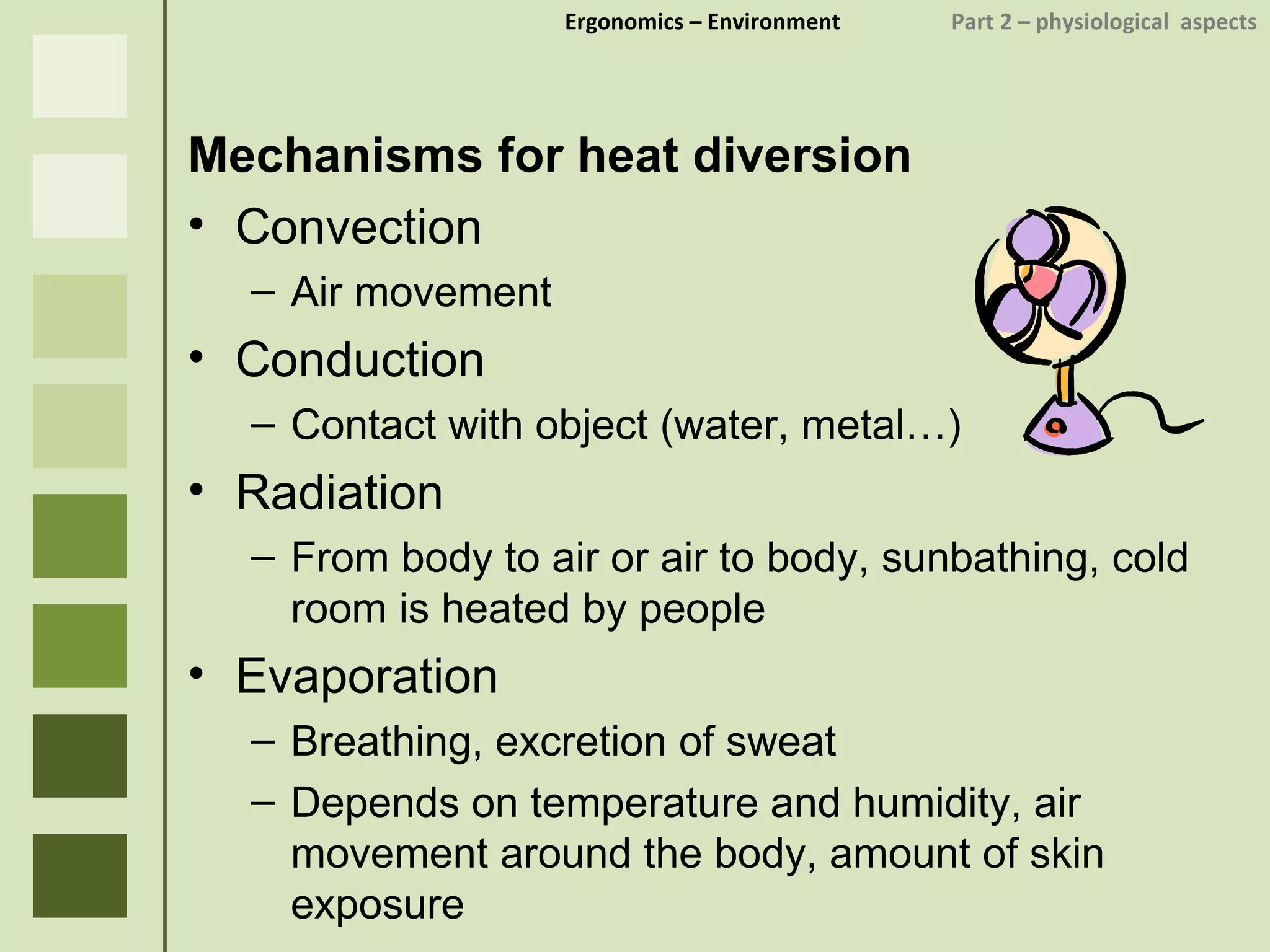
Ergonomics  – Environment    Part 2 –  physiological  aspects Mechanisms for heat diversion Convection Air movement Conduction Contact with object (water, metal…) Radiation From body to air or air to body, sunbathing, cold room is heated by people Evaporation Breathing, excretion of sweat Depends on temperature and humidity, air movement around the body, amount of skin exposure
Ergonomics  – Environment    Part 2 –  physiological  aspects Heat affects your work relaxes the work pace exhaustive Lower physical performance Increased numbers of mistakes and accidents
Ergonomics  – Environment    Part 2 –  physiological  aspects How to prevent? Knowledge, attention Adequate hydration Adaption of behavior and physical activity Clothes Activity Condition Acclimatizing
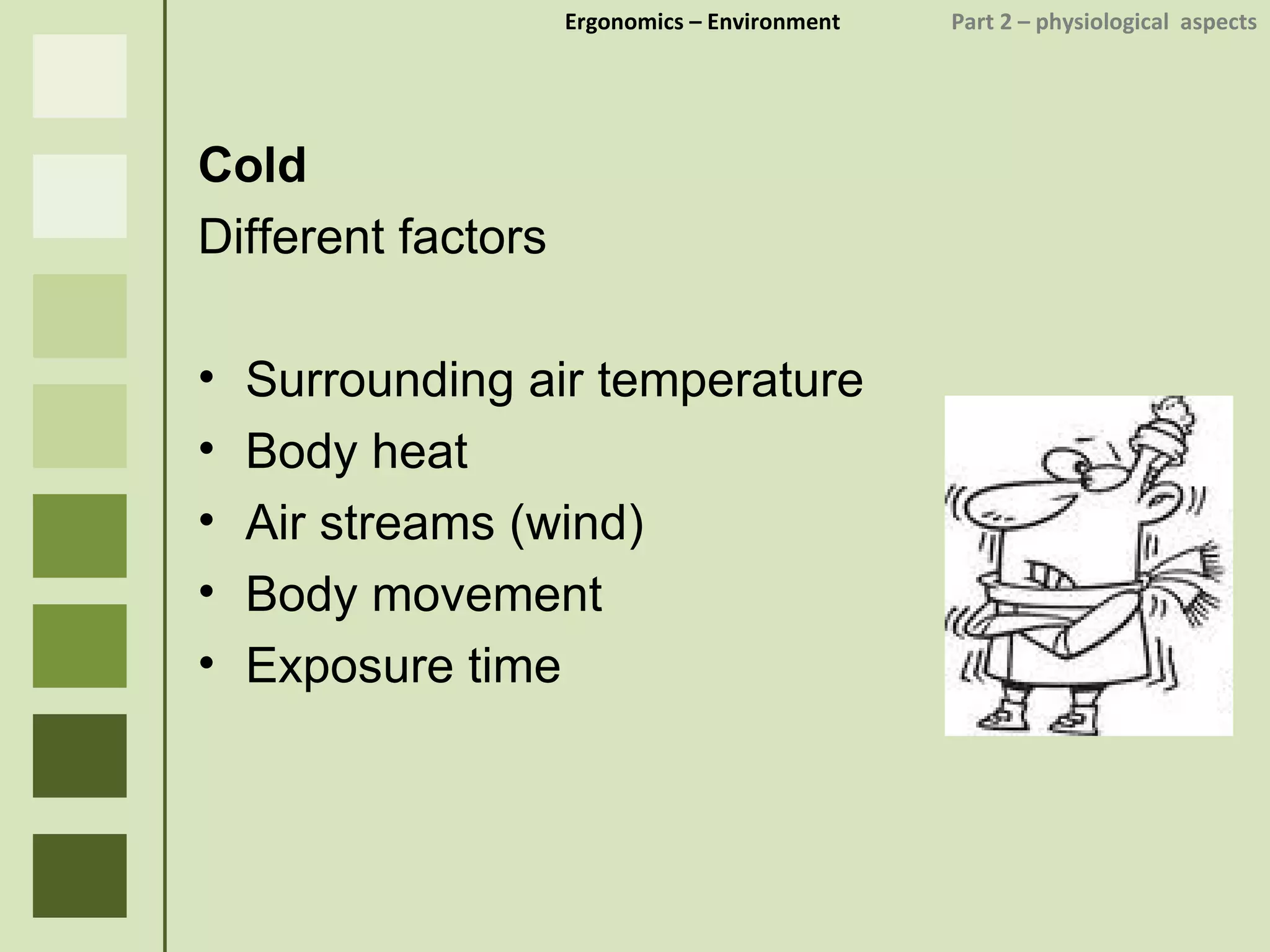
Ergonomics  – Environment    Part 2 –  physiological  aspects Cold Different factors Surrounding air temperature Body heat Air streams (wind) Body movement Exposure time
Ergonomics  – Environment    Part 2 –  physiological  aspects Surrounding cold It is an increasing heat loss to the surroundings, when you are in a cold area. Muscular hypertonia, results in “shivering” and is the body's attempt to sustain body heat. When exposed to cold during a long period of time, the body loses energy faster then it can produce This can occur even with temperature over  0 o  C
Ergonomics  – Environment    Part 2 –  physiological  aspects Hypothermia = the core temperature is below 35 o  C There is different levels of hypothermia Light:  35 o  -32 o  C Medium: 32 o  -28 o  C Severe: below 28 o  C Notice that cold kills in 2 steps Exposure Cold Wind Exhaustion
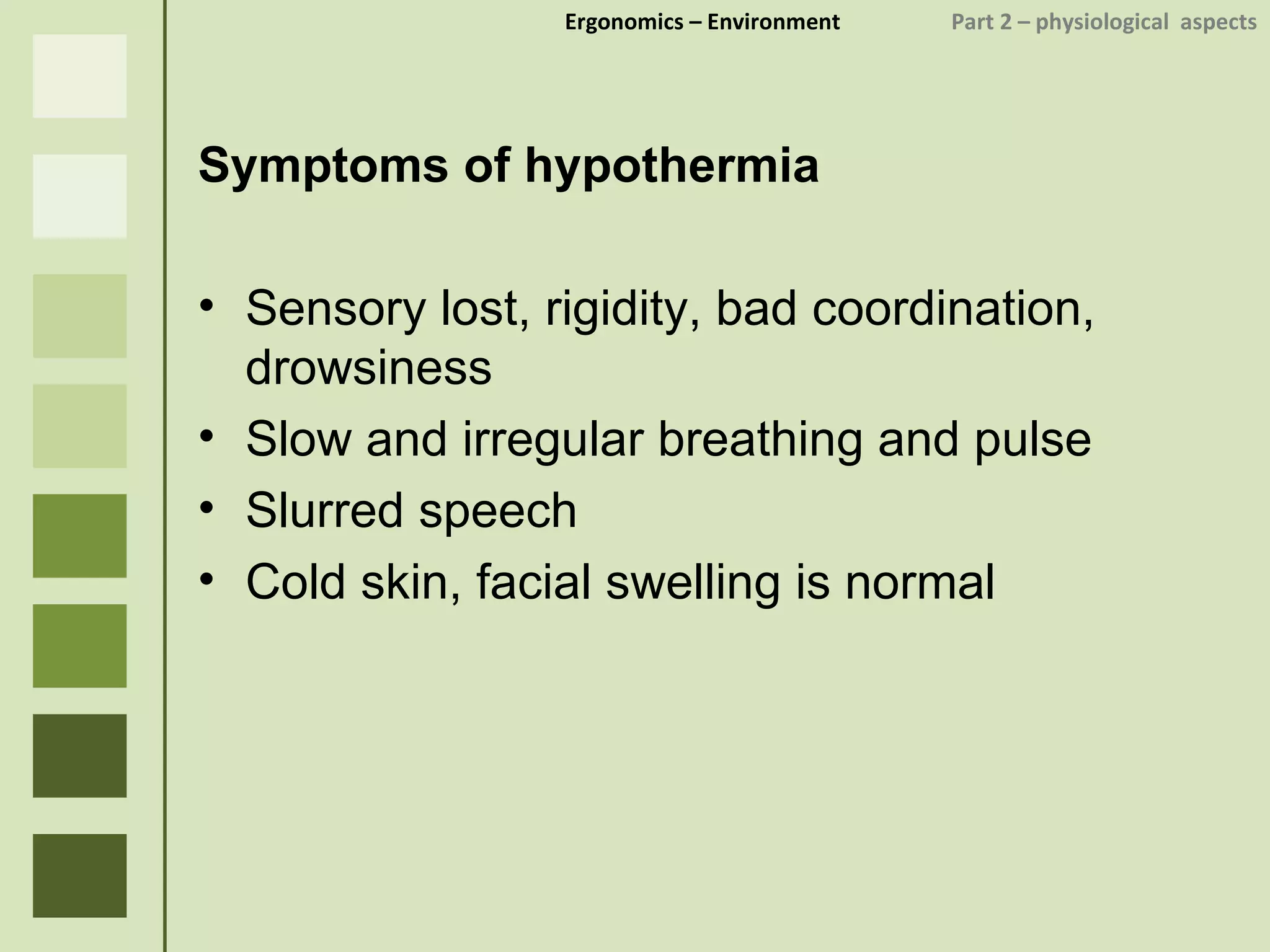
Ergonomics  – Environment    Part 2 –  physiological  aspects Symptoms of hypothermia Sensory lost, rigidity, bad coordination, drowsiness Slow and irregular breathing and pulse Slurred speech Cold skin, facial swelling is normal
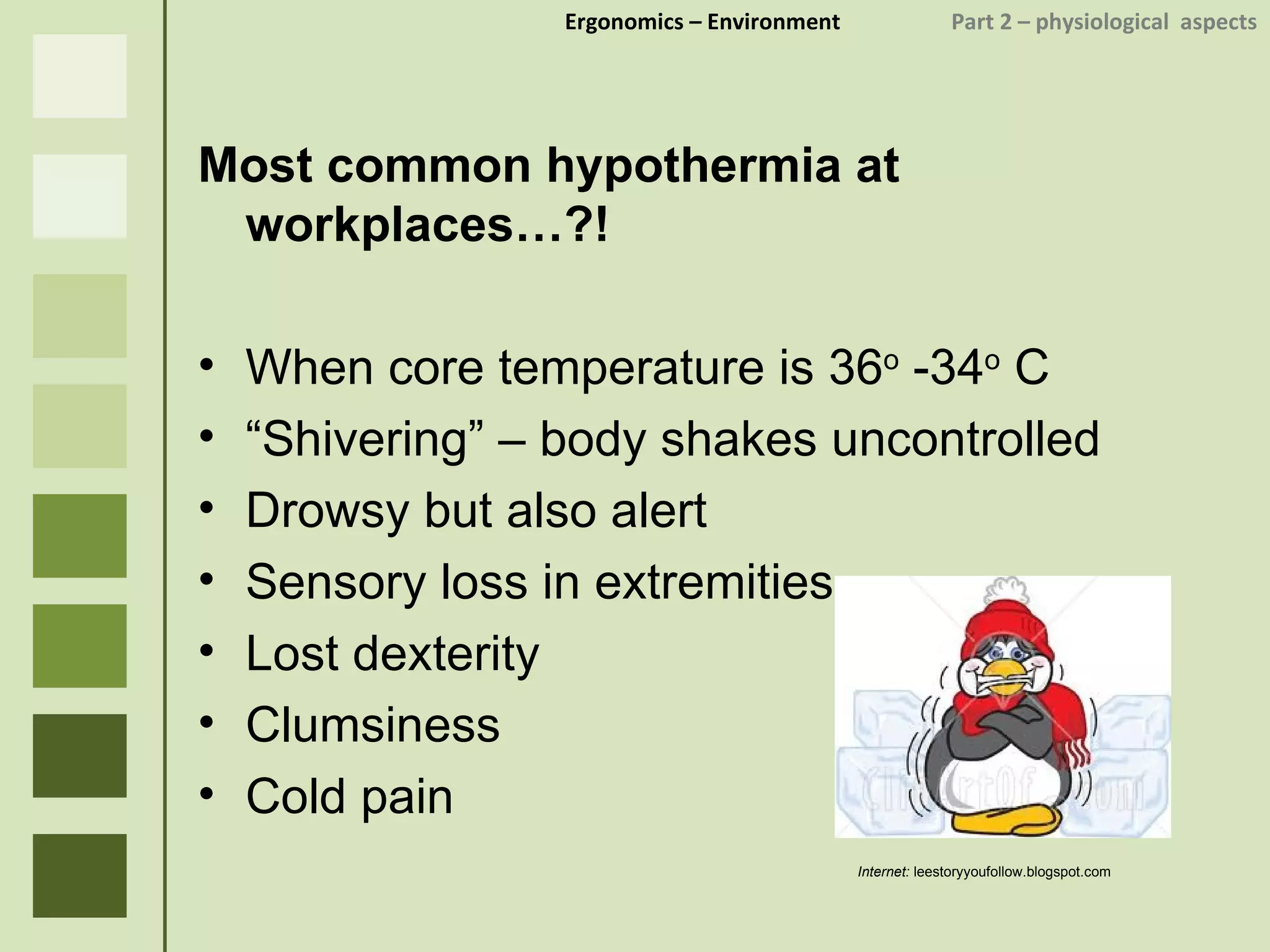
Ergonomics  – Environment    Part 2 –  physiological  aspects Most common hypothermia at workplaces…?! When core temperature is 36 o  -34 o  C “ Shivering” – body shakes uncontrolled Drowsy but also alert Sensory loss in extremities Lost dexterity Clumsiness Cold pain  Internet:  leestoryyoufollow.blogspot.com
Ergonomics  – Environment    Part 2 –  physiological  aspects Protection against hypothermia A warm cap Different layers of clothes Protect feet and hands Drink much fluid Slow the pace down during activities in cold
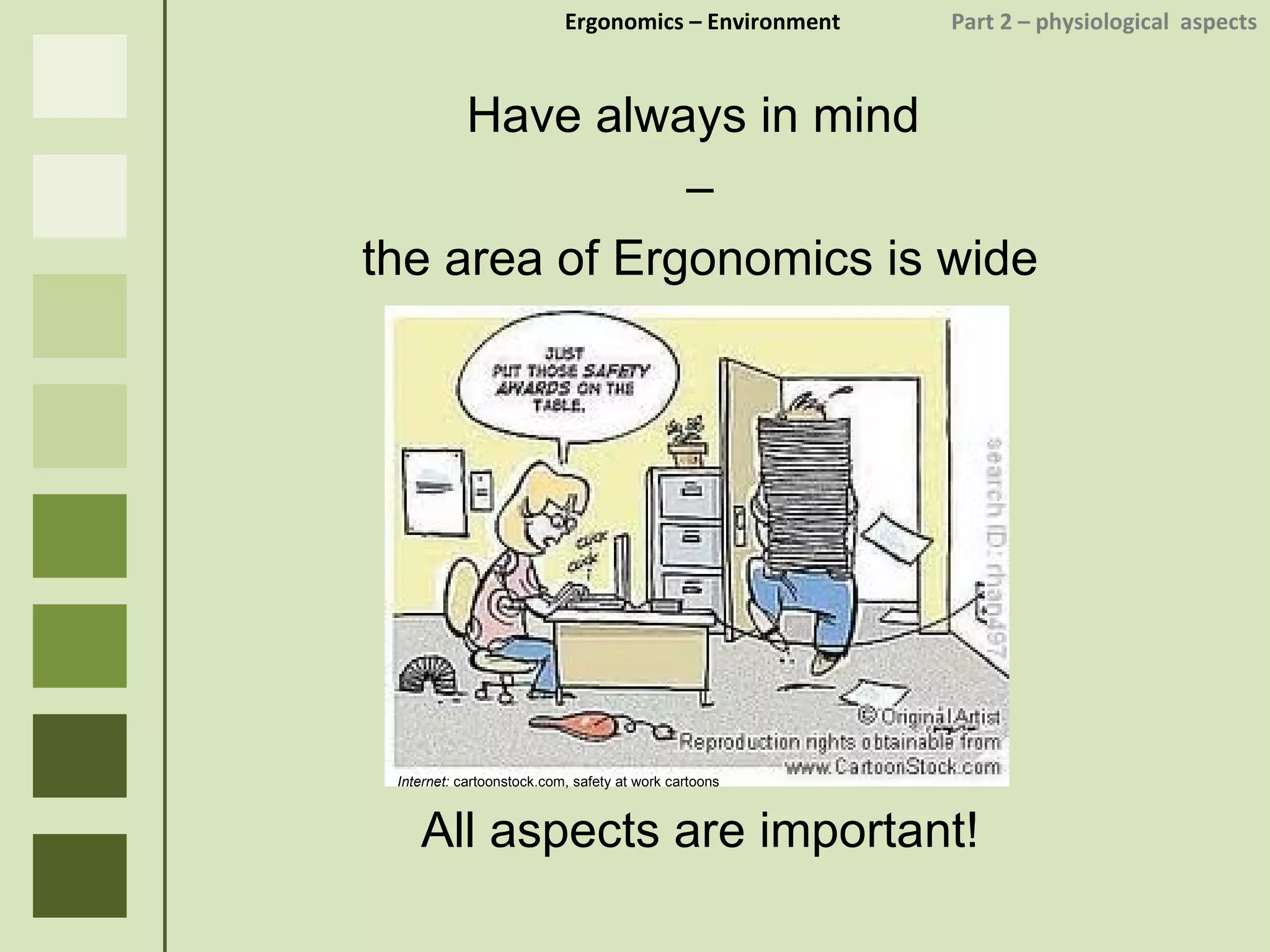
Ergonomics  – Environment    Part 2 –  physiological  aspects Have always in mind  – the area of Ergonomics is wide All aspects are important! Internet:  cartoonstock.com, safety at work cartoons

Ergonomics environment

  • 1.
    Ergonomics -Environment Part 2 – physiological aspects
  • 2.
    Ergonomics –Environment Part 2 – physiological aspects Ergonomics is so much more then just how we sit by the computer. The surrounding environment affects the work more then you think. Internet: clipartof.com Cartoon Computer Geek With A Messy Office
  • 3.
    Ergonomics –Environment Part 2 – physiological aspects Light Sound Vibrations Air Temperature These physiological subjects are very important for the human being in the work environment. All of the subjects above, affects persons in different ways. Some in a bad way and can lead to different sicknesses. This means– bad ergonomics
  • 4.
    Ergonomics –Environment Part 2 – physiological aspects Light Why is our sight unique? The eye can/have… Interpret different eye visions Color seeing Detail seeing Night vision Depth perception Contrast perception Internet: http://www.clker.com/clipart-23244.html
  • 5.
    Ergonomics –Environment Part 2 – physiological aspects The human eye is a fantastic ”construction”. With help from this sense it is possible to experience the surrounding environment. But the eyes are sensitive so it is important to “take care” of them. In our workplaces there is different things that you with knowledge of ergonomics should think extra about. Internet: healthy-ojas.com Eye vision & eye sight. Light reflects off an object enters the eye.
  • 6.
    Ergonomics –Environment Part 2 – physiological aspects Affects the environment Computer work Dry eyes Head ache ” Vulture neck” Industrial work with many particles in the air Dry office air Air-condition Smoking Fumes etc.
  • 7.
    Ergonomics –Environment Part 2 – physiological aspects You have about 3600 eye movements/ h Things to think about at computer screen work Distance for the eye Screen settings Light settings
  • 8.
    Ergonomics –Environment Part 2 – physiological aspects Things to think about at computer screen work Distance for the eye Screen settings Light settings The size of the screen Space for documents Your arms Placing the screen at the right height Internet: picturesof.net A Colorful Cartoon of a Man Worried About His Smoking Computer Monitor …
  • 9.
    Ergonomics –Environment Part 2 – physiological aspects Things to think about at computer screen work Distance for the eye Screen settings Light settings Free from flicker Free from reflections and mirroring Clear text and contrast Light background and dark signs Easily be adjusted Good readability
  • 10.
    Ergonomics –Environment Part 2 – physiological aspects Things to think about at computer screen work Distance for the eye Screen settings Light settings Light-coloured room The light and the workplace should be coordinated Appropriate contrast between screen and surrounding environment Considering the worker’s need
  • 11.
    Ergonomics –Environment Part 2 – physiological aspects Ceiling lights It should be both up- and downward lightning Spotlighting If there is a need. Must be adjustable and should not dazzle Daylight Use it as much as possible. When working at a computer, let it come in from the side. There should always be a possibility to shield of from troublesome lighting Internet: 123rf.com Cartoon office worker busy on his laptop at his desk stock photography
  • 12.
    Ergonomics –Environment Part 2 – physiological aspects Dry Eyes Symptoms Internet: naturalypure.com Dry Eyes Natural Relief / Unique Oral Formula blurred vision ” watery” eyes light sensitivity ” burning” feeling itching What can be the reason? The air Strained eyes To long time in front of the screen What to do? Humidifier Lower the room temperature – lower the evaporation Eyeglasses Avoid putting your head forward, shaping a long “S” in the spine, “vulture neck”
  • 13.
    Ergonomics –Environment Part 2 – physiological aspects Glasses The employer is only paying for the glasses if your work requires special glasses Work goggles is a work tool, which belongs to the employer. But it is a labour law! If the private glasses are not enough for your tasks, the employer can help you. If there is a need of visual aids to help performing the work, the employer should provide this.
  • 14.
    Ergonomics –Environment Part 2 – physiological aspects Good advices regarding light/eye ergonomics! Good ventilation Not to hot or cold Screen position at least an arms length from the body The top half of the screen should be in eyes height. Let the eyes take a break from the screen every 15 minute, and focus on something further away during 1-2 minutes. (eye muscles relax) Blink quickly a few times to hydrate the eyes
  • 15.
    Ergonomics –Environment Part 2 – physiological aspects Sound The human body is affected by every type of sound. It is not always that we hear everything. Some sounds are always there but we do not notice them. What kind of sounds do you hear right now? Internet: toonpool.comCartoon: Sounds (medium) by deleuran tagged sound,noise,birds,workers
  • 16.
    Ergonomics –Environment Part 2 – physiological aspects Every day exposure Traffic Ventilation system Music Telephone Computer work Is there some sounds that is not mentioned ? Birds in the nature Disco, Concerts Neighbours Work colleagues
  • 17.
    Ergonomics –Environment Part 2 – physiological aspects Health affects Degraded hearing Ringing in the ears Sleep disorder Degraded learning capacity (Plausible –higher risk for heart diseases) Sensitive groups Children and youths Persons with already degraded hearing Elderly
  • 18.
    Ergonomics –Environment Part 2 – physiological aspects How do we prevent hearing disorders? It is the employers obligation to provide the workers with hearing protectors. This is often used at construction work. It is important to mention that hearing protectors is a temporary solution. The primary aim is to lower the total sound around noisy workplaces.
  • 19.
    Ergonomics –Environment Part 2 – physiological aspects How do we prevent hearing disorders? By using different fabrics and materials that can absorb sound. It is important to notice that the sound levels have increased in places that previous used to be quiet. Why do you think that is? Have you given it a thought at your workplace? Internet: rummuser.com
  • 20.
    Ergonomics –Environment Part 2 – physiological aspects Vibrations There is different definitions of vibrations Hand and arm Total body Sea sickness Internet: clipartguide.com Internet: dearrichblog.blogspot.com
  • 21.
    Ergonomics –Environment Part 2 – physiological aspects Hand and arm vibrations Energy to the body thru hand held tools Chainsaw, Drilling machine, Pneumatic tools Total Body Vibrations Energy to the body thru seat or floor Affect the whole body Truck-, Bus-, Tractor driver
  • 22.
    Ergonomics –Environment Part 2 – physiological aspects How much vibration exposure is needed before the human body is affected? This vary from person to person, how sensitive for vibrations they are. Depending on how long the body has been exposed to vibrations, the damages on the body vary.
  • 23.
    Ergonomics –Environment Part 2 – physiological aspects The affect on the human body Increased energy consumption Increased muscle activity Increased strain on discs If the muscles are fatigue, the vibrations increases and increase the strain on discs and can lead to back pain.
  • 24.
    Ergonomics –Environment Part 2 – physiological aspects To prevent some vibration exposure Use back support Some type of damping in the seat Use a material that absorb some of the vibration and does not transfer it to the body Have in mind that you can be exposed to secondary vibration. What is done to prevent that? Internet: offthemark.com Vibrating Cell Phone Spider Web
  • 25.
    Ergonomics –Environment Part 2 – physiological aspects Temperature Normal body temperature is around 36,2 o C (35,6 o - 37,8 o C) 34 o C or below – slow metabolism, degenerated heart activity 45 o C – dead Balance between heat- and lost production = constant body heat
  • 26.
    Ergonomics –Environment Part 2 – physiological aspects All tissues produces heat, this is because of all particles that are in motion produces kinetic energy which is generating heat. When you are resting, most heat is used in liver, heart and brain and the endocrine organs. When you are being physically active the muscles increase the heat production. When finished the activity, the heat production normalize but the heat loss keeps going until the balance is normalized.
  • 27.
    Ergonomics –Environment Part 2 – physiological aspects The human being has functions in the skin and inside the body that sense when to heat or cool down. When you are hot on the inside, the “hot” blood is going from inside the body out to the skin and cools down and then back again. “ Cold hands = warm heart ” The highest temperature in the body is in the head, chest and abdomen, the coldest is in fingers and feet. The external temperature can vary between 20 o C and 40 o C
  • 28.
    Ergonomics –Environment Part 2 – physiological aspects Temperature sensitivity is very varying Depends on Clothes Food Physical exertion Time of the year and day Body size Age, gender, habits The sensitivity is most distinct on women, children and elderly.
  • 29.
    Ergonomics –Environment Part 2 – physiological aspects Mechanisms for heat diversion Convection Air movement Conduction Contact with object (water, metal…) Radiation From body to air or air to body, sunbathing, cold room is heated by people Evaporation Breathing, excretion of sweat Depends on temperature and humidity, air movement around the body, amount of skin exposure
  • 30.
    Ergonomics –Environment Part 2 – physiological aspects Heat affects your work relaxes the work pace exhaustive Lower physical performance Increased numbers of mistakes and accidents
  • 31.
    Ergonomics –Environment Part 2 – physiological aspects How to prevent? Knowledge, attention Adequate hydration Adaption of behavior and physical activity Clothes Activity Condition Acclimatizing
  • 32.
    Ergonomics –Environment Part 2 – physiological aspects Cold Different factors Surrounding air temperature Body heat Air streams (wind) Body movement Exposure time
  • 33.
    Ergonomics –Environment Part 2 – physiological aspects Surrounding cold It is an increasing heat loss to the surroundings, when you are in a cold area. Muscular hypertonia, results in “shivering” and is the body's attempt to sustain body heat. When exposed to cold during a long period of time, the body loses energy faster then it can produce This can occur even with temperature over 0 o C
  • 34.
    Ergonomics –Environment Part 2 – physiological aspects Hypothermia = the core temperature is below 35 o C There is different levels of hypothermia Light: 35 o -32 o C Medium: 32 o -28 o C Severe: below 28 o C Notice that cold kills in 2 steps Exposure Cold Wind Exhaustion
  • 35.
    Ergonomics –Environment Part 2 – physiological aspects Symptoms of hypothermia Sensory lost, rigidity, bad coordination, drowsiness Slow and irregular breathing and pulse Slurred speech Cold skin, facial swelling is normal
  • 36.
    Ergonomics –Environment Part 2 – physiological aspects Most common hypothermia at workplaces…?! When core temperature is 36 o -34 o C “ Shivering” – body shakes uncontrolled Drowsy but also alert Sensory loss in extremities Lost dexterity Clumsiness Cold pain Internet: leestoryyoufollow.blogspot.com
  • 37.
    Ergonomics –Environment Part 2 – physiological aspects Protection against hypothermia A warm cap Different layers of clothes Protect feet and hands Drink much fluid Slow the pace down during activities in cold
  • 38.
    Ergonomics –Environment Part 2 – physiological aspects Have always in mind – the area of Ergonomics is wide All aspects are important! Internet: cartoonstock.com, safety at work cartoons