Open Research in the New
    Zealand Context
   The workshop will attempt to explore the
meaning of ‘Open Research’ in the New Zealand
   context. It will explore the views of those
   attending the workshop on the value and
 feasability of Open Research in New Zealand.

    New Zealand eResearch Symposium,
         Wellington, July 4 2012

                  This work is licensed under a Creative Commons
                  Attribution 3.0 New Zealand License.
Overall Questions
• What is Open Research and if we want it how do we get
  there?
• How do we move from the list of principles to a list of
  actionable tasks?
• What are the main themes that should be included in a
  document to be presented to relevant stakeholders (i.e.
  institutions, funding agencies, etc.) to promote/incentivise
  adoption?
• Who should write that document? Who should endorse it?
• What should the purpose of the document be how does
  understanding this shape the format of the document?
Stage 1
Go into groups and come back with
3 opportunities which would enable
NZ research to be more….
Opportunities
•   Single data space (computational ready data and infrastructure to store data and a
    single integrated virtual collaboration research space built into that infrastructure)
    -> Reference to Earthcube (http://earthcube.ning.com/)
•   Human space – researchers linkage: at the levels of researcher-researcher
    (identify/discover expertise) and researcher-public
•   More research by more people and accessible to the world
•   Shift in culture – sharing as default
•   NZ as model for weightless economy – defeat the tyranny of distance.
•   Share NZ research data across agencies
•   Make NZ data more accessible and exciting to the world
•   Galvanise more support for nz data and opportunities
•   Tell better science stories
•   Open framework for knowledge – opening stuff up is half the process
•   Collective intelligence building eureka – move away from the lonely dude in the
    bathtub
•   Communities – build them don’t discourage them
•   Knowledge not just data
Stage 2
Identify the 3 more critical barriers to changing
and improving on the assigned topic.
  Topics to discuss:
  – Infrastructure
  – Communities
  – Collaboration
  – Culture
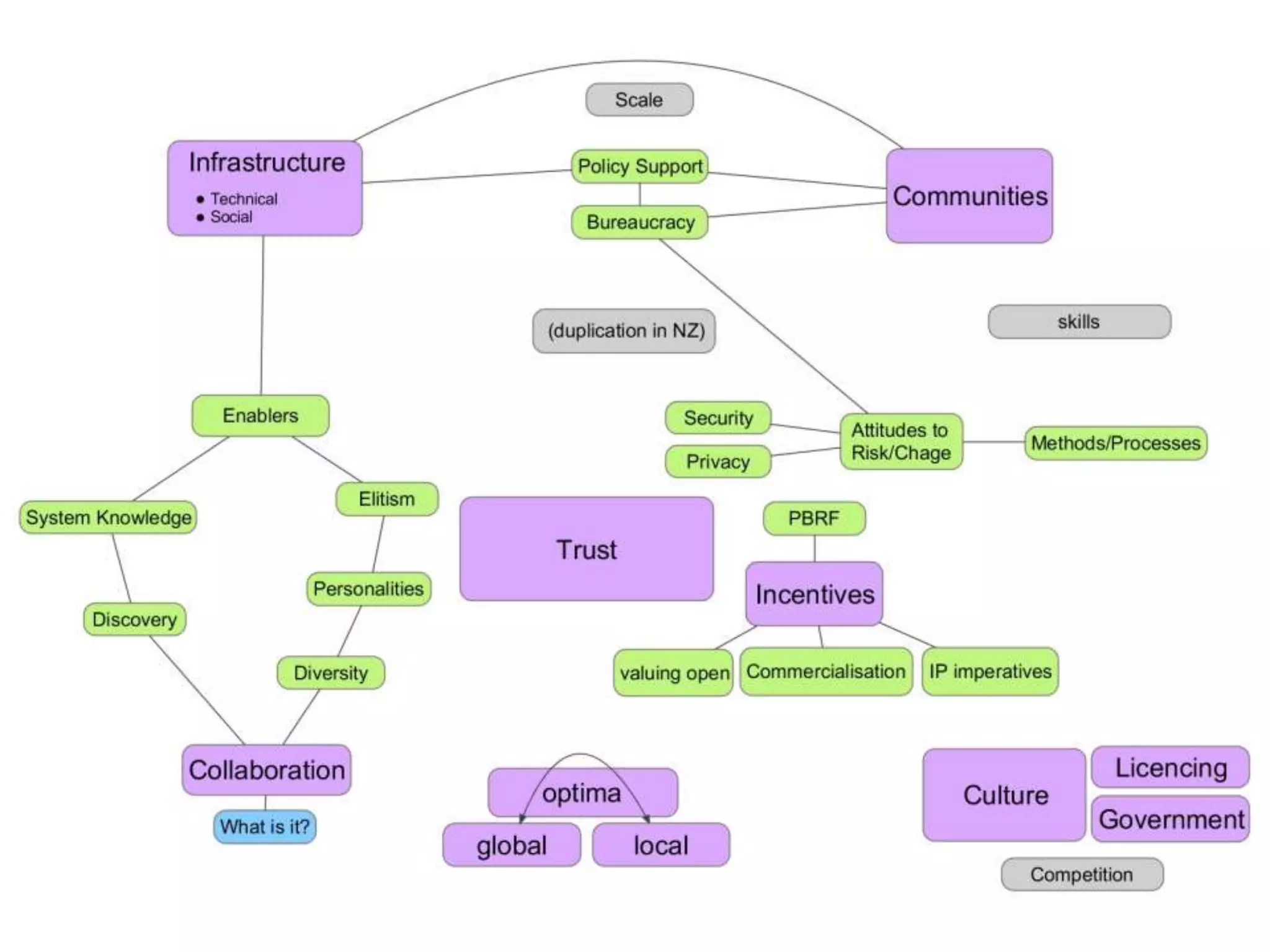
Opportunity 1: Infrastructure
 Identify the 3 main challenges or hurdles associated
                with your opportunity
Challenges
• University support of infrastructure – do we know what we have, and
  what we need to build for what we need to do or are we just adding stuff
• Governance over infrastructure – Who makes the decision, who has
  ownership (or feels ownership)
• Institutional infrastructure – does it meet the needs of the people. Or
  after investing do we need to buy more to fit individual needs
• Research is built around great ideas – but need the wheels to keep it
  moving
• Competition and siloed ownership of data – hard to build infrastructure as
  a one size fits all. How do we manage shared and unshared environments?
  -> culture comes in here too
• Trained professionals to support. People don’t know what they don’t
  know. Need to provide a HR element to infrastructure to bridge the
  software and hardware and make it meaningful to researchers
Opportunity 2: Communities
 Identify the 3 main challenges or hurdles associated
                with your opportunity
Challenges
• Bureaucracy and all of its levels and embedded inertia
• Context of NZ being a small country and too much duplication
  creating more bureaucracy
• Lack of enablers: (e.g., elitism, money, space, vision, etc)
• Rules for doing science: Conservative ideals and culture and
  policies and settings do not facilitate collaboration.
• Lack of diversity
• Value placed on how to build and sustain communities
• *Recommended reading: The art of Community
Opportunity 3 : Collaboration
 Identify the 3 main challenges or hurdles associated
                with your opportunity
Challenges:
• Collaboration in terms of who is collaborating with whom – it is an
  opportunity but might not be followed through
• $ not identified as a challenge
• Knowledge gap: Need to introduce the right hand to the left hand
• Gap in NZ between businesses and research organisations: Failure to
  identify opportunities due to lack of knowledge
• Commercialisation: When it is the goal of everything you do then you
  loose the opportunity to make something that will enable something else
  but that might not be a goal in itself
• Personalities: You can have the $, the policy, the ethics and all the
  cake, but you can still come across human interaction-level barriers
• Methodology alignment between collaborating groups
• Need to think of the difference between collaboration vs cooperation.
Opportunity 4: Culture
 Identify the 3 main challenges or hurdles associated
                with your opportunity
Challenges:
• Risk: Researchers are change averse/ Institutions pay the cost for
  change/ Cost of Open Access/ Data security and privacy
• PBRF and other metrics of performance
• IP imperatives
• Value of open research vs. traditional research -> What is the return
  and how do you measure it?
• Incentives and leadership
• Who carries the burden of cost?
• Continuity…..
• Demographics – different generations have different attitudes
• Fragmentation
• Thinking and attitudes
Go have coffee and moan
Harass the person who is your biggest hurdle (if
they are in the room) and get a better sense of
why they don’t do things the way you want
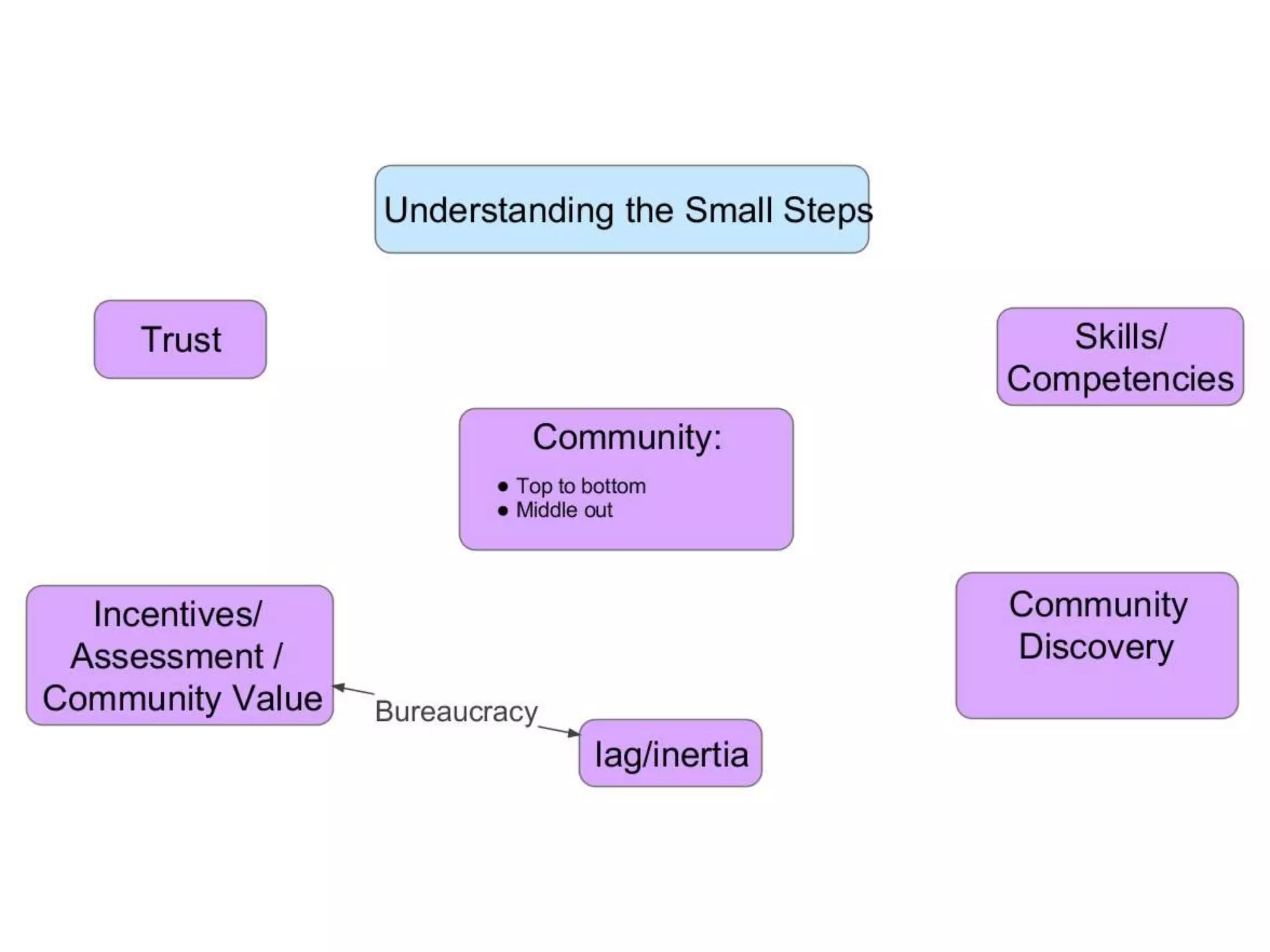
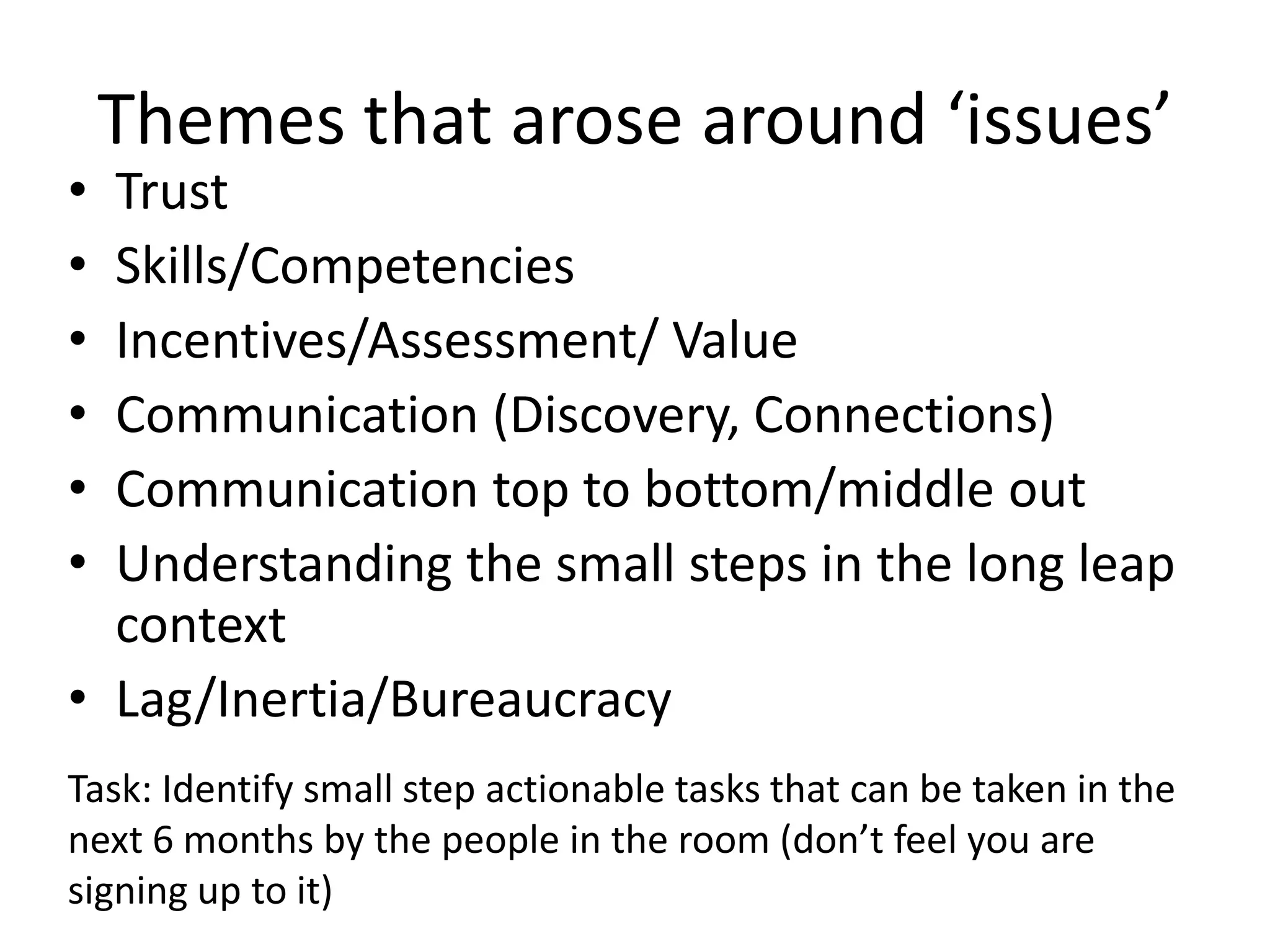
Themes that arose around ‘issues’
• Trust
• Skills/Competencies
• Incentives/Assessment/ Value
• Communication (Discovery, Connections)
• Communication top to bottom/middle out
• Understanding the small steps in the long leap
  context
• Lag/Inertia/Bureaucracy
Task: Identify small step actionable tasks that can be taken in the
next 6 months by the people in the room (don’t feel you are
signing up to it)
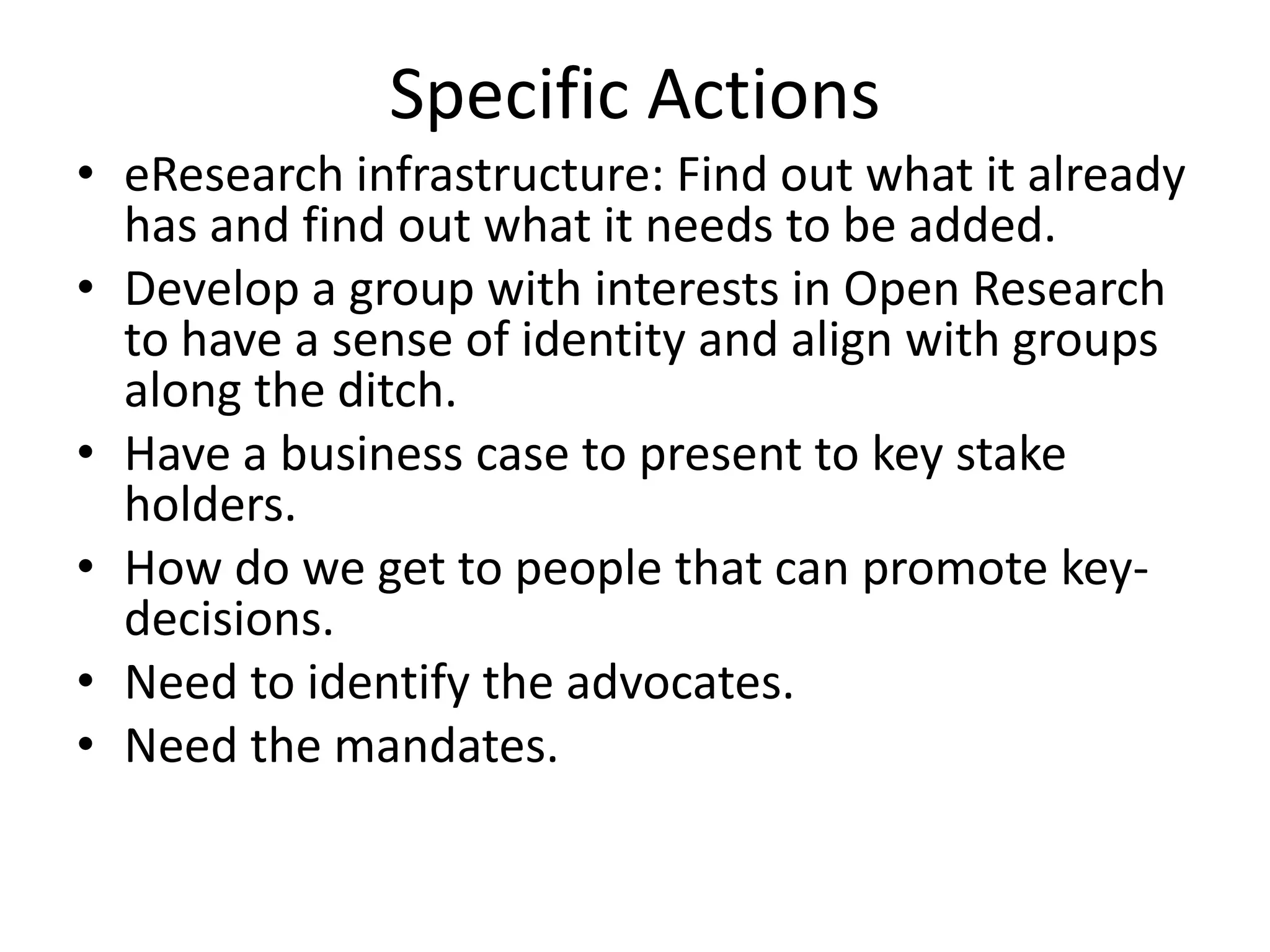
Specific Actions
• eResearch infrastructure: Find out what it already
  has and find out what it needs to be added.
• Develop a group with interests in Open Research
  to have a sense of identity and align with groups
  along the ditch.
• Have a business case to present to key stake
  holders.
• How do we get to people that can promote key-
  decisions.
• Need to identify the advocates.
• Need the mandates.
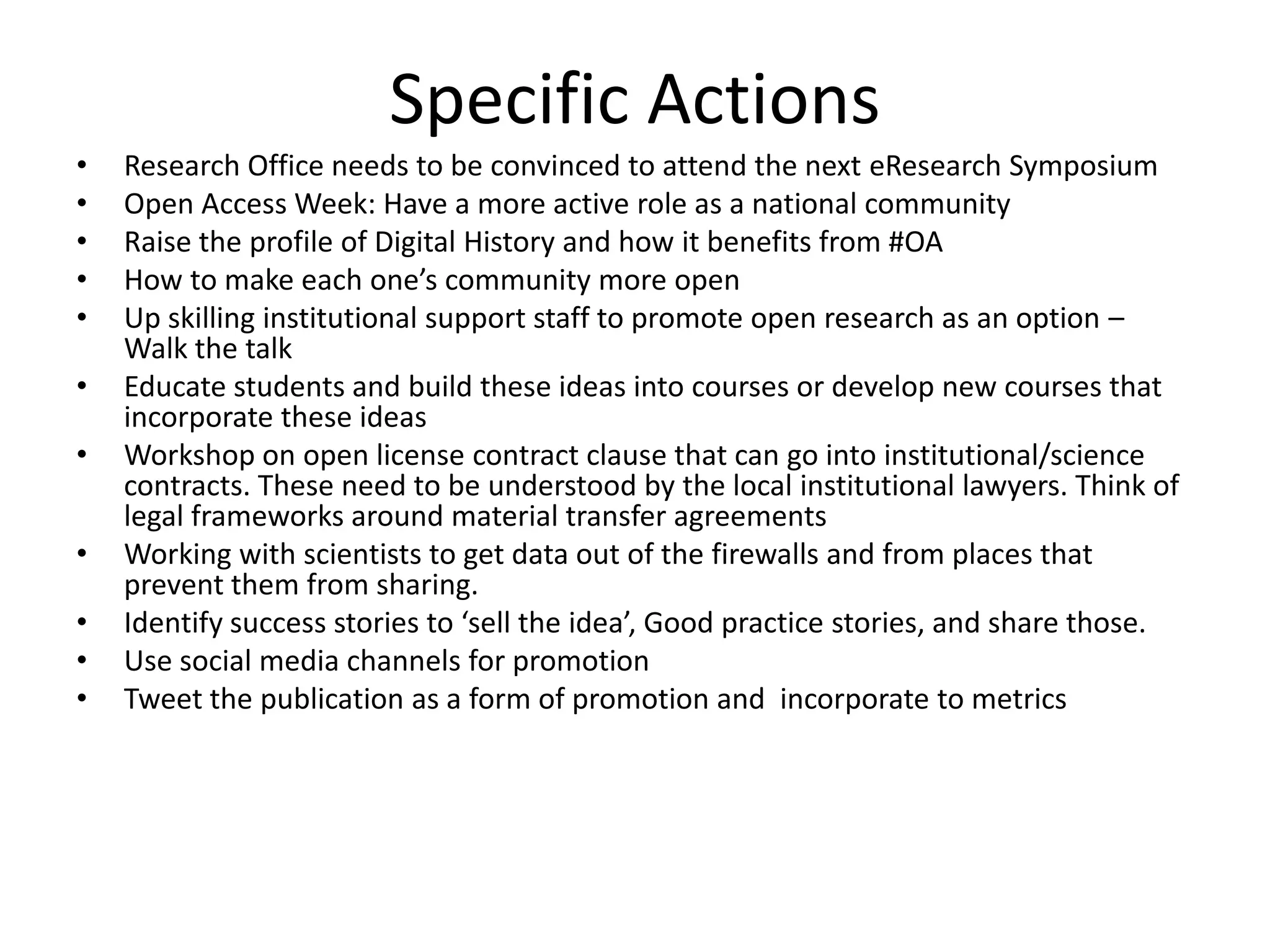
Specific Actions
•   Research Office needs to be convinced to attend the next eResearch Symposium
•   Open Access Week: Have a more active role as a national community
•   Raise the profile of Digital History and how it benefits from #OA
•   How to make each one’s community more open
•   Up skilling institutional support staff to promote open research as an option –
    Walk the talk
•   Educate students and build these ideas into courses or develop new courses that
    incorporate these ideas
•   Workshop on open license contract clause that can go into institutional/science
    contracts. These need to be understood by the local institutional lawyers. Think of
    legal frameworks around material transfer agreements
•   Working with scientists to get data out of the firewalls and from places that
    prevent them from sharing.
•   Identify success stories to ‘sell the idea’, Good practice stories, and share those.
•   Use social media channels for promotion
•   Tweet the publication as a form of promotion and incorporate to metrics
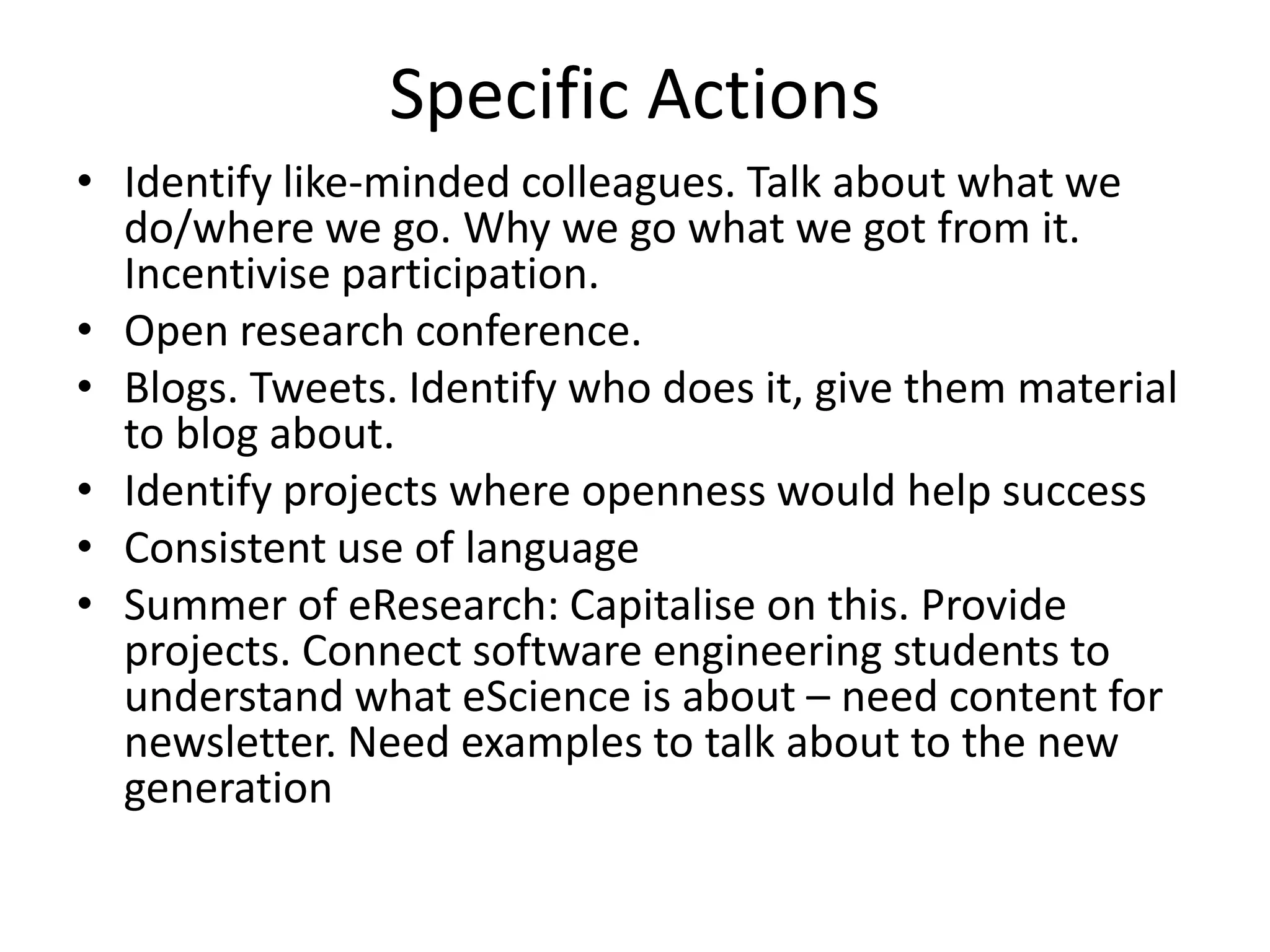
Specific Actions
• Identify like-minded colleagues. Talk about what we
  do/where we go. Why we go what we got from it.
  Incentivise participation.
• Open research conference.
• Blogs. Tweets. Identify who does it, give them material
  to blog about.
• Identify projects where openness would help success
• Consistent use of language
• Summer of eResearch: Capitalise on this. Provide
  projects. Connect software engineering students to
  understand what eScience is about – need content for
  newsletter. Need examples to talk about to the new
  generation
Specific Actions
• Networking – what are the different
  organisations doing? Lets not duplicate efforts
  but rather work together.
• Think of networking those promoting
  adoption at a national level. Need to be
  transparent within our own community
• Need high speed access and endless storage
• Otago has a series of seminars around Open
  Access that will be shared.
Wrapup
•   Build a network that includes key people
•   Build a network that provides identity
•   Share resources
•   Facilitate communication channels
•   Try to understand more what the gaps and
    needs are in the regional and national space
Overall Questions
• What is Open Research and if we want it how do we get
  there?
• How do we move from the list of principles to a list of
  actionable tasks?
• What are the main themes that should be included in a
  document to be presented to relevant stakeholders (i.e.
  institutions, funding agencies, etc.) to promote/incentivise
  adoption?
• Who should write that document? Who should endorse it?
• What should the purpose of the document be how does
  understanding this shape the format of the document?
Shameless Plugs (aka opportunities)
• Creative Commons ANZ – Discussion as part of NetHui. We will talk
  about Open Access and OERs.
• CatalystIT Open Source Awards. Awards Gala I 7 November. There is
  a category on Open Science -> Go nominate someone!
• NZ AU Open Research Conference
• National Digital Forum 20-23 November. Mix and Mash.
  Humanities and Technology Camp.
• Archives Conference August in Brisbane
• Open Access Week October University of Auckland with guest
  speaker Alex Holcobe
• eResearch Australia October 28 Nov 1 Sydney. It is the kickoff of
  Australasia EarthCube with Cliff Jacobs
• Open Access Conference in South Africa.
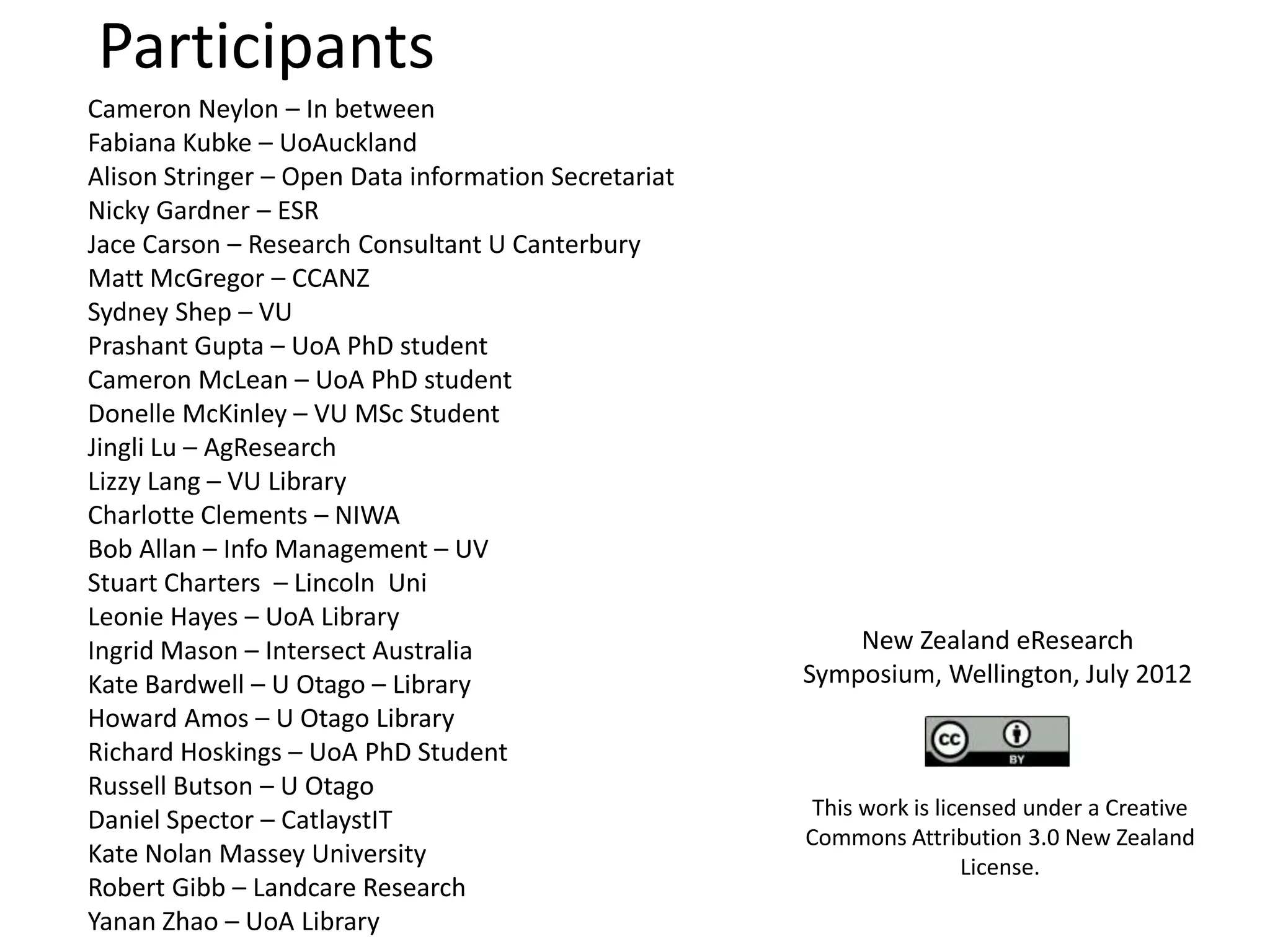
Participants
Cameron Neylon – In between
Fabiana Kubke – UoAuckland
Alison Stringer – Open Data information Secretariat
Nicky Gardner – ESR
Jace Carson – Research Consultant U Canterbury
Matt McGregor – CCANZ
Sydney Shep – VU
Prashant Gupta – UoA PhD student
Cameron McLean – UoA PhD student
Donelle McKinley – VU MSc Student
Jingli Lu – AgResearch
Lizzy Lang – VU Library
Charlotte Clements – NIWA
Bob Allan – Info Management – UV
Stuart Charters – Lincoln Uni
Leonie Hayes – UoA Library
Ingrid Mason – Intersect Australia                        New Zealand eResearch
Kate Bardwell – U Otago – Library                     Symposium, Wellington, July 2012
Howard Amos – U Otago Library
Richard Hoskings – UoA PhD Student
Russell Butson – U Otago
                                                       This work is licensed under a Creative
Daniel Spector – CatlaystIT
                                                      Commons Attribution 3.0 New Zealand
Kate Nolan Massey University                                           License.
Robert Gibb – Landcare Research
Yanan Zhao – UoA Library

eReearch Symposium workshop on Open Research

  • 1.
    Open Research inthe New Zealand Context The workshop will attempt to explore the meaning of ‘Open Research’ in the New Zealand context. It will explore the views of those attending the workshop on the value and feasability of Open Research in New Zealand. New Zealand eResearch Symposium, Wellington, July 4 2012 This work is licensed under a Creative Commons Attribution 3.0 New Zealand License.
  • 2.
    Overall Questions • Whatis Open Research and if we want it how do we get there? • How do we move from the list of principles to a list of actionable tasks? • What are the main themes that should be included in a document to be presented to relevant stakeholders (i.e. institutions, funding agencies, etc.) to promote/incentivise adoption? • Who should write that document? Who should endorse it? • What should the purpose of the document be how does understanding this shape the format of the document?
  • 3.
    Stage 1 Go intogroups and come back with 3 opportunities which would enable NZ research to be more….
  • 4.
    Opportunities • Single data space (computational ready data and infrastructure to store data and a single integrated virtual collaboration research space built into that infrastructure) -> Reference to Earthcube (http://earthcube.ning.com/) • Human space – researchers linkage: at the levels of researcher-researcher (identify/discover expertise) and researcher-public • More research by more people and accessible to the world • Shift in culture – sharing as default • NZ as model for weightless economy – defeat the tyranny of distance. • Share NZ research data across agencies • Make NZ data more accessible and exciting to the world • Galvanise more support for nz data and opportunities • Tell better science stories • Open framework for knowledge – opening stuff up is half the process • Collective intelligence building eureka – move away from the lonely dude in the bathtub • Communities – build them don’t discourage them • Knowledge not just data
  • 6.
    Stage 2 Identify the3 more critical barriers to changing and improving on the assigned topic. Topics to discuss: – Infrastructure – Communities – Collaboration – Culture
  • 8.
    Opportunity 1: Infrastructure Identify the 3 main challenges or hurdles associated with your opportunity Challenges • University support of infrastructure – do we know what we have, and what we need to build for what we need to do or are we just adding stuff • Governance over infrastructure – Who makes the decision, who has ownership (or feels ownership) • Institutional infrastructure – does it meet the needs of the people. Or after investing do we need to buy more to fit individual needs • Research is built around great ideas – but need the wheels to keep it moving • Competition and siloed ownership of data – hard to build infrastructure as a one size fits all. How do we manage shared and unshared environments? -> culture comes in here too • Trained professionals to support. People don’t know what they don’t know. Need to provide a HR element to infrastructure to bridge the software and hardware and make it meaningful to researchers
  • 9.
    Opportunity 2: Communities Identify the 3 main challenges or hurdles associated with your opportunity Challenges • Bureaucracy and all of its levels and embedded inertia • Context of NZ being a small country and too much duplication creating more bureaucracy • Lack of enablers: (e.g., elitism, money, space, vision, etc) • Rules for doing science: Conservative ideals and culture and policies and settings do not facilitate collaboration. • Lack of diversity • Value placed on how to build and sustain communities • *Recommended reading: The art of Community
  • 10.
    Opportunity 3 :Collaboration Identify the 3 main challenges or hurdles associated with your opportunity Challenges: • Collaboration in terms of who is collaborating with whom – it is an opportunity but might not be followed through • $ not identified as a challenge • Knowledge gap: Need to introduce the right hand to the left hand • Gap in NZ between businesses and research organisations: Failure to identify opportunities due to lack of knowledge • Commercialisation: When it is the goal of everything you do then you loose the opportunity to make something that will enable something else but that might not be a goal in itself • Personalities: You can have the $, the policy, the ethics and all the cake, but you can still come across human interaction-level barriers • Methodology alignment between collaborating groups • Need to think of the difference between collaboration vs cooperation.
  • 11.
    Opportunity 4: Culture Identify the 3 main challenges or hurdles associated with your opportunity Challenges: • Risk: Researchers are change averse/ Institutions pay the cost for change/ Cost of Open Access/ Data security and privacy • PBRF and other metrics of performance • IP imperatives • Value of open research vs. traditional research -> What is the return and how do you measure it? • Incentives and leadership • Who carries the burden of cost? • Continuity….. • Demographics – different generations have different attitudes • Fragmentation • Thinking and attitudes
  • 12.
    Go have coffeeand moan Harass the person who is your biggest hurdle (if they are in the room) and get a better sense of why they don’t do things the way you want
  • 13.
    Themes that arosearound ‘issues’ • Trust • Skills/Competencies • Incentives/Assessment/ Value • Communication (Discovery, Connections) • Communication top to bottom/middle out • Understanding the small steps in the long leap context • Lag/Inertia/Bureaucracy Task: Identify small step actionable tasks that can be taken in the next 6 months by the people in the room (don’t feel you are signing up to it)
  • 14.
    Specific Actions • eResearchinfrastructure: Find out what it already has and find out what it needs to be added. • Develop a group with interests in Open Research to have a sense of identity and align with groups along the ditch. • Have a business case to present to key stake holders. • How do we get to people that can promote key- decisions. • Need to identify the advocates. • Need the mandates.
  • 15.
    Specific Actions • Research Office needs to be convinced to attend the next eResearch Symposium • Open Access Week: Have a more active role as a national community • Raise the profile of Digital History and how it benefits from #OA • How to make each one’s community more open • Up skilling institutional support staff to promote open research as an option – Walk the talk • Educate students and build these ideas into courses or develop new courses that incorporate these ideas • Workshop on open license contract clause that can go into institutional/science contracts. These need to be understood by the local institutional lawyers. Think of legal frameworks around material transfer agreements • Working with scientists to get data out of the firewalls and from places that prevent them from sharing. • Identify success stories to ‘sell the idea’, Good practice stories, and share those. • Use social media channels for promotion • Tweet the publication as a form of promotion and incorporate to metrics
  • 16.
    Specific Actions • Identifylike-minded colleagues. Talk about what we do/where we go. Why we go what we got from it. Incentivise participation. • Open research conference. • Blogs. Tweets. Identify who does it, give them material to blog about. • Identify projects where openness would help success • Consistent use of language • Summer of eResearch: Capitalise on this. Provide projects. Connect software engineering students to understand what eScience is about – need content for newsletter. Need examples to talk about to the new generation
  • 17.
    Specific Actions • Networking– what are the different organisations doing? Lets not duplicate efforts but rather work together. • Think of networking those promoting adoption at a national level. Need to be transparent within our own community • Need high speed access and endless storage • Otago has a series of seminars around Open Access that will be shared.
  • 18.
    Wrapup • Build a network that includes key people • Build a network that provides identity • Share resources • Facilitate communication channels • Try to understand more what the gaps and needs are in the regional and national space
  • 19.
    Overall Questions • Whatis Open Research and if we want it how do we get there? • How do we move from the list of principles to a list of actionable tasks? • What are the main themes that should be included in a document to be presented to relevant stakeholders (i.e. institutions, funding agencies, etc.) to promote/incentivise adoption? • Who should write that document? Who should endorse it? • What should the purpose of the document be how does understanding this shape the format of the document?
  • 20.
    Shameless Plugs (akaopportunities) • Creative Commons ANZ – Discussion as part of NetHui. We will talk about Open Access and OERs. • CatalystIT Open Source Awards. Awards Gala I 7 November. There is a category on Open Science -> Go nominate someone! • NZ AU Open Research Conference • National Digital Forum 20-23 November. Mix and Mash. Humanities and Technology Camp. • Archives Conference August in Brisbane • Open Access Week October University of Auckland with guest speaker Alex Holcobe • eResearch Australia October 28 Nov 1 Sydney. It is the kickoff of Australasia EarthCube with Cliff Jacobs • Open Access Conference in South Africa.
  • 21.
    Participants Cameron Neylon –In between Fabiana Kubke – UoAuckland Alison Stringer – Open Data information Secretariat Nicky Gardner – ESR Jace Carson – Research Consultant U Canterbury Matt McGregor – CCANZ Sydney Shep – VU Prashant Gupta – UoA PhD student Cameron McLean – UoA PhD student Donelle McKinley – VU MSc Student Jingli Lu – AgResearch Lizzy Lang – VU Library Charlotte Clements – NIWA Bob Allan – Info Management – UV Stuart Charters – Lincoln Uni Leonie Hayes – UoA Library Ingrid Mason – Intersect Australia New Zealand eResearch Kate Bardwell – U Otago – Library Symposium, Wellington, July 2012 Howard Amos – U Otago Library Richard Hoskings – UoA PhD Student Russell Butson – U Otago This work is licensed under a Creative Daniel Spector – CatlaystIT Commons Attribution 3.0 New Zealand Kate Nolan Massey University License. Robert Gibb – Landcare Research Yanan Zhao – UoA Library