Open Science Process
Open Science Course, University of Jyväskylä 14.11.2016
Jessica Parland-von Essen
License: Ministry of Education and Culture, CC BY 4.0
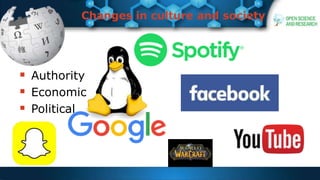
Changes in culture and society
 Authority
 Economic
 Political
Changes in Communication
 Media Convergence
 Publish first, filter then
 Amount
 Sustainability
By me (mine) [Public domain], via Wikimedia Commons
Publishing
 Digitization has driven prices up
 In Finland 51% of costs in Soc&Hum-journals
go to the five big international publishers
 Total cost over last 5 years 60 million euros
Open Science & Open Access
 Copyright in Finland applied to all works
 No one can make copies or develop a work
unless it’s licensed by all copyright holders
 Licensing can be used to give different rights
 For research data CC0 and CC-BY 4.0 are
recommended in Finland
 The more you give the further you reach
Open Science
Open Science is the practice of science in such a way that
others can collaborate and contribute, where research data,
lab notes and other research processes are freely available,
under terms that enable reuse, redistribution and reproduction
of the research and its underlying data and methods.
FOSTER
https://www.fosteropenscience.eu/foster-taxonomy/open-science-definition
What are the societal benefits of open access to
research publications and other results?
 Increasing the quality of science
 Developing new ways for collaboration
 Increasing impact of science
 Increasing the innovation capacity
 Supporting life-long learning
 Ensuring trust in science and research
 Developing citizen science
What are the benefits for the researcher?
 Better impact and visibility
 Complying to funders and employers policies
 Stronger networks
 More efficient work
 Future access to own materials
 Better and more sustainable science
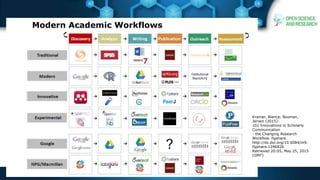
Kramer, Bianca; Bosman,
Jeroen (2015):
101 Innovations in Scholarly
Communication
- the Changing Research
Workflow. figshare.
http://dx.doi.org/10.6084/m9.
figshare.1286826
Retrieved 20:05, May 25, 2015
(GMT)
Modern Academic Workflows
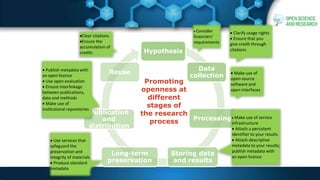
Hypothesis
Data
collection
Processing
Storing data
and results
Long-term
preservation
Publication
and
distribution
Reuse Publish metadata with
an open licence
 Use open evaluation
 Ensure interlinkage
between publications,
data and methods
 Make use of
institutional repositories
Promoting
openness at
different
stages of
the research
process
 Consider
financiers'
requirements
 Clarify usage rights
 Ensure that you
give credit through
citations
 Make use of
open-source
software and
open interfaces
 Make use of service
infrastructure
 Attach a persistent
identifier to your results
 Attach descriptive
metadata to your results;
publish metadata with
an open licence
 Use services that
safeguard the
preservation and
integrity of materials
 Produce standard
metadata
Clear citations
Ensure the
accumulation of
credits
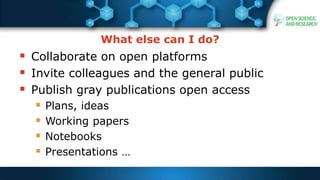
What else can I do?
 Collaborate on open platforms
 Invite colleagues and the general public
 Publish gray publications open access
 Plans, ideas
 Working papers
 Notebooks
 Presentations …
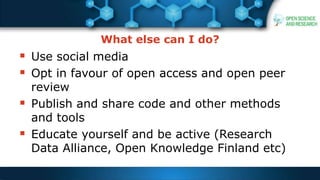
What else can I do?
 Use social media
 Opt in favour of open access and open peer
review
 Publish and share code and other methods
and tools
 Educate yourself and be active (Research
Data Alliance, Open Knowledge Finland etc)
101 Innovations in Scholarly Communication
Jeroen Bosman & Bianca Kramer
 https://figshare.com/articles/101_Innovations_in_Scholarly_Communication_the_Changing_Resear
ch_Workflow/1286826
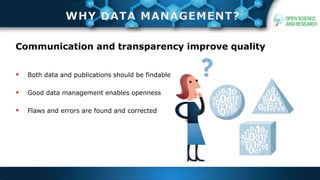
Communication and transparency improve quality
 Both data and publications should be findable
 Good data management enables openness
 Flaws and errors are found and corrected
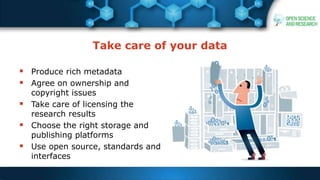
Take care of your data
 Produce rich metadata
 Agree on ownership and
copyright issues
 Take care of licensing the
research results
 Choose the right storage and
publishing platforms
 Use open source, standards and
interfaces
GOOD DATA MANAGEMENT
ENSURES
INTEGRITY AND REPRODUCIBILITY
THINGS TO CONSIDER
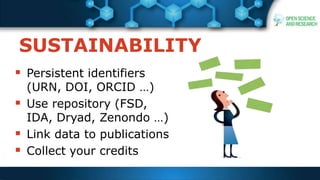
 Persistent identifiers
(URN, DOI, ORCID …)
 Use repository (FSD,
IDA, Dryad, Zenondo …)
 Link data to publications
 Collect your credits
SUSTAINABILITY
THINGS TO CONSIDER
PLANNING
http://www.fsd.uta.fi/tiedonhallinta/
http://www.fsd.uta.fi/en/data_management_planning/
Finnish Social Science Data Archive
Finnish Data Management Guide
https://www.tdata.fi/tutkimusdatan-hallinta
Avoimen tieteen käsikirja
http://avointiede.fi/www-kasikirja
THINGS TO CONSIDER
 How the data has been created
(primary, secondary)
 Facts about instruments
 Code books and other information
about variables
 Standard Operating Procedures
 Detailed instructions, workflow etc
 Used standards and vocabularies
DOCUMENTATION
THINGS TO CONSIDER
LAWS &
RESTRICTIONS
Copyright
Personal integrity
Commercial data
Funder’s requirements
Policies of organization
Contracts
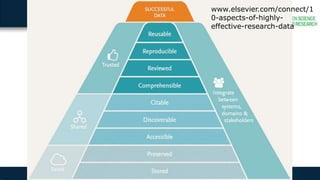
www.elsevier.com/connect/1
0-aspects-of-highly-
effective-research-data
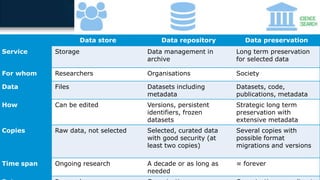
Data store Data repository Data preservation
Service Storage Data management in
archive
Long term preservation
for selected data
For whom Researchers Organisations Society
Data Files Datasets including
metadata
Datasets, code,
publications, metadata
How Can be edited Versions, persistent
identifiers, frozen
datasets
Strategic long term
preservation with
extensive metadata
Copies Raw data, not selected Selected, curated data
with good security (at
least two copies)
Several copies with
possible format
migrations and versions
Time span Ongoing research A decade or as long as
needed
≈ forever
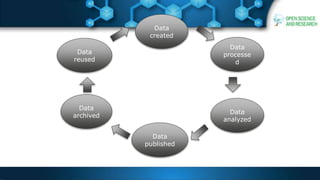
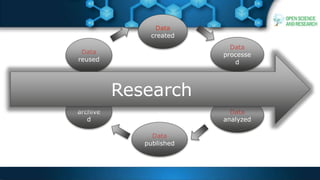
Data
created
Data
archived
Data
reused
Data
published
Data
analyzed
Data
processe
d
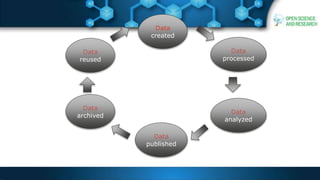
Data
created
Data
archived
Data
reused
Data
published
Data
analyzed
Data
processed
Data
created
Data
archive
d
Data
reused
Data
published
Data
analyzed
Data
processe
d
Research
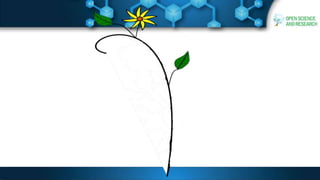
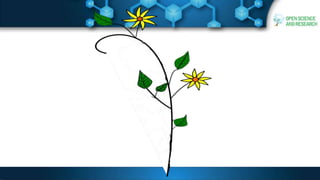
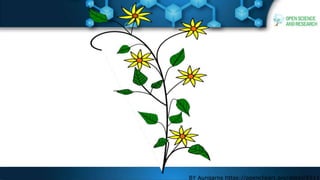
BY Aungarns https://openclipart.org/detail/65119
Credit
Illustrations by Jørgen Stamp
Published on www.digitalbevaring.dk
Licensed under CC BY 2.5 DK
Modified by OKM/ATT

Open Science Process

  • 1.
    Open Science Process OpenScience Course, University of Jyväskylä 14.11.2016 Jessica Parland-von Essen License: Ministry of Education and Culture, CC BY 4.0
  • 2.
    Changes in cultureand society  Authority  Economic  Political
  • 3.
    Changes in Communication Media Convergence  Publish first, filter then  Amount  Sustainability By me (mine) [Public domain], via Wikimedia Commons
  • 4.
    Publishing  Digitization hasdriven prices up  In Finland 51% of costs in Soc&Hum-journals go to the five big international publishers  Total cost over last 5 years 60 million euros
  • 6.
    Open Science &Open Access  Copyright in Finland applied to all works  No one can make copies or develop a work unless it’s licensed by all copyright holders  Licensing can be used to give different rights  For research data CC0 and CC-BY 4.0 are recommended in Finland  The more you give the further you reach
  • 7.
    Open Science Open Scienceis the practice of science in such a way that others can collaborate and contribute, where research data, lab notes and other research processes are freely available, under terms that enable reuse, redistribution and reproduction of the research and its underlying data and methods. FOSTER https://www.fosteropenscience.eu/foster-taxonomy/open-science-definition
  • 8.
    What are thesocietal benefits of open access to research publications and other results?  Increasing the quality of science  Developing new ways for collaboration  Increasing impact of science  Increasing the innovation capacity  Supporting life-long learning  Ensuring trust in science and research  Developing citizen science
  • 9.
    What are thebenefits for the researcher?  Better impact and visibility  Complying to funders and employers policies  Stronger networks  More efficient work  Future access to own materials  Better and more sustainable science
  • 10.
    Kramer, Bianca; Bosman, Jeroen(2015): 101 Innovations in Scholarly Communication - the Changing Research Workflow. figshare. http://dx.doi.org/10.6084/m9. figshare.1286826 Retrieved 20:05, May 25, 2015 (GMT) Modern Academic Workflows
  • 11.
    Hypothesis Data collection Processing Storing data and results Long-term preservation Publication and distribution ReusePublish metadata with an open licence  Use open evaluation  Ensure interlinkage between publications, data and methods  Make use of institutional repositories Promoting openness at different stages of the research process  Consider financiers' requirements  Clarify usage rights  Ensure that you give credit through citations  Make use of open-source software and open interfaces  Make use of service infrastructure  Attach a persistent identifier to your results  Attach descriptive metadata to your results; publish metadata with an open licence  Use services that safeguard the preservation and integrity of materials  Produce standard metadata Clear citations Ensure the accumulation of credits
  • 12.
    What else canI do?  Collaborate on open platforms  Invite colleagues and the general public  Publish gray publications open access  Plans, ideas  Working papers  Notebooks  Presentations …
  • 13.
    What else canI do?  Use social media  Opt in favour of open access and open peer review  Publish and share code and other methods and tools  Educate yourself and be active (Research Data Alliance, Open Knowledge Finland etc)
  • 14.
    101 Innovations inScholarly Communication Jeroen Bosman & Bianca Kramer  https://figshare.com/articles/101_Innovations_in_Scholarly_Communication_the_Changing_Resear ch_Workflow/1286826
  • 15.
    Communication and transparencyimprove quality  Both data and publications should be findable  Good data management enables openness  Flaws and errors are found and corrected
  • 16.
    Take care ofyour data  Produce rich metadata  Agree on ownership and copyright issues  Take care of licensing the research results  Choose the right storage and publishing platforms  Use open source, standards and interfaces
  • 17.
  • 18.
    THINGS TO CONSIDER Persistent identifiers (URN, DOI, ORCID …)  Use repository (FSD, IDA, Dryad, Zenondo …)  Link data to publications  Collect your credits SUSTAINABILITY
  • 19.
    THINGS TO CONSIDER PLANNING http://www.fsd.uta.fi/tiedonhallinta/ http://www.fsd.uta.fi/en/data_management_planning/ FinnishSocial Science Data Archive Finnish Data Management Guide https://www.tdata.fi/tutkimusdatan-hallinta Avoimen tieteen käsikirja http://avointiede.fi/www-kasikirja
  • 20.
    THINGS TO CONSIDER How the data has been created (primary, secondary)  Facts about instruments  Code books and other information about variables  Standard Operating Procedures  Detailed instructions, workflow etc  Used standards and vocabularies DOCUMENTATION
  • 21.
    THINGS TO CONSIDER LAWS& RESTRICTIONS Copyright Personal integrity Commercial data Funder’s requirements Policies of organization Contracts
  • 22.
  • 23.
    Data store Datarepository Data preservation Service Storage Data management in archive Long term preservation for selected data For whom Researchers Organisations Society Data Files Datasets including metadata Datasets, code, publications, metadata How Can be edited Versions, persistent identifiers, frozen datasets Strategic long term preservation with extensive metadata Copies Raw data, not selected Selected, curated data with good security (at least two copies) Several copies with possible format migrations and versions Time span Ongoing research A decade or as long as needed ≈ forever
  • 24.
  • 25.
  • 26.
  • 29.
  • 30.
    Credit Illustrations by JørgenStamp Published on www.digitalbevaring.dk Licensed under CC BY 2.5 DK Modified by OKM/ATT

Editor's Notes

  • #20 http://datalib.edina.ac.uk/mantra/ https://class.coursera.org/datamanagement-003 http://www.fsd.uta.fi/tiedonhallinta/ https://prezi.com/2dk9d6qv6lei/avoin-tiede-ja-tutkimus/