ERD Activity
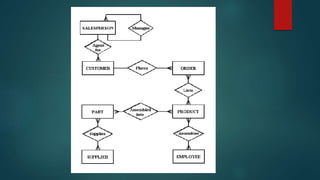
 A salesperson may manage many other salespeople.
 A salesperson is managed by only one salespeople.
 A salesperson can be an agent for many customers.
 A customer is managed by one salespeople.
 A customer can place many orders. An order can be placed by
one customer.
 An order lists many inventory items.
 An inventory item may be listed on many orders.
 An inventory item is assembled from many parts.
 A part may be assembled into many inventory items. Many
employees assemble an inventory item from many parts. A
supplier supplies many parts.
 A part may be supplied by many suppliers.
 A manufacturing company produces products. The
following product information is stored: product name,
product ID and quantity on hand. These products are made
up of many components. Each component can be supplied
by one or more suppliers. The following component
information is kept: component ID, name, description,
suppliers who supply them, and products in which they are
used.
 Create an ERD to show how you would track this
information.
 Show entity names, primary keys, attributes for each entity,
relationships between the entities and cardinality.
Assumptions
A supplier can exist without providing components.
A component does not have to be associated with a
supplier.
A component does not have to be associated with a
product. Not all components are used in products.
A product cannot exist without components.
ERD Answer
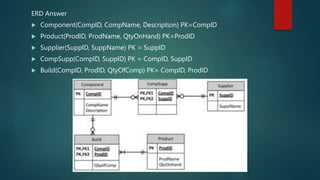
 Component(CompID, CompName, Description) PK=CompID
 Product(ProdID, ProdName, QtyOnHand) PK=ProdID
 Supplier(SuppID, SuppName) PK = SuppID
 CompSupp(CompID, SuppID) PK = CompID, SuppID
 Build(CompID, ProdID, QtyOfComp) PK= CompID, ProdID
Practice Excercise
 Suppose you are given the following requirements for a simple
database for the National Hockey League (NHL):
 the NHL has many teams,
 each team has a name, a city, a coach, a captain, and a set of players,
 each player belongs to only one team,
 each player has a name, a position (such as left wing or goalie), a skill
level, and a set of injury records,
 a team captain is also a player,
 a game is played between two teams (referred to as host_team and
guest_team) and has a date (such as May 11th, 2022) and a score (such as
4 to 2).
 Construct a clean and concise ER diagram for the NHL database using
the Chen notation as in your textbook. List your assumptions and
clearly indicate the cardinality mappings as well as any role indicators
in your ER diagram.
 Create an ERD for a car dealership. The dealership sells both new and used cars, and it operates
a service facility. Base your design on the following business rules:
 •A salesperson may sell many cars, but each car is sold by only one salesperson.
 •A customer may buy many cars, but each car is bought by only one customer.
 •A salesperson writes a single invoice for each car he or she sells.
 •A customer gets an invoice for each car he or she buys.
 •A customer may come in just to have his or her car serviced; that is, a customer need not buy a
car to be classified as a customer.
 •When a customer takes one or more cars in for repair or service, one service ticket is written for
each car.
 •The car dealership maintains a service history for each of the cars serviced. The service records
are referenced by the car’s serial number.
 •A car brought in for service can be worked on by many mechanics, and each mechanic may
work on many cars.
 •A car that is serviced may or may not need parts (e.g., adjusting a carburetor or cleaning a fuel
injector nozzle does not require providing new parts).

ERD Activity.pptx

  • 1.
  • 2.
     A salespersonmay manage many other salespeople.  A salesperson is managed by only one salespeople.  A salesperson can be an agent for many customers.  A customer is managed by one salespeople.  A customer can place many orders. An order can be placed by one customer.  An order lists many inventory items.  An inventory item may be listed on many orders.  An inventory item is assembled from many parts.  A part may be assembled into many inventory items. Many employees assemble an inventory item from many parts. A supplier supplies many parts.  A part may be supplied by many suppliers.
  • 4.
     A manufacturingcompany produces products. The following product information is stored: product name, product ID and quantity on hand. These products are made up of many components. Each component can be supplied by one or more suppliers. The following component information is kept: component ID, name, description, suppliers who supply them, and products in which they are used.  Create an ERD to show how you would track this information.  Show entity names, primary keys, attributes for each entity, relationships between the entities and cardinality.
  • 5.
    Assumptions A supplier canexist without providing components. A component does not have to be associated with a supplier. A component does not have to be associated with a product. Not all components are used in products. A product cannot exist without components.
  • 6.
    ERD Answer  Component(CompID,CompName, Description) PK=CompID  Product(ProdID, ProdName, QtyOnHand) PK=ProdID  Supplier(SuppID, SuppName) PK = SuppID  CompSupp(CompID, SuppID) PK = CompID, SuppID  Build(CompID, ProdID, QtyOfComp) PK= CompID, ProdID
  • 7.
  • 8.
     Suppose youare given the following requirements for a simple database for the National Hockey League (NHL):  the NHL has many teams,  each team has a name, a city, a coach, a captain, and a set of players,  each player belongs to only one team,  each player has a name, a position (such as left wing or goalie), a skill level, and a set of injury records,  a team captain is also a player,  a game is played between two teams (referred to as host_team and guest_team) and has a date (such as May 11th, 2022) and a score (such as 4 to 2).  Construct a clean and concise ER diagram for the NHL database using the Chen notation as in your textbook. List your assumptions and clearly indicate the cardinality mappings as well as any role indicators in your ER diagram.
  • 9.
     Create anERD for a car dealership. The dealership sells both new and used cars, and it operates a service facility. Base your design on the following business rules:  •A salesperson may sell many cars, but each car is sold by only one salesperson.  •A customer may buy many cars, but each car is bought by only one customer.  •A salesperson writes a single invoice for each car he or she sells.  •A customer gets an invoice for each car he or she buys.  •A customer may come in just to have his or her car serviced; that is, a customer need not buy a car to be classified as a customer.  •When a customer takes one or more cars in for repair or service, one service ticket is written for each car.  •The car dealership maintains a service history for each of the cars serviced. The service records are referenced by the car’s serial number.  •A car brought in for service can be worked on by many mechanics, and each mechanic may work on many cars.  •A car that is serviced may or may not need parts (e.g., adjusting a carburetor or cleaning a fuel injector nozzle does not require providing new parts).