Java Arrays
Array
•Break 'array' down into sounds: [UH] +
[RAY] - say it out loud and exaggerate the
sounds until you can consistently produce
them.
Array
•noun as in collection, considerable
group
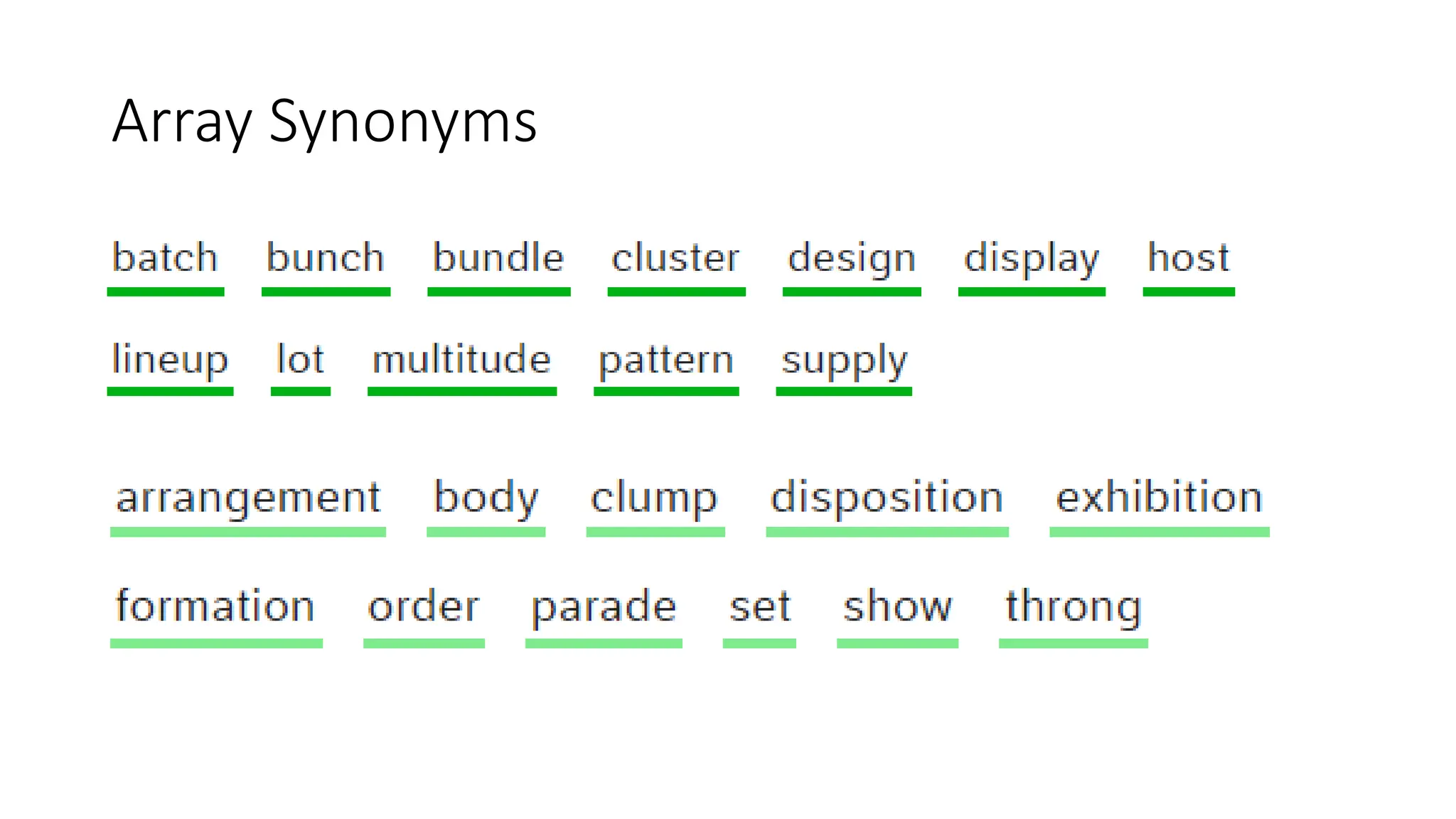
Array Synonyms
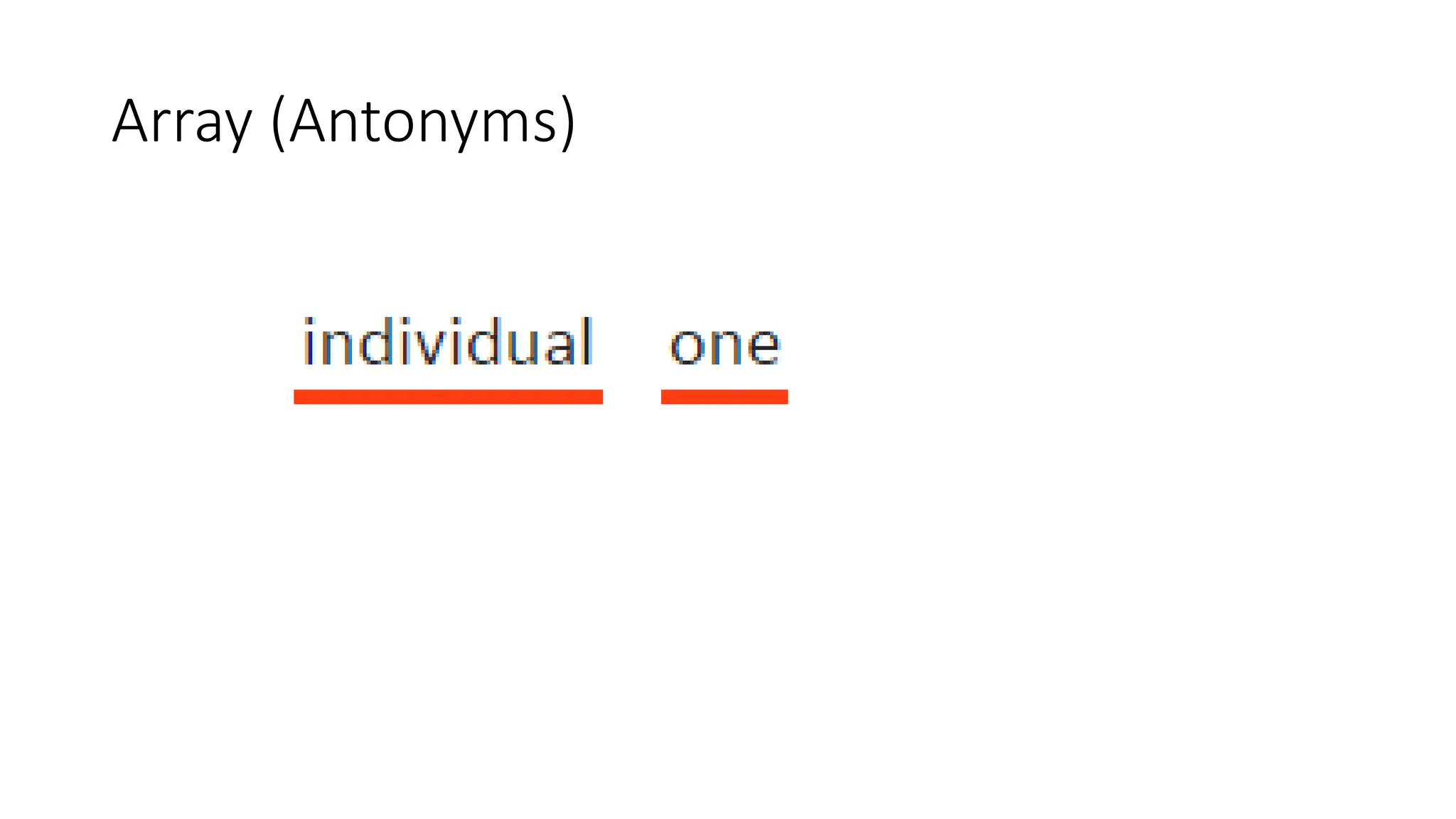
Array (Antonyms)
Array
• verb as in arrange in collection or order
Use Array in a sentence
Arrays
•Arrays provide a way to store and organize
multiple values of the same type, making it
easier to work with large sets of data.
Arrays
•An array is a collection (sequence)
of a fixed number of variables called
elements or components, wherein
all the elements are of the same
data type.
Arrays
•A one-dimensional array is an array
in which the elements are arranged
in a list form.
Arrays
•An array is a data structure that
can store a fixed-size sequence
of elements of the same data
type.
Arrays
•An array is an object in Java, which
means it can be assigned to a
variable, passed as a parameter to a
method, and returned as a value
from a method.
Arrays
•Arrays in Java are zero-indexed, which
means that the first element in an
array has an index of 0, the second
element has an index of 1, and so on.
The length of an array is fixed when it
is created and cannot be changed later.
Arrays
•Arrays in Java are zero-indexed, which
means that the first element in an
array has an index of 0, the second
element has an index of 1, and so on.
•The length of an array is fixed when it
is created and cannot be changed later.
Arrays
•Java arrays can store elements of any data
type, including primitive types such as int,
double, and Boolean, as well as object
types such as String and Integer.
•Arrays can also be multi-dimensional,
meaning that they can have multiple rows
and columns.
Arrays
•Arrays in Java are commonly used to store
collections of data, such as a list of
numbers, a set of strings, or a series of
objects.
•By using arrays, we can access and
manipulate collections of data more
efficiently than using individual variables.

Arrays in Reading.pptx

  • 1.
  • 2.
    Array •Break 'array' downinto sounds: [UH] + [RAY] - say it out loud and exaggerate the sounds until you can consistently produce them.
  • 3.
    Array •noun as incollection, considerable group
  • 4.
  • 5.
  • 6.
    Array • verb asin arrange in collection or order
  • 7.
    Use Array ina sentence
  • 8.
    Arrays •Arrays provide away to store and organize multiple values of the same type, making it easier to work with large sets of data.
  • 9.
    Arrays •An array isa collection (sequence) of a fixed number of variables called elements or components, wherein all the elements are of the same data type.
  • 10.
    Arrays •A one-dimensional arrayis an array in which the elements are arranged in a list form.
  • 11.
    Arrays •An array isa data structure that can store a fixed-size sequence of elements of the same data type.
  • 12.
    Arrays •An array isan object in Java, which means it can be assigned to a variable, passed as a parameter to a method, and returned as a value from a method.
  • 13.
    Arrays •Arrays in Javaare zero-indexed, which means that the first element in an array has an index of 0, the second element has an index of 1, and so on. The length of an array is fixed when it is created and cannot be changed later.
  • 14.
    Arrays •Arrays in Javaare zero-indexed, which means that the first element in an array has an index of 0, the second element has an index of 1, and so on. •The length of an array is fixed when it is created and cannot be changed later.
  • 15.
    Arrays •Java arrays canstore elements of any data type, including primitive types such as int, double, and Boolean, as well as object types such as String and Integer. •Arrays can also be multi-dimensional, meaning that they can have multiple rows and columns.
  • 16.
    Arrays •Arrays in Javaare commonly used to store collections of data, such as a list of numbers, a set of strings, or a series of objects. •By using arrays, we can access and manipulate collections of data more efficiently than using individual variables.