ASSEMBLY LANGUAGE
Introduction
 Assembly language is a low-level programming language
for a computer or other programmable device specific
to a particular computer architecture in contrast to
most high-level programming languages, which are
generally portable across multiple systems.
 Assembly language is converted into executable
machine code by a utility program referred to as an
assembler like NASM, MASM, etc.
Introduction
 Each personal computer has a microprocessor that
manages the computer's arithmetical, logical, and
control activities.
 Each family of processors has its own set of
instructions for handling various operations such as
getting input from keyboard, displaying information
on screen and performing various other jobs.
 These set of instructions are called 'machine
language instructions'.
Introduction
 A processor understands only machine language
instructions, which are strings of 1's and 0’s.
 However, machine language is too obscure and
complex for using in software development.
 the low-level assembly language is designed for a
specific family of processors that represents various
instructions in symbolic code and a more
understandable form.
Advantages of
Assembly Language
Having an understanding of assembly language makes
one aware of −
 How programs interface with OS, processor, and BIOS;
 How data is represented in memory and other external
devices;
 How the processor accesses and executes instruction;
 How instructions access and process data;
 How a program accesses external devices.
Advantages of
Assembly Language
Other advantages of using assembly language are −
 It requires less memory and execution time;
 It allows hardware-specific complex jobs in an easier
way;
 It is suitable for time-critical jobs;
 It is most suitable for writing interrupt service routines
and other memory resident programs.
Basic Features of PC Hardware
 The main internal hardware of a PC consists of
processor, memory, and registers.
 Registers are processor components that hold data and
address. To execute a program, the system copies it
from the external device into the internal memory.
The processor executes the program instructions.
 The fundamental unit of computer storage is a bit; it
could be ON (1) or OFF (0) and a group of 8 related
bits makes a byte on most of the modern computers.
Basic Features of PC Hardware
The processor supports the following data sizes −
 Word: a 2-byte data item
 Doubleword: a 4-byte (32 bit) data item
 Quadword: an 8-byte (64 bit) data item
 Paragraph: a 16-byte (128 bit) area
 Kilobyte: 1024 bytes
 Megabyte: 1,048,576 bytes
Assembly Language Parts
An assembly program can be divided into three sections −
The data section,
The bss section, and
The text section.
Data section
 The data section is used for declaring initialized data or
constants.
 This data does not change at runtime.
 You can declare various constant values, file names, or
buffer size, etc., in this section.
 The syntax for declaring data section is −
section.data
bss section
 The bss section is used for declaring variables.
 The syntax for declaring bss section is −
section.bss
Text section
 The text section is used for keeping the actual
code.
 This section must begin with the declaration global
_start, which tells the kernel where the program
execution begins.
 The syntax for declaring text section is −
section.text global _start_start:
Comments
 Assembly language comment begins with a
semicolon (;). It may contain any printable
character including blank. It can appear on a line
by itself, like −
 ; This program displays a message on screen
or, on the same line along with an instruction, like
−
add eax, ebx ; adds ebx to eax
Assembly Language Statements
Assembly language programs consist of three types of
statements −
 Executable instructions or instructions,
 Assembler directives or pseudo-ops, and
 Macros.
Assembly Language Statements
 The executable instructions or
simply instructions tell the processor what to do.
 Each instruction consists of an operation
code (opcode).
 Each executable instruction generates one
machine language instruction.
Assembly Language Statements
 The assembler directives or pseudo-ops tell the
assembler about the various aspects of the
assembly process.
 These are non-executable and do not generate
machine language instructions.
 Macros are basically a text substitution
mechanism.
.
Syntax of Assembly Language
Statements
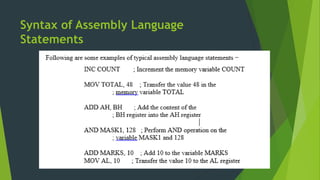
 Assembly language statements are entered one statement
per line. Each statement follows the following format −
[label] mnemonic [operands] [;comment]
 The fields in the square brackets are optional. A basic
instruction has two parts, the first one is the name of the
instruction (or the mnemonic), which is to be executed,
and the second are the operands or the parameters of
the command.
Syntax of Assembly Language
Statements
Structure of a NASM Program
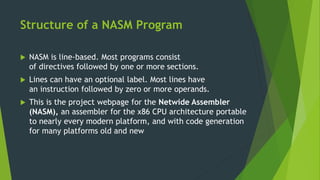
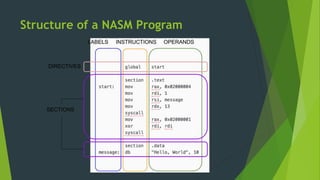
 NASM is line-based. Most programs consist
of directives followed by one or more sections.
 Lines can have an optional label. Most lines have
an instruction followed by zero or more operands.
 This is the project webpage for the Netwide Assembler
(NASM), an assembler for the x86 CPU architecture portable
to nearly every modern platform, and with code generation
for many platforms old and new
Structure of a NASM Program
Memory Segments
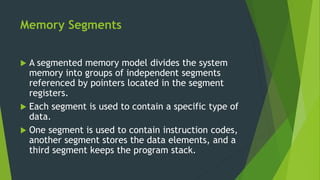
 A segmented memory model divides the system
memory into groups of independent segments
referenced by pointers located in the segment
registers.
 Each segment is used to contain a specific type of
data.
 One segment is used to contain instruction codes,
another segment stores the data elements, and a
third segment keeps the program stack.
Memory Segments
In the light of the above discussion, we can specify
various memory segments as −
 Data segment − It is represented by .data section and
the .bss. The .data section is used to declare the
memory region, where data elements are stored for
the program. This section cannot be expanded after
the data elements are declared, and it remains static
throughout the program.
 The .bss section is also a static memory section that
contains buffers for data to be declared later in the
program. This buffer memory is zero-filled.
Memory Segments
 Code segment − It is represented
by .text section. This defines an area in memory
that stores the instruction codes. This is also a
fixed area.
 Stack − This segment contains data values passed
to functions and procedures within the program.
TASM
 Turbo Assembler (sometimes shortened to
the name of the executable, TASM) is an
assembler for software development
published by Borland in 1989. It runs on and
produces code for 16- or 32-bit x86 MS-DOS
and compatible on Microsoft Windows
MASM
 The Microsoft Macro Assembler (MASM) is an
x86 assembler that uses the Intel syntax for
MS-DOS and Microsoft Windows.
 Beginning with MASM 8.0, there are two
versions of the assembler: One for 16-bit &
32-bit assembly sources, and another for
64-bit sources only.
 Assemblers expect either the original syntax used
in the Intel instruction set documentation - the
Intel syntax - or the so-called AT&T syntax
developed at the AT&T Bell Labs.
 AT&T uses mov src, dest, Intel uses mov dest, src,
amongst other differences.
 Windows assemblers prefer Intel syntax (TASM,
MASM), most Linux/UNIX assemblers use AT&T.
NASM uses a variant of the Intel syntax.
 Assemblers have their own syntax for directives
affecting the assembly process, macros and
comments. These usually differ from assembler to
assembler
QUIZ
______________1. What symbol defines Comments in Assembly Language?
______________2. This section is used to declare the memory region,
where data elements are stored for the program.
______________3. This defines an area in memory that stores the
instruction codes. This is also a fixed area.
______________4. Which part of the assembly language tells the kernel
where the program execution begins?
______________5. Which tells the assembler about the various aspects of
the assembly process. These are non-executable and do not generate
machine language instructions.
______________6. What is the syntax in declaring data section?
______________7. This segment contains data values passed to functions
and procedures within the program.
______________8. What is the fundamental unit of computer storage?
_____9_______10. Advantages of understanding Assembly language
1. Semicolon
2. Data segment
3. Code segment
4. global _start,
5. assembler directives
6. section.data
7. Stack
8. bit
 How programs interface with OS, processor, and BIOS;
 How data is represented in memory and other external devices;
 How the processor accesses and executes instruction;
 How instructions access and process data;
 How a program accesses external devices.

ASSEMBLY LANGUAGE.pptx

  • 1.
  • 3.
    Introduction  Assembly languageis a low-level programming language for a computer or other programmable device specific to a particular computer architecture in contrast to most high-level programming languages, which are generally portable across multiple systems.  Assembly language is converted into executable machine code by a utility program referred to as an assembler like NASM, MASM, etc.
  • 4.
    Introduction  Each personalcomputer has a microprocessor that manages the computer's arithmetical, logical, and control activities.  Each family of processors has its own set of instructions for handling various operations such as getting input from keyboard, displaying information on screen and performing various other jobs.  These set of instructions are called 'machine language instructions'.
  • 5.
    Introduction  A processorunderstands only machine language instructions, which are strings of 1's and 0’s.  However, machine language is too obscure and complex for using in software development.  the low-level assembly language is designed for a specific family of processors that represents various instructions in symbolic code and a more understandable form.
  • 6.
    Advantages of Assembly Language Havingan understanding of assembly language makes one aware of −  How programs interface with OS, processor, and BIOS;  How data is represented in memory and other external devices;  How the processor accesses and executes instruction;  How instructions access and process data;  How a program accesses external devices.
  • 7.
    Advantages of Assembly Language Otheradvantages of using assembly language are −  It requires less memory and execution time;  It allows hardware-specific complex jobs in an easier way;  It is suitable for time-critical jobs;  It is most suitable for writing interrupt service routines and other memory resident programs.
  • 8.
    Basic Features ofPC Hardware  The main internal hardware of a PC consists of processor, memory, and registers.  Registers are processor components that hold data and address. To execute a program, the system copies it from the external device into the internal memory. The processor executes the program instructions.  The fundamental unit of computer storage is a bit; it could be ON (1) or OFF (0) and a group of 8 related bits makes a byte on most of the modern computers.
  • 9.
    Basic Features ofPC Hardware The processor supports the following data sizes −  Word: a 2-byte data item  Doubleword: a 4-byte (32 bit) data item  Quadword: an 8-byte (64 bit) data item  Paragraph: a 16-byte (128 bit) area  Kilobyte: 1024 bytes  Megabyte: 1,048,576 bytes
  • 10.
    Assembly Language Parts Anassembly program can be divided into three sections − The data section, The bss section, and The text section.
  • 11.
    Data section  Thedata section is used for declaring initialized data or constants.  This data does not change at runtime.  You can declare various constant values, file names, or buffer size, etc., in this section.  The syntax for declaring data section is − section.data
  • 12.
    bss section  Thebss section is used for declaring variables.  The syntax for declaring bss section is − section.bss
  • 13.
    Text section  Thetext section is used for keeping the actual code.  This section must begin with the declaration global _start, which tells the kernel where the program execution begins.  The syntax for declaring text section is − section.text global _start_start:
  • 14.
    Comments  Assembly languagecomment begins with a semicolon (;). It may contain any printable character including blank. It can appear on a line by itself, like −  ; This program displays a message on screen or, on the same line along with an instruction, like − add eax, ebx ; adds ebx to eax
  • 15.
    Assembly Language Statements Assemblylanguage programs consist of three types of statements −  Executable instructions or instructions,  Assembler directives or pseudo-ops, and  Macros.
  • 16.
    Assembly Language Statements The executable instructions or simply instructions tell the processor what to do.  Each instruction consists of an operation code (opcode).  Each executable instruction generates one machine language instruction.
  • 17.
    Assembly Language Statements The assembler directives or pseudo-ops tell the assembler about the various aspects of the assembly process.  These are non-executable and do not generate machine language instructions.  Macros are basically a text substitution mechanism. .
  • 18.
    Syntax of AssemblyLanguage Statements  Assembly language statements are entered one statement per line. Each statement follows the following format − [label] mnemonic [operands] [;comment]  The fields in the square brackets are optional. A basic instruction has two parts, the first one is the name of the instruction (or the mnemonic), which is to be executed, and the second are the operands or the parameters of the command.
  • 19.
    Syntax of AssemblyLanguage Statements
  • 20.
    Structure of aNASM Program  NASM is line-based. Most programs consist of directives followed by one or more sections.  Lines can have an optional label. Most lines have an instruction followed by zero or more operands.  This is the project webpage for the Netwide Assembler (NASM), an assembler for the x86 CPU architecture portable to nearly every modern platform, and with code generation for many platforms old and new
  • 21.
    Structure of aNASM Program
  • 22.
    Memory Segments  Asegmented memory model divides the system memory into groups of independent segments referenced by pointers located in the segment registers.  Each segment is used to contain a specific type of data.  One segment is used to contain instruction codes, another segment stores the data elements, and a third segment keeps the program stack.
  • 23.
    Memory Segments In thelight of the above discussion, we can specify various memory segments as −  Data segment − It is represented by .data section and the .bss. The .data section is used to declare the memory region, where data elements are stored for the program. This section cannot be expanded after the data elements are declared, and it remains static throughout the program.  The .bss section is also a static memory section that contains buffers for data to be declared later in the program. This buffer memory is zero-filled.
  • 24.
    Memory Segments  Codesegment − It is represented by .text section. This defines an area in memory that stores the instruction codes. This is also a fixed area.  Stack − This segment contains data values passed to functions and procedures within the program.
  • 25.
    TASM  Turbo Assembler(sometimes shortened to the name of the executable, TASM) is an assembler for software development published by Borland in 1989. It runs on and produces code for 16- or 32-bit x86 MS-DOS and compatible on Microsoft Windows
  • 26.
    MASM  The MicrosoftMacro Assembler (MASM) is an x86 assembler that uses the Intel syntax for MS-DOS and Microsoft Windows.  Beginning with MASM 8.0, there are two versions of the assembler: One for 16-bit & 32-bit assembly sources, and another for 64-bit sources only.
  • 27.
     Assemblers expecteither the original syntax used in the Intel instruction set documentation - the Intel syntax - or the so-called AT&T syntax developed at the AT&T Bell Labs.  AT&T uses mov src, dest, Intel uses mov dest, src, amongst other differences.
  • 28.
     Windows assemblersprefer Intel syntax (TASM, MASM), most Linux/UNIX assemblers use AT&T. NASM uses a variant of the Intel syntax.  Assemblers have their own syntax for directives affecting the assembly process, macros and comments. These usually differ from assembler to assembler
  • 29.
  • 30.
    ______________1. What symboldefines Comments in Assembly Language? ______________2. This section is used to declare the memory region, where data elements are stored for the program. ______________3. This defines an area in memory that stores the instruction codes. This is also a fixed area. ______________4. Which part of the assembly language tells the kernel where the program execution begins? ______________5. Which tells the assembler about the various aspects of the assembly process. These are non-executable and do not generate machine language instructions. ______________6. What is the syntax in declaring data section? ______________7. This segment contains data values passed to functions and procedures within the program. ______________8. What is the fundamental unit of computer storage? _____9_______10. Advantages of understanding Assembly language
  • 31.
    1. Semicolon 2. Datasegment 3. Code segment 4. global _start, 5. assembler directives 6. section.data 7. Stack 8. bit  How programs interface with OS, processor, and BIOS;  How data is represented in memory and other external devices;  How the processor accesses and executes instruction;  How instructions access and process data;  How a program accesses external devices.