Key Action 2
HE
Guidance on
applications
David Hibler
Joanna Collins
Overall objectives

• Boost skills, employability, labour market
relevance
• Modernise education, training, youth work
• Focus on young people
Key facts

• Simpler, cross-sectoral structure based on
‘Key Actions’
• Worth €940m to UK over seven years
• Replaces Lifelong Learning Programme,
Youth in Action and other EU programmes
• Addresses EU agenda for modernisation
of HE
Erasmus+ is
‘the new EU
programme for
education,
training, youth
and sport’
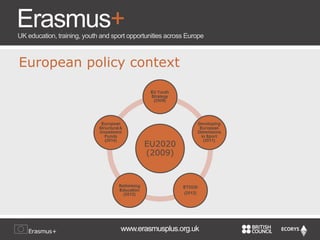
European policy context
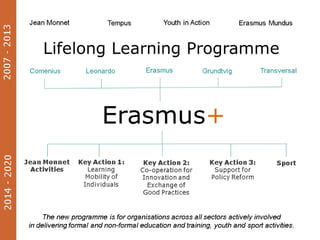
Key Actions
• Key Action 1: Learning Mobility of Individuals
• Key Action 2: Co-operation for Innovation and
Exchange of Good Practices
• Key Action 3: Support for Policy Reform
• Some activities managed centrally, not by
National Agencies
• Organisation, not individual applications
• No funding for preparatory visits
Key Action 2
•
•
•
•
•

Strategic Partnerships (by sector and crosssectoral)
Knowledge Alliances and Sector Skills Alliances
Capacity Building Projects
Support to IT Platforms
Broadly, absorbs Tempus within changed focus
Key Action 2 Strategic partnerships
• Development, transfer and/or implementation of
innovative practice (incl. mobility) and
development of labour market skills
• Partnership size and type flexible
• HE, VET, schools, adult education, youth and
cross-sectoral
• Funding based on unit costs
Strategic partnerships in HE
Basic criteria
• Wide variety of organisations: public or private,
professional bodies, NGOs etc, in programme countries;
sectoral, cross-sectoral
• Participating HEIs - Erasmus Charter for Higher Education
(ECHE)
• Minimum 3 organisations from 3 programme countries
• Up to €150,000 per year
• 2 or 3 years: duration depends on objectives and activities
• Overall budget less for UK, expect much competition
Application deadline

DEADLINE
30 APRIL
12.00 CENTRAL EUROPEAN TIME
(11.00 BST)
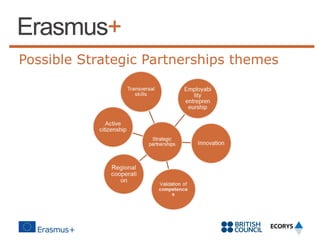
Possible Strategic Partnerships themes
Priorities for KA2 HE
• Enhance quality and relevance of learning, attainment
levels
• Key skills: entrepreneurship, languages, digital
• labour market relevance: links with work
• Non traditional approaches, virtual mobility, use of ICT
• Professional development
• Capacity building, Organisational development
• Equity and inclusion
• Pursue EC priorities for modernisation of HE
Projects
•
•
•
•
•
•

Address policy objectives
Foster transversal (cross-cutting) skills for employability
Promote practical experience, work-based learning
Professional development in using ICT, support for OER
Develop innovative curricula
Validation of non-formal and informal learning and
connection with formal; transition to new levels with
European tools, link with national recognition systems
• Career guidance and counselling
Activities
• Very flexible to deliver project objectives
Separate budget lines:
• Project management and meetings
• Intellectual outputs
• Multiplier events
• Teaching, training and learning activities
• Linguistic support
• Dissemination of results
Award criteria
• Relevance: policy; needs; objectives; synergies between
fields; innovative or complementary; added EU value
• Design and implementation : work programme phases;
consistency; methodology; quality control; VFM;
appropriate T&L if any; recognition of learning outcomes
• Quality of team and cooperation: participating
organisation skills and competencies ; tasks and
responsibilities; management arrangements
• Impact & dissemination: evaluation; impact;
dissemination; sustainability
• Programme Guide pages 99 to 100
The application eform
• Completed on-line
• Guidelines on NA website www.erasmusplus.org.uk
• “Declaration of Honour” to be signed off by legal
representative of institution (download for signature,
scan, upload)
• IT issues- to Erasmus helpdesk
Erasmus@britishcouncil.org
Advice

• Read relevant sections of Programme Guide, especially
objectives and priorities for KA2 (pages 93 to 96); award
criteria (pages 99 to 100); examples of projects (page
243)
• See project examples
http://eacea.ec.europa.eu/llp/project_reports/project_reports_e
• Guidance on using the eforms is at [t.b.c.]
• Read full application form and guidance before
completing the form
The application form content overview
• Context: background
• Participating organisations: basic information
• Description of the project: rationale for project and
partnership, objectives
• Preparation and project management: including m&e;
target groups
• Project activities: details of all outputs and activities
The application form content overview
•
•
•
•

Follow-up: dissemination, use of results, sustainability
Budget: management and activities
Project summary
Formal aspects: data protection, sign off
Context and participating organisations
•
•
•
•

Basic information
NA – select UK1
Details fill in automatically when PIC input
HEIs – accredited (ECHE), do not have to add further
information to show eligibility
• Summary of background and experience
• Partners – as above
Description of the project, objectives
• Rationale, issues and needs ie why this project?
• Innovative or complementary: how fits with other activity?
• Partners: how chosen? skills, knowledge, experience? New
partners? EU added value
• Communication and meetings, partners and stakeholders
• Priorities (cf EU priorities) - overall objectives eg partnerships
between education and employment
• Topics - eg regional dimension; environment; discipline
• Results: outputs, products, changes; people trained, skills,
knowledge, cultural awareness, languages
NB not outputs covered below under “activities”.
Preparation and project management
• Preparation: analyses, planning, building engagement,
possibly before funding starts (cf. “activities”)
• Budget and timelines: management and monitoring
budget between partners, monitoring timelines, rectifying
• Quality of activities: monitoring quality of delivery; who,
how, when? (cf. “activities”)
• Risks: internal and external, how monitored and mitigated
• Assessing achievement: qualitative and quantitative
indicators and activities (outputs, results, objectives) cf.
“activities” and “impact” below
Implementation
• Organisation of activities: who, what, where, how
coordinated, timelines (template annex promised)
• Target groups: who? cf. “needs”, above
• Participants with fewer opportunities: number; proportion of
participants
• Support for them
• Difficulties in participation
Project activities (and outputs)
• Divided into types
• For each type (eg intellectual outputs, events, mobility) :
– Phase of the project: Preparation; Implementation;
Follow-up; Dissemination; Closure
– Title
– Description
– Tasks
– Estimated start and end dates
– Organisation leading the activity
– Other participating organisations.
Intellectual outputs
• Publications eg academic papers; policy recommendations
at different levels; curricula , course materials; training
materials; assessment methods, materials; handbooks,
advice, guidance; case studies ; good practice; websites;
innovative uses of IT and different media; software
• Type
• Languages
• Media
 
Multiplier events
•
•
•
•

Emphasis on visibility and dissemination in Erasmus+
Beyond participating individuals and organisations
Event type
Intellectual outputs covered
Learning, teaching and training activities
• Must contribute to overall objectives of project
• Eligibility criteria and funding different from mobility in KA1:
quality criteria (eg recognition) the same
• Students: blended mobility i.e. up to 2 months physical
mobility with virtual mobility
• Staff teaching and training: 2 to 12 months
• Intensive programmes of 5 days to two months
• Short – term joint staff training events: 5 days to 2 months
Learning, teaching and training activities
•
•
•
•

Activity type – click as appropriate
Activity description
Number of participants
Participants with special needs: even if you are not sure of
the details, included any anticipated participation by people
with special needs.
• Accompanying persons – as above
• Long (months) or short term (days) – as appropriate.
• Participating organisations
Follow up - impact
• Impact (effects, results, changes) on participating
individuals and organisations and other stakeholders
• Impact beyond the project, local, regional, national,
European
• Measurement – who, what, how
Follow up - dissemination
• Important in Erasmus+ - added value of EU funding, wider
reach and impact
• Communicating successes and results widely: for use by
others including other sectors; to influence policy; into the
future
• Measureable, realistic objectives
• Timetable
• Resource planning
• Involvement of target groups if possible
Follow up - dissemination
•
•
•
•

Target audiences, different levels
Responsibilities, skills of team
Accessibility, media
Monitoring
Sustainability

• Of project activities and results
• Resources – financial, other (eg institutional support)
Budget (summary)
•
•
•
•

Different activities: different funding levels and structures
Most payments conditional on justification in application
Unit costs and lump sums, with ceilings
Project management - 500 per month for coordinating;250
per month for participating
• Transnational project meetings (must be justified) per
participant and distance travelled
• Intellectual outputs per day and staff role (manager,
researcher/teacher/trainer, technician, administrator)
Budget (summary)
• Multiplier events related to intellectual outputs: per local
and foreign participant
• Learning, teaching, training: travel by distance, and
subsistence per participant by day or month
• Linguistic support: lump sum per participant in 2 to 12
months mobility
• Special needs: actuals – costs included in application
• Exceptional costs: 75% actuals , subcontracted goods and
services which partners cannot provide
Project Summary
• Synopsis: to be used for publicity, uploaded to EC
dissemination platform
• Context
• Objectives
• Participants
• Activities
• Methodology
• Results, impact, longer term benefits
• Summary of participating organisations and budget
ECAS and PICs
• Need PIC http://www.erasmusplus.org.uk/how-to-apply
• HEIs ask Erasmus coordinator
• Other organisations: register on the European
Commission Authentication Service (ECAS), see
http://www.erasmusplus.org.uk/how-to-apply
• Log in to Participant Portal with ECAS account details,
see EC Participant Portal User Manual
• Register on the Unique Registration Facility (URF)
• You will receive a PIC.
Further information
• Call for Proposals and Programme Guide
http://ec.europa.eu/programmes/erasmusplus/index_en.htm
• UK NA website, www.erasmusplus.org.uk
• #erasmusplusuk – BC/Ecorys hashtag
• Erasmus Helpdesk (detail) erasmus@britishcouncil.org
• Examples of centralised projects under LLP
http://eacea.ec.europa.eu/llp/project_reports/project_rep
orts_erasmus_en.php

Erasmus+ webinar presentation ka2 he jc

  • 1.
    Key Action 2 HE Guidanceon applications David Hibler Joanna Collins
  • 2.
    Overall objectives • Boostskills, employability, labour market relevance • Modernise education, training, youth work • Focus on young people
  • 3.
    Key facts • Simpler,cross-sectoral structure based on ‘Key Actions’ • Worth €940m to UK over seven years • Replaces Lifelong Learning Programme, Youth in Action and other EU programmes • Addresses EU agenda for modernisation of HE
  • 4.
    Erasmus+ is ‘the newEU programme for education, training, youth and sport’
  • 5.
  • 6.
    Key Actions • KeyAction 1: Learning Mobility of Individuals • Key Action 2: Co-operation for Innovation and Exchange of Good Practices • Key Action 3: Support for Policy Reform • Some activities managed centrally, not by National Agencies • Organisation, not individual applications • No funding for preparatory visits
  • 7.
    Key Action 2 • • • • • StrategicPartnerships (by sector and crosssectoral) Knowledge Alliances and Sector Skills Alliances Capacity Building Projects Support to IT Platforms Broadly, absorbs Tempus within changed focus
  • 8.
    Key Action 2Strategic partnerships • Development, transfer and/or implementation of innovative practice (incl. mobility) and development of labour market skills • Partnership size and type flexible • HE, VET, schools, adult education, youth and cross-sectoral • Funding based on unit costs
  • 9.
  • 10.
    Basic criteria • Widevariety of organisations: public or private, professional bodies, NGOs etc, in programme countries; sectoral, cross-sectoral • Participating HEIs - Erasmus Charter for Higher Education (ECHE) • Minimum 3 organisations from 3 programme countries • Up to €150,000 per year • 2 or 3 years: duration depends on objectives and activities • Overall budget less for UK, expect much competition
  • 11.
    Application deadline DEADLINE 30 APRIL 12.00CENTRAL EUROPEAN TIME (11.00 BST)
  • 12.
  • 13.
    Priorities for KA2HE • Enhance quality and relevance of learning, attainment levels • Key skills: entrepreneurship, languages, digital • labour market relevance: links with work • Non traditional approaches, virtual mobility, use of ICT • Professional development • Capacity building, Organisational development • Equity and inclusion • Pursue EC priorities for modernisation of HE
  • 14.
    Projects • • • • • • Address policy objectives Fostertransversal (cross-cutting) skills for employability Promote practical experience, work-based learning Professional development in using ICT, support for OER Develop innovative curricula Validation of non-formal and informal learning and connection with formal; transition to new levels with European tools, link with national recognition systems • Career guidance and counselling
  • 15.
    Activities • Very flexibleto deliver project objectives Separate budget lines: • Project management and meetings • Intellectual outputs • Multiplier events • Teaching, training and learning activities • Linguistic support • Dissemination of results
  • 16.
    Award criteria • Relevance:policy; needs; objectives; synergies between fields; innovative or complementary; added EU value • Design and implementation : work programme phases; consistency; methodology; quality control; VFM; appropriate T&L if any; recognition of learning outcomes • Quality of team and cooperation: participating organisation skills and competencies ; tasks and responsibilities; management arrangements • Impact & dissemination: evaluation; impact; dissemination; sustainability • Programme Guide pages 99 to 100
  • 17.
    The application eform •Completed on-line • Guidelines on NA website www.erasmusplus.org.uk • “Declaration of Honour” to be signed off by legal representative of institution (download for signature, scan, upload) • IT issues- to Erasmus helpdesk Erasmus@britishcouncil.org
  • 18.
    Advice • Read relevantsections of Programme Guide, especially objectives and priorities for KA2 (pages 93 to 96); award criteria (pages 99 to 100); examples of projects (page 243) • See project examples http://eacea.ec.europa.eu/llp/project_reports/project_reports_e • Guidance on using the eforms is at [t.b.c.] • Read full application form and guidance before completing the form
  • 19.
    The application formcontent overview • Context: background • Participating organisations: basic information • Description of the project: rationale for project and partnership, objectives • Preparation and project management: including m&e; target groups • Project activities: details of all outputs and activities
  • 20.
    The application formcontent overview • • • • Follow-up: dissemination, use of results, sustainability Budget: management and activities Project summary Formal aspects: data protection, sign off
  • 21.
    Context and participatingorganisations • • • • Basic information NA – select UK1 Details fill in automatically when PIC input HEIs – accredited (ECHE), do not have to add further information to show eligibility • Summary of background and experience • Partners – as above
  • 22.
    Description of theproject, objectives • Rationale, issues and needs ie why this project? • Innovative or complementary: how fits with other activity? • Partners: how chosen? skills, knowledge, experience? New partners? EU added value • Communication and meetings, partners and stakeholders • Priorities (cf EU priorities) - overall objectives eg partnerships between education and employment • Topics - eg regional dimension; environment; discipline • Results: outputs, products, changes; people trained, skills, knowledge, cultural awareness, languages NB not outputs covered below under “activities”.
  • 23.
    Preparation and projectmanagement • Preparation: analyses, planning, building engagement, possibly before funding starts (cf. “activities”) • Budget and timelines: management and monitoring budget between partners, monitoring timelines, rectifying • Quality of activities: monitoring quality of delivery; who, how, when? (cf. “activities”) • Risks: internal and external, how monitored and mitigated • Assessing achievement: qualitative and quantitative indicators and activities (outputs, results, objectives) cf. “activities” and “impact” below
  • 24.
    Implementation • Organisation ofactivities: who, what, where, how coordinated, timelines (template annex promised) • Target groups: who? cf. “needs”, above • Participants with fewer opportunities: number; proportion of participants • Support for them • Difficulties in participation
  • 25.
    Project activities (andoutputs) • Divided into types • For each type (eg intellectual outputs, events, mobility) : – Phase of the project: Preparation; Implementation; Follow-up; Dissemination; Closure – Title – Description – Tasks – Estimated start and end dates – Organisation leading the activity – Other participating organisations.
  • 26.
    Intellectual outputs • Publicationseg academic papers; policy recommendations at different levels; curricula , course materials; training materials; assessment methods, materials; handbooks, advice, guidance; case studies ; good practice; websites; innovative uses of IT and different media; software • Type • Languages • Media  
  • 27.
    Multiplier events • • • • Emphasis onvisibility and dissemination in Erasmus+ Beyond participating individuals and organisations Event type Intellectual outputs covered
  • 28.
    Learning, teaching andtraining activities • Must contribute to overall objectives of project • Eligibility criteria and funding different from mobility in KA1: quality criteria (eg recognition) the same • Students: blended mobility i.e. up to 2 months physical mobility with virtual mobility • Staff teaching and training: 2 to 12 months • Intensive programmes of 5 days to two months • Short – term joint staff training events: 5 days to 2 months
  • 29.
    Learning, teaching andtraining activities • • • • Activity type – click as appropriate Activity description Number of participants Participants with special needs: even if you are not sure of the details, included any anticipated participation by people with special needs. • Accompanying persons – as above • Long (months) or short term (days) – as appropriate. • Participating organisations
  • 30.
    Follow up -impact • Impact (effects, results, changes) on participating individuals and organisations and other stakeholders • Impact beyond the project, local, regional, national, European • Measurement – who, what, how
  • 31.
    Follow up -dissemination • Important in Erasmus+ - added value of EU funding, wider reach and impact • Communicating successes and results widely: for use by others including other sectors; to influence policy; into the future • Measureable, realistic objectives • Timetable • Resource planning • Involvement of target groups if possible
  • 32.
    Follow up -dissemination • • • • Target audiences, different levels Responsibilities, skills of team Accessibility, media Monitoring
  • 33.
    Sustainability • Of projectactivities and results • Resources – financial, other (eg institutional support)
  • 34.
    Budget (summary) • • • • Different activities:different funding levels and structures Most payments conditional on justification in application Unit costs and lump sums, with ceilings Project management - 500 per month for coordinating;250 per month for participating • Transnational project meetings (must be justified) per participant and distance travelled • Intellectual outputs per day and staff role (manager, researcher/teacher/trainer, technician, administrator)
  • 35.
    Budget (summary) • Multiplierevents related to intellectual outputs: per local and foreign participant • Learning, teaching, training: travel by distance, and subsistence per participant by day or month • Linguistic support: lump sum per participant in 2 to 12 months mobility • Special needs: actuals – costs included in application • Exceptional costs: 75% actuals , subcontracted goods and services which partners cannot provide
  • 36.
    Project Summary • Synopsis:to be used for publicity, uploaded to EC dissemination platform • Context • Objectives • Participants • Activities • Methodology • Results, impact, longer term benefits • Summary of participating organisations and budget
  • 37.
    ECAS and PICs •Need PIC http://www.erasmusplus.org.uk/how-to-apply • HEIs ask Erasmus coordinator • Other organisations: register on the European Commission Authentication Service (ECAS), see http://www.erasmusplus.org.uk/how-to-apply • Log in to Participant Portal with ECAS account details, see EC Participant Portal User Manual • Register on the Unique Registration Facility (URF) • You will receive a PIC.
  • 38.
    Further information • Callfor Proposals and Programme Guide http://ec.europa.eu/programmes/erasmusplus/index_en.htm • UK NA website, www.erasmusplus.org.uk • #erasmusplusuk – BC/Ecorys hashtag • Erasmus Helpdesk (detail) erasmus@britishcouncil.org • Examples of centralised projects under LLP http://eacea.ec.europa.eu/llp/project_reports/project_rep orts_erasmus_en.php

Editor's Notes

  • #2 FHL
  • #5 KA2 HE intensive programmes but not stand alone; centralised actions (which);
  • #8 Tempus – not yet
  • #9 Round 1 “countries” = programme countries
  • #11 Objectives and activities ie looking for well-structured project.
  • #14 Attainment levels
  • #15 Priorities:
  • #22 Need to know partner PICs
  • #23 Rationale and needs: In context of EU priorities as laid out in Programme Guide p 26-27 and 93-94. evidence of needs eg needs analysis innovative or complementary – this or other organisations, why new, no overlap (docs mention rights) Partners in context of objectives. New – because more impact on them. Priorities and Topics CHECK Not intellectual outputs, multiplier events, T&L,
  • #24 Preparation – expected to be included under activities but could also be before Include simple work programme/ timeline as annex – EC may provide a template.
  • #29 Learning outcomes are recognised and validated in the same way as under KA1 and in line with the ECHE. ECTS recommended for recognition.
  • #31 “substantial positive impact” on participating organisations, staff and learners – occurring during and remaining after the project. Outside the organisations ie could be transferred and used in other European countries. Incl, innovation at systems level, input to policy. (proportionality) scaleability
  • #32 Quality of plan – appropriateness eg of target groups for dissemination of specific results; will ensure best use of results; adequate resources.
  • #33 If relevant, open access to materials, documents, media,
  • #34 In context going beyond project plans for a multiplier effect; If relevant, integrated in management and pedagogy of participating organisations Participating organisations can if relevant attract cofunding or other support to ensure sustainability of activities and continued use of outputs and results.
  • #37 NA responsible for quality so may edit.