ENTERPRICE RESOURCE PLANNING
Presented By
Ch. Anusha
What is ERP?
 The practice of consolidating an enterprise’s
planning, manufacturing, sales and
marketing efforts into one management
system.
 Combines all databases across departments
into a single database that can be accessed
by all employees.
 ERP automates the tasks involved in
performing a business process.
2
ERP Components
 Finance: modules for
bookeeping and making
sure the bills are paid on
time. Examples:
 General ledger
 Accounts receivable
 Accounts payable
 HR: software for handling
personnel-related tasks
for corporate managers
and individual employees.
Examples:
 HR administration
 Payroll
 Self-service HR
 Manufacturing and
Logistics: A group of
applications for planning
production, taking orders
and delivering products to
the customer. Examples:
 Production planning
 Materials management
 Order entry and
processing
 Warehouse management
3
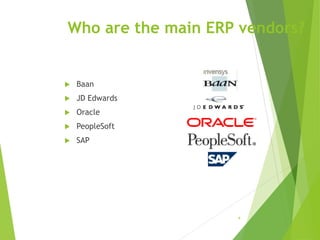
Who are the main ERP vendors?
 Baan
 JD Edwards
 Oracle
 PeopleSoft
 SAP
4
Why ERP?
3 Major Reasons:
To integrate financial data.
To standardize manufacturing
processes.
To standardize HR
information.
5
ERP Project and Time
 Real transformational ERP efforts will usually run
between 1 to 3 years, on average.
 Short implementations (3 to 6 months):
 small companies,
 implementation limited to a small area of the company, or
 the company only used the financial pieces of the ERP
system.
 The important thing is not to focus on how long it
will take but to understand why you need ERP and
how you will use it to improve your business.
6
Hidden Costs of ERP
 Training
 Integration and testing
 Data conversion
 Data analysis
 Consultants
 Replacing best and brightest staff after
implementation
 Implementation teams can never stop
 Waiting for ROI
 Post-ERP depression
7
Benefits of ERP Systems
 Improving integration, flexibility
 Fewer errors
 Improved speed and efficiency
 More complete access to information
 Lower total costs in the complete supply
chain
 Shorten throughput times
 Sustained involvement and commitment of
the top management 8
Benefits of ERP Systems (cont’d)
 Reduce stock to a minimum
 Enlarge product assortment
 Improve product quality
 Provide more reliable delivery dates and higher service
to the customer
 Efficiently coordinate global demand, supply and
production
9
ERP Implementation
 Biggest IT project that most companies ever
handle,
 Changes the entire company, and
 Has repercussions in all departments and
divisions of the organization.
 It is essential that all the key players
understand the scope of the project.
 This is an IT-Related Project.
10
Best Practices of ERP
Implementation
 A Business Strategy aligned with
Business Processes
 Top-Down Project Support and
commitment
 Change Management
 Extensive Education and Training
 Data Clean up and Data Integrity
 Implementation is viewed as an
ongoing process
11
Best Practices of ERP
Implementation
 Business strategy that will give you a
competitive advantage
 Analyze and map your current business
processes
 Develop your objectives
 Evaluate your business strategy and
ERP plan before you commit to
software acquisition and installation.
12
Best Practices of ERP
Implementation
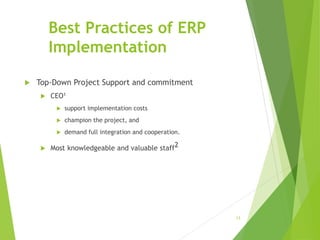
 Top-Down Project Support and commitment
 CEO1
 support implementation costs
 champion the project, and
 demand full integration and cooperation.
 Most knowledgeable and valuable staff2
13
Best Practices of ERP
Implementation
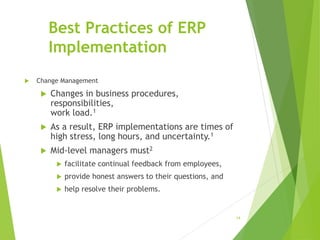
 Change Management
 Changes in business procedures,
responsibilities,
work load.1
 As a result, ERP implementations are times of
high stress, long hours, and uncertainty.1
 Mid-level managers must2
 facilitate continual feedback from employees,
 provide honest answers to their questions, and
 help resolve their problems.
14
Best Practices of ERP
Implementation
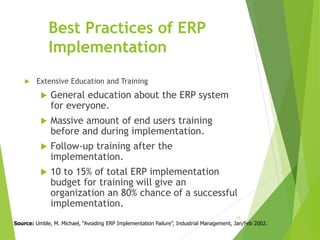
 Extensive Education and Training
 General education about the ERP system
for everyone.
 Massive amount of end users training
before and during implementation.
 Follow-up training after the
implementation.
 10 to 15% of total ERP implementation
budget for training will give an
organization an 80% chance of a successful
implementation.
15
Source: Umble, M. Michael, “Avoiding ERP Implementation Failure”, Industrial Management, Jan/Feb 2002.
Best Practices of ERP
Implementation
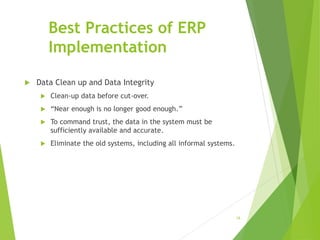
 Data Clean up and Data Integrity
 Clean-up data before cut-over.
 “Near enough is no longer good enough.”
 To command trust, the data in the system must be
sufficiently available and accurate.
 Eliminate the old systems, including all informal systems.
16
Best Practices of ERP
Implementation
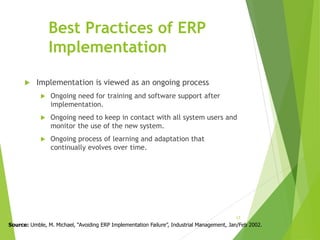
 Implementation is viewed as an ongoing process
 Ongoing need for training and software support after
implementation.
 Ongoing need to keep in contact with all system users and
monitor the use of the new system.
 Ongoing process of learning and adaptation that
continually evolves over time.
17
Source: Umble, M. Michael, “Avoiding ERP Implementation Failure”, Industrial Management, Jan/Feb 2002.
ERP Implementation Phases
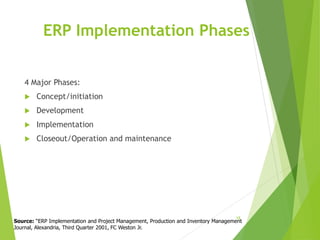
4 Major Phases:
 Concept/initiation
 Development
 Implementation
 Closeout/Operation and maintenance
18
Source: “ERP Implementation and Project Management, Production and Inventory Management
Journal, Alexandria, Third Quarter 2001, FC Weston Jr.
Conclusion
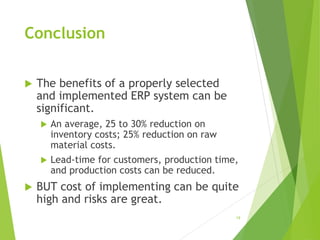
 The benefits of a properly selected
and implemented ERP system can be
significant.
 An average, 25 to 30% reduction on
inventory costs; 25% reduction on raw
material costs.
 Lead-time for customers, production time,
and production costs can be reduced.
 BUT cost of implementing can be quite
high and risks are great.
19
QUERIES…?
THANK YOU

Er pppt

  • 1.
  • 2.
    What is ERP? The practice of consolidating an enterprise’s planning, manufacturing, sales and marketing efforts into one management system.  Combines all databases across departments into a single database that can be accessed by all employees.  ERP automates the tasks involved in performing a business process. 2
  • 3.
    ERP Components  Finance:modules for bookeeping and making sure the bills are paid on time. Examples:  General ledger  Accounts receivable  Accounts payable  HR: software for handling personnel-related tasks for corporate managers and individual employees. Examples:  HR administration  Payroll  Self-service HR  Manufacturing and Logistics: A group of applications for planning production, taking orders and delivering products to the customer. Examples:  Production planning  Materials management  Order entry and processing  Warehouse management 3
  • 4.
    Who are themain ERP vendors?  Baan  JD Edwards  Oracle  PeopleSoft  SAP 4
  • 5.
    Why ERP? 3 MajorReasons: To integrate financial data. To standardize manufacturing processes. To standardize HR information. 5
  • 6.
    ERP Project andTime  Real transformational ERP efforts will usually run between 1 to 3 years, on average.  Short implementations (3 to 6 months):  small companies,  implementation limited to a small area of the company, or  the company only used the financial pieces of the ERP system.  The important thing is not to focus on how long it will take but to understand why you need ERP and how you will use it to improve your business. 6
  • 7.
    Hidden Costs ofERP  Training  Integration and testing  Data conversion  Data analysis  Consultants  Replacing best and brightest staff after implementation  Implementation teams can never stop  Waiting for ROI  Post-ERP depression 7
  • 8.
    Benefits of ERPSystems  Improving integration, flexibility  Fewer errors  Improved speed and efficiency  More complete access to information  Lower total costs in the complete supply chain  Shorten throughput times  Sustained involvement and commitment of the top management 8
  • 9.
    Benefits of ERPSystems (cont’d)  Reduce stock to a minimum  Enlarge product assortment  Improve product quality  Provide more reliable delivery dates and higher service to the customer  Efficiently coordinate global demand, supply and production 9
  • 10.
    ERP Implementation  BiggestIT project that most companies ever handle,  Changes the entire company, and  Has repercussions in all departments and divisions of the organization.  It is essential that all the key players understand the scope of the project.  This is an IT-Related Project. 10
  • 11.
    Best Practices ofERP Implementation  A Business Strategy aligned with Business Processes  Top-Down Project Support and commitment  Change Management  Extensive Education and Training  Data Clean up and Data Integrity  Implementation is viewed as an ongoing process 11
  • 12.
    Best Practices ofERP Implementation  Business strategy that will give you a competitive advantage  Analyze and map your current business processes  Develop your objectives  Evaluate your business strategy and ERP plan before you commit to software acquisition and installation. 12
  • 13.
    Best Practices ofERP Implementation  Top-Down Project Support and commitment  CEO1  support implementation costs  champion the project, and  demand full integration and cooperation.  Most knowledgeable and valuable staff2 13
  • 14.
    Best Practices ofERP Implementation  Change Management  Changes in business procedures, responsibilities, work load.1  As a result, ERP implementations are times of high stress, long hours, and uncertainty.1  Mid-level managers must2  facilitate continual feedback from employees,  provide honest answers to their questions, and  help resolve their problems. 14
  • 15.
    Best Practices ofERP Implementation  Extensive Education and Training  General education about the ERP system for everyone.  Massive amount of end users training before and during implementation.  Follow-up training after the implementation.  10 to 15% of total ERP implementation budget for training will give an organization an 80% chance of a successful implementation. 15 Source: Umble, M. Michael, “Avoiding ERP Implementation Failure”, Industrial Management, Jan/Feb 2002.
  • 16.
    Best Practices ofERP Implementation  Data Clean up and Data Integrity  Clean-up data before cut-over.  “Near enough is no longer good enough.”  To command trust, the data in the system must be sufficiently available and accurate.  Eliminate the old systems, including all informal systems. 16
  • 17.
    Best Practices ofERP Implementation  Implementation is viewed as an ongoing process  Ongoing need for training and software support after implementation.  Ongoing need to keep in contact with all system users and monitor the use of the new system.  Ongoing process of learning and adaptation that continually evolves over time. 17 Source: Umble, M. Michael, “Avoiding ERP Implementation Failure”, Industrial Management, Jan/Feb 2002.
  • 18.
    ERP Implementation Phases 4Major Phases:  Concept/initiation  Development  Implementation  Closeout/Operation and maintenance 18 Source: “ERP Implementation and Project Management, Production and Inventory Management Journal, Alexandria, Third Quarter 2001, FC Weston Jr.
  • 19.
    Conclusion  The benefitsof a properly selected and implemented ERP system can be significant.  An average, 25 to 30% reduction on inventory costs; 25% reduction on raw material costs.  Lead-time for customers, production time, and production costs can be reduced.  BUT cost of implementing can be quite high and risks are great. 19
  • 20.
  • 21.