Mgr. Petr Lupač, Ph.D.
Charles University in Prague
World Internet Project
The Czech Republic
Financed due to Grant Agency of the Czech Republic (GA13-21024S)
„World Internet Project –The Czech Republic II“
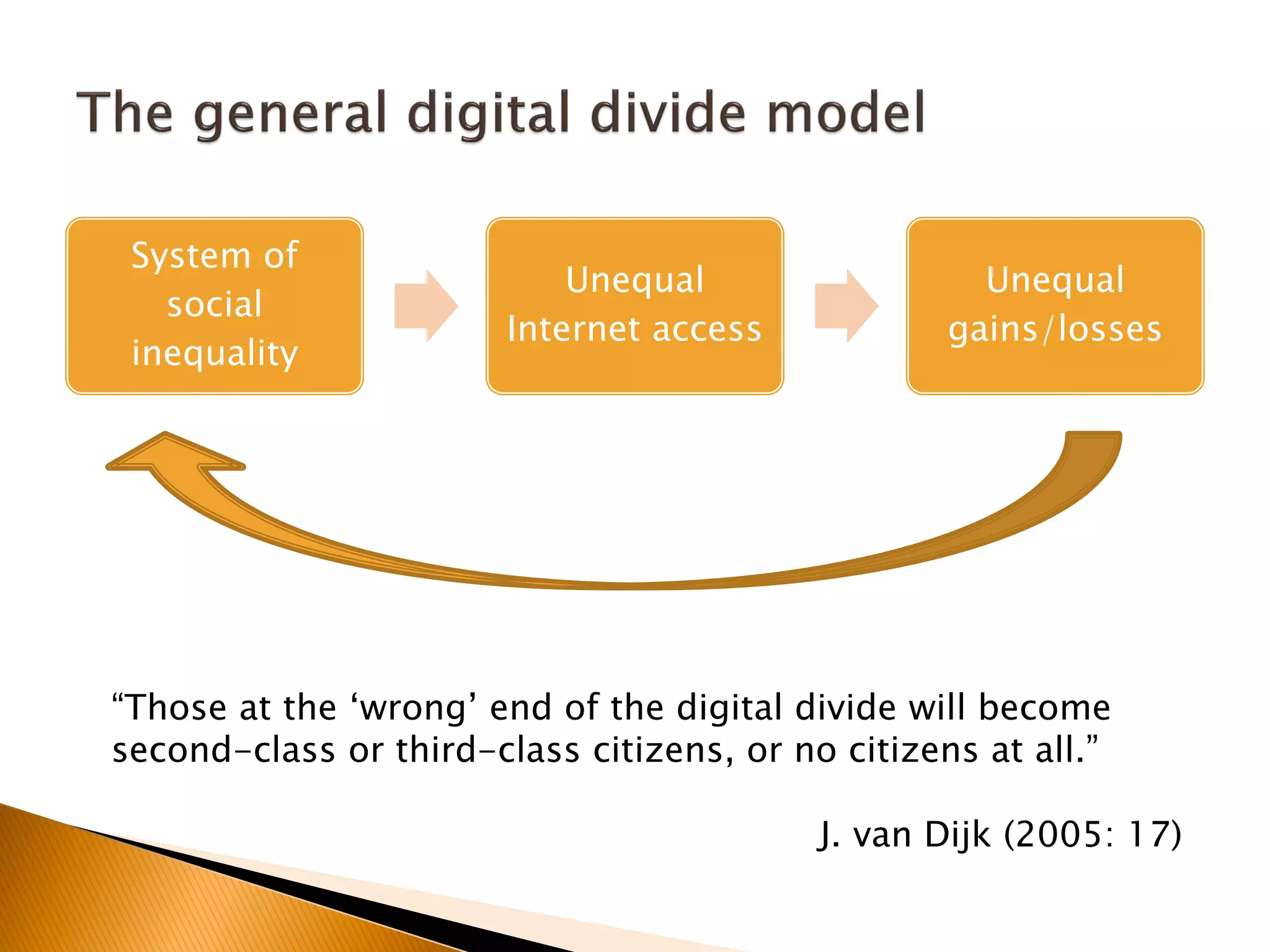
System of
social
inequality
Unequal
Internet access
Unequal
gains/losses
“Those at the ‘wrong’ end of the digital divide will become
second-class or third-class citizens, or no citizens at all.”
J. van Dijk (2005: 17)
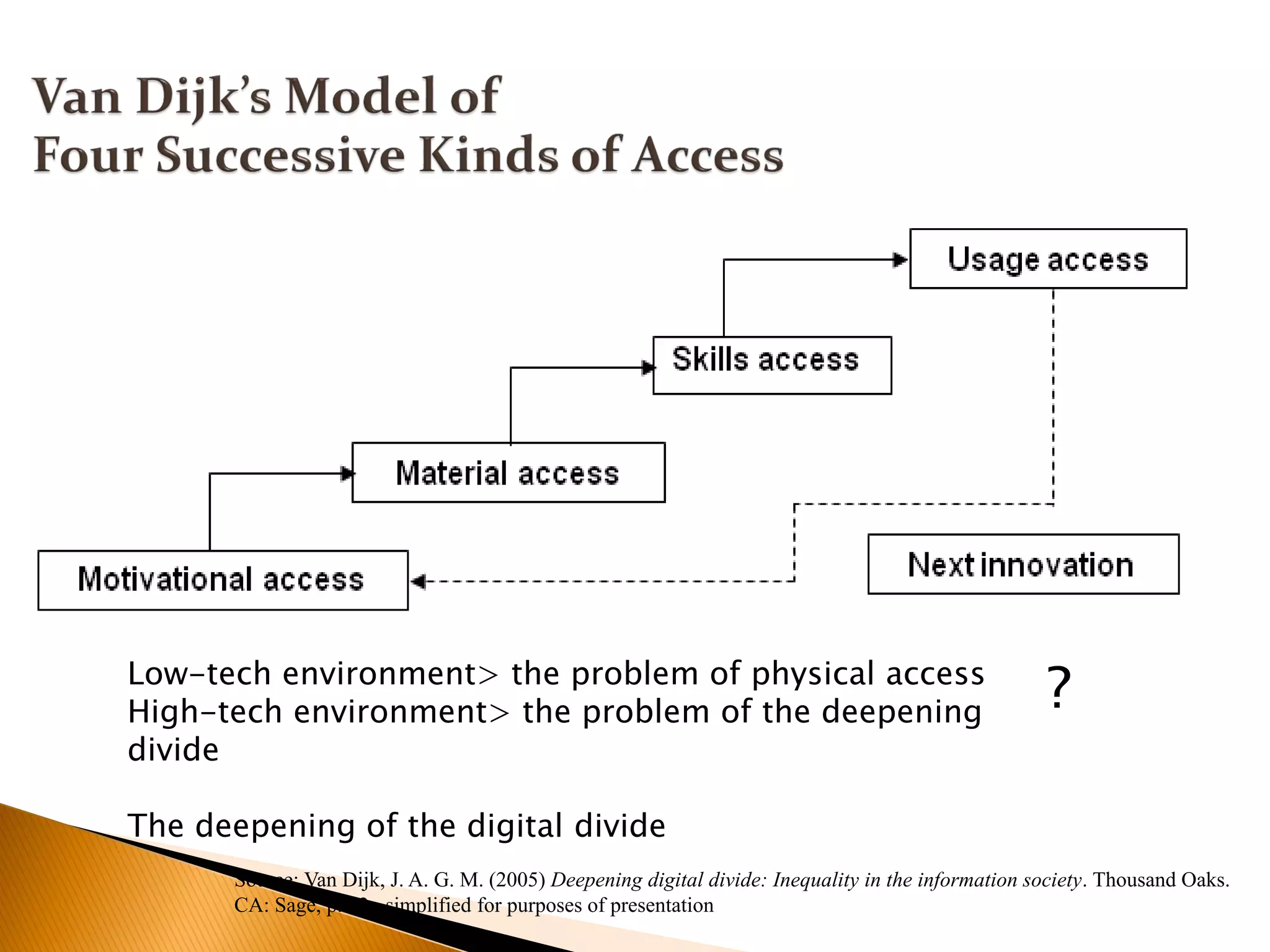
Source: Van Dijk, J. A. G. M. (2005) Deepening digital divide: Inequality in the information society. Thousand Oaks.
CA: Sage, p. 22; simplified for purposes of presentation
Low-tech environment> the problem of physical access
High-tech environment> the problem of the deepening
divide
The deepening of the digital divide
?
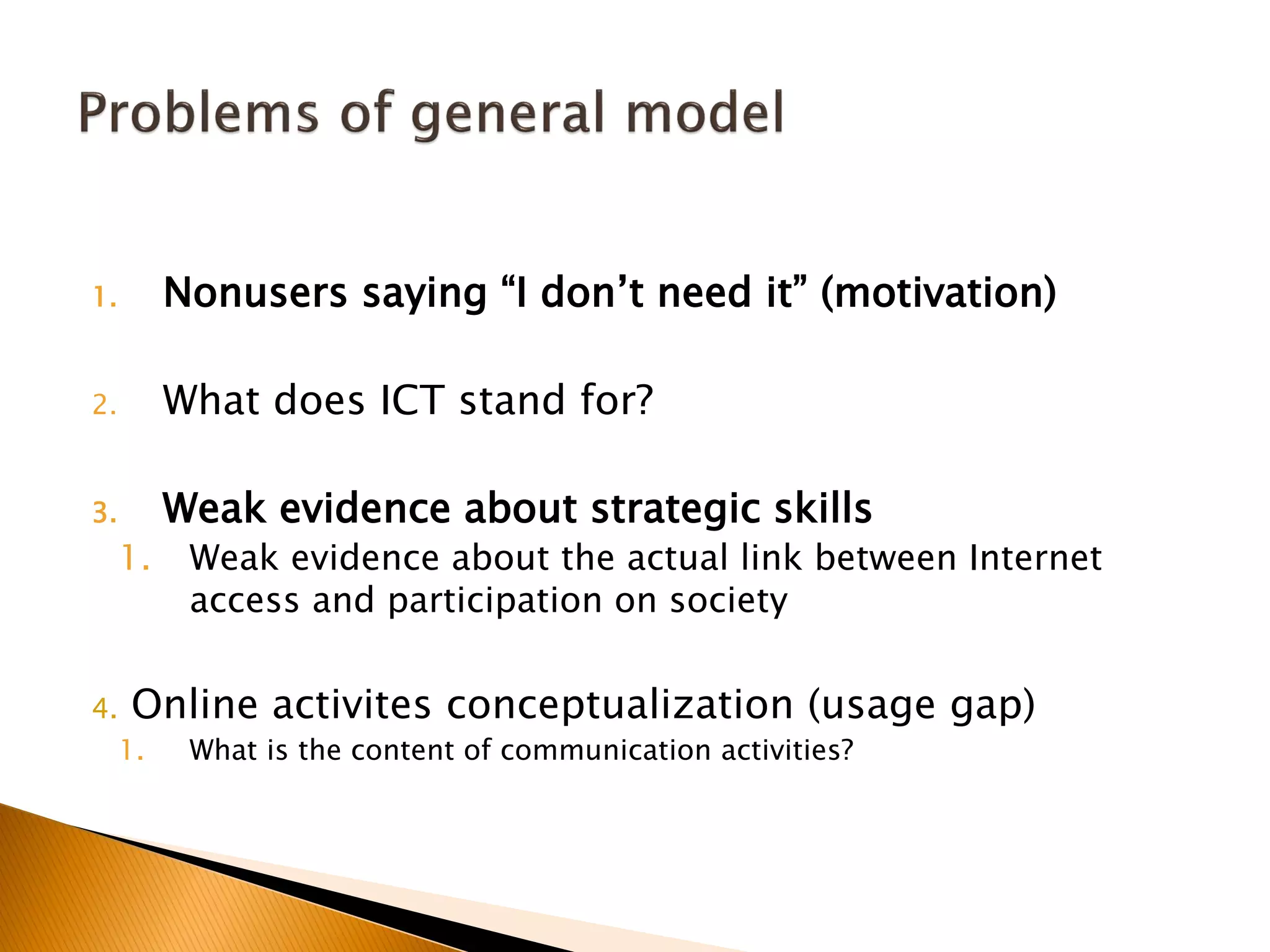
1. Nonusers saying “I don’t need it” (motivation)
2. What does ICT stand for?
3. Weak evidence about strategic skills
1. Weak evidence about the actual link between Internet
access and participation on society
4. Online activites conceptualization (usage gap)
1. What is the content of communication activities?
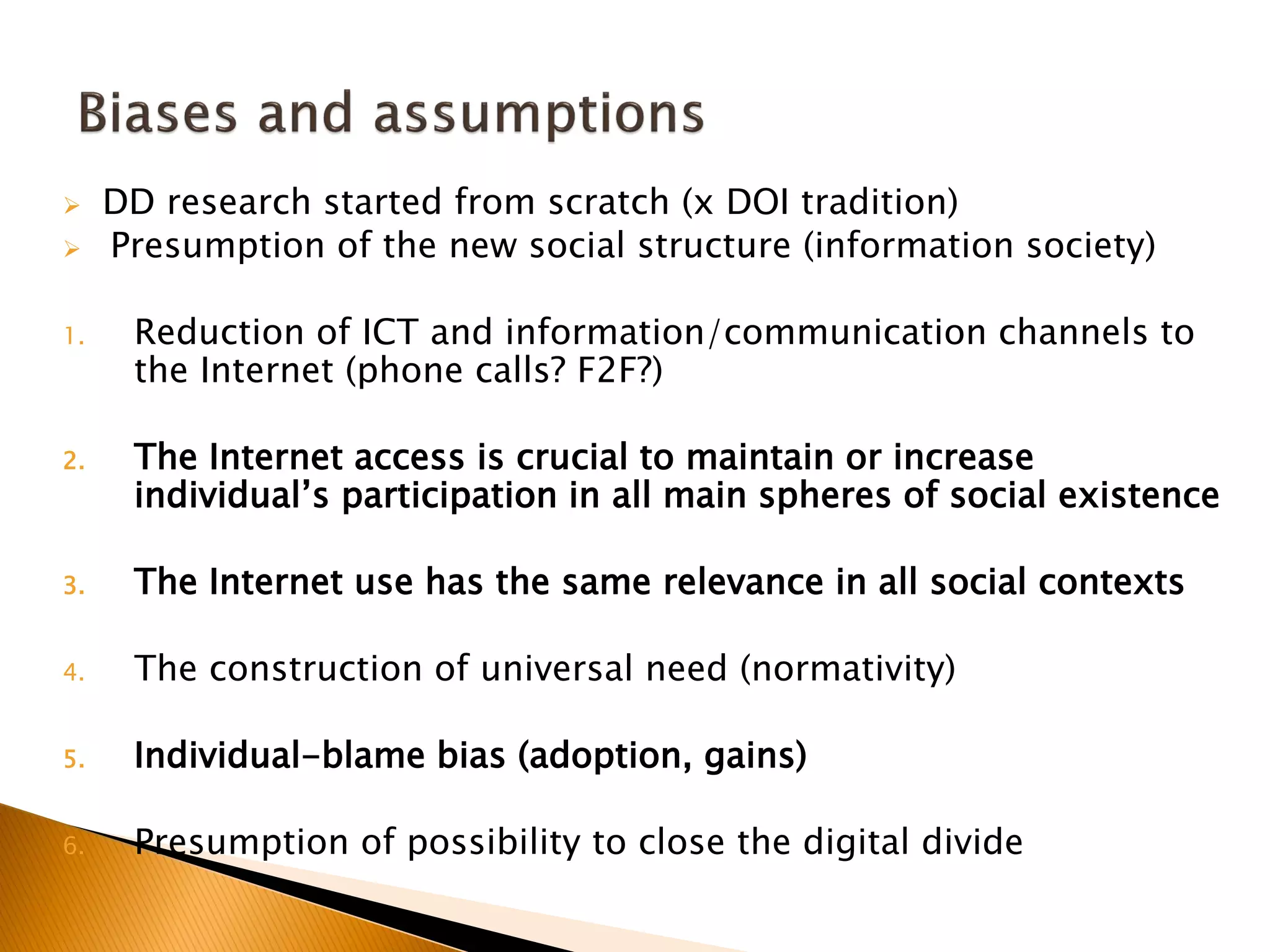
 DD research started from scratch (x DOI tradition)
 Presumption of the new social structure (information society)
1. Reduction of ICT and information/communication channels to
the Internet (phone calls? F2F?)
2. The Internet access is crucial to maintain or increase
individual’s participation in all main spheres of social existence
3. The Internet use has the same relevance in all social contexts
4. The construction of universal need (normativity)
5. Individual-blame bias (adoption, gains)
6. Presumption of possibility to close the digital divide
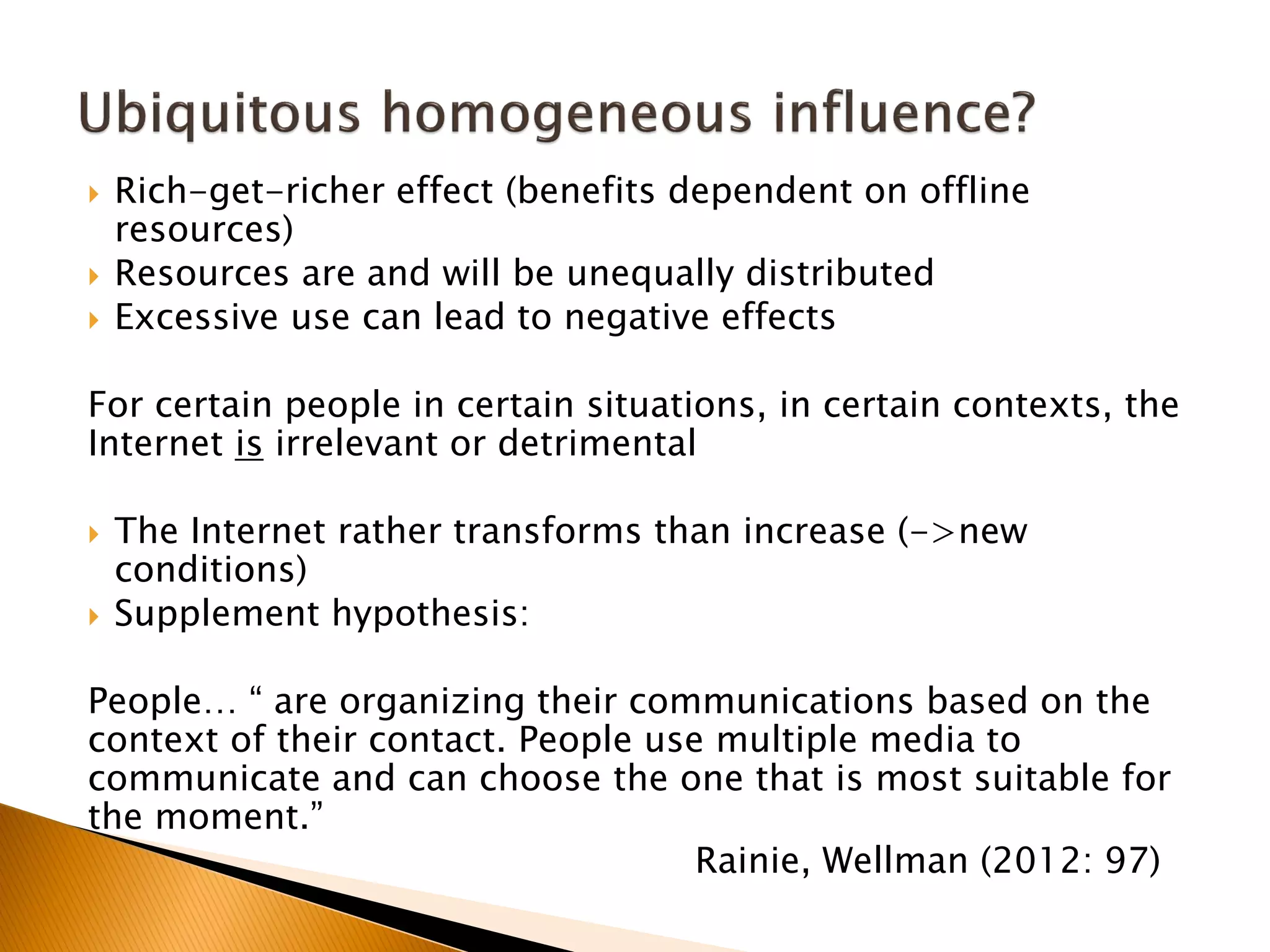
 Rich-get-richer effect (benefits dependent on offline
resources)
 Resources are and will be unequally distributed
 Excessive use can lead to negative effects
For certain people in certain situations, in certain contexts, the
Internet is irrelevant or detrimental
 The Internet rather transforms than increase (->new
conditions)
 Supplement hypothesis:
People… “ are organizing their communications based on the
context of their contact. People use multiple media to
communicate and can choose the one that is most suitable for
the moment.”
Rainie, Wellman (2012: 97)
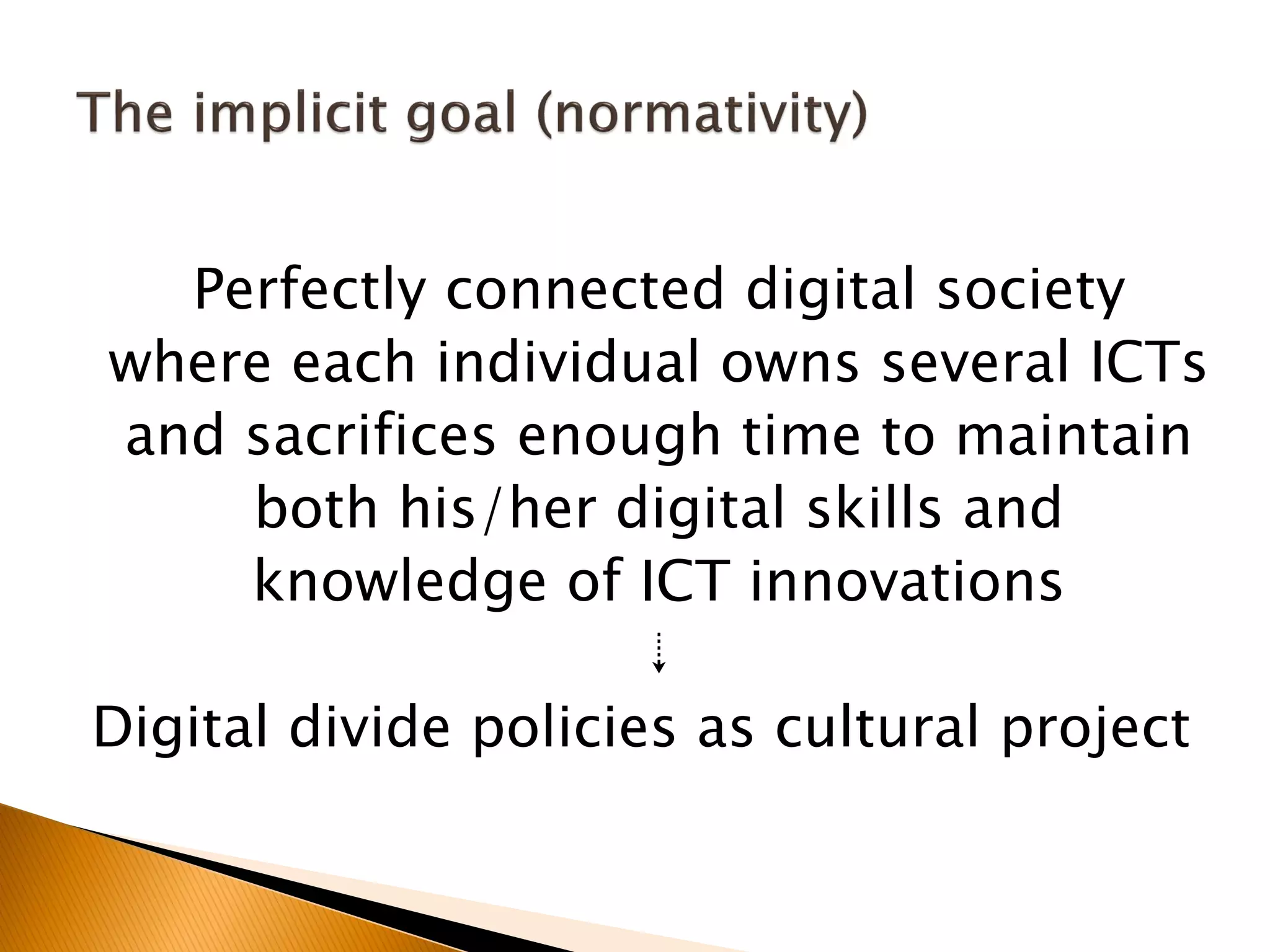
Perfectly connected digital society
where each individual owns several ICTs
and sacrifices enough time to maintain
both his/her digital skills and
knowledge of ICT innovations
⇣
Digital divide policies as cultural project
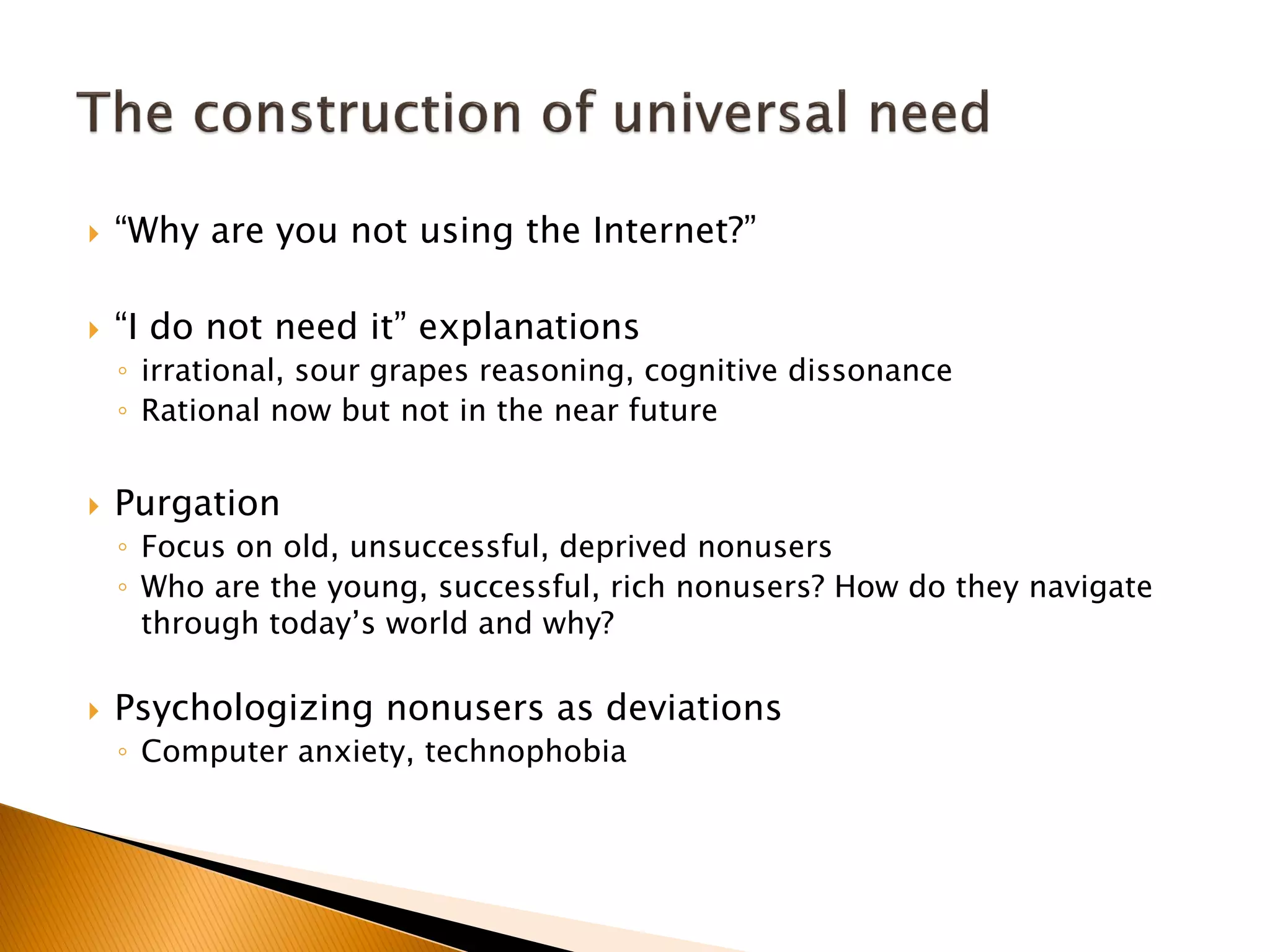
 “Why are you not using the Internet?”
 “I do not need it” explanations
◦ irrational, sour grapes reasoning, cognitive dissonance
◦ Rational now but not in the near future
 Purgation
◦ Focus on old, unsuccessful, deprived nonusers
◦ Who are the young, successful, rich nonusers? How do they navigate
through today’s world and why?
 Psychologizing nonusers as deviations
◦ Computer anxiety, technophobia
“the tendency to hold an individual responsible for his or her
problems, rather than the system of which the individual is a part
(Caplan and Nelson, 1973)”
(Rogers, 1983: 103)
 Individual factors of adoption (scdmg, attitudes, motivation, …)
 ICT use as an individual, isolated activity (x cultures of sharing)
 Outcomes derived from individual skills and online activities
 „Usage gap“ overlooks the content of „communication activities“
 Nonusers are not isolated entities
Metcalf’s Law :
“the value of a telecommunications network is proportional to the
square of the number of connected users of the system”
The Flip Side of Metcalf’s Law (Tongia & Wilson, 2011):
“as a network grows in size and value, those outside the network
face growing disparities. (…) The increasing costs of not being in
the network can spread to the “included”.
Examples:
- Car transportation and sidewalks, public transport
- Health care system and uninsured
- Taxi driving system nowadays and nonusers
- Broadband Internet and those with slow connection
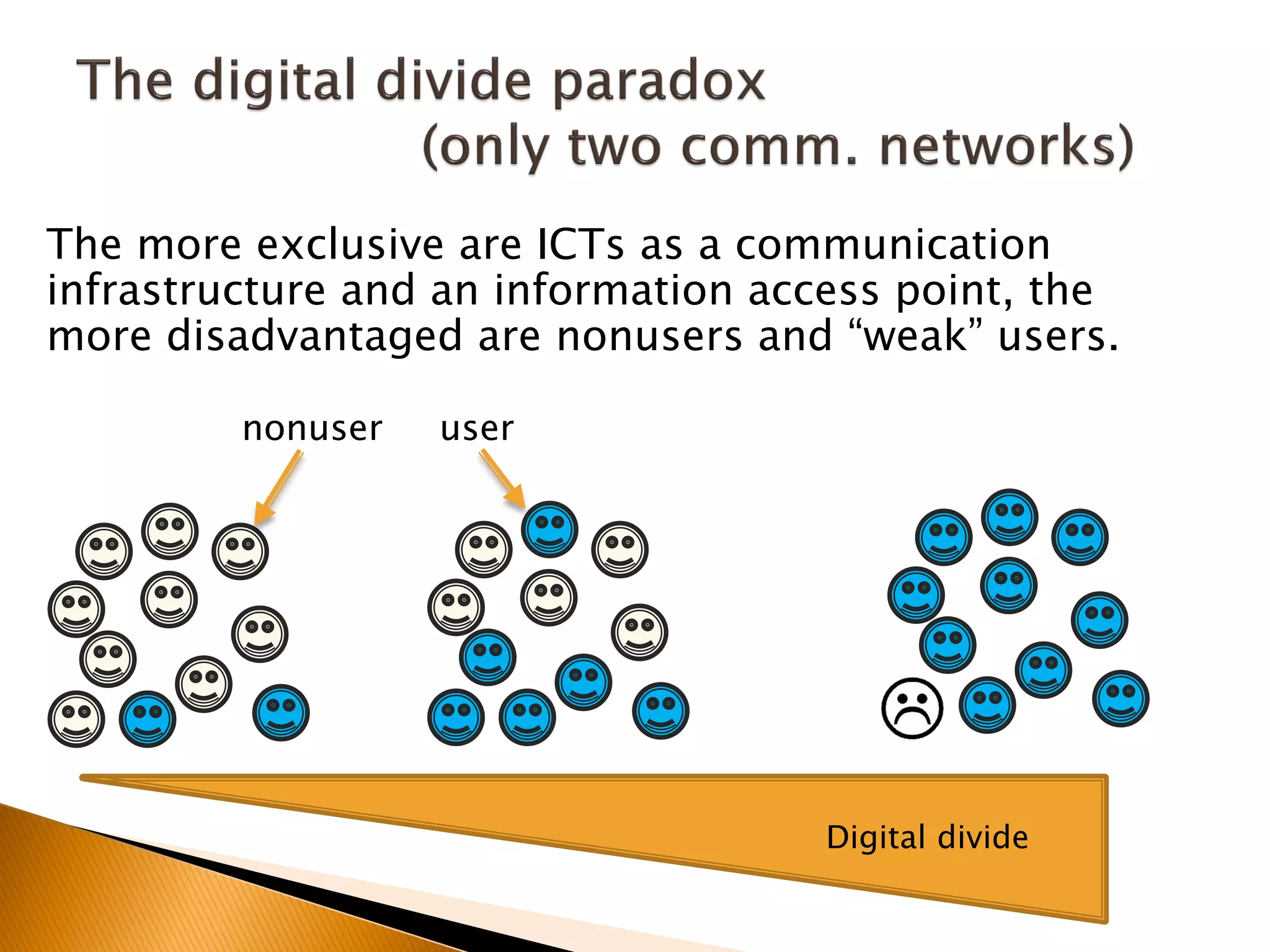
The more exclusive are ICTs as a communication
infrastructure and an information access point, the
more disadvantaged are nonusers and “weak” users.
nonuser user
Digital divide
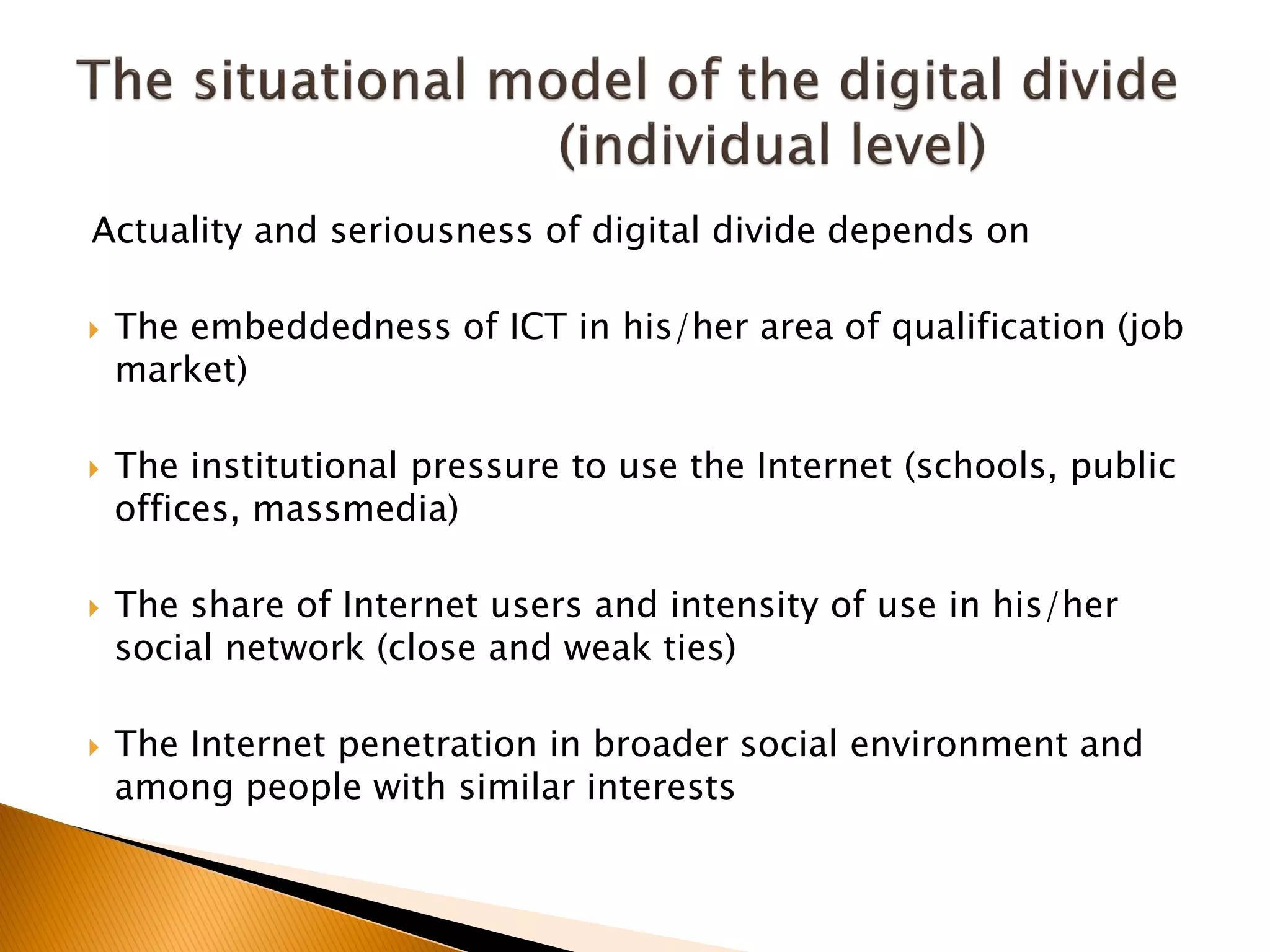
In the given situation, actuality and seriousness of digital divide
depends on
 Ratio of communication networks size
 Availability of alternative communication channels or information
sources
 The costs differences (incl. translation points)
 Infrastructure-induced required level of skills
 Situational digital divide
(Situational information society !)
Actuality and seriousness of digital divide depends on
 The embeddedness of ICT in his/her area of qualification (job
market)
 The institutional pressure to use the Internet (schools, public
offices, massmedia)
 The share of Internet users and intensity of use in his/her
social network (close and weak ties)
 The Internet penetration in broader social environment and
among people with similar interests
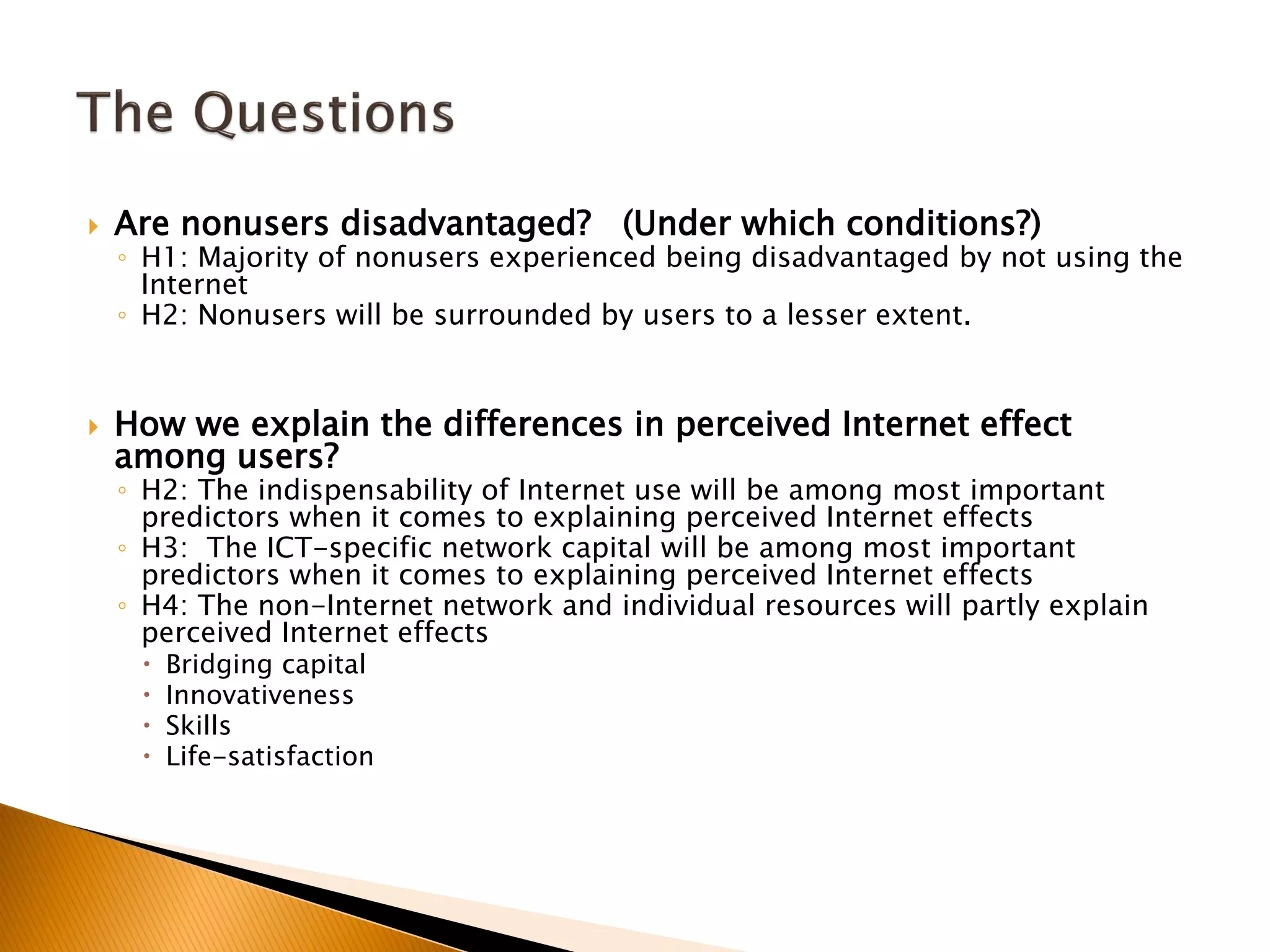
 Are nonusers disadvantaged? (Under which conditions?)
◦ H1: Majority of nonusers experienced being disadvantaged by not using the
Internet
◦ H2: Nonusers will be surrounded by users to a lesser extent.
 How we explain the differences in perceived Internet effect
among users?
◦ H2: The indispensability of Internet use will be among most important
predictors when it comes to explaining perceived Internet effects
◦ H3: The ICT-specific network capital will be among most important
predictors when it comes to explaining perceived Internet effects
◦ H4: The non-Internet network and individual resources will partly explain
perceived Internet effects
 Bridging capital
 Innovativeness
 Skills
 Life-satisfaction
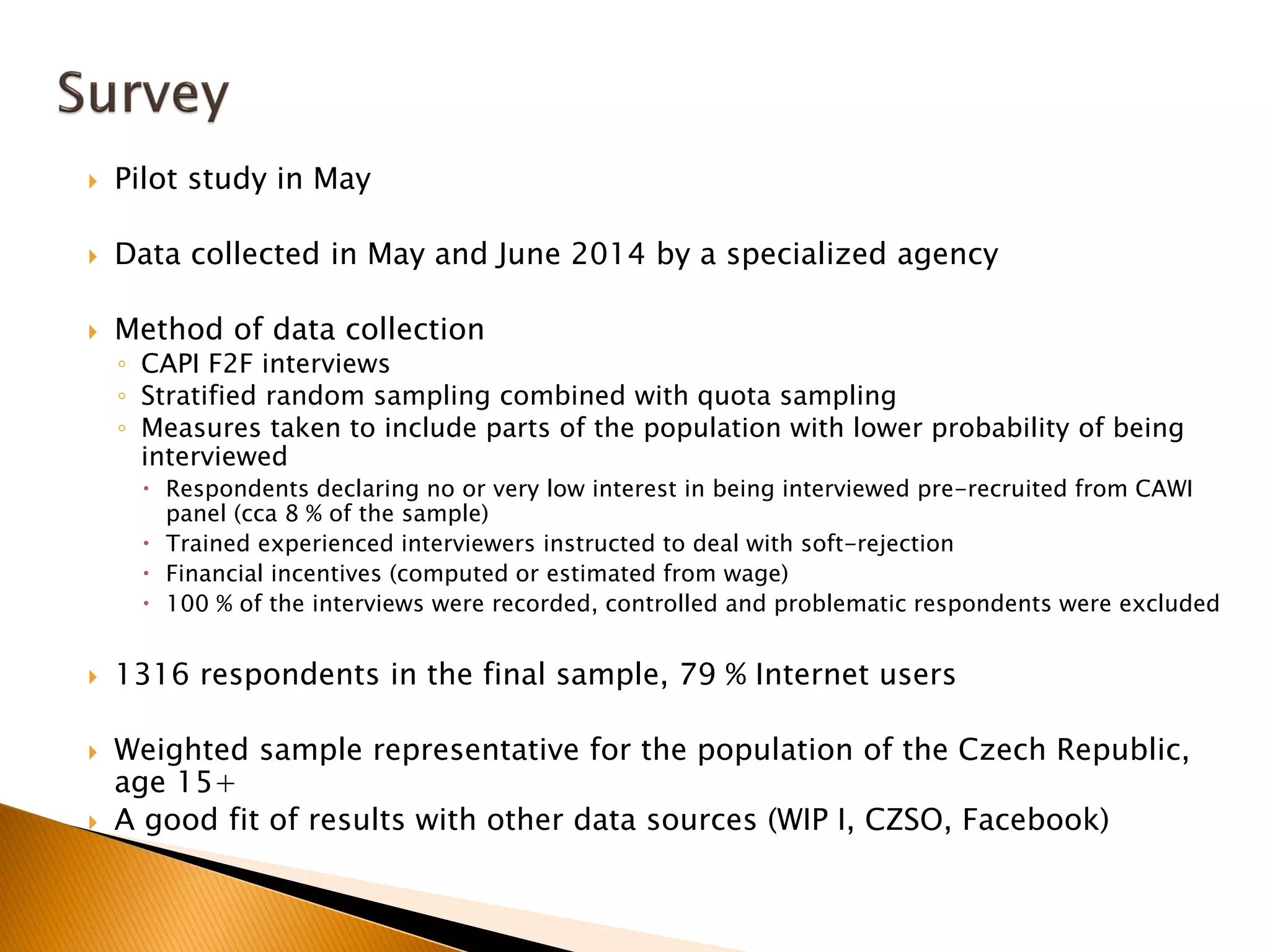
 Pilot study in May
 Data collected in May and June 2014 by a specialized agency
 Method of data collection
◦ CAPI F2F interviews
◦ Stratified random sampling combined with quota sampling
◦ Measures taken to include parts of the population with lower probability of being
interviewed
 Respondents declaring no or very low interest in being interviewed pre-recruited from CAWI
panel (cca 8 % of the sample)
 Trained experienced interviewers instructed to deal with soft-rejection
 Financial incentives (computed or estimated from wage)
 100 % of the interviews were recorded, controlled and problematic respondents were excluded
 1316 respondents in the final sample, 79 % Internet users
 Weighted sample representative for the population of the Czech Republic,
age 15+
 A good fit of results with other data sources (WIP I, CZSO, Facebook)
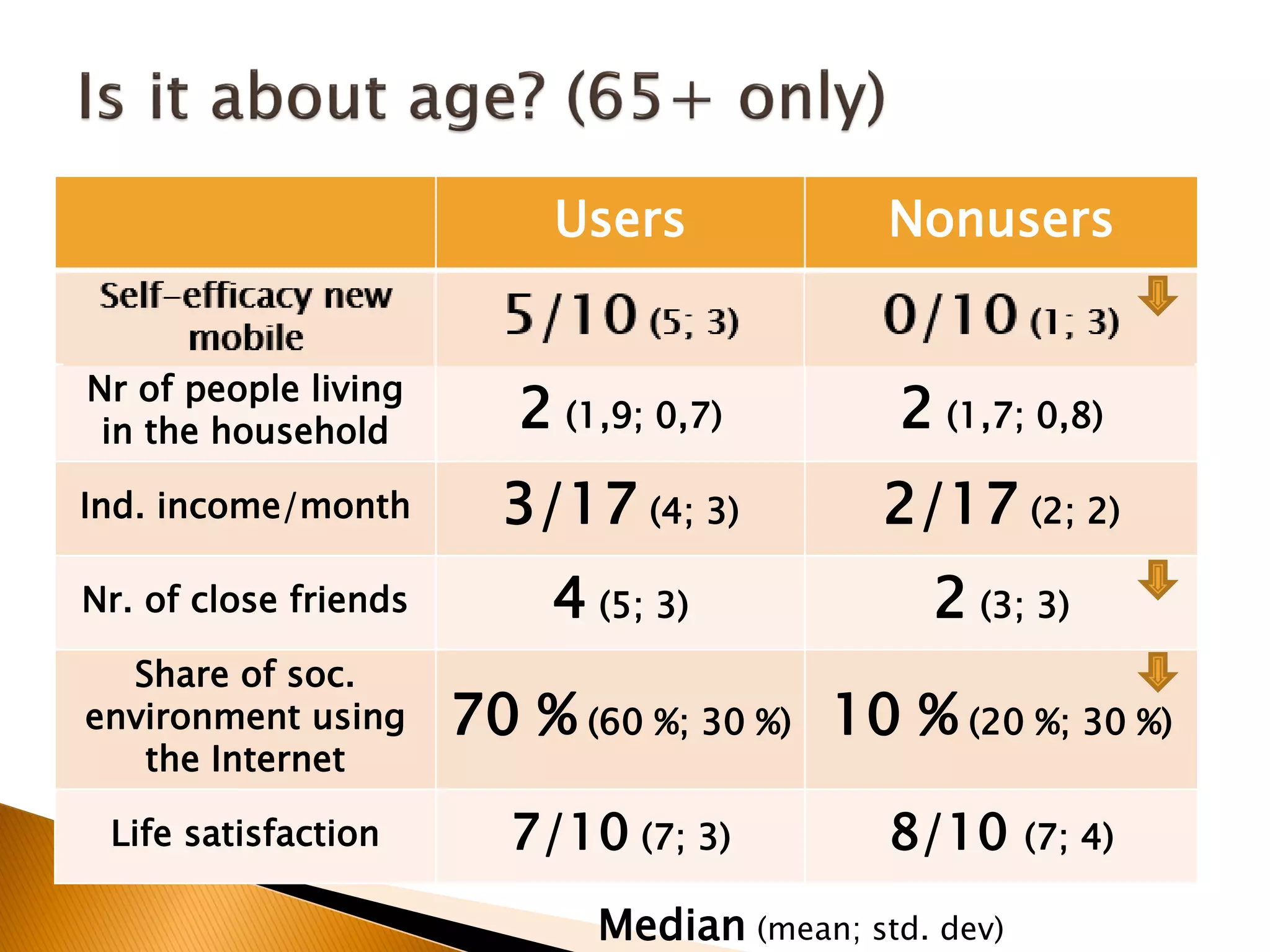
Users Nonusers
Nr of people living
in the household 2 (1,9; 0,7) 2 (1,7; 0,8)
Ind. income/month 3/17 (4; 3) 2/17 (2; 2)
Nr. of close friends 4 (5; 3) 2 (3; 3)
Share of soc.
environment using
the Internet
70 % (60 %; 30 %) 10 % (20 %; 30 %)
Life satisfaction 7/10 (7; 3) 8/10 (7; 4)
Median (mean; std. dev)
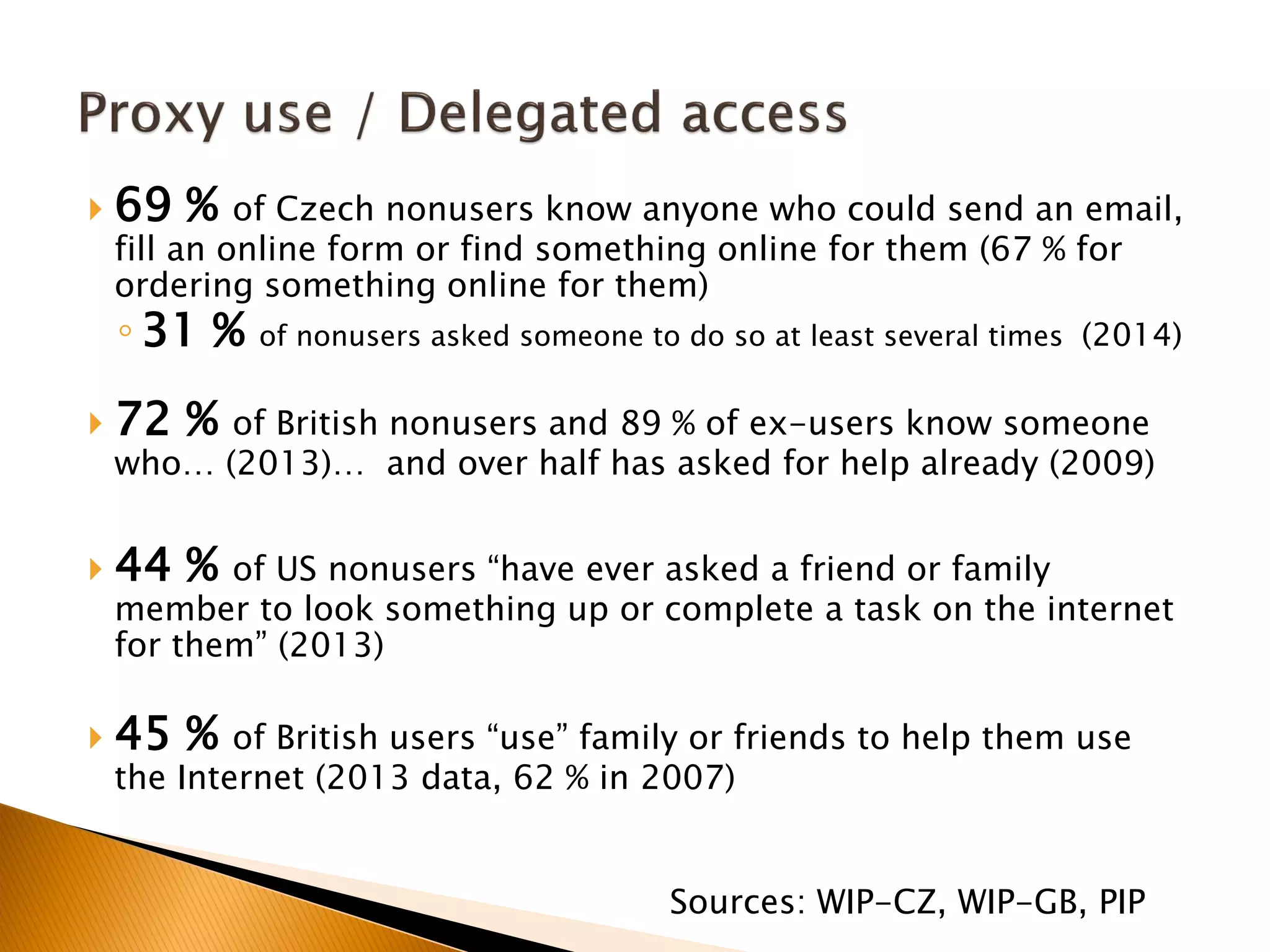
 69 % of Czech nonusers know anyone who could send an email,
fill an online form or find something online for them (67 % for
ordering something online for them)
◦ 31 % of nonusers asked someone to do so at least several times (2014)
 72 % of British nonusers and 89 % of ex-users know someone
who… (2013)… and over half has asked for help already (2009)
 44 % of US nonusers “have ever asked a friend or family
member to look something up or complete a task on the internet
for them” (2013)
 45 % of British users “use” family or friends to help them use
the Internet (2013 data, 62 % in 2007)
Sources: WIP-CZ, WIP-GB, PIP
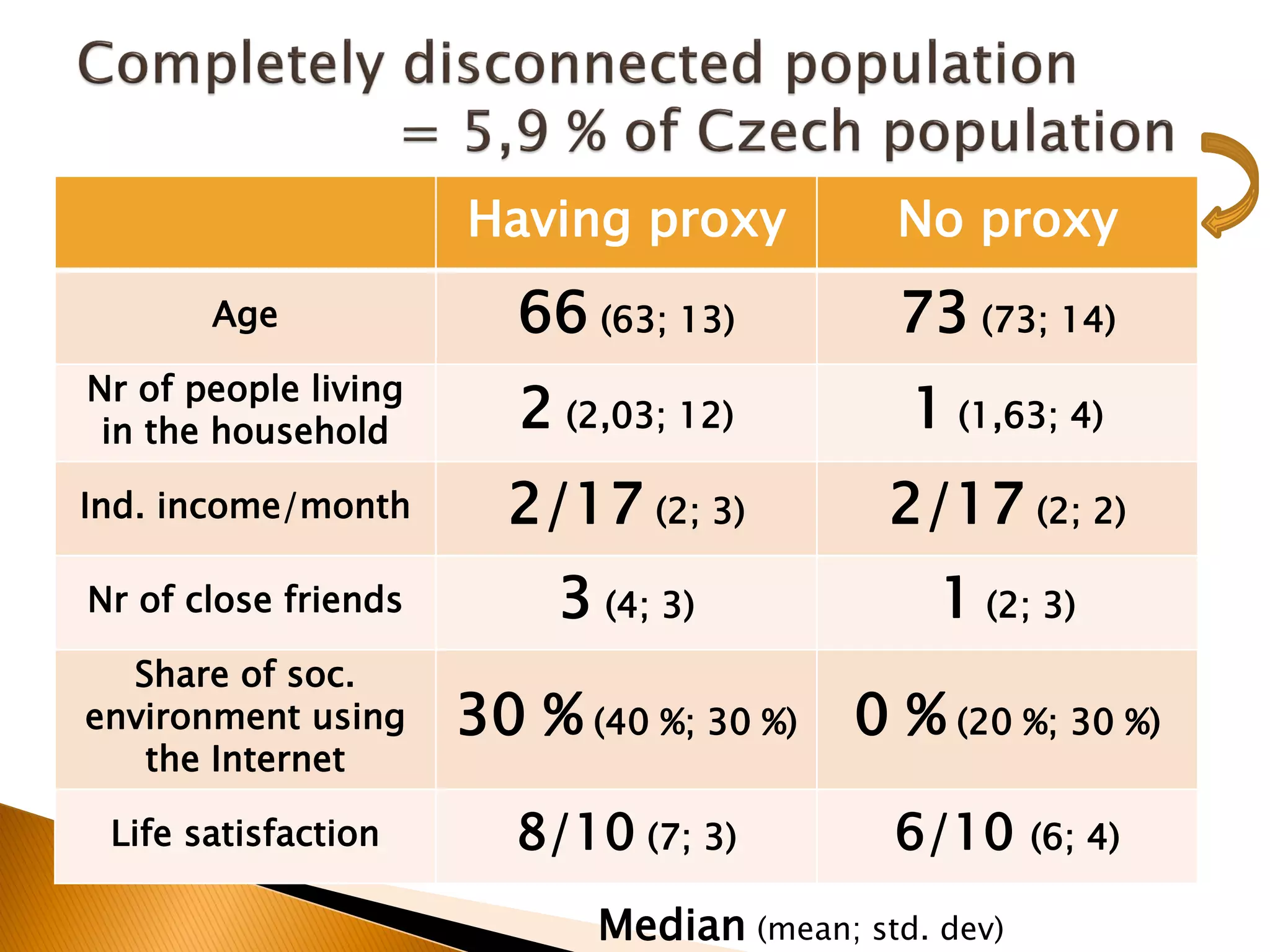
Having proxy No proxy
Age 66 (63; 13) 73 (73; 14)
Nr of people living
in the household 2 (2,03; 12) 1 (1,63; 4)
Ind. income/month 2/17 (2; 3) 2/17 (2; 2)
Nr of close friends 3 (4; 3) 1 (2; 3)
Share of soc.
environment using
the Internet
30 % (40 %; 30 %) 0 % (20 %; 30 %)
Life satisfaction 8/10 (7; 3) 6/10 (6; 4)
Median (mean; std. dev)
Question:
Not-using the Internet can be either advantage or disadvantage.
Thinking about your personal experience in the recent years, how
much does the fact that you are not using the Internet affected
your life in the following areas?
Please, answer with the help of a scale, where -5 means significant
worsening and +5 means significant improvement.
[Scale:]
-5 -4 -3 -2 -1 0 1 2 3 4 5
(-5=Significant worsening 5 = Significant
improvement)
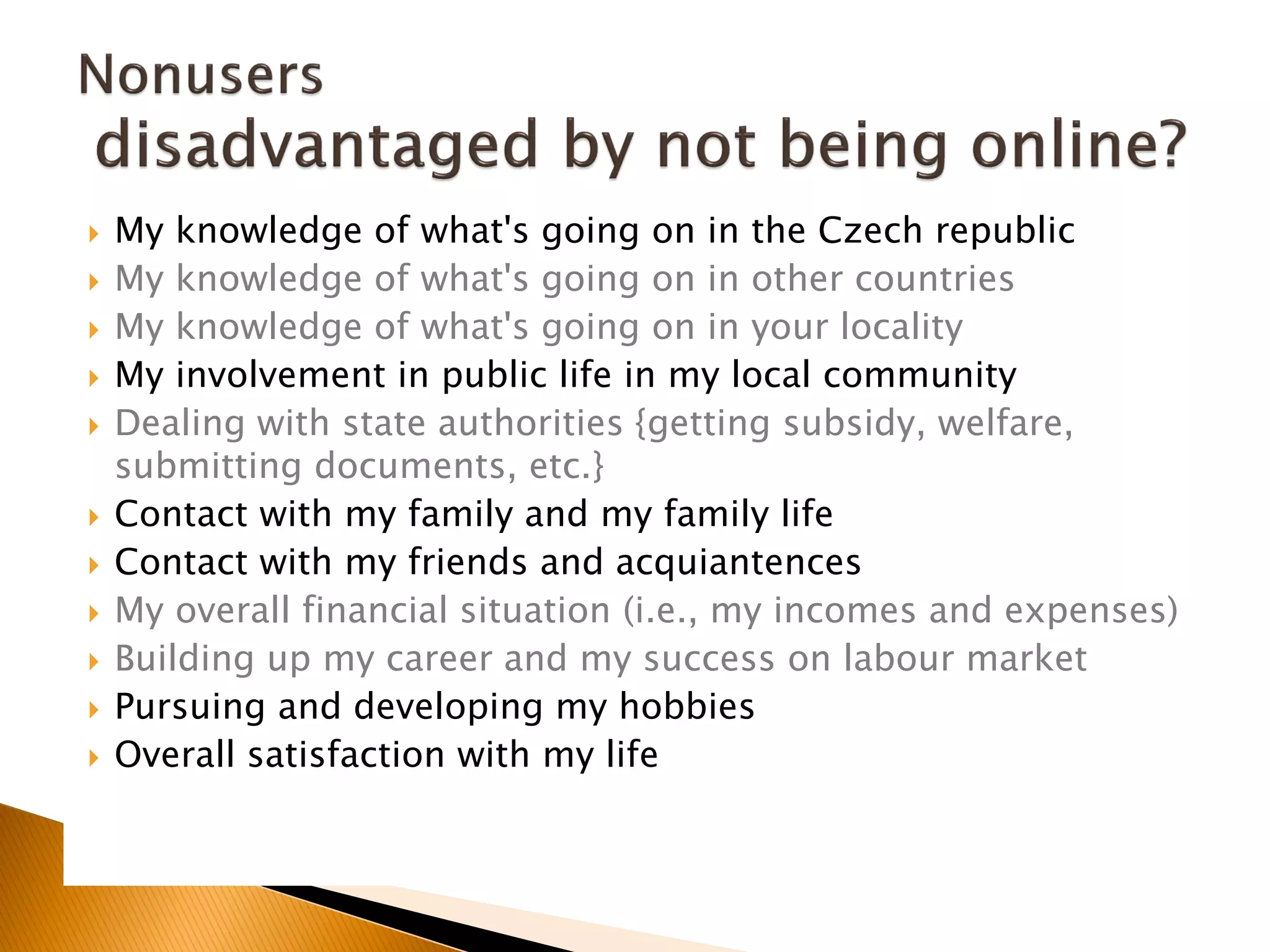
 My knowledge of what's going on in the Czech republic
 My knowledge of what's going on in other countries
 My knowledge of what's going on in your locality
 My involvement in public life in my local community
 Dealing with state authorities {getting subsidy, welfare,
submitting documents, etc.}
 Contact with my family and my family life
 Contact with my friends and acquiantences
 My overall financial situation (i.e., my incomes and expenses)
 Building up my career and my success on labour market
 Pursuing and developing my hobbies
 Overall satisfaction with my life
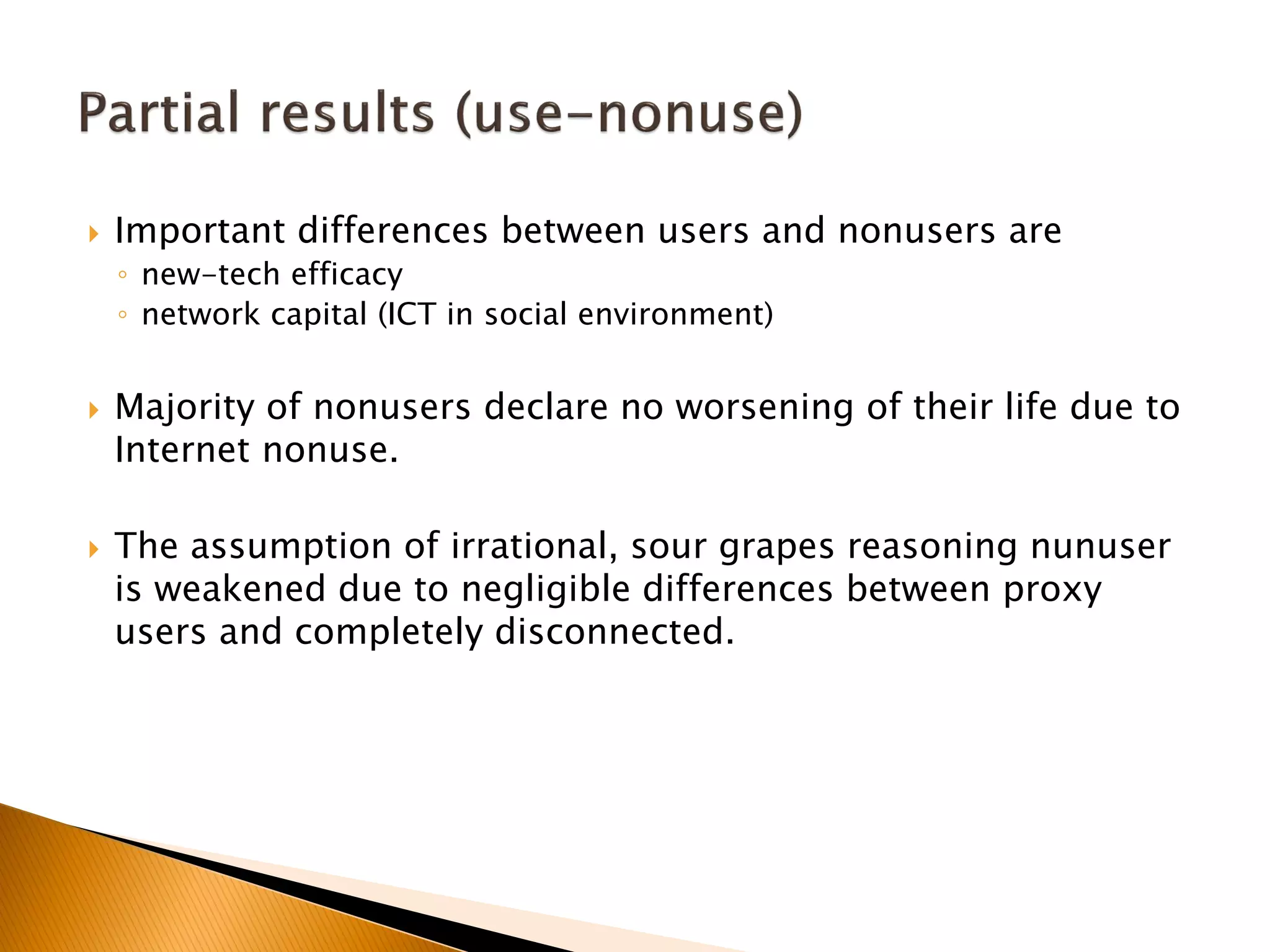
 Important differences between users and nonusers are
◦ new-tech efficacy
◦ network capital (ICT in social environment)
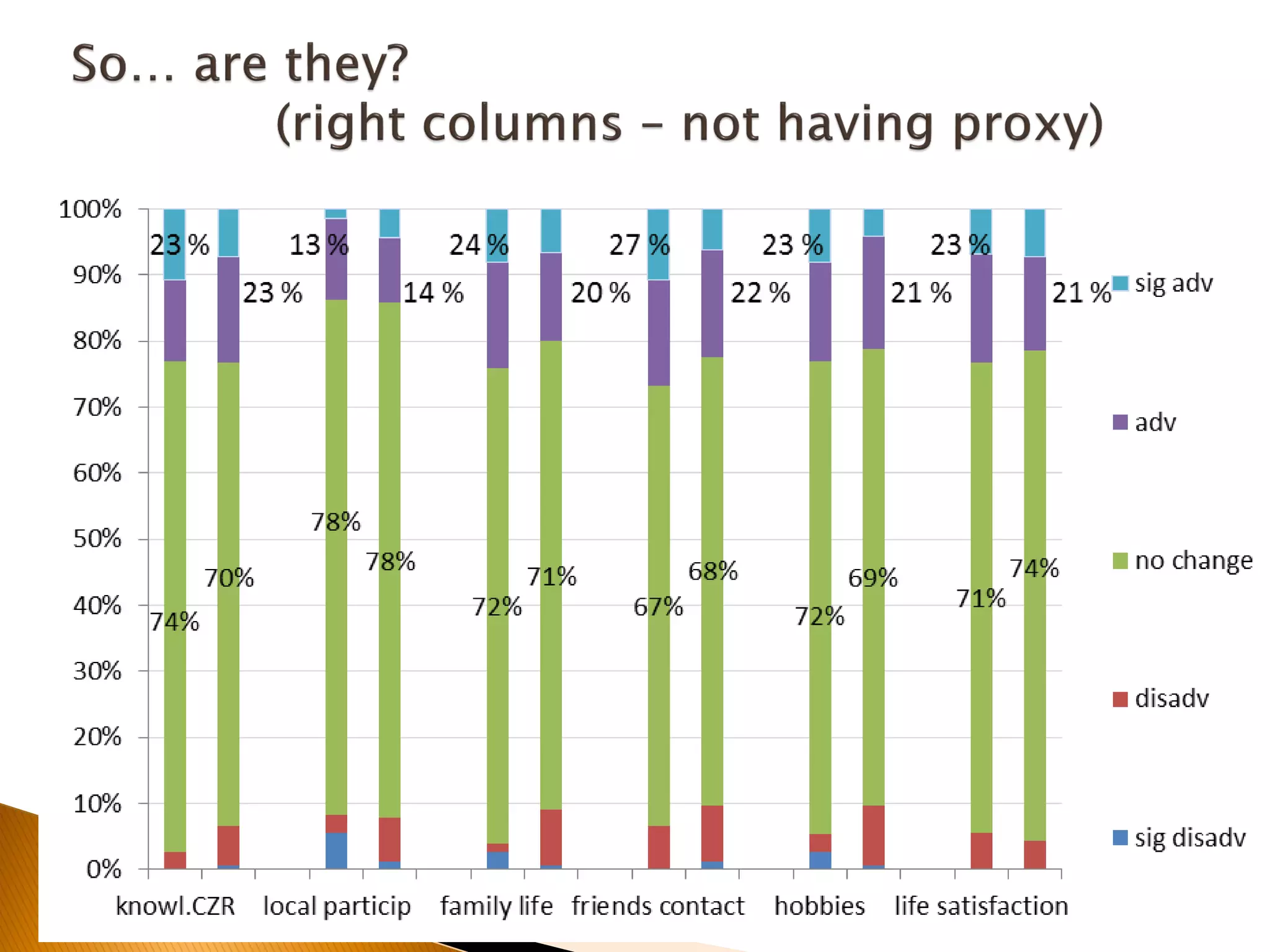
 Majority of nonusers declare no worsening of their life due to
Internet nonuse.
 The assumption of irrational, sour grapes reasoning nunuser
is weakened due to negligible differences between proxy
users and completely disconnected.
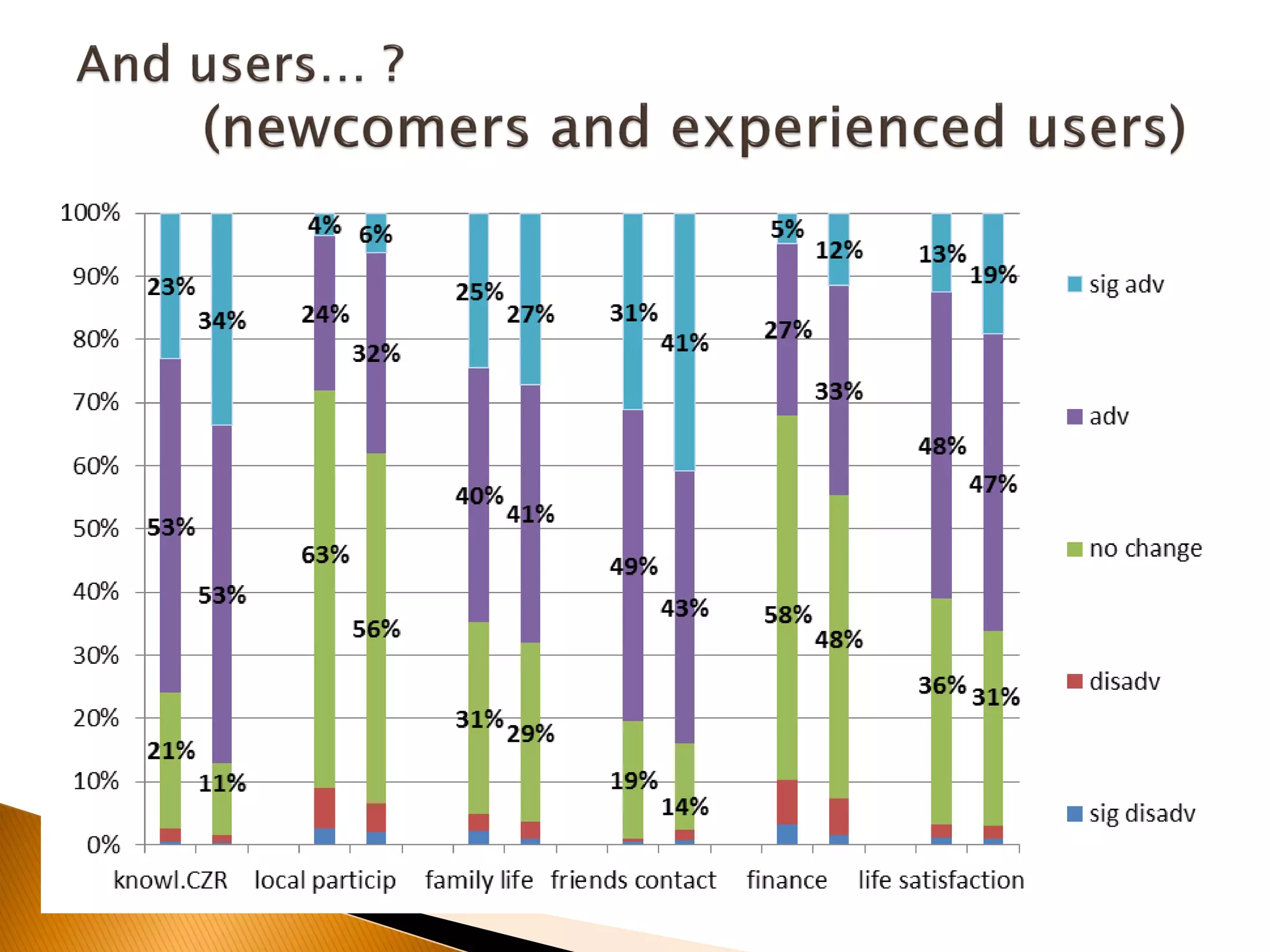
Using the Internet can either improve or worsen people's lifes.
When you think about your personal experience in the last
years, how much influences your Internet use following areas
of your life?
Please, answer with the help of a scale, where -5 means
significant worsening and +5 means significant improvement.
[Scale:]
-5 -4 -3 -2 -1 0 1 2 3 4 5
(-5=Significant worsening 5 = Significant improvement)
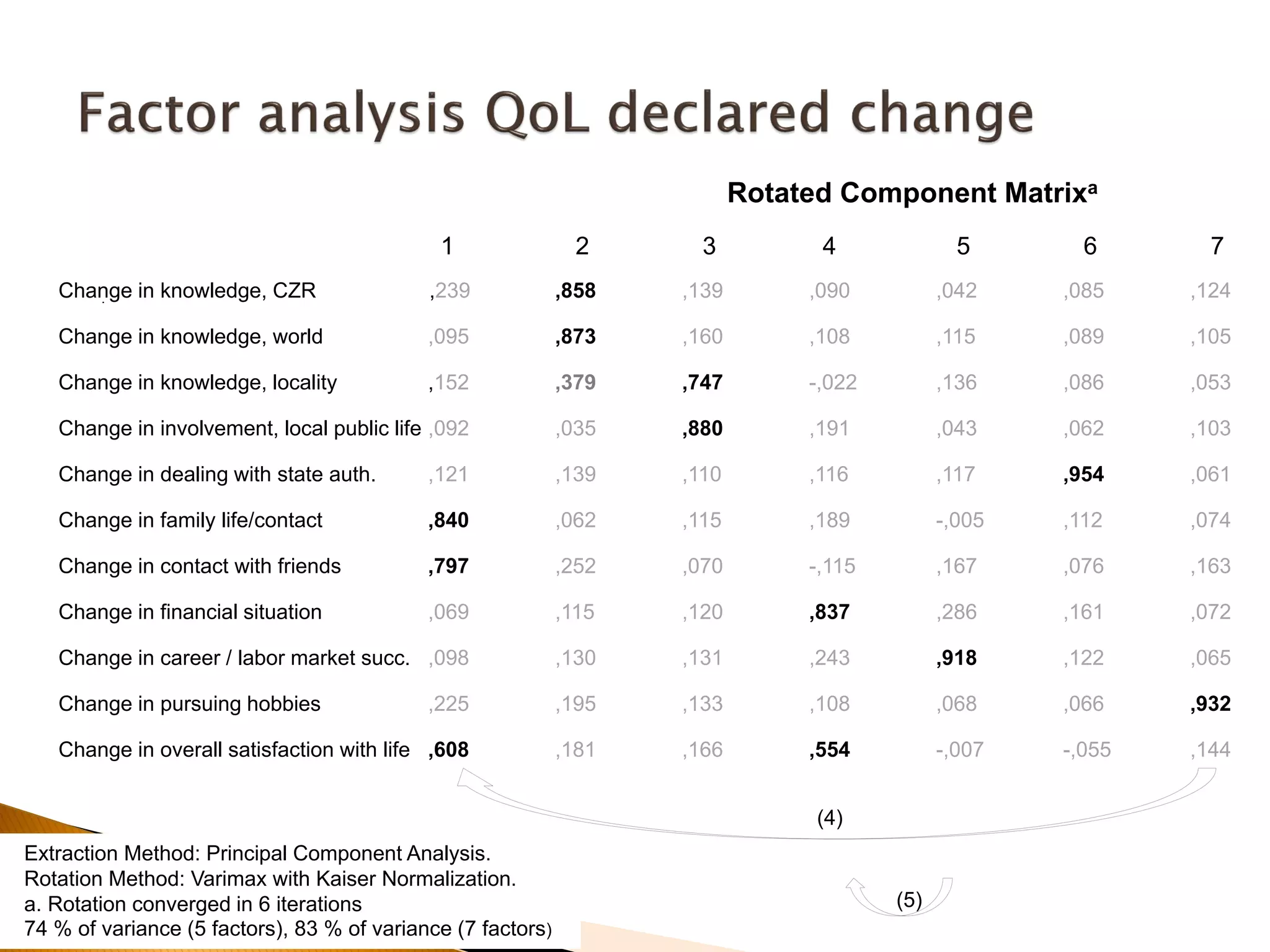
Rotated Component Matrixa
1 2 3 4 5 6 7
Change in knowledge, CZR ,239 ,858 ,139 ,090 ,042 ,085 ,124
Change in knowledge, world ,095 ,873 ,160 ,108 ,115 ,089 ,105
Change in knowledge, locality ,152 ,379 ,747 -,022 ,136 ,086 ,053
Change in involvement, local public life ,092 ,035 ,880 ,191 ,043 ,062 ,103
Change in dealing with state auth. ,121 ,139 ,110 ,116 ,117 ,954 ,061
Change in family life/contact ,840 ,062 ,115 ,189 -,005 ,112 ,074
Change in contact with friends ,797 ,252 ,070 -,115 ,167 ,076 ,163
Change in financial situation ,069 ,115 ,120 ,837 ,286 ,161 ,072
Change in career / labor market succ. ,098 ,130 ,131 ,243 ,918 ,122 ,065
Change in pursuing hobbies ,225 ,195 ,133 ,108 ,068 ,066 ,932
Change in overall satisfaction with life ,608 ,181 ,166 ,554 -,007 -,055 ,144
(4)
(5)
.
Extraction Method: Principal Component Analysis.
Rotation Method: Varimax with Kaiser Normalization.
a. Rotation converged in 6 iterations
74 % of variance (5 factors), 83 % of variance (7 factors)
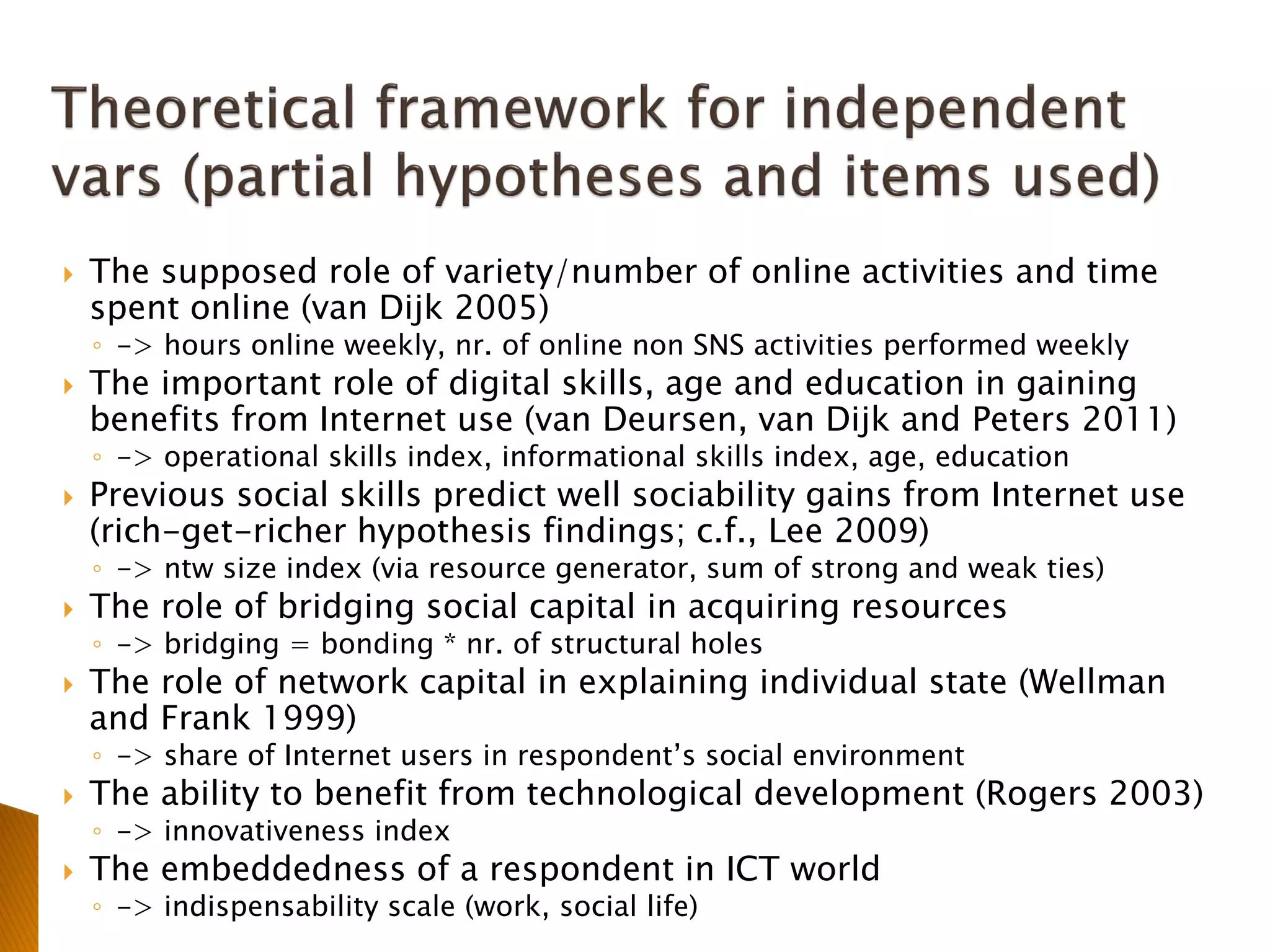
 The supposed role of variety/number of online activities and time
spent online (van Dijk 2005)
◦ -> hours online weekly, nr. of online non SNS activities performed weekly
 The important role of digital skills, age and education in gaining
benefits from Internet use (van Deursen, van Dijk and Peters 2011)
◦ -> operational skills index, informational skills index, age, education
 Previous social skills predict well sociability gains from Internet use
(rich-get-richer hypothesis findings; c.f., Lee 2009)
◦ -> ntw size index (via resource generator, sum of strong and weak ties)
 The role of bridging social capital in acquiring resources
◦ -> bridging = bonding * nr. of structural holes
 The role of network capital in explaining individual state (Wellman
and Frank 1999)
◦ -> share of Internet users in respondent’s social environment
 The ability to benefit from technological development (Rogers 2003)
◦ -> innovativeness index
 The embeddedness of a respondent in ICT world
◦ -> indispensability scale (work, social life)
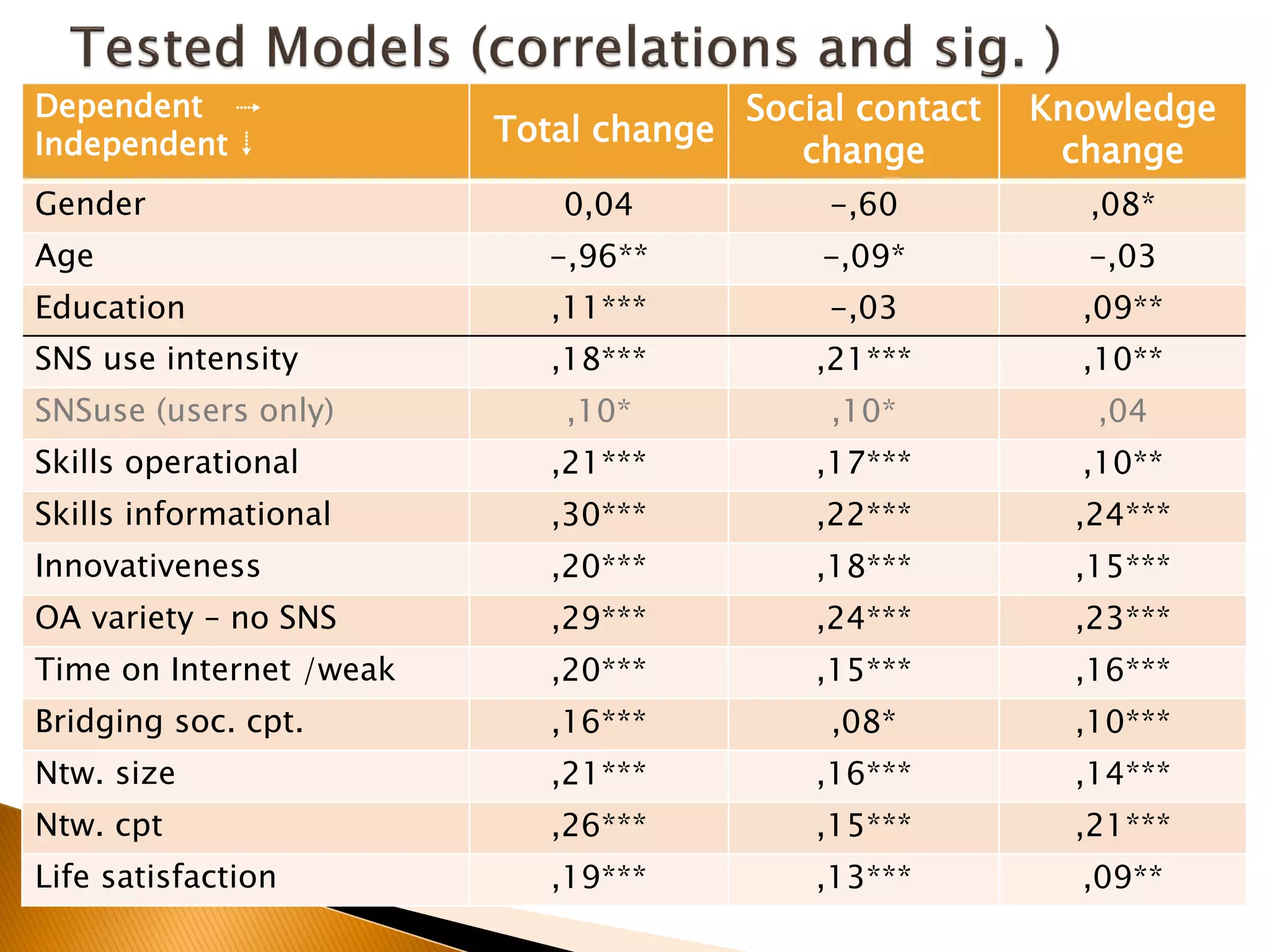
Dependent ⇢
Independent ⇣ Total change
Social contact
change
Knowledge
change
Gender 0,04 -,60 ,08*
Age -,96** -,09* -,03
Education ,11*** -,03 ,09**
SNS use intensity ,18*** ,21*** ,10**
SNSuse (users only) ,10* ,10* ,04
Skills operational ,21*** ,17*** ,10**
Skills informational ,30*** ,22*** ,24***
Innovativeness ,20*** ,18*** ,15***
OA variety – no SNS ,29*** ,24*** ,23***
Time on Internet /weak ,20*** ,15*** ,16***
Bridging soc. cpt. ,16*** ,08* ,10***
Ntw. size ,21*** ,16*** ,14***
Ntw. cpt ,26*** ,15*** ,21***
Life satisfaction ,19*** ,13*** ,09**
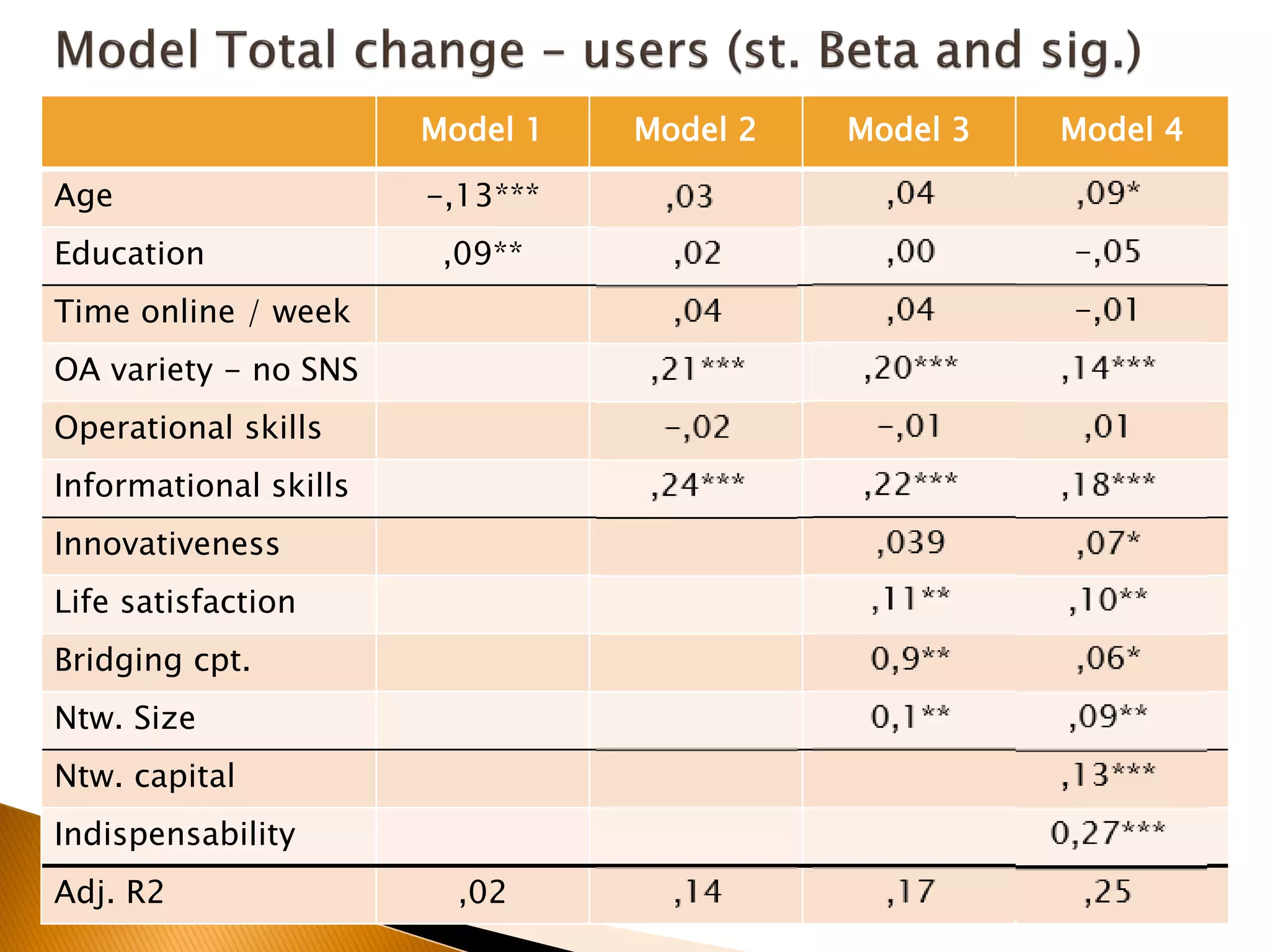
Model 1 Model 2 Model 3 Model 4
Age -,13***
Education ,09**
Time online / week
OA variety - no SNS
Operational skills
Informational skills
Innovativeness
Life satisfaction
Bridging cpt.
Ntw. Size
Ntw. capital
Indispensability
Adj. R2 ,02
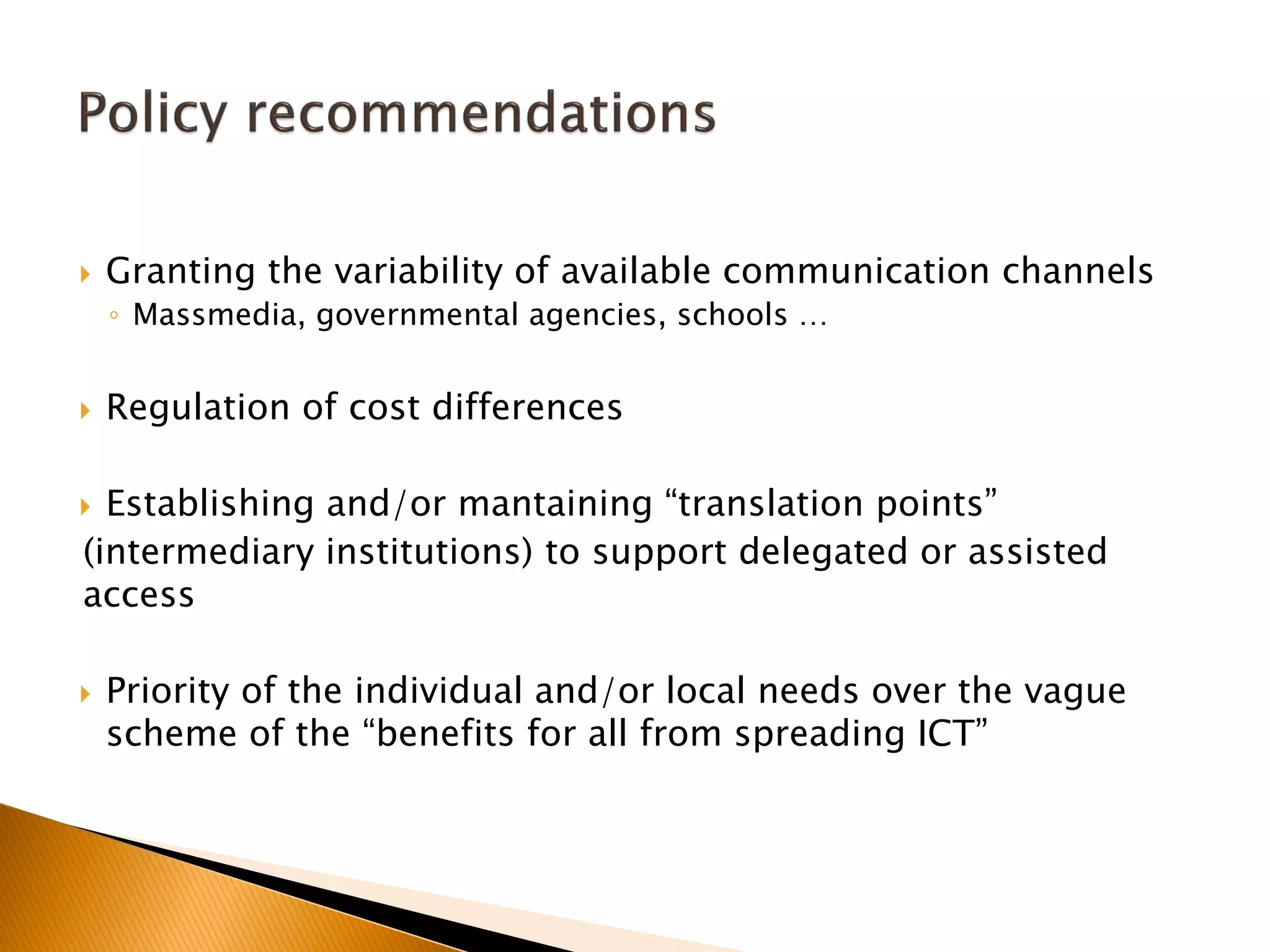
 Granting the variability of available communication channels
◦ Massmedia, governmental agencies, schools …
 Regulation of cost differences
 Establishing and/or mantaining “translation points”
(intermediary institutions) to support delegated or assisted
access
 Priority of the individual and/or local needs over the vague
scheme of the “benefits for all from spreading ICT”
Mgr. Petr Lupač, Ph.D.
PETR.LUPAC@FF.CUNI.CZ
@PetrLupac
Department of Sociology
Charles University in Prague, Faculty of Arts
Celetna 13, Prague
The Czech Republic

The need for a new digital divide model

  • 1.
    Mgr. Petr Lupač,Ph.D. Charles University in Prague World Internet Project The Czech Republic Financed due to Grant Agency of the Czech Republic (GA13-21024S) „World Internet Project –The Czech Republic II“
  • 2.
    System of social inequality Unequal Internet access Unequal gains/losses “Thoseat the ‘wrong’ end of the digital divide will become second-class or third-class citizens, or no citizens at all.” J. van Dijk (2005: 17)
  • 3.
    Source: Van Dijk,J. A. G. M. (2005) Deepening digital divide: Inequality in the information society. Thousand Oaks. CA: Sage, p. 22; simplified for purposes of presentation Low-tech environment> the problem of physical access High-tech environment> the problem of the deepening divide The deepening of the digital divide ?
  • 4.
    1. Nonusers saying“I don’t need it” (motivation) 2. What does ICT stand for? 3. Weak evidence about strategic skills 1. Weak evidence about the actual link between Internet access and participation on society 4. Online activites conceptualization (usage gap) 1. What is the content of communication activities?
  • 5.
     DD researchstarted from scratch (x DOI tradition)  Presumption of the new social structure (information society) 1. Reduction of ICT and information/communication channels to the Internet (phone calls? F2F?) 2. The Internet access is crucial to maintain or increase individual’s participation in all main spheres of social existence 3. The Internet use has the same relevance in all social contexts 4. The construction of universal need (normativity) 5. Individual-blame bias (adoption, gains) 6. Presumption of possibility to close the digital divide
  • 6.
     Rich-get-richer effect(benefits dependent on offline resources)  Resources are and will be unequally distributed  Excessive use can lead to negative effects For certain people in certain situations, in certain contexts, the Internet is irrelevant or detrimental  The Internet rather transforms than increase (->new conditions)  Supplement hypothesis: People… “ are organizing their communications based on the context of their contact. People use multiple media to communicate and can choose the one that is most suitable for the moment.” Rainie, Wellman (2012: 97)
  • 7.
    Perfectly connected digitalsociety where each individual owns several ICTs and sacrifices enough time to maintain both his/her digital skills and knowledge of ICT innovations ⇣ Digital divide policies as cultural project
  • 8.
     “Why areyou not using the Internet?”  “I do not need it” explanations ◦ irrational, sour grapes reasoning, cognitive dissonance ◦ Rational now but not in the near future  Purgation ◦ Focus on old, unsuccessful, deprived nonusers ◦ Who are the young, successful, rich nonusers? How do they navigate through today’s world and why?  Psychologizing nonusers as deviations ◦ Computer anxiety, technophobia
  • 9.
    “the tendency tohold an individual responsible for his or her problems, rather than the system of which the individual is a part (Caplan and Nelson, 1973)” (Rogers, 1983: 103)  Individual factors of adoption (scdmg, attitudes, motivation, …)  ICT use as an individual, isolated activity (x cultures of sharing)  Outcomes derived from individual skills and online activities  „Usage gap“ overlooks the content of „communication activities“  Nonusers are not isolated entities
  • 10.
    Metcalf’s Law : “thevalue of a telecommunications network is proportional to the square of the number of connected users of the system” The Flip Side of Metcalf’s Law (Tongia & Wilson, 2011): “as a network grows in size and value, those outside the network face growing disparities. (…) The increasing costs of not being in the network can spread to the “included”. Examples: - Car transportation and sidewalks, public transport - Health care system and uninsured - Taxi driving system nowadays and nonusers - Broadband Internet and those with slow connection
  • 11.
    The more exclusiveare ICTs as a communication infrastructure and an information access point, the more disadvantaged are nonusers and “weak” users. nonuser user Digital divide
  • 12.
    In the givensituation, actuality and seriousness of digital divide depends on  Ratio of communication networks size  Availability of alternative communication channels or information sources  The costs differences (incl. translation points)  Infrastructure-induced required level of skills  Situational digital divide (Situational information society !)
  • 13.
    Actuality and seriousnessof digital divide depends on  The embeddedness of ICT in his/her area of qualification (job market)  The institutional pressure to use the Internet (schools, public offices, massmedia)  The share of Internet users and intensity of use in his/her social network (close and weak ties)  The Internet penetration in broader social environment and among people with similar interests
  • 14.
     Are nonusersdisadvantaged? (Under which conditions?) ◦ H1: Majority of nonusers experienced being disadvantaged by not using the Internet ◦ H2: Nonusers will be surrounded by users to a lesser extent.  How we explain the differences in perceived Internet effect among users? ◦ H2: The indispensability of Internet use will be among most important predictors when it comes to explaining perceived Internet effects ◦ H3: The ICT-specific network capital will be among most important predictors when it comes to explaining perceived Internet effects ◦ H4: The non-Internet network and individual resources will partly explain perceived Internet effects  Bridging capital  Innovativeness  Skills  Life-satisfaction
  • 15.
     Pilot studyin May  Data collected in May and June 2014 by a specialized agency  Method of data collection ◦ CAPI F2F interviews ◦ Stratified random sampling combined with quota sampling ◦ Measures taken to include parts of the population with lower probability of being interviewed  Respondents declaring no or very low interest in being interviewed pre-recruited from CAWI panel (cca 8 % of the sample)  Trained experienced interviewers instructed to deal with soft-rejection  Financial incentives (computed or estimated from wage)  100 % of the interviews were recorded, controlled and problematic respondents were excluded  1316 respondents in the final sample, 79 % Internet users  Weighted sample representative for the population of the Czech Republic, age 15+  A good fit of results with other data sources (WIP I, CZSO, Facebook)
  • 16.
    Users Nonusers Nr ofpeople living in the household 2 (1,9; 0,7) 2 (1,7; 0,8) Ind. income/month 3/17 (4; 3) 2/17 (2; 2) Nr. of close friends 4 (5; 3) 2 (3; 3) Share of soc. environment using the Internet 70 % (60 %; 30 %) 10 % (20 %; 30 %) Life satisfaction 7/10 (7; 3) 8/10 (7; 4) Median (mean; std. dev)
  • 17.
     69 %of Czech nonusers know anyone who could send an email, fill an online form or find something online for them (67 % for ordering something online for them) ◦ 31 % of nonusers asked someone to do so at least several times (2014)  72 % of British nonusers and 89 % of ex-users know someone who… (2013)… and over half has asked for help already (2009)  44 % of US nonusers “have ever asked a friend or family member to look something up or complete a task on the internet for them” (2013)  45 % of British users “use” family or friends to help them use the Internet (2013 data, 62 % in 2007) Sources: WIP-CZ, WIP-GB, PIP
  • 18.
    Having proxy Noproxy Age 66 (63; 13) 73 (73; 14) Nr of people living in the household 2 (2,03; 12) 1 (1,63; 4) Ind. income/month 2/17 (2; 3) 2/17 (2; 2) Nr of close friends 3 (4; 3) 1 (2; 3) Share of soc. environment using the Internet 30 % (40 %; 30 %) 0 % (20 %; 30 %) Life satisfaction 8/10 (7; 3) 6/10 (6; 4) Median (mean; std. dev)
  • 19.
    Question: Not-using the Internetcan be either advantage or disadvantage. Thinking about your personal experience in the recent years, how much does the fact that you are not using the Internet affected your life in the following areas? Please, answer with the help of a scale, where -5 means significant worsening and +5 means significant improvement. [Scale:] -5 -4 -3 -2 -1 0 1 2 3 4 5 (-5=Significant worsening 5 = Significant improvement)
  • 20.
     My knowledgeof what's going on in the Czech republic  My knowledge of what's going on in other countries  My knowledge of what's going on in your locality  My involvement in public life in my local community  Dealing with state authorities {getting subsidy, welfare, submitting documents, etc.}  Contact with my family and my family life  Contact with my friends and acquiantences  My overall financial situation (i.e., my incomes and expenses)  Building up my career and my success on labour market  Pursuing and developing my hobbies  Overall satisfaction with my life
  • 22.
     Important differencesbetween users and nonusers are ◦ new-tech efficacy ◦ network capital (ICT in social environment)  Majority of nonusers declare no worsening of their life due to Internet nonuse.  The assumption of irrational, sour grapes reasoning nunuser is weakened due to negligible differences between proxy users and completely disconnected.
  • 23.
    Using the Internetcan either improve or worsen people's lifes. When you think about your personal experience in the last years, how much influences your Internet use following areas of your life? Please, answer with the help of a scale, where -5 means significant worsening and +5 means significant improvement. [Scale:] -5 -4 -3 -2 -1 0 1 2 3 4 5 (-5=Significant worsening 5 = Significant improvement)
  • 24.
    Rotated Component Matrixa 12 3 4 5 6 7 Change in knowledge, CZR ,239 ,858 ,139 ,090 ,042 ,085 ,124 Change in knowledge, world ,095 ,873 ,160 ,108 ,115 ,089 ,105 Change in knowledge, locality ,152 ,379 ,747 -,022 ,136 ,086 ,053 Change in involvement, local public life ,092 ,035 ,880 ,191 ,043 ,062 ,103 Change in dealing with state auth. ,121 ,139 ,110 ,116 ,117 ,954 ,061 Change in family life/contact ,840 ,062 ,115 ,189 -,005 ,112 ,074 Change in contact with friends ,797 ,252 ,070 -,115 ,167 ,076 ,163 Change in financial situation ,069 ,115 ,120 ,837 ,286 ,161 ,072 Change in career / labor market succ. ,098 ,130 ,131 ,243 ,918 ,122 ,065 Change in pursuing hobbies ,225 ,195 ,133 ,108 ,068 ,066 ,932 Change in overall satisfaction with life ,608 ,181 ,166 ,554 -,007 -,055 ,144 (4) (5) . Extraction Method: Principal Component Analysis. Rotation Method: Varimax with Kaiser Normalization. a. Rotation converged in 6 iterations 74 % of variance (5 factors), 83 % of variance (7 factors)
  • 26.
     The supposedrole of variety/number of online activities and time spent online (van Dijk 2005) ◦ -> hours online weekly, nr. of online non SNS activities performed weekly  The important role of digital skills, age and education in gaining benefits from Internet use (van Deursen, van Dijk and Peters 2011) ◦ -> operational skills index, informational skills index, age, education  Previous social skills predict well sociability gains from Internet use (rich-get-richer hypothesis findings; c.f., Lee 2009) ◦ -> ntw size index (via resource generator, sum of strong and weak ties)  The role of bridging social capital in acquiring resources ◦ -> bridging = bonding * nr. of structural holes  The role of network capital in explaining individual state (Wellman and Frank 1999) ◦ -> share of Internet users in respondent’s social environment  The ability to benefit from technological development (Rogers 2003) ◦ -> innovativeness index  The embeddedness of a respondent in ICT world ◦ -> indispensability scale (work, social life)
  • 27.
    Dependent ⇢ Independent ⇣Total change Social contact change Knowledge change Gender 0,04 -,60 ,08* Age -,96** -,09* -,03 Education ,11*** -,03 ,09** SNS use intensity ,18*** ,21*** ,10** SNSuse (users only) ,10* ,10* ,04 Skills operational ,21*** ,17*** ,10** Skills informational ,30*** ,22*** ,24*** Innovativeness ,20*** ,18*** ,15*** OA variety – no SNS ,29*** ,24*** ,23*** Time on Internet /weak ,20*** ,15*** ,16*** Bridging soc. cpt. ,16*** ,08* ,10*** Ntw. size ,21*** ,16*** ,14*** Ntw. cpt ,26*** ,15*** ,21*** Life satisfaction ,19*** ,13*** ,09**
  • 28.
    Model 1 Model2 Model 3 Model 4 Age -,13*** Education ,09** Time online / week OA variety - no SNS Operational skills Informational skills Innovativeness Life satisfaction Bridging cpt. Ntw. Size Ntw. capital Indispensability Adj. R2 ,02
  • 29.
     Granting thevariability of available communication channels ◦ Massmedia, governmental agencies, schools …  Regulation of cost differences  Establishing and/or mantaining “translation points” (intermediary institutions) to support delegated or assisted access  Priority of the individual and/or local needs over the vague scheme of the “benefits for all from spreading ICT”
  • 30.
    Mgr. Petr Lupač,Ph.D. PETR.LUPAC@FF.CUNI.CZ @PetrLupac Department of Sociology Charles University in Prague, Faculty of Arts Celetna 13, Prague The Czech Republic